In this article
The first time you drive a 7,000-pound truck onto a frozen lake, the experience is visceral. You hear the tires crunching against the snowpack, but it’s what you feel through the suspension that matters most.
The ice beneath you is not a concrete slab. It is a living, bending plate resting on a fluid foundation. It flexes. It groans. And if you don’t respect the ice mechanics governing that deflection, it fails.
I have spent decades traversing the ice belt, and I can tell you that safety is not found on a generalized laminate card in your glovebox or the predictions of the Old Farmer’s Almanac. True competence comes from understanding that the ice cover is a viscoelastic system.
Air temperature trends, water movement, and speed dictate the difference between a successful trip and a catastrophic breakthrough. Understanding the applied physics of load bearing moves you beyond lucky guesswork and into the practice of calculated risk assessment.
What is the Fundamental Structure of a Frozen Lake?
To drive safely, you must stop viewing the lake as a solid floor and start viewing it as a structural beam. The ice sheet functions as a loaded plate resting on an elastic foundation, a concept engineers in cold regions engineering refer to as the Winkler Foundation model.
How does the ice sheet interact with the water below?
When a load—like your truck or portable wheelhouses—is applied to the ice, the sheet does not simply compress. Instead, it bends downward, displacing the water beneath it. This creates a wide, shallow depression known as the deflection bowl.
The water immediately fights back. It provides a restoring upward force (buoyancy) that is directly proportional to the volume of water displaced by this bowl. Safety relies entirely on the ice’s flexural strength—its stiffness.
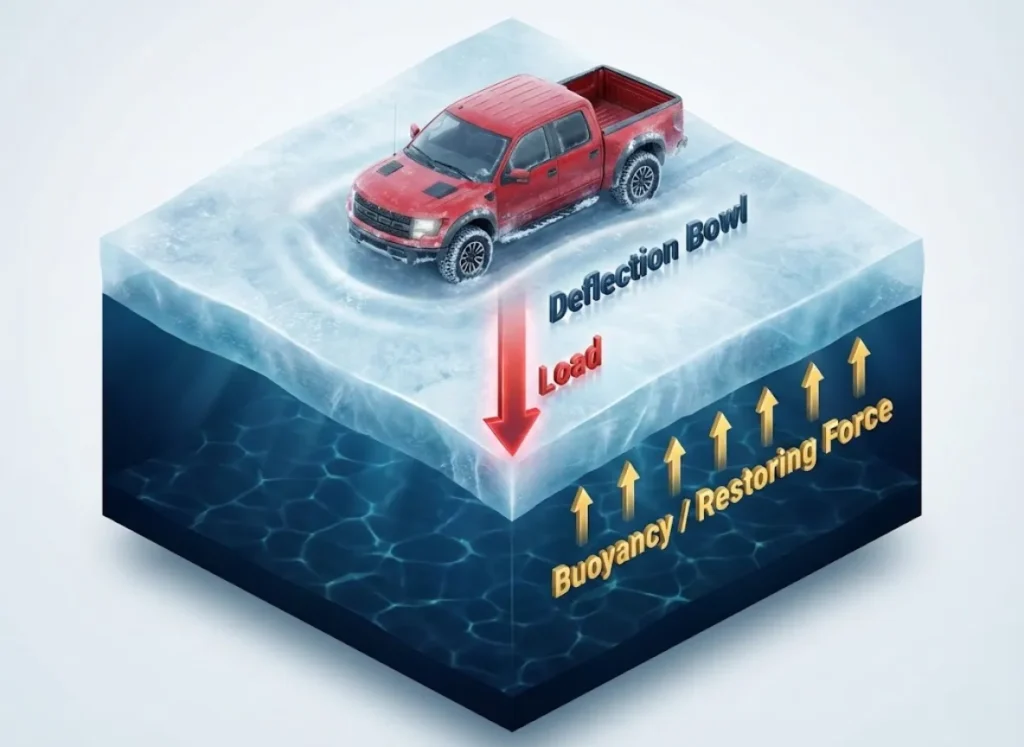
The ice sheet acts as a beam that must distribute your vehicle’s weight over a large enough area to engage sufficient water for support. If the ice depth is insufficient, the deflection bowl becomes deep and narrow. This concentrates bending stress at the center until the ice exceeds its bearing strength.
We can look to the deformation analysis of elastic beams on Winkler foundations to understand this physics. This interaction explains why weight distribution is critical. A dispersed load creates a wider bowl, engaging more water for support than a concentrated point load. This theoretical understanding is the bedrock for mastering the safety protocols for first ice fishing, where the margin for error is razor-thin.
Why is ice thickness not a guarantee of safety?
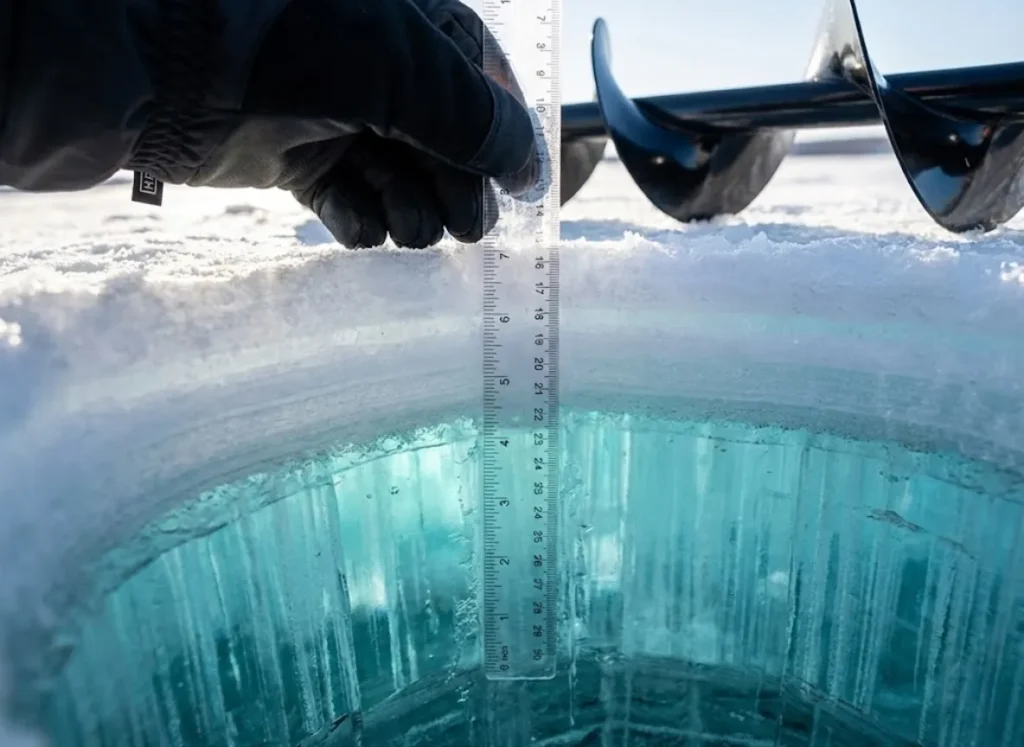
A common mistake is assuming that 12 inches of ice is always strong enough for a truck. This ignores the ice quality and material composition of the sheet. Ice is a stratified material, often composed of two distinct layers: Columnar (Blue) Ice and Granular (White) Ice.
Clear ice (blue) forms slowly under calm, cold conditions. Its crystals align vertically, offering maximum compressive strength. White ice (also known as snow ice, opaque ice, or frozen slush) forms from refrozen snow or frozen frazil. It is filled with air bubbles and possesses a chaotic crystal structure that disrupts stress transfer.
The Cold Regions Research and Engineering Laboratory (CRREL) and engineering standards generally dictate that snow ice possesses only 50% of the flexural strength of clear ice. State of the art reviews on ice bearing capacity validate this structural inferiority. Therefore, you must calculate Effective Thickness.
The formula is simple: Total Effective Thickness = (Blue Ice) + (0.5 x White Ice).
If you measure a 12-inch sheet composed of 6 inches of blue ice and 6 inches of snow ice, you do not have 12 inches of strength. You have the equivalent of a 9-inch sheet (6 + 0.5(6) = 9).
Accurately determining these layers requires drilling test holes using heavy lithium augers or a manual spud bar to feel the transition. While professional ice road operators might use Ground Penetrating Radar (GPR) for regular GPR ice scans, anglers must rely on using a well-maintained ice auger with sharp blades to cut cleanly through the strata without shattering the core sample.
How Do We Calculate Safe Bearing Capacity?
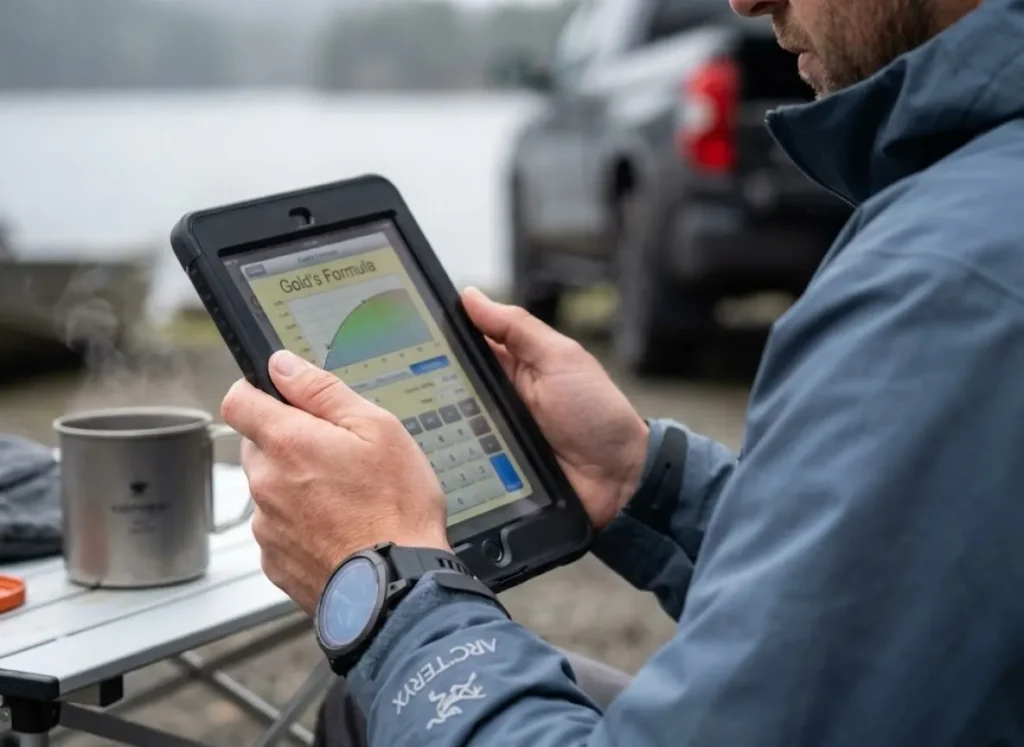
Once you have determined the quality of the beam, you need to apply the mathematics required to determine exactly how much weight that structure can hold. We do this using Gold’s Formula.
What is Gold’s Formula and how do we use it?
Gold’s Formula, derived from Gold L.W. 1971, is the governing equation for ice thickness safety physics load bearing. It relates the Allowable Load to the square of the thickness. The variable A is a risk coefficient. For conservative public safety in uncontrolled environments, A=50 psi is the standard.
The formula demonstrates a powerful quadratic relationship: doubling the ice thickness quadruples its load bearing capacity. The determination of bearing capacity guidelines by the NRC provides the historical basis for this calculation.

While construction equipment operations might use a higher ‘A’ value under strict supervision, anglers should stick to 50 psi to account for hidden thermal expansion cracks or springs.
This formula explains why thin/weak ice is treacherous. The drop-off in strength from 4 inches to 2 inches is not linear; it is exponential. Standard Minnesota DNR charts often simplify this, but for heavy rigs, you need the raw math. Before heading out with your essential first trip ice fishing gear, use this formula on your effective ice thickness measurement to define your specific weight tolerances.
Why Does Time Matter for Stationary Loads?
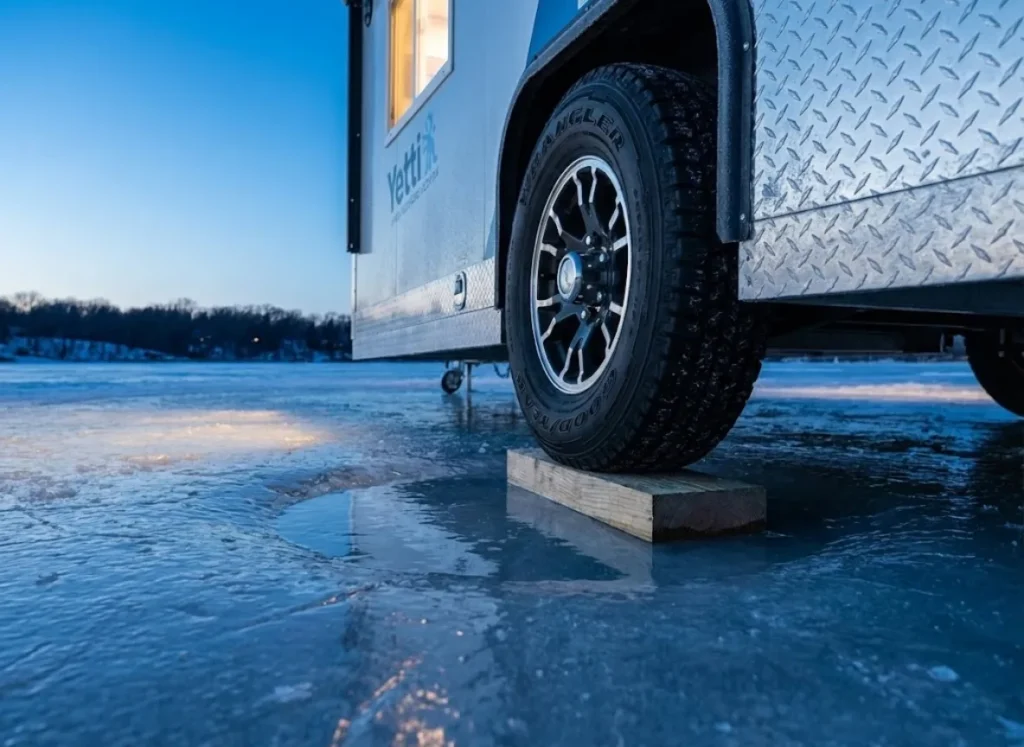
The math above gives us a safe load for a moving vehicle. However, the physics change entirely when that vehicle stops moving and parks for the weekend. This is where many portable wheelhouses run into trouble.
What is viscoelastic creep and why is it dangerous?
Ice is viscoelastic. This means it behaves like a solid under short-term loads (driving across it) but flows like a viscous fluid under long-term loads (parking on it). When a heavy wheelhouse sits in one spot, the deflection bowl deepens continuously over time due to creep, even if the weight remains constant.
This phenomenon creates the “2-Hour Rule”. Loads remaining stationary for longer than two hours require significantly more thickness than moving loads. Snow cover often acts as insulation, preventing the ice from thickening and hiding this deflection.
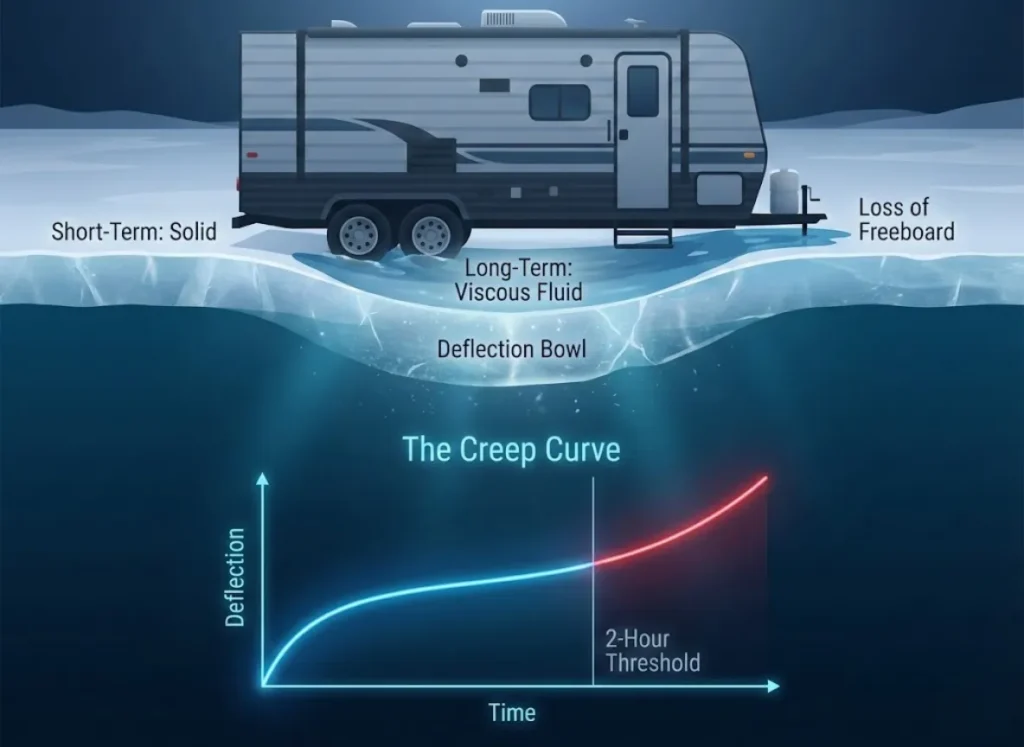
Modelling creep deformation in floating ice sheets shows that if the deflection bowl deepens enough to submerge the ice surface (loss of freeboard), water floods the area. This warms the ice and accelerates failure.
To account for creep, safety standards suggest increasing the required thickness by 50% to 100% for long-term stationary loads. A thickness that is perfectly safe to drive across may lead to a breakthrough if you park on it overnight. This is a critical factor when selecting ice fishing shelters optimized for rigidity versus weight.
Pro-Tip: When you park your wheelhouse for the weekend, block the frame up off the ice immediately. Check your holes every hour for the first three hours. If water starts welling up significantly around the tires or blocks, the ice is succumbing to creep. Move immediately.
How Does Movement Affect Ice Stability?
Time is the enemy of the stationary load. For the mobile angler, the primary enemy is the physics of wave resonance.
What is critical velocity and the “Bow Wave”?
As a vehicle moves across the ice cover, it pushes a gravity wave of water beneath the sheet, similar to the bow wave of a boat. Critical Velocity occurs when the vehicle’s speed matches the speed of this wave propagation. This typically happens between 15 and 22 mph.
At this specific speed, Hydrodynamic Resonance occurs. The wave amplifies the deflection bowl, potentially doubling the bending stress on the ice sheet. We see this detailed in studies regarding critical embankment velocity and wave propagation.
A “Blowout” happens when the wave becomes too steep for the ice to contain, leading to catastrophic failure behind the vehicle. This effect is amplified in shallow water, where the wave has nowhere to disperse.
The safety protocol is to drive well below critical velocity—ideally under 15 mph—to prevent resonance from building. This protects you, your truck, and your ice fishing rod and reel combo from going for a swim. Operators of the Kuskokwim ice road manage these speeds strictly to maintain ice road integrity.
Why is vehicle spacing critical to preventing failure?
Every vehicle creates a “stress halo” around it. This is defined by the Characteristic Length of the ice sheet, which is typically 15 to 20 times the thickness. If two vehicles park too close, their deflection bowls merge.
This causes Constructive Interference, creating a stress point deeper than either load would cause individually. The USACE Engineering Manual 1110-2-1612 helps derive the 50-foot spacing rule (often cited as the 50ft rule). This ensures that these stress fields do not overlap dangerously.
This is why you must disconnect your truck from your wheelhouse immediately upon parking. A connected rig represents a massive, concentrated system weight. Ignoring distance between vehicles is a common cause of failure, especially when exploring popular destinations like the best ice fishing lakes in Minnesota.
How Do We Interpret Signs of Impending Failure?
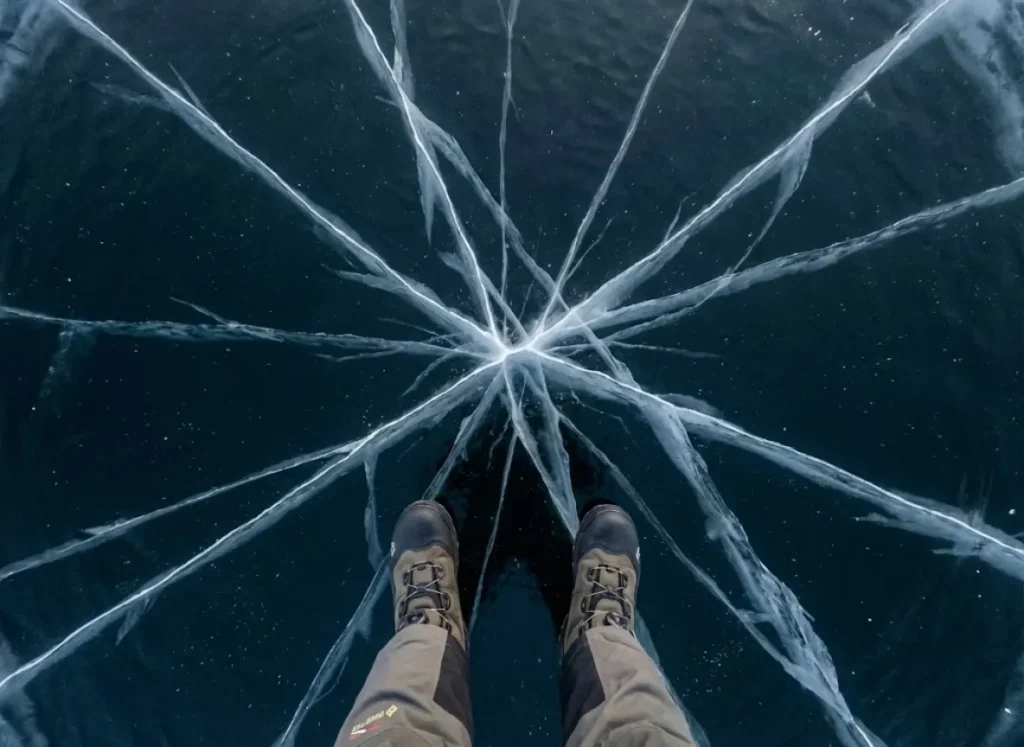
Even with perfect calculations and spacing, the environment is dynamic. The final skill in your ice safety guidelines arsenal is reading the language of the ice itself.
What is the difference between radial and circumferential cracks?
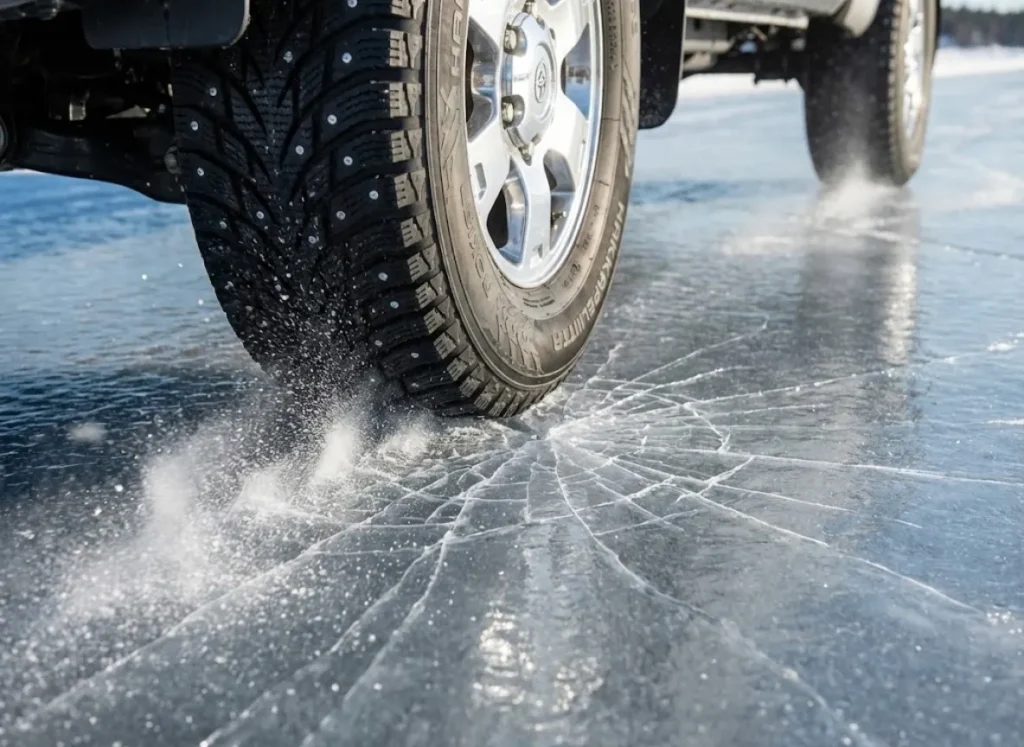
The ice usually warns you before it fails. Radial Cracks radiate outward from the load like spokes on a wheel. They act as the “First Warning,” indicating that the ice is bending significantly—likely at 50% of its practical bearing strength.
The danger escalates with Circumferential Cracks. These form circles around the load, connecting the radial spokes. This indicates that the “wedges” formed by the radial cracks are breaking.
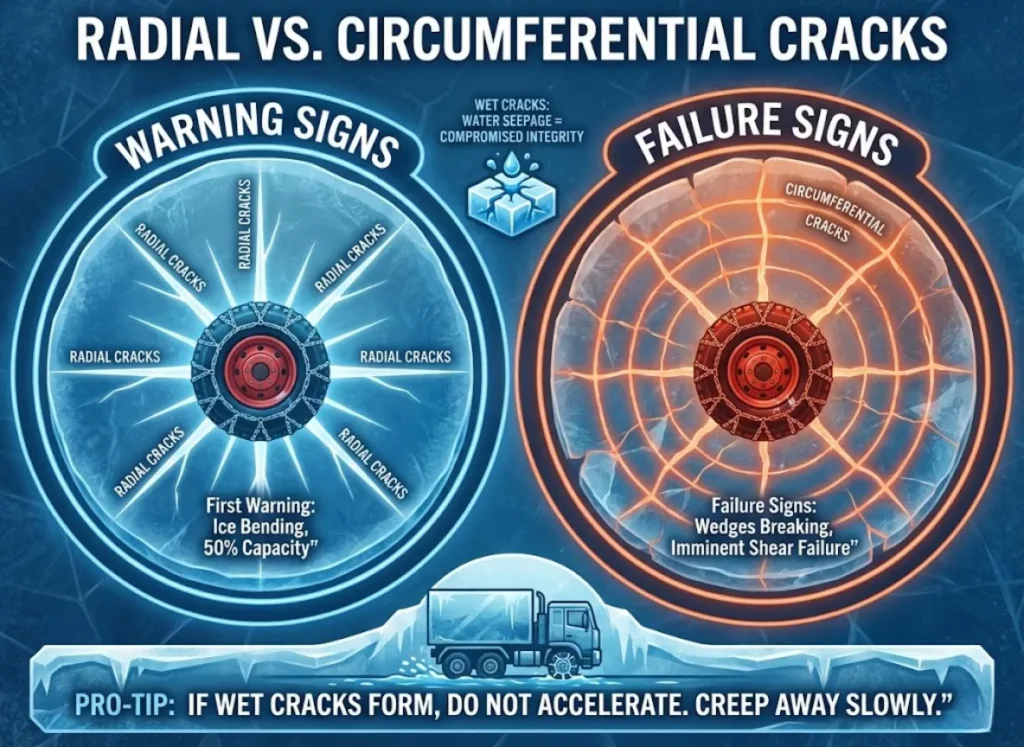
Penetration fracture analysis of ice plates identifies this pattern as a signal of imminent shear failure. If you see rings forming around your truck, evacuation must be instant.
You must also distinguish between Dry Cracks (thermal contraction, generally safe) and Wet Cracks. If water begins to pool around your tires or seep up through cracks, the ice cover integrity is compromised. This visual assessment is a vital component of implementing the definitive guide to fishing safety.
Pro-Tip: If you see wet cracks forming, do not slam on the gas. Rapid acceleration creates torque and waves. Put the vehicle in gear and creep away slowly and smoothly to reduce dynamic stress on the already failing plate.
Final Assessment
The frozen lake is a complex environment governed by fluid dynamics and fracture mechanics. We must remember that ice is a floating plate, not a solid floor.
By applying Gold’s Formula (P=Ah2), we realize that thickness provides exponential strength, but we must discount weak snow ice to find our Effective Thickness. We must respect Stationary Creep, knowing that a parked house stresses the ice far more than a moving one. We must drive slowly to avoid Hydrodynamic Resonance and keep our distance to prevent stress halos from merging.
Before your next trip, calculate the “Total System Weight” of your rig—truck, house, and gear. Use the physics outlined here to determine your personal safety factor.
FAQ – Frequently Asked Questions about Ice Load Bearing Safety
Is white ice safe to drive on?
White ice (snow ice) has approximately 50% of the strength of clear ice. You must count only half of the white ice layer when calculating the total effective ice thickness for safety.
How long can I leave my wheelhouse parked in one spot?
For heavy wheelhouses, the 2-hour rule applies. After two hours, viscoelastic creep significantly reduces bearing capacity. For overnight stays, ensure you have 50-100% more ice thickness than the minimum required to drive the vehicle.
Why do I need to park 50 feet away from other vehicles?
A 50-foot buffer prevents the deflection bowls of two vehicles from merging. If bowls overlap, the combined stress on the ice increases dramatically, risking a breakthrough even on safe ice.
Does driving faster make it safer on thin ice?
No. Driving faster creates a gravity wave (similar to a boat wake) that can fracture the ice. It is critical to drive slowly (under 15 mph) to avoid Critical Velocity resonance.
Risk Disclaimer: Fishing, boating, and all related outdoor activities involve inherent risks that
can lead to injury. The information provided on Master Fishing Mag is for educational and informational purposes
only. While we strive for accuracy, the information, techniques, and advice on gear and safety are not a substitute
for your own best judgment, local knowledge, and adherence to official regulations. Fishing regulations, including
seasons, size limits, and species restrictions, change frequently and vary by location. Always consult the latest
official regulations from your local fish and wildlife agency before heading out. Proper handling of hooks, knives,
and other sharp equipment is essential for safety. Furthermore, be aware of local fish consumption advisories. By
using this website, you agree that you are solely responsible for your own safety and for complying with all
applicable laws. Any reliance you place on our content is strictly at your own risk. Master Fishing Mag and its
authors will not be held liable for any injury, damage, or loss sustained in connection with the use of the
information herein.
Affiliate Disclosure: We are a participant in the Amazon Services LLC Associates Program, an
affiliate advertising program designed to provide a means for us to earn advertising fees by advertising and linking
to Amazon.com. As an Amazon Associate, we earn from qualifying purchases. We also participate in other affiliate
programs and may receive a commission on products purchased through our links, at no extra cost to you. Additional
terms are found in the terms of service.