

In this article
The squall blew through at midnight, and by sunrise, our formerly clear-water reservoir looked like chocolate milk. To a casual angler, a skunking felt inevitable. I spent fifteen years running away from muddy water before I learned that the fish are still exactly where you left them. Turbid water isn’t a mystery; it is simply an altered energy equation. When suspended sediment blocks light penetration, fish biology pivots from a visual system to a mechanosensory operation. They stop looking for prey and start feeling for it. This shift means you must understand the physics of visibility and the hydrodynamics of vibration. You must isolate specific vibration frequencies and severe contrast profiles to force strikes when visibility drops to zero. Here is how you handle bad water?no panic, no wasted casts, and zero assumptions.
Quick Answer: Fishing turbid water requires shifting your rig to prioritize mechanical displacement over visual realism. Cut your normal retrieve speed in half to mitigate metabolic limitations, maximize visual contrast using opaque black or harsh UV colors, and deploy high-displacement gear?like robust vibrating jigs or single Colorado blades?to violently stimulate the lateral line.
The Physics of Underwater Optics in High-Turbidity Environments
Most people buy lures because the paint jobs look spectacular on the shelf. In clear water, those visual treats catch fish. But in brown water, you’re just fishing for anglers. To consistently catch fish in spring runoff conditions, you have to understand exactly how turbidity blocks light.
Mechanisms of Light Scattering and Absorption
When sunlight hits water, it scatters or gets absorbed. Clean lakes handle absorption primarily, eating long red and orange spectrums. Short blues and greens penetrate deeply. But when a storm dumps tons of sediment into a tributary, clay particles act like a brick wall. They furiously absorb photons and scatter shorter wavelengths before they an inch.
Longer wavelengths win here. Reds, oranges, and stark yellows hold ground longest in heavy silt. This physical reality means an intricate, photo-realistic pattern on an expensive swimbait is wasted. If red photons are absorbed by the thick water before hitting the lure, your beautiful bait turns into a featureless shadow.
This separates stained water from actual mud. Tannin-stained water absorbs light but doesn’t scatter it, maintaining visual contrast. True turbidity scatters light in every direction, creating a blurred wall. The visual field collapses from twenty feet down to a mere two inches, mandating an immediate response to the shift in lure visibility.
Rayleigh vs. Mie Scattering: Why Particle Size Matters
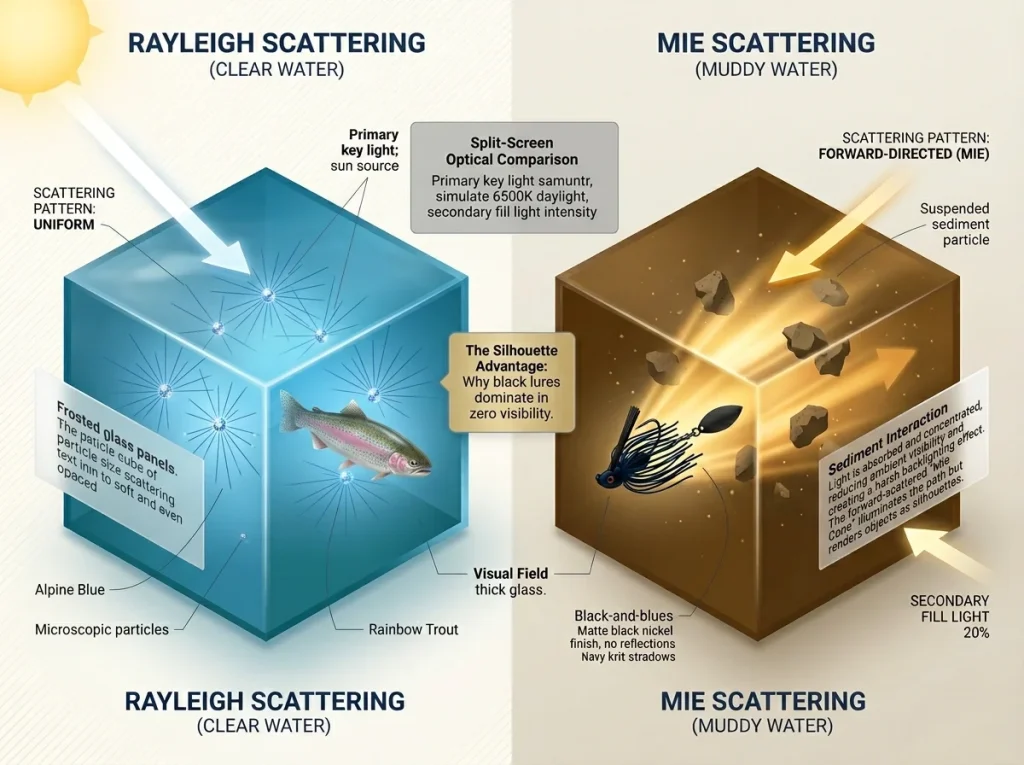
In clear water, microscopic particles scatter short wavelengths evenly. But fresh mudlines shift how light bends. Extremely large suspended particles create a forward-directed cone pattern characteristic of Mie scattering.
What does this complex optical shift mean practically? Light does not bounce evenly back to the predator’s eye. Heavy sediment forces light exclusively forward. If your bulky bait sits between the sun and a hungry bass, the forward-scattered light defines its dark silhouette. Washouts occur when baits are lit from the front against the brown haze. Stop matching the hatch; start casting the sharpest possible shadow.
I learned this the hard way on the Mississippi backwaters. I spent hours throwing realistic shad patterns with zero action. The moment I tied on a black blade bait, the forward scattering let the bass see the outline. They didn’t care about the scales; they cared about the shape blocking the light.
This optical math demands a full tactical shift, requiring you to rethink how fish perceive your lures. Now we explore the physical loopholes in total darkness.
The Role of Fluorescence and UV Penetration
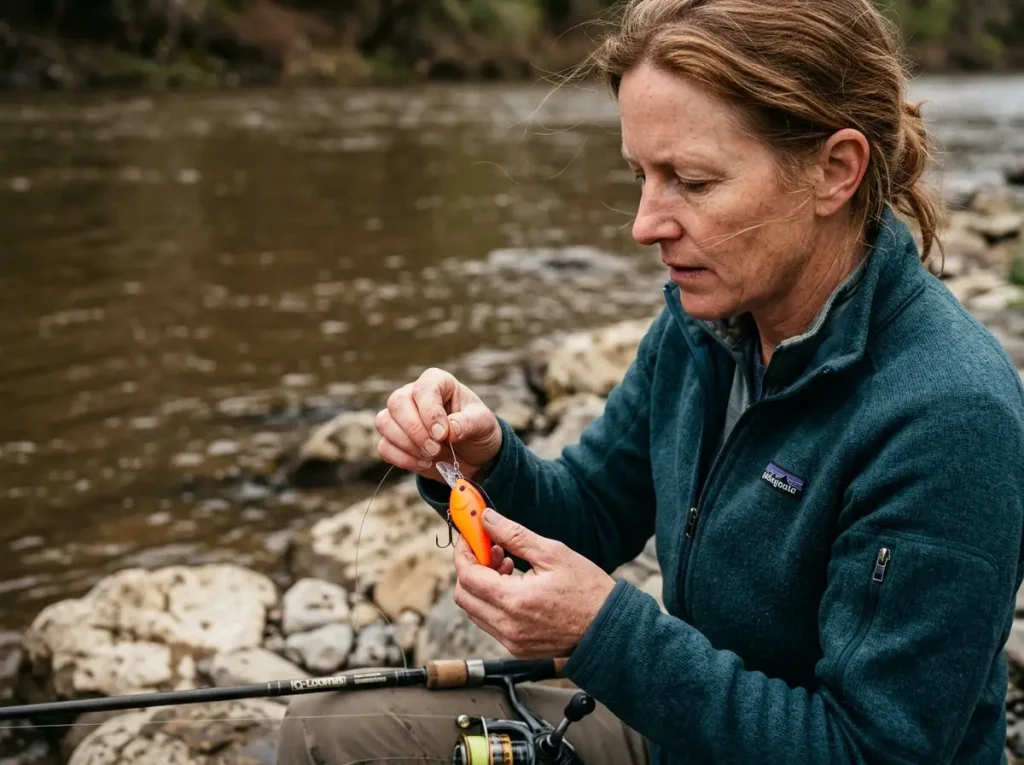
When standard light fails, heavy fluorescence provides a physical loophole. Standard paint reflects visible light. Fluorescent dye physically absorbs short-wavelength ultraviolet radiation and re-emits it visibly. Because UV light pierces a dense particulate load far better than regular visible light, a fluorescent bait generates artificial luminance. A chartreuse lure pops against a brown background because it exploits an energy band standard colors cannot touch.
Pro-Tip: Early-spring muddy water often maintains significantly better UV penetration due to fewer dissolved organics, making neon orange an absolute must for shallow-running crankbaits.
Biological Sensory Systems and the Octavolateralis Pivot
When vision fails, veteran predators like largemouth bass instantly pivot their hunting strategy to their lateral line system. If you don’t deliver a mechanical signal they can feel through thick water, your lure simply does not exist.
The Lateral Line System: Superficial vs. Canal Neuromasts
The primary lateral line is a sensitive mechanosensory array composed of cellular organs called neuromasts. Superficial neuromasts sit exposed on the skin. They are highly sensitive but rapidly get overwhelmed by background noise; a turbulent eddy blasts them constantly with useless information.
To filter garbage noise, predators rely on deep canal neuromasts. Recessed inside bony skin tubes, the physical canal structure operates like an acoustic filter. It ignores slow currents and isolates rapid sudden accelerations. If you want a vicious strike, target these deep receptors. You need a massive lure that displaces heavy water to violently deflect the cilia hiding inside those tubes. You are consciously leveraging the fish lateral line system.
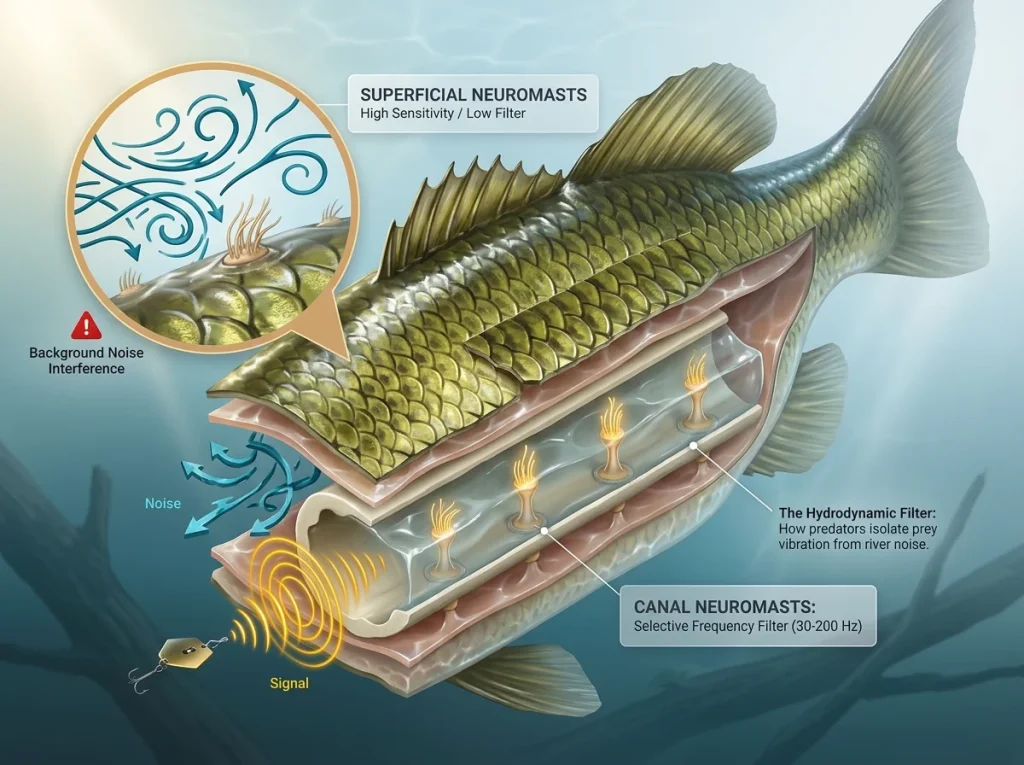
Mechanoreceptor Activation Thresholds (30-200 Hz)
Neuromasts possess specific mechanical tuning. A big bass ignores irrelevant noise floating in the river. Studies show the trunk lateral line only collects heavy acceleration beating between 30 and 200 vibrations per second.
This unbending biological reality dictates every lure selection. A finesse bait vibrating slowly goes unregistered as prey. Screaming past loudly sounds like buzzing static. You need a bulky lure that securely matches strict biological tuning. A massive pulse beating inside that sweet spot rings like an alarm bell, isolating your bait from chaotic fluid flow.
Hitting specific vibration frequencies is mandatory. A fish feels the vibration first, but the brain’s reaction determines the bite.
FFT Processing and the Social Decision-Making Network
When a mechanical signal travels the lateral line nerve bundle, it smashes into the hindbrain. Without visual confirmation, the stressed fish instantly calculates the location, speed, and trajectory of the prey based on feeling hydrodynamic stress waves.
This intense processing triggers the activation of the Social Decision-Making Network. If the incoming mechanical signal is weak, fading, or confusingly inconsistent, the brain short-circuits the feeding response. The smart predator securely sits tight against a submerged log and lets your bait swim away. Your heavy mechanical signal must consistently be rhythmic to authorize a strike. If your retrieve cadence is smooth in zero-visibility water, you might as well cast onto the pavement.
Hydrodynamics of Lure Vibration and Displacement
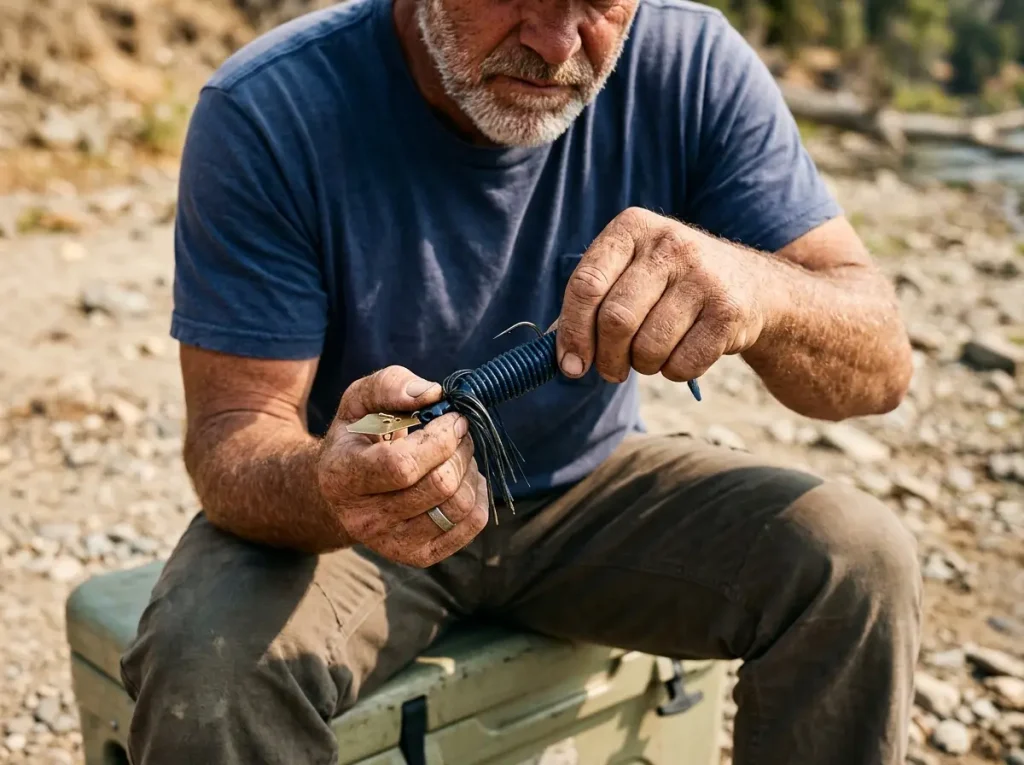
Many beginner anglers mistakenly think throwing massive lures translates to massive displacement. They tie on a giant silent swimbait and wonder why the rod tip feels dead. Honest displacement is about mastering water resistance. Precise hydrodynamics require specific blocky shapes to wildly move heavy fluid.
Manning’s n and Surface Roughness in Lure Engineering
Water resistance depends on surface roughness. A smooth soft plastic trailer creates almost zero boundary-layer resistance. It slips and quietly through the fluid column.
Conversely, big lures built securely with ribbed plastic trailers, pitted faces, or hammered metal blades drastically increase blunt form drag. That severe physical resistance force converts into localized strong turbulence, sending pressure waves blasting out into the surrounding dirty water. In clear water, that absurd noise can easily spook wary fish. In muddy silt, it is the only reliable way they ever know you are exactly there.
Vortex Shedding and the Strouhal Frequency
When fast water force rushes over the blunt plastic lip of a deep crankbait, it curls behind the plastic and repeatedly sheds violent whirlpools. A tight narrow plastic bill sheds them rapidly, causing a frantic buzzing vibration. A wide squared blunt bill severely dumps them, causing a thick wide hunting hard thud.
You must optimize your adjustments to crankbait hydrodynamics and bill angles exclusively for bad conditions. In dirty brown water, you require wide aggressive harsh vortex shedding to securely generate loud low-frequency powerful thumps. The wider and flatter the bill lip, the heavier the strong turbulence. You truly are trying to abruptly move a heavy wall of dirty water.
We know surface roughness matters, but mud changes fluid physics.
The Cauchy-Reynolds Interaction in Silt-Heavy Water
Pro-Tip: Testing heavy new soft plastics poolside reveals critically their specific flutter thresholds. A thickly-cut trailer securely rigged on a heavy chatterbait triggers violent intense turbulence when fished severely slow.
When a flooded river fills with dense runoff, the specific gravity and varying viscosity of the brown water profoundly change. The dark fluid physically thickens under weight. This specific weight shift dramatically moves the threshold predicting when water flips wildly from smooth fluid flow to aggressive turbulence.
In heavy suspended solids, a giant lure generates much harder turbulence at much slower speeds than it would in clear lake water. But the materials must interact specifically with heavy drag. If putting a flimsy silicone rubber skirt on a flipping in heavy current, the interaction of hydrodynamic drag loads on flexible components forces the thin skirt to fold backwards.
When you put a thin skirt in strong drag, it collapses into a stiff shape and displaces nothing. You must use thick plastics that refuse to fold. They fight against the thick water and produce the intense lateral line signals required for a massive strike.
Bioenergetics: The Metabolic Cost of Foraging Failure
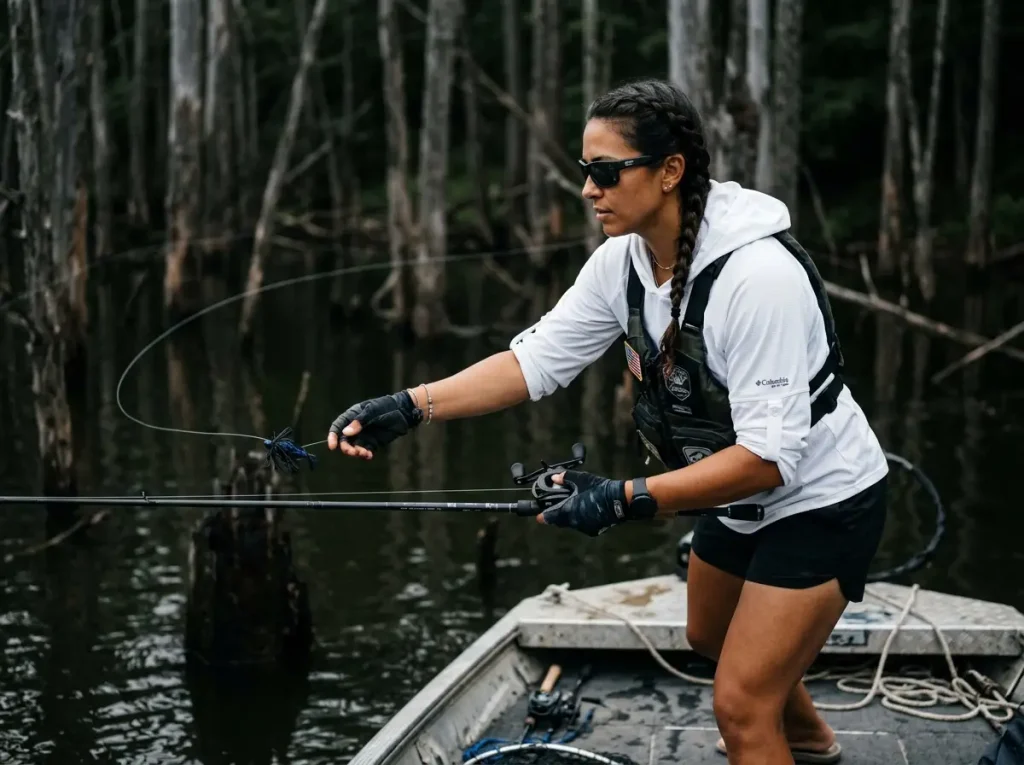
Understanding how fish perceive the lure is halfway. Now we address why they refuse to chase it. Muddy water is exhaustive and suffocating. You cannot fish fast when fish are counting calories. The strike zone shrinks exactly onto their face.
The Tortuous Search Path and Reactive Distance
When visibility drops, a straight search path changes to a complex mess. The lack of visual markers forces an alteration of foraging efficiency and search path strategy. Research shows that foraging in turbidity leads to extreme energy burn. Predatory success rates plummet to barely fifteen percent.
They burn massive fuel and catch nothing. Consequently, their reactive distance drops to almost zero. A huge bass will not chase a spinnerbait thirty feet a mud flat. You must thread the blades near their nose.
Compensatory Swimming and Oxygen Debt
A failed strike in clear water is a skipped meal. A missed strike in thick mud is an anaerobic crisis. When a bass lunges blindly at a heavy vibration and misses, it frantically burns reserves. Ambient silt damages gills, decreasing their physical ability to pull oxygen from surrounding water.
This toxic combination creates severe oxygen debt. If they miss your lure twice, they shut down and pin their bellies to the mud. To force a reaction, you must accommodate the biological realities of fish metabolism. Reel slower. Pause longer. Guarantee a slow target they cannot miss on the first attempt.
Knowing they refuse to chase, your tactical placement must logically become highly geometric.
Blockage Ratios in Structured Environments
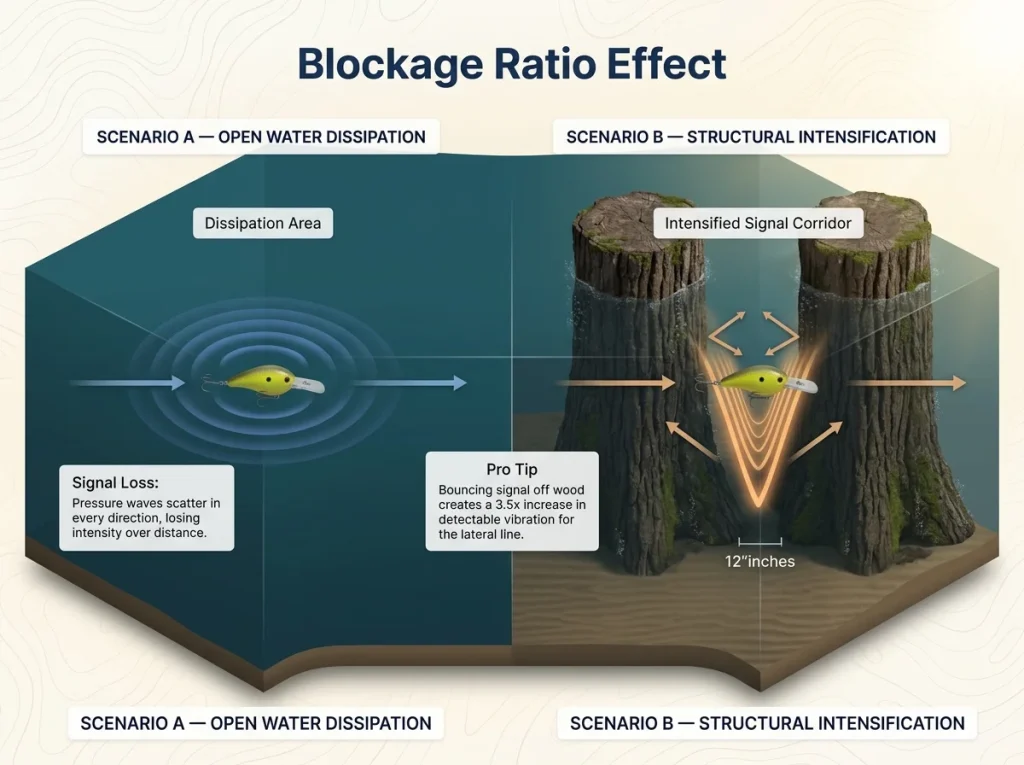
Why do veteran anglers cast into dense logjams when water turns brown? It is all fluid dynamics. When you reel a crankbait through open water, the pressure wave dissipates harmlessly. Reel that same bait through a tight gap between two submerged oak trunks, and the displaced water has nowhere left to go.
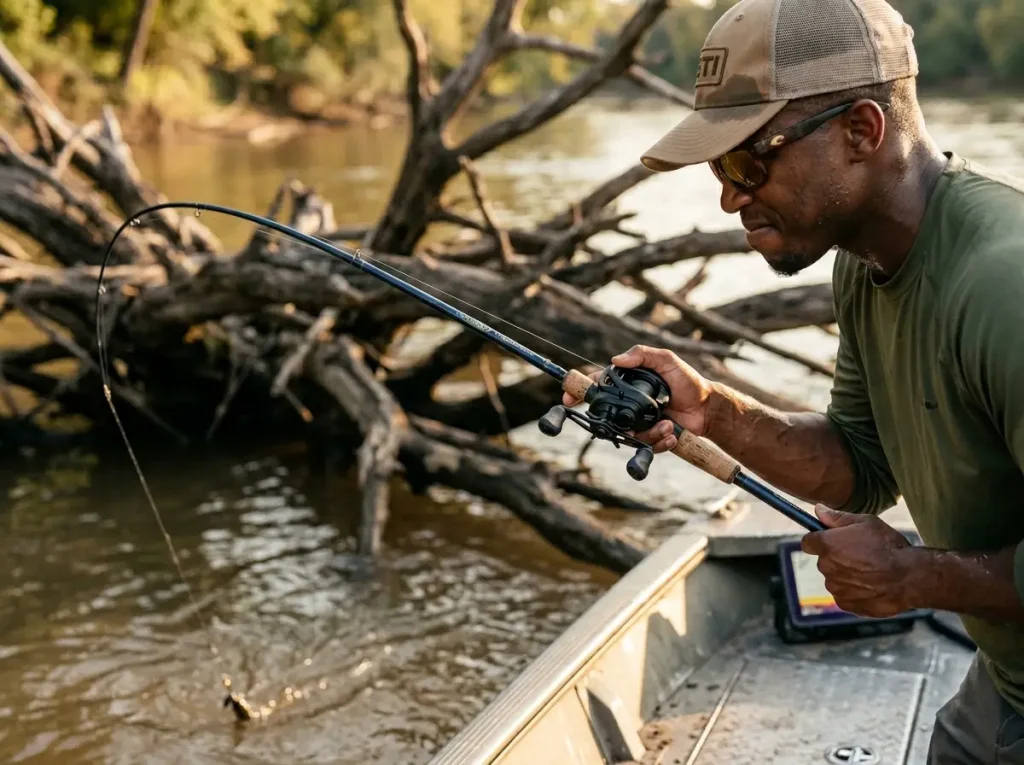
The hard structure forces a high blockage ratio. The vibration of your lure bounces off thick logs, multiplying the hydrodynamic signal. For a large predator engaging in ambush positioning, that amplified mechanical signal is impossible to ignore. Deflect your square-bill off the wood aggressively. Hard deflections yield the hardest strikes.
Equipment Forensics: Engineering the Muddy Water Arsenal

Your tackle box must logically become an engineering bay. Every lure adjustment prioritizes mechanical noise rigidly over slick visual realism. We are aggressively auditing everything securely tied to the strong line.
Spinnerbait Physics: Colorado vs. Willow Leaf Displacement
Before making your first cast, start analyzing varying spinnerbait blade types. The standard Willow Leaf blade is a slender diamond shape. It spins tight against the frame, producing bright flash but zero mechanical thump. Throwing a double-willow rig in zero-visibility water is an amateur error.
You desperately need big Colorado blades. A round single Colorado blade freely rotates at a wide forty-five degree angle. It aggressively churns heavy water. It catches so much thick resistance that you force feel the rod tip throbbing hard in your hands. That displacement projects low-frequency pressure waves straight through dense bottom silt beds. Tie on the biggest single Colorado you currently own.
Vibrating Jigs and Acoustic Impulse Responses
The difference between a cheap vibrating and a premium one is how fast it starts hunting. I?ve dropped standard twenty-dollar jigs right next to the boat and watched them stutter instantly, while cheaper blade setups need three long feet of cranking just to get out of their own way. In the heavy mud, that exact three feet is the whole entire strike zone.
The modern vibrating broke old rules of dirty water. The hexagonal metal blade produces violent stuttering action. The heavy lure hunts actively side to side, shedding specific vortices fast enough mimicking the tight panic signature of a dying baitfish.
However, classic chatterbaits physically are incomplete without matching the exactly right plastic trailer. A lifeless split-tail will not displace enough water. You need an aggressive thick soft plastic trailer that force forces the back end of the bait exactly to violently kick loud and hard.
Acoustic materials actively matter inside deep dense mud. A brass clacker or tungsten weight emits a sharp tight crack penetrating than simply the dull regular thud of standard poured soft lead. Tungsten slices through heavy gravel sharp noise. Soft delivers fiercely a lower boom that securely carries extremely straight through dense flat soft mud bottoms.
The Contrast Spectrum: Embracing Maximum Silhouette
Subtle colors wash out when suspended solids scatter light.
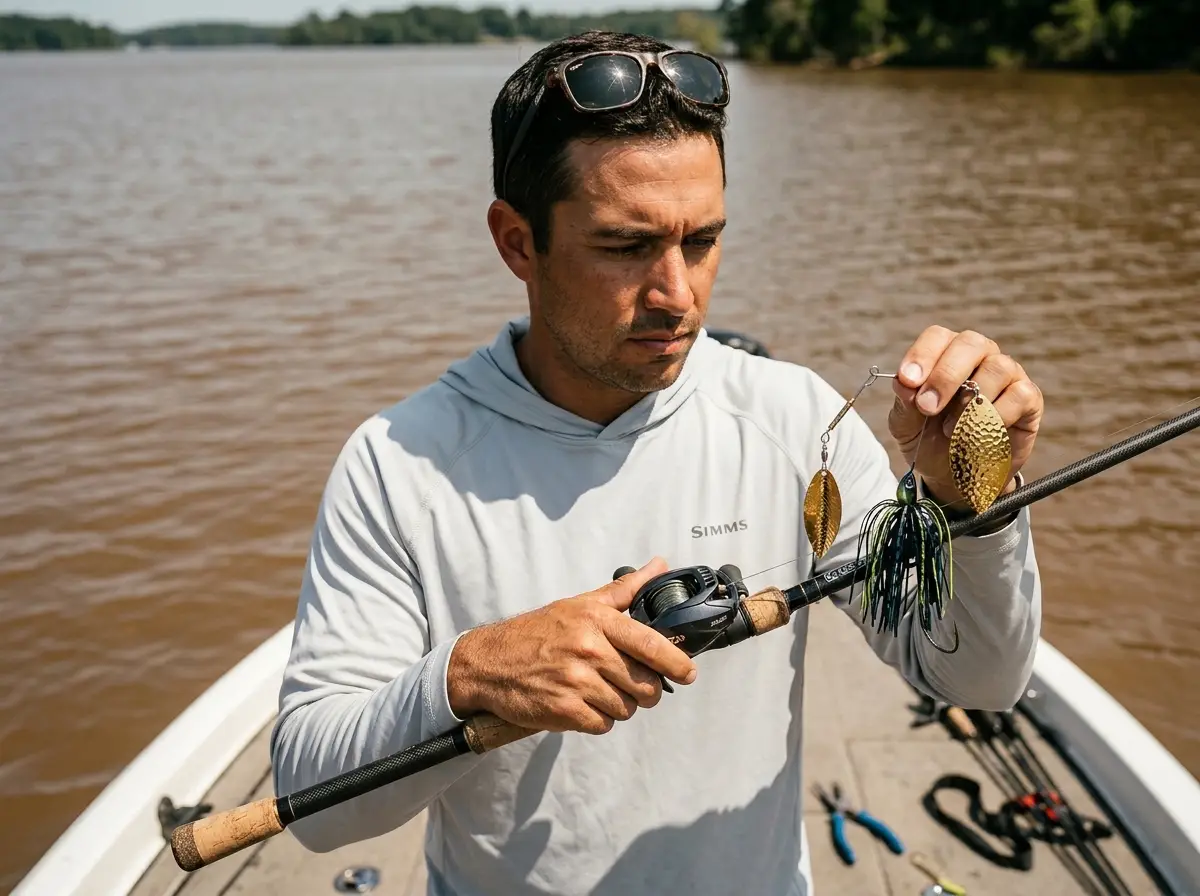
A black and blue contrast profile instantly delivers maximum silhouette. Solid black absorbs weak remaining light, providing a tremendous sharp edge against the hazy background. It gives their limited vision a mechanical target to snap at. Forget natural baitfish patterns. You either burn their eyes with chartreuse or black out the sun.
Tactical Execution: The Turbidity Adjustment Matrix
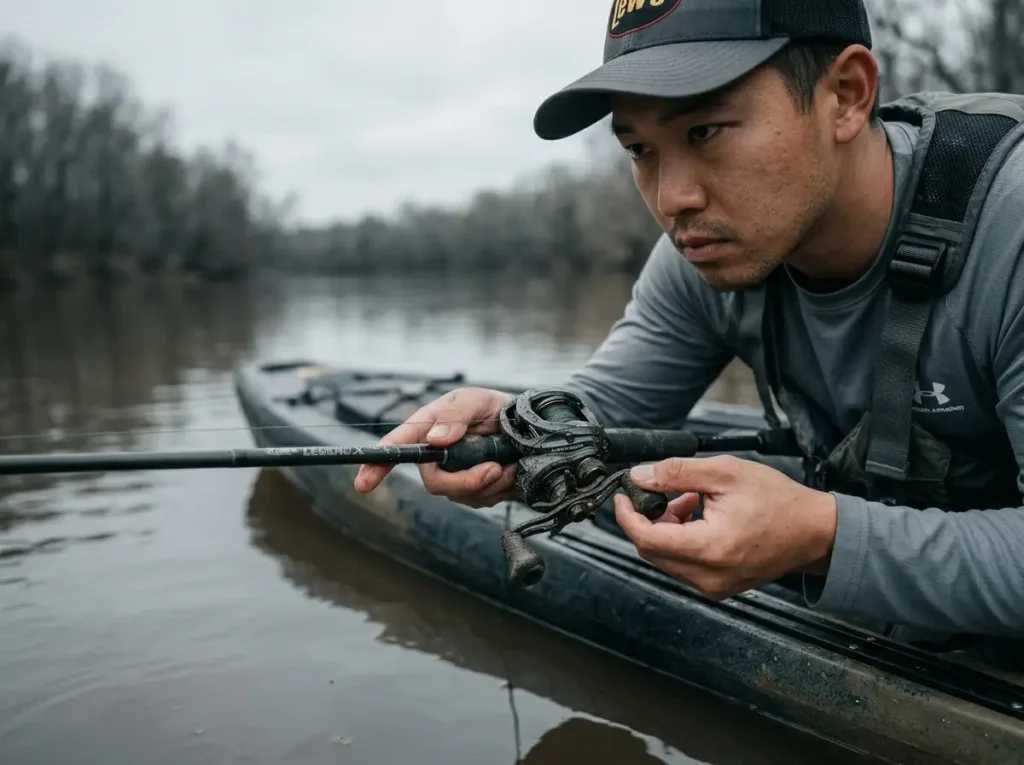
The main separator between a casual angler and a seasoned guide on a blown-out river is the ability to analyze ruined water and call the correct mechanical audible. Setting up a turbidity adjustment matrix creates a repeatable system.
Secchi Depth Calibration and Sensory Channel Mapping
The minute your boat hits dirty water, test the clarity. Drop the rod tip straight down. If the tip vanishes before it hits twelve inches, vision is secondary. You are operating on mechanosensory dominance.
If you have two feet of visibility, you have stained conditions and can rely on hybrid visual cues like bright flash alongside deep vibration. Fighting extreme turbidity requires unbending commitment. Tackling extreme spring runoff conditions means trusting raw power of the lateral line above everything else.
Retrieve Cadence Modifications for Low-Visibility
The fastest way to guarantee a skunking during a mud-out is fishing at your normal pace. You must consistently halve the speed of the bait.
Transitioning to a slow, methodical stop-and-go retrieve mitigates agonizing metabolic cost. By crawling a bait, you deliver a thumping meal onto their face. This reduces their need to burn oxygen reserves through a desperate burst. Slow rolling a heavy spinnerbait over a submerged brush pile is exactly what slow predator biology demands.
The slower you move, the deeper those acoustic signals push through the sediment base.
Assessing Sound Propagation in Saturated Sediments
Science regarding the physics of sound confirmed something veteran anglers understood for decades. Sound physically behaves when water is thick. According to models of sound propagation in water-saturated sediment, fast high-frequency ticking gets muffled quickly by dense particulate loads.
Pro-Tip: Drag heavy jigs in the substrate during zero vis scenarios. Interface waves reach bottom-dwelling hogs that suspended baits miss.
However, slow low-frequency, deep substrate vibrations travel exceptionally cleanly. When slowly dragging a heavy lead football jig across a rocky flat, bottom mud essentially acts as a perfect conduit for the resulting impact waves. Those deep low-pitch thuds resonate powerfully through the solid bottom far away from the blinding scattering noise of the turbulent middle water column. You send loud tactical angling adaptations straight through the hard floor, directly to where the biggest older fish are pinned.
Conclusion
We have established the physics. Lure adjustments dictate daily success on swollen rivers. Photometric attenuation destroys realistic color profiles, mandating either high-contrast black-blue models or fluorescent UV paints to combat muddy water. The biological requirement of the trunk lateral line demands shedding frequencies tuned to the 30 to 100 Hz sweet spot. These are best generated by massive single Colorado blades and friction heavy trailers. Above all else, you must respect the harsh bioenergetic debt heavy turbid water inflicts on resting fish by slowing your retrieve to half-speed and putting baits tighter into hard cover than you ever dared prior.
When a weather front creates a murky brown mess, trust raw mechanical displacement. Drag a heavy spinnerbait through the thickest log laydown and force the bite where they live.
FAQ
What color lure is best for muddy water?
? Quick Answer: Solid black and blue color combinations or bright UV chartreuse paints are superior in thick water. These high-contrast dark shades cut through suspended solids by creating an unmissable deep silhouette or reflecting the last surviving ultraviolet rays. Realistic paint patterns wash out immediately in dense turbidity and turn invisible.
Do fish bite in chocolate milk water?
? Quick Answer: Yes they absolutely do, but they alter their natural hunting behavior. They pin themselves tightly against solid hard wood cover to actively avoid fighting river current, and rely completely on their sensitive mechanosensory layer to feel heavy prey blindly approaching them. They will not chase a moving bait long distances because doing so burns entirely too much precious oxygen in an incredibly stressful and toxic environment.
How do you attract fish in murky water?
? Quick Answer: You must use slow-moving bulky heavy baits that emit intense low-frequency pressure deep waves during the slow retrieve. Heavy poured lead jigs, wide-wobbling chunky square-bills, and big round single bladed brass spinnerbaits reliably generate extreme amounts of localized tight turbulence in the middle column. This extreme lateral line stimulation guides the predator directly to the hook.
Is muddy water warmer or colder than clear water?
? Quick Answer: High-turbidity environments often warm up significantly faster than clean clear water. Dense particulate matter absorbs solar radiation efficiently, creating temperature spikes during sunny days. This warmth can trigger aggressive shallow-water feeding behaviors, provided your lure possesses the required harsh acoustic footprint to be found by the fish.
Risk Disclaimer: Fishing, boating, and all related outdoor activities involve inherent risks that
can lead to injury. The information provided on Master Fishing Mag is for educational and informational purposes
only. While we strive for accuracy, the information, techniques, and advice on gear and safety are not a substitute
for your own best judgment, local knowledge, and adherence to official regulations. Fishing regulations, including
seasons, size limits, and species restrictions, change frequently and vary by location. Always consult the latest
official regulations from your local fish and wildlife agency before heading out. Proper handling of hooks, knives,
and other sharp equipment is essential for safety. Furthermore, be aware of local fish consumption advisories. By
using this website, you agree that you are solely responsible for your own safety and for complying with all
applicable laws. Any reliance you place on our content is strictly at your own risk. Master Fishing Mag and its
authors will not be held liable for any injury, damage, or loss sustained in connection with the use of the
information herein.
Affiliate Disclosure: We are a participant in the Amazon Services LLC Associates Program, an
affiliate advertising program designed to provide a means for us to earn advertising fees by advertising and linking
to Amazon.com. As an Amazon Associate, we earn from qualifying purchases. We also participate in other affiliate
programs and may receive a commission on products purchased through our links, at no extra cost to you. Additional
terms are found in the terms of service.