
In this article
You see what looks like a cloud of smoke rising from the bottom of the flat, drifting downwind like something is burning underneath the water. Your first instinct is to cast at it. So you do — and immediately a shape explodes out of that cloud and crosses the flat at something approaching 30 miles per hour, leaving nothing behind but ripples and humility. That’s a mudding bonefish. Welcome to the Florida Keys. After more than two decades on these flats, I still get schooled regularly, but I’ve learned enough to stop making the beginner mistakes — and to understand why they happen. This guide covers the things most bonefishing articles skip: the tidal logic, the biology behind the technique, the visual reading skills, and what actually happens the first time you step on a guided skiff.
⚡ Quick Answer: Florida Keys bonefishing peaks April through October, with the incoming tide as your prime window. Islamorada is the most accessible starting point. Keys bonefish are harder than Bahamas fish — educated, spooky, and difficult to spot in turtle grass. Read on for the tactics that make the difference between a full day and a fishless one.
What Makes the Florida Keys Flats Different from Other Destinations
The educated fish problem
People who have fished the Bahamas come to the Keys expecting the same fish. They are not the same fish.
A bonefish on a remote Bahamian flat may have seen a handful of flies in its life. A bonefish in Islamorada has seen every version of the Crazy Charlie that exists, plus whatever new pattern the local guides are testing this season. It has been cast at poorly, spooked by boat noise, and hooked before. Educated bonefish are not paranoid — they’re calculating. They don’t bolt at the first unnatural movement. They just angle two degrees off course and disappear into the turtle grass.
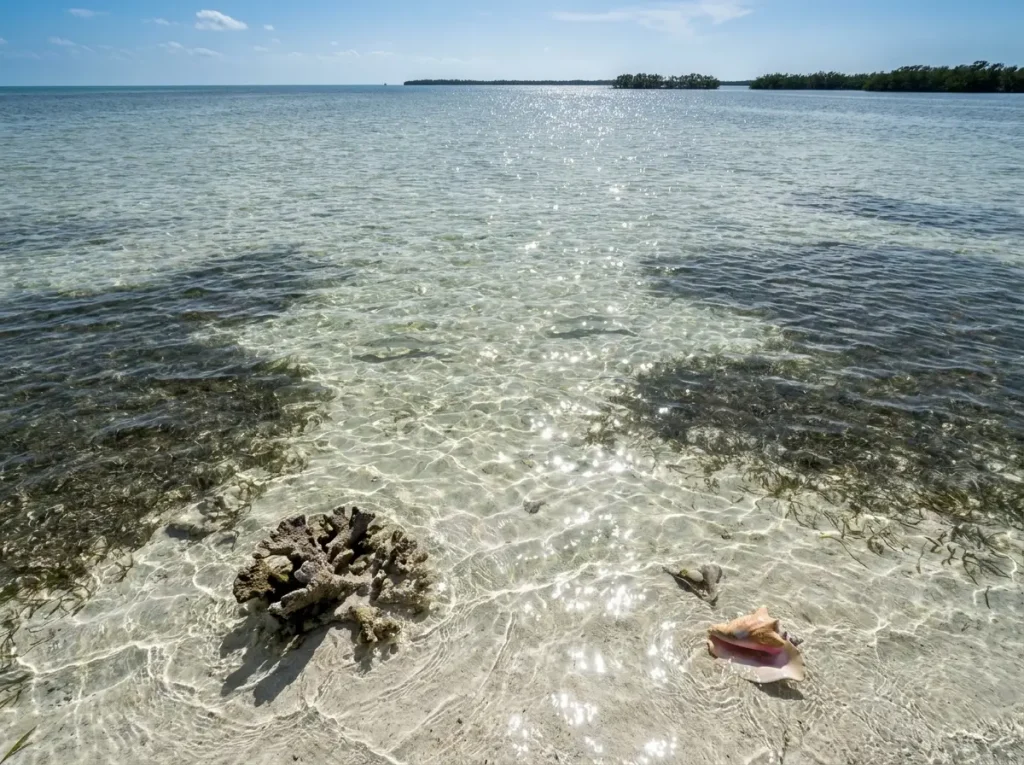
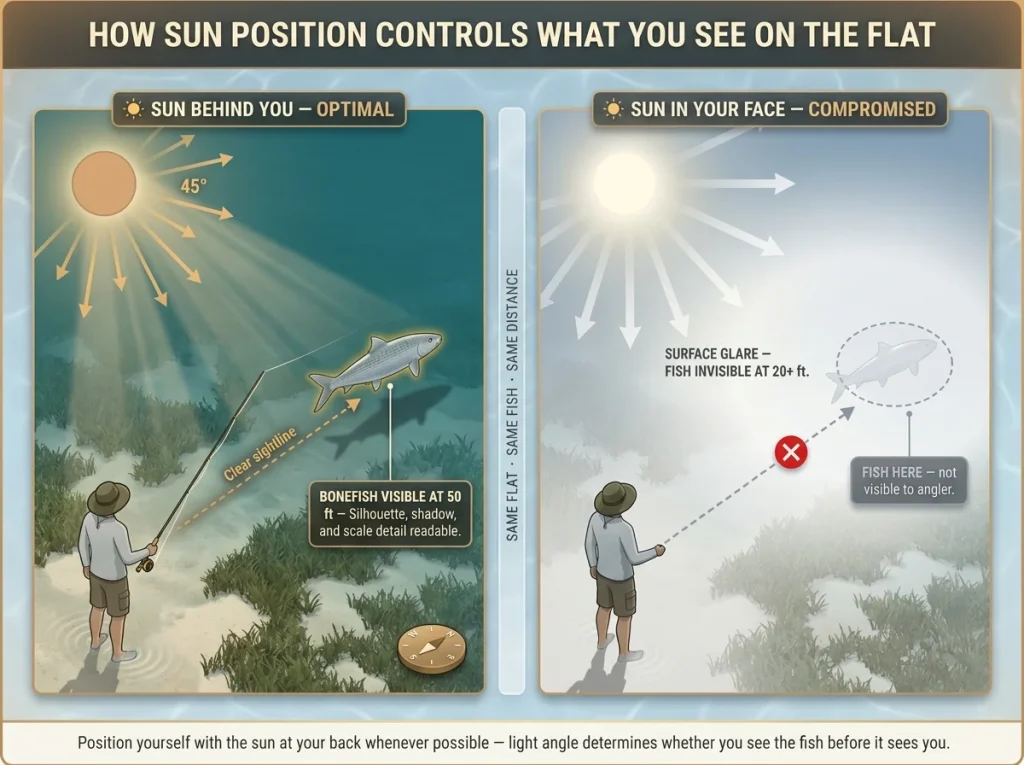
The bottom makes this harder. In the Bahamas, white sand flats give you a bright background that makes even a faint grey shadow readable at 60 feet. On most Keys flats, you’re looking through 8 inches of water at a patchwork of dark grass and pale sand. The bonefish coloring — grey above, silver on the flanks, white below — evolved to vanish into exactly this background. It works.
Pro tip: If you’ve never sight-fished before, consider one trip to the Bahamas first. It calibrates your eyes and your expectations for what the Keys will ask of you.
Turtle grass and why you can’t see them coming
Your ability to spot fish on a Keys flat is almost entirely a function of polarized lens quality and sun position. With the sun behind you and good optics, you can pick out a bonefish at 50 feet through the grass. With the sun at 90 degrees or in your face, you’ll miss fish that are 20 feet away.
But the flat tells you where the fish are even when you can’t see them. A V-shaped ripple on dead-calm water is a waking bonefish moving too fast in skinny water. A subtle shimmer where nothing should be moving is a tailing fish with its head buried in the bottom. A pale cloud drifting downwind from a patch of clear water is mudding — the first behavior most first-timers learn to recognize, usually right after they cast directly into it.
Why the Keys fishery matters — and what it means for you
A University of Miami study estimated that a single bonefish in the Florida Keys generates about $3,500 per year in economic activity — close to $75,000 over its lifetime, according to Bonefish & Tarpon Trust flats fisheries research. That number is why the culture around these fish is strictly catch-and-release. Not just expected. Legally required.
Handle fish quickly, keep them in the water as much as possible, and take your photo fast. On hot summer days — 85-degree air, 82-degree water — a bonefish needs a full water revival before it swims off. The Florida Fish and Wildlife Conservation Commission’s bonefish regulations and handling guidelines cover the specifics. Read them before your trip.
Where to Find Bonefish in the Florida Keys
Islamorada — the bonefishing capital
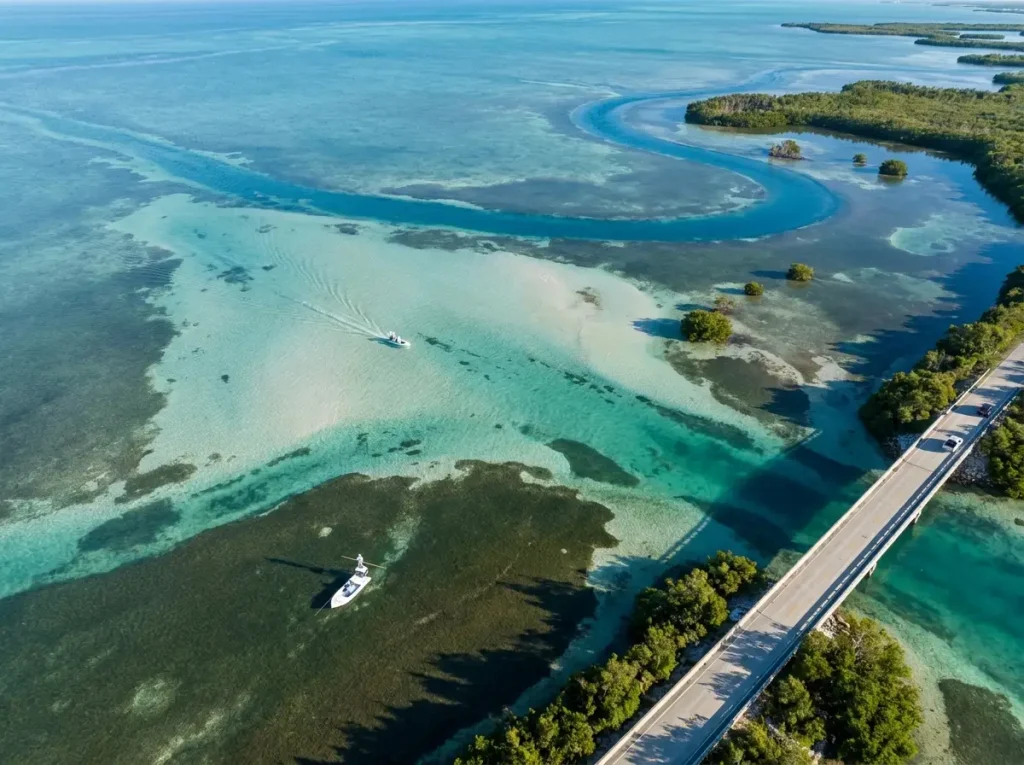
If you’re making your first Keys bonefish trip, Islamorada is where you start. The cluster of six small islands centered around mile marker 82 has more guide boats, more accessible flats, and more bonefish per square mile than anywhere else on the chain.
The Highway Flat — shallow water visible from the Overseas Highway bridge — is where most newcomers get their first look at a real flat. It’s accessible by wading and gets enough pressure that the fish here are fully educated. Think of it as calibration, not prime fishing.
Anne’s Beach and the backcountry ponds on the Florida Bay side fish better because they’re harder to reach. A guide in a shallow-draft skiff can get into pockets that no wade fisherman will find. Our Everglades backcountry fishing guide covers the adjacent ecosystem just north of the Upper Keys — the tidal logic and species overlap is nearly identical.
Pro tip: The Islamorada flats fish best when a mild southeast wind puts a slight chop on the water. Dead-flat calm is terrible — the fish see everything and hear everything. A 5-to-10-mph ripple disguises your approach and relaxes the fish enough to eat.
Lower Keys and the Marquesas — where the bigger fish live
The Lower Keys from Big Pine Key through Key West hold bigger individual bonefish than Islamorada. The Marquesas Keys, about 20 miles west of Key West, are where you go for larger fish and far fewer boats. Getting there requires a serious boat run across open water or a committed guided trip — which is exactly why it stays less pressured.
These flats also hold more permit, so the Lower Keys are the place to aim if you want to mix bonefish and permit on the same trip.
Backcountry flats — spring and fall transition zones
Spring and fall are when the backcountry really moves. Transition-season bonefish travel through mangrove edges and shallow backcountry ponds in larger groups than they’ll hold in summer. The edges of marsh flats at low tide are worth checking — permit, bonefish, and snapper will all work the border looking for prey the tidal drop is flushing out.
The same pattern governs snook behavior in this same inshore ecosystem — both species use tidal movement to position on ambush edges. Understanding why snook hold where they hold on a falling tide gives you a useful framework for reading bonefish movement in the same water.
Reading the Tides for Florida Keys Bonefishing
The incoming tide window — when to be on the flat
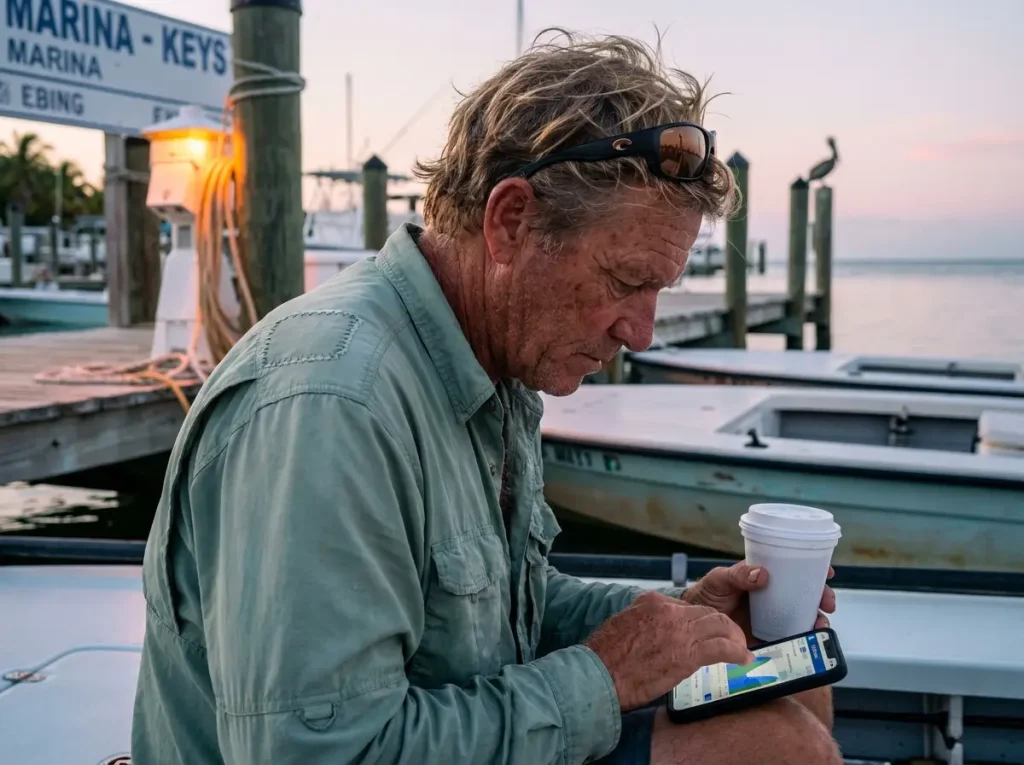
The most common mistake among new Keys anglers isn’t the cast or the presentation. It’s arriving at the flat three hours too late.
Bonefish move onto the flat on the incoming tide. As the water rises, it pushes prey species — crabs, shrimp, small worms — off the bottom and into the water column. Bonefish follow that food source as the flood covers the flat edge. The first two hours of incoming tide, when at least moderate current is running, are when fish are actively feeding and moving in predictable directions. They are not sitting still. They are cruising.
According to research published by the Bonefish & Tarpon Trust, bonefish feed more aggressively when moderate tidal current is present. At slack water — the pause between incoming and outgoing — feeding drops off noticeably. The fish that were moving in a predictable line an hour ago are now scattered and harder to intercept.
Plan to be on the flat 30 minutes before the tide starts flooding, positioned with the sun behind you, and ready to fish the first 90 minutes of the incoming window. That’s your best time.
Neap tides vs spring tides and what most anglers get wrong
Here’s the thing almost nobody talks about when booking a Keys trip: the lunar calendar matters as much as the season.
During neap tides — the smaller tide exchanges at the quarter moon phases — the water doesn’t move as far or as fast. The fish don’t have to travel as far to reach feeding areas, so they’re available more consistently throughout the day. Neap tides are more forgiving.
During spring tides — the large exchanges at full and new moon — the water rises significantly higher and falls significantly lower. Fish push deeper onto the flat during the flood, which sounds ideal. But on a full moon, those same fish may have been feeding all night in extremely shallow water. By sunrise, they’ve already eaten. They’re resting, not feeding.
If you’re booking a trip and have date flexibility, compare your window against the lunar calendar. A neap tide week in shoulder season frequently outfishes a spring tide week in peak season.
Pro tip: The difference between a 2-foot and a 4-foot tidal swing changes everything about how far bonefish travel and when they’re catchable. Build your schedule around the tide table, not just the calendar month.
What to do at slack water
Move. Slack water on a bonefish flat is not a coffee break. The fish that were cruising 20 minutes ago have likely dropped back to the flat edge or moved into deeper water to rest.
Use the slack to reposition to a flat where the tide is still running, or find the channel edges where water is still funneling through the structure. The science behind how tidal currents affect predator positioning shows that bonefish consistently stage at current edges — understanding tidal velocity versus height, not just the tide height itself, changes how you read the water. Our full breakdown of reading tides for fishing walks through the Rule of Twelfths and what it means for actual current speed during each tidal phase.
How to Read a Bonefish on the Flat
Tailing, mudding, and waking — what each behavior tells you
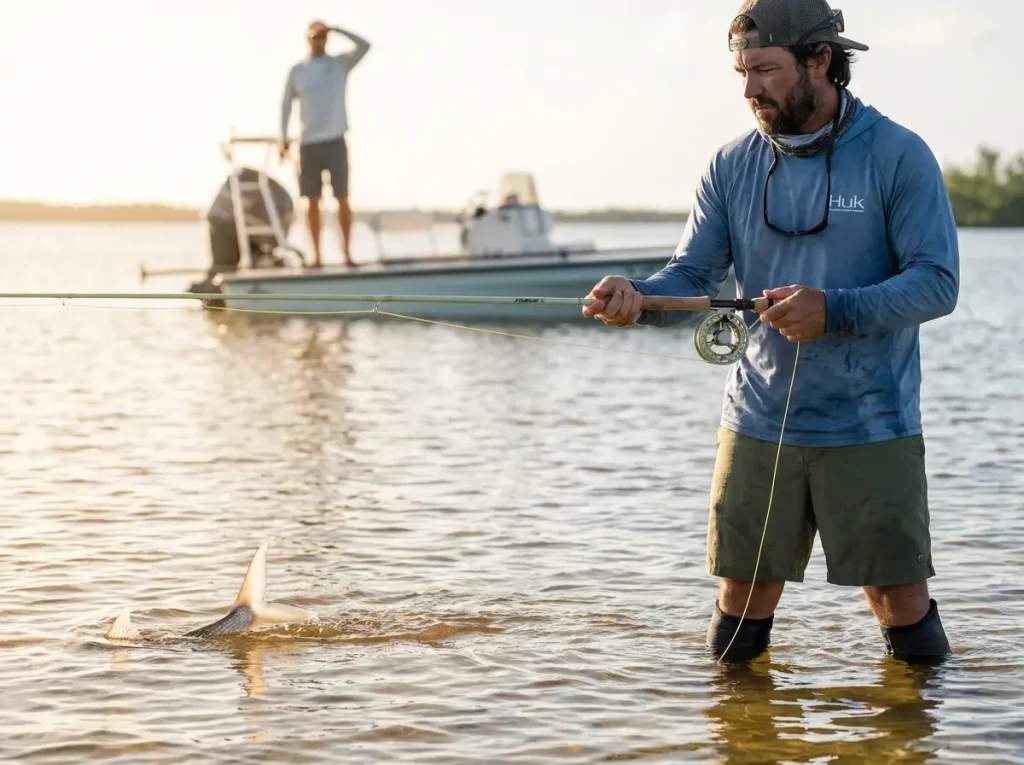
A tailing bonefish is feeding with its head buried in the bottom. Its tail breaks the surface — sometimes a full fork, sometimes just the tip of one lobe. It’s the clearest signal in bonefishing. The fish is stationary or nearly so, feeding intently. Cast 3 to 5 feet in front of the tail, let the fly sink, and strip.
A mudding bonefish is feeding too, but usually in a school. The cloud of disturbed substrate drifts downwind or downcurrent from where the fish actually are. The fish are at the upwind edge of that cloud — moving toward undisturbed bottom, not sitting in the center of what they’ve already worked over. This is where beginners cast into the cloud instead of 6 feet ahead of it.
A waking fish is moving fast and shallow — so shallow that the dorsal fin or tail creates a V-wake on the surface. This fish is aware. It’s probably not feeding. Present to a waking fish with a 6-foot lead and a fly that lands like a whisper.
The grey ghost problem in turtle grass
“Grey ghost” isn’t poetry. It’s what these fish actually look like when they disappear — which is often.
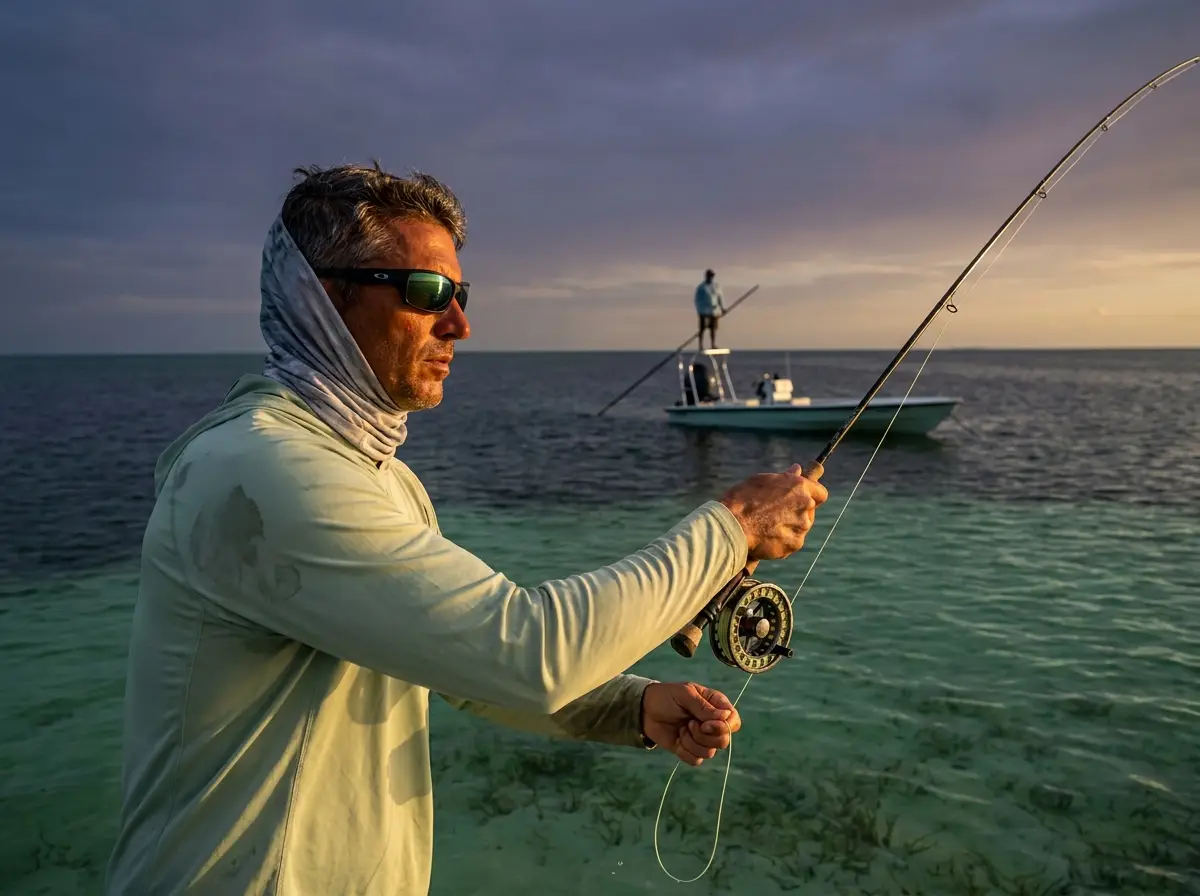
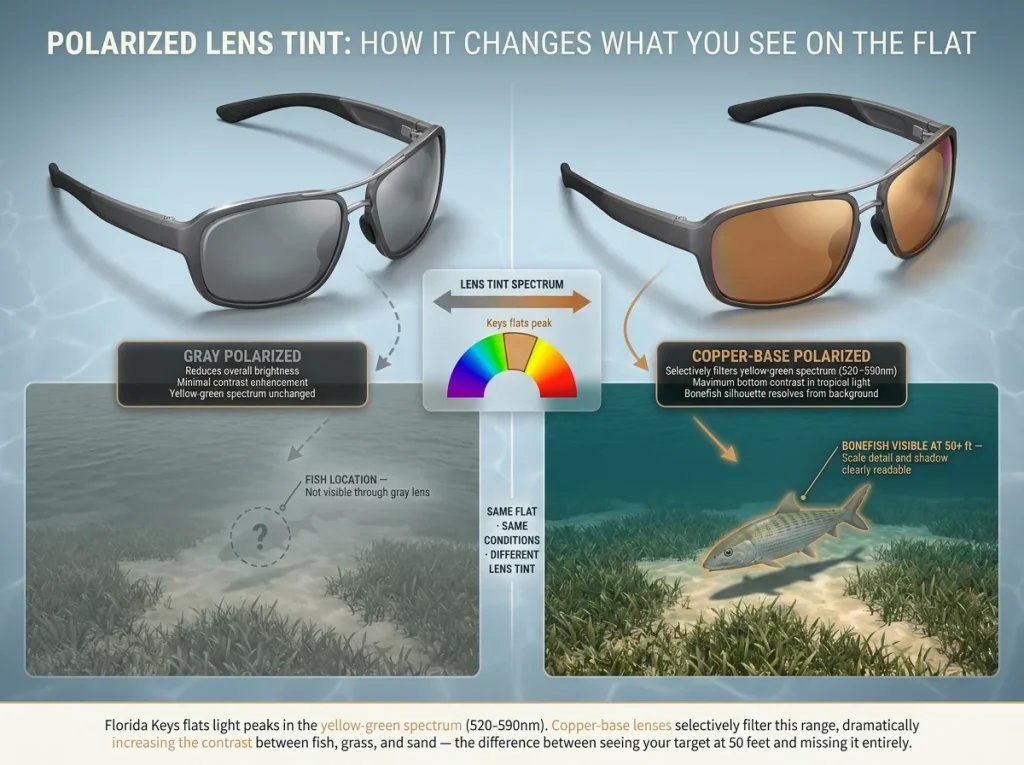
On a white sand flat, bonefish appear as dark shadows over a bright background. On a turtle grass flat, you’re looking for a faint silver torpedo the exact shade of refracted tropical light through green water. The copper-base polarized lens is what separates the fish you see from the fish you miss. Gray lenses reduce brightness but flatten contrast. Green lenses work for trout in dappled freshwater shade. In the yellow-green spectrum of flats light, copper or amber-base lenses add the contrast you need to distinguish a moving fish from a moving grass blade.
Your first 15 minutes on any new flat are calibration time. Let your eyes learn what the grass looks like, what the sand looks like, what the light is doing at this particular angle and depth. Once your brain has that baseline, the fish start resolving out of the background.
Guide clock positions and what to do when you hear them
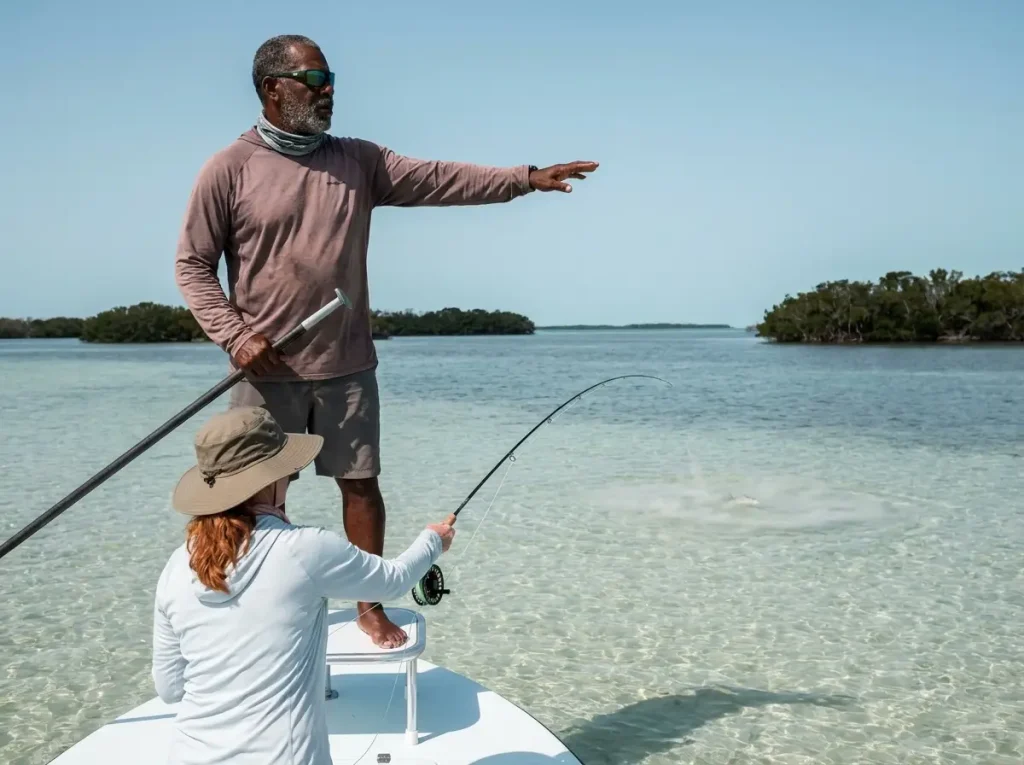
Your guide calls fish using clock positions. Twelve o’clock is straight off the bow. Three o’clock is directly right. Nine is left. Six is behind you.
When you hear “one o’clock, 40 feet,” your first job is not to cast. It’s to find the fish. Get your eyes on the target — the tail, the mud cloud, the wake — confirm you see what the guide sees, then make the cast. A cast in the right direction to the wrong depth wastes both the shot and your guide’s patience.
Pro tip: If you hear the clock position and genuinely cannot see the fish, say so immediately. “I’m on the clock but I don’t have the fish” is far better than a blind cast that lands on top of a bonefish you couldn’t see. Good guides expect this from first-timers. They’re not judging you — they’re trying to help you catch fish.
Fly Fishing Technique for Florida Keys Bonefish
The cast — distance, angle, and the 3-to-6-foot lead
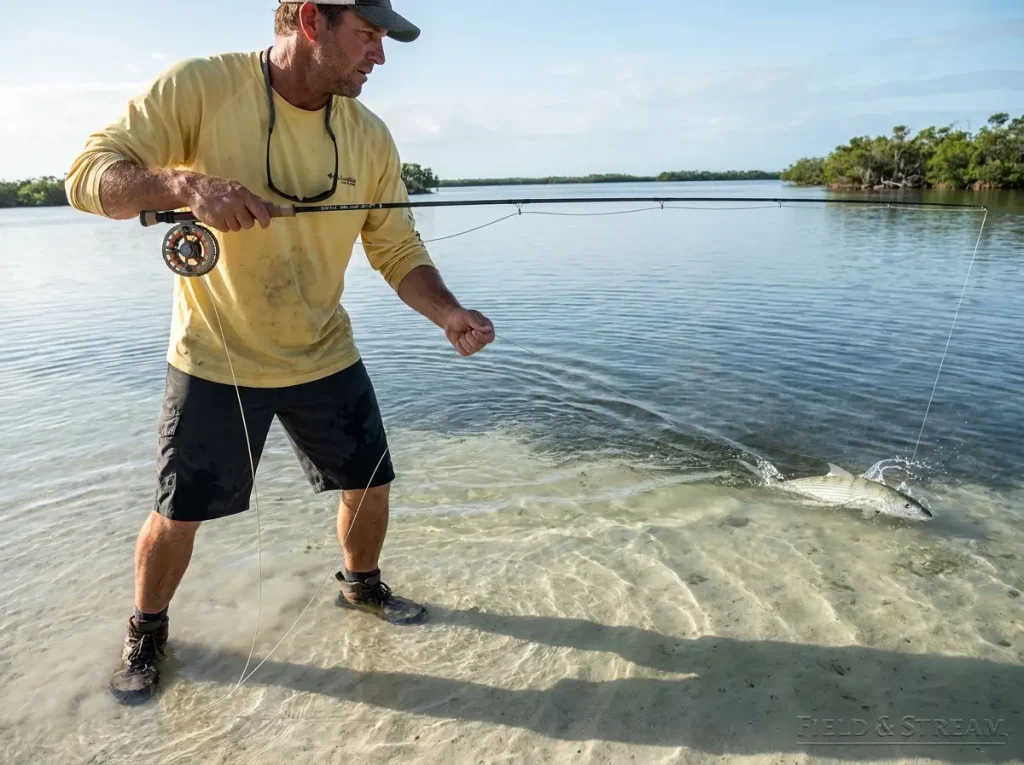
Most bonefishing casts happen between 30 and 60 feet. That’s not far for a competent caster. The problem is that the cast has to happen fast — the guide calls the fish, the window for a good presentation is maybe 5 to 10 seconds — and it has to land quietly.
The fly should land 3 to 6 feet in front of the fish’s nose, on its travel line, and sink before the fish arrives. Too close and the splash spooks the fish. Too far and it never sees the fly. The sweet spot is that 3-to-6-foot lead. On your first few trips, you’ll blow this repeatedly. That’s normal.
A double haul is not optional in the Keys. The southeast wind runs 10-15 mph most days, and getting a weighted fly to turn over cleanly in that wind requires the double haul. Tom Rosenbauer’s instructional video on the basics of fly fishing for bonefish covers the mechanics with enough clarity to be worth watching before your first trip.
The strip-set — why the freshwater instinct will cost you fish
This is the one. If you’ve spent any time trout fishing, your brain has a wired reflex: when a fish takes, lift the rod tip. It’s instant. It’s automatic. It’s completely wrong for bonefish.
When a bonefish picks up your fly, its mouth is open — and stays open. Here’s the biology: bonefish feed using pharyngeal teeth, a set of crushing pads at the back of the throat rather than at the front of the mouth. The fish scoops up a mouthful of substrate, crushes the crabs or shrimp with these crushers, and expels the sand and mud out through its gills. During this whole process, the mouth stays open.
Lift the rod tip and the fly slides straight out of that open mouth. You’ve moved it at the wrong angle and the wrong speed. You feel what seems like a solid take, then nothing.
The strip-set works because it moves the hook parallel to the water rather than up and away. Point the rod at the fish and pull the line firmly with your stripping hand — a long, smooth pull, like a firm handshake. The hook finds the corner of the open mouth and seats. Every trout angler loses their first bonefish to the reflex lift. Usually their second one too. Practice the strip-set motion before you get on the water — pull it off a dock post, a tree, whatever is available. Rewire the reflex before the fish teaches you.
The retrieve — what a fleeing crab looks like
Once the fly is in front of the fish, the retrieve tells it what the fly is supposed to be. Bonefish eat crabs, shrimp, and small worms mostly. A fleeing crab moves in short, erratic bursts — small ticks of 2-3 inches followed by a longer sliding strip of 6-10 inches. The longer strip mimics the crab gaining speed as it tries to escape. Strip too slowly and the fly just drags. Strip too evenly and it looks nothing like something alive.
When the fish is very close — 10 feet or less — slow down or stop completely. A crab doesn’t sprint when the predator is on top of it. It freezes. This is often when the take happens: you stop the retrieve, the fly sinks a few inches, and the fish commits.
Gear for Florida Keys Bonefishing
Rod, reel, and line setup
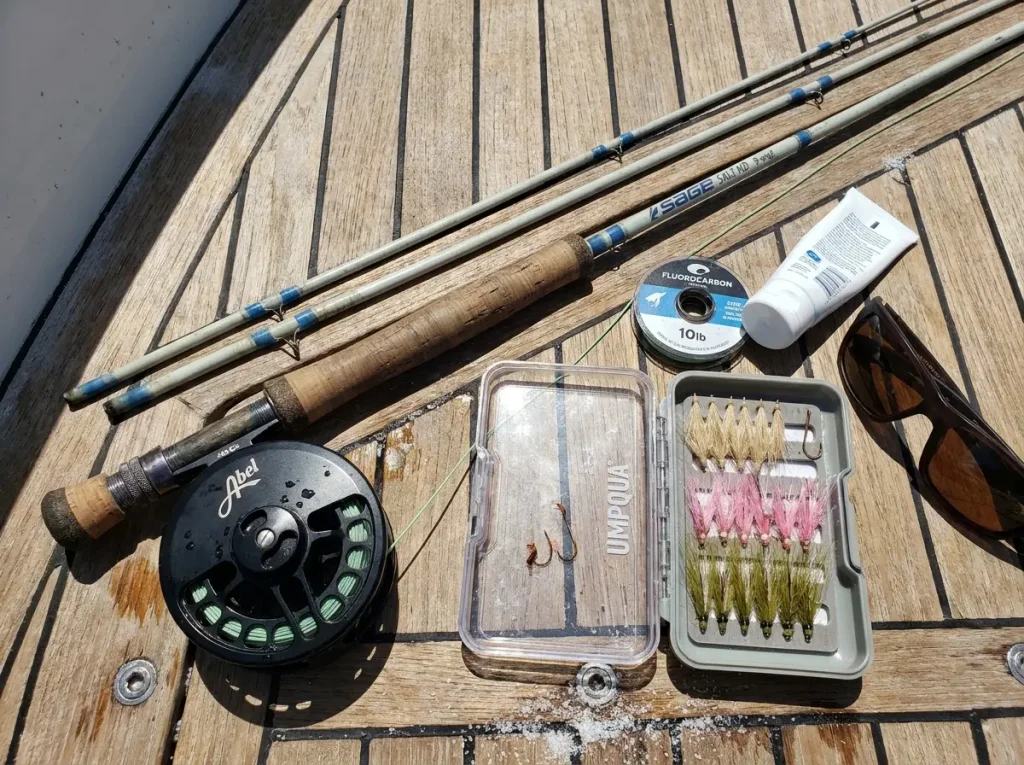
The standard Keys bonefish setup is an 8- or 9-weight fly rod, with the 9-weight preferred for consistent southeast wind. You want a fast-action rod with enough backbone to drive the double haul into a headwind — a soft-tip rod will tire you out by 10 AM and won’t turn over a weighted fly in 15 mph of breeze.
Pair it with a large-arbor reel loaded with a tropical-rated weight-forward floating fly line. Standard freshwater lines go limp in 85-degree air and don’t shoot cleanly. Tropical lines are stiffer and cost more, but the difference is real from the first cast.
Behind the line, carry at minimum 200 yards of 20-pound backing. A solid bonefish can run 100 yards in its first sprint alone. 150 yards of backing is not enough. 200 is the floor.
The fly box — what actually catches Keys bonefish
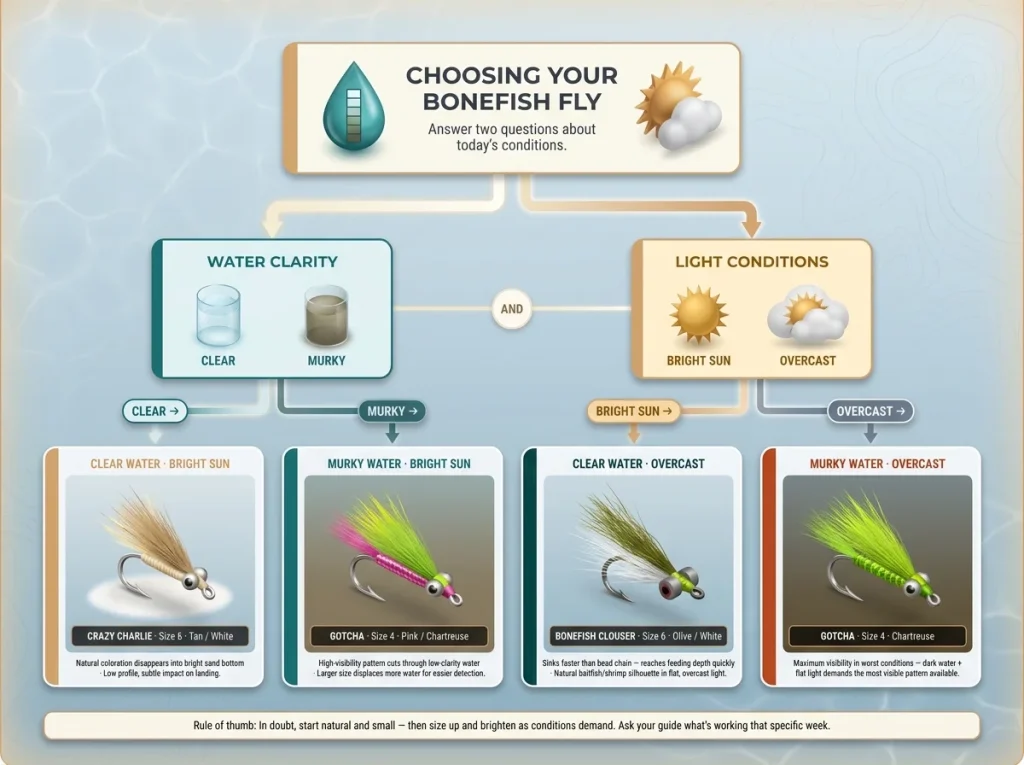
The standard patterns are not mysterious: Crazy Charlie in white or tan (size 6), Gotcha in pink or chartreuse (size 4-6), and Bonefish Clouser in olive and white. The specific pattern matters less than the size and sink rate — the fly needs to reach the bottom fast enough to be where the fish is looking, which is down.
Fly color in the Keys comes down to light and clarity. On bright days with high sun and clear water, smaller and more natural-colored flies tend to outperform bright patterns. In overcast conditions or late afternoon light, brighter flies get more attention. Your guide will know what’s been working that week. Pay attention when they change your fly.
Polarized lenses — why copper matters more than you think
Lens choice has more impact on how many fish you see than almost any other piece of gear you bring.
Copper-base or amber-base polarized lenses are the standard for tropical flats fishing. They add contrast in the yellow-green spectrum — exactly the light environment of a Florida Keys flat. Gray lenses reduce glare without adding contrast. Green lenses work well for freshwater trout where you’re looking for fish in shaded ripple water, not through tropical sky reflection.
Costa Del Mar copper-base lenses in the 580P glass formulation are what most Keys guides wear. That’s not brand loyalty — it’s the specific combination of glass versus polycarbonate optical clarity and tint temperature that works in this light. Inexpensive polarized sunglasses are often polarized in only one angular orientation, which doesn’t match the angle of tropical surface glare. The physics are different here.
Pro tip: Budget the best polarized lenses you can afford before the trip. Good optics will put more fish in front of you in one day than a week of fishing with poor ones.
Hiring a Bonefish Guide in the Florida Keys
What it costs and what that money buys you
A full-day guided bonefish trip in the Florida Keys runs $450 to $700 for the boat, typically for two anglers. That covers the skiff, the guide’s time and knowledge, and usually rods and flies if you need them. Tip separately — $50 to $100 per angler for a productive day is the standard.
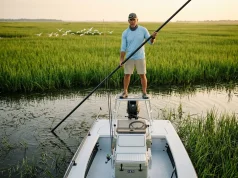
That’s real money. What it buys you is access to water you can’t reach by wading and eyes that have been trained on this flat for years. A good guide doesn’t just pole you to fish — they teach you. They call the position, correct your cast in real time, and tell you exactly what the fish did when you blow the presentation. That compressed information is worth the day rate even if you catch nothing.
The Islamorada guide community is competitive and generally high quality. Bad guides don’t last when there are this many options. Ask specifically about guides who are good teachers if you’re a beginner — some specialize in putting experienced anglers on fish, others in building skills from scratch. They’re different skill sets.
What to tell your guide before the skiff launches
The most valuable thing you can tell your guide before the trip is your actual experience level — not the level you wish you had. Where you actually are.
A guide who knows you’ve never sight-fished will spend the first hour teaching you to look before asking you to cast. A guide who assumes you’re experienced will put you on a fish immediately, watch you blow the presentation, and spend the next hour recalibrating — which wastes fishing time for both of you.
Tell them: how comfortable you are with the double haul, whether you’ve cast in wind before, and whether you’ve done the strip-set before or only trout fished. This takes 90 seconds. It changes the entire day.
Guide etiquette — what spooks fish before the first cast
Bonefish are not scared of people. They’re sensitive to vibration, silhouette, and unnatural water disturbance. Most of what spooks fish on a guided trip comes from the angler, not the guide.
On the skiff: don’t drag gear across the deck, don’t drop anything, and don’t shuffle your feet. The hull transmits vibration directly into the water column. One dropped water bottle can clear a flat in 30 seconds.
When wading: move slowly. Your silhouette against the sky is as visible to a bonefish as its tail is to you.
For sunscreen: use reef-safe, non-toxic zinc formulas only. The oils from standard sunscreen in calm, shallow water can be detectable by fish at very low concentrations. On a windless flat, this matters.
For catch-and-release handling on warm summer days: keep the fish in the water as much as possible, complete a proper revival facing the fish into any available current, and don’t let go until it swims away on its own. Our guide to warm-water fish release and revival covers the full protocol, including the specific time thresholds for safe air exposure in different water temperatures.
Conclusion
Three things will change your first Keys bonefish trip more than any other: get on the flat at the start of the incoming tide, eliminate the trout-set reflex before you step on the boat, and buy better polarized lenses than you think you need. The Florida Keys will not be easy on you — the fish are too smart and the conditions too variable for that. But when you finally read a mudding cloud correctly, lead the fly by 4 feet, feel the strip-set take hold, and watch 150 yards of backing disappear in about four seconds, you’ll understand why people keep coming back. Do the work before you go. The fish are worth it.
FAQ
What is the best time of year for bonefishing in the Florida Keys?
April through October is the main season, with July through October the peak because bonefish are spawning and spending more time on the flats. Winter fishing produces as well — bonefish school in colder months, making them easier to spot even when they’re less aggressive. December through February can be productive for patient anglers willing to work through cold-front windows.
Do you need a guide to bonefish the Florida Keys?
No, but for a first trip the value is hard to match. The flats are public water and accessible by wading or kayak, but a guide’s eyes, positioning knowledge, and skiff access to the backcountry will put you on fish most solo anglers never find. Hire a guide for at least one day on your first trip to learn the water, then fish on your own in subsequent trips if you want to cut costs.
What flies work best for bonefish in the Florida Keys?
The Crazy Charlie in tan or white, Gotcha in pink, and Bonefish Clouser in olive-white cover most situations. Carry sizes 4 and 6 in multiple colors. On bright days in clear water, smaller and more natural patterns tend to outperform bright ones. When in doubt, ask your guide what’s been working that specific week — patterns shift seasonally and even weekly based on what prey species are most active.
How big do bonefish get in the Florida Keys?
The average Keys bonefish runs 3 to 5 pounds. Fish in the 7-to-10-pound range show up regularly in the Lower Keys and around the Marquesas. What makes Keys fish notable isn’t the average size — it’s the difficulty of the fishing itself. A 4-pound Keys bonefish on a turtle grass flat is a harder catch than a 6-pound Bahamas fish on white sand, and most experienced anglers rate it as more satisfying for that reason.
Is bonefishing in the Florida Keys catch-and-release only?
Yes — bonefish are legally protected in Florida waters under Florida Fish and Wildlife Conservation Commission regulations, with no harvest allowed. The culture fully aligns with the law here. Handle fish quickly, keep them wet, and complete a proper water revival in warm conditions before letting them swim away.
Risk Disclaimer: Fishing, boating, and all related outdoor activities involve inherent risks that
can lead to injury. The information provided on Master Fishing Mag is for educational and informational purposes
only. While we strive for accuracy, the information, techniques, and advice on gear and safety are not a substitute
for your own best judgment, local knowledge, and adherence to official regulations. Fishing regulations, including
seasons, size limits, and species restrictions, change frequently and vary by location. Always consult the latest
official regulations from your local fish and wildlife agency before heading out. Proper handling of hooks, knives,
and other sharp equipment is essential for safety. Furthermore, be aware of local fish consumption advisories. By
using this website, you agree that you are solely responsible for your own safety and for complying with all
applicable laws. Any reliance you place on our content is strictly at your own risk. Master Fishing Mag and its
authors will not be held liable for any injury, damage, or loss sustained in connection with the use of the
information herein.
Affiliate Disclosure: We are a participant in the Amazon Services LLC Associates Program, an
affiliate advertising program designed to provide a means for us to earn advertising fees by advertising and linking
to Amazon.com. As an Amazon Associate, we earn from qualifying purchases. We also participate in other affiliate
programs and may receive a commission on products purchased through our links, at no extra cost to you. Additional
terms are found in the terms of service.