
In this article
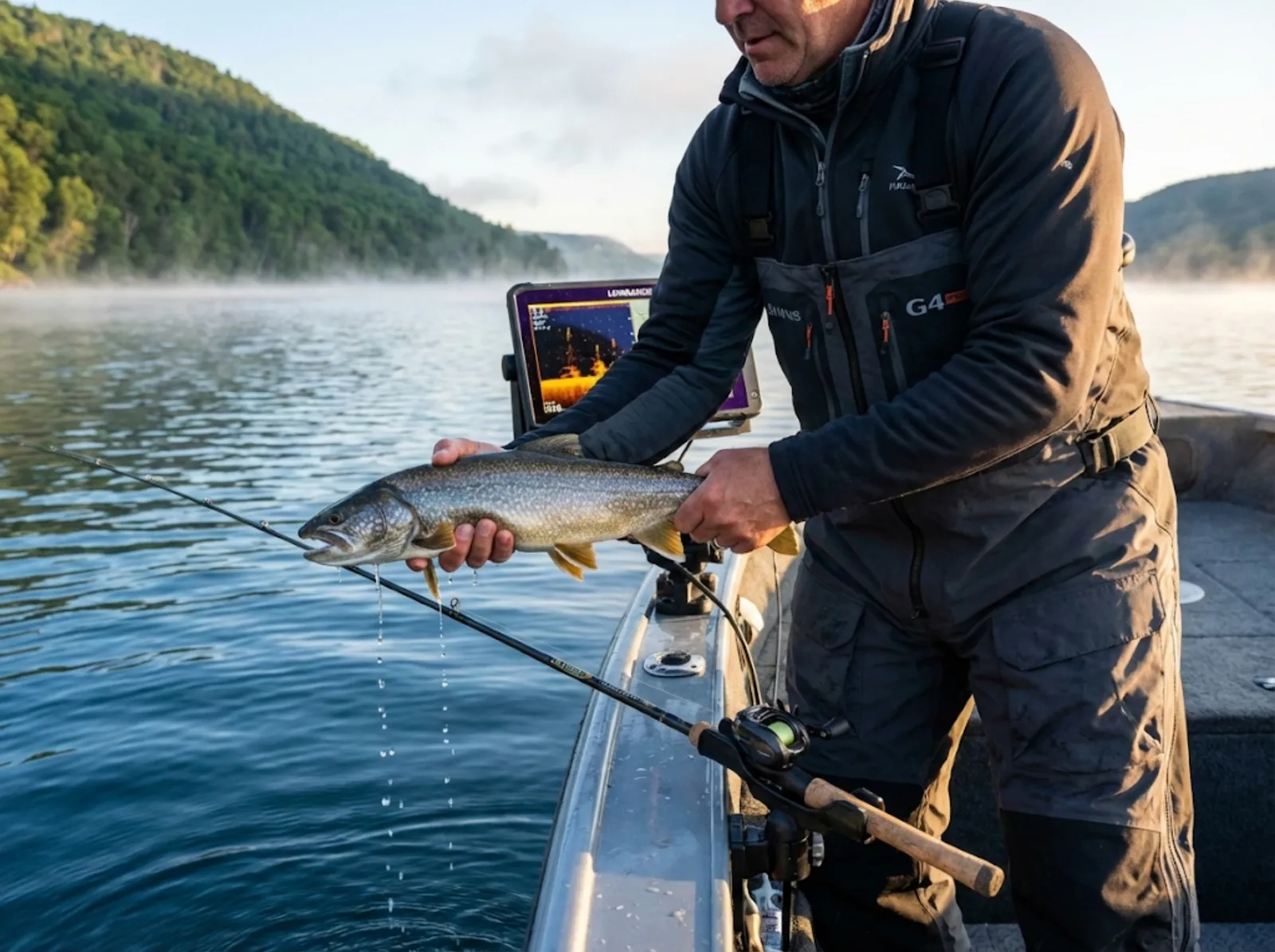
The depth finder flickered past 400 feet, then 500, as the jigging spoon dropped into Seneca Lake’s inky abyss. Above, June sunshine warmed the surface—but down here, water temperatures hovered near 40°F. That’s the thing about fishing the Finger Lakes: you’re working two completely different worlds stacked on top of each other. Warmwater bass patrol the shallows while coldwater giants cruise depths that would swallow a 50-story building.
After years of guiding these waters—from first-ice panfish on Honeoye to summer lake trout on Seneca—I’ve learned that success here comes down to understanding what makes these glacial lakes tick. This guide covers everything you need to plan a productive trip: which lake matches your goals, what techniques actually work in deep water, how the regulations differ from lake to lake, and whether hiring a guide makes more sense than going it alone.
⚡ Quick Answer: The Finger Lakes offer a unique “two-story” fishing experience where coldwater species (lake trout, salmon, brown trout) hold deep while warmwater species (bass, panfish, walleye) stay shallow. Seneca Lake is the “Lake Trout Capital of the World,” Otisco holds trophy tiger musky, and Skaneateles has an unlimited walleye limit due to a suppression regulation. Match your target species to the right lake, understand the special regulations, and consider a charter for deep-water species if you lack the gear.
Understanding the Finger Lakes “Two-Story” Fishery
These aren’t your typical farm ponds. The Finger Lakes were carved by the Laurentide Ice Sheet, leaving behind narrow, linear basins with extreme depths. Seneca Lake bottoms out around 618 feet—its deepest point actually sits below sea level. That single lake holds nearly half the total water volume of all 11 Finger Lakes combined.
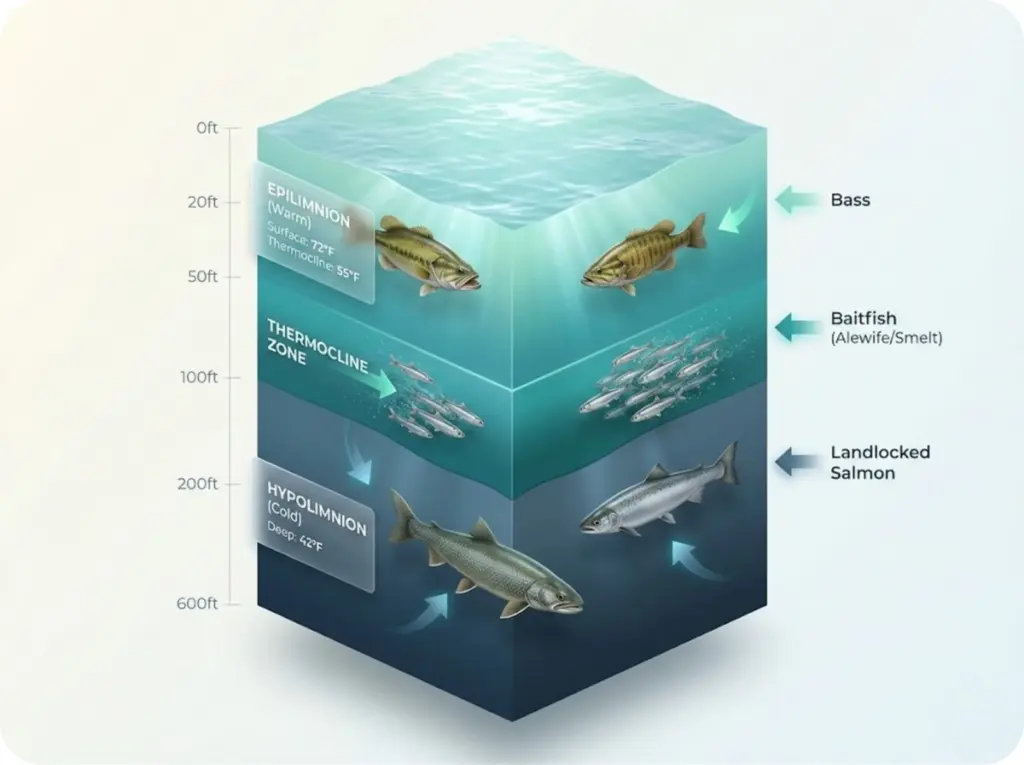
This massive thermal mass changes the game. In summer, lake stratification creates distinct layers: a warm surface layer (the epilimnion), a transition zone called the thermocline, and the cold hypolimnion below. Lake trout and landlocked salmon live in that deep cold water year-round, usually 39°F to 50°F. Meanwhile, largemouth bass and smallmouth bass hunt the warmer shallows above.
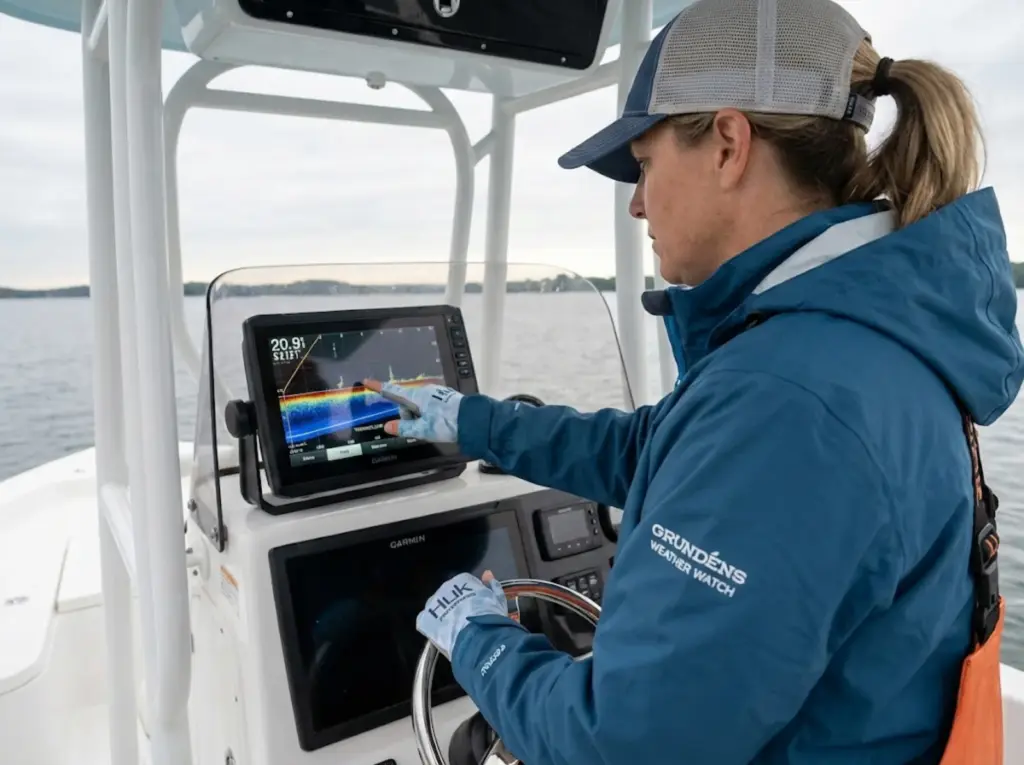
Pro tip: If you aren’t marking fish on sonar, you’re probably fishing above or below the thermocline. Find that temperature break on your depth finder—that’s where baitfish and predators concentrate in summer.
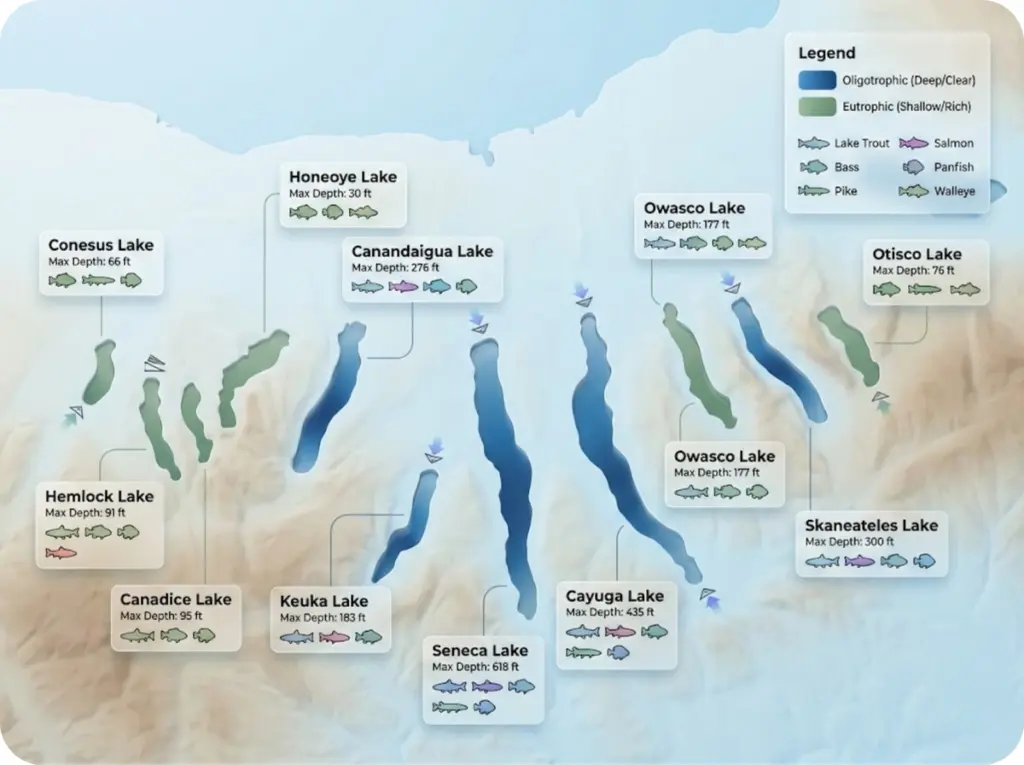
The lakes also divide into two categories that shape everything from species mix to technique selection. Oligotrophic lakes like Seneca, Cayuga, and Skaneateles are deep, cold, and crystal clear—perfect for trout and salmon but demanding ultralight line in the clear water. Eutrophic lakes like Otisco, Honeoye, and Conesus are shallower, weedier, and nutrient-rich—better habitat for bass, pike, walleye, and panfish.
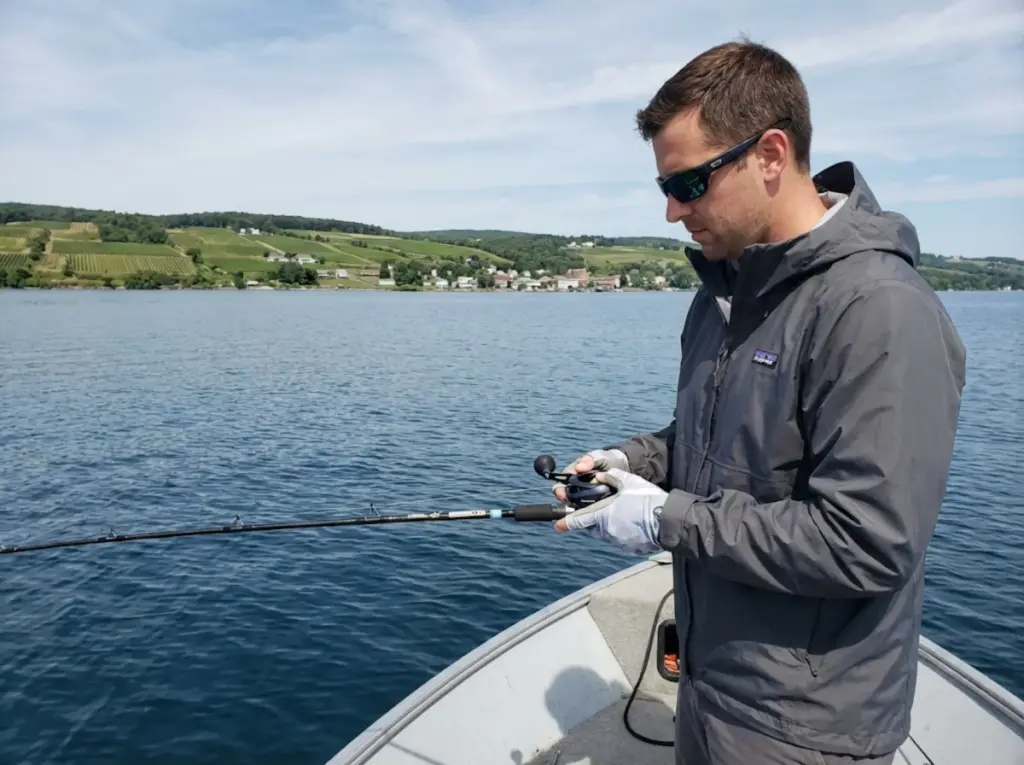
Skaneateles Lake is so clear it serves as unfiltered drinking water for Syracuse. Secchi disk readings regularly exceed 10 meters, which means fish can absolutely see your braided line. Down there, you need long fluorocarbon leaders—20 feet or more—and finesse presentations that wouldn’t look out of place on a pressured suburban pond.
Lake-by-Lake Fishing Guide: Match Your Goals to the Right Water
With 11 lakes to choose from, the first decision is matching your target species and experience level to the right water.
Seneca and Cayuga: The Deep-Water Trophy Destinations
Seneca Lake has earned its reputation as the “Lake Trout Capital of the World.” At 43,342 acres with depths exceeding 600 feet, it supports both stocked and naturally reproducing lake trout populations. The forage base here revolves around alewives—massive schools of baitfish suspended over deep water that lake trout chase in open-water feeding patterns.
Cayuga Lake runs a close second at 42,500 acres with a maximum depth around 435 feet. It holds the New York state record brown trout at 22 pounds 4 ounces. The shallow north end near Montezuma National Wildlife Refuge grows thick with Hydrilla and milfoil—fantastic cover for trophy largemouth bass if you can navigate the vegetation.
For access, hit Seneca Lake State Park in Geneva for the north end, Sampson State Park mid-lake, or Watkins Glen for the south. Cayuga anglers use Allan H. Treman Marine Park near Ithaca for south-end access.
Otisco Lake: Tiger Musky Headquarters
This is New York’s number-one priority water for tiger musky stocking—approximately 11,000 sterile hybrids go in annually, plus 44,000 walleye on a biannual schedule. Unlike the deep oligotrophic giants, Otisco is shallow and eutrophic—weedier, greener, and perfect for predators that ambush from cover.
A causeway roadbed nearly bisects the lake, creating a massive fish-holding structure. Patrol those drop-offs with glide baits and bucktails, keeping safe musky handling practices in mind for the trophy-class fish this lake produces.
Critical regulation note: The tiger musky minimum length at Otisco is 36 inches—stricter than the statewide 30-inch rule. This gives fish time to reach trophy size before they’re harvested.
Skaneateles and Keuka: Clear-Water Finesse
Skaneateles demands finesse. Water clarity here is extreme, and smallmouth bass require 4-6lb fluorocarbon presentations rather than the 12lb rigs you might run elsewhere. But there’s a unique opportunity: walleye here fall under a suppression regulation with unlimited daily possession and a 12-inch minimum. The NYSDEC actively encourages anglers to harvest walleye to protect native trout populations.
Keuka Lake offers its own character—the only “Y-shaped” lake in the region. Strong wild lake trout reproduction means high catch rates (though many fish run small). The Bluff Point peninsula tip creates steep structure that holds fish year-round, and the Y-shape gives you a tactical wind option: if one branch is blown out, the other stays fishable.
Honeoye and the Panfish Lakes
Not every trip needs to target deep-water giants. Honeoye Lake maxes out around 30 feet—classified as a trophy panfish destination with big bluegill, pumpkinseed, and crappie readily available. It’s also the first lake to freeze safely in winter, making it the go-to for early-ice panfish and walleye.
These shallow eutrophic lakes work perfectly for targeting big bluegill in summer holding zones without the specialized deep-water gear that Seneca and Cayuga require.
Deep-Water Techniques: Trolling, Jigging, and the Seth Green Rig
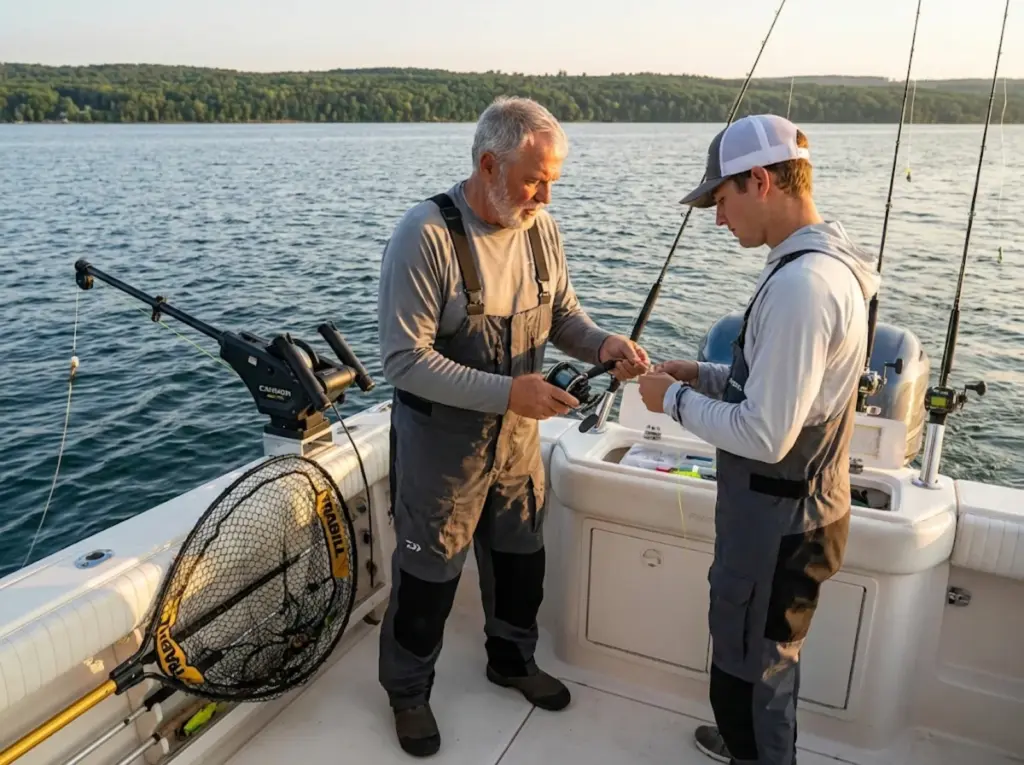
The big trout and salmon holding 100 to 300 feet down require specialized approaches. You’re not casting a spinner and hoping.
The Seth Green Rig: A Finger Lakes Original
This regional trolling system predates modern electric downriggers. It uses heavy main line, a 24-32oz weight, and multiple leaders (called droppers) spaced at intervals to cover different depths simultaneously. Trolling speed runs around 1 mph—slow enough for precise depth control.
The Seth Green Rig works best on boats with roller-tip rod guides to reduce friction on deep sets. It’s a regional tradition that predates modern electronics—and it still catches fish.
Vertical Jigging: “Video Game Fishing” at 300 Feet
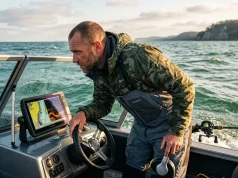
Modern CHIRP sonar changed everything. Vertical jigging now lets you watch the interaction between your lure and approaching fish in real-time on screen—hence the nickname “video game fishing.”
The setup is straightforward: low-stretch braided line (30lb+) for bite detection, a fluorocarbon leader for abrasion resistance in clear water, and a heavy jigging spoon weighted around 1 gram per foot of depth. So for 200 feet of water, you’re dropping a 1.5oz jig.
The cadence matters. Jig sharply, then crank toward the surface. When a lake trout rises toward your bait on the screen, reel faster—not slower. That “fleeing” action triggers the chase instinct. It takes some practice to resist setting the hook the instant you see movement, but the visual feedback makes it addictive once you understand vertical jigging depth mechanics.
Pro tip: When you see a laker rise toward your jig on sonar, speed up your retrieve. The chase instinct kicks in when prey tries to escape.
Downriggers and Copper Line
For consistent depth control, electric downrigger systems with precise depth monitoring are the modern standard. Copper trolling wire achieves depth without the heavy lead-core weight penalty, maintaining better lure action at 100+ feet.
Here’s the economic reality: gearing up for deep-water trolling means investment in downriggers ($300-500 each), a quality fishfinder/chartplotter ($500-2000), and specialized rods. For weekend visitors, that math often favors hiring a charter instead.
Navigating Finger Lakes Regulations: The Rules That Differ
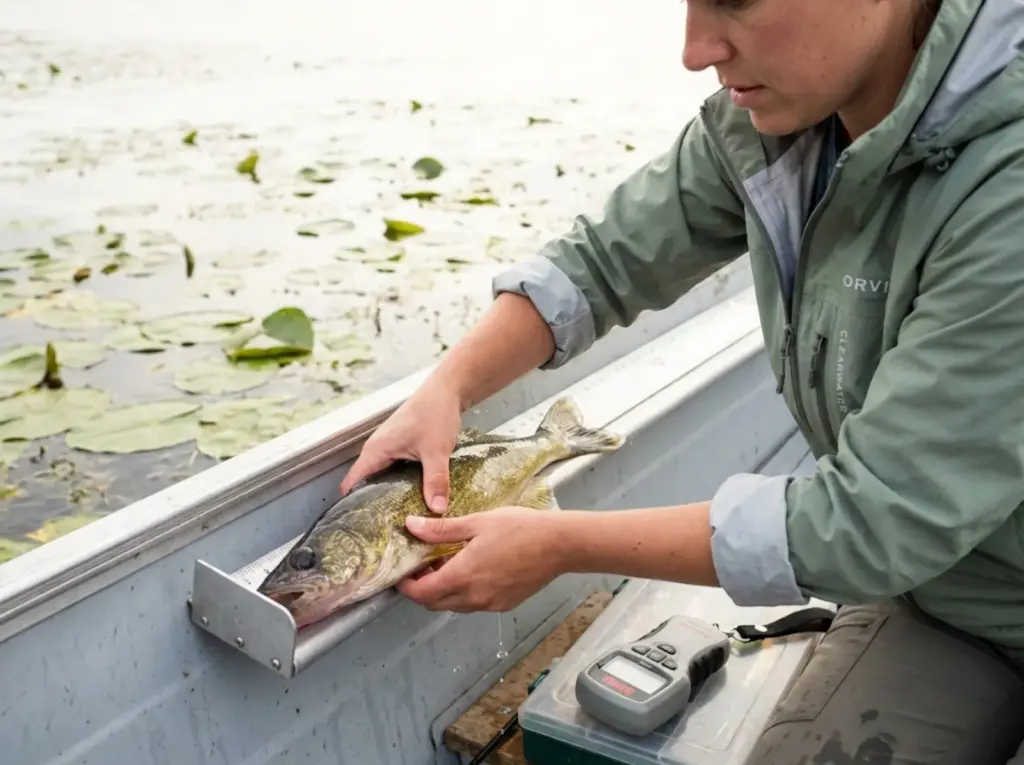
The Finger Lakes operate under Special Regulations that override New York’s general freshwater rules. Assuming statewide limits apply could mean an expensive ticket—or worse, a confiscated fish.
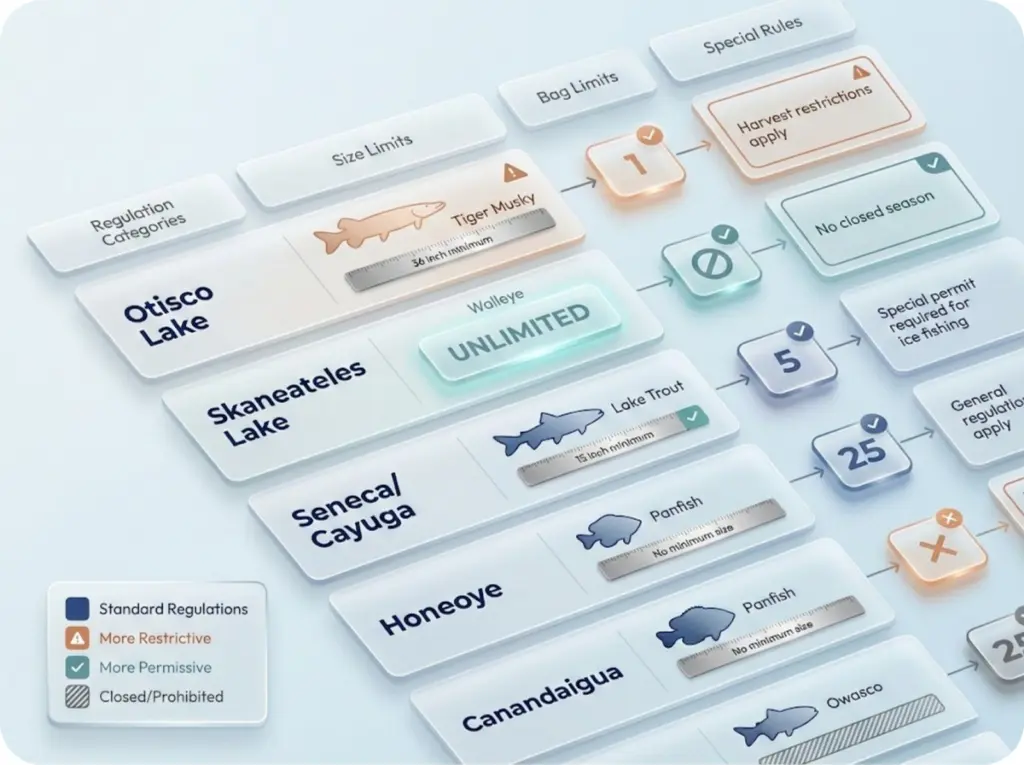
Lake-Specific Limits
Key differences you need to know:
Lake Trout run a consistent 15-inch minimum with a 5-fish daily limit, open all year across all 11 lakes. But walleye and musky rules vary dramatically.
Walleye at Skaneateles: 12-inch minimum, unlimited possession (suppression regulation). At Otisco, Owasco, Honeoye, and Conesus: 18-inch minimum with only 3-fish daily—stricter than statewide rules.
Tiger Musky at Otisco: 36-inch minimum, 1 daily (vs. statewide 30 inches).
Black Bass follow a catch-and-release only window from December 1 through June 14 across all lakes.
Pro tip: Download the current NYSDEC regulations guide before every trip—rules update annually on April 1, and “I didn’t know” won’t work at a checkpoint.
Tributary Rules: The Spring Run Minefield
Most tributaries close entirely for trout and salmon from mid-October through March to protect spawning fish. But specific creek sections have their own extended seasons or catch-and-release-only windows.
Equipment restrictions are common: many tributaries mandate single hook, artificial lures only during runs to prevent snagging. Before hitting Catherine Creek or Naples Creek for rainbow trout in spring, check the specific segment rules on the official NYSDEC tributary regulations page.
Spring run timing follows a predictable calendar: Rainbow trout peak late March through April. Walleye move late April through May. Landlocked salmon run September and October. Brown trout spawn in November.
DIY vs. Charter: The Cost-Benefit Analysis
The gear investment question comes down to how often you’ll fish these specific waters.
When DIY Makes Sense
Shore fishing and panfish trips require minimal gear. A spinning rod, basic tackle, and a fishing license get you on Honeoye for bluegill or the Conesus causeways for pike. Kayak and small-boat anglers can effectively target warmwater species without the specialized deep-water equipment.
Public boat launches exist at all 11 lakes, though weekend congestion gets real. Arriving by 6 AM beats the 8 AM crowd—and catches the morning bite before it cools off.
For anglers who already own downriggers and quality electronics from fishing other deep lakes, the Finger Lakes absolutely reward DIY trips. The learning curve for locating thermocline-suspended trout steepens without local knowledge, but the fish are there.
When Hiring a Guide Pays Off
Charter pricing runs $400-450 for a half-day (5 hours) and $550-650 for a full day (8 hours), plus roughly $75 per extra person. Notable services include Fishing The Finger Lakes with Jonathan Evans, Captain Joe’s Seneca Lake Charters, and Finger Lakes Angling Zone with John Gaulke.
For a one-week-per-year visiting angler, charter economics make sense. The equipment investment for proper deep-water trolling—downriggers, electronics, specialized rods—easily exceeds $3,000. A single charter trip provides boat, tackle, local knowledge, and often access to private launches that avoid public ramp congestion.
Look for guides holding both NYS Licensed Professional Guide and USCG Captain credentials—those certifications mean safety training and accountability. You can also try shore fishing tactics if budget is tight.
Ice Fishing the Finger Lakes: Safety and Strategy
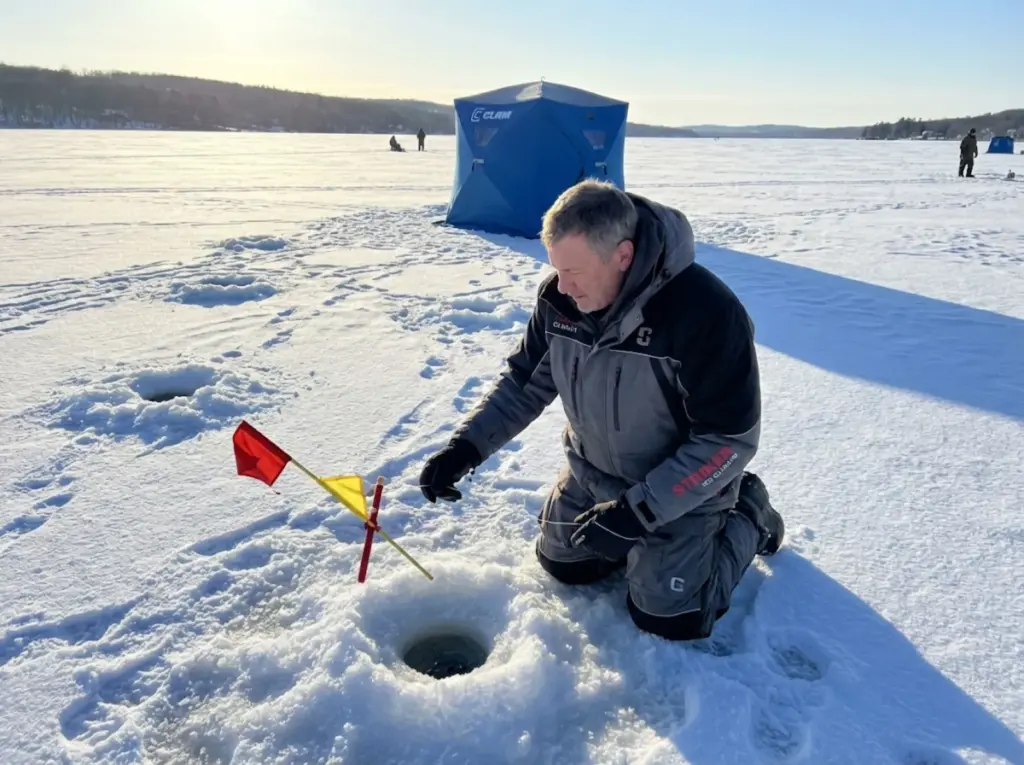
Hardwater fishing here comes with unique hazards that make ice safety non-negotiable.
The Risks Most Anglers Miss
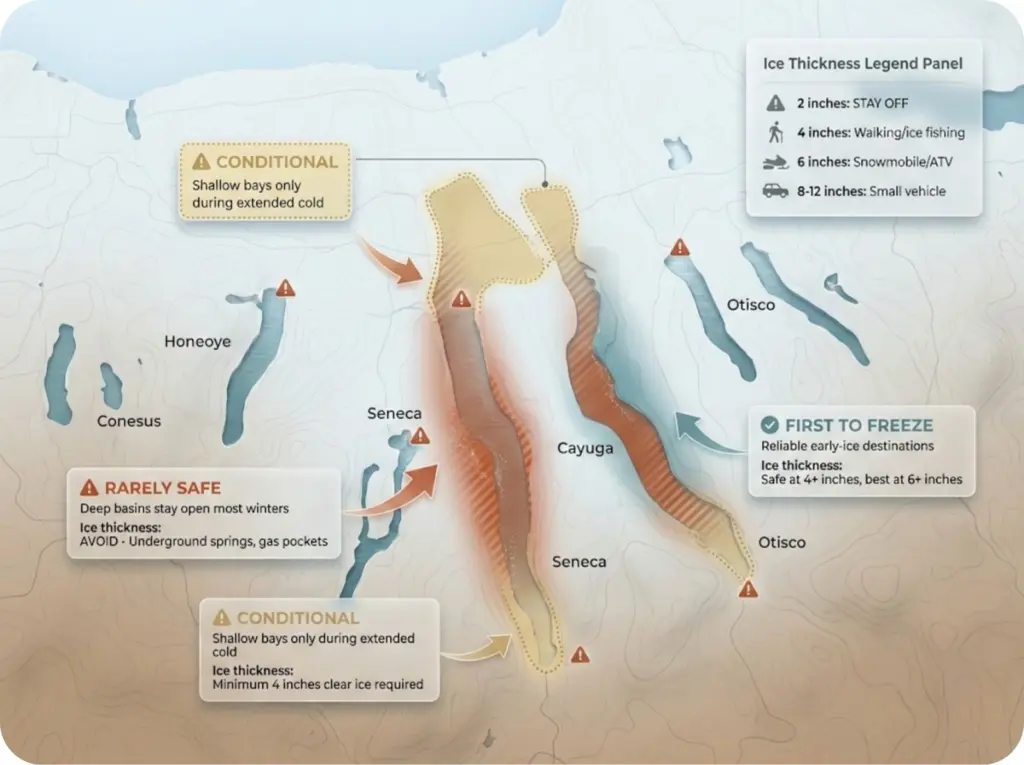
Due to depth, currents, and thermal mass, the central basins of Seneca and Cayuga rarely freeze safely. These lakes stay open through most winters, with ice fishing restricted to shallow bays at the extreme north and south ends—and only during extended cold periods.
Underground springs and gas pockets create thin spots even when surface ice looks solid. The “below-normal cold temperatures” threshold matters: short cold snaps following mild weeks build dangerous false floors. Honeoye, Conesus, and Otisco freeze more reliably, making them the primary early-ice destinations.
First Safe Days: Early Ice Tactics
When ice does lock up safely on Honeoye, panfish and walleye congregate at predictable depths. Mark those spots with GPS waypoints during summer fishing and return to the same structure once ice forms—understanding ice physics and load-bearing keeps you safe during that transition.
Shallow eutrophic lakes retain oxygen better in early winter, delivering aggressive panfish bites before the mid-winter slowdown sets in. Gear requirements are simple: ice rod, jigging spoon or tungsten jig, portable flasher. No need for the $3,000 deep-water trolling investment.
Conclusion
The Finger Lakes reward anglers who understand the vertical dimension. Match your target species to the right water type: oligotrophic giants for lake trout and salmon, eutrophic bowls for bass and panfish, Otisco for tiger musky if you’re after something different. Know which regulations differ—the Skaneateles walleye loophole and Otisco’s 36-inch musky limit aren’t statewide rules. And before you invest thousands in deep-water gear for an annual trip, run the math on a charter day.
The thermocline is your tactical advantage. Learn to read it on sonar and fish the edges where baitfish and predators concentrate. That’s where the Finger Lakes stop being confusing and start making sense.
FAQ
What is the best Finger Lake for trophy lake trout?
Seneca Lake is the Lake Trout Capital of the World, offering the highest catch rates with fish in depths exceeding 600 feet. Cayuga Lake also produces trophy-class brown trout, including the New York state record at 22 pounds 4 ounces.
Do I need a boat to fish the Finger Lakes?
Not necessarily. Shallow lakes like Honeoye and Conesus offer productive shore fishing for panfish, bass, and pike. For deep-water trout and salmon on Seneca or Cayuga, boat access—via rental, personal watercraft, or charter—is essential.
Why is there no walleye limit at Skaneateles Lake?
Walleye threaten native trout populations in this ultra-clear oligotrophic lake. The NYSDEC implemented an unlimited harvest regulation to suppress walleye numbers and protect the native fishery—it is the one lake where keeping every walleye helps conservation.
Can I ice fish on Seneca Lake?
The main basin rarely freezes safely due to its immense depth and thermal mass. Ice fishing is limited to small sheltered bays at the extreme north and south ends during extended cold periods. Safer options include Honeoye, Conesus, and Otisco lakes.
What is vertical jigging video game fishing?
It refers to using high-resolution CHIRP sonar to watch your jig and approaching fish interact in real-time on screen. You react to fish movements—speeding up your retrieve to trigger chase response—making the experience interactive like a video game.
Risk Disclaimer: Fishing, boating, and all related outdoor activities involve inherent risks that
can lead to injury. The information provided on Master Fishing Mag is for educational and informational purposes
only. While we strive for accuracy, the information, techniques, and advice on gear and safety are not a substitute
for your own best judgment, local knowledge, and adherence to official regulations. Fishing regulations, including
seasons, size limits, and species restrictions, change frequently and vary by location. Always consult the latest
official regulations from your local fish and wildlife agency before heading out. Proper handling of hooks, knives,
and other sharp equipment is essential for safety. Furthermore, be aware of local fish consumption advisories. By
using this website, you agree that you are solely responsible for your own safety and for complying with all
applicable laws. Any reliance you place on our content is strictly at your own risk. Master Fishing Mag and its
authors will not be held liable for any injury, damage, or loss sustained in connection with the use of the
information herein.
Affiliate Disclosure: We are a participant in the Amazon Services LLC Associates Program, an
affiliate advertising program designed to provide a means for us to earn advertising fees by advertising and linking
to Amazon.com. As an Amazon Associate, we earn from qualifying purchases. We also participate in other affiliate
programs and may receive a commission on products purchased through our links, at no extra cost to you. Additional
terms are found in the terms of service.