In this article
You pull the fish alongside the boat, and the victory instantly sours. The Walleye isn’t swimming; it’s listing on its side, belly distended tight as a drum, eyes bulging like marbles. A pink mass protrudes from its mouth.
This isn’t a tired fish. It is a creature physically broken by the ascent. Most anglers call it “bloating,” but the correct term is barotrauma. It is a violent collision between physiology and the unyielding laws of fluid dynamics.
As someone who has spent decades on the water, I can tell you that ignoring this phenomenon turns a well-intentioned release into a death sentence. True outdoor competence comes from turning theoretical knowledge into practical, confident action. In this guide, we will move beyond luck and understand the invisible forces at play underwater, ensuring you have the physics-based knowledge to mitigate swim bladder disease symptoms and ensure the catch and release survival of your trophy.
What is the Relationship Between Depth and Pressure?

To understand why fish suffer when brought to the surface, we first have to understand the environment they live in. The water column isn’t just empty space; it is weight.
How does water pressure change as you go deeper?
We live at the bottom of an ocean of air, experiencing 1 atmosphere (atm) of pressure. However, water has a much higher fluid density—approximately 800 times denser than air. This density creates a steep gradient known as hydrostatic pressure.
For every 10 meters (33 feet) you descend, the pressure increases by 1 atm (1 atm per 10m). To calculate the absolute pressure a fish experiences, you must add the surface pressure to the water pressure. For example, at 33 feet, a fish is under 2 atm—double the pressure of the air above.
This “Rule of Tens” (or 1 atm per 33ft) means that pressure changes are most drastic in shallow water. The relative pressure change from 33 feet to the surface results in a 50% reduction. This is far more violent than the change from 300 feet to 260 feet.
Understanding these fundamental principles of hydrostatic pressure explains why even “shallow” deep fishing (30-40 feet) can be lethal for certain species. Anglers must visualize the water column not just as distance, but as a crushing pressure that diminishes linearly as they reel up. While we often track fishing barometric pressure trends to predict feeding windows, it is the hydrostatic pressure that dictates the fish’s physical survival.
Why does the swim bladder expand during ascent?
The behavior of the gas in the swim bladder (or gas bladder) is governed by Boyle’s Law. This physical law states that the volume of a gas is inversely proportional to the gas pressure exerted on it. As you reel a fish up, external ambient pressure decreases, causing the gas inside the bladder to expand exponentially.
A swim bladder containing 50mL of gas at 99 feet (4 atm) will expand to 200mL by the time it reaches the surface (1 atm). That is a four-fold increase in swim bladder volume.
Pro-Tip: If you are marking fish deep on your electronics, remember that how to read a fish finder relies on sonar bouncing off this exact gas pocket. A large return at depth means a massive expansion risk at the surface.
This expansion is often compared to a “balloon in an elevator analogy,” but there is a key difference. Unlike a balloon, the swim bladder is trapped inside a rigid skeletal structure. The volume changes predicted by Boyle’s Law force organs out of place, crushing the kidneys and heart against the body wall. The most critical swim bladder expansion occurs in the final 30 feet of the retrieve, where the volume doubles in just seconds.
How Does the Swim Bladder Function Biologically?
Physics applies to everything underwater, but biology determines which fish survive the ascent and which ones suffer. Not all fish manage buoyancy control the same way.
What is the difference between open and closed bladder systems?
Evolution has produced two distinct systems for maintaining neutral buoyancy: Physostomous (Open) and Physoclistous (Closed). This anatomical distinction creates the “Risk List” for anglers.
Physostomous fish—like herring, carp, Trout, Salmon, and Pike—retain a connection called the pneumatic duct between the air bladder and the gut. This allows them to physically “burp” air to relieve pressure. While they can still suffer trauma, their ability to off-gas gives them a massive survival advantage.
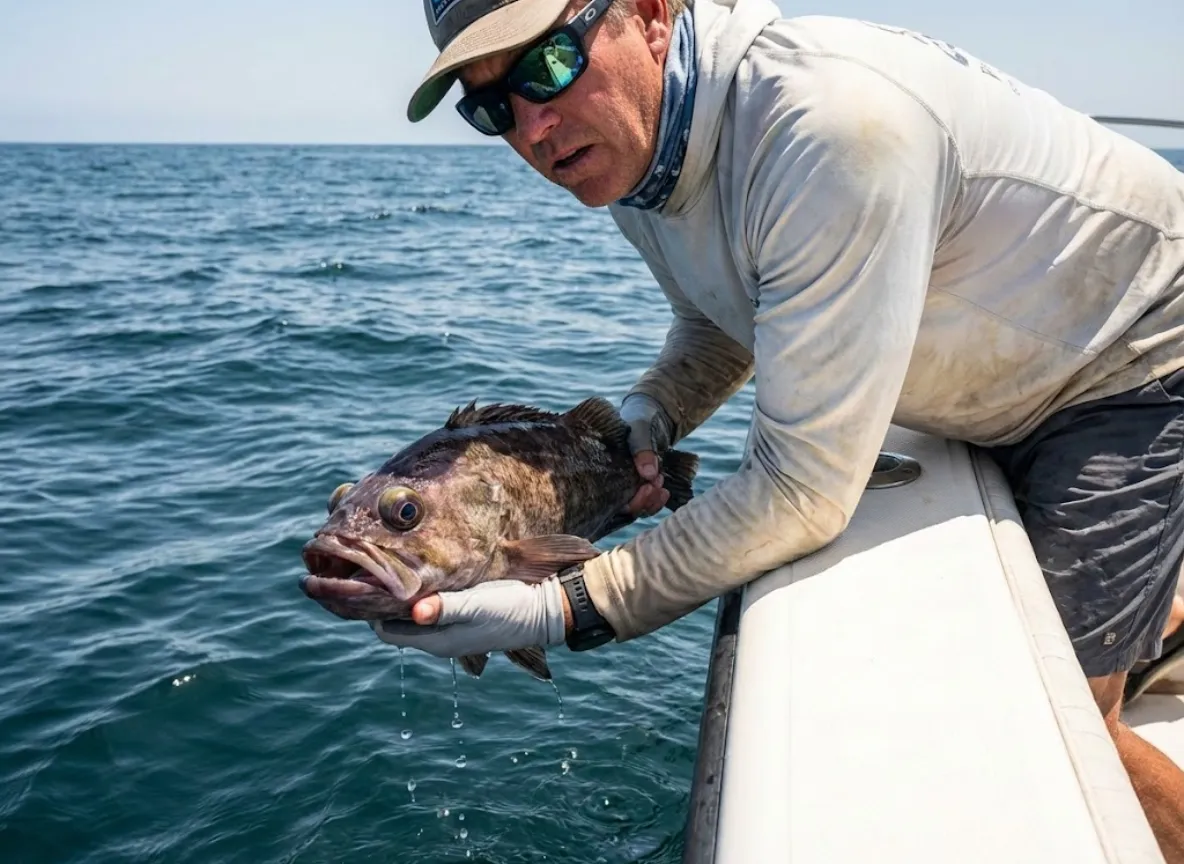
Physoclistous fish lose this duct during development. Species like Bass, Perch, Walleye Pollock, Cod, and Rockfish act as sealed pressure vessels with no escape route for expanding gas. These represent the primary victims of barotrauma.
A comparative analysis of fish species susceptibilities shows that physoclists are significantly more likely to suffer fatal injury. Identifying your target species as an “Open” or “Closed” system is the first step in determining whether you need descender gear. For example, if you are learning walleye fishing 101 techniques, you are targeting a physoclistous species and must be prepared for barotrauma.
How do fish inflate their swim bladders against pressure?
For fish with physoclist swim bladders, inflating that sealed hydrostatic organ requires a biological mechanism that borders on the miraculous. To facilitate gas secretion at depth, fish use a vascular structure called the rete mirabile (“wonderful net”) and a gas gland.
The gas gland secretes lactic acid into the blood. This acidification triggers the Root effect (and the related Bohr effect), which reduces the blood’s capacity to hold oxygen, forcing hemoglobin to dump its oxygen load. The rete mirabile uses countercurrent exchange to trap this oxygen and build up immense partial pressure, driving gas into the bladder against the crushing water pressure.
While this system acts as an efficient biological pump comprised of tiny gas factories, it is slow. It takes hours to secrete or facilitate gas resorption. This reality debunks the “Slow Reel” myth.
You cannot reel a fish slowly enough to match the hours-long biological resorption rate required to prevent barotrauma. The detailed gas secretion and countercurrent concentration mechanics simply cannot keep up with a reel. The mismatch between the speed of the angler’s reel (minutes) and the speed of the fish’s physiology (hours) is the root cause of the injury. This physical stress is a key factor in modern catch and release techniques, emphasizing speed and efficiency over “gentle” play times.
Why Does Rapid Ascent Cause Injury?
We know the physics and the biology. Now we must look at the pathology of barotrauma so you can identify the symptoms immediately.
What physically happens to the organs during barotrauma?
The most common symptom anglers see is Gastric Eversion. This is where the expanding swim bladder pushes the stomach inside out and into the mouth. It is crucial to note that the pink mass is not the bladder itself; it is the stomach.
Other symptoms include Exophthalmia (the pop-eye phenomenon), where gas bubbles form behind the eye sockets, pushing the eyes outward. Systemic Embolisms can also occur, which are essentially “the bends” for fish, blocking blood flow to the gills and heart.
The signs of barotrauma in fish are clear indicators that a fish is positively buoyant. It is physically incapable of returning to depth without help due to the extreme extra buoyancy. While the stomach in the mouth looks like a fatal injury or bladder rupture, it is often reversible if you are holding a fish correctly and treat it quickly.
How does temperature affect survival rates?
Pressure isn’t the only variable. In the heat of summer, the water column hides a thermal barrier that can double the lethality of the catch.
Deep water is cold, and surface water in summer is hot. A rapid temperature change of just 9°C (16°F) can induce thermal shock. When barotrauma is combined with thermal shock, mortality rates skyrocket because the fish’s metabolism fails while its organs are crushed.
This is known as “Cumulative Trauma.” Research quantifying delayed mortality from barotrauma indicates that survival is significantly higher in winter when the water column temperature is uniform.
Pro-Tip: During July and August, minimize handling time to a matter of seconds. Keep the fish in the water while unhooking to mitigate thermal stress.
Anglers following summer fishing tips must be hyper-aware of this synergy between heat and pressure.
How Can Anglers Prevent Mortality?
The transition from catching to saving is the mark of a master angler. We must equip ourselves with the mechanical solution that saves the catch.
Why is recompression better than venting?
For years, “Venting” or “Fizzing” (puncturing the fish with a needle) was the norm. However, this carries high risks of infection and accidental organ puncture. The modern gold standard is Descending, or Recompression.
Descending uses a weighted device to lower the fish back to depth. This uses hydrostatic pressure to re-compress the gas naturally. As the fish descends, the bladder shrinks, the stomach retracts, and the eyes recede without invasive surgery.
Comparative studies on the effectiveness of venting and descender devices confirm that descending significantly reduces discard mortality. While we are discussing the physics here, our guide on fixing barotrauma in fish provides the step-by-step procedure for doing this on the water.
What tools are required for effective descending?
You need a dedicated tool to do this right. Pressure-release devices, like the SeaQualizer, are the premium option. They clamp to the jaw and automatically open at a set depth.
Simpler options include Inverted Hook devices (like the Shelton) or Lip Clamps (like RokLees) that require a manual jerk of the rod to release the fish. The California Department of Fish and Wildlife provides excellent resources on rockfish barotrauma and descending devices to help you choose.
The decision is simple: If the fish is a Physoclist caught deeper than 30ft and shows signs of trauma, you must descend it. A descending device is now one of the essential fishing tools that belongs on your boat alongside your pliers and life jackets.
Final Thoughts
Understanding the mechanics of the swim bladder changes the way we fish. We now know that water pressure doubles in the first 33 feet, causing gas volumes to expand violently according to Boyle’s Law. We understand that Bass and Walleye are “Closed Systems” that cannot off-gas quickly, making the “slow reel” a myth.
Most importantly, we know that descending devices use physics to reverse the injury. These are critical tools for sustainable fishing practices. Equip your boat with a descending device today and practice using it—your next trophy catch’s life depends on your preparation.
FAQ – Frequently Asked Questions about Swim Bladder Mechanics
Is the pink thing in the fish’s mouth the swim bladder?
No, that is the stomach. The expanding swim bladder (located near the spine) pushes the stomach inside out through the esophagus (Gastric Eversion). Never puncture the stomach; simply recompressing the fish will pull the stomach back into place naturally.
Does reeling the fish in slowly prevent barotrauma?
Generally, no. Research on species like Snapper shows it takes hours to resorb gas, so reeling slow (which takes minutes) is not slow enough to prevent expansion. While it may reduce stress, it does not prevent the physics of Boyle’s Law from expanding the bladder.
Is fizzing or venting a fish illegal?
It varies by jurisdiction, but many conservation agencies now strongly recommend or mandate descending devices over venting due to the risk of injury. Check your local regulations as descending gear requirements are becoming standard.
Which fish species are most at risk for swim bladder issues?
Physoclistous (closed bladder) fish are at highest risk, including Largemouth or Smallmouth Bass, Walleye, Perch, Rockfish, Snapper, and Grouper. Physostomous (open bladder) fish like Trout, Salmon, and Catfish can burp air via the pneumatic duct and are much less susceptible to permanent barotrauma.
Risk Disclaimer: Fishing, boating, and all related outdoor activities involve inherent risks that can lead to injury. The information provided on Master Fishing Mag is for educational and informational purposes only. While we strive for accuracy, the information, techniques, and advice on gear and safety are not a substitute for your own best judgment, local knowledge, and adherence to official regulations. Fishing regulations, including seasons, size limits, and species restrictions, change frequently and vary by location. Always consult the latest official regulations from your local fish and wildlife agency before heading out. Proper handling of hooks, knives, and other sharp equipment is essential for safety. Furthermore, be aware of local fish consumption advisories. By using this website, you agree that you are solely responsible for your own safety and for complying with all applicable laws. Any reliance you place on our content is strictly at your own risk. Master Fishing Mag and its authors will not be held liable for any injury, damage, or loss sustained in connection with the use of the information herein.
Affiliate Disclosure: We are a participant in the Amazon Services LLC Associates Program, an affiliate advertising program designed to provide a means for us to earn advertising fees by advertising and linking to Amazon.com. As an Amazon Associate, we earn from qualifying purchases. We also participate in other affiliate programs and may receive a commission on products purchased through our links, at no extra cost to you. Additional terms are found in the terms of service.