In this article
The banks are barren in July. The shallow stumps that held heavy stringers in May are now ghost towns. You can cast at that shoreline cover until your arm cramps, but the result is usually the same: empty livewells and frustration.
This isn’t a lack of fish; it is a mass migration dictated by invisible physics. The lake has built a wall—the thermocline—and 90% of the biosphere has moved to its edge. Over decades of guiding and studying reservoir biology, I’ve learned that ignoring this invisible barrier is the single most common reason anglers fail during summertime fishing.
This guide moves beyond luck. We are going to look at the science of thermal stratification, calibrate your electronics to visualize the invisible, and apply the physics of tungsten and hydrodynamics to put your lure exactly where the fish are forced to breathe.
What is the Thermocline and Why Does It Dictate Fishing Success?

To catch fish in summer, you must stop thinking of the lake as a swimming pool and start seeing it as a layer cake. The water column is not uniform; it is divided into distinct zones that determine where life can—and cannot—exist.
How does water density create invisible barriers in a lake?
Water creates a “Density Engine” based on temperature. Water is heaviest and most dense at 39°F (4°C). As it warms, it becomes lighter. In the summer, the sun heats the surface, creating a layer of warm, light water called the Epilimnion. This layer floats on top of the deep, cold, heavy water known as the Hypolimnion.
Separating these two opposing forces within the water column stratification is the Metalimnion, or the Thermocline. In limnology and aquatic biology, this is defined as the layer where water temperature drops rapidly—usually more than 1°C per meter. This isn’t just a temperature shift; it acts as a “density fence.”
This thermal stratification has physical implications for your fishing. The density difference is so strong that it prevents the oxygen-rich surface water from mixing with the stagnant deep water.
The depth of this layer is determined by environmental variables like solar penetration into the photic zone and wind fetch. In northern glacial lakes with clear water, the sun penetrates deeper, pushing the thermocline down. In murky water or turbid southern reservoirs, it stays shallow. Understanding this USACE guidance on reservoir stratification mechanics is critical for interpreting what you see on the water.
This creates a “Hard Deck.” It is a physical barrier to acoustic signals and biological life. Once you understand this architecture, you can build a complete summer fishing system that eliminates dead water.
Why do oxygen levels crash below the thermocline?
The surface layer (Epilimnion) is constantly re-oxygenated by wind, wave action, and photosynthesis. The deep layer (Hypolimnion), however, is sealed off. It creates a trap for freshwater sportfishing enthusiasts who fish too deep.
In the deep layer, bacterial decomposition consumes oxygen. As organic matter like dead phytoplankton, zooplankton, and detritus sinks to the bottom, bacteria break it down, stripping oxygen from the water in the process. Since the “density fence” prevents surface air from mixing down, the oxygen is never replenished.
This results in Hypoxia (<2-3 mg/L) or Anoxia (0 mg/L). Even though the deep water is cool and inviting, it is a “Dead Zone.” According to EPA dissolved oxygen criteria for aquatic life, most game fish cannot survive here. Hardier species like carp or catfish might tolerate the fringe, but sensitive predators avoid it.
This creates a “Biological Floor.” Fish cannot physically sustain metabolism below this line. While some oligotrophic (clear/infertile) lakes retain enough dissolved oxygen to support Lake Trout, most fertile bass reservoirs suffocate everything below the thermocline. Fishing here is a waste of time. This oxygen depletion is a primary driver in late summer walleye fishing, pushing these predators into very specific bands of water.
Pro-Tip: If your lure comes up smelling like sulfur or rotten eggs, you are fishing too deep. You are dragging bait through anoxic sludge where no bass can breathe. Crank up 5 feet immediately.
How Do You Identify the Thermocline on Your Fish Finder?
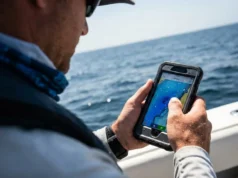
Knowing the layer exists is theory; seeing it on your screen is the first step toward exploitation. Most anglers have the technology—whether using 2D sonar, Down Imaging, or Side Imaging—to see this layer but have the wrong settings to visualize it.
How should you calibrate your sonar settings to reveal the layer?
Sonar works by sending sound waves that bounce off objects. However, sound waves also bounce off density changes. The drastic change in water density at the thermocline creates an acoustic impedance mismatch. On your screen, this looks like “sonar clutter,” “fuzz,” or a horizontal band of interference.
The problem is “Auto.” Modern units are designed to give you a pretty picture, so they filter this “interference” out. You must switch to Manual Sensitivity/Gain. To find the layer, increase your sonar sensitivity to about 85-90%. The screen will fill with noise. Then, back off slightly until a horizontal band remains at a constant depth across the screen.
For Garmin users, you often need to lower or disable “TVG” (Time Variable Gain) and “Surface Noise.” These filters often suppress the mid-water return you are looking for.
Humminbird users need to utilize “Switchfire Max Mode.” This displays raw data. If you run in “Clear Mode,” the unit will scrub the fuzzy lines from your view, leaving you blind to the most important structure in the lake.
Lowrance users should adjust their “Colorline” or “Color Track” to 75-80%. This helps make the soft density layer pop as a distinct color, differentiating it from the hard bottom. Validating these returns follows the logic found in NOAA research on algorithmic characterization of stratification. This is a vital step in mastering your fish finder for summer success.
Why Do Game Fish Converge on the Thermocline?
Fish do not have a choice. They are driven by “Bioenergetics,” a physiological calculation where energy intake must exceed energy output. This forces predator and prey into a narrow strip of water.
What is the “Bioenergetic Squeeze” and how does it trap predators?
This phenomenon is known as the “Squeeze.” It is the collision of lethal heat from the surface and lethal suffocation from the bottom. Fish are cold-blooded; their species temperature preference dictates their metabolism. In the hot surface water, their metabolism races, requiring immense amounts of food to survive.
Fish seek the coolest water possible to lower their respiration costs, but they are stopped by the oxygen floor. The thermocline represents the mathematical optimum—the intersection where water temperature is tolerable, and oxygen is sufficient.
Largemouth and Smallmouth Bass react differently. Largemouth are opportunists; they will hover right at the intersection where submerged timber, humps, or points meet the thermocline. Smallmouth are more oxygen-sensitive and act as indicators of the “hard floor.”
Walleye tend to suspend in open water just above the thermocline, looking up to ambush shad or alewives silhouetted against the light. Even Crappie will stack up in this transition layer.
Lake Trout face the highest risk. As “Cold Water Obligates,” they are forced deep. If the hypolimnion goes anoxic, they face a summer kill event. NOAA bioenergetics models of fish growth confirm that temperature and consumption rates drive these location shifts. This ties directly into understanding largemouth bass biology and their summer behavior.
What Tactics Effectively Target Fish Suspended in the Thermocline?
You have found the zone and understand the prey. Now, you must execute the presentation with mathematical precision using the right fishing rods and lures. Close isn’t good enough.
How does line diameter and lure choice determine depth precision?
“Depth” is not just the number on the lure box. It is a function of Lure Design + Line Diameter + Line Out. Many anglers fail to reach the thermocline because their line is too thick.
Switching from 20lb monofilament to 10lb braid or fluorocarbon (thinner diameter) can increase diving depth by 20-30%. This is due to reduced hydrodynamic drag. If the thermocline is at 18 feet, and your deep diving crankbait only runs to 15 feet on heavy line, you are fishing effectively zero percent of the time.
Categorize your lures. A Rapala DT10 might work for shallow thermoclines, but you may need a Strike King 10XD or a heavy body swimbait for deep reservoirs.
When vertical jigging or using countdown methods, the physics of density matters. Tungsten is roughly 1.7 times denser than lead (19.3 g/cm³ vs 11.3 g/cm³). A tungsten weight sinks about 1 second faster per 16 feet of depth compared to lead. Over a day of fishing, this saves minutes of “dead time” waiting for the bait to drop.
More importantly, the hardness of tungsten helps you feel the “fuzz.” You can often feel the transition from the soft drag of the thermocline to the hard structure intersecting it. This sensitivity is key when learning how to fish deep diving crankbaits and jigs effectively.
When Does the Pattern End? (The Seasonal Transition)
Seasons change, and the stability of the thermocline is temporary. You must recognize when the walls come down, a period known as “The Turnover.”
What are the signs of Fall Turnover and how does it reset the lake?
As autumn approaches, surface water cools. Eventually, it matches the temperature of the deep water. This eliminates the density barrier. With the wall gone, wind energy mixes the entire water column, a reversal of the spring warming process.
This fall lake turnover can turn the lake chaotic. You might smell “Rotten Eggs,” which is Hydrogen Sulfide gas released from the bottom as the layers mix. You may see bubbling surface water or sudden cloudiness as decaying matter rises.
This leads to the “October Lull.” Oxygen levels equalize throughout the lake, meaning fish can go anywhere. They scatter, and the chemical changes can stress them, suppressing feeding.
Pro-Tip: During turnover, abandon the deep pattern. Run to the backs of creeks or very shallow water where the turnover effects are less severe, or wait a week for the lake to stabilize.
According to the Purdue Extension guide to pond ecosystem management, this mixing is vital for the long-term health of the water, even if it ruins fishing for a week. Recognizing this shift is critical, especially for fall fishing for pike and other cool-water predators.
Putting It All Together
The “Summer Slump” is rarely a result of fish not eating; it is a result of anglers fishing where the fish physically cannot exist. The thermocline acts as a “hard deck,” concentrating 90% of game fish in a specific depth band.
To succeed, you must manually calibrate your sonar to see the density change. You must stop “fishing dead water” in the hypoxic depths. And you must use precision gear—from line diameter to tungsten weights—to keep your lure in the strike zone.
Next time you launch the boat in July, don’t just cast. Scan. Find the invisible floor, and turn the summer slump into your most productive season. Share your thermocline success stories in the comments below.
FAQ – Frequently Asked Questions
What does a thermocline look like on a fish finder?
It appears as a horizontal band of clutter, fuzz, or interference across the screen at a constant depth. You typically need to increase sensitivity and disable Surface Clarity or Noise Rejection filters to see it clearly.
Can fish survive below the thermocline?
Generally, no. In most fertile lakes, the water below the thermocline (Hypolimnion) is hypoxic (low oxygen) or anoxic (no oxygen). Exceptions occur in very clear, deep oligotrophic lakes where Trout may live deep, but in typical reservoirs, deep water is a Dead Zone in summer.
How deep is the thermocline usually found?
It varies by water clarity and wind exposure. In murky water, it can be as shallow as 8-12 feet; in clear reservoirs, it is often 20-35 feet. It typically starts shallow in early summer and is pushed deeper as the heat of the season progresses.
Do all lakes have a thermocline?
No. Shallow ponds (under 10-15 feet) or rivers with strong current often mix continuously and do not stratify. Large, deep, standing bodies of water are the primary candidates for distinct stratification.
Risk Disclaimer: Fishing, boating, and all related outdoor activities involve inherent risks that can lead to injury. The information provided on Master Fishing Mag is for educational and informational purposes only. While we strive for accuracy, the information, techniques, and advice on gear and safety are not a substitute for your own best judgment, local knowledge, and adherence to official regulations. Fishing regulations, including seasons, size limits, and species restrictions, change frequently and vary by location. Always consult the latest official regulations from your local fish and wildlife agency before heading out. Proper handling of hooks, knives, and other sharp equipment is essential for safety. Furthermore, be aware of local fish consumption advisories. By using this website, you agree that you are solely responsible for your own safety and for complying with all applicable laws. Any reliance you place on our content is strictly at your own risk. Master Fishing Mag and its authors will not be held liable for any injury, damage, or loss sustained in connection with the use of the information herein.
Affiliate Disclosure: We are a participant in the Amazon Services LLC Associates Program, an affiliate advertising program designed to provide a means for us to earn advertising fees by advertising and linking to Amazon.com. As an Amazon Associate, we earn from qualifying purchases. We also participate in other affiliate programs and may receive a commission on products purchased through our links, at no extra cost to you. Additional terms are found in the terms of service.