
In this article
The rod loads, the line goes tight, and for a split second, the connection is solid. Then, the line goes limp and the fly rockets back toward your face. We have all stood there, staring at the water, wondering if it was bad luck.
It usually isn’t. It is a failure of physics.
For decades, the angling world has treated the barb as a necessary component of the hook, a jagged insurance policy against lost fish. But from an engineering standpoint, the traditional barbed hook is a mechanical crutch. It functions as a mechanical wedge that demands excessive force to overcome the friction coefficient of the fish’s jaw.
By stripping away the barb, you aren’t just making a choice for sustainable angling and the welfare of the fish. You are upgrading to a precision instrument. Mastering the barbless hook transforms you from a passive participant relying on a latch into an active engineer of tension. Here is how the raw mechanics of inclined planes and penetration resistance turn a “handicap” into a high-performance mechanical advantage.
What is the fundamental mechanical difference between barbed and barbless hooks?
To understand why we lose or land fish, we have to stop looking at hooks as mere wires bent into shape and start viewing them as simple machines. The hook set is nothing more than the application of force to overcome resistance.
How does the “Wedge vs. Spear” physics alter penetration force?
The barbed hook functions mechanically as a compound wedge. It features a primary inclined plane (the hook point) that initiates the puncture, followed immediately by a steeper, reverse-facing secondary plane (the barb). To seat this hook, you must generate enough kinetic energy to force that secondary opposing wedge through the soft tissue.
To get a barbed hook out, you have to force the hole in the fish’s mouth to open much wider than the wire of the hook itself. When you do that, the fish’s flesh squeezes back against the barb with massive pressure. That extra squeeze is exactly what creates the friction needed to lock the hook in place, making the barb act like a one-way brake that keeps the fish from shaking free.
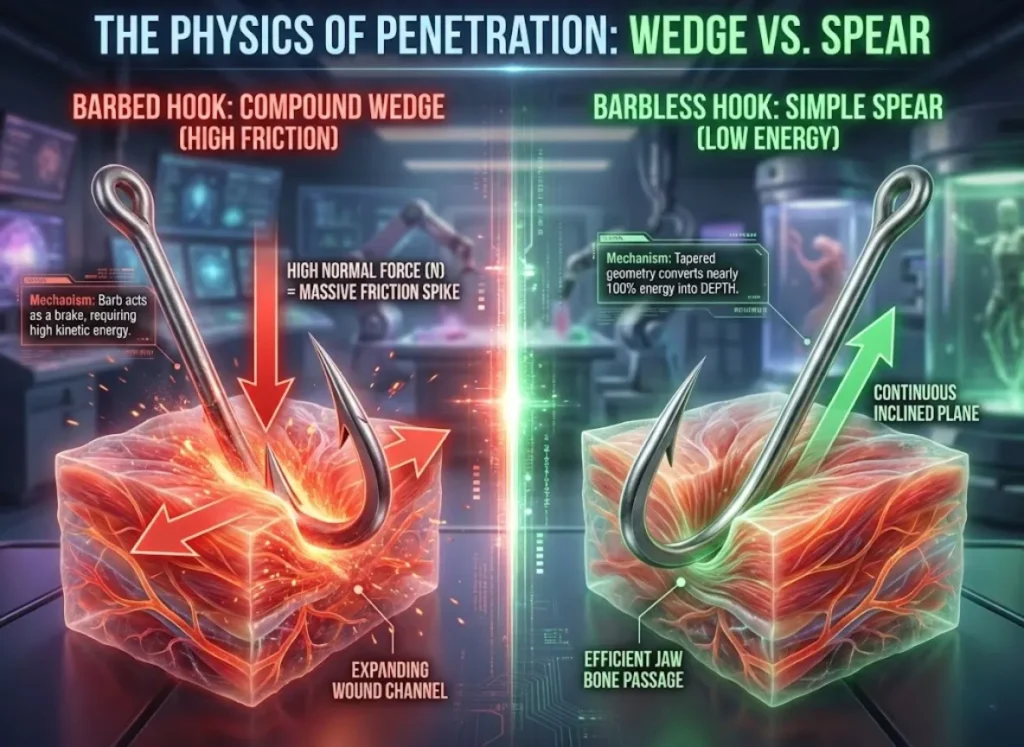
In contrast, the barbless hook functions as a simple spear. It presents a single, continuous inclined plane with a gradually tapering geometry. This allows for “Low Energy Penetration.” The point can pass through hard structures like the jaw bone or maxillary plate with minimal input force from the rod.
Without that friction spike, the hook travels until it hits the bend. This converts nearly 100% of your strike energy into depth rather than wasting it on widening the entry hole. This aligns with research on puncture mechanics of soft tissue, which validates the lower force thresholds required to penetrate skin and cartilage when the wedge profile is removed.
Pro-Tip: Because barbless hooks penetrate with so little resistance, you must avoid the “trout set” reflex. A gentle lift is often all that is needed. Violent hook sets with barbless points can actually blow the hook right through the tissue, creating a large exit wound.
Once you understand the physics, you can better visualize the mechanics of the hookset and why lighter movements become effective.
Why does wire diameter dictate the energy required for a hook set?
Sharpness is often the only metric anglers worry about, but diameter is the silent killer of penetration. Resistance follows the square of the wire diameter rule, meaning the force required to enter a solid medium increases disproportionately as the gauge thickens.
A standard size #12 hook has a cross-sectional area significantly larger than a 1x fine wire equivalent. This leads to a massive increase in the force required to drive it home. Barbless hooks often utilize finer wire gauges because they do not need the structural bulk to support a cut-in barb—a projection that weakens the shaft.
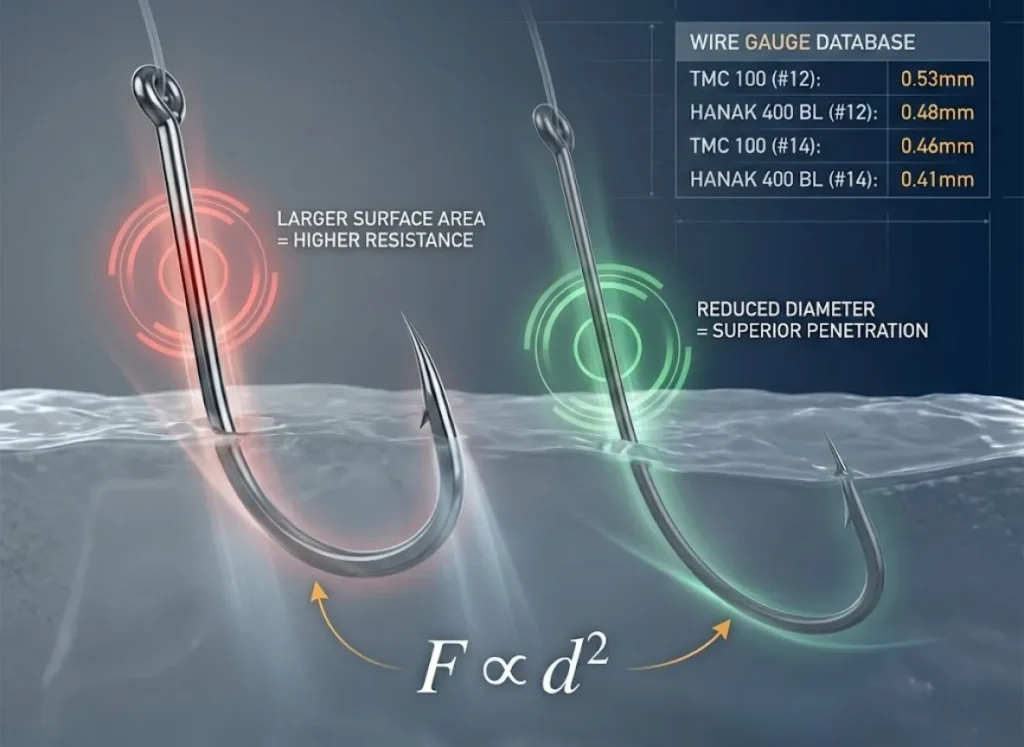
This reduction in surface area allows you to use lighter rods and finer tippets without risking breakage during the set. High-end competition hooks optimize this by combining fine wire with long needle points, elongating the taper to further reduce the angle of attack.
Data from cardboard penetration tests suggests that a 10% reduction in wire diameter can result in a penetration efficiency gain of over 20%. This confirms that sizing down is a mechanical advantage, a concept supported by studies on the physical and mechanical properties of fishing hooks.
If you are confused about how manufacturers label these gauges, our guide to the science of fishing hook sizes breaks down the lack of standardization across brands like Mustad USA and others.
Does scientific data support the switch to barbless for conservation?
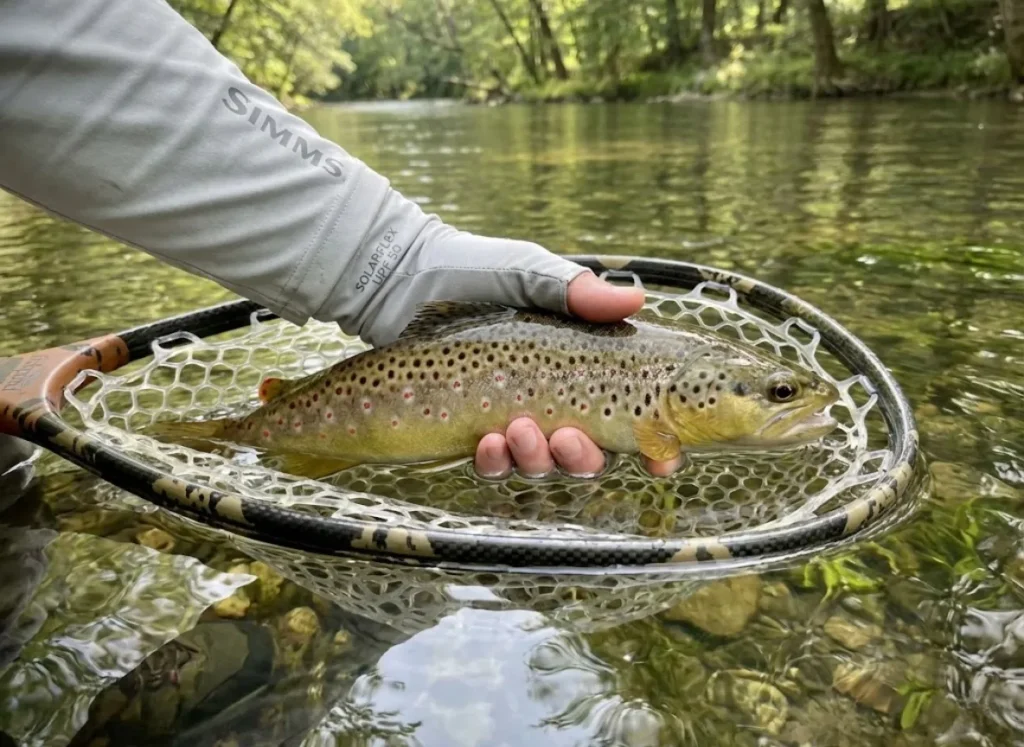
Anglers often debate mortality rates emotionally. However, we need to look at the “Conservation Cost” using hard data rather than anecdotes. The results might surprise you.
What does the data reveal about mortality rates versus handling time?
There is a pervasive myth that barbless hooks dramatically save lives solely by their shape. However, meta-analysis of hooking mortality (referencing work similar to researchers like Steven J. Cooke) indicates that direct death rates differ negligibly between barbed (4.5%) and barbless (4.2%) hooks. If a fish is hooked in the carotid artery or heart, the barb is rarely the deciding factor.
The true value lies in morbidity reduction—specifically, mean unhooking time.
Prolonged air exposure leads to gill collapse and physiological stress. Barbless hooks allow for removal in seconds, often without touching the fish or removing it from the water using hemostats or forceps. Shorter handling times correlate directly with faster physiological recovery and reduced post-release mortality.

The biological advantage is operational. It minimizes the “Time Tax” on the fish’s biology. Implementing data-backed catch and release techniques centers on this speed, aligning with catch and release ethics promoted by groups like Trout Unlimited.
How does wound histology differ between puncture and laceration?
The type of wound dictates how the fish heals. A barbless hook creates a clean “Puncture Wound.” Tissue fibers are separated radially and elastically displaced. Upon removal, the elastic nature of the mouth tissue allows the puncture channel to collapse back on itself.
This “self-sealing” mechanism minimizes the wound diameter exposed to waterborne pathogens.
Conversely, a barbed hook creates a “Laceration” during removal. The barb acts as a reverse-facing blade that tears tissue, creating a jagged, irregular wound channel. These do not seal cleanly, increasing infection risk.
This difference is critical for minimizing tissue trauma. Techniques to reduce catch-and-release mortality emphasize avoiding this damage. Using tools specifically designed for minimizing tissue trauma, like the Ketchum Release or sturdy pliers, further aids in leaving a clean exit wound.
How does the lack of a mechanical lock change angling technique?
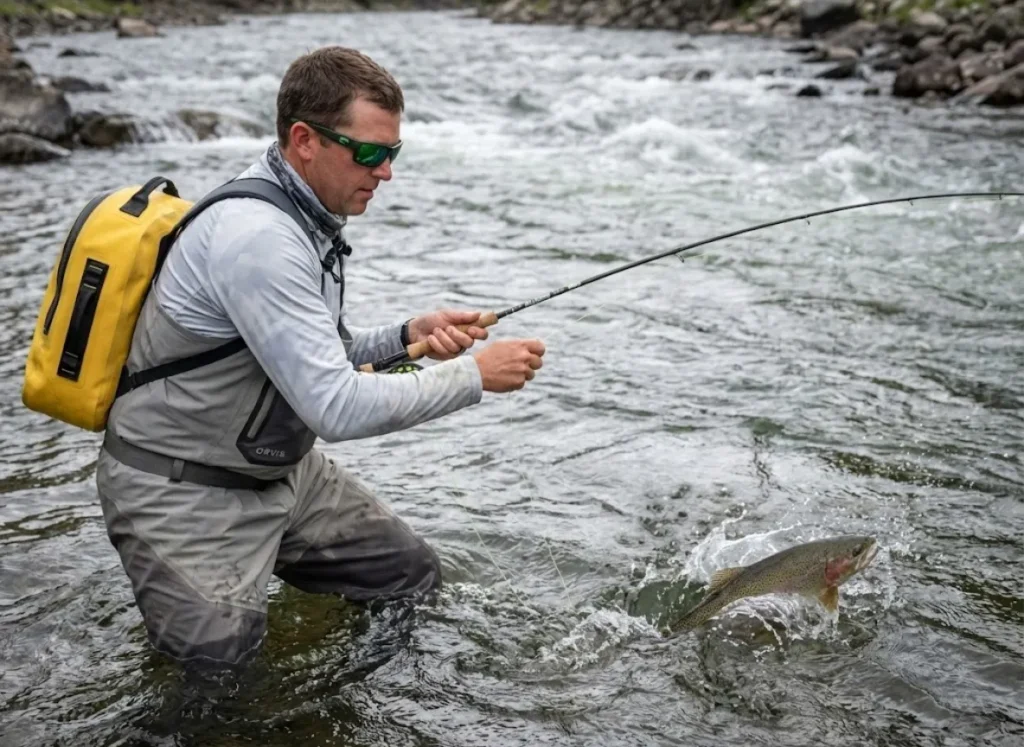
You have removed the mechanical lock. Now, you must replace it with skill. This brings us to the Stiletto Effect, the primary reason novice anglers lose fish on barbless tackle.
What is the “Stiletto Effect” and why does it cause fish loss?
The Stiletto Effect is a mechanical phenomenon where a barbless hook slides back and forth within the wound channel during periods of variable tension. It acts like a sewing machine needle.
If the line goes slack during a head shake, the hook may back out partially. When tension is reapplied, it penetrates at a new angle. This rapid reciprocation can create multiple exit wounds or enlarge the original hole until the hook simply falls out, a process known as unbuttoning mechanics.
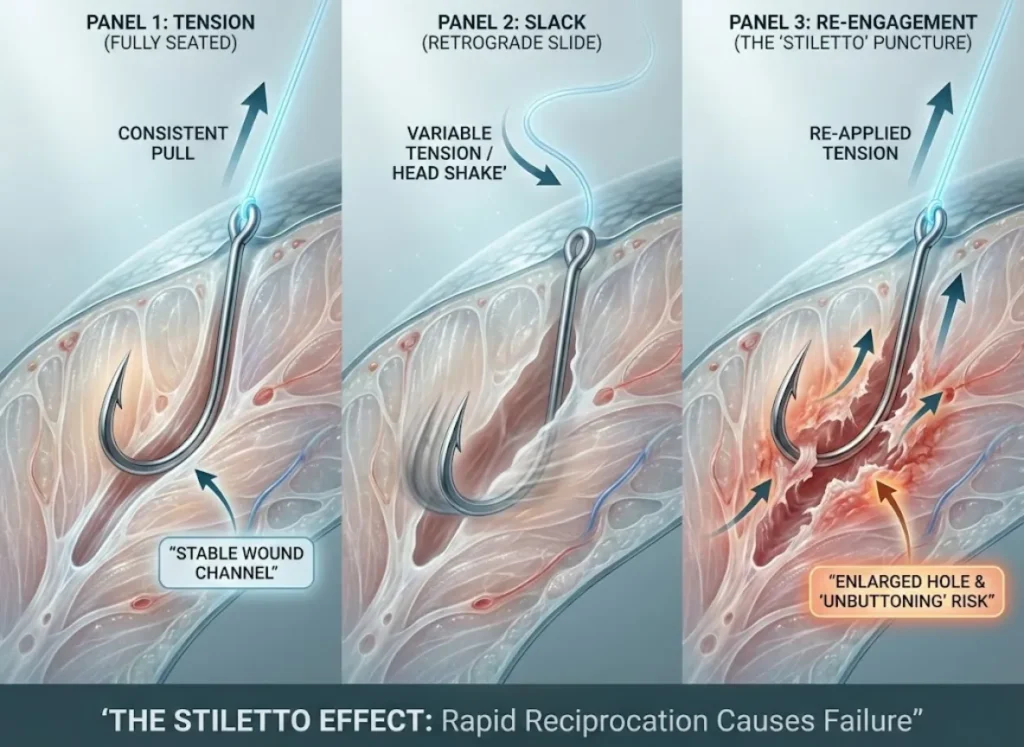
This explains why some claim unpredictable fish—barbless hooks are a bad mix. It is not a failure of the hook point, but a failure of retention stability. Studies on the performance of barbed and barbless hooks document the trade-off: faster unhooking comes with a potential landing deficit if consistent tension is ignored. Proper reel drag systems and tension management are your primary defense against this slide.
How must rod selection and fighting angles adapt to maintain tension?
To prevent the Stiletto Effect, “Zero Slack Tolerance” is mandatory. Your system must remain loaded at all times to keep the hook seated against the bend, maintaining tight lines.
You should favor rods with softer tips or “moderate” actions. These act as shock absorbers, maintaining a deep rod bend even when the fish changes direction toward you. Stiff, fast-action rods often recover too quickly, creating momentary slack line risk that dislodges the point.
Pro-Tip: Fight the fish with the rod low and to the side. “Side Pressure” leverages the hook shank across the corner of the mouth, mechanically locking it in place. A high, vertical rod position often pulls the hook straight up and out of the mouth’s roof.
Following catch and release best practices also means fighting decisively. The longer the fight, the higher the probability of a slack event. For this style of fighting, understanding rod power versus action is essential to choosing the right gear.
Which specific hook geometries maximize holding power without a barb?
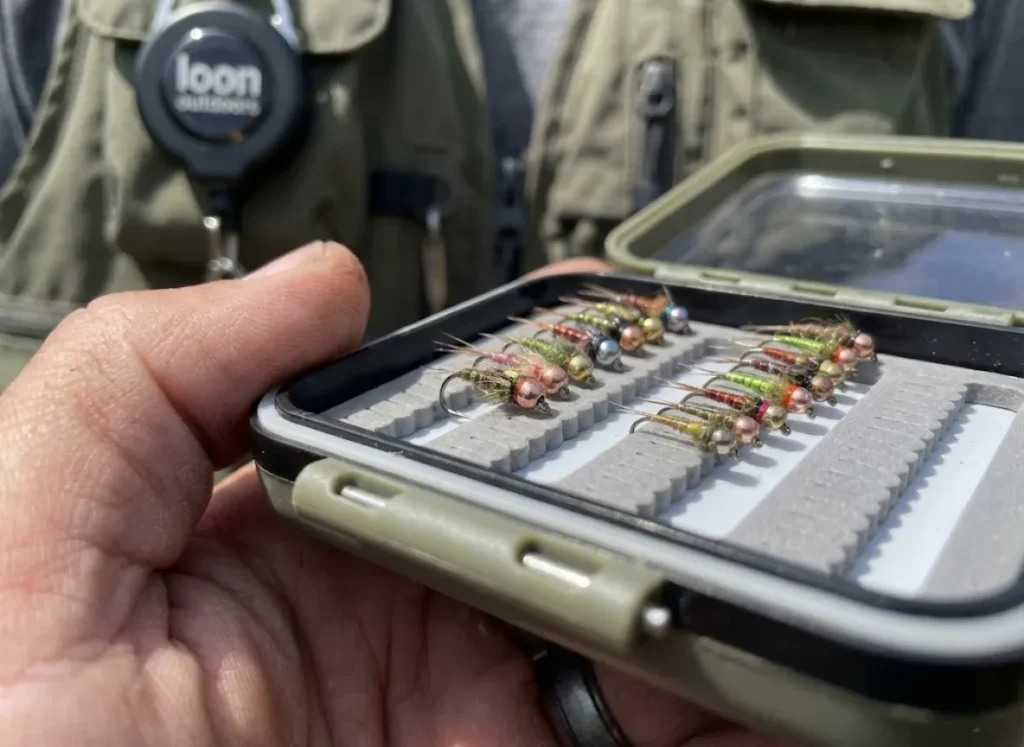
Not all barbless hooks are created equal. There is a vast difference between true engineering and simple modification using a grinding wheel.
How do “Manufactured Barbless” points compare to “Pinched Barbs”?
Many anglers start by crushing the barbs on standard hooks using needle-nose pliers. While better than nothing, pinched barbs often retain a structural “bump” or deformity on the wire profile. This bump acts as a friction point that impedes smooth penetration.
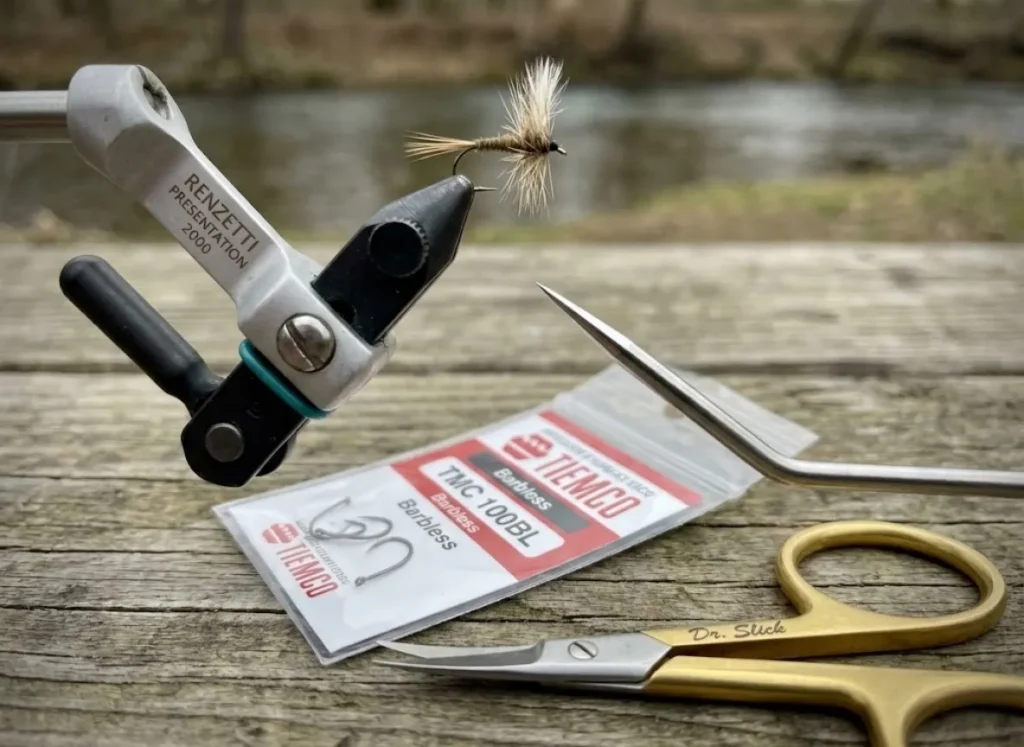
Manufactured barbless hooks, like Hanak jig hooks, Umpqua U-series, or Tiemco models, are designed from the wire up with elongated, spear-like points. These designs feature a gradual, continuous taper that maximizes mechanical advantage and often utilize chemical sharpening.
Comparing specific Tiemco hook specifications reveals that purpose-built hooks often have distinct wire profiles compared to their barbed counterparts. Understanding the strategic breakdown of terminal tackle helps in selecting the right geometry for the job.
Why are Jig Hooks and Upturned Points superior for retention?
Jig hooks with a 60-degree angled eye alter the mechanics entirely. When weighted, they ride “point up.” This orientation targets the hard, cartilaginous upper lip or snout of the fish.
While hard tissue is difficult for a traditional barbed hook to penetrate, the “Barbless Spear” penetrates it easily. Once embedded in bone or dense cartilage, the hook is structurally secure. It does not rely on soft tissue friction, making it nearly impossible for the hook to tear out or back out.
Current barbless circle hooks research supports the concept that specific point geometries, like upturned points or downturned eyes, improve retention. This is why selecting optimal jighead geometries is standard practice in competitive angling circles.
Conclusion
Switching to barbless hooks isn’t just about being a ‘nice’ fisherman; it’s about making your gear work better. Without a barb acting like a speed bump, the hook slides in much deeper and with way less effort. This allows you to use those delicate, thin-wire hooks that catch more fish but usually struggle to set. It also gets the fish back in the water faster, so they survive. Plus, because a barbless hook can slip out more easily, it forces you to keep constant tension, which ultimately makes you a sharper, more skilled angler.
Physics wins. Time saves. Tension is king.
Ready to refine your tackle? Browse our deep-dive reviews of high-performance manufactured barbless hooks to find the perfect hook gauge for your next outing.
FAQ – Frequently Asked Questions
Do barbless hooks penetrate deeper than barbed hooks?
Yes. Due to the lack of a secondary wedge (the barb), barbless hooks encounter significantly less penetration resistance. They penetrate deeper with less rod force because the continuous taper converts strike energy into depth rather than widening the wound channel.
Do you lose more fish with barbless hooks?
Statistically, landing rates can drop by roughly 20% for unskilled anglers. However, this gap narrows to near-zero for experienced anglers who maintain proper line tension. The loss is usually due to slack line allowing the hook to back out, not the hook failing to hold.
What is the Stiletto Effect in fishing?
The Stiletto Effect occurs when a barbless hook slides in and out of the wound channel during slack line risk events. This rapid reciprocation acts like a sewing machine needle, potentially enlarging the hole or causing the hook to fall out.
Are pinched barbs the same as manufactured barbless hooks?
No. Pinched barbs often leave a structural bump on the wire that increases penetration resistance. Manufactured barbless hooks feature longer, finer conical point designs specifically for deep, low-force penetration.
Risk Disclaimer: Fishing, boating, and all related outdoor activities involve inherent risks that
can lead to injury. The information provided on Master Fishing Mag is for educational and informational purposes
only. While we strive for accuracy, the information, techniques, and advice on gear and safety are not a substitute
for your own best judgment, local knowledge, and adherence to official regulations. Fishing regulations, including
seasons, size limits, and species restrictions, change frequently and vary by location. Always consult the latest
official regulations from your local fish and wildlife agency before heading out. Proper handling of hooks, knives,
and other sharp equipment is essential for safety. Furthermore, be aware of local fish consumption advisories. By
using this website, you agree that you are solely responsible for your own safety and for complying with all
applicable laws. Any reliance you place on our content is strictly at your own risk. Master Fishing Mag and its
authors will not be held liable for any injury, damage, or loss sustained in connection with the use of the
information herein.
Affiliate Disclosure: We are a participant in the Amazon Services LLC Associates Program, an
affiliate advertising program designed to provide a means for us to earn advertising fees by advertising and linking
to Amazon.com. As an Amazon Associate, we earn from qualifying purchases. We also participate in other affiliate
programs and may receive a commission on products purchased through our links, at no extra cost to you. Additional
terms are found in the terms of service.