

In this article
You are staring at a slack line, waiting for a sign. Suddenly, you feel a distinct “suction tick” travel up the graphite rod into your palm. You reel down and swing, but the hook comes back empty.
You assume the fish short-struck or “nipped” at the tail. The truth is much more frustrating. That “tick” you felt was a ghost.
By the time that subtle vibration traveled through the water, up your line, and down the rod blank to your nervous system, the feeding event that caused it was already ancient history in biological time. A largemouth bass (Micropterus salmoides) does not bite in the way a dog snaps a bone. Unlike ram feeding predators (like pike) that overtake prey, bass operate a high-velocity vacuum pump that generates explosive negative pressure.
It inhales water and prey faster than the human eye can process a blink.
As someone who has spent decades studying both the water and the fish physiology beneath it, I’ve learned that catching big bass isn’t about faster reflexes. It is about understanding the invisible kinematics of the strike. In this guide, we will break down the 30-40 milliseconds window of a bass strike, the role of lure density in your selection, and how to engineer your tackle to bridge the gap between human reaction time and biological speed.
What Actually Happens When a Bass Strikes?
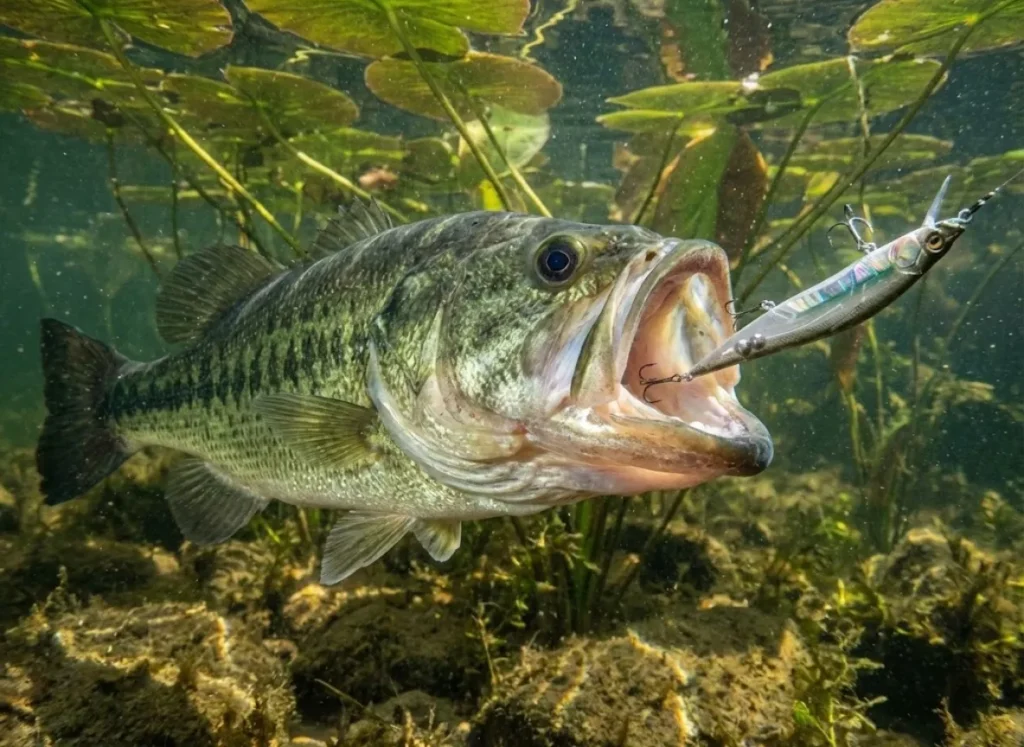
To catch the fish, you must first dismantle the semantic error of “biting.” Bass rarely clamp down on a moving target with their jaws. Instead, bony fishes—specifically aquatic suction feeders—rely on a violent, biomechanical event known as suction feeding.
How does the bass mouth generate a vacuum?
The strike begins with a rapid, coordinated expansion of the buccal cavity (the mouth) and the opercular cavity (the gills). The hyoid bone drops, and the premaxilla shoots forward, increasing the internal mouth cavity volume exponentially in a fraction of a second.
According to Boyle’s Law, this sudden increase in volume creates a massive drop in pressure inside the mouth. This forms a steep negative pressure gradient relative to the surrounding lake water. The high-pressure ambient water rushes violently into the low-pressure zone, creating a “central jet” of fluid traveling at speeds up to 3 meters per second.
Your lure is not grabbed. It is entrained in this rush of fluid and dragged into the mouth by the density of the water itself.
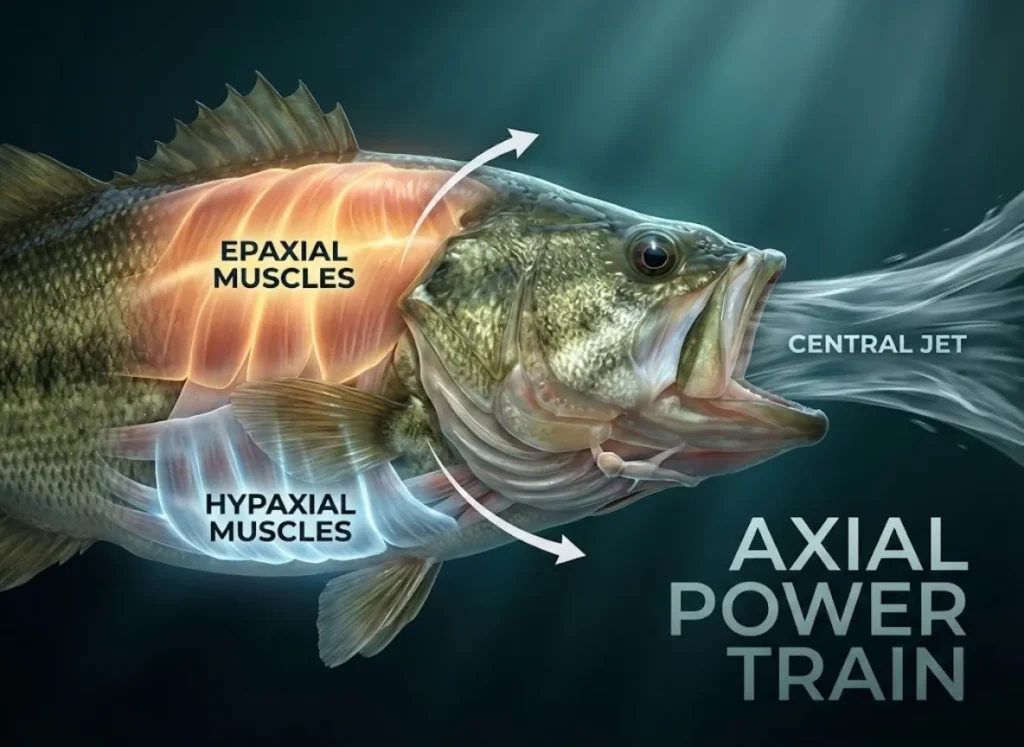
Most anglers assume the small cranial muscles do the work. However, the power capacity for this explosive mouth expansion actually comes from the massive axial swimming muscles—the fillets. A study by the Proceedings of the National Academy of Sciences (PNAS)—specifically the Camp et al. study involving researchers from Brown University—confirmed that axial brawn powers suction feeding in largemouth bass.
The epaxial muscles along the spine pull the skull upward, while the hypaxial muscles on the belly pull the hyoid apparatus down. This musculoskeletal movement generates nearly 15 watts of power to drive the suction. When you feel a strike, you aren’t just feeling a jaw hinge; you are feeling the fish throw its entire body open.
Understanding these definitive Largemouth Bass facts is crucial. It reveals why even small bass can nearly rip the rod from your hand—you are fighting the fish’s core strength.
Why Do You Miss Fish You Feel Strike?
Once you understand the sheer power generating this vacuum-suction force, the next variable to contend with is the terrifying strike speed at which it operates. Comparative physiology proves that our reflexes are often biologically insufficient for detecting this ultrafast feeding in real-time.
Is human reaction time fast enough for suction feeding?
The entire suction feeding event—from the moment the mouth begins to open, to peak gape size, and finally to closure—occurs within a window of 30 to 50 milliseconds. It is a blur of motion that happens faster than a camera shutter.
In contrast, data from the Harvard University BioNumbers database indicates that the fastest human visual reaction time is approximately 250 milliseconds. Tactile (touch) reaction time hovers around 155 milliseconds.
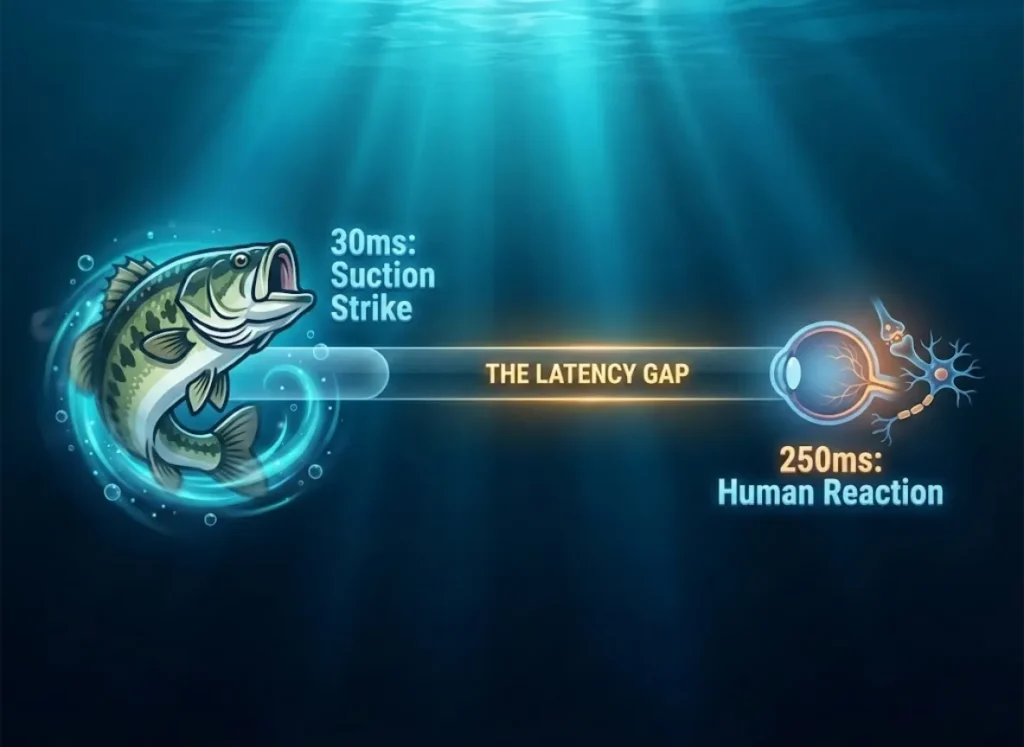
This creates a 200ms delay—a massive “latency gap.” By the time your brain processes the signal, the fish has already completed the strike. Mathematically, it is impossible to set the hook during the intake.
When you set the hook, you are engaging the retention phase. You are essentially fishing the past, hoping the fish hasn’t rejected the lure yet.
The “spit” reflex anglers often blame is actually a gustatory rejection. The bass detects the artificial texture of plastic or metal and reverses the pump to eject the lure. Because of the hookset lag, your success relies on extending that retention time through salt-impregnated soft plastic (texture) and scent.
Since “feeling the bite” means you are already late, you must master the mechanics for setting the hook to capitalize on those fleeting milliseconds of retention.
Pro-Tip: If you are missing fast strikes, don’t try to be faster. Instead, use a softer rod tip. A moderate action rod allows the fish to hold the lure slightly longer without feeling the resistance of the rod backbone, buying you precious time to react.
How Does Lure Weight Affect Suction Mechanics?
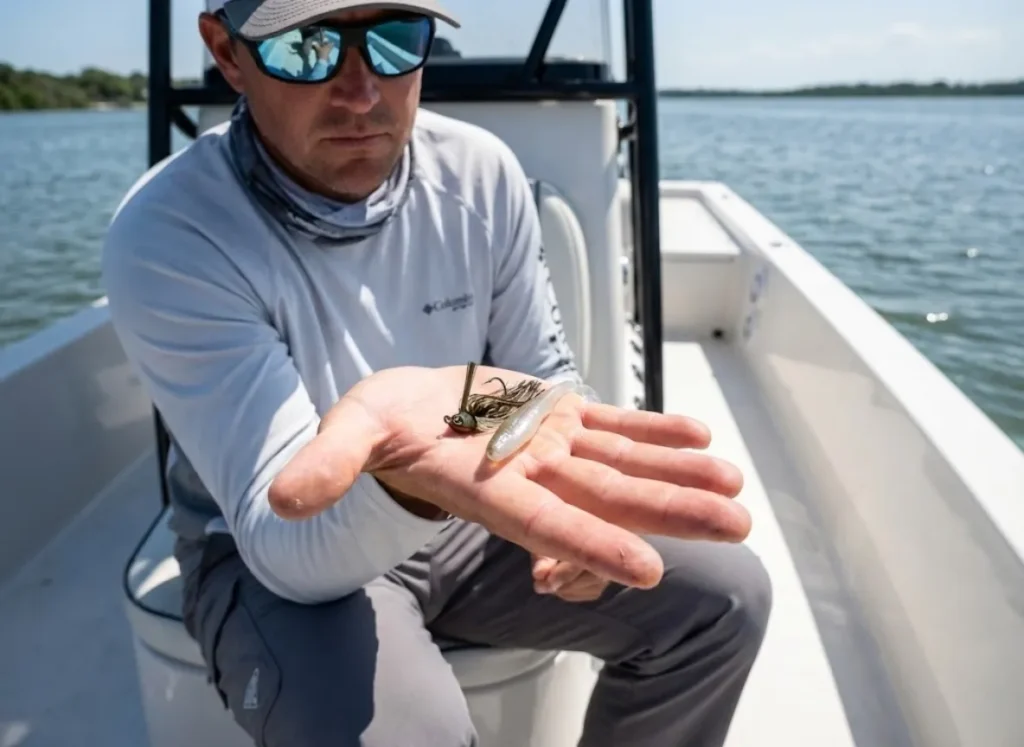
If the bass functions as a vacuum, the object it is trying to inhale matters immensely. This brings us to the hydrodynamic relationship between specific gravity (lure density) and the vacuum force required to move it.
Why do heavy lures cause short strikes?
Suction feeding fishes rely on fluid entrainment. The lure must flow with the water into the mouth. Lures with high Specific Gravity (SG), such as a tungsten jig or heavy flipping weights, possess significant inertia. They resist rapid acceleration.
According to Newton’s Second Law ($F=ma$), the bass must generate massive force to accelerate a heavy jig from 0 to 3 meters per second in just 15 milliseconds.
If the bass calibrates its suction force for a lightweight crayfish but encounters a heavy tungsten weight, the vacuum will be insufficient. The water rushes in, but the heavy lure lags behind. This results in a short strike where the bass gets the trailer but misses the hook.
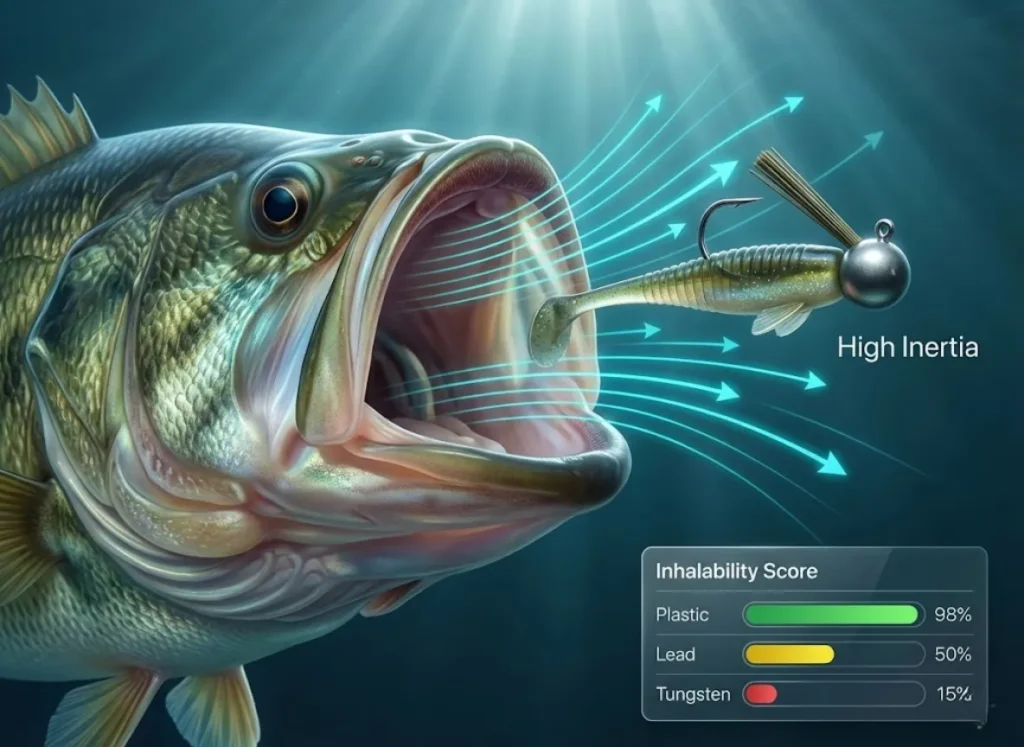
This inertial mismatch is the primary cause of missed fish on heavy bass fishing tactics. Research in the Journal of Experimental Biology confirms that sensing the strike of a predator fish depends on the specific gravity of the prey fish.
In cold water, bass generate less power with their axial swimming muscles, making heavy lures even harder to inhale. Tactical adjustments involve “downsizing” weight not just for stealth, but to increase “inhalability.” A lighter lure flows easier. Consulting a modern guide to fishing weights can help you select a density that matches the fish’s energy level, rather than just the depth of the water.
How Can You Engineer Your Gear to Feel the Vacuum?
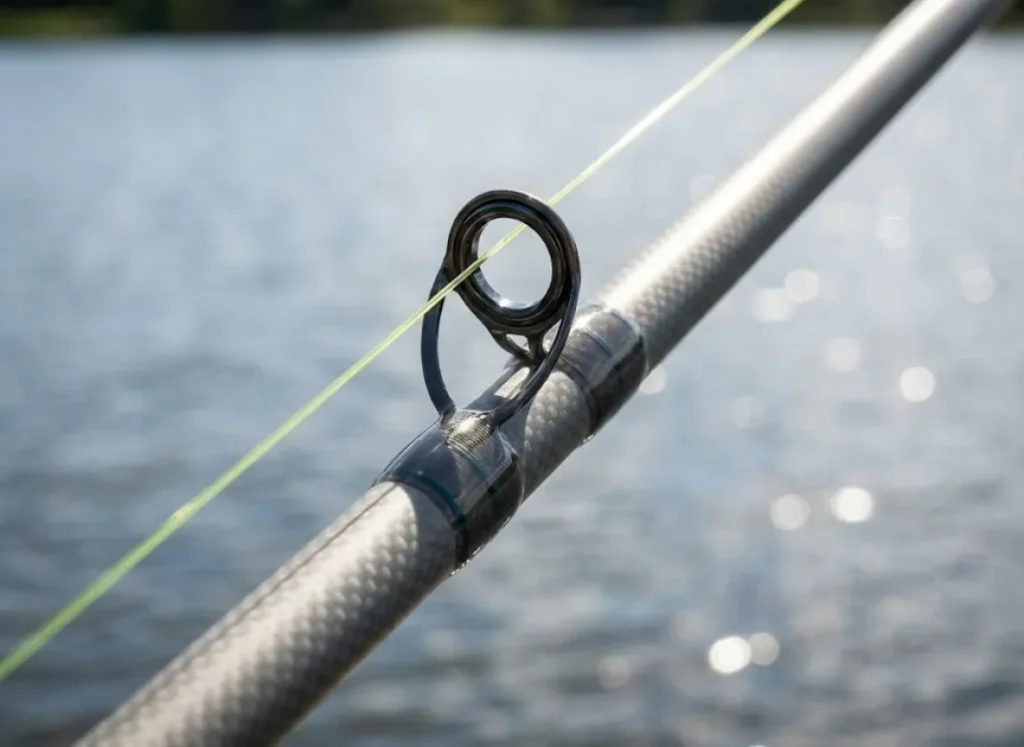
Once the lure is successfully inhaled, the challenge shifts to transmitting that information back to your hand. We can use a material science framework to select line and high-sensitivity rods that minimize signal damping.
Does fishing line type change vibration transmission?
Your fishing line acts as the conductor for the mechanical vibration of the suction feed; its material properties determine signal fidelity. Monofilament (Nylon) has high elasticity. It acts as a shock absorber that dampens the high-frequency “tick” of the vacuum collapse, often masking the bite entirely.
Braided line (PE) has near-zero stretch, offering the highest vibration transmission efficiency. However, its low density causes it to float. This creates a “bow” or slack curve in the wind. A slack curve kills vibration transfer. Even the most sensitive braid fails if the line is not tight.
Fluorocarbon stands apart due to its high specific gravity (~1.78). It sinks, creating a straighter, tighter connection between the rod tip and the lure. This straight trajectory minimizes the “catenary curve,” allowing for better tactile transmission and slack line sensitivity.
Pro-Tip: Watch your line where it enters the water. A bass can inhale a lure and swim toward you without transmitting any vibration to the rod. The only sign will be a sudden “jump” or slackening of the line.
The “Slack Line Paradox” dictates that you need enough slack to allow the bass to inhale the lure without resistance, but enough tension to transmit the signal. Research published in The Journal of Experimental Biology details the opercular mouth-opening mechanism, highlighting the minute forces we are trying to detect. For a deeper understanding of which material suits your style, review our breakdown of braid vs fluorocarbon vs monofilament.
What Happens After the Suction?
When the signal finally reaches you, and the hook is set, you are often engaging a specific anatomical structure deep in the fish’s throat.
What is the “heavy” sensation on the line?
Often, you won’t feel a sharp “tick.” Instead, you will feel a sudden “heaviness” or “mushy” sensation. This indicates the suction occurs successfully, and the bass has passed the prey to the pharyngeal teeth crushers located in the throat.
These “crushers” are far more powerful than the sandpaper teeth on the lips. They utilize significant bite force to manipulate prey exoskeletons of crayfish or scales of bluegill sunfish before swallowing. The “heavy” feel is the friction of these powerful throat muscles clamping down on your soft plastic lure.
The National Institutes of Health (PubMed) hosts studies on the functional significance of these jaws, noting the co-localization of taste buds and teeth. Because the bait is being crushed into a ball, the hook point is often buried in plastic or pressed against hard crushing pads.
A “heavy” bite requires a hook-set timing that is immediate and forceful. You must drive the hook point through the ball of plastic and into the tough pharyngeal tissue. However, this is also where the science of catch and release becomes vital. Deep hooking is a higher risk when the fish has engaged the pharyngeal jaws, requiring careful removal tools and techniques to ensure the fish survives.
The Final Takeaway
To master the strike, we must respect the biology of the opponent. The bass strike is a 30-millisecond vacuum-suction force powered by the fish’s core swimming muscles, occurring far faster than your ability to blink.
Success relies on “inhalability”—matching the specific gravity of your lure to the fish’s energy level to ensure it enters the mouth. Remember, you are always reacting to the “retention phase,” not the strike itself. The “heavy” feel is the pharyngeal crushers at work, signaling that the fish has fully committed.
Next time you rig up, choose your line and lure weights not just for the depth, but for the physics of the inhale.
FAQ – Frequently Asked Questions
Do bass bite or suck their food?
Bass primarily use suction feeding. They rapidly expand their mouth cavity and gills to create a vacuum that pulls prey fish in. They rarely bite in the mechanical sense unless they are pinning stationary prey against a surface or the bottom.
Why do I miss fish that I feel tap the lure?
The tap is often the sound of the vacuum collapsing or the bass spitting the lure out. Because human reaction time (~200ms) is slower than the strike (~30ms), you are likely reacting after the fish has already rejected the bait.
Does fluorocarbon line help you feel bites better?
Yes, because fluorocarbon is denser than water (sinks), creating a straighter line path between the rod and lure. This direct connection transmits vibration better than monofilament or floating braid that often has a slack bow in it.
What are the teeth in the back of a bass’s throat?
These are called pharyngeal teeth crushers. They are a second set of jaws used to crush hard prey like crayfish or shad and position food for swallowing. When these engage your lure, it creates the heavy sensation you feel on the line.
Risk Disclaimer: Fishing, boating, and all related outdoor activities involve inherent risks that
can lead to injury. The information provided on Master Fishing Mag is for educational and informational purposes
only. While we strive for accuracy, the information, techniques, and advice on gear and safety are not a substitute
for your own best judgment, local knowledge, and adherence to official regulations. Fishing regulations, including
seasons, size limits, and species restrictions, change frequently and vary by location. Always consult the latest
official regulations from your local fish and wildlife agency before heading out. Proper handling of hooks, knives,
and other sharp equipment is essential for safety. Furthermore, be aware of local fish consumption advisories. By
using this website, you agree that you are solely responsible for your own safety and for complying with all
applicable laws. Any reliance you place on our content is strictly at your own risk. Master Fishing Mag and its
authors will not be held liable for any injury, damage, or loss sustained in connection with the use of the
information herein.
Affiliate Disclosure: We are a participant in the Amazon Services LLC Associates Program, an
affiliate advertising program designed to provide a means for us to earn advertising fees by advertising and linking
to Amazon.com. As an Amazon Associate, we earn from qualifying purchases. We also participate in other affiliate
programs and may receive a commission on products purchased through our links, at no extra cost to you. Additional
terms are found in the terms of service.