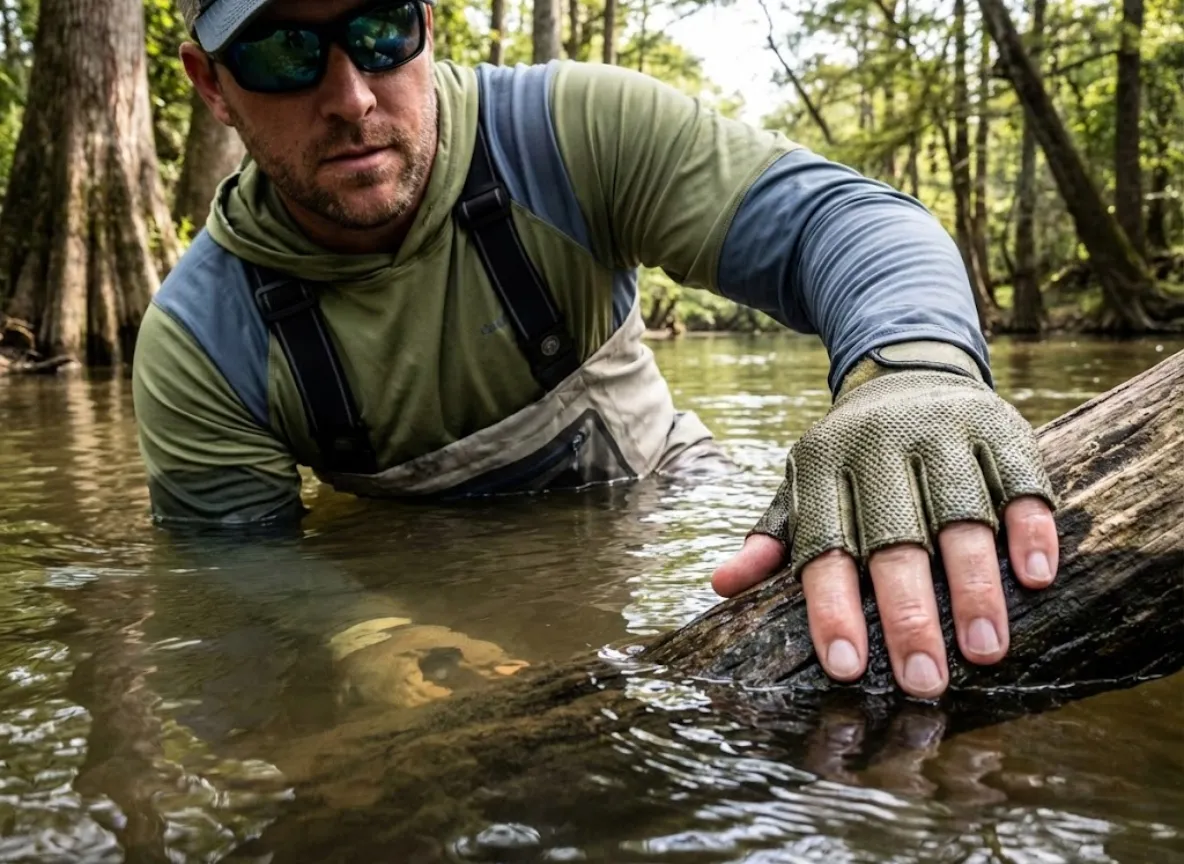
You are shoulder-deep in muddy water, your hand guiding itself into a hollow log you cannot see. The strike, when it comes, is not a polite tug; it is a violent, rotary collision with sixty pounds of muscle and serrated bone. In the specific discipline of extreme fishing, a standard casting glove is not gear—it is a liability. Hand fishing places you in direct combat with biological hazards, and the only barrier between your skin and a deep-tissue infection is the engineering of your glove.
I have spent decades wading through murky river systems, learning the hard way that not all armor is created equal. Through trial, error, and plenty of antiseptic, I’ve moved from relying on luck to relying on physics. This hybrid safety guide strips away the marketing noise to focus on what actually keeps your fingers intact: biomechanical personal protective equipment (PPE) designed to withstand the crushing, thrashing reality of the grab.
Pro-Tip: Always rinse your gloves with a diluted bleach solution immediately after a trip. Catfish slime carries bacteria that can turn a minor scratch into a major infection if left to incubate in damp fabric.
How to Choose the Right Noodling Protection
Selecting the right gear isn’t about finding the most expensive brand; it’s about understanding the specific mechanical threats waiting in the dark. Whether you are targeting Flathead Catfish or giant Blue Catfish, we need to move beyond general “safety ratings” and look at how materials perform when subjected to aquatic stress and biological violence.
Why “Cut Resistance” Won’t Save You From a Spine
Standard industrial safety ratings fail here because a catfish spine functions as a calcified needle—a puncture hazard—not a blade. This is the core debate of puncture proof vs cut resistant materials. While Level 5 cut resistance (often found in Dyneema or Kevlar weaves) is fantastic at stopping a slicing motion, the fibers will simply separate when hit by a needle point, allowing deep penetration. True protection requires plating, such as SuperFabric, or tight-weave epoxy guards that deflect the tip rather than catching it.
This distinction is critical because, as noted in medical studies on recreational fishing injuries, puncture wounds from spines are primary vectors for serious infection. Once you understand that a spine acts like a hypodermic needle, the need for specialized materials becomes non-negotiable. You can see this biological weapon in detail in our guide to channel catfish facts, which breaks down the anatomy that renders standard gloves useless.
Grip Chemistry: Combating the “Death Roll”
A glove that stops a spine is useless if it becomes too slick to hold the fish that delivered it. The “death roll” is the catfish’s primary defense, a rotational frenzy designed to rip free from your grasp. Leather is a poor choice here; it is hydrophilic, meaning it absorbs water, becomes heavy, and eventually rots. More importantly, wet leather loses friction against channel catfish slime.
You need a hydrophobic coating—like latex dipped options or sandy nitrile—that channels fluid away from the contact point to create a mechanical lock. This requirement for specialized chemical coatings makes noodling gear distinct; unlike standard fishing gloves designed for sun and cold, your gear must act as a sacrificial layer against “river rash” caused by the sandpaper-like rasp pads of the fish’s mouth. According to recent ANSI/ISEA hand protection standards, understanding abrasion resistance and grip ratings is just as vital as impact protection.
Our Selection Process: How We Built This Guide
We do not rely on “feel” alone; we analyze the physics of materials under aquatic stress to build absolute trust. Every glove in this guide was scored against six specific criteria, including Puncture Resistance (ANSI ratings), Wet Grip Efficacy, and “Anti-Deglove” security.
We cross-referenced manufacturer specifications with verified YouTube video reviews and reports from the noodling community to identify gear that survives actual river conditions. We looked beyond generic best of lists to perform a true investigation of material capabilities. While we may earn a commission from the links below, our safety recommendations are based on torture tests and data, not payouts.
The Best Noodling Gloves of 2026: Our Top Recommendations for Every Need
Our Top Picks for The Armored Trophy Hunter (“The Heavy”)
Lindy Fish Handling Glove
$$$$
Widely recognized as the “Gold Standard” for puncture protection, the Lindy glove utilizes proprietary SuperFabric® armor plates to deflect spines and hooks. It is designed for the angler who refuses to compromise on safety, offering significantly higher puncture resistance than standard fishing gloves. The gauntlet style and Velcro wrist strap provide excellent retention during a death roll, ensuring the glove stays put when it matters most. However, this level of armor comes at a cost: the material is notably stiff, significantly reducing tactile sensitivity and making fine motor tasks like knot tying difficult until broken in.
A secret weapon borrowed from the industrial safety sector, the 9014 is engineered to stop hypodermic needles, making it incredibly effective against catfish spines. It combines medical-grade puncture defense with a wrinkle rubber palm that offers superior wet grip compared to rigid armor plates. The multiple layers of SuperFabric provide a dense shield against deep tissue injury without the bulk of a full gauntlet. The primary drawback is the sizing; the multi-layer construction makes them run tight, and the extreme stiffness in the palm can cause hand fatigue during long sessions of grappling.
Bridging the gap between industrial safety and outdoor utility, the ThornArmor is designed to stop landscaping thorns, mechanically mimicking the defense needed against spines. It features a robust Airprene cuff and wrap-around plating, offering better retention and coverage than standard knit gloves. This glove excels in environments where you might be grabbing onto submerged roots or brush while searching for a hole. Be aware, however, that the breathable back-of-hand mesh—while great for comfort—offers zero puncture resistance, leaving your knuckles vulnerable if you reach blindly into a jagged structure.
Our Top Picks for The Tactical Finesse Noodler (“The Feeler”)
Berkley Coated Fishing Gloves
$$$$
A staple for the finesse noodler, this glove prioritizes grip above all else. Its textured composite coating is chemically engineered to lock onto catfish slime, allowing you to control slippery fish with minimal grip strength. The flexibility allows for decent feedback, letting you differentiate between a rock and a jaw before you commit. The trade-off is stark: it offers virtually zero puncture defense. If you take a direct hit from a spine or a large hook, the material will fail instantly, making this a choice for the confident, not the cautious.
Overall
Puncture Resistance
Abrasion Resistance
Wet Grip Efficacy
Tactile Sensitivity
Submerged Durability
ANSI RatingN/A (General Purpose)
Primary Armoring MaterialCotton/Polymer blend
Cuff ArchitectureKnit Wrist
Coating Texture ProfileTextured Coated Polymer
You Should Buy This If…
Your priority is maximum grip on slimy fish.
You want high tactile sensitivity to feel the bite.
You are looking for a budget-friendly option.
You Should Reconsider If…
You expect protection from spines (zero puncture defense).
You are sensitive to smells (cotton absorbs “fish funk”).
Featuring a thick crinkle latex coating, these gloves offer a more robust barrier than standard coated gloves while maintaining exceptional slime grip. A critical advantage for the deep-water noodler is their ability to float, preventing expensive gear loss during a chaotic wrestle or if you need to shed them quickly. The “crinkle” texture acts like a thousand tiny suction cups on slick skin. However, users with smaller hands often find the latex dip stiff and bulky, which can lead to hand fatigue and reduced dexterity during long days on the water.
Designed for the angler who demands 100% tactile feedback, the Fish Monkey Shorty leaves fingertips exposed for the ultimate sensitivity. This design allows you to feel the exact texture of a submerged log or the subtle brush of a fin, giving you a reaction time advantage that armored gloves kill. It also features superior sun protection and a quick-drying build. The danger, of course, is obvious: your most sensitive digits are completely naked. Reaching into a hole with exposed fingers is a calculated risk that invites cuts, bites, and snaps from snapping turtles.
Our Top Picks for The Budget-Conscious Weekend Warrior (“The DIYer”)
Gorilla Grip (Grease Monkey) Dip Gloves
$$$$
The ultimate “Hardware Store Special,” these gloves are extremely thin and feature a proprietary “Never Slip” coating that rivals expensive fishing gear. For the price of a coffee, you get incredible dexterity and a “second skin” fit that lets you manipulate tackle or feel the river bottom with ease. They are perfect for a one-off trip where you don’t want to ruin expensive gear. But make no mistake: these are disposable tools. They offer zero protection against spines, and the coating will begin to peel after just a few tough encounters with rocks or rasp pads.
Overall
Puncture Resistance
Abrasion Resistance
Wet Grip Efficacy
Tactile Sensitivity
Submerged Durability
ANSI RatingN/A
Primary Armoring MaterialNylon knit + Polymer dip
Cuff ArchitectureKnit
Coating Texture ProfileProprietary Polymer
You Should Buy This If…
You need a cheap, disposable option for a one-off trip.
You want a “second skin” fit with high grip.
You prioritize dexterity over durability.
You Should Reconsider If…
You expect them to last more than a weekend (coating peels).
Often mistaken for “proof” gloves, these are food-grade cut-resistant gloves ideal for protecting against slicing hazards like underwater glass or rusty rebar. They are fantastic for cleaning fish back at the dock or navigating urban waterways littered with debris. However, this recommendation comes with a severe safety warning: while they stop a knife slice, the loose weave offers zero resistance to a direct catfish spine puncture. A spine will separate the fibers and pass straight through to your skin, so never use these thinking you are wearing armor against the fish itself.
A garage staple that transitions well to the river, the FastFit utilizes synthetic leather that handles abrasion from rasping teeth better than simple knits. The elastic cuff allows for rapid removal, and the tactical fit is familiar to anyone who works with their hands. It serves as a solid middle-ground for protecting against general scrapes and “bass rash.” But be warned: synthetic leather absorbs water instantly. Once wet, these gloves become heavy, soggy, and lose significant grip strength, turning a tactical advantage into a slippery liability during a wrestle.
Overall
Puncture Resistance
Abrasion Resistance
Wet Grip Efficacy
Tactile Sensitivity
Submerged Durability
ANSI RatingLow (abrasion only)
Primary Armoring MaterialSynthetic Leather palm / TrekDry back
Cuff ArchitectureElastic
Coating Texture ProfileSynthetic Leather Texture
You Should Buy This If…
You want a glove you can use for mechanics work after the trip.
You prefer a tactical, form-fitting design.
You need moderate abrasion resistance against “river rash.”
You Should Reconsider If…
You hate gloves that get heavy when wet (absorbs water).
You need to stop a spine (fabric offers no armor).
Noodling forces a stark choice between protection and connection. The physics are simple: only plating like SuperFabric can reliably stop a catfish spine, while woven fabrics are limited to stopping slices. Friction is equally non-negotiable; when slime is involved, chemical coatings like latex and nitrile outperform leather every single time. And finally, fit is safety—a loose glove in a strong current is a drowning hazard waiting to happen. Don’t let a trip to the ER end your season early—invest in the armor that matches your ambition. For total safety, pair these with noodling sleeves or forearm guards to bridge the gap between glove and skin, completing your PPE for contact fishing.
FAQ – Frequently Asked Questions
Will cut-resistant gloves stop a catfish spine?
No. Cut resistance (ANSI A1-A9) measures protection against slicing blades; a catfish spine is a puncture hazard that will separate the weave and penetrate the skin. You need specific Puncture Resistance (like the HexArmor 9014) to stop spines.
Can I use standard leather work gloves for noodling?
It is not recommended. Leather is hydrophilic, meaning it absorbs water, becomes incredibly heavy, and loses almost all friction when coated in catfish slime.
How do I stop the death roll from tearing up my hands?
You need a glove with high Abrasion Resistance. The catfish’s rasping pads act like sandpaper; a glove with a dipped rubber or synthetic leather palm acts as a sacrificial layer to prevent river rash.
Why do I need a strap on my noodling gloves?
To prevent degloving. When a large fish spins, the torque can pull a loose glove off your hand, leaving you exposed or, worse, trapping the glove on an underwater snag.
Risk Disclaimer: Fishing, boating, and all related outdoor activities involve inherent risks that can lead to injury. The information provided on Master Fishing Mag is for educational and informational purposes only. While we strive for accuracy, the information, techniques, and advice on gear and safety are not a substitute for your own best judgment, local knowledge, and adherence to official regulations. Fishing regulations, including seasons, size limits, and species restrictions, change frequently and vary by location. Always consult the latest official regulations from your local fish and wildlife agency before heading out. Proper handling of hooks, knives, and other sharp equipment is essential for safety. Furthermore, be aware of local fish consumption advisories. By using this website, you agree that you are solely responsible for your own safety and for complying with all applicable laws. Any reliance you place on our content is strictly at your own risk. Master Fishing Mag and its authors will not be held liable for any injury, damage, or loss sustained in connection with the use of the information herein.
Affiliate Disclosure: We are a participant in the Amazon Services LLC Associates Program, an affiliate advertising program designed to provide a means for us to earn advertising fees by advertising and linking to Amazon.com. As an Amazon Associate, we earn from qualifying purchases. We also participate in other affiliate programs and may receive a commission on products purchased through our links, at no extra cost to you. Additional terms are found in the terms of service.