In this article
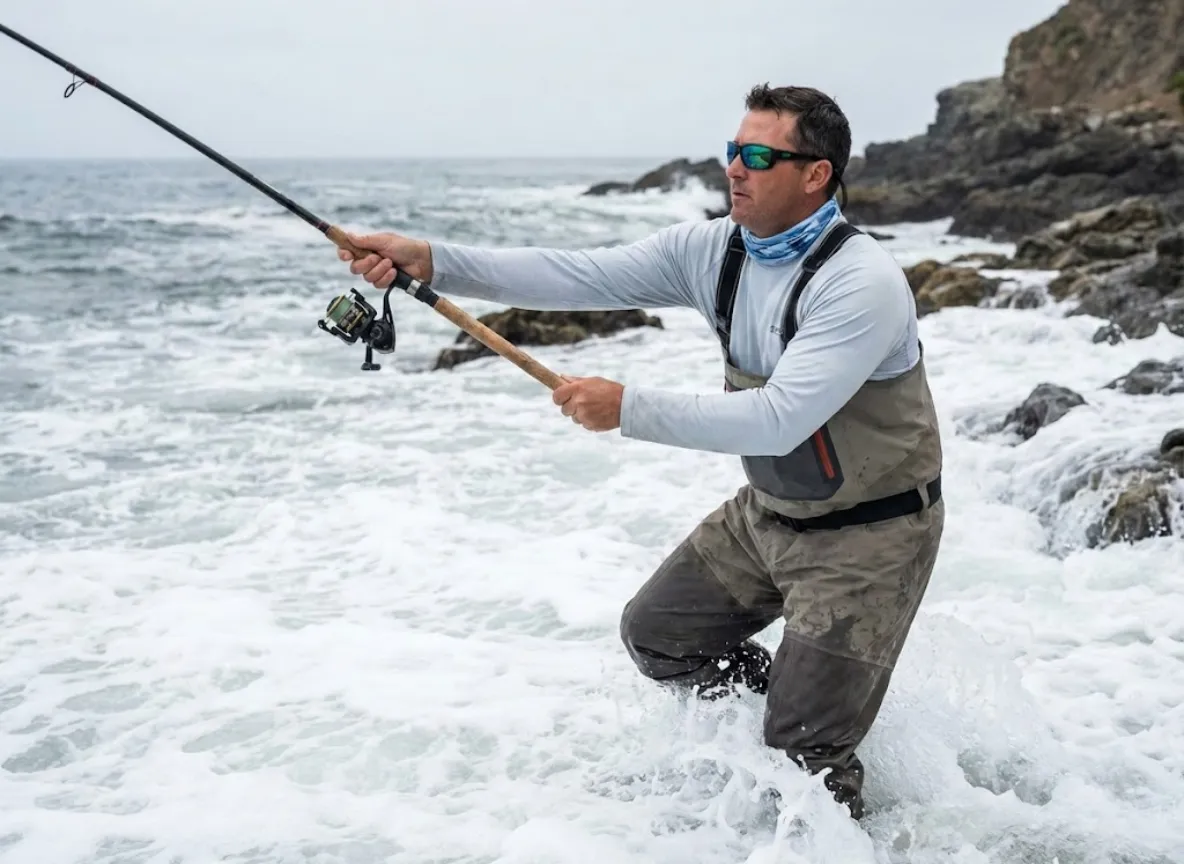
The surf at the end of a five-mile scramble does not care that you had to hike in. It does not care that your rod had to fit inside a 65-liter hiking backpack or survive a slide down a granite scree field. The wind on the open beach screams at 20 knots, and the striped bass are holding in the second trough, eighty yards out.
If your surf casting gear was chosen for convenience rather than ballistics, your trip ends the moment you reach the water. For the backcountry surf angler, the “travel rod” is not a toy; it is a specialized piece of artillery that must disassemble for the approach and reassemble for war.
We aren’t talking about telescopic gimmicks here. We are talking about solving the hiker’s dilemma: transporting high-leverage surf gear into remote zones without sacrificing the structural integrity required to land trophy fish. From spigot ferrules to bias-wrapped joints, we are breaking down the tools that balance packability with the fighting power needed for shark or redfish.
How to Choose the Right Travel Surf Rod

Selecting the ideal surf rod for the backcountry requires a shift in perspective. You aren’t just looking for rod length and fast action; you are looking for engineering that withstands the dynamic forces of a hike and the corrosive violence of the salt.
Why Does Ferrule Integrity Matter?
Ferrule integrity dictates both the casting distance and structural safety of a multi-piece rod. In cheap designs, “tip-over-butt” connections often create stiff sections. This “flat spot” interrupts the rod’s parabolic arc, killing the kinetic energy transfer needed for long range casting. Premium travel rods utilize spigot ferrules (internal pegs) or bias-wrapped joints to maintain a continuous taper, debunking the old 1-piece vs 4-piece myth.
Beyond distance casting, loose joints are a catastrophic failure point. Repetitive casting creates vibration that can slowly back a ferrule out. If the connection isn’t flush, the female end will crack under load.
Understanding the specific parts of a fishing rod helps you identify these connection types before you buy. If you can’t feel the vibration of a topwater lure or a subtle strike because the joints are deadening the sensation, you are fishing blind.
Pro-Tip: Always carry a small stick of ferrule wax in your repair kit. A thin coating on the male end of the joint prevents rotation and keeps the sections locked tight during hundreds of casts, preventing the dreaded “mid-cast separation.”
What is the Packability Index?
The Packability Index is the measure of a rod’s collapsed length relative to standard hiking gear dimensions. Ideally, a rod should break down to under 34 inches—meaning it fits in a 32-inch tube or similar—to allow for vertical storage inside or strapped to the side of most standard packs. This keeps the center of gravity close to your spine and prevents the tube from snagging on overhead branches.
While soft cases work for overhead bins, they are useless on the trail. You need rigid PVC or crush-proof tubes when navigating rocky shorelines. However, there is a trade-off.
More sections (5-piece vs. 3-piece) equals better packability but introduces more potential failure points if the engineering isn’t perfect. When selecting one of the best fishing backpacks for hiking, ensure the side compression straps align with your rod tube’s length to prevent swaying.
Rod Power vs. Action in the Surf
“Power” is your resistance to bending—it’s what lets you throw a 4-ounce pyramid sinker into a headwind. “Action” is where the rod bends. In the surf, you generally want a “Fast” action (bending mostly at the tip) to generate the line speed required for distance. However, a rod that is too stiff can rip hooks out of soft-mouthed fish like weakfish or sea trout.
Multi-piece travel rods often feel stiffer than their 1-piece counterparts due to the reinforced ferrules. This means a “Medium” travel rod might behave more like a “Medium-Heavy.” It is vital to understand the differences between rod action and power so you don’t end up with a broomstick that can’t load a light lure, or a noodle that folds over in the current.
Saltwater Durability & Materials
Saltwater is relentless. It attacks guide frames through rust and seizes reel seats with corrosion. For a rod that lives in a backpack, often put away wet after a long hike out, material choice is non-negotiable. You want 316 Stainless Steel or Titanium guide frames with Aluminum Oxide guides or better.
The blank material itself involves a trade-off. High modulus graphite is incredibly sensitive and light, but it is brittle. If you trip on a root and smack the rod tube against a rock, graphite can fracture.
Composite blanks (a mix of graphite and fiberglass) offer better impact resistance. This durability is often worth the slight weight penalty when comparing saltwater vs freshwater gear durability.
Our Selection Process: How We Built This Guide
We recognize that “travel rods” have historically been viewed as inferior backups. We rejected that premise. To build this guide, we sought tools that perform indistinguishably from 1-piece surf heavers. We examined heavy hitters like the PENN Squadron III, Tsunami SaltX, and Shimano Tiralejo XX, but focused our final curation on units that solved the packability-to-power ratio.
Every rod was scored against six specific criteria, including Casting Efficiency (Recovery), Saltwater Durability, and the critical “Hike-to-Fish” suitability. We analyzed user sentiment from expert forums like StripersOnline and SurfTalk, reviewed manufacturer engineering documents for material specs (SCII Carbon, HVF Graphite), and prioritized widely available 2026 models. We prioritize gear that survives the hike; our reputation depends on your success in the field.
The Best Travel Surf Rods of 2026: Our Top Recommendations
Our Top Picks for The Expedition Angler (The Pro)

Our Top Picks for The Budget-Conscious Adventurer (The Scout)
Conclusion
Know your target before you pack. Heavy surf requires the backbone of an Okuma or Daiwa, while estuary finesse demands the sensitivity of a lighter blank. But regardless of the brand, respect the ferrule. The joint is the weak point. Wax it, check it, and choose spigot or V-Joints if your budget allows.
When packing, ensure your rod tube fits inside or flush against your pack to prevent damage during the approach hike. Stop letting logistics dictate your fishing grounds. Choose the rod that fits your trek, strap it to your pack, and reach the remote beaches that others can’t.
Frequently Asked Questions about Travel Surf Rods
Can travel surf rods really cast as far as 1-piece rods?
Modern travel rods with V-Joint or Spigot technology (like the Daiwa Ardito) cast 90-95% as far as one-piece rods. However, budget rods with poor ferrules will suffer from reduced distance due to flat spots in the blank that interrupt the energy transfer.
How do I stop my multi-piece rod from coming apart while casting?
Apply ferrule wax to the male end of the joints and check the connections every 20-30 casts. Loose ferrules are the leading cause of breakage, as the female end will crack under stress if not fully seated.
Can I carry a surf rod on a plane?
Yes, but almost never as a carry-on due to length restrictions (usually max 22). A 4-piece surf rod in a hard tube can easily be checked as standard luggage or packed inside a large duffel bag to avoid oversized baggage fees.
What is the best way to attach a rod tube to a hiking backpack?
Place the base of the tube in the side water bottle pocket and secure the top with the side compression straps. Ensure the tube does not extend more than 6 inches above your head to avoid snagging on low-hanging branches during your hike.
Risk Disclaimer: Fishing, boating, and all related outdoor activities involve inherent risks that can lead to injury. The information provided on Master Fishing Mag is for educational and informational purposes only. While we strive for accuracy, the information, techniques, and advice on gear and safety are not a substitute for your own best judgment, local knowledge, and adherence to official regulations. Fishing regulations, including seasons, size limits, and species restrictions, change frequently and vary by location. Always consult the latest official regulations from your local fish and wildlife agency before heading out. Proper handling of hooks, knives, and other sharp equipment is essential for safety. Furthermore, be aware of local fish consumption advisories. By using this website, you agree that you are solely responsible for your own safety and for complying with all applicable laws. Any reliance you place on our content is strictly at your own risk. Master Fishing Mag and its authors will not be held liable for any injury, damage, or loss sustained in connection with the use of the information herein.
Affiliate Disclosure: We are a participant in the Amazon Services LLC Associates Program, an affiliate advertising program designed to provide a means for us to earn advertising fees by advertising and linking to Amazon.com. As an Amazon Associate, we earn from qualifying purchases. We also participate in other affiliate programs and may receive a commission on products purchased through our links, at no extra cost to you. Additional terms are found in the terms of service.