In this article
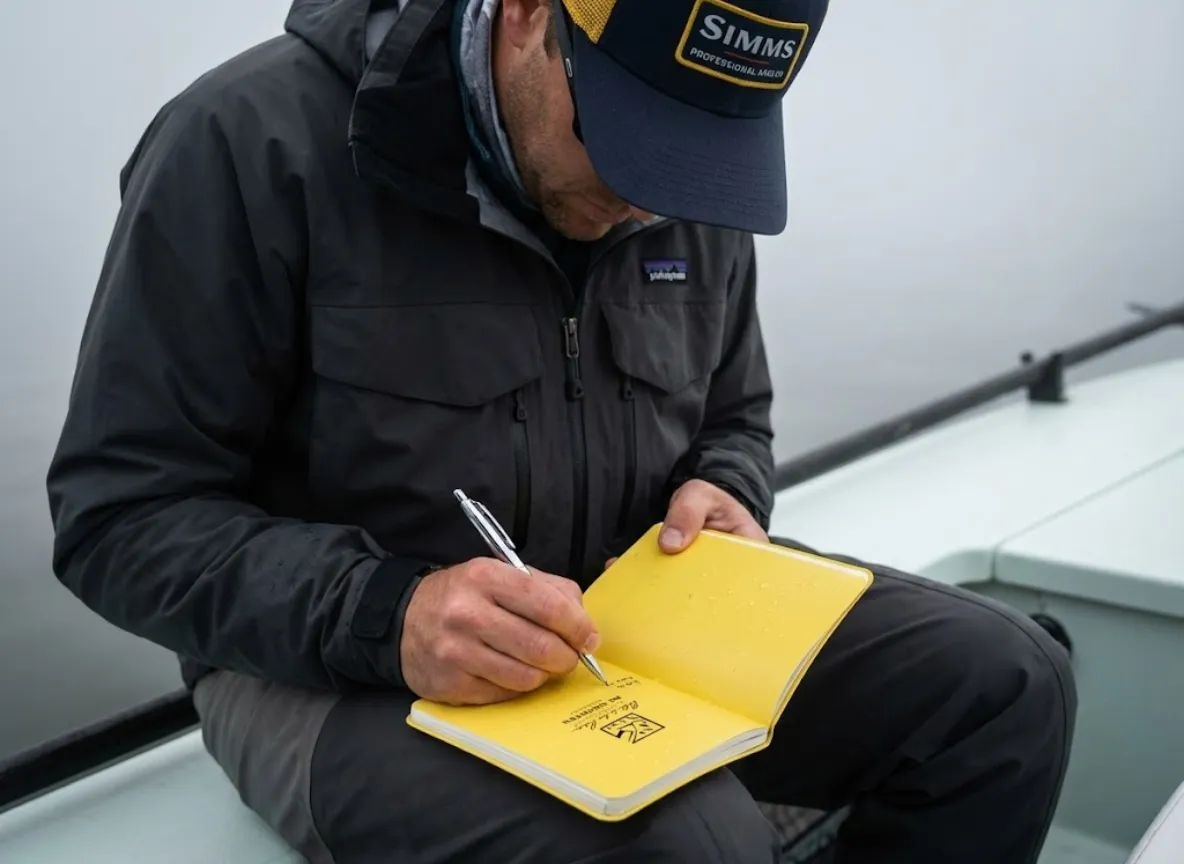
I still have my first paper logbooks from twenty years ago. They are spiraled, coffee-stained notebooks filled with enthusiastic scribbles like “Caught a bunch at the big oak tree” or “Weather: Nice.” At the time, I thought I was building a library of secrets. In reality, I was hoarding noise. Fisheries science relies on precision, and so should you.
A fishing logbook is not a diary; it is a data set. However, a collection filled with gaps, guesses, and inconsistent “sunny” checkboxes is worse than useless—it is misleading. Most of us sit on a goldmine of historical patterns buried under layers of “dirty data,” rendering years of hard-earned detailed fishing effort statistically invisible.
To turn past luck into future strategy, we must stop passive recording and start auditing. This guide transforms the frustrated archivist into a practitioner of angling data stewardship. It equips you with the protocols to clean, validate, and leverage your history for data-driven decisions.
Why do personal fishing records degrade over time?

Data Entropy is the natural tendency for a logbook to become disordered over time due to inconsistent data entry workflows. It happens to the best of us. One season you record water temperature in Fahrenheit; the next, you skip it entirely because you forgot your thermometer.
This manifests as “Temporal Drift,” where you record a catch days after it happened, blurring the specific time window. It also appears as “Geospatial Ambiguity,” using slang names like “The Honey Hole” instead of GPS waypoints. These inconsistencies create “noise” that drowns out the “signal” of legitimate fish behavior patterns.
The most dangerous result is the “Zombie Record”—an entry that exists but lacks critical keys like specific location or date, making it useless for analysis. Without a data maintenance audit, the dataset suffers from “Taxonomic Confusion,” where fish species like bass, redfish, trout, and tuna are labeled inconsistently. Just as you perform sustainable fishing gear maintenance to extend the life of your reels, you must maintain your logbook data to preserve its value against this decay.
Pro-Tip: Schedule a “Hygiene Audit” of your logbook during the off-season or widely spaced intervals (e.g., every 50 entries) to catch nomenclature drift before it becomes unmanageable.
How do we define “Quality” in a fishing log?
Quality is measured by Completeness (absence of missing values like lure color, lure type, or soft plastic choice) and Timeliness (latency between the catch and the record). If you wait a week to log a trip, the subtle details of wind direction and wind speed are replaced by generic memories. Consistency rating ensures uniformity, such as always recording pressure in millibars rather than switching between inHg and hPa.
Accuracy refers to how close the recorded value is to the true value verified by external gauges. The Department of Health and Human Services defines the six dimensions of data quality regarding patient records. We apply those same rigorous standards (Accuracy, Completeness, Consistency) to our angling history, whether we are tracking hook-up ratio, vessel fuel usage, or rod specifications.
Adhering to FAIR Principles (Findable, Accessible, Interoperable, Reusable) ensures the data remains viable for decades. Validity checks prevent biological impossibilities, such as recording a 50-inch Bluegill or a water temperature of 120°F. By contributing high-quality catch and effort logs to citizen science projects, you are doing more than catching fish; you are upholding a cornerstone of fish conservation for anglers. Finally, FAO guidelines on fishery data emphasize the need for standardized collection methods to ensure your personal data can eventually interface with broader fisheries management efforts.
Is your current logbook tool sabotaging your data?
Why is “Data Sovereignty” critical for long-term analysis?
Data Sovereignty is the user’s absolute ownership and control over their dataset, independent of the logbook apps developer. Many popular apps lock data into proprietary formats. If the app shuts down or changes its business model, you lose your life’s work. The “Container Audit” begins by verifying if your tool allows for a full export of metadata, not just waypoints.
The “Gold Standard” for auditing is the CSV export (Comma Separated Values). This format allows data to be cleaned in Excel or Python. Tools that only offer PDF export or GPX files strip the context—weather, leader material, species—from the location, destroying the analytical value.
NOAA’s recreational survey standards mandate transparent data management and access, highlighting the importance of open formats. When evaluating the best fishing apps, look past the fancy maps and check their data exportability. True stewardship requires an “Exit Strategy”: always having a cloud backup file stored independently from the electronic logbook platform.
How do you clean “Dirty Data” from your records?
The “Hygiene Audit” starts with identifying Null Values (blanks)—the “black holes” of analysis that skew averages. You must decide between Deletion (removing the row) or Imputation (filling the blank with an average or external data source) based on why the data is missing. You must also detect Duplicates caused by cloud sync errors, usually signaled by identical timestamps for the same species count.
Next, standardize your Taxonomy. Convert all colloquial names (“Bucketmouth,” “Bronzeback”) into a single Controlled Vocabulary. The Integrated Taxonomic Information System provides the federal standard for species nomenclature, which is essential for consistent sorting.
This allows for distinguishing specific biology, such as the nuances found in largemouth bass facts, rather than using generic terms. Finally, normalize Location Names; “Miller’s Cove” and “Millers Cove” are treated as different places by software, splitting your catch history unnecessarily. Make it a standard operating procedure to review these monthly.
How can government databases validate your personal history?
How do you use NOAA Climate Data Online to verify weather conditions?
NOAA’s National Centers for Environmental Information hosts the Climate Data Online archives, which acts as the ultimate arbiter for historical weather. This tool allows users to backfill missing air temp and precipitation data using NOAA atmospheric data. The process involves selecting “Daily Summaries” in the search tool and choosing a specific “Station” (like a local airport) rather than a vague Zip Code.
This retrieval allows for the Imputation of missing “Air Temp” fields in the logbook with high-precision federal data. Comparing personal logs against NOAA Fisheries or weather data acts as a “Truth Test.” If your log says “Sunny” but NOAA records 1.5 inches of rain, the entry is flagged as suspect. This is particularly useful for verifying historical precipitation to understand effective river fishing after rain strategies for future trips.
How do you utilize USGS Water Data to reconstruct river conditions?
For freshwater anglers, Discharge (cfs) and Gage Height are the master variables, often more predictive than weather. The USGS Water Data for the Nation system provides historical streamflow archives through the National Water Information System (NWIS). This allows users to look up historical “Daily Data” or “Instantaneous Data” for specific river gauges.
By matching the “Site Number” of the nearest gauge to your fishing location, you can import precise flow rates into your logbook. This data helps identify the “Goldilocks Zone”—the specific flow window where fish are reachable and active. It solves the problem of “Visual Estimation” error, allowing you to correlate digital discharge rates with visual cues on how to read a river for fishing. While water clarity and turbidity are harder to reconstruct historically, flow data offers a strong proxy for track water quality changes.
Which variables actually predict fish behavior?
Is barometric pressure a reliable predictor or a persistent myth?
Many anglers treat barometric pressure graphs as a primary driver, but scientific audits suggest it is often a Proxy Variable. Bemidji State University research found no significant influence of barometric pressure on Yellow Perch feeding in controlled environments. Physiologically, the pressure change from a weather front is negligible to a fish compared to moving a few feet vertically in the water column.
The “bite” often associated with falling pressure is likely triggered by associated environmental factors: Low Light, Wind, and Cloud Cover. Understanding the data-backed reality of fishing barometric pressure trends allows you to separate myth from mechanic to improve angling predictability. In your audit, do not delete pressure data, but weight it lower than light intensity or temperature in your predictive models.
How critical is water temperature compared to solunar phases?
Water temperature is the Critical Variable because fish are ectotherms; their metabolism and feeding routines are thermodynamically locked to their environment. For species like Largemouth Bass, digestion slows dramatically below 50°F, making temperature a “Hard Constraint” on feeding frequency. An audit must prioritize filling temperature gaps above all else.
Solunar cycles and moon phases are statistically significant for apex predators but negligible for opportunistic feeders. Research published in PLOS ONE indicates distinct lunar effects on Muskellunge catch rates, validating the concept for specific species.
However, you should weigh metabolic constraints heavily against the subtle influence of fishing by the moon when planning your trips. Prioritize “Water Temp” as the primary filter in your database, using tide charts or Solunar data only as a secondary “tie-breaker.”
Pro-Tip: If your log is missing water temperature, use air temperature history from NOAA as a rough proxy, applying a 3-day rolling average to estimate the water trend (warming or cooling).
Closing the Audit
True angling science mastery is not just about time on the water, but the rigorous stewardship of the knowledge gained there. By securing Data Sovereignty, you ensure your history belongs to you, not an app developer. By prioritizing data integrity and hygiene, you eliminate the “Zombie Records” that skew your understanding of success.
Through External Validation using NOAA and USGS data, you transform subjective memories into objective facts. Finally, by applying pattern recognition to clean data, you focus your analysis on what matters—temperature and flow—rather than folklore.
Start your audit today by exporting your current logs to CSV and performing a simple “Null Value” scan. You are building a second brain for your fishing; ensure it is accurate so you can predict future bites with confidence.
FAQ – Frequently Asked Questions
How often should I audit my fishing logbook data?
Conduct a Hygiene Audit monthly to correct immediate errors while memory is fresh, and a Deep Audit annually (off-season) to integrate external NOAA or USGS data. Regular intervals prevent the accumulation of Dirty Data and serve as a reliable monthly data review protocol.
Can I use barometric pressure from a weather app for my log?
It is acceptable for real-time logging, but you should cross-reference it with NOAA Station Pressure during your audit for accuracy. Phone apps often report Sea Level Pressure, which differs from the actual pressure at your specific elevation.
What is the best format to export my fishing data for long-term storage?
CSV (Comma Separated Values) is the industry standard because it is non-proprietary, human-readable, and compatible with almost all data analysis software (Excel, Google Sheets, Python). Avoid physical preservation on waterproof paper as a primary method or image-based exports as they cannot be easily analyzed.
How do I handle skunked trips (zero catch) in my logbook?
Record them with the same detail as successful trips. Zero Catch data is critical for calculating true Catch Per Unit Effort (CPUE) and catch-and-release data. Omitting failed trips creates Survivorship Bias, leading you to believe fishing is always good at certain spots.
Risk Disclaimer: Fishing, boating, and all related outdoor activities involve inherent risks that can lead to injury. The information provided on Master Fishing Mag is for educational and informational purposes only. While we strive for accuracy, the information, techniques, and advice on gear and safety are not a substitute for your own best judgment, local knowledge, and adherence to official regulations. Fishing regulations, including seasons, size limits, and species restrictions, change frequently and vary by location. Always consult the latest official regulations from your local fish and wildlife agency before heading out. Proper handling of hooks, knives, and other sharp equipment is essential for safety. Furthermore, be aware of local fish consumption advisories. By using this website, you agree that you are solely responsible for your own safety and for complying with all applicable laws. Any reliance you place on our content is strictly at your own risk. Master Fishing Mag and its authors will not be held liable for any injury, damage, or loss sustained in connection with the use of the information herein.
Affiliate Disclosure: We are a participant in the Amazon Services LLC Associates Program, an affiliate advertising program designed to provide a means for us to earn advertising fees by advertising and linking to Amazon.com. As an Amazon Associate, we earn from qualifying purchases. We also participate in other affiliate programs and may receive a commission on products purchased through our links, at no extra cost to you. Additional terms are found in the terms of service.