In this article
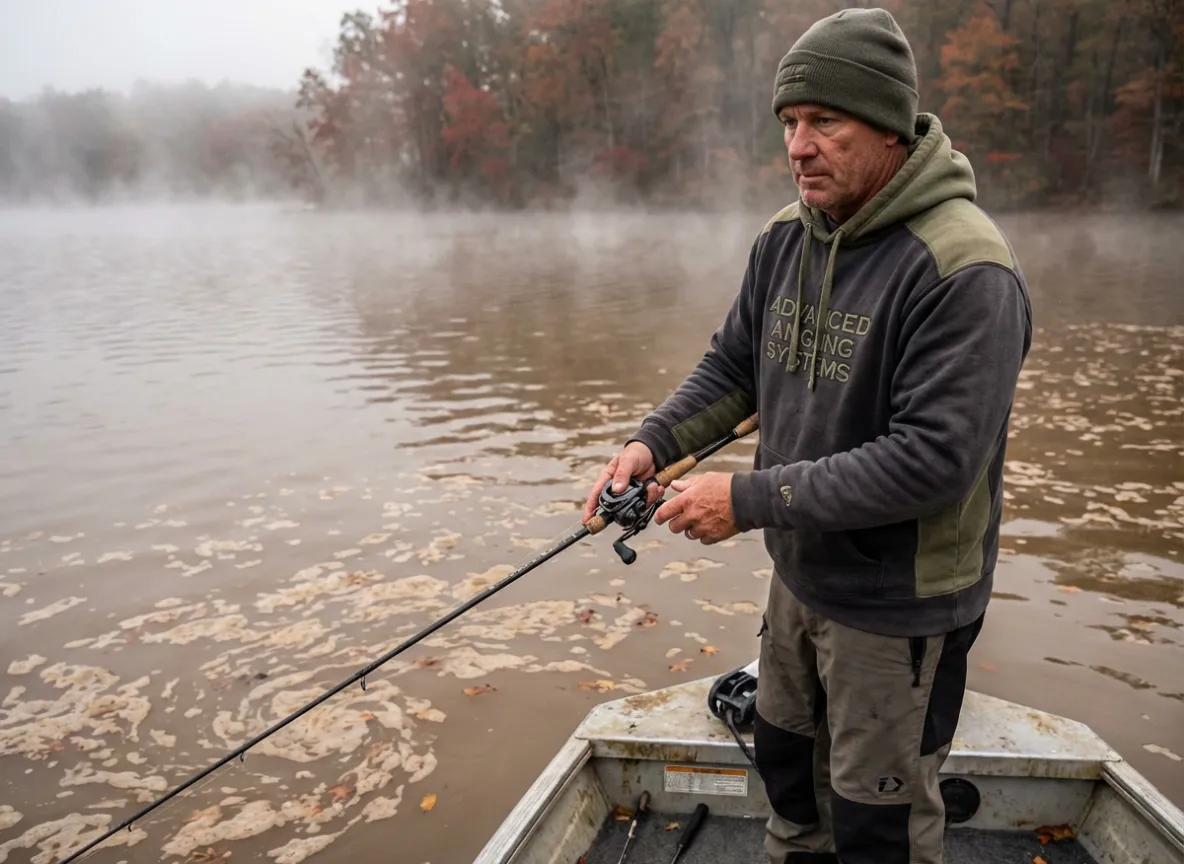
You step onto the casting deck and the air feels different—crisp, heavy, and carrying the distinct, sulfurous scent of rotten eggs. The water, clear just a week ago, now looks like coffee with cream. The surface is littered with decaying leaves and strange foam. Most anglers call this “The Funk” and pack up their gear, defeated by the invisible barrier that shuts down the bite.
I have seen this scenario play out countless times over decades of guiding. A hot streak suddenly turns cold, and the lake seems devoid of life. But this biological chaos is actually a predictable hydrodynamic event governed by a single number: 39.2°F.
Understanding the limnology and thermodynamics of lake turnover transforms this seasonal obstacle from a mystery into a solvable equation in recreational angling. By learning the science, you can turn the dreaded “dead sea” days into opportunities for precision angling.
What is the Physics Behind Lake Turnover?

Why is Water Density the Key Driver?
Liquid water behaves differently than almost any other substance. While most substances get denser as they freeze, USGS data on water density and weight confirms that freshwater reaches its maximum density (heaviness) at exactly 39.2°F (4°C). This specific property of water molecules is the engine that drives the entire turnover process.
As autumn air cools the surface waters (Epilimnion) toward this critical temperature, they become heavier than the warmer water column below. Gravity takes over, forcing this heavy, cold surface water to sink. It displaces the lighter water upwards in a continuous vertical mixing cycle driven by fluid dynamics.
This sinking action begins to erode the stable summer thermocline that anglers rely on for deep-water positioning. However, the full “turnover” waits for the point of isothermy. Isothermy occurs when the temperature (and therefore water density) becomes uniform from the surface to the lake floor, removing the physical resistance to mixing. Once this equilibrium is reached, wind energy and wind shear act as the final catalyst, rolling the entire water column over like a relentless conveyor belt.
How Does Stratification Break Down?
Turnover is the complete destruction of thermal stratification, caused by the cooling surface water punching through the Thermocline density barrier.
During summer, dimictic lakes (common freshwater lakes deeper than 20 feet, such as Lake Mendota or Lake Champlain) resemble a “layered cake.” You have the warm Epilimnion on top, the rapid-change Metalimnion (Thermocline) in the middle, and the cold Hypolimnion at the bottom. The Clean Lakes Alliance explanation of seasonal stratification illustrates how the Thermocline acts as a “density wall.” This wall physically prevents the oxygen-rich surface water from mixing with the nutrient-rich bottom water.
The breakdown is often accelerated by the Seiche Effect, where strong autumn winds or atmospheric pressure shifts push surface water to one side of the lake. This tilts the thermocline and forces deep water upwind. This process redistributes phosphorus and nitrogen from the lake sediments into the water column through nutrient cycling, often triggering a “second spring” of algal blooms. For the angler, the disappearance of the Thermocline means fish are no longer squeezed into specific depth bands and can roam the entire vertical column.
How Does Turnover Impact Water Chemistry and Fish Health?
Why Does the Lake Smell Like Rotten Eggs?
The distinct “turnover smell” is caused by hydrogen sulfide, a gas produced by anaerobic bacteria in the deep, oxygen-starved Hypolimnion.
During summer stratification, this gas is trapped in the “basement” of the lake, unable to escape through the density barrier of the Thermocline. When the lake turns over, the mixing brings this accumulated gas to the surface. As noted by the Washington State Department of Ecology on wetland odors, the gas then off-gasses into the atmosphere, creating that unmistakable rotten egg smell.
This smell is a critical diagnostic tool. If you smell it, the deep, toxic water is actively mixing with the surface water. Hydrogen sulfide is highly toxic to fish, interfering with cellular respiration. This forces gamefish to flee areas of intense upwelling. The presence of the gas often correlates with “dead water” zones where fish activity is non-existent until the gas dissipates.
What Happens to Dissolved Oxygen Levels?
The most violent impact of turnover is the DO depletion or the “Oxygen Squeeze,” a temporary reduction in overall dissolved oxygen levels throughout the lake.
The process mixes the oxygen-rich surface water (e.g., 8 ppm) with the massive volume of anoxic waters (0 ppm). This drags the oxygen concentration down to stress levels, often hitting the 3-5 ppm range identified by the Virginia Water Resources Research Center on DO assessment as critical for aquatic organisms. This rapid drop triggers a physiological stress response. Elevated cortisol levels suppress the metabolic urge to feed.
Fish enter a state of “metabolic pause.” They suspend activity to conserve energy while their bodies adjust to the new chemical environment. This explains why bass metabolic rates drop and the “Fall Funk” sets in. The fish aren’t being picky; they are physically struggling to breathe efficiently. Recovery takes time. The bite typically remains suppressed for 1-2 weeks until wind and photosynthesis re-oxygenate the homogenized water column to prevent winterkill.
How Can Anglers Diagnose the Turnover Phase?
What Visual and Olfactory Signs Confirm Active Turnover?
Water Clarity and Turbidity Spikes are the first sign. Look for a sudden change in clarity, often described as “Turnover Soup.” The Minnesota DNR on seasonal lake changes notes that this coffee-colored or milky appearance is caused by suspended bottom sediment mixing upwards, drastically reducing Secchi depth.
Surface Debris also accumulates rapidly. The rising water currents lift decaying organic matter—leaves, weed particles, and detritus—from the bottom. This creates rafts of sludge or foam lines even in calm water. Additionally, the Nose Test remains your most reliable confirmation. If you catch a whiff of sulfur, the bottom water has reached the surface.
It is important to note the lake morphology and spatial heterogeneity of the event. Turnover rarely happens to the entire lake simultaneously; the main lake basin often turns before protected creek arms. If you encounter these signs, the tactical move is to “run from the turnover.” You must understand how fish see in murky water and realize that visual feeding in these zones is nearly impossible. Seek shallow bays or river inlets that stabilized earlier or never stratified.
How Can Sonar and Temperature Probes Verify the Event?
To scientifically verify the turnover, perform the “Isothermal Protocol.” Stop your boat over the deepest part of the basin and measure the surface temperature. Then, drop a temperature probe (or lower a sensor) to 25-30 feet. If the deep water temperature is within 1-2°F of the surface, the lake has turned. Carver County Water Management on monitoring data highlights that significant temperature anomalies (10°F+) indicate the lake is still stratified.
Pro-Tip: If you don’t have a dedicated temp probe, use a heavy jig. Pitch it out, let it sit on the bottom for 2 minutes, and reel it in fast. Grab the lead head immediately. If it feels bone-chillingly cold compared to the surface water, the lake hasn’t turned yet.
Next, analyze your 2D Sonar. A defined horizontal line at 20-25ft indicates the Thermocline is still intact. During active turnover, the sonar screen will often appear “fuzzy” or filled with vertical interference caused by rising bubbles and particulate matter. For help interpreting sonar clutter, look for scattered returns throughout the column rather than distinct arches holding to structure.
What Fishing Strategies Work During Turnover Conditions?
Where Should You Locate to Avoid the “Dead Zone”?
The primary strategy is avoidance: “Run from the Turnover.” Leave the main lake basin where stratification—and therefore the mixing shock—was most severe.
Target major creek arms and river inflows. These shallower, moving waters often do not stratify deeply and maintain higher oxygen levels throughout the fall. Seek out shallow vegetation (0-5ft) in backwaters. As indicated by Texas Parks and Wildlife on livewell oxygen management, aquatic plants produce oxygen through photosynthesis, creating localized “life rafts” for stressed fish.
If you must fish the main lake, target vertical structure like bridge pilings or bluffs rather than horizontal flats. Fish in the main lake will often suspend high in the water column to access the first available oxygen from wind-driven mixing, ignoring bottom cover completely. Look for the “mud line” where a clear creek inlet meets the turbid main lake. Predators will often patrol these fishing current seams to ambush displaced forage along the visibility edge.
Which Lure Physics Overcome Low Visibility?
In “Turnover Soup,” visibility drops to near zero, rendering natural color patterns and sight-based lures ineffective. You must target the lateral line system, the fish’s organ for detecting vibration and pressure changes.
Select lures with high water displacement. Spinnerbaits with large Colorado blades (which thump rather than flash) or wide-wobbling squarebill crankbaits are ideal. According to an IGFA article on underwater hearing and vibration, fish rely heavily on detecting particle motion in low visibility, making vibration a superior trigger to sight.
Chatterbaits (Bladed Jigs) are exceptionally effective here. The hexagonal blade creates a violent, erratic pressure wave that fish can “feel” before they see. Utilizing Color Contrast Physics is also vital. In turbid water, solid Black or Blue silhouettes provide the sharpest contrast against the murky background.
Pro-Tip: Put down the finesse gear. A lethargic fish in zero visibility won’t find a drop shot. You need to force a reaction strike. Crash your crankbait into rocks or rip your chatterbait through grass to trigger a reflex bite.
For fish that have moved off the bank, deep diving crankbait tactics using wide-bodied lures can help you reach suspended fish that are ignoring bottom contact baits.
Final Thoughts
Lake turnover is not a curse; it is a hydrodynamic inevitability caused by water reaching its maximum density at 39.2°F. This creates a gravitational conveyor belt that mixes the lake and temporarily resets the ecosystem. The resulting “Fall Funk” is simply a biological response to the “Oxygen Squeeze” and chemical changes.
Success requires shifting tactics. You must diagnose the event using your nose and sonar, then flee to oxygen-rich creek arms or use high-vibration lures to target the lateral line. Next time you hit the water in autumn, don’t let the smell of sulfur turn you around. Use your temperature probe, find the stable water, and turn a biological crisis into a tactical advantage. Share your turnover turnaround stories in the comments below.
FAQ – Frequently Asked Questions
How long does lake turnover typically last?
The active vertical mixing phase typically lasts 5 to 10 days, depending on wind velocity and the surface area to depth ratio. However, water chemistry and dissolved oxygen levels may take an additional 1 to 2 weeks to fully stabilize before fish resume aggressive feeding.
Do all lakes turn over in the fall?
No, only dimictic lakes (typically deeper than 20-25 feet) stratify and turn over. Shallow ponds and polymictic lakes mix continuously throughout the summer due to wind and do not experience the drastic chemical shock of a fall turnover. Conversely, meromictic lakes are so deep or chemically stratified that they never fully mix.
Is it safe to eat fish caught during turnover?
Yes, fish caught during turnover are safe to eat. While the water may smell like rotten eggs due to dissolved gas, this does not typically taint the meat of the fish itself.
Can lake turnover happen in the spring?
Yes. Dimictic lakes turn over twice a year: once in the fall (cooling to 39°F) and once during spring turnover (warming to 39°F). The spring event is generally less disruptive to fishing because the water column is already oxygenated from the winter, unlike the anoxic shock of the fall event.
Risk Disclaimer: Fishing, boating, and all related outdoor activities involve inherent risks that can lead to injury. The information provided on Master Fishing Mag is for educational and informational purposes only. While we strive for accuracy, the information, techniques, and advice on gear and safety are not a substitute for your own best judgment, local knowledge, and adherence to official regulations. Fishing regulations, including seasons, size limits, and species restrictions, change frequently and vary by location. Always consult the latest official regulations from your local fish and wildlife agency before heading out. Proper handling of hooks, knives, and other sharp equipment is essential for safety. Furthermore, be aware of local fish consumption advisories. By using this website, you agree that you are solely responsible for your own safety and for complying with all applicable laws. Any reliance you place on our content is strictly at your own risk. Master Fishing Mag and its authors will not be held liable for any injury, damage, or loss sustained in connection with the use of the information herein.
Affiliate Disclosure: We are a participant in the Amazon Services LLC Associates Program, an affiliate advertising program designed to provide a means for us to earn advertising fees by advertising and linking to Amazon.com. As an Amazon Associate, we earn from qualifying purchases. We also participate in other affiliate programs and may receive a commission on products purchased through our links, at no extra cost to you. Additional terms are found in the terms of service.