
In this article
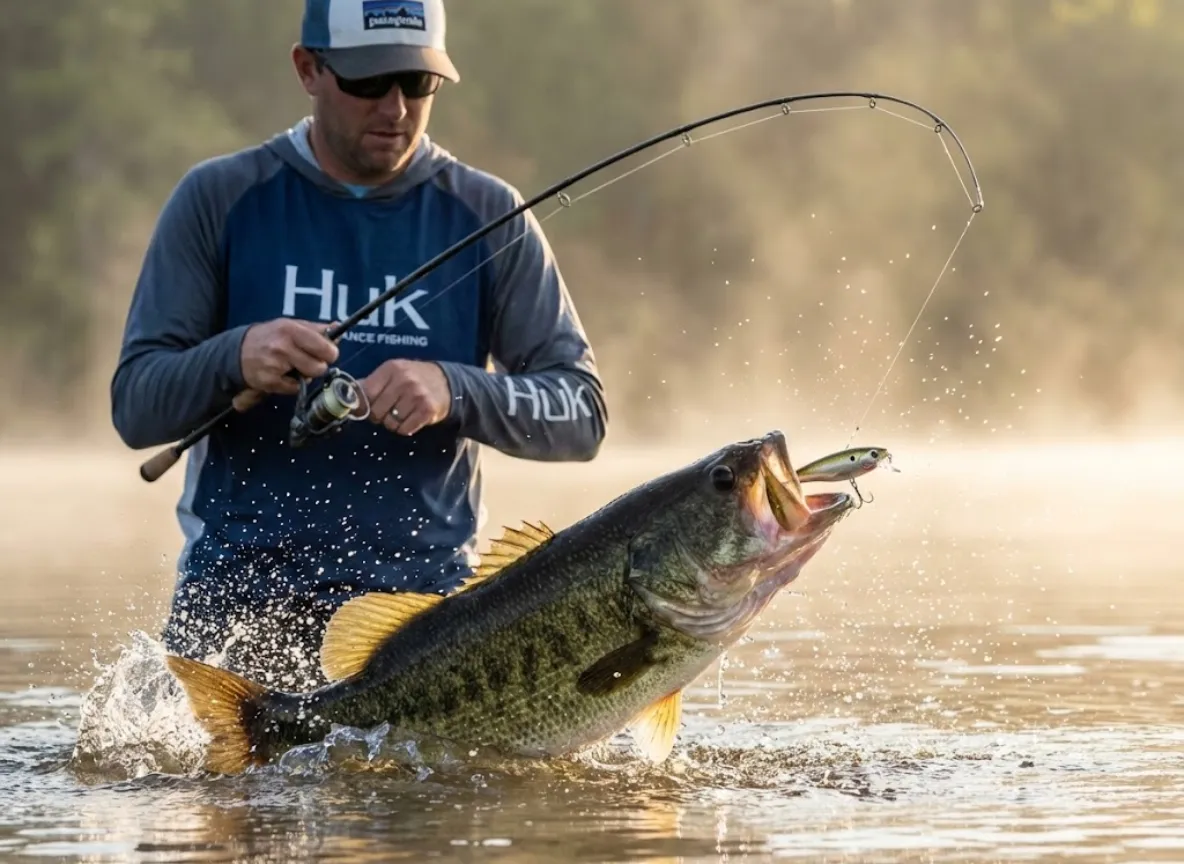
The water explodes. White spray erupts around the lure, the rod loads for a split second, and then—nothing. The lure sits bobbing in the foam, untouched, while the adrenaline dumps uselessly into your bloodstream.
We have all been there. You replay the moment, blaming your reflexes or bad luck. But after decades on the water and studying the science beneath the surface, I can tell you this is rarely random. It is a collision of physics and biology that you failed to calculate.
The missed topwater strike is often a mathematical certainty caused by light refraction, hydrodynamic displacement, and the specific limitations of a fish’s eye. To stop missing and start connecting with topwaters, we have to stop fishing on hope and start fishing with physics. By understanding how light bends and water moves, we can turn a frantic reaction into a calculated hookset timing.
Why is the surface of the water optically deceptive?
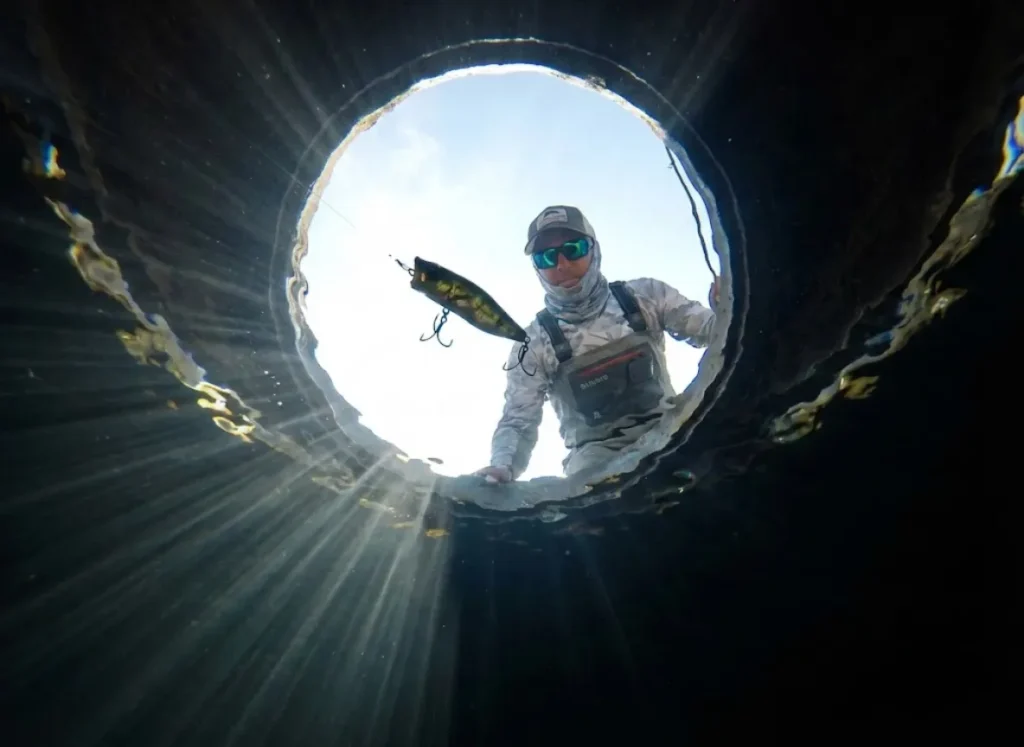
When you look into the water, you see the fish. When the fish looks up at you, it sees a distorted, compressed version of reality. This disconnect is caused by the physics of refraction and optics, creating a spatial error between where your topwater lure is and where the predator thinks it is.
What is Snell’s Window and how does it distort vision?
The root of the problem lies in the density difference at the water-air interface. Light waves travel slower in water, bending as they cross the surface. This phenomenon is governed by the definition of the refractive index, which measures the optical density of the medium. Air has an index of roughly 1.00, while water sits at a 1.33 refractive index.
This bending away from normal follows Snell’s Law (and the specific variables of Snell’s equation), a mathematical framework that dictates exactly how much light shifts direction. For a fish looking up, this creates a strict boundary known as the Critical Angle.
Anything outside this angle is subjected to total internal reflection, meaning the fish sees a perfect mirror of the bottom substrate rather than the sky. Consequently, a fish’s entire field of view above the water is compressed into a cone of light known as Snell’s Window. This measures just 97.2 degrees wide (the 97.2 degree view), acting like a “manhole” through which the fish views the sky.
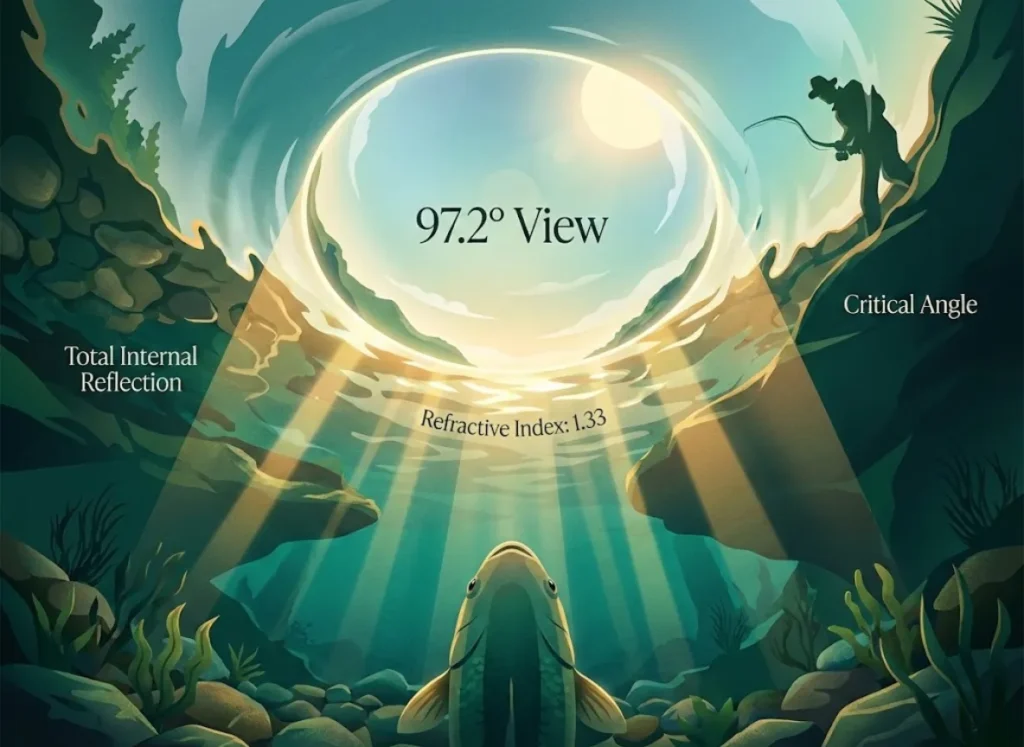
This compression creates the fisheye effect or visual distortion. Objects near the horizon—like an angler standing on a bank—are squashed into the rim of the window. For the predator, this optical geometry creates a blind spot for low-angle targets.
It also shifts the apparent location versus the true depth of your lure. To the fish, the lure appears higher and further away than it actually is. Because of this, long casts—or under the radar casting—are vital. They keep you hidden in the “mirror zone” outside the window. This approach mirrors the physics of high-altitude angling, where clear water and high-angle light make stealth and positioning the primary drivers of success.
How does surface turbulence affect target integrity?
If the water were perfectly flat, the fish could learn to compensate for Snell’s Law. However, wind and current turn the surface into chaos. Waves act as dynamic lenses. The crests of waves focus light, while the troughs disperse it.
This results in Optical Fragmentation. A single topwater lure silhouette is broken into disjointed shards or “ghost images.” At any given millisecond, the fish might see three pieces of your lure in three different places.
Recent studies on Snell’s window in wavy water validate that wave slope significantly alters the dimensions of the optical window, stretching and shrinking the window diameter rapidly. This forces the predator to integrate temporal data—glimpses of the target—rather than tracking a steady image.
Pro-Tip: In choppy water, switch to solid black lures. Contrast overrides color detail. A solid black silhouette is harder for the waves to “shatter” visually than a translucent or natural-colored pattern.
In shallow water, this creates “Snell’s Blanket,” where flashes of skylight mix with reflections of the bottom. This visual noise explains why selecting the right tool from a data-backed topwater fishing guide is critical; you need a lure that generates enough acoustic or displacement noise to help the fish locate it when its eyes are failing.
How does the biology of the predator contribute to the miss?
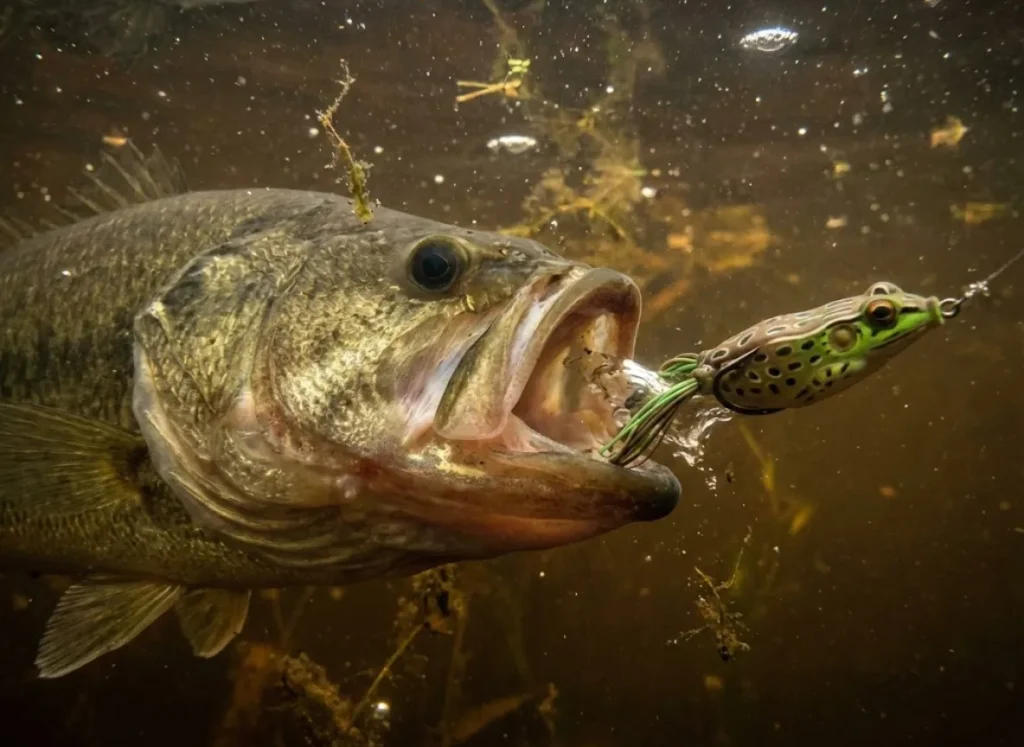
While the environment distorts the target, the fish’s own anatomy creates physical hurdles. Basic ichthyology tells us that the way a bass, trout, or rockfish eats is violent, but it creates a hydrodynamic force that can work against the angler.
How does suction feeding interact with lure buoyancy?
Predatory fish generally utilize Suction Feeding. They rapidly expand their buccal cavity (mouth and throat), creating a massive vacuum that pulls water and prey inside. However, just before that vacuum opens, the fish pushes a pressure wave ahead of it.
This is the Bow Wave. During a high-speed vertical approach with high strike velocity, this positive pressure hits the surface tension first. This creates a Hydrodynamic Displacement paradox. The water pushing up against a high-buoyancy lure, like a hollow body frog or a Snag Proof frog, pushes the lure away from the fish’s mouth the instant before it opens.
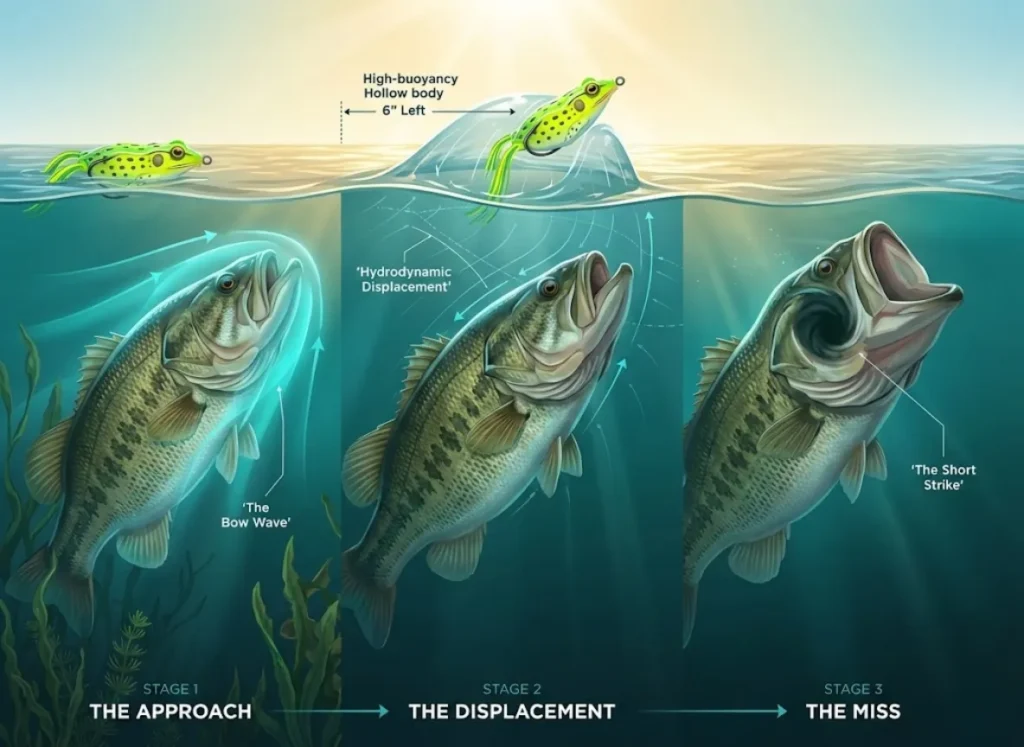
This phenomenon is unique to the surface boundary. Underwater, the prey has water on all sides and gets sucked in. On the surface, the lure has nowhere to go but up or sideways.
Detailed research into fish swimming mechanics and behaviour highlights how these pressure gradients function, explaining why lighter lures result in more short strikes or empty blow-ups.
This is why topwater bites often look like the fish completely missed. They did. They blew a hole in the water, and the lure fell into it after the jaws snapped shut. This mechanical issue is distinct from the biological design of largemouth bass biology, which relies on a massive bucket-style mouth that usually compensates for poor aim—except at the surface.
Can fish visually compensate for refractive errors?
Fish are not helpless against physics. Some species have evolved remarkable workarounds. Evidence from uses motor adaptation in shooting shows that Archerfish can learn to correct for refraction displacement through trial and error.
This is called “Motor Adaptation.” It is a learned skill, not an innate one. Older, larger fish are often better at hitting top water lures because they have failed thousands of times before. However, this compensation has limits. Novel angles, unusual lure cadence, or complex light conditions can still fool the predator’s predictive algorithm.
The anatomy of the Teleost Eye complicates this further. Fish eyes are spherical and often myopic (nearsighted). They cannot change focus—or accommodate—as fast as they can swim. As a bass rockets from 10 feet deep to the surface, it effectively goes blind in the final split second.
To maintain a lock, fish often rely on binocular vision for depth perception. However, the science of fish vision reveals that their binocular zone is narrow. If the lure moves laterally across the surface, it may pass into monocular vision, reducing depth accuracy right at the moment of the fish attack.
How can anglers fix the “miss” with gear and timing?
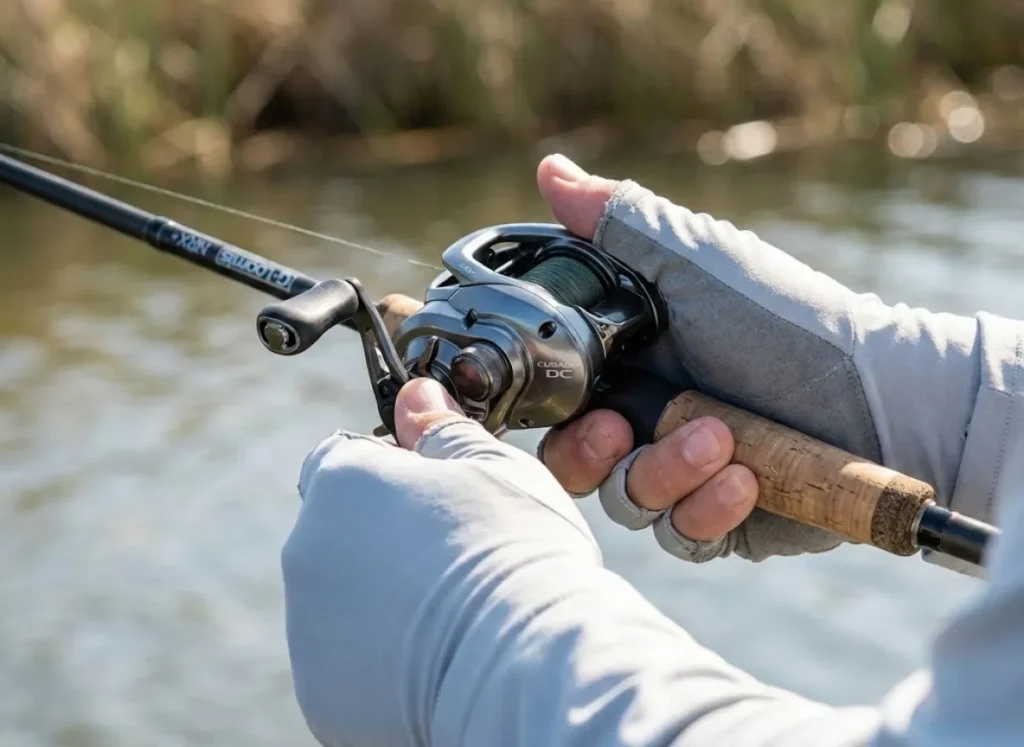
We know the water bends light and the fish pushes the lure away. We cannot change physics, but we can change how our gear reacts to it. The goal is to introduce a margin of error that favors the hook point.
How do rod and line properties mitigate the “miss”?
The most common cause of a missed fish is an angler who reacts too fast with gear that is too stiff. This is where Young’s Modulus (Elasticity) and line stretch come into play.
Braid line (PE) has near-zero stretch. When you combine high-vis braid with a stiff rod and a high-speed baitcasting reel, you exacerbate the “Bow Wave” error. You feel the bite instantly and pull the lure away before the vacuum has time to pull it back in.
Monofilament line acts as a shock absorber. Its inherent stretch allows the lure to linger in the suction zone for milliseconds longer. For treble-hook topwater plugs like poppers, prop baits, or walk-the-dog lures (such as the Moonwalker lure), this delay is often the difference between a hooked lip and a flying lure. Avoid fluorocarbon line for most topwater applications, as its density causes it to sink, ruining the action.
You must also consider rod action. A Fast Action rod bends only at the tip, reacting instantly. A Parabolic or medium-heavy rod action bends deep into the blank.
Pro-Tip: Adopt the “System Damping” approach. If you use braided line (fast response), use a glass or composite rod (slow response). If you use a graphite rod (fast response), use monofilament (slow response). Never use a fast rod with braid for treble hooks.
The “Load-Up” Principle dictates that you should wait for the weight of the fish before swinging. A parabolic rod forces you to wait because the rod must flex before it transmits power to the hook. This naturally counteracts the fish’s inaccuracy.
While we focus on mechanics, we must not ignore optics. Research on seeing red: color vision clarifies that largemouth bass have specific spectral sensitivities. However, against the bright backlight of the surface, contrast usually wins in lure color selection. But gear choice goes beyond color; understanding rod power vs action decoded ensures you have the mechanical leverage to drive hooks home once the connection is made.
Topwater Fishing Mechanics
Comparison of lure categories, physical mechanics, and recommended tackle configurations.
Physics Error
Bow Wave Displacement: The lure pushes water ahead, often pushing the bait away from the strike.
Setup & Timing
Line: 65lb Braid. Hookset: 2-3 second manual delay to ensure the fish has collapsed the body.
Physics Error
Refractive Targeting Error: Light refraction causes the fish to misjudge the exact surface position during the zig-zag motion.
Setup & Timing
Line: 15-20lb Mono. Hookset: Wait for Weight (Auto Delay). Let the rod load before striking.
Physics Error
Suction Resistance: The concave mouth creates a vacuum that can make it harder for the fish to inhale the lure cleanly.
Setup & Timing
Line: Mono or Braid w/ Leader. Hookset: 1 Second pause after the splash disappears.
Physics Error
Pursuit Velocity Lag: Constant movement requires the fish to calculate a lead on the target, often resulting in “short strikes.”
Setup & Timing
Line: 30-50lb Braid. Hookset: Immediate Sweep. Do not wait; the fish is already moving with the lure.
When should you delay the hookset?
Your brain processes a visual stimulus in about 200 milliseconds. A bass strike can happen in 40 to 100 milliseconds. You are biologically too slow to react to the strike itself, yet often too fast for the mechanics of the hookset.
The solution is the “Turn Hypothesis.” A bass strikes from below, inhales, and then turns its head to return to the depths. Striking while the fish is facing you pulls the lure out. Striking after it turns pulls the hook into the corner of the mouth. This is similar to spearfishing logic: you don’t aim where the fish is, but where it is going.
For hollow body frogs, use the “2-Second Count” or the one-mississippi rule. This accounts for the bow wave displacement and ensures the fish has re-acquired the lure. For treble hooks and buzzbaits, use the “Wait for Weight” method—do not swing until the rod loads up.
You can also use the “Pause” in your retrieval to help the fish. A moving target requires predicting three-dimensional target motion, which is difficult through refracted, choppy water. Pausing the lure turns a predictive target into a static one, allowing the fish to obtain a binocular lock.
If the fish misses, do not reel in. The mechanics of setting the hook are irrelevant if the fish is gone, but the fish is often still looking for the prey it thinks it stunned. Immediately deploy a follow-up strategy with a subsurface lure or sinking bait. A weightless fluke, soft plastics, or a texas-rigged speed craw cast into the boil often triggers an instant strike because the predator is in a state of high arousal.
Conclusion
The “miss” isn’t a failure of luck; it is a failure to account for variables. Snell’s Law displaces the image of your lure. Hydrodynamic Bow Waves push your bait away from the strike. The fish is shooting at a moving target through a distorted lens with eyes that can’t refocus fast enough.
Your job is to act as the error-correction system. Use System Damping—stretchy line or softer rods—to buy the fish time. Utilize Stealth Geometry by casting long to stay out of the predator’s window. And most importantly, use a hookset delay. Give biology a chance to catch up to physics.
Next time you see a giant splash, don’t just react—calculate. Explore our full library of exclusive fishing tips and weekly fishing reports to continue mastering the physics of the water.
FAQ – Frequently Asked Questions about Topwater Misses
Why do bass blow up on a lure but not touch it?
This is often caused by the Bow Wave effect. The pressure of the fish’s rapid approach pushes a lightweight lure away just before the mouth opens. Additionally, refractive error can cause the fish to strike at a ghost image of the lure created by wave facets.
Does lure color matter for topwater miss rates?
In bright conditions, silhouette (contrast) is more important than color details because the fish sees the lure against the bright sky (Snell’s Window). Black or dark colors create the strongest silhouette, making it easier for the fish to track the target accurately.
Should I use braided line for all topwater fishing?
No. Braid line has zero stretch, which can pull treble-hook lures (like poppers) out of the mouth too quickly or rip hooks free. Braid is best for hollow body frogs where heavy hooks require instant force; use monofilament line for treble hooks to add a shock absorber delay.
How long should I wait to set the hook on a frog?
The standard rule is 2-3 seconds, or a deliberate One-Mississippi, Two-Mississippi count. This delay ensures the fish has fully engulfed the bulky lure and turned back down, positioning the hooks for a secure hold in the corner of the mouth.
Risk Disclaimer: Fishing, boating, and all related outdoor activities involve inherent risks that
can lead to injury. The information provided on Master Fishing Mag is for educational and informational purposes
only. While we strive for accuracy, the information, techniques, and advice on gear and safety are not a substitute
for your own best judgment, local knowledge, and adherence to official regulations. Fishing regulations, including
seasons, size limits, and species restrictions, change frequently and vary by location. Always consult the latest
official regulations from your local fish and wildlife agency before heading out. Proper handling of hooks, knives,
and other sharp equipment is essential for safety. Furthermore, be aware of local fish consumption advisories. By
using this website, you agree that you are solely responsible for your own safety and for complying with all
applicable laws. Any reliance you place on our content is strictly at your own risk. Master Fishing Mag and its
authors will not be held liable for any injury, damage, or loss sustained in connection with the use of the
information herein.
Affiliate Disclosure: We are a participant in the Amazon Services LLC Associates Program, an
affiliate advertising program designed to provide a means for us to earn advertising fees by advertising and linking
to Amazon.com. As an Amazon Associate, we earn from qualifying purchases. We also participate in other affiliate
programs and may receive a commission on products purchased through our links, at no extra cost to you. Additional
terms are found in the terms of service.