Home Apparel & Accessories Best Fishing Net Guide: Boat, Bank & Kayak Picks

Best Fishing Net Guide: Boat, Bank & Kayak Picks

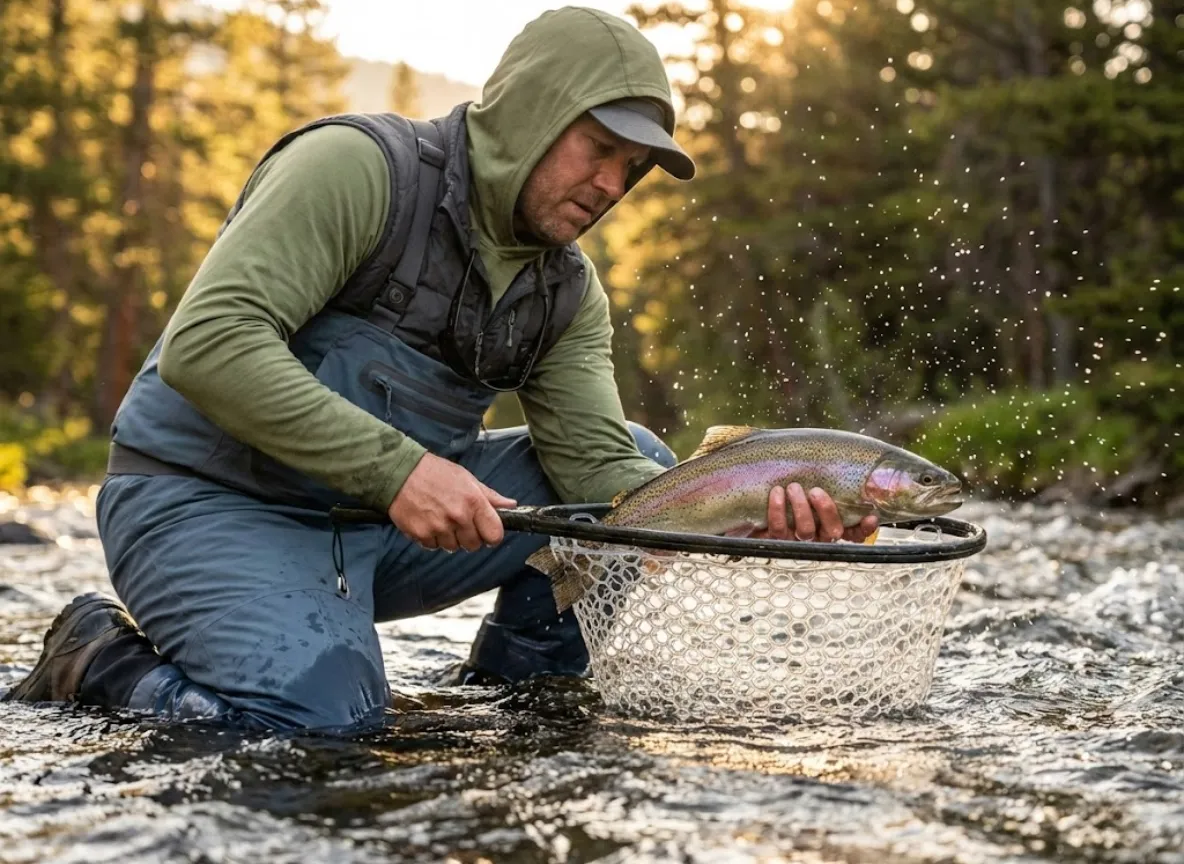
Angler using a rubber mesh landing net to safely lift a trout from a rushing river during golden hour.

You successfully land the fish, pop the hook, and watch it kick away into the current with vigor. You high-five your buddy, assuming a successful release. But biological reality is often crueler than our assumptions. Research indicates that release mortality frequently occurs 48 to 96 hours after the fish leaves your sight. The culprit is rarely exhaustion; it is the abrasion of the cutaneous mucous layer—the “slime coat”—caused by outdated mesh materials.

I have dragged nets through miles of scrub oak on bank/wade fishing trips and deployed them from kayak cockpits in gale-force winds. I’ve learned that a fishing net is no longer just a basket or basic terminal tackle to secure dinner; it is a portable live well designed for catch-and-release success and to prevent delayed mortality.

If you treat your net as a life-support system rather than a capture device, you change the dynamic entirely. This guide moves beyond generic recommendations to the intersection of conservation science (protecting the slime coat) and mechanical leverage (protecting your wrist). We will explore why “Ghost” rubber mesh is the non-negotiable standard, how handle length dictates torque, and which specialized tool fits your specific environment—from high-deck bass boats to intimate trout streams.

How to Choose the Right Fishing Net

Close up of a trout resting safely in a clear rubber ghost mesh net to protect its slime coat.

We need to arm you with objective knowledge. You shouldn’t just buy a net; you should select a tool based on biological and physical requirements.

Why Does Mesh Material Matter? (The Science of the Slime Coat)

The most critical component of your net is the mesh netting. A fish’s slime coat is a living immune system, rich in antibodies and antimicrobial peptides that fight off bacteria and parasites. When you drag a fish across knotted nylon, cheap string-style netting, or fine micromesh, the material acts like sandpaper. It strips this protective layer, leaving the fish open to Saprolegnia (fungal) infections days later.

A split-screen macro infographic comparing fishing net materials. The left side, labeled 'KNOTTED NYLON', shows rough netting scraping away a fish's protective slime coat. The right side, labeled 'MOLDED RUBBER', shows smooth mesh gliding over the intact slime coat.

For this reason, molded silicone or rubber “Ghost” mesh is the industry standard for fish management. It is non-porous, prevents hooks from snagging, and causes the absolute lowest amount of scale loss. Independent studies have shown significant differences in injury and mortality rates based on mesh type, confirming that a fish-friendly mesh is essential for survival.

Once we secure the fish’s health by implementing proper catch and release techniques, we must consider the mechanics of the angler’s effort.

How Does Handle Length Affect Leverage? (The Physics of Torque)

A net operates as a Class 3 lever. The further the net hoop is from your hand, the heavier the fish feels. This is the physics of the moment arm: a 10lb fish on a 6ft handle exerts exponentially more torque on your wrist than the same fish on a 2ft handle.

A sophisticated 3D infographic illustrating a fishing net acting as a Class 3 lever. The image features a carbon fiber handle held by a gloved hand, with holographic overlays labeling the 'Fulcrum' at the wrist, 'Effort' at the grip, and the fish in the net as the 'Load'. A visual heat map gradient along the handle indicates increasing torque.

For solo anglers, this leverage physics is critical. You need lighter, stiffer materials like a carbon fiber handle to manage this torque with one hand. Understanding these forces is the prerequisite to safely holding the fish for a photo or de-hooking without dropping it or injuring yourself, helping to minimize forearm strain.

Our Selection Process: How We Built This Guide

Various fishing nets laid out on a truck tailgate for testing and measurement during gear review.

We recognize that the “average angler” does not exist; gear must be matched to the operational environment. We evaluated options from major players like EGO, Ranger Nets, and Simms alongside niche manufacturers. Every net in this guide was scored on a 5-point scale across five dimensions: Fish Safety (FS), Ergonomics & Leverage (EL), Durability & Build (DB), Portability (PS), and Value (VP).

We actively looked for failure points. We sought out sticky grips that peel, brittle yoke construction that cracks in the cold, and handles that sink. While we may earn a commission from links here, our primary allegiance is to the biological integrity of the fishery and the longevity of your gear.

The Best Fishing Nets of 2026: Our Top Recommendations for Every Need

A premium carbon fiber fishing net leaning against a boat gunwale with a lake in the background.

Our Top Picks for The Conservation Specialist (Wade & Fly)

These anglers operate on foot in moving water, often targeting trout in tailwaters or small streams. They prioritize weight, “stealth,” and fish safety above all else. A heavy net is a liability when hiking miles of riverbank or wading deep currents. While we respect the craftsmanship of a handmade net or premium options like the Simms Daymaker or Brodin, the picks below offer the best balance of utility and biology.

Fishpond Nomad Mid-Length Net

$ $ $ $
Fishpond Nomad Mid-Length Net

The Fishpond Nomad is widely considered the benchmark for professional guides, and for good reason. Constructed from a carbon fiber and fiberglass composite, it is incredibly light, waterproof, and inherently buoyant. The ‘warm to the touch’ material is a distinct advantage during freezing winter wade sessions compared to aluminum. Its clear rubber ‘Ghost’ mesh is the gold standard for slime coat preservation. However, it is not without faults; the mid-length handle can be an awkward ‘tweener’ size—sometimes too long for a wading belt yet too short for a high boat deck. It also commands a premium price that pushes the limit for many budgets.

Overall
Fish Safety
Ergonomics
Durability
Portability
Value
Material

Carbon Fiber/Fiberglass Composite

Weight

~1.0 lb (453g)

Hoop Size

13″ x 18″ (Teardrop)

Handle Length

~18″ (37″ Total)

You Should Buy This If…

  • You prioritize fish safety above all else (full rubber mesh).
  • You fish in freezing conditions (composite handles stay warmer than aluminum).
  • You need a net that doubles as a wading staff in a pinch.

You Should Reconsider If…

  • You are on a strict budget (premium price point).
  • You use high concentrations of DEET (can degrade the RiverKoat finish).

Frabill Floating Trout Net

$ $ $ $
Frabill Floating Trout Net

For the angler who needs utility without the investment-grade price tag, the Frabill Floating Trout Net is the responsible budget choice. Its defining feature is the foam-padded hoop which ensures the net floats flat on the surface. This creates a portable live well, allowing you to unhook fish in the water while the net drifts safely alongside you. While the dipped micro-mesh is a step up from basic nylon, it is not snag-proof; small treble hooks can and will get hopelessly tangled in the fine holes. Additionally, the hardware feels cheaper, with foam and screws that will degrade faster than composite alternatives.

Overall
Fish Safety
Ergonomics
Durability
Portability
Value
Material

Aluminum with Foam Padding

Weight

0.8 – 1.0 lb

Mesh

Dipped Micro-Mesh (Rubber coated nylon)

Feature

Automatic Floatation

You Should Buy This If…

  • You are budget-conscious but still want decent conservation performance.
  • You frequently drop gear or need to unhook fish solo in current.
  • You need something ultra-lightweight.

You Should Reconsider If…

  • You use small treble hooks (micro-mesh is prone to tangling).
  • You are looking for an heirloom product (foam and screws degrade over time).

Our Top Picks for The Boat Captain (Bass, Walleye & Pike)

These anglers deal with high gunwales, limited deck space, and heavy fish. Structural rigidity and reach are critical. A flimsy handle here means a lost trophy. While the EGO S1 Slider and EGO S2 Slider Guide Net are popular for their extendable reach, the picks below focus on heavy-duty durability for big-water muskie fishing and walleye fishing where strength is the priority.

StowMaster Tournament TS108S

$ $ $ $
StowMaster Tournament TS108S

The StowMaster TS108S acts as the ‘Transformer’ of boat nets, solving the perennial issue of deck clutter. Its patented hoop folds by 50%, allowing a massive, Musky-capable net to vanish into a standard rod locker. The aircraft-grade aluminum construction features extruded ridges that prevent the handle from twisting under load—a common failure in telescopic nets. However, the ‘Guardian’ mesh is rubber-dipped nylon, not full molded rubber. While strong, it is not completely snag-free. Also, at nearly 5 pounds fully extended, deploying this net one-handed requires significant wrist strength.

Overall
Fish Safety
Ergonomics
Durability
Portability
Value
Material

6061 T6 Aluminum

Length

Telescoping (Up to 108″)

Folded Size

~11″ x 40″

Mesh

Guardian (Rubber-dipped nylon)

You Should Buy This If…

  • Deck space is at a premium and you need to stow the net in a locker.
  • You target large species (Pike/Musky) requiring a massive hoop.
  • You need extreme reach (high freeboard boats).

You Should Reconsider If…

  • You require 100% snag-free molded rubber (uses dipped nylon).
  • You have wrist issues (can be heavy to deploy one-handed).

Beckman Coated Nets

$ $ $ $
Beckman Coated Nets

Legendary in salmon and walleye circles, Beckman nets are built for the sheer brute force required when a 30-pound fish thrashes boat-side. The defining feature is the internal Y-Bar reinforcement within the aluminum hoop, which offers zero flex and superior directional control. The ‘Quick-Connect’ channel eliminates plastic failure points found in other sliding mechanisms. However, this is a tool for the ‘Meat Hauler.’ It is bulky, heavy, and the push-button mechanism on telescoping models can be finicky to align in the heat of the moment, leading to frustration if you aren’t practiced with it.

Overall
Fish Safety
Ergonomics
Durability
Portability
Value
Material

Reinforced Aluminum (Y-Bar)

Handle

Fixed or Extendable

Mesh

Coated Nylon (Blue)

Connection

Quick-Connect Pin

You Should Buy This If…

  • Strength is your only metric; you lift heavy fish frequently.
  • You want a net that will likely outlast the boat itself.
  • You prefer simple, mechanical connections over complex sliders.

You Should Reconsider If…

  • You need a compact net (fixed hoop is bulky).
  • You struggle with aligning locking pins in the heat of the moment.

Promar Grande Series

$ $ $ $
Promar Grande Series

The Promar Grande serves as the workhorse for the budget-conscious boat captain. It provides massive capacity and decent reach without the premium price tag of a StowMaster. The ‘HookResist’ multi-layer coating on the ‘B’ models mimics the performance of more expensive bags, minimizing tangles and water drag. But you get what you pay for in longevity. Long-term users often report rust on the screws and mechanical issues with the twist-lock handle after a few seasons. If you choose the standard poly mesh version instead of the coated one, prepare for a nightmare of snagged treble hooks.

Overall
Fish Safety
Ergonomics
Durability
Portability
Value
Material

Aluminum Handle (1 1/4″ dia)

Hoop

28″ x 30″ (Large)

Handle

Telescopic 48″-96″

Mesh

HookResist Coated

You Should Buy This If…

  • You need a large net for occasional big game trips.
  • You want the best value-per-inch of hoop size.
  • You prefer a simple twist-lock mechanism.

You Should Reconsider If…

  • Deck space is tight (large fixed hoop dominates space).
  • You fish primarily catch-and-release for sensitive species (coating is rougher than rubber).

Our Top Picks for The Kayak & Solo Angler

These anglers sit low to the water with limited leverage. Floatation and one-handed operation are requirements, not luxuries. If you can’t lift it with one arm while fighting a fish with the other, it’s useless. Avoid the temptation of a cheap Restcloud telescoping aluminum or a Wakeman retractable rubber model; they often rust in saltwater or sink when dropped.

YakAttack Leverage Landing Net

$ $ $ $
YakAttack Leverage Landing Net

The YakAttack Leverage Landing Net is a physics-based solution to the ‘weak wrist’ problem of seated fishing. Its revolutionary forearm brace shifts the fulcrum from your wrist to your elbow, granting you immense leverage to scoop heavy fish one-handed. It folds down to fit tight kayak decks and the foam extension allows it to sit ready in a rod holder. The full rubber mesh is excellent for safety. The downside? The unique shape requires a specific motion to operate effectively, and the hinge mechanism can be stiff or tricky to unlock quickly until it’s broken in.

Overall
Fish Safety
Ergonomics
Durability
Portability
Value
Material

Aluminum/Composite

Design

Folding, Forearm Grip

Mesh

Full Rubber

Storage

Foam extension fits rod holders

You Should Buy This If…

  • You fish from a kayak and struggle to lift fish one-handed.
  • You want a net that stores ready-to-deploy in a rod tube.
  • You prioritize full rubber mesh for fish safety.

You Should Reconsider If…

  • You are unwilling to practice the unique scooping motion.
  • The forearm brace interferes with your specific PFD (Life Vest) design.

KastKing Brutus Foldable Net

$ $ $ $
KastKing Brutus Foldable Net

For the entry-level kayaker, the KastKing Brutus is an aggressive contender in the value segment. Its U-shaped folding design allows it to stow easily in small kayak hatches, and the availability of a silicone mesh option at this price point makes it a viable conservation tool. It’s lightweight and quick to deploy. However, you must avoid the PVC mesh version if you care about tangles. Also, the construction relies on plastic joints and buttons that are prone to seizing or breaking over time, especially if exposed to saltwater.

Overall
Fish Safety
Ergonomics
Durability
Portability
Value
Material

6063 Aluminum (1mm wall)

Mesh

Silicone (Rubber) or PVC options

Design

Folding U-Shape

Capacity

Rated up to 44lbs (Claimed)

You Should Buy This If…

  • You are on a strict budget but want a folding net.
  • You hike into spots and need extreme compactness.
  • You select the silicone mesh option (avoid the PVC).

You Should Reconsider If…

  • You fish in saltwater (joints are prone to seizing/corrosion).
  • You need a net to last for decades (plastic joints are weak points).

Bubba Carbon Fiber Landing Net

$ $ $ $
Bubba Carbon Fiber Landing Net

Bubba brings their iconic non-slip grip technology to the landing game with a net designed for the salt. The massive carbon fiber handle is impervious to corrosion and offers extreme stiffness, rated for a whopping 75lbs. The red rubber grip provides unmatched security when your hands are wet or slimy with bait. It fits perfectly in rocket launchers. However, this net is heavy and does not float well on its own. Additionally, it uses PVC-coated nylon rather than a full silicone basket, which is a slight step down in pure fish safety compared to full rubber options.

Overall
Fish Safety
Ergonomics
Durability
Portability
Value
Material

Carbon Fiber Handle

Rating

75 lbs

Mesh

PVC Coated Nylon

Grip

Iconic Non-Slip Red Rubber

You Should Buy This If…

  • You fish exclusively in saltwater and fear corrosion.
  • Grip security is your main concern (wet/slimy hands).
  • You need extreme handle stiffness for heavy lifting.

You Should Reconsider If…

  • You want a full silicone rubber bag (uses PVC coated nylon).
  • You need a folding net (hoop is rigid).

Conclusion

Conservation is king. If your net isn’t rubber—or at least high-quality coated—you are risking the future of the fish you catch. Physics wins every time; don’t try to use a boat net in a kayak or a wade net from a high deck.

A $150 net that lasts a lifetime and saves 500 fish is infinitely cheaper than a $30 net that breaks in a year and kills 10% of your catch. Stop losing fish at the rail. Upgrade to a tool that matches your specific fishing style and protect the resource for your next trip.

FAQ – Frequently Asked Questions

Why do fish die after being released even if they swim away?

Delayed mortality is often caused by the removal of the slime coat (mucous layer) during netting, leading to osmotic stress and fungal infections days later. Using a Molded Rubber Net significantly reduces this risk compared to knotted nylon.

What is the Zip Tie Hack for fishing nets?

This is a field repair technique where anglers carry UV-resistant zip ties to instantly stitch a torn rubber net bag back to the hoop without ending their trip. It creates a repair often stronger than the original cotton stitching.

Can I use a boat net for kayak fishing?

Generally, no. Long handles on boat nets are unwieldy in a seated position and often lack the floatation required if dropped overboard. Look for specialized nets like the YakAttack Leverage Net designed for low-center-of-gravity use.

How do I clean a rubber fishing net?

Rinse with fresh water after every saltwater use and avoid leaving it in direct sunlight, which causes the rubber to depolymerize (become sticky or brittle). Proper cleaning also prevents invasive species transfer between bodies of water. For more detailed maintenance, read our guide on sustainable fishing gear maintenance.

Risk Disclaimer: Fishing, boating, and all related outdoor activities involve inherent risks that can lead to injury. The information provided on Master Fishing Mag is for educational and informational purposes only. While we strive for accuracy, the information, techniques, and advice on gear and safety are not a substitute for your own best judgment, local knowledge, and adherence to official regulations. Fishing regulations, including seasons, size limits, and species restrictions, change frequently and vary by location. Always consult the latest official regulations from your local fish and wildlife agency before heading out. Proper handling of hooks, knives, and other sharp equipment is essential for safety. Furthermore, be aware of local fish consumption advisories. By using this website, you agree that you are solely responsible for your own safety and for complying with all applicable laws. Any reliance you place on our content is strictly at your own risk. Master Fishing Mag and its authors will not be held liable for any injury, damage, or loss sustained in connection with the use of the information herein.

Affiliate Disclosure: We are a participant in the Amazon Services LLC Associates Program, an affiliate advertising program designed to provide a means for us to earn advertising fees by advertising and linking to Amazon.com. As an Amazon Associate, we earn from qualifying purchases. We also participate in other affiliate programs and may receive a commission on products purchased through our links, at no extra cost to you. Additional terms are found in the terms of service.