In this article
The water erupts, the line goes tight, and for the next few minutes, you are locked in a chaotic bio-mechanical contest. It is the moment we live for. But when the fight ends and the fish slides into the net, the clock starts ticking on its survival.
This moment is not passive; it is a critical biological intervention. As someone who has spent decades guiding clients and studying aquatic ecosystems, I have learned that sustainable angling and responsible recreational fishing require more than good intentions. They demand a clinical understanding of physiology.
We need to reframe the angler from a simple “catcher” to a “field medic.” Every decision—from the fish-friendly gear you select before casting to how you handle the fish alongside the boat—determines whether that animal swims away to spawn or sinks to the bottom as a delayed casualty. This guide helps you master the catch and release best practices and the science behind the release, ensuring your interaction with the resource remains sustainable for generations to come.
Why does physiology dictate the rules of catch and release?

Rules are easy to break when they feel arbitrary. However, once you understand the invisible physiological layer and biological costs of angling, “best practices” transform into medical necessities. We must look beyond the splash to understand why fish mortality occurs after release.
What happens to a fish’s body during the fight?
The “fight” triggers an immediate sympathetic nervous system response. The fish’s bloodstream floods with cortisol and adrenaline to fuel its escape. Intense muscular exertion rapidly depletes glucose levels and glycogen reserves in the liver and muscles, switching the fish’s metabolism from aerobic to anaerobic.
This anaerobic activity produces lactic acid buildup as a byproduct. It accumulates in muscle tissue and lowers the blood pH, a condition known as metabolic acidosis. As this intensifies, it disrupts cellular function and can lead to muscle rigidity or loss of equilibrium hours after the fish has swam away.
This is why balancing the fight time is crucial. You need a setup capable of landing the fish quickly—potentially utilizing the heaviest tippet possible for the conditions and a tight drag setting—to ensure you have enough backbone to end the battle before the fish reaches total exhaustion.
If the water temperature is high, the stakes are higher. Warmer water increases the fish’s basal metabolic rate while holding less oxygen, significantly narrowing the window for recovery.
Why is the mucus coating considered the fish’s “immune system”?
The “slime” on a fish is a complex, biologically active biopolymer that serves as the first line of defense against the environmental layer and aquatic pathogens. It is not just lubrication; it contains essential enzymes like lysozymes and antibodies that actively kill bacteria, fungi, and parasites on contact.
This mucus coating also acts as an osmotic seal. It prevents vital ions like sodium and chloride from leaking out and stops water from uncontrollably entering the fish’s body. Handling a fish with dry hands, abrasive gloves, or carpeted decks strips this layer, compromising slime coat integrity.
The result is often a secondary fungal infection (Saprolegnia), visible as white, cotton-like patches days later. Understanding this biological mechanism is the foundation of fish conservation for anglers. Prioritizing wet hands over wet gloves (which can still be abrasive) isn’t just an etiquette suggestion; it is a medical requirement to maintain the integrity of the animal’s immune system.
Which gear choices significantly reduce mortality rates?
Proactive catch-and-release measures begin before you leave the dock. By evaluating your tackle box through a conservation ethics lens, you can equip yourself with tools designed to minimize suffering and reduce tissue damage.
How do hook types and modifications influence survival?
The geometry of your hook dictates the severity of the wound. Barbless hooks are the first step. Crushing or filing down the barb with needle-nose pliers reduces the force required to remove the hook, directly correlating to shorter handling times and less air exposure.
While they improve efficiency for artificial lures, circle hooks are the scientific standard for bait anglers and live bait. They are designed to slide out of the gullet and rotate into the corner of the jaw, reducing deep hooking mortality by up to 50%.
Material choice is equally vital. If a fish is deep-hooked, invasive surgery with hemostats or a hook remover is often fatal. The “Triage” mindset dictates that if a hook is lodged in the gills, vital organs, or gut, cut the line is statistically safer. For this strategy to work, you must use corrodible hooks like non-stainless steel hooks (bronze or carbon) that will rot out over time.
Pro-Tip: If you cannot find barbless hooks for your specific lure, use a pair of needle-nose pliers to crimp the barbs down flat. Run the point through a piece of fabric; if it snags on the way out, crimp it again.
Understanding the science of fishing hook sizes allows you to match the hook not just to the bait, but to the mouth structure of the target species, further reducing the chance of foul hooking.
Why are rubber landing nets the gold standard?
Whether you are in trout waters or chasing tarpon, the net is often the most damaging tool in the boat. Knotted polypropylene or nylon nets act like abrasive cheese graters, causing severe fin fraying and descaling. This damage opens immediate pathways for infection.
A rubberized landing net or PVC-coated mesh is smooth and non-absorbent. It glides over the fish’s skin rather than scraping it. Additionally, hooks do not penetrate rubber mesh. This prevents the dreaded “net tangle” that forces anglers to keep fish out of water for extended periods while untangling treble hooks.
| Net Material Impact | |||
|---|---|---|---|
| Net Type | Mucus Score | Snag Score | Verdict |
| Rubber / PVC Coated | High (Least damage) | High (No tangles) | Gold Standard |
| Knotless Nylon | Medium (Strips some slime) | Medium (Hooks can bury) | Acceptable if wet |
| Knotted Poly/Nylon | Low (Abrasive “cheese grater”) | Low (Nightmare tangles) | AVOID |
For serious conservationists, investing in fish-safe landing nets with knotless mesh is mandatory. Look for flat-bottomed rubber nets that allow the fish to lie naturally without its spine being curled or compressed under its own weight.
How should you execute the “Critical Minute” of handling?
Once the fish is alongside the boat, your technique becomes the deciding factor. This phase is the “Critical Minute,” where bio-mechanics and timing must align perfectly to ensure post-catch survival.
What is the “60-Second Rule” for air exposure?
Fish gills are supported by water. In air, the delicate filaments collapse and stick together, instantly reducing surface area and halting respiration. The “Critical Threshold” for air exposure is less than 60 seconds. After this point, mortality rates in exercised fish spike significantly.
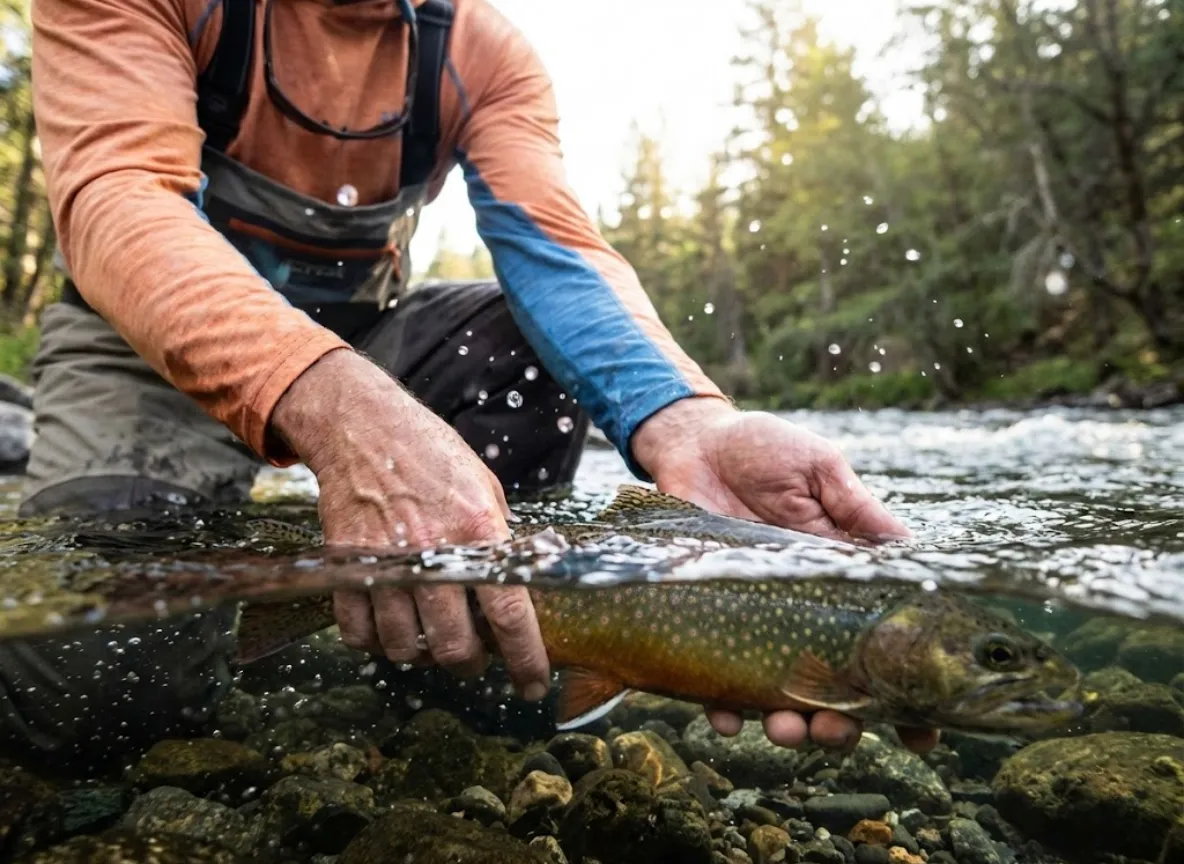
The ideal protocol is “Keep ‘Em Wet.” Unhook the fish while it remains submerged in the net, utilizing the water’s buoyancy to support it. If a photo is necessary, lift the fish for time duration of 10 seconds or less. A practical rule of thumb is to hold your own breath while the fish is out of the water; when you need air, the fish is desperate for water.
Monitor the “Drip Test.” A healthy fish should be dripping water. If the skin becomes tacky or dry, you have exceeded the safe exposure window. This is even more vital during heat waves; implementing a complete summer fishing system includes reducing handling time to zero when water temperature rises above 65°F for sensitive species like trout.
How do you perform a “Bio-Safe” hold?
Gentle gripping pressure and structure matter. Never hold a fish over 5lbs vertically by the jaw. This places the entire body weight on the neck vertebrae and can dislocate the jaw or rupture the isthmus.
Always use a cradle support or horizontal hold. Support the fish with two hands—one securely gripping the tail peduncle and the other cradling the belly or pectoral area to distribute the weight. For detailed visuals on hand placement, review our guide on holding fish correctly.
Avoid the “Gill Plate Grip” unless you are certain your fingers are sliding under the plate toward the chin and not touching the red gill rakers. When returning the fish, use the RAMP Checklist (Reflex Action Mortality Predictor) as part of your revival diagnostics. Check for Eye Roll (eyes track gravity), Tail Clamp (reaction to touch), and Dorsal Fin Erection (equilibrium) before letting go.
How do you treat Barotrauma in deep-water species?
While standard handling applies to most catch and release techniques, deep water presents a unique crisis. Fish pulled from depths greater than 30 feet may suffer from barotrauma, effectively “the bends.” Following Boyle’s Law, as water pressure decreases on ascent, gas volume in the swim bladder increases.
This causes the stomach to evert out of the mouth and eyes to bulge. These fish are too buoyant to submerge. Do not vent (poke) the fish with venting tools unless you are professionally trained.
The modern gold standard is recompression using descender devices, release weights, or release baskets. These tools clamp or weigh the fish down, releasing it only when it reaches a specific recompression depth where the pressure naturally re-compresses the gas.
Pro-Tip: If you don’t have a commercial descending device, use a large inverted barbless hook with a heavy weight attached. Hook it lightly to the fish’s lower lip, lower it to depth, and jerk sharply to release.
Recognizing the symptoms is the first step in fixing barotrauma in fish. Survival rates for descended fish, returned via at depth release, are significantly higher than those released at the surface to float away.
The Steward’s Path
Catch and release fishing is a biological stress event, but it doesn’t have to be a lethal one. By understanding the physiology of stress, equipping yourself with rubber nets and proper hooks, and executing clinical triage protocols, you change the outcome.
Every release is a choice. You can simply let a fish go, or you can ensure it survives. The catch and release techniques detailed here—from the 60-second rule to the horizontal hold—are the difference between a fading memory and a fish that lives to fight another day. Download our “Angler’s Ethics Checklist” to keep in your tackle box, or explore our species-specific handling matrix guides to refine your approach further.
FAQ – Frequently Asked Questions
How long can a fish safely stay out of water?
Research indicates that mortality risks spike significantly after 60 seconds of air exposure. Ideally, keep the fish in the water entirely, or limit lift time to 10 seconds or less (hold your breath as a timer).
Should I remove the hook if the fish has swallowed it deep?
No, you should cut the line using wire cutters as close to the hook eye as possible. Studies show that cutting the line results in a 50-90% higher survival rate than attempting to dig the hook out of the esophagus or gut.
Does touching a fish with dry hands actually hurt it?
Yes, dry hands remove the protective slime coat (mucus), which serves as the fish’s immune system and osmotic barrier. This leaves the fish vulnerable to fatal fungal infections and parasitic attacks days after release.
What is the best way to revive a tired fish?
Resuscitate the fish by holding it facing into the current (or move it gently forward) to push fresh oxygenated water over the gills. Do not move the fish back and forth, as gills function one-way and backward motion can damage the valves.
Risk Disclaimer: Fishing, boating, and all related outdoor activities involve inherent risks that can lead to injury. The information provided on Master Fishing Mag is for educational and informational purposes only. While we strive for accuracy, the information, techniques, and advice on gear and safety are not a substitute for your own best judgment, local knowledge, and adherence to official regulations. Fishing regulations, including seasons, size limits, and species restrictions, change frequently and vary by location. Always consult the latest official regulations from your local fish and wildlife agency before heading out. Proper handling of hooks, knives, and other sharp equipment is essential for safety. Furthermore, be aware of local fish consumption advisories. By using this website, you agree that you are solely responsible for your own safety and for complying with all applicable laws. Any reliance you place on our content is strictly at your own risk. Master Fishing Mag and its authors will not be held liable for any injury, damage, or loss sustained in connection with the use of the information herein.
Affiliate Disclosure: We are a participant in the Amazon Services LLC Associates Program, an affiliate advertising program designed to provide a means for us to earn advertising fees by advertising and linking to Amazon.com. As an Amazon Associate, we earn from qualifying purchases. We also participate in other affiliate programs and may receive a commission on products purchased through our links, at no extra cost to you. Additional terms are found in the terms of service.