In this article
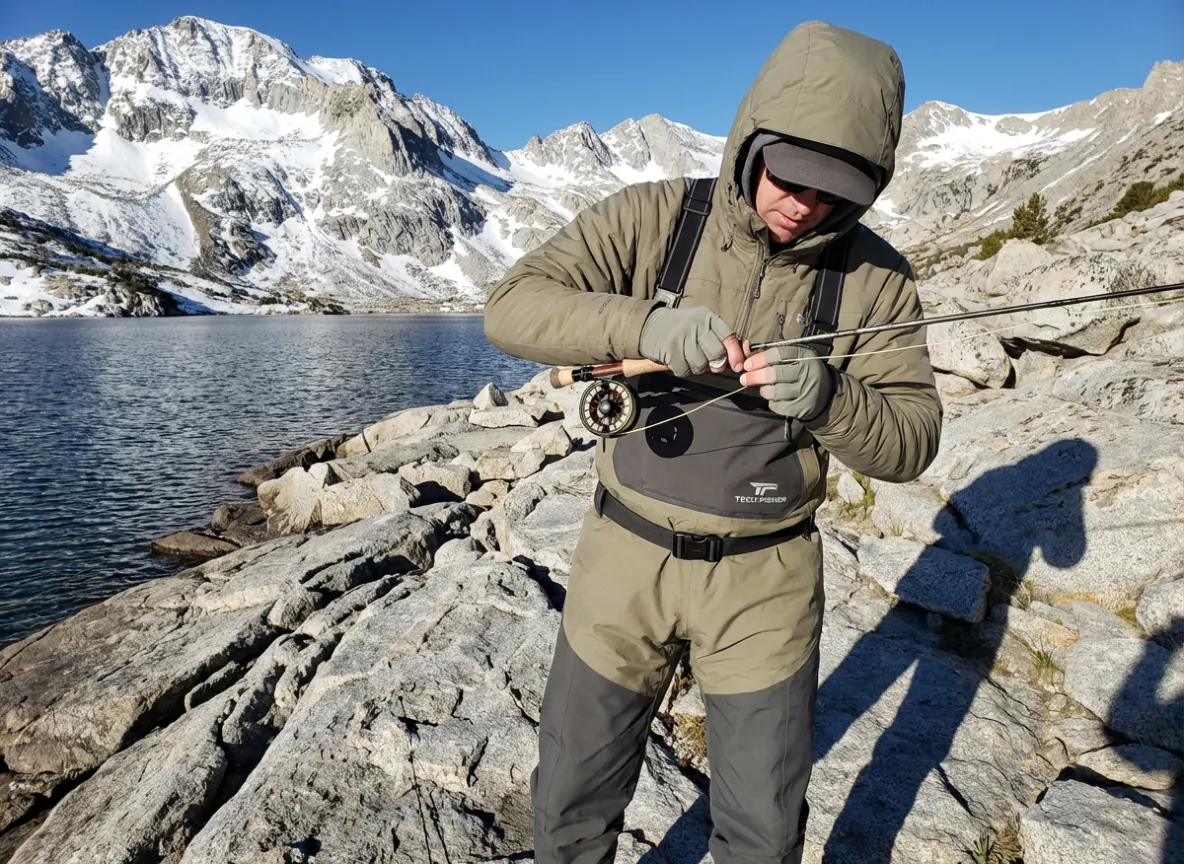
The first time you step up to a pristine tarn in the Rocky Mountains or Sierra Nevada at 10,000 feet, you notice the lungs working harder before you even wet a line. But when you make that first cast—a motion you’ve executed thousands of times at sea level—something feels mechanically wrong. The fly loop collapses. The leader piles up in a heap rather than laying out straight.
It feels like amateur hour, but it isn’t your skill that has failed; it is your understanding of the medium. At this elevation, the air is not just thinner air; it is a fundamentally different atmospheric layer. Oxygen partial pressure plummets, UV penetration bombards the water column without the usual atmospheric filtration, and aerodynamic drag is reduced by nearly 27%.
To succeed in alpine angling, you must move beyond luck and apply a rigorous understanding of environmental physics. We are going to recalibrate your technical approach—from ballistics to ichthyology—to align with the shifted laws of nature in the high country. This is your technical field manual for backcountry fly fishing and high-elevation lure fishing.
1.0 Atmospheric Physics: Why Do Mechanics Fail at Elevation?

At 10,000 feet, the air is significantly thinner than it is at sea level. This creates a strange contradiction for the fisherman: heavy lures actually sail further because there is less air resistance to slow them down, while fly lines often fail to perform because the air is too thin to catch the line and carry it properly.
How does reduced air density alter projectile dynamics?
For the spin fisherman using a micro slow lazy jig or a dense casting bubble, this is a distinct advantage. The drag equation dictates that with lower density, the retarding force on a lure is minimized, allowing for casts that punch well beyond your usual range. However, for the fly angler, drag is a necessary component of the cast.
The friction of the air against the unrolling loop is what helps the leader turn over and straighten out. Without that resistance, the energy dissipates poorly, leading to the dreaded “turnover failure.” To fix this, you cannot rely on the same stroke you use in the lowlands.
You must artificially increase the Reynolds number—and manage Reynolds shear stress—by generating higher line velocities. This is why decoding rod power and rod action is critical before the hike begins. An ultra light power rod might struggle here; a fast-action rod is a tool to generate the speed required to stabilize your loop against the reduced weight of the atmosphere.
Mass distribution becomes your ally in this environment. Lines with aggressive, front-loaded tapers (shooting heads) utilize increased momentum to force the turnover where aerodynamics fail. You have to punch through the thin air physics rather than glide through it.
Pro-Tip: If you are fly fishing above the tree line, shorten your leader by 12 to 18 inches. This stiffens the transfer of energy, compensating for the lack of air resistance and helping your flies turn over cleanly.
According to The Ideal Gas Law and air density calculations provided by NASA, these density changes are predictable constants. By acknowledging them, you stop fighting the air and start working with it to boost your fishing success.
2.0 Aquatic Optics: How Do Trout See in Ultra-Clear Water?
Once you have adjusted your casting stroke, you must turn your attention to the optical layer. Colorado alpine lakes and waters on the Tibetan Plateau are typically oligotrophic (nutrient-poor), lacking suspended solids. This creates ultra-clear water with visibility bordering on absolute, which fundamentally changes how trout detect predators.
What is Snell’s Window and how does it dictate stealth?
In turbid water, light diffuses, softening the edges of a fish’s vision. In an alpine lake, the boundary for Snell’s Window—the 97.2° cone of vision through which trout see the sky—is razor-sharp. Outside this cone, the surface acts as a perfect mirror reflecting the lake bottom.
If you stand tall on the bank, you are projecting your silhouette directly into that cone. Spot-and-stalk tactical geometry requires staying low. By keeping your profile below the 48.6° incidence angle, your image is reflected off the surface via Total Internal Reflection, rendering you invisible to the fish.
This intense mountain light makes your gear stand out more to the fish. A floating nylon leader leaves a “dent” in the water’s surface that casts a clear shadow on the bottom, which easily spooks trout. To stay hidden, you need a line that vanishes. Fluorocarbon is much harder for fish to see because it blends into the water much better than nylon. More importantly, it sinks, getting rid of that surface shadow that usually tips off wary fish.
Why are UV-reflective lures more effective at altitude?
Light composition changes with altitude. UV-B radiation increases by approximately 10-12% for every 1,000 meters of elevation. In lowland waters, Dissolved Organic Carbon (DOC) filters this out, but alpine water is often devoid of DOC.
This allows high-energy UV-B and UV-A wavelengths to penetrate deep into the deep water column, often deeper than red or yellow visible light. Studies on the visual systems of salmonids confirm that trout, particularly high-altitude fish, retain retinal cones sensitive to UV light (peak absorption ~355nm). They use this to detect the contrast of zooplankton, their primary food source.
Standard colored lures often appear grey or black at uv attenuation depth. However, when selecting and rigging lures for trout fishing in the high country, prioritize UV-fluorescent materials. These absorb high-energy photons and re-emit them as visible light, causing the lure to effectively “glow.” Metallic or white finishes that bounce ambient background radiation also mimic the UV signature of baitfish or insect carapaces.
Research on UV attenuation in alpine lakes suggests that in these environments, a UV-active lure is not a gimmick; it is the most biologically accurate presentation you can make for brook trout or brown trout (Salmo trutta).
3.0 Hydrodynamics & Biology: The Oxygen-Metabolism Squeeze
Visual deception gets the strike, but the fish’s ability to even pursue that lure is governed by the biological layer and the invisible chemistry of the water column.
How does altitude alter dissolved oxygen availability?
Henry’s Law states that the concentration of dissolved oxygen is proportional to its partial pressure. At 10,000 feet, the atmospheric partial pressure of oxygen is roughly 31% lower than at sea level. This means the “driving force” pushing oxygen into the water is weak.
Even if the water is fully saturated (DO saturation), the absolute mass of oxygen available is significantly reduced. This creates a dangerous “thermal-hypoxic squeeze” as the day warms up. As water temperature, the thermocline, and dissolved oxygen interact, the trout are caught in a bind.
Rising water temperature increases their metabolic rates, demanding more oxygen exactly when oxygen solubility is at its lowest.
To find fish, look for the mechanical layer. Target inlets, waterfalls, or wind-swept shorelines where high-velocity turbulence acts as an “oxygen pump,” supercharging the water beyond the limits of passive diffusion. Understanding the relationship between altitude and oxygen helps you realize that freshwater fish aren’t just hiding; they are seeking life support.
4.0 Physiology & Field Protocols: The Pressure Myth vs. Reality
While oxygen levels dictate where fish live, it is often the changing weather that dictates when they feed. However, most fishermen misunderstand why.
Does barometric pressure actually bloat fish?
There is a persistent myth that low pressure (storms) causes swim bladders to expand, bloating the fish and forcing them deep to relieve the pain. Physics refutes this entirely. A typical storm drops pressure by about 0.5 inHg. According to hydrostatic pressure principles and Boyle’s Law, a fish only needs to swim down roughly 6 inches to fully counteract this change.
Trout are physostomous fish. As detailed in swim bladder mechanics, they possess a pneumatic duct connecting the bladder to the esophagus, allowing for rapid gas regulation. They are not suffering during a pressure drop like physoclistous fish (e.g., perch) might.
The fishing frenzy during a storm is driven by light and safety, not bloating. Cloudy skies reduce the contrast of the fish’s shadow, and wind chop disrupts Snell’s Window. Understanding physostomous swim bladder function frees you to aggressively target shallow littoral zones during low-pressure events, knowing the rainbow trout (Oncorhynchus mykiss) are hunting, not hurting.
How must handling change to prevent mortality?
Hooking these fish in thin air brings a grave responsibility. Fighting a fish is an anaerobic activity that generates lactate and creates an oxygen debt. In the low partial pressure environment of high altitude, recovering from this debt takes significantly longer than at sea level.
Worse yet, the arid alpine air is lethal to gill filaments. The delicate lamellae can dry out and collapse in seconds, causing permanent gas exchange failure even after release. The science of catch and release at this altitude demands a zero-exposure policy.
Pro-Tip: Upgrade your tippet strength (use 4X instead of 5X). The water may be clear, but the fish’s metabolic fragility takes precedence. Heavier tippet allows you to land the fish 30% faster, preserving its glycogen stores for survival.
Keep the fish submerged in a rubber net at all times. When releasing, hold the fish into the current to facilitate “ram ventilation,” artificially forcing water over the gills until you feel the fish kick away strongly. Following the principles of catch and release set by the National Park Service is not just a suggestion; it is a requirement for the sustainability of these isolated fisheries.
Tactical Summary
Success in the alpine zone is rarely an accident. It is the result of aligning your fishing tactics with physics.
- Aerodynamics: You use faster rod actions and aggressive tapers to overcome low air density.
- Optics: You use fluorocarbon and a low profile to defeat the clarity of Snell’s Window.
- Spectrums: You utilize UV-reflective lures to match the light penetration of oligotrophic water.
- Physiology: You handle fish with extreme care, acknowledging the hypoxic reality of their environment.
Next time you hike above the tree line, don’t just bring your rod—bring this physics-based fishing IQ.
FAQ – Frequently Asked Questions about High Altitude Fishing Physics
Does fishing get better or worse at high altitude?
It is often more productive due to lower fishing activity, but technically more difficult due to clear water and environmental extremes. Success depends on adjusting for the spookiness of fish in high-visibility water and the short feeding windows dictated by thermal conditions.
How does altitude affect dissolved oxygen in water?
Altitude reduces the atmospheric pressure driving oxygen into the water. This limits the total available oxygen (mg/L) for trout, often forcing them into high-velocity areas or specific thermal layers to breathe efficiently.
Can fish see UV light?
Yes, salmonids (trout or salmon) possess specific retinal cones sensitive to ultraviolet light (~355nm), especially in juvenile stages and high-altitude populations. This allows them to detect zooplankton and prey items that contrast against the UV-saturated background of clear alpine water.
Why do my casts fall short or pile up at high elevation?
The reduced air density lowers the aerodynamic drag that usually helps the fly loop unroll and the leader straighten out. To fix this, you need to generate higher line speeds (kinetic energy) to maintain loop stability in the thinner air.
Risk Disclaimer: Fishing, boating, and all related outdoor activities involve inherent risks that can lead to injury. The information provided on Master Fishing Mag is for educational and informational purposes only. While we strive for accuracy, the information, techniques, and advice on gear and safety are not a substitute for your own best judgment, local knowledge, and adherence to official regulations. Fishing regulations, including seasons, size limits, and species restrictions, change frequently and vary by location. Always consult the latest official regulations from your local fish and wildlife agency before heading out. Proper handling of hooks, knives, and other sharp equipment is essential for safety. Furthermore, be aware of local fish consumption advisories. By using this website, you agree that you are solely responsible for your own safety and for complying with all applicable laws. Any reliance you place on our content is strictly at your own risk. Master Fishing Mag and its authors will not be held liable for any injury, damage, or loss sustained in connection with the use of the information herein.
Affiliate Disclosure: We are a participant in the Amazon Services LLC Associates Program, an affiliate advertising program designed to provide a means for us to earn advertising fees by advertising and linking to Amazon.com. As an Amazon Associate, we earn from qualifying purchases. We also participate in other affiliate programs and may receive a commission on products purchased through our links, at no extra cost to you. Additional terms are found in the terms of service.