In this article
The line goes slack, the rod loads, and the drag screams. In this moment, the predator-prey dynamic is pure. However, the instant the fish breaks the surface tension, the dynamic shifts from pursuit to stewardship. You are no longer just an angler; you are the sole life-support system for an aquatic organism forcibly transitioned into a hostile, low-pressure, gravity-heavy environment.
The “Hero Shot” is the currency of modern fishing culture, but its cost should not be the creature’s life. I have seen too many trophy fish swim away vigorously, only to be found floating belly-up downstream an hour later. True competence in recreational fishing is not demonstrated by the landing, but by the release—watching the fish kick away strong, slime coat intact and jaw structure uncompromised.
This guide transforms biological data into wilderness instinct, ensuring your interaction is a survival event, not a mortality statistic.
Why is the “Human-Fish Interaction Event” biologically critical?

The “Human-Fish Interaction Event” is critical because fish species are biologically engineered for zero-gravity suspension and aqueous respiration. Removing them from water instantly initiates respiratory collapse and compromises their primary immune defense, the mucosal layer.
How does air exposure affect fish physiology?
When a freshwater or saltwater fish is lifted from the water, the impact is immediate. Gills are composed of delicate filaments called lamellae. Underwater, they float freely to maximize surface area for oxygen absorption. In the air, surface tension causes these gill filaments to collapse and stick together, drastically reducing their ability to exchange gas. This triggers the Hypoxic Cascade.
Even if the fish holds its breath, it is chemically suffocating. Imagine human lungs filling with concrete; that is the sensation of oxygen deprivation for a fish. The metabolism shifts to anaerobic respiration, creating an oxygen debt and producing lactate. This accumulation drops blood pH, resulting in metabolic acidosis. This is why studies on physiological effects of brief air exposure in salmonidae suggest that crossing the 60-Second Threshold can impair equilibrium and swimming ability for hours.
Pro-Tip: If you are struggling to remove a hook, keep the fish submerged in the net. Every second the gills are underwater pauses the “hypoxia clock,” giving you time to work without suffocating the catch.
We often see the “walking dead” phenomenon: a fish releases vigorously due to the acute flight response but dies hours later because it cannot recover from the acidosis. To prevent this, mastering revival techniques and the science of catch and release techniques is just as important as mastering the cast. Warm water exacerbates this issue, as metabolic rates rise with temperature, making air exposure exponentially more damaging for hot trout or stressed muskie.
Why is the “slime coat” essential for immune health?
That slippery feeling on a fish isn’t just lubrication; it is a complex, living shield. The mucosal immune system contains lectins, lysozymes, and antimicrobial peptides that act as the fish’s first line of defense against parasites and bacteria. It also regulates osmosis, keeping essential fluids inside the fish and water out.
Touching a fish with dry hands, or worse, cotton gloves, acts like sandpaper. It wicks away moisture and physically strips this layer. Once that barrier is breached, it opens a portal for opportunistic water molds like Saprolegnia.
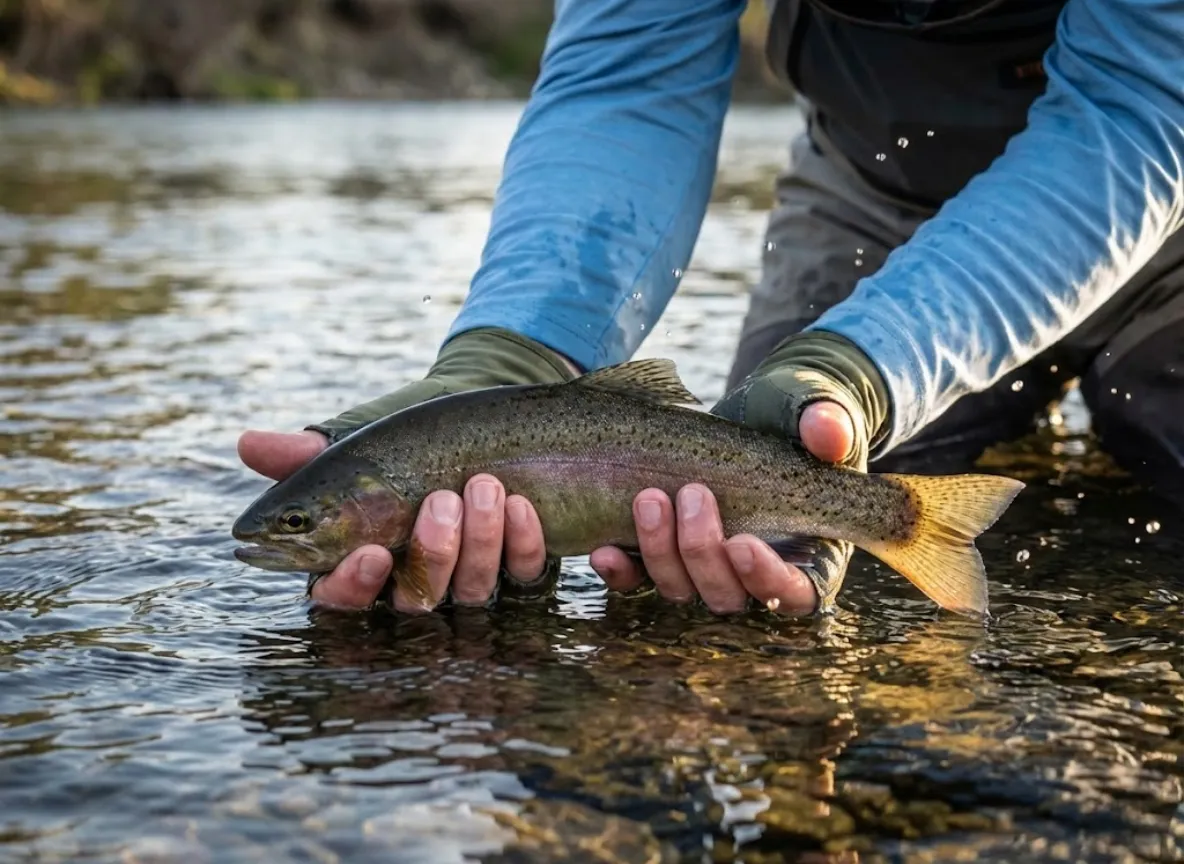
Pro-Tip: Always wet your hands before touching a fish. This creates a hydro-layer between your skin and the fish’s scales, reducing friction and preventing the removal of mucus.
While rubber gloves are acceptable for handling dangerous leaders or spines (provided they are wet), cloth is a hazard. Placing a fish on a dry deck or dirt bank is biologically equivalent to a severe burn. Understanding this barrier is a fundamental part of fish conservation for anglers, as the window of vulnerability to infection remains open for days post-release. NIH reviews on epidermal mucus function confirm that this layer is not just physical protection, but a biological necessity.
What gear constitutes a conservation-grade handling kit?
Your toolkit must evolve to match the biology of your quarry, whether you are chasing panfish like crappie and bluegill, or heavy hitters like catfish and carp. Traditional equipment often favors the angler’s convenience over fish safety.
Which landing net materials minimize injury?
The material of your net is the single most significant factor in external injury rates. Old-school knotted nylon nets act like cheese graters. The knots split the caudal peduncle (tail wrist) and strip scales, creating immediate injury sites.
A rubberized landing net is the conservation standard. It is smooth, non-porous, and supports the fish’s weight through elasticity rather than rigidity. Also, hooks rarely snag in rubber, which directly reduces handling time and air exposure. Research on landing net mesh types and injury rates consistently scores rubber nets as having the lowest mortality correlation.
Net Safety Matrix
Comparison of net materials and their impact on fish health
Slime Coat Retention
High
Fin Integrity
High
Hook Snag Resistance
Excellent
Slime Coat Retention
Moderate (if wet)
Fin Integrity
Moderate
Hook Snag Resistance
Poor
Slime Coat Retention
Very Low
Fin Integrity
Low (Splits fins)
Hook Snag Resistance
Very Poor
When selecting fish-safe landing nets, look for flat-bottomed designs. These allow the fish to lie naturally rather than being folded into a U-shape, which can strain the spine and vertebrae.
When are mechanical grippers (e.g., BogaGrip) safe to use?
Lip grippers are useful tools, but they carry a high risk of user error. The non-negotiable feature of any safe gripper is a rotating head (swivel). If a fish spins while clamped in a fixed-head gripper, the torque can break the mandible or separate the tongue—injuries that are often fatal.
Grippers should primarily be used for control while the fish is in the water. This allows you to use your needle-nose pliers to remove hooks safely without handling the body. However, never hang a heavy fish vertically by the jaw alone. The jaw is designed for suction, not for supporting the creature’s entire body weight against gravity.
Guidelines on mechanical grippers and fish injury highlight the severe damage caused by rigid lifting. If you must lift a fish, use a “Two-Point” technique: grip the jaw to control the head, but immediately support the belly with your other hand. Using field-tested best fishing pliers in tandem with a safe gripper ensures you can unhook the fish quickly while keeping your hands clear of treble hooks and teeth.
How do you execute species-specific holding protocols?
A largemouth bass is not a trout, and a northern pike is not a sunfish. Understanding the skeletal and muscular limitations of specific game fish is required to avoid structural damage.
What is the “Two-Handed Horizontal Hold” for Bass?
The “Jaw Jacker” is perhaps the most common handling error in bass fishing. This occurs when an angler holds a largemouth or smallmouth bass by the lower lip and torques it horizontally without supporting the tail. This puts immense pressure on the temporomandibular joint and the isthmus.
While Bass Care 101 guidelines from the Maryland DNR suggest a vertical plumb-line hold is marginally acceptable for small fish (<5 lbs), applying the 10-degree rule (never angle more than 10 degrees without support) is vital. The Two-Handed Horizontal Hold is the gold standard. Place your thumb inside the lip for a firm grip, curl your fingers under the jaw, and use your second hand to cradle the anal fins area. Avoid the “air guitar hold” where the fish is bent awkwardly.
Reviewing these Largemouth Bass biological facts reveals that damage to the isthmus impairs the vacuum pressure required for the bass to feed. If you break the jaw, you starve the fish.
How do you safely handle Trout and Salmonids?
Trout—including brook trout, rainbow trout, lake trout, and steelhead—are exponentially more fragile than bass. Their jaws are cartilaginous and weak; “lipping” a trout will almost certainly dislocate the jaw. Trout also have a loose scale structure that sheds easily.
The proper technique is the Cradle Grip or belly cradle. With wet hands, slide one hand gently under the pectoral fins (avoiding a tight death squeeze near the vital organs like the heart) and grasp the tail wrist with the other.
Thermal sensitivity is also a major factor. Learning the fundamentals of trout fishing for beginners includes knowing when not to fish. In water over 65°F (18°C), metabolic stress is heightened for hot trout, and they should ideally never be removed from the water. Adhere to the trout handling reminders from conservation groups: keep them wet, use barbless hooks, and release them facing current to aid respiration.
How do you manage the dentition and length of Pike and Muskie?
Esox species like Northern Pike and Muskellunge (Muskie) present a challenge due to their length and teeth. Their extreme length makes them susceptible to vertebral separation if held vertically; gravity pulls the heavy stomach and internal organs downward, straining the connective tissue.
The safest hold is the Gill Plate Grip (or “The Giller”), but it requires precision. You must slide your fingers inside the operculum (gill cover) but stay strictly on the hard bone plate.
Touching the red gill rakers can cause fatal bleeding for the fish and severe lacerations for the angler. Always support the belly horizontally. For trophy-sized fish, consider using a cradle net or releasing them in the water. Jaw spreaders and wire cutters are essential safety tools here. Following catch-and-release fish handling protocols from the Ontario Ministry ensures these apex predators survive to fight again. Before targeting them, spend time analyzing strategic Northern Pike facts to understand their anatomy.
How do you manage complex handling scenarios?
Sometimes you are a solo angler, or the fish has been pulled from the depths. These scenarios require specific operational mindsets, similar to handling walleye or sharks in salt water fishing where spines and teeth are dangerous.
What is the “Solo Angler Protocol” for netting and photos?
Fishing alone removes your safety net—literally and figuratively. The “Rod Behind” technique is essential: disengage the reel and secure the rod under your armpit or in a holder before attempting to lift the net. Trying to high-stick a fish into a net with one hand is a recipe for broken graphite.
Once the fish is netted, leave it in the water. This is your staging area. Set up your camera, prepare your pliers, and ensure your personal safety. Implementing our definitive fishing safety tips is vital here; wearing a PFD and a Kill Switch is mandatory when leaning over the gunwale to self-land a fish.
Recent Muskellunge catch-and-release mortality studies indicate that air exposure is cumulative. Use a 10-second timer on your phone to self-photograph. Lift the fish, take the shot, and return it instantly. If the setup takes too long, sacrifice the photo, not the fish.
How do you treat Barotrauma in deep-water species?
When you pull a fish like a Bass, Walleye, or Rockfish from deep water (usually 20+ feet), Boyle’s Law takes effect. The decrease in pressure causes the gas in their swim bladder to expand. Because these fish are physoclistous (they cannot “burp” air), the gas expands internally, causing the stomach to protrude from the mouth and eyes to bulge.
Releasing a “floater” is a death sentence. The old method of “fizzing” (puncturing the fish with a needle) is invasive and risky. The modern solution is a Descending Device. This weighted clamp returns the fish to the depth where it was hooked, allowing the pressure to naturally recompress the gas.
The DESCEND Act requirements from NOAA highlight the shift toward mandatory possession of this gear in many marine fisheries. If you fish deep, you must carry a device like a SeaQualizer. For a detailed breakdown on using these tools, try following our step-by-step guide on fixing barotrauma in fish.
Conclusion
The difference between a dead fish and a survivor often comes down to seconds and moisture.
- The 60-Second Rule: Hard limits on air exposure are the single biggest factor in survival.
- Structure & Slime: Always support the fish’s weight horizontally and never touch them with dry hands or cloth.
- The Right Tool: Use rubberized landing nets and descending devices to minimize mechanical injury.
The ethical angling mandate is simple: A successful release is not when the fish leaves your hand, but when it survives to spawn another day. Fish deserve that chance.
Ready to upgrade your handling kit? Explore our reviews of the Best Conservation-Grade Landing Nets or share your own release tips in the comments below.
FAQ – Frequently Asked Questions
Is it okay to hold a bass vertically by the lip?
Only if the bass weighs less than 5 lbs and is held perfectly vertical (plumb line). However, a two-handed horizontal hold is always safer and recommended for all sizes to prevent jaw and isthmus damage.
Why can’t I use a towel or gloves to hold a fish?
Cloth towels and cotton gloves act as abrasives that strip the fish’s protective slime coat (mucosal immune system), leaving them vulnerable to deadly infections like Saprolegnia. Use bare, wet hands or non-absorbent wet gloves.
What should I do if a fish is bleeding from the gills?
If it is a legal eater fish (harvestable), you should keep it, as gill injuries are often fatal. If release is mandatory, hold the fish in oxygenated water to promote clotting; do not attempt to touch or treat the gills yourself.
How long can a fish stay out of water?
Research indicates that permanent damage or mortality risks increase significantly after 60 seconds of air exposure. The best practice is to keep the fish in the water as much as possible and limit air time to under 30 seconds.
Risk Disclaimer: Fishing, boating, and all related outdoor activities involve inherent risks that can lead to injury. The information provided on Master Fishing Mag is for educational and informational purposes only. While we strive for accuracy, the information, techniques, and advice on gear and safety are not a substitute for your own best judgment, local knowledge, and adherence to official regulations. Fishing regulations, including seasons, size limits, and species restrictions, change frequently and vary by location. Always consult the latest official regulations from your local fish and wildlife agency before heading out. Proper handling of hooks, knives, and other sharp equipment is essential for safety. Furthermore, be aware of local fish consumption advisories. By using this website, you agree that you are solely responsible for your own safety and for complying with all applicable laws. Any reliance you place on our content is strictly at your own risk. Master Fishing Mag and its authors will not be held liable for any injury, damage, or loss sustained in connection with the use of the information herein.
Affiliate Disclosure: We are a participant in the Amazon Services LLC Associates Program, an affiliate advertising program designed to provide a means for us to earn advertising fees by advertising and linking to Amazon.com. As an Amazon Associate, we earn from qualifying purchases. We also participate in other affiliate programs and may receive a commission on products purchased through our links, at no extra cost to you. Additional terms are found in the terms of service.