In this article
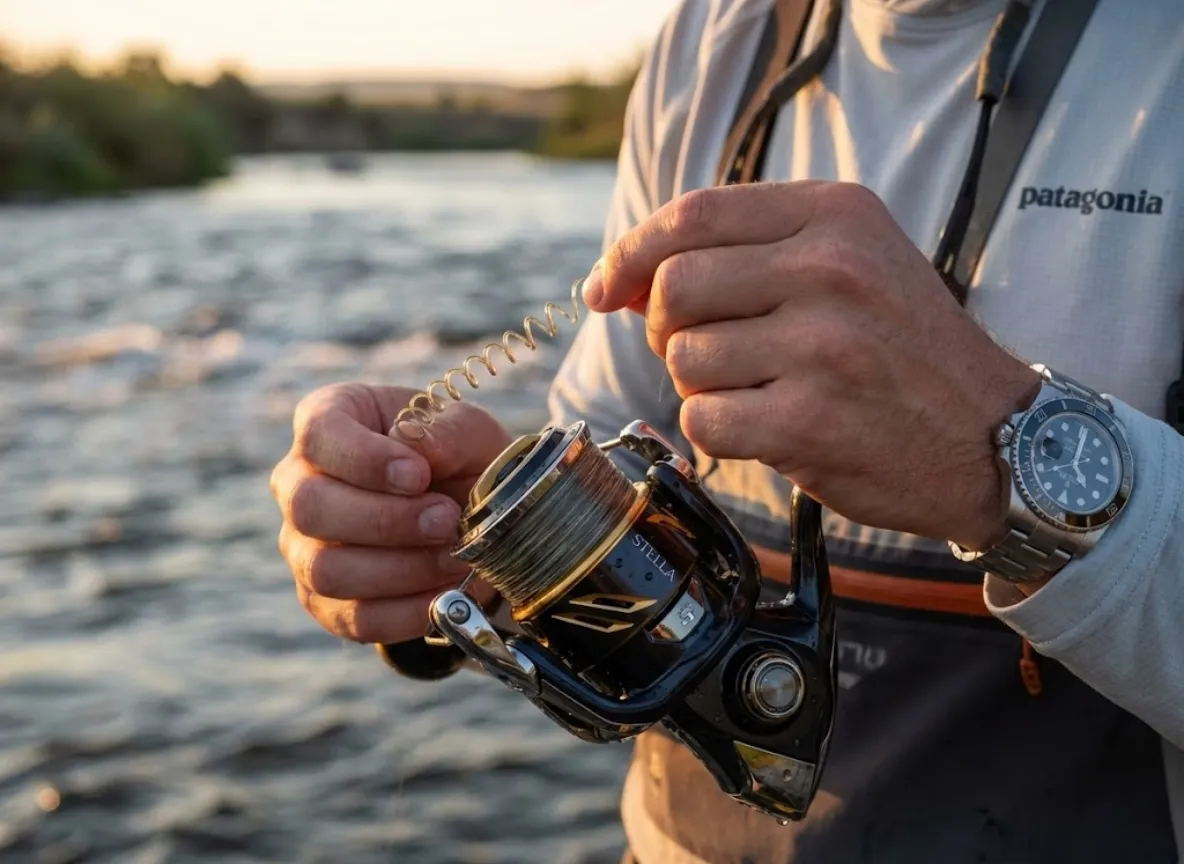
There is a specific kind of heartbreak known only to anglers who wake up before dawn. You hike to the water’s edge, spot a trophy bass holding near cover, and make that first, critical cast. But instead of flying straight and true, the line springs off your spool looking like a coiled vintage telephone cord. The lure falls short, the line slaps the water, and the fish vanishes.
That helical mess—fishing line memory—is not just bad luck. As a guide, I tell my clients that it is a mechanical failure of the equipment. It creates friction in the guides, destroys casting accuracy, and ruins the presentation of your lure. To reclaim your performance, you must stop treating this line memory problem as an annoyance and start treating it as a material science puzzle. We solve fishing line memory issues through thermal annealing and mechanical stress relief.
Here is how to diagnose the issue, remove line memory safely at home, and handle emergency field triage when you are already on the water.
What is actually happening to my line?

Before you start pulling on your unruly line or boiling water, you must define the physical phenomenon occurring inside your reel. Distinguishing between bending stress and torsional stress is the difference between fixing the problem and making it significantly worse.
Is it line memory or line twist?
Line memory is the material retaining the shape of the spool, forming large, clean memory coils. Line twist is a torsional issue where the line spins on its own axis, creating kinks, knots, and pigtailing.
To diagnose this, strip about ten feet of fresh line off your reel and let it hang slack with a swimbait or weight attached. Watch how the line behaves in the air.
If the line forms large, vertical loops that resemble the curvature of your spool, you are dealing with high memory. This is a bending stress issue. However, if the line kinks back on itself, braids together, or if the lure begins spinning wildly, you are fighting line twist. This often happens when a stuck swivel fails to rotate or you spool a spinning reel incorrectly.
This distinction is vital. Treating twist with memory fixes—like heating—can disastrously lock the torque into the molecular structure. While memory is caused by storage, twist is often the result of spooling your spinning reel correctly or reeling against the drag. If you identify twist, the solution involves counter-rotation (often called the boat-drag technique), not heat. If you identify memory, you need to relax the nylon polymers, as confirmed by studies on the tensile properties of twisted polymer structures.
Why does fishing line behave like a slinky?
Modern fishing lines, specifically Nylon monofilament and Fluorocarbon, are semi-crystalline polymers composed of long molecular chains. When you wind new line onto a spool under tension, the chains in the amorphous regions of the plastic slide past one another to relieve that stress—a process known as “creep.”
Over time, the fishing line actually changes its internal structure to match the curve of the spool, effectively “locking” that shape into the material’s memory. The severity of these coils comes down to a simple mismatch between the thickness of your line and the size of your reel. If you wrap a thick, stiff line around a small spool, you are forcing it into a very tight bend. This creates stubborn, springy coils that will cause tangles and kill your casting distance the moment you try to use it.
Time and temperature accelerate this process. Heat allows the molecular chains to reorganize faster. This explains why a reel left in a hot garage with high ambient temperature during summer will have far worse memory than one stored in a cool basement. The line suffers from a time-dependent strain recovery failure; it simply lacks the internal energy to snap back to straightness without assistance. UV light can also degrade the plasticizers in nylon, making old line stiffer and more prone to coiling.
Researchers studying the glass transition temperature of Nylon 6 have found that while heat caused the problem, controlled heat is also the only way to reverse it. This understanding of spool radius and polymer strain is a major factor when looking at line management on modern spinning reels.
How do I fix line memory at home?
The most effective method for removing line memory coils is “Thermal Annealing.” This involves heating the line just enough to relax the internal polymer bonds without melting them or degrading the line’s strength.
What is the “Safe Thermal Zone” for heating line?
The “Safe Thermal Zone” for treating fishing line is strictly 45°C to 60°C (hot tap water). You must never use boiling water.
To perform this fix, remove the spool from your spinning reel or baitcasting reel. This protects the drag grease and internal washers. Submerge the spool in a bowl of this warm water for about 20 minutes. The goal is to exceed the material’s Glass Transition Temperature (Tg), allowing chain mobility, while staying well below the melting point.
Boiling water (100°C) is dangerous to the equipment. It can degrade Nylon’s tensile strength by 15-20% and melt internal components if you skip removing the spool. Understanding the thermodynamic characteristics of aliphatic polyamide helps us see why excess heat destroys the crystal structure of the line.
Pro-Tip: Cooling is just as important as heating. Do not take the warm spool out and immediately handle it. Let the water cool to room temperature with the spool submerged. This “sets” the relaxation, ensuring the line remains straight.
Treating your line with this thermal bath is a key part of tackle maintenance and routine sustainable gear maintenance, extending the lifespan of your products and keeping wasted line out of landfills.
How does material type change the soaking process?
Not all fishing lines react to water the same way. Nylon Monofilament is hygroscopic, meaning it absorbs water. In this scenario, the water acts as a plasticizer.
For Nylon, a warm soak works through two mechanisms: thermal energy relaxes the chains, and water absorption chemically softens the line, lowering the energy required for those chains to move. This is why some anglers notice their line limpness improves after it has been wet for an hour.
Fluorocarbon, conversely, is hydrophobic. It does not absorb water and relies entirely on thermal penetration. Because Fluorocarbon is denser and acts as a better insulator, it requires a longer soak duration—typically 30 to 45 minutes—to ensure the heat reaches the deep layers of the spool near the arbor.
Technical papers regarding the influence of water on mechanical properties confirm that while a cold soak might help Nylon slightly, it does nothing for Fluorocarbon. You need the water temperature to be elevated. This behavior is a critical differentiator when choosing between braid vs fluorocarbon vs monofilament. Many anglers rely on line conditioner or line-detangling products, but these are essentially surface lubricants; they cannot reset the core memory like heat can.
How can I remove coils while on the water?
Thermal annealing is the gold standard for home preparation. However, if you arrive at the lake and find your line unfishable, you need a “Field Triage” technique. These rely on mechanical yielding and friction rather than ambient heat.
Can I stretch the line to remove memory?
Yes. The most common field fix is the “Tree Anchor” or hand-stretch technique. This involves tying your line to a stationary object—like a tree branch or fence post—and walking off about 50 to 75 yards of line.
Once the line is out, apply steady, sustained stretch tension. Do not jerk the rod. You want to feel the line stretch significantly. Hold this tension for 30 to 60 seconds. You are aiming for the “Yield Point”—the degree of stretch where the polymer chains slide out of their coiled position but do not permanently deform or snap.
Patents describing the method of manufacturing a super high floating line utilize similar stretching processes to alter line properties. However, be cautious with light lines under 6lb test. Stretching them too close to their breaking strength can compromise their diameter.
You must also ensure you are using secure angling knots to attach the line to the anchor. If the knot slips, the line can shoot back at you with dangerous velocity. Reel the line taut back onto the spool, using your fingers to apply tension. This is a temporary emergency 30-second field fix; without heat to reset the bonds, the memory will eventually return.
What is the “Belt Friction” technique?
For thick leaders or heavy fly line that resist simple stretching, you may need “Flash Annealing” via friction. This is often referred to as the leather friction technique.
Run the coiled section of the leader rapidly through a folded piece of leather, a piece of rubber, or even your leather belt while applying tight pressure. The friction generates immediate, localized heat—often exceeding 60°C—at the exact point of the bend.
Pro-Tip: Speed is critical here. Pulling too slowly generates no heat, while pulling too fast without pressure just abrades the line. You must find the sweet spot where the line feels warm to the touch immediately after passing through the material.
This is a high-risk, high-reward tactic. Excessive heat can glaze or weaken the outer coating of the line, which is a significant concern in fly fishing line manufacturing. Use this primarily when tying a leader for snook and reds where the fluorocarbon is thick enough to withstand the abuse. This is the only way to how to remove memory (coils) from your fly line leader effectively in the field.
Conclusion
Line memory is not a curse; it is a symptom of physics of casting and polymers. By understanding the line management science behind your gear, you can ensure your presentation remains natural and your casting distance stays long.
- Heat beats Force: Thermal annealing at roughly 50°C is the safest way to reset polymer memory and achieve minimal memory.
- The Boiling Myth: Never use boiling water. It degrades tensile strength and ruins reel grease.
- Material Matters: Wet nylon relaxes faster due to water absorption; you must stretch fluorocarbon line or use pure heat.
- Prevention: A large arbor reel and proper storage tension are the first line of defense to avoid memory.
Check your spools tonight. If they look like springs, soak in warm water now so you aren’t fighting your gear longevity on the water tomorrow.
FAQ – Frequently Asked Questions
Does boiling water damage fishing line?
Yes. Boiling water (100°C) exceeds the safe thermal limit for Nylon, causing hydrolytic degradation that can reduce line strength by up to 20%. It also poses a severe risk to your reel, as it can melt the grease in your drag system and bearings.
How do I stop my fishing line from coiling?
Use a Large Arbor Reel. Increasing the spool diameter reduces the strain on the line ($\epsilon = r/R$), preventing tight coils from locking in. Regularly treating the line with a polymer-bonding line conditioner can also help maintain flexibility and reduce water absorption issues in Nylon.
Does braided fishing line have memory?
Generally, no. Braids are made of woven polyethylene fibers which do not possess the same crystal lattice structure as monofilament, meaning they offer low memory line performance. If braid appears stiff or coiled, it is usually due to the waxy coating, which will soften with use or a quick mechanical pulls.
What is the difference between line memory and line twist?
Geometry. Line memory manifests as vertical loops (like a slinky) caused by storage on a spool; Line twist manifests as kinks or braiding caused by the line rotating on its axis (often creating wind knots). Memory is fixed by heat or stretching; Twist is fixed by untwisting the line via trolling or spinning the lure in the opposite direction.
Risk Disclaimer: Fishing, boating, and all related outdoor activities involve inherent risks that can lead to injury. The information provided on Master Fishing Mag is for educational and informational purposes only. While we strive for accuracy, the information, techniques, and advice on gear and safety are not a substitute for your own best judgment, local knowledge, and adherence to official regulations. Fishing regulations, including seasons, size limits, and species restrictions, change frequently and vary by location. Always consult the latest official regulations from your local fish and wildlife agency before heading out. Proper handling of hooks, knives, and other sharp equipment is essential for safety. Furthermore, be aware of local fish consumption advisories. By using this website, you agree that you are solely responsible for your own safety and for complying with all applicable laws. Any reliance you place on our content is strictly at your own risk. Master Fishing Mag and its authors will not be held liable for any injury, damage, or loss sustained in connection with the use of the information herein.
Affiliate Disclosure: We are a participant in the Amazon Services LLC Associates Program, an affiliate advertising program designed to provide a means for us to earn advertising fees by advertising and linking to Amazon.com. As an Amazon Associate, we earn from qualifying purchases. We also participate in other affiliate programs and may receive a commission on products purchased through our links, at no extra cost to you. Additional terms are found in the terms of service.