

In this article
The engine cuts, and the boat drifts silently across the invisible line in the middle of the river. One cast to the left lands in Maryland; a cast to the right lands in Virginia. In your cooler, a Red Drum sits on ice—legal by one state’s ruler, potentially criminal by the other’s.
This is the reality of modern angling. The challenge isn’t just hooking the fish, but navigating the complex overlap of biology, geography, and law that governs the water. As a guide, I’ve seen seasoned anglers freeze up when a game warden approaches, not because they are poachers, but because the fishing regulations handbook feels like a legal labyrinth.
Mastering these state fishing regulations is as critical to your success as your knot-tying skills. It serves as the barrier between a successful harvest and a court date. We are going to strip away the bureaucratic jargon and look at the economic logic of licenses, the geopolitical complexity of borders, and the biological necessity of limits. By the end, you will have the confidence to navigate any jurisdiction legally, armed with your own angler’s simplified legal companion.
How Do License Costs and Structures Work?

This section demystifies the financial architecture of fishing, helping anglers optimize their spending by understanding fee structure, residency tiers, duration math, and hidden endorsements.
Why is there such a price disparity between residents and non-residents?
State agencies operate on a “user-pay, public-benefit” model. License fees directly fund wildlife resource management and conservation efforts within that specific jurisdiction. Residents pay into the system continuously through state taxes and local economic participation, earning them a subsidized “base rate.” For example, a resident cost might be $17 while a non-resident cost hits $47. Non-residents are viewed as “importers of pressure” and “exporters of resources,” leading states to charge premiums to offset the lack of local tax contribution.
However, there is a secondary economic driver. Federal funding relies heavily on the apportionment of funds under the Dingell-Johnson Act. This matches state funds based on the number of paid license holders. This incentivizes fishery managers to sell volume, not just high-priced tickets. “Destination Fisheries” like California or Colorado leverage their unique biological assets—like stream trout or migratory fish—to command higher market prices, essentially treating the license as a premium access pass. Understanding this allows you to budget accurately, recognizing that the extra fee is a necessary conservation tariff. Funding derived from the Dingell-Johnson Act is what keeps the hatcheries running and the boat ramps paved.
When does an Annual License make more sense than a Short-Term Pass?
To decide, perform a simple “Breakeven Analysis” by dividing the cost of the non-resident annual license by the daily cost of a 1-day license or 3-day license. In states like Florida, the breakeven point is often around 9 days. If you plan to fish more than two long weekends, the annual option is the superior value. However, in high-cost states like California, the sport fishing license fees are steeper. An annual pass (~$170) requires nearly 9 separate fishing days to justify the cost over the daily rate (~$19), making short-term passes better for casual tourists.
Comparative License Cost Analysis
State-by-State Fishing License Cost Breakdown & Non-Resident Multipliers
License Type
Annual Sport Fishing
Non-Resident Cost
~$169.82
License Type
Annual Saltwater
Non-Resident Cost
$47.00
License Type
All-Water Package
Non-Resident Cost
$68.00
License Type
Annual Fishing
Non-Resident Cost
$60.00
License Type
Freshwater Annual
Non-Resident Cost
$39.50
License Type
Freshwater Annual
Non-Resident Cost
$84.50
Beyond the math, consider the “hassle factor.” Annual licenses often grant license reciprocity privileges that short-term passes do not. This is critical if you are planning your next family fishing vacation on border waters. Additionally, an annual license allows for spontaneous trips without the friction of finding a vendor at 5:00 AM. Always check the valid dates; in some regions, fishing licenses are effective from March 1 to the last day of February of the following year, while others run 365 days from purchase.
Pro-Tip: If buying a license late in the year (e.g., November), check if the state offers a “Year-to-Date” discount or if you should wait for the new calendar year to begin. Some states sell next year’s license starting in December, which is valid immediately.
What are “Endorsements” and why are they required?
A “Base License” is often just an entry ticket; specific species or bodies of water require additional “Endorsements” or “Stamps.” State agencies segregate these fees to fund specific hatcheries or monitoring programs. For instance, Columbia River salmon and steelhead endorsement requirements channel funds directly into the management of that specific, sensitive ecosystem. Fishing for a target species without the specific trout stamp, saltwater endorsement, or snook permit is legally equivalent to fishing without a license.
“All-Water” or sportsman’s package options often bundle these endorsements at a discount, eliminating the risk of accidental non-compliance. Some endorsements are not species-specific but method-specific, such as a “Two-Rod Validation” for rod and reel fishing. This allows the use of a second line in waters where only one is standard. Always verify if a general endorsement covers all marine species or if highly regulated targets like lobster permit holders or king salmon stamp buyers need their own permits. This is vital when targeting the Pacific Northwest salmon run, where missing a single stamp can lead to significant fines.
Where Does My License Actually Cover?
This section clarifies the geopolitical confusion of “invisible lines,” specifically addressing reciprocity zones on border rivers and the jurisdictional shift between state and federal ocean waters.
How does Reciprocity work on border waters like the Potomac or Lake Texoma?
Reciprocity agreements allow a license from State A to be valid in specific shared waters of State B, but usually only on the “main stem” of the river or lake. The “Tributary Trap” is the most common violation. Drifting from the main river (reciprocal zone) into a creek or bay (state-specific zone) renders your foreign license invalid immediately. Specific “Lake Licenses” often solve this by creating a unified permit valid for the entire reservoir, covering both public waters and adjoining areas.
For example, the Potomac River sport fishing license reciprocity boundaries create a unique zone where Maryland, Virginia, and PRFC licenses are valid in the main tidal channel. However, boundaries are strictly defined by bridges. Shoreline fishing often breaks reciprocity; if you are standing on the bank, you generally must hold the license of that specific state. Even if you are fishing on own land, ensure you understand private property rights versus public water access.
This is similar to the challenges of navigating boundaries during Great Lakes tributary fishing, where Tribal, State, and Canadian waters often converge. Always identify the specific physical landmarks that mark the start and end of the reciprocity zone before launching.
What is the “Red Snapper Trap” regarding State vs. Federal waters?
Coastal waters are divided into State jurisdiction (usually 0-3 nautical miles, or 0-9nm for TX/FL Gulf) and the Federal Exclusive Economic Zone (EEZ) extending beyond that. The “Snapper Trap” occurs when a season is open in State waters but closed in Federal waters. Catching a fish legally in state waters does not always protect you if you transport it through closed federal waters. Generally, federal fishing rules supersede state laws once you cross the boundary line.
GPS technology is essential for compliance. Modern chart plotters display these state vs federal water boundaries for reef fish, allowing anglers to ensure they are fishing in the correct jurisdiction. Some states have “transit” rules allowing you to pass through closed federal waters with state-caught fish if gear is stowed and you do not stop. The Lacey Act creates a “federal overlay,” meaning a violation of state boundary laws can escalate into a federal trafficking offense. This applies even when managing barotrauma in fish caught at these depths; releasing a fish improperly in the wrong zone can still result in a citation.
What Can I Keep and How Do I Measure It?
This section bridges the gap between biological conservation and angler behavior, focusing on the precise definitions of measurements and limits that prevent unintentional poaching.
What is the difference between Fork Length and Total Length?
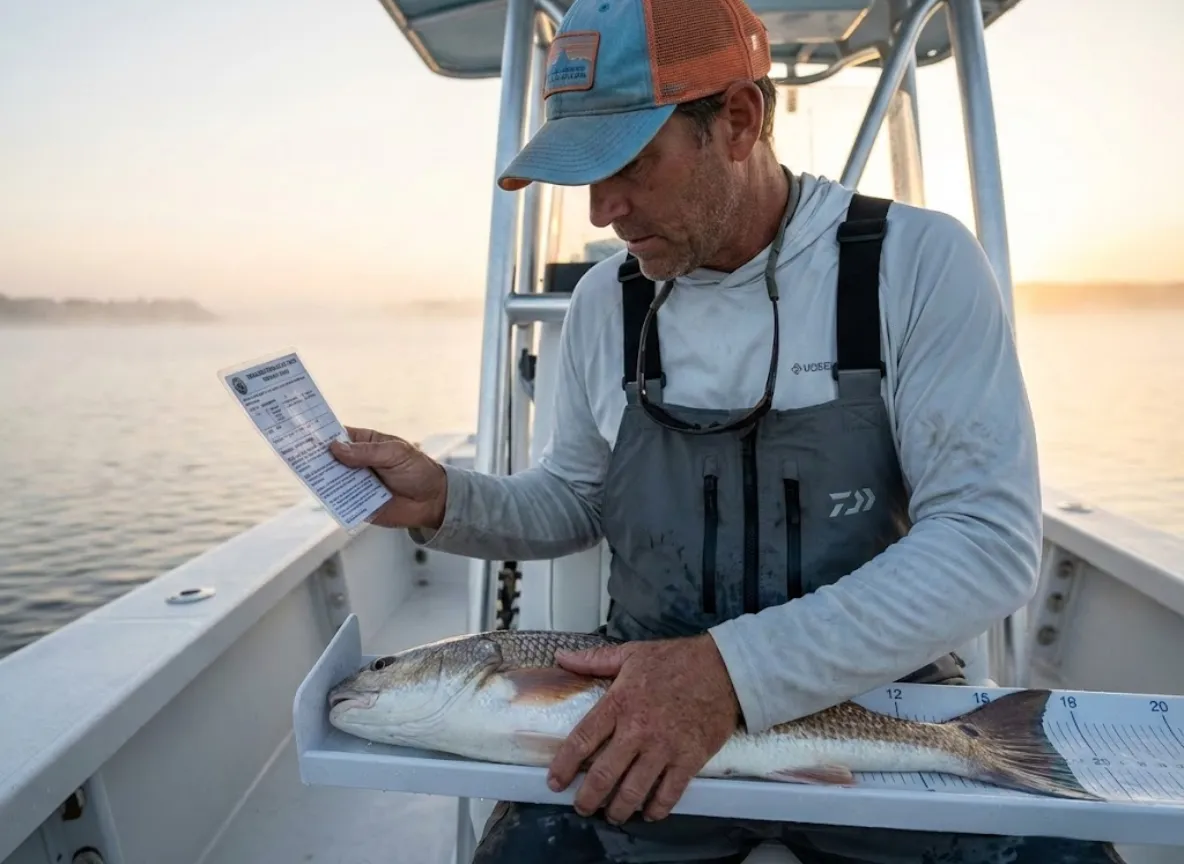
Total Length (TL) is measured from the snout to the tip of the tail, typically with the tail lobes pinched together to maximize length. This is common for largemouth bass, red drum, and trout species like rainbow trout or brown trout. Fork Length (FL) is measured from the snout to the center of the fork in the tail, with the tail in a natural position. This is standard for rigid-tailed ocean fish like Amberjack. Using the wrong method creates a mathematical error. A fish measured via “Total Length” (pinched) will appear longer than its “Fork Length,” leading to the accidental harvest of undersized fish if the law requires FL.
Biologists use Fork Length for species with rigid tails because pinching them is difficult and inconsistent. Soft-tailed fish are pinched to standardize the measurement against “tail fray.” A rigid measuring board (bump board) is legally superior to a flexible tape measure, as tapes can bend over the fish’s body, artificially inflating the measurement. Always verify the standard fish measurement guidelines for each species, whether you are chasing panfish, walleye, or catfish. Accurate measurement is the first step in practicing proper catch and release techniques for fish that don’t make the cut.
What is the difference between Creel Limit and Possession Limit?
Daily creel limit (often called daily bag limit) is the maximum number of fish you may harvest in a single 24-hour period. Possession Limit is the total maximum number of fish you may possess anywhere, including your cooler, car, or home freezer (typically 2x the daily limit). The “Freezer Trap” catches multi-day anglers. If you catch a limit on Day 1 and Day 2, you cannot legally fish on Day 3 without eating or gifting your previous catch to lower your possession count.
Possession limits exist to prevent “stockpiling” and ensuring equitable distribution of the resource. Processed fish still count toward your aggregate possession limit and usually must be kept with skin patches intact to allow for species identification. Refer to the definition of creel and possession limits for your specific state. Also, remember that limits apply to the individual. You cannot retain a fish to help fill your boat partner’s limit. This rule applies even when managing your catch in a livewell; keep catches distinguishable if possible.
How Do I Ensure Compliance in the Field?
This section provides actionable advice on avoiding penalties and utilizing technology to maintain real-time compliance.
What are the consequences of non-compliance?
Penalties are rarely simple “tickets.” They often include “Civil Restitution” fees per fish, meaning you pay the fine plus the replacement biological value of the animal. “Major Violations,” such as being over-limit on protected length limit species or taking endangered fish, can escalate to criminal misdemeanors. Florida statutes regarding major fishing violations indicate that this can result in the seizure of gear, boats, and vehicles used in the commission of the crime.
The Lacey Act makes it a federal crime to transport illegally taken wildlife across state lines. This turns a local infraction into a federal case. Ignorance of the law is not a valid legal defense, regardless of open season dates or closed season dates. Compliance is the cheapest insurance policy; the cost of an annual license is often less than 10% of the fine for fishing without a license. This legal risk is similar to the regulations regarding transporting aquatic invasive species, where moving the wrong biological material across a line carries heavy penalties.
How can I build a localized “Cheat Sheet”?
Download GPS-enabled apps like Fish Rules, Fish Washington® Mobile, or Fishbrain. These automatically update regulations based on your specific location, detecting if you are in State or Federal waters. However, electronics fail. Create a physical “Target Card” by laminating a small index card listing the slot limit and bag limits for your top 5 target species. Attach it to your tackle box or boat console.
Mark your measuring device with permanent marker lines indicating the minimum length and maximum length for your local species. This provides an instant visual “Go/No-Go” gauge. Take screenshots of the digital regulations before leaving cell service, as remote streams often lack the signal needed to check the DNR website or online purchase links. Just as you would focus on adding essential fishing tools to your kit, consider your regulation cheat sheet a mandatory piece of gear.
Pro-Tip: Program the local reporting hotlines or Game Warden dispatch number into your phone contacts. If you see a violation or have a borderline legal question while on the water, a quick call can save the resource or your own license.
Final Thoughts
Navigating fishing regulations is about more than avoiding fines; it is about participating in the stewardship of the fishery.
- Cost vs. Value: Annual passes typically pay for themselves after just 9 days of fishing.
- The Geography Rule: Your license is valid only where you stand or float; know your boundaries.
- The Measurement Standard: Know the difference between a pinched tail (Total Length) and a natural tail (Fork Length).
- The Compliance Mindset: Use digital tools and physical cheat sheets to stay legal.
Check your specific state’s digital regulations today, whether it’s Alaska or the California Fish and Game Commission, and build your own “Cheat Sheet” before your next cast—confidence is the best tackle you can carry.
FAQ – Frequently Asked Questions
Do seniors need a fishing license?
In many states like Florida, residents over 65 (senior exemption) are exempt from purchasing a license but must carry proof of age and residency. However, other states like Texas and Indiana still require seniors to purchase a discounted Senior License, so never assume it is free without checking. Always verify age exemption details.
Can I clean or fillet my fish on the boat before I get to shore?
Generally, no. Filleting rules in most states require fish to be landed with heads and tails intact to allow wardens to verify the species and length. Some exceptions exist for specific species, but you must usually leave a patch of skin attached for identification.
Does a freshwater license cover me if I go to the coast?
Usually no. Most coastal states strictly separate Freshwater and Saltwater licenses, requiring you to purchase a separate endorsement or an All-Water package. Using a freshwater license in tidal or brackish inland waters near the coast is a common violation.
If I catch a fish in state waters, can I transport it through closed federal waters?
This depends on the Transit Rule of the specific region. Generally, you may pass through if the gear is stowed and you do not stop. However, possessing a fish in federal waters that is federally closed is risky and requires strict adherence to non-stop transit protocols.
Are there special licenses for specific groups?
Yes. Most states offer discounted or free licenses for specific demographics, including youth or junior anglers (often under 16), disabled veterans, and active military personnel. Lifetime license options are also available in many regions, serving as a long-term investment against rising fees.
Risk Disclaimer: Fishing, boating, and all related outdoor activities involve inherent risks that can lead to injury. The information provided on Master Fishing Mag is for educational and informational purposes only. While we strive for accuracy, the information, techniques, and advice on gear and safety are not a substitute for your own best judgment, local knowledge, and adherence to official regulations. Fishing regulations, including seasons, size limits, and species restrictions, change frequently and vary by location. Always consult the latest official regulations from your local fish and wildlife agency before heading out. Proper handling of hooks, knives, and other sharp equipment is essential for safety. Furthermore, be aware of local fish consumption advisories. By using this website, you agree that you are solely responsible for your own safety and for complying with all applicable laws. Any reliance you place on our content is strictly at your own risk. Master Fishing Mag and its authors will not be held liable for any injury, damage, or loss sustained in connection with the use of the information herein.
Affiliate Disclosure: We are a participant in the Amazon Services LLC Associates Program, an affiliate advertising program designed to provide a means for us to earn advertising fees by advertising and linking to Amazon.com. As an Amazon Associate, we earn from qualifying purchases. We also participate in other affiliate programs and may receive a commission on products purchased through our links, at no extra cost to you. Additional terms are found in the terms of service.

