
In this article
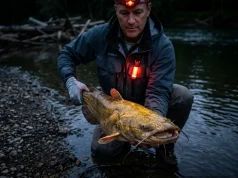
The sun dips below the tree line, and the littoral zone undergoes a violent, silent shift. The visual dominance of bass and pike recedes, surrendering the water to an adversary engineered for the dark. For channel catfish, blue catfish, and flathead catfish, night is not a time of rest; it is a time of sensory dominance where the rules of freshwater angling flip entirely.
I have spent decades guiding on river systems where the difference between a skunked boat and a trophy photo isn’t luck—it’s biology. Success in this environment requires more than a generic lantern and a rusty bell. It demands a nocturnal catfishing strategy that aligns human engineering with the predator’s biological vulnerabilities.
In this guide, we will move past the basic concept of “fishing in the dark” and execute a precision hunting operation. We will dismantle the biological layer of the catfish’s sensory handover, leverage the physics of red light to remain invisible, and organize a “clean deck” system that eliminates chaos. By the end, you will stop fearing the lack of visibility and start using it as your primary weapon.
Why does the biological playing field shift after sunset?
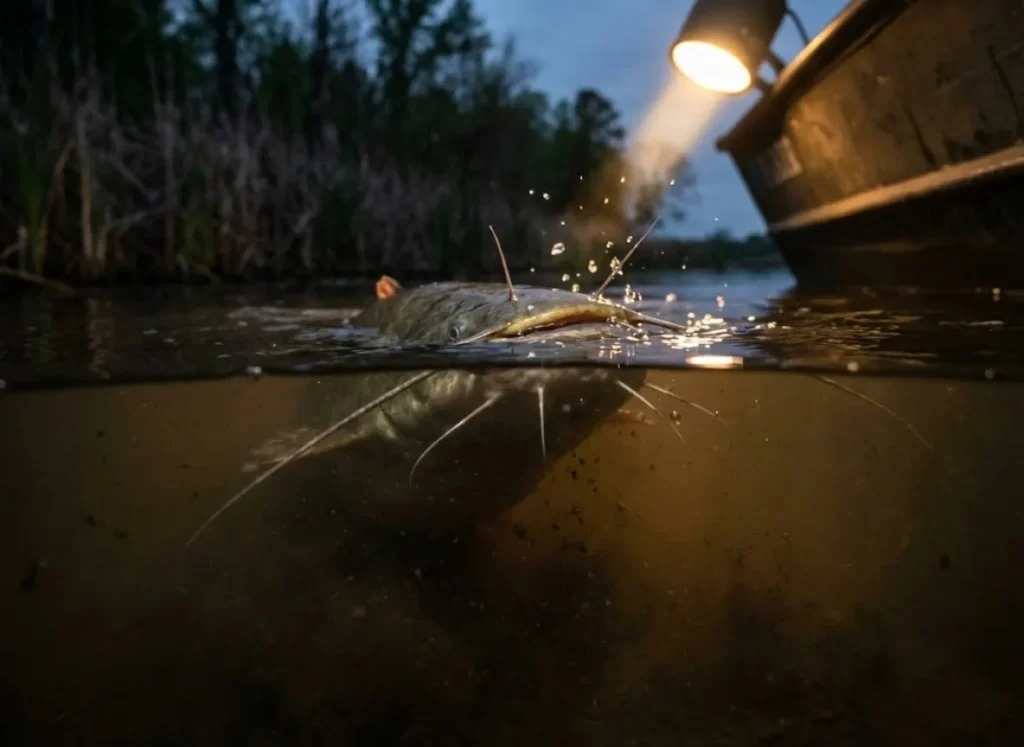
The biological playing field shifts because catfish undergo a physiological transition, deprioritizing vision to rely on the lateral line system for wake tracking and ampullary organs for close-range electroreception.
How does the “Sensory Handover” dictate bait presentation?
As light levels drop, catfish undergo a “Sensory Handover.” The reliance on the visual cortex diminishes, and the processing of hydrodynamic and chemical signals takes primary control. The lateral line system becomes the primary long-range tracking tool. Research indicates that Siluridae species possess the ability to “wake track” prey by sensing velocity gradients in the water column.
This biological reality invalidates stationary, silent baits in still water. Without visual confirmation, a nocturnal hunter relies on turbulence to locate the target. Tactically, this necessitates the use of “noisy” bait presentations. Live bait, such as bluegill, sunfish, or gizzard shad, is superior because their distress struggles create a hydrodynamic wake. Controlled experiments on wake tracking capabilities confirm that catfish can follow these trails in total darkness for up to 10 seconds, provided the wake structure remains intact.
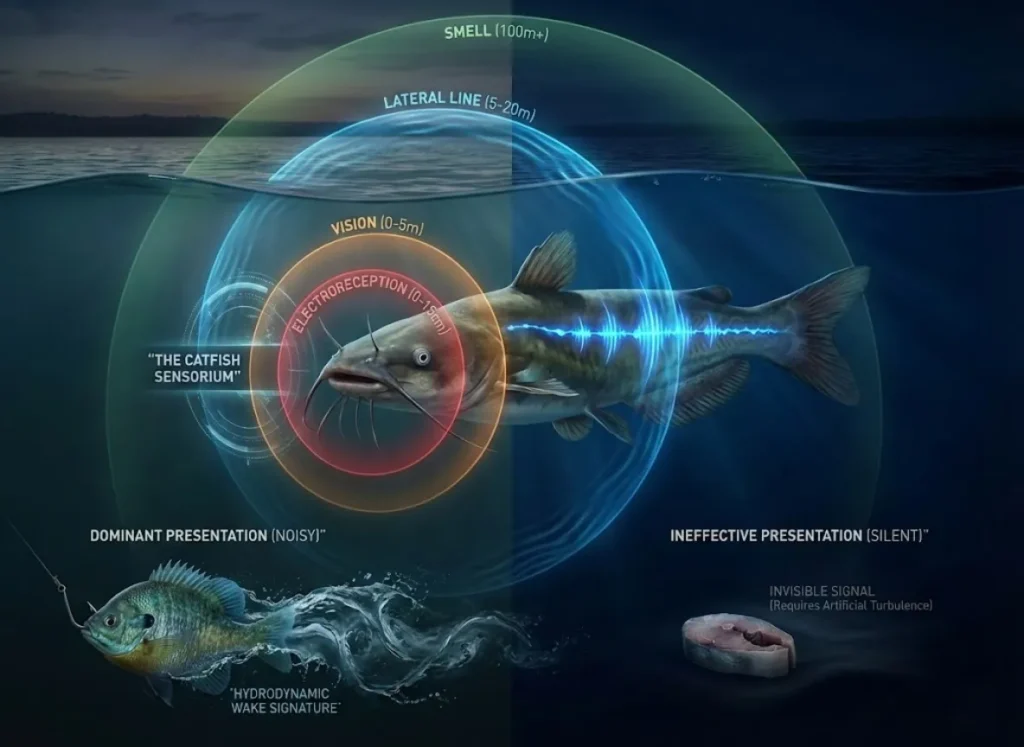
To exploit this, you must prioritize keeping live bait vigorous. A lethargic bait emits a weak hydrodynamic signature, rendering it invisible to a lateral line hunter. For cut bait (fresh threadfin shad or whitefish), the angler must artificially introduce turbulence by dragging baits or utilizing current to carry the wake structure downstream. The “Wake Tracking” hypothesis suggests that frequent recasting is not just about covering water, but about refreshing the hydrodynamic signature of the rig.
Pro-Tip: If fishing stagnant water with cut bait, induce “artificial turbulence” by lifting your rod tip two feet every 90 seconds. This pulses the bait and sends a pressure wave out to nearby lateral lines.
While scent-sensitive eating-size catfish in farm ponds might readily take stinkbaits, chicken livers, or nightcrawlers, targeting monster catfish requires targeting their vibration sensors first.
How does electroreception influence terminal tackle selection?
While the lateral line guides the fish to the vicinity, the final commit is governed by a sense most anglers ignore entirely. North American catfish possess ampullary organs capable of detecting weak DC electric fields, a sense often mistakenly attributed only to sharks. This “sixth sense” is a close-quarters targeting system, effective at ranges of less than 15cm, used to detect the bioelectric fields of prey respiration.
In the final moments of a strike, when darkness or turbidity renders vision useless, the fish strikes at the electric signature. This introduces the concept of “Galvanic Distortion.” Large, exposed metal components—like uncoated brass swivels on a Santee Cooper rig or slip-sinker rig—can generate unnatural galvanic fields. Sensitivity of ampullary electroreceptors in channel catfish is high enough that these metallic anomalies can cause hesitation, often felt by the angler as “short strikes” or “mouthing” the bait.
Advanced tactical rigging involves “Electro-Stealth.” This implies optimizing your terminal tackle components by using rubberized sinkers, plastic sliders on your sliding bottom rig, or heat-shrink tubing over swivels to dampen “electric noise.” By minimizing metallic anomalies near your circle hooks (such as Daiichi bleeding bait circle hooks), you reduce the unnatural signals that cause a wary trophy to abort the strike at the last second.
How do we manipulate the physics of light and sound?
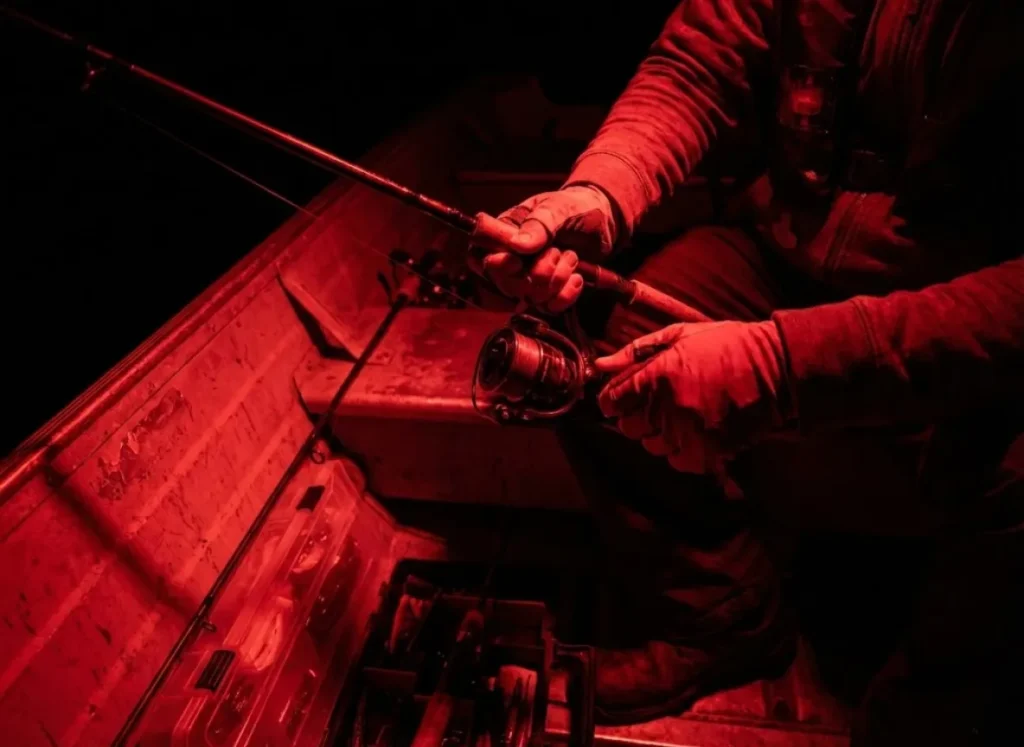
We manipulate the physics of light and sound by utilizing red light spectra to preserve human night vision while remaining invisible to the water column, and by dampening deck impact noise to evade the catfish’s Weberian Apparatus.
Why is spectral management critical for the “Night Ops” boat?
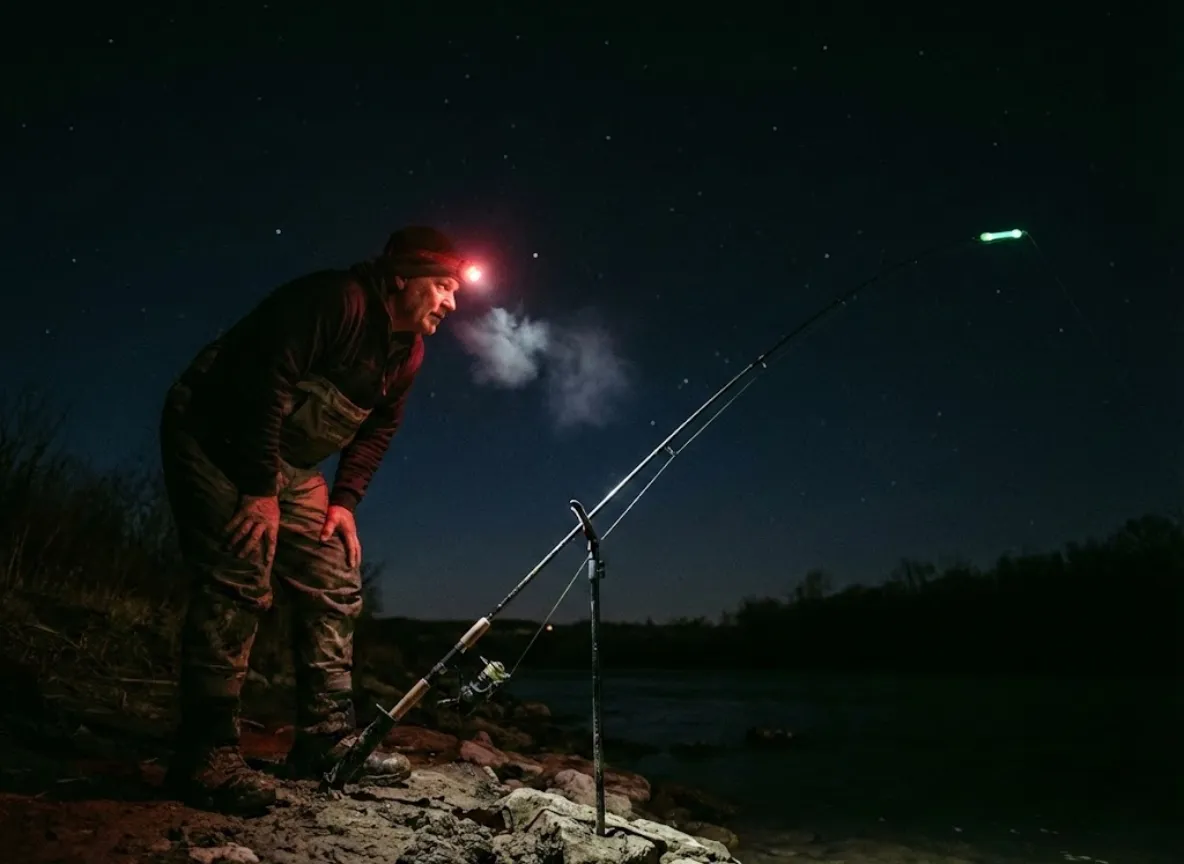
The “bring a flashlight” mentality is obsolete. The goal is Rhodopsin preservation—maintaining the human eye’s adaptation to darkness while functioning safely. Red light (620–750 nm) is the operational standard. It does not bleach visual purple (rhodopsin) in the human eye, allowing for instant transitions between looking at the illuminated deck and scanning the dark water.
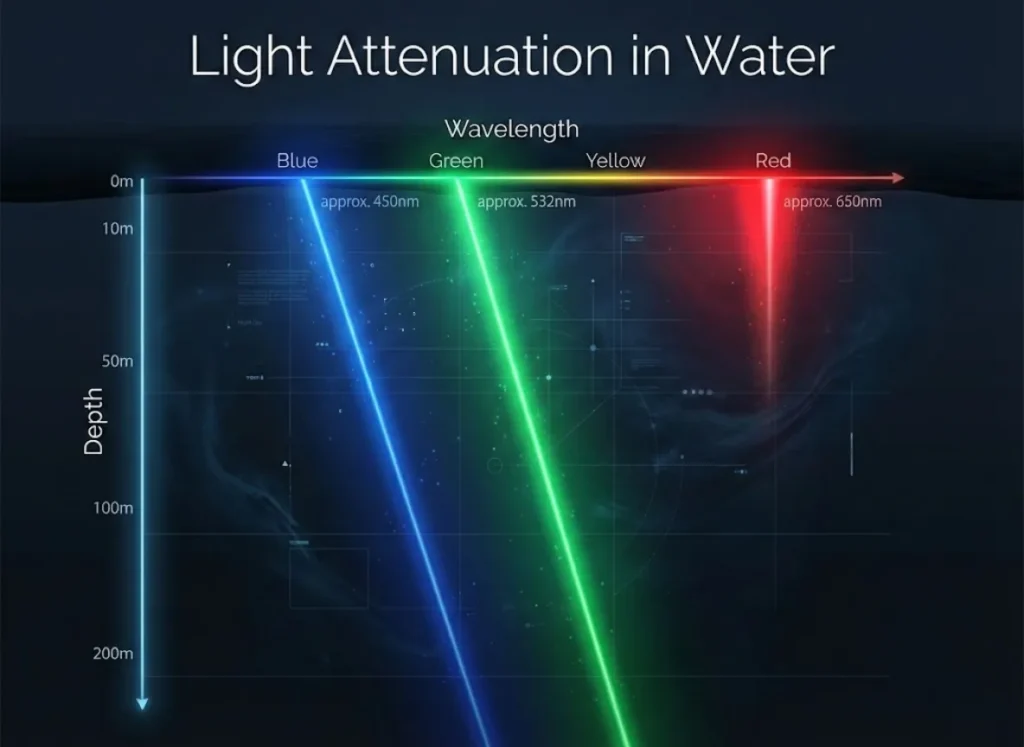
More importantly, water acts as a selective filter. Red light suffers from rapid attenuation, meaning its energy is absorbed within the first few meters of the water column. This physics principle validates the “below-gunwale” lighting strategy. Red LED boat lights mounted low prevent light spill from penetrating deep enough to spook photosensitive fish, which is critical when understanding how fish vision functions in low light.
In contrast, UV (Blacklight) is utilized strictly for strike indication. Its high-frequency wavelength causes fluorescent monofilament leader material and rod tips to “pop” against the black background without illuminating the boat’s interior. White light (high lumens) is reserved strictly for navigation and landing fish. Scientific literature on the spectral sensitivity of catfish retina confirms that while they are sensitive to contrast, the rapid absorption of red wavelengths offers the best camouflage for the angler using a headlamp or deck strips.
How does the “Weberian Apparatus” punish careless noise?
While light management keeps you hidden, sound discipline prevents you from announcing your presence before the bait even hits the water. Sound travels approximately 4.5 times faster in water than in air and retains energy over vastly longer distances.
Catfish possess a Weberian Apparatus, a chain of small bones connecting the swim bladder to the inner ear. This essentially turns their body into a hydrophone amplifier. This anatomical feature makes them hypersensitive to mechanical impact sounds, such as dropping pliers, stomping on the deck, or the “clank” of banging anchors. Studies on acoustic propagation efficiency in freshwater quantify just how effectively these impact noises travel, alerting predators hundreds of feet away.
The “Stealth Protocol” requires a carpeted or rubberized deck surface to dampen impact noise; EVA foam mats are ideal for aluminum boats. Furthermore, anchoring must be executed with “Soft Deployment,” which involves lowering the anchor hand-over-hand rather than tossing it. In shallow water, utilizing silent anchoring systems like shallow water poles or Spot-Lock is far superior to chains grinding on the bottom. In water shallower than 10 feet, this stealth mechanics discipline is often the single highest variable in catch rates.
What gear constitutes the “Night Ops” system?
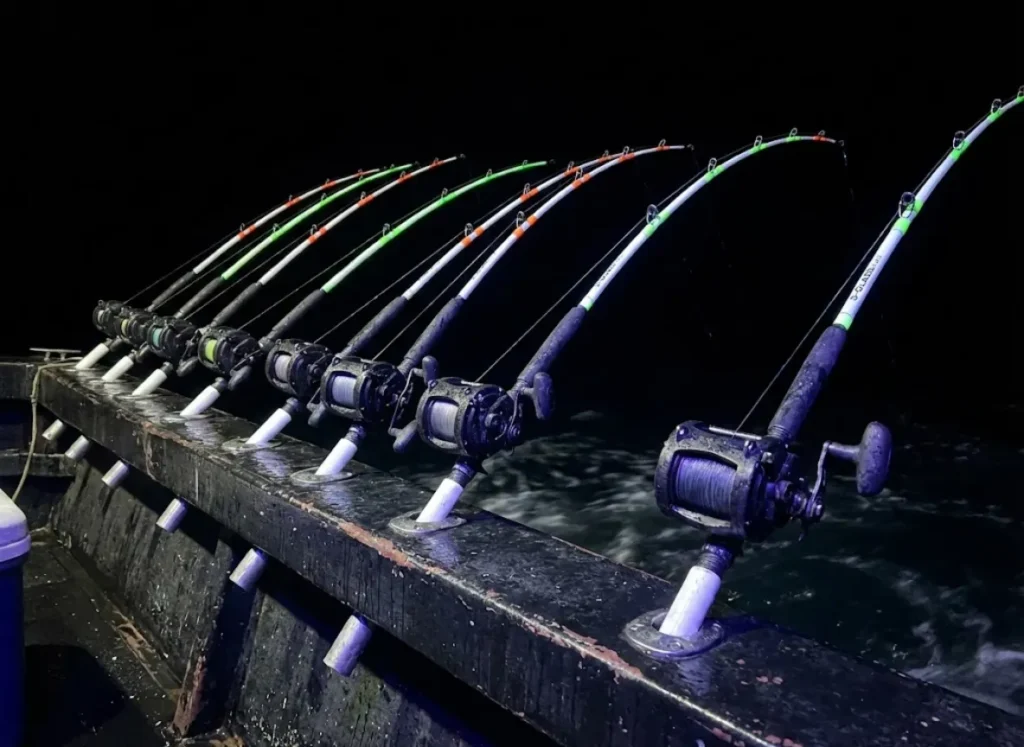
The “Night Ops” system relies on S-Glass rods for UV visibility and loading, loud bait clickers for auditory alerts, and a strict “Tactile Deck” organization strategy to ensure safety and efficiency.
Which rod and reel technologies optimize nocturnal bite detection?
Visual bite detection fails at night without specific material aids. The “Tactical Blueprint” calls for S-Glass or composite medium-heavy action rods (classic options like the Ugly Stik or specialized Castaway rods) treated with UV-reactive paint or high-visibility glow tips. S-Glass is preferred for its durability and specific modulus. This material allows the rod to “load” deep into the blank, providing a visual curve that is easier to see under blacklight than a fast-action carbon tip.
This deep loading is necessary to absorb the violent, initial run typical of the predatory behavior of Pylodictis olivaris (flathead catfish). When understanding rod blank materials, realize that graphite recovers too quickly for reliable night monitoring; glass keeps the rod bent, giving you that split-second longer to react.
Baitcasting reels (such as Abu Garcia reels) must feature a loud, distinct clicker mechanism. This audible signal is non-negotiable for the sleeping or multitasking angler. The “NOSI” (Night Ops Suitability Index) prioritizes ergonomics over aesthetics; controls must be adjustable by feel. Advanced systems utilize “Homecoming Mode” alarms which feature a rear-facing LED to guide the boat back to the spot after dropping baits.
Pro-Tip: Apply a 2-inch strip of white reflective tape just below the tip guide of your rod. Even without UV paint, this will catch the faintest ambient light or headlamp beam when the rod dips.
How does the “Tactile Deck” concept mitigate safety risks?
The “Tactile Deck” strategy relies on proprioception and high-contrast marking. Darkness destroys depth perception, making net hoops and gunwales tripping hazards. Anglers should map their workspace using glow-tape or reflective safety tape. Critical nodes include the deep hoop net (for gauging distance to fish), plier handles, and the trolling motor pedal.
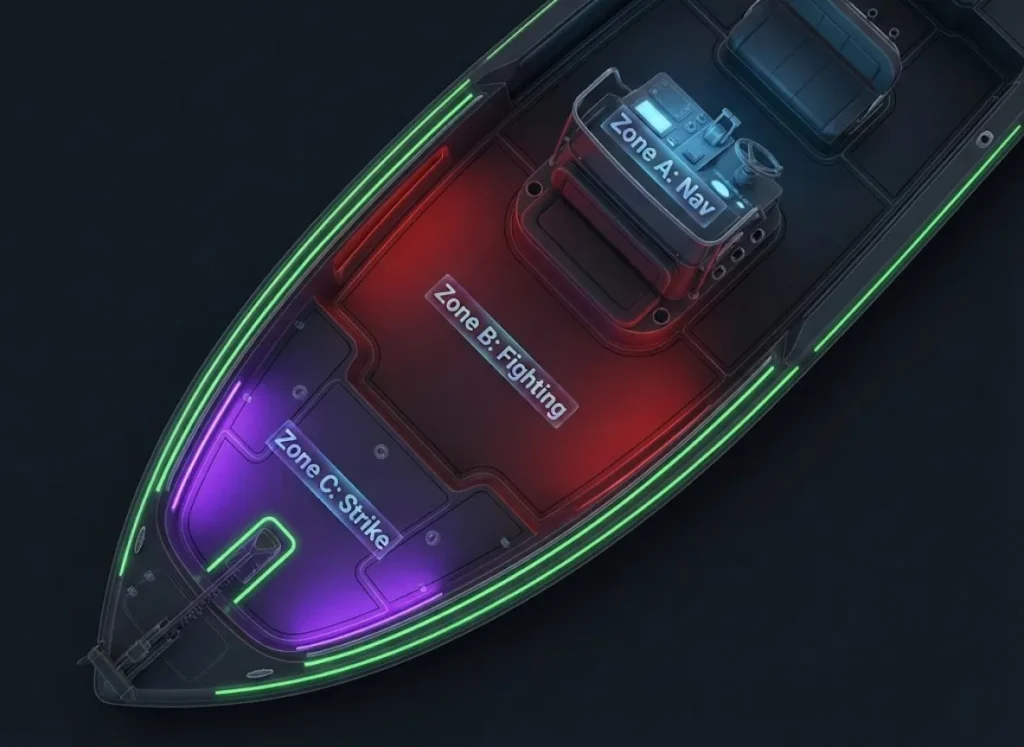
Establish a “Clean Deck Policy”: Zone A is for navigation, Zone B for fighting fish. Nothing (coolers, tackle bags) enters Zone B once lines are out. Personal safety gear moves from “recommended” to “critical life support.” Auto-inflating PFDs or a life jacket are mandatory because disorientation upon falling into dark water significantly increases drowning risk. Keep insect repellent or a Thermacell unit in a fixed location to maintain focus without swatting mosquitoes.
Adhering to USCG navigation light requirements is the legal baseline, but true safety comes from organization. The “Buddy System” acts as a cognitive safety net. Sleep deprivation degrades decision-making; a two-man rotation ensures one alert operator is always monitoring the environment. This rigorous organization minimizes the logistical friction that causes most anglers to quit early and aligns with essential fishing safety protocols.
Conclusion
Night fishing is not simply fishing without the sun. It is a biological game of “Sensory Handover,” requiring baits that appeal to the lateral line through turbulence and ampullary organs through galvanic stealth. By adopting red light for vision preservation and dampening sound to cheat the Weberian Apparatus, you become a ghost in the machine.
Organization is your safety net; a “Tactile Deck” marked with glow sticks and cleared of debris allows for confident blind operation in zero visibility. Master the dark, and you master the water.
FAQ – Frequently Asked Questions
Do catfish bite better at night?
Yes, generally. Catfish species are biologically adapted for low-light predation, executing nocturnal feeding migrations from deep resting holes to shallow flats, points, and sandbars to feed aggressively.
What is the best color light for night fishing?
Red light is superior for general boat fishing tasks. It preserves your natural night vision (rhodopsin) and is quickly absorbed by water, making it less likely to spook shallow fish compared to white light.
How deep should I fish for catfish at night?
Fish shallower than you think. Active catfish often migrate up humps, ledges, and gravel bars in 2 to 10 feet of water to ambush baitfish that are also moving shallow at night.
Do I need different bait at night?
While the bait types (shad, bluegill) remain the same, using live or fresh-cut bait is more critical. You need to maximize scent and vibration to help the fish locate the bait without sight. Whether you are shore fishing or drift fishing, fresh bait is key.
Risk Disclaimer: Fishing, boating, and all related outdoor activities involve inherent risks that
can lead to injury. The information provided on Master Fishing Mag is for educational and informational purposes
only. While we strive for accuracy, the information, techniques, and advice on gear and safety are not a substitute
for your own best judgment, local knowledge, and adherence to official regulations. Fishing regulations, including
seasons, size limits, and species restrictions, change frequently and vary by location. Always consult the latest
official regulations from your local fish and wildlife agency before heading out. Proper handling of hooks, knives,
and other sharp equipment is essential for safety. Furthermore, be aware of local fish consumption advisories. By
using this website, you agree that you are solely responsible for your own safety and for complying with all
applicable laws. Any reliance you place on our content is strictly at your own risk. Master Fishing Mag and its
authors will not be held liable for any injury, damage, or loss sustained in connection with the use of the
information herein.
Affiliate Disclosure: We are a participant in the Amazon Services LLC Associates Program, an
affiliate advertising program designed to provide a means for us to earn advertising fees by advertising and linking
to Amazon.com. As an Amazon Associate, we earn from qualifying purchases. We also participate in other affiliate
programs and may receive a commission on products purchased through our links, at no extra cost to you. Additional
terms are found in the terms of service.