
In this article
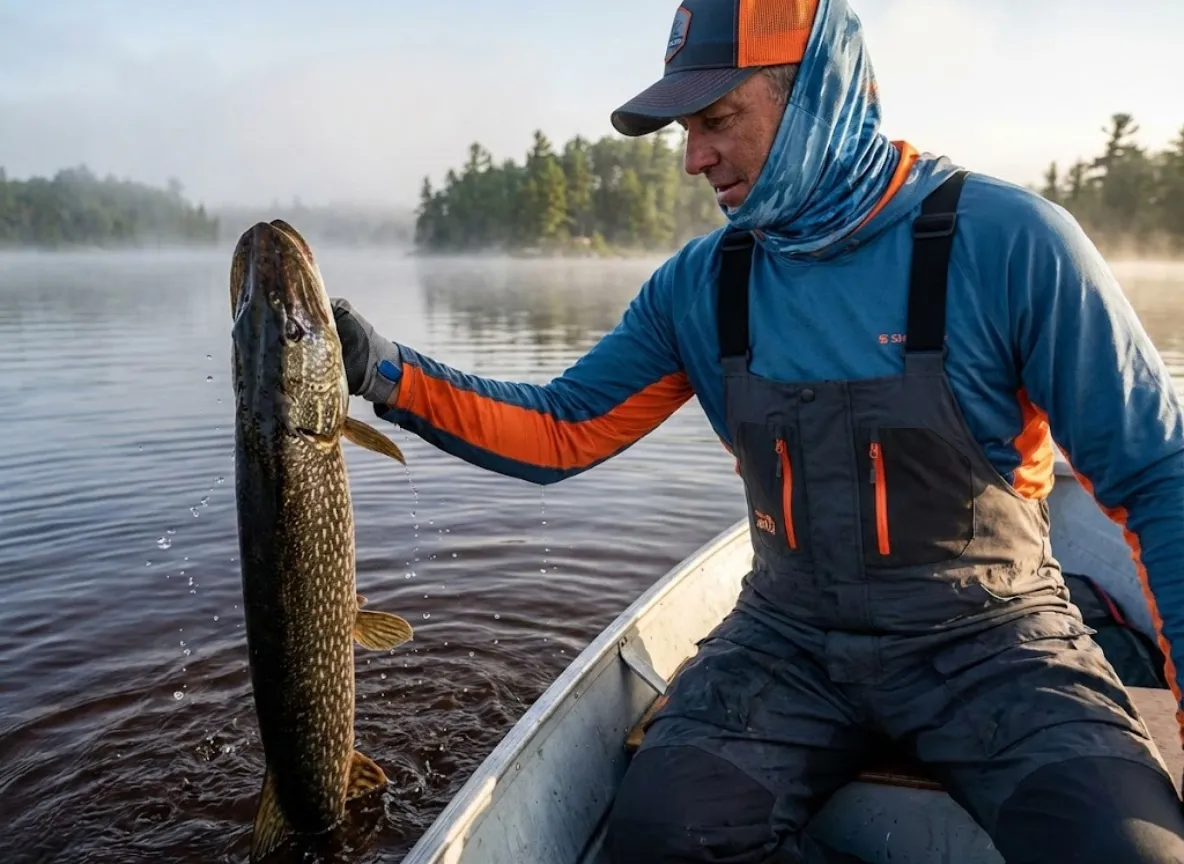
The water erupts less than five feet from the boat. There is no experimental nibble, no hesitation—just a violent, lateral slash that bends a graphite rod straight to its cork handle. This is not the cautious behavior of a grazer; it is the calculated strike of the Northern Pike (Esox lucius).
In my years of guiding clients on northern shield lakes and the vast waters of the Upper Midwest, I have seen seasoned anglers tremble after a strike from a heavy pike. To catch the “Water Wolf”—or “Slough Shark,” “Jackfish,” and “Gator,” as they are locally known—you must look past this aggressive reputation and understand the mechanics of the machine.
The pike is an evolutionary masterpiece of hydrodynamics and sensory precision, a true lie-in-wait predator. This guide moves beyond basic identification. We will deconstruct the pike’s biological blueprint—from muscle fiber types to sensory arrays—to show you exactly how to adapt your gear and tactics for confident, predictable success.
What Distinguishes the Northern Pike from Other Apex Predators?
How do you identify a Northern Pike vs. a Muskellunge?
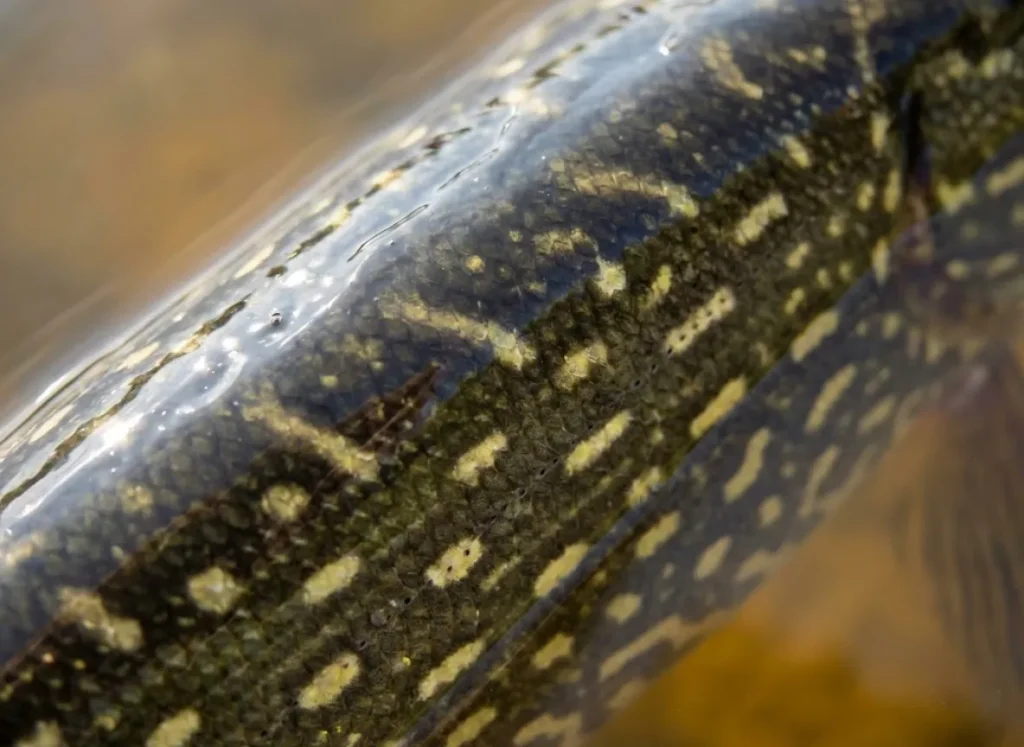
The most reliable way to distinguish a Northern Pike from a Muskellunge is by examining the markings and the pore count on the underside of the jaw. Northern Pike feature light, bean-shaped or cardioid spots on a dark green background and possess 5 or fewer mandibular pores per side. Conversely, Muskies generally display dark markings on a light background and have 6 to 9 pores.
Confusion between these two Esocidae family cousins is common, but accuracy is critical. Identification starts with the pattern. Remember this rule: Pike are light-on-dark; Muskies are dark-on-light. Next, look at the tail. The caudal fin of a pike is somewhat rounded, while the muskie has deeply forked, pointed lobes.
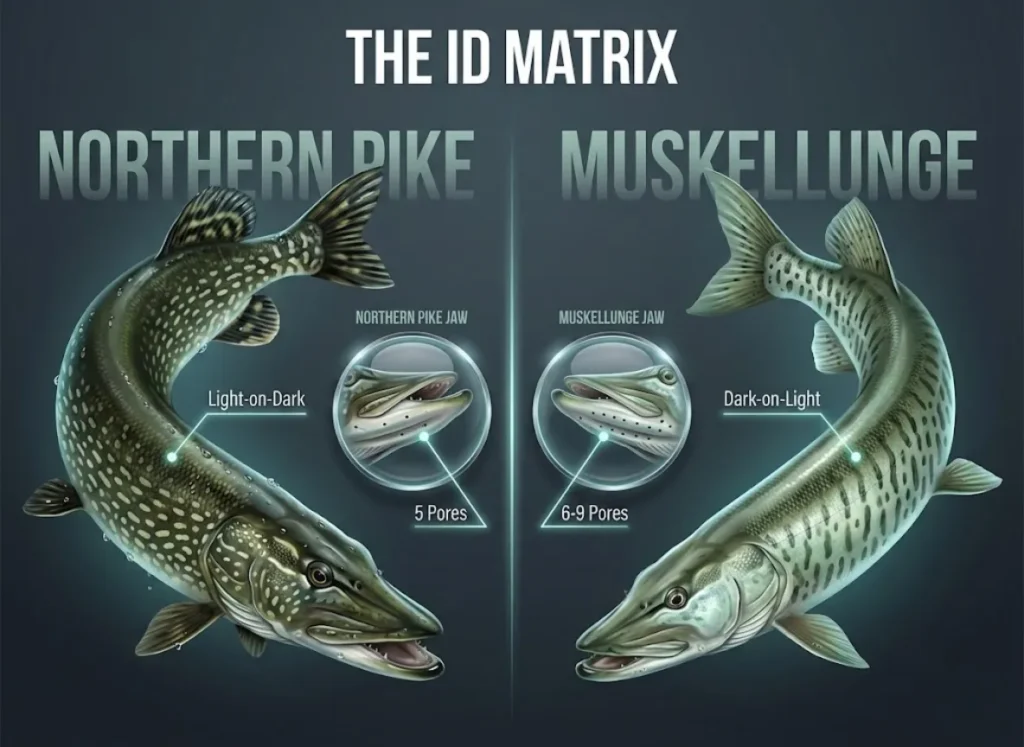
For the definitive “legal” test, you must get close. Flip the fish over gently. Northern Pike typically have 5 or fewer sensory pores on the underside of the lower jaw. Muskies have 6 to 9. The U.S. Fish & Wildlife Service details how these traits remain consistent across their native range, separating them from look-alikes like the Chain Pickerel.
Be wary of the Tiger Muskie. This sterile hybrid displays distinct, bold vertical stripes and grows rapidly due to “hybrid vigor.” Misidentification here can lead to serious regulatory violations. Slot limits and harvest regulations often differ drastically between pike and muskie in the same water. If you are specifically targeting the larger cousin, mastering how to catch musky begins with knowing exactly what you are casting at.
Why is the Pike’s “Water Wolf” reputation biologically accurate?
The nickname “Water Wolf” is biologically earned through the pack-like hunting behavior of young pike and the solitary, territorial dominance of adults.
Juvenile pike often hunt in loose associations in areas of high prey density, such as weed beds or submerged logs. As they mature, they transition into solitary predators that stake claims on specific structural elements. They are opportunistic feeders, willing to consume yellow perch, suckers, waterfowl, ducklings, frogs, and muskrats.
Pro-Tip: If you catch a small pike on a specific weed point, cast again immediately. Smaller pike often school up. If you catch a massive pike there, move on—that giant likely ate or chased away everything else in the zip code.
Cannibalism is a primary population regulator. Large pike are the main predators of small pike, creating a “density-dependent” ecosystem. According to the University of Michigan’s Animal Diversity Web, this predation structure is vital for healthy fisheries.
In lakes where large “cannibal” pike are over-harvested, populations often crash into a “stunted” state. The lake becomes filled with thousands of small “hammer handles” because the natural population control—the trophy fish—is gone. This dictates that releasing large trophies is essential for the ecosystem. Utilizing proper catch and release techniques ensures these vital population controllers survive the encounter.
How Does Esox lucius Anatomy Dictate Angling Tactics?
Why does the “Sagittal” fin placement change how you fight the fish?
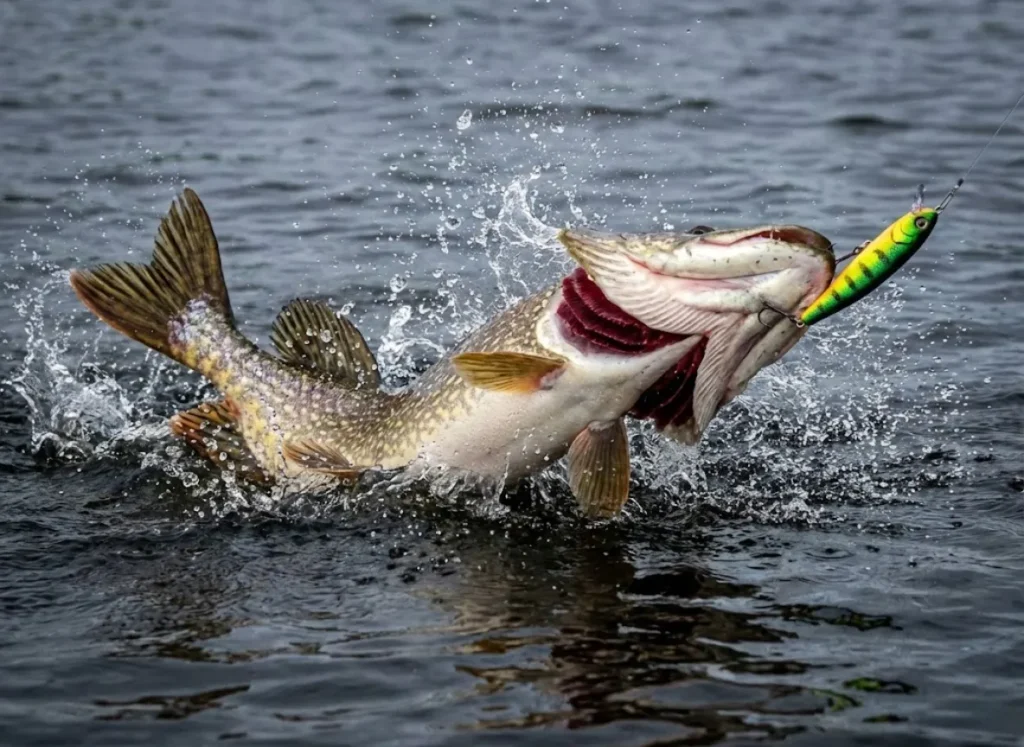
The “sagittal” fin placement means the dorsal and anal fins are positioned far back on the body, aligned with the tail to create a massive surface area that generates explosive burst speed rather than endurance.
Unlike bass or trout, pike are built like dragsters. This alignment allows for the “S-shape strike position,” generating acceleration from 0 to 8-10 mph in fractions of a second. Tactically, this means pike are sprinters designed for short, violent bursts.
This physiology has a downside. Pike musculature is dominated by white muscle fibers. These are powerful but anaerobic, meaning they accumulate lactic acid rapidly. The Minnesota Department of Natural Resources Life History analysis details how this limits their stamina.
Over-playing a pike on light tackle leads to severe lactic acidosis. This causes delayed mortality, where the fish swims away only to die hours later. Anglers must understand rod action vs power to select gear heavy enough to land the fish quickly. You need to end the fight while the fish still has the energy reserves to recover.
How does the Pike’s sensory array influence lure selection?
Pike are visual-acoustic hunters that rely on spotting silhouettes against the surface and detecting low-frequency vibrations through their lateral line system.
Their large, dorsal-anterior mobile eyes provide binocular vision for judging distance along their duck-billed snout. However, this placement creates a blind spot directly below and behind them. Lures should always be retrieved above the pike’s eye level. A lure dragging on the bottom is often invisible to a pike suspending two feet up.
In the stained water common to pike territory, red light is absorbed first. This makes Gold and Chartreuse colors far more visible than dark reds or blues. This is a matter of freshwater ichthyology and physics.
Pro-Tip: In muddy water, ignore color and focus on “thump.” A Colorado-blade spinnerbait moves more water than a willow blade, helping the pike locate your lure using its lateral line before it ever sees it.
The Ontario Ministry of Natural Resources documents how this sensory reliance shifts based on water clarity. The lateral line detects vibrations between 5-100 Hz, allowing pike to track prey through hydrodynamic wakes even in zero visibility.
When the strike comes, the sensory pores on the jaw guide the final snap-bite. This precision necessitates bite-proof leaders like Fluorocarbon or Titanium to survive the sharp teeth. For a deeper look at why color matters, read our guide on how do fish see underwater.
Where Can You Find Northern Pike Throughout the Seasons?
How do water temperature and oxygen levels drive Pike migration?
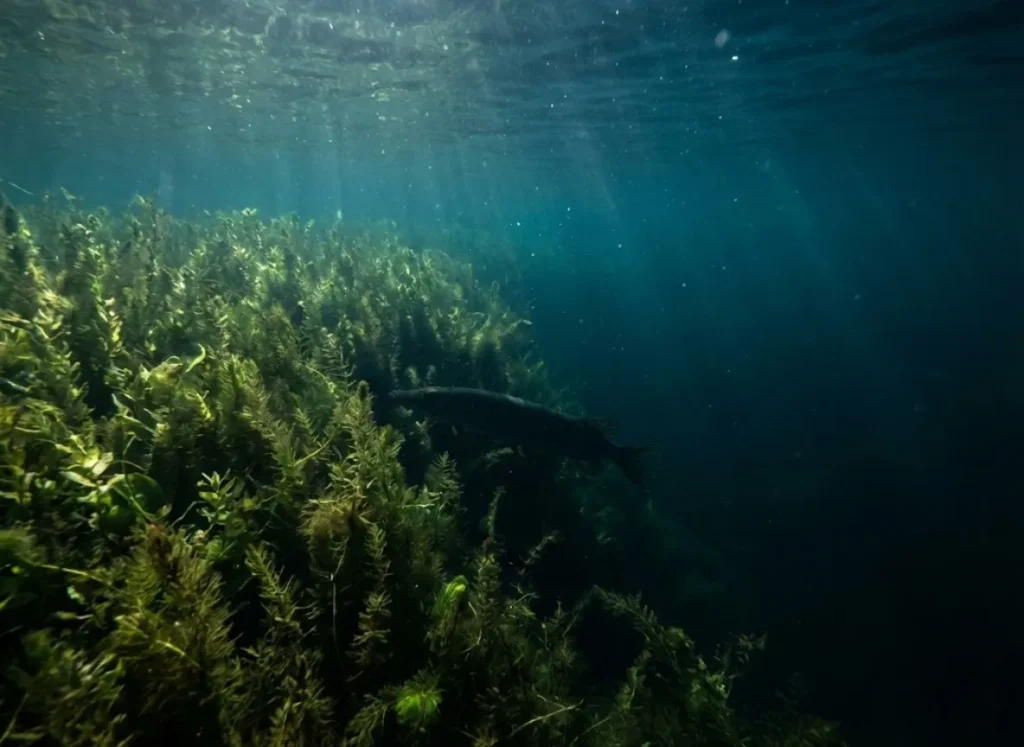
Pike movement is driven by a “thermal squeeze,” migrating to find water between 60°F and 65°F (their metabolic optimum) while seeking sufficient dissolved oxygen levels.
In spring and late fall, these temperatures are readily available in the shallows. Spawning timing typically aligns with ice-out in March-April, where female pike arrive in marshy backwaters to lay adhesive eggs on vegetation. However, as surface temperatures exceed 70°F, large pike experience physiological stress. Their metabolism spikes, but they cannot process oxygen fast enough to support it.

This forces a migration known as the “Summer Squeeze.” Trophy fish abandon the shallows for deeper water near the thermocline or cold-water springs. The Minnesota Department of Natural Resources species profile highlights how they become caught between the need for cool water (deep) and high dissolved oxygen (often shallow).
They concentrate in specific “thermal refuges” during this time. Understanding this prevents the common mistake of beating the banks in August. Whether you are fishing the Great Lakes, the brackish Baltic Sea, or a gravel pit in the UK, the temperature rules apply. For more strategies on handling the heat, check our summer fishing tips.
What Are the Realities of Handling and Consuming Northern Pike?
How do you conquer the infamous “Y-Bone” for the table?
You can conquer the Y-bone by utilizing the “5-fillet method,” a technique that removes the back strap first and then isolates the Y-bones as a separate strip, leaving boneless loins.
The “Y-bones” are epineural bones. They float in the muscle tissue to stiffen the back for that explosive acceleration we discussed earlier; they are not connected to the rib cage. The fear of these bones prevents many anglers from eating pike, which is a mistake. The meat is white, flaky, and superior to many other freshwater species.
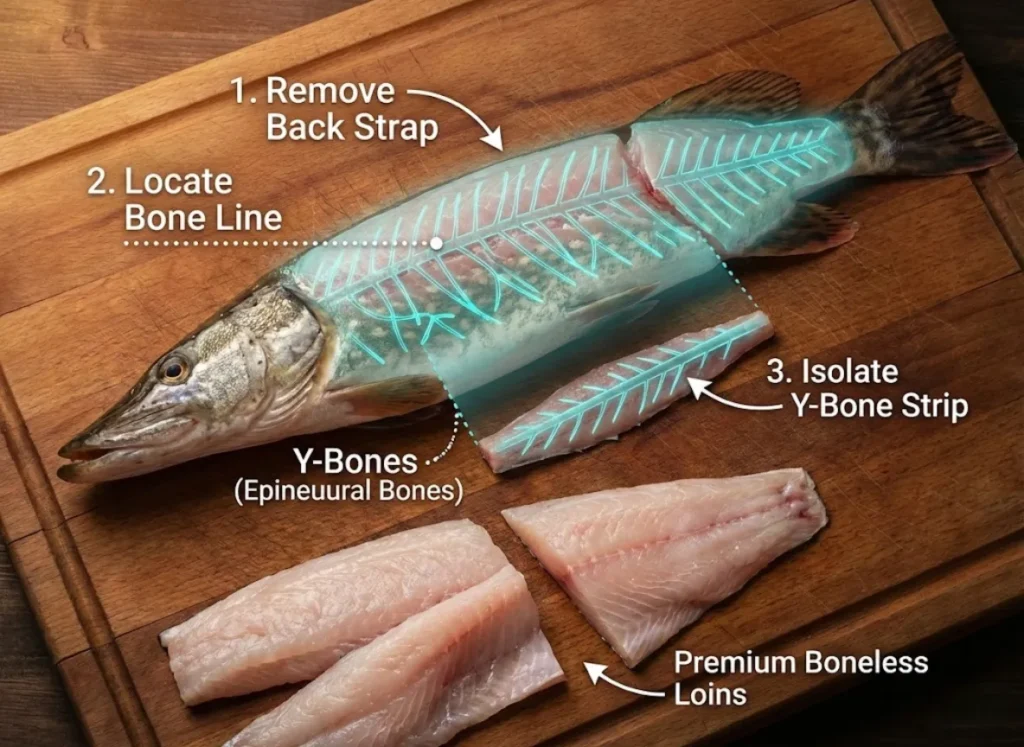
The Invasive Species Centre outlines the anatomical structure that makes this fish unique. To fillet properly, remove the dorsal meat (back strap). Then, locate the white line of bone tips on the flank. Cut along the outside, then the inside of this line. This removes the bone rack as a single strip.
Mastering this transforms a “nuisance fish” into premium table fare. This encourages the harvest of smaller, abundant pike while saving the big breeders. Of course, getting the fish to the cleaning table requires safety first. Review how to hold a fish to manage the slime and teeth without injury to you or the catch.
Conclusion
True competence in the outdoors comes from turning theoretical knowledge into confident action. By understanding the Northern Pike, you stop relying on luck and start utilizing biological intelligence.
- Identification is Key: Distinguish Pike from Muskies via mandibular pores (5 vs. 6-9) to keep your fishing legal and responsible.
- Biology Dictates Gear: The anaerobic fight requires heavy gear to prevent lethal exhaustion.
- Temperature Rules All: Success is found by following the 60-65°F thermal window.
- Resource Stewardship: Conquering the Y-bone allows for ethical harvest of small fish, preserving the trophy females.
Ready to test your knowledge on the water? Explore our comprehensive Gear Guides to build the perfect pike setup before your next trip.
FAQ – Frequently Asked Questions
How big do Northern Pike get?
While the average catch is often between 18 and 24 inches, Northern Pike can grow to trophy sizes exceeding 40 to 50 inches and weighing over 30 pounds. There is a significant female vs male size disparity; nearly all pike over 35 inches are female.
Do Northern Pike shed their teeth in the summer?
No, the idea that pike shed all their teeth at once in summer is a myth. They are polyphyodonts, meaning they replace lost individual teeth continuously throughout their lives. The perceived lack of biting in late summer is usually due to thermal stress driving them to deep water.
Are Northern Pike dangerous to humans?
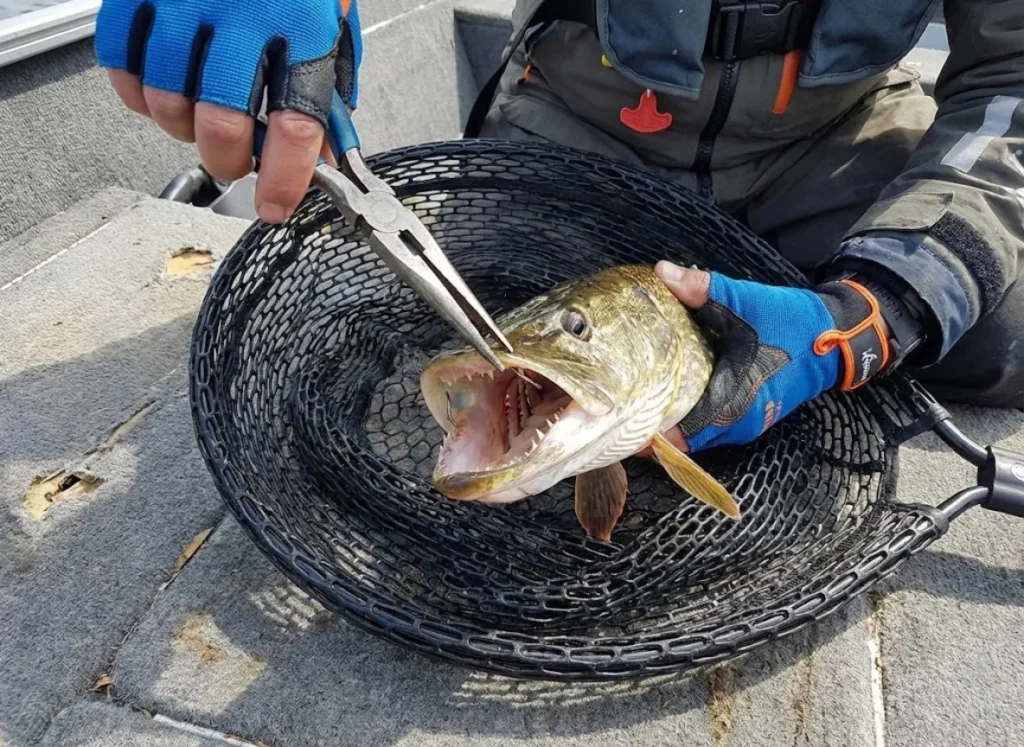
Pike are not aggressive toward humans in the water, but their razor-sharp, anticoagulant-coated teeth pose a significant risk during handling. Always use long-nose pliers and jaw spreaders to remove hooks to avoid deep lacerations.
Is Northern Pike good to eat?
Yes, Northern Pike is excellent table fare with white, flaky, mild-tasting meat that rivals Walleye. The primary barrier is the presence of Y-bones, which require a specific filleting technique to remove effectively.
Risk Disclaimer: Fishing, boating, and all related outdoor activities involve inherent risks that
can lead to injury. The information provided on Master Fishing Mag is for educational and informational purposes
only. While we strive for accuracy, the information, techniques, and advice on gear and safety are not a substitute
for your own best judgment, local knowledge, and adherence to official regulations. Fishing regulations, including
seasons, size limits, and species restrictions, change frequently and vary by location. Always consult the latest
official regulations from your local fish and wildlife agency before heading out. Proper handling of hooks, knives,
and other sharp equipment is essential for safety. Furthermore, be aware of local fish consumption advisories. By
using this website, you agree that you are solely responsible for your own safety and for complying with all
applicable laws. Any reliance you place on our content is strictly at your own risk. Master Fishing Mag and its
authors will not be held liable for any injury, damage, or loss sustained in connection with the use of the
information herein.
Affiliate Disclosure: We are a participant in the Amazon Services LLC Associates Program, an
affiliate advertising program designed to provide a means for us to earn advertising fees by advertising and linking
to Amazon.com. As an Amazon Associate, we earn from qualifying purchases. We also participate in other affiliate
programs and may receive a commission on products purchased through our links, at no extra cost to you. Additional
terms are found in the terms of service.