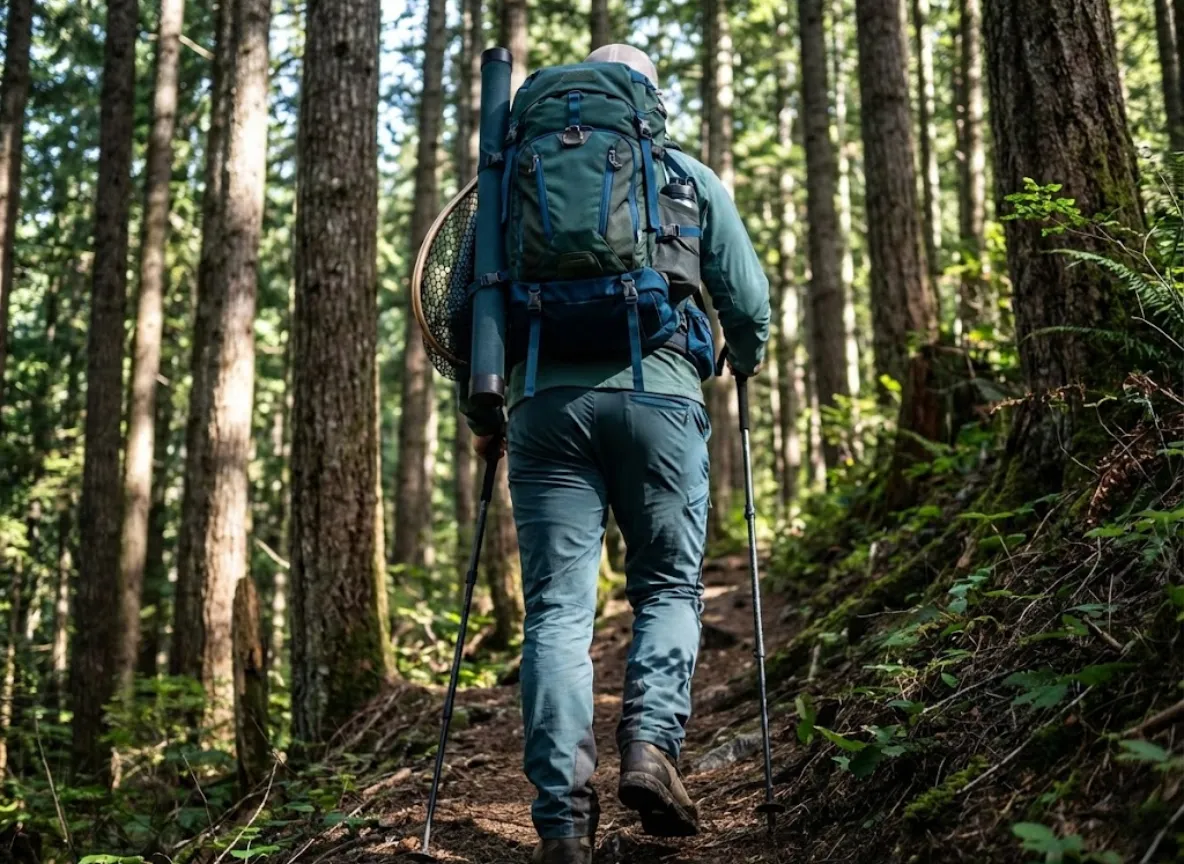
A three-mile push into the White Mountains or a scramble down to remote river stretches turns into a torture march when a standard backpack strap compresses your brachial plexus. Fishing gear is dense—lead sinkers, tungsten jigs, and fishing reels weigh significantly more than sleeping bags—yet most anglers shove this weight into packs with zero suspension support. The result isn’t just discomfort; it’s lost focus and reduced time with lines in the water.
True backcountry angling requires a system that manages this dead weight while keeping terminal fishing tackle instantly accessible when the bite turns on. This guide bridges the gap between the “hiking” world and the hike-in fishing world. We break down the suspension gap, the critical difference between splash-proof and fully submersible ratings, and the workflow architecture that increases your fishing efficiency. Whether you are targeting cutthroat trout in the high country or are a mobile bank fishing pro, the right tactical fishing backpack transforms you from a disorganized carrier of tackle storage into a tactical, mobile hunter.
How to Choose the Right Fishing Backpack
Marketing buzzwords often obscure the reality of how a pack performs in the field. To make a smart, confident choice for your next fishing journey, we need to look at biomechanics and material science.
Suspension Mechanics: The “Lead Weight” Reality
Most fishing-specific packs fail because they ignore the density of the cargo. A 20L fishing pack often weighs more than a 40L camping pack due to the sheer density of lead weights, jig heads, and metal tools. Without proper weight distribution, this load hangs entirely on your shoulders, restricting blood flow to the arms and causing neuromuscular fatigue that affects casting accuracy.
A rigid frame sheet combined with a load-bearing hip belt is essential for trekking over two miles. This system transfers 70-80% of the pack weight from the shoulders to the iliac crest (hips), allowing your large leg muscles to carry the load rather than your neck. Ventilation is also key; look for air mesh panels to manage sweat during hot weather fishing.
Before you buy, you must start by auditing your loadout based on truly essential fishing tools, cutting weight at the source so your suspension system—including load lifters—can work effectively.
Pro-Tip: If your pack lacks a rigid frame, pack your stiffest, largest tackle tray closest to your back panel. This acts as a makeshift frame sheet, preventing soft plastics or reels from digging into your spine during the hike.
Submersible Integrity: The “Dry-Gear” Index
“Waterproof” is the most abused term in the fishing industry. There is a massive functional difference between IPX4 (Rain Resistant) and IPX7 (Submersible). DWR (Durable Water Repellent) coatings eventually “wet out” under heavy rain or friction, meaning your spare clothes will get damp. For absolute protection comparable to the Simms Dry Creek Z or Yeti Panga 28L, you need TPU welded fabrics which are physically impermeable.
The saltwater factor is equally critical. Standard metal zipper sliders will corrode and seize when exposed to saline environments like Florida’s Gulf Coast. If you fish the salt, look for TRU Zip technology or plastic molded teeth. Complete your weather defense system by pairing your submersible pack with top-tier fishing rain gear, ensuring that while your gear stays dry inside the pack, you stay operational outside of it.
Our Selection Process: How We Built This Guide
We do not accept paid placements for “top spots.” Every product here is evaluated on performance data. We scored candidates on six specific criteria: Submersible Integrity, Mobile Accessibility, Suspension Mechanics, Tackle Management, Rod Integration, and Durability.
Our analysis involved reviewing technical specifications like denier count (from 600D Oxford to 1000D Nylon) and coating types, alongside long-term failure reports regarding zipper corrosion and delamination. We filtered these products for specific user personas—from adventure angler to generalist angler—to ensure the recommendations match real-world fishing styles. Please note that we may earn a commission if you purchase through our links, which supports our independent research.
The Best Fishing Backpacks of 2026: Our Top Recommendations for Every Need
Our Top Picks for The Hard-Use Professional (Backcountry Specialist)
Fishpond Thunderhead Submersible Backpack
$$$$
The Fishpond Thunderhead is the gold standard for the eco-conscious angler who demands absolute failure-proof performance in wet environments. Constructed from recycled ‘NewStream’ fabric, this is essentially a high-performance dry bag equipped with a harness. It offers IPX7 submersible protection, meaning you can swim a river crossing with your DSLR camera inside and it will remain bone-dry. While the modularity is excellent for attaching net holsters or chest packs, the main TRU Zip closure is stiff and requires two hands to operate, making quick access difficult. This is a trade-off for total waterproof reliability; buy this if your gear’s survival is more important than fast access.
Overall
Submersible Integrity
Mobile Accessibility
Suspension Mechanics
Tackle Management
Rod/Tool Integration
Volume28 Liters
Weight3.05 lbs
Material900D TPU Coated Recycled Nylon
Zipper TypeTRU Zip (Toothless/Submersible)
You Should Buy This If…
You regularly swim rivers or fish in torrential rainforest conditions.
You carry high-value electronics (DSLRs) that cannot get wet.
Sustainability and recycled materials are a priority for you.
You Should Reconsider If…
You need quick, one-handed access to gear (the zipper is stiff).
While not a dedicated fishing pack, the Osprey Talon 22 is the ‘Secret Weapon’ for anglers whose priority is the hike itself. It offers suspension technology decades ahead of the fishing industry, utilizing an injection-molded frame sheet and bio-stretch harness that makes heavy loads feel negligible. It is the superior choice for high-mileage days where comfort outweighs dedicated tackle slots. However, because it is a hiking pack first, it lacks native rod holders or tackle organization. You will need to use packing cubes for your trays and DIY some straps for your rod tubes. If you hike 10 miles to fish for one hour, this is your bag.
Overall
Submersible Integrity
Mobile Accessibility
Suspension Mechanics
Tackle Management
Rod/Tool Integration
Volume22 Liters
Weight2.38 lbs
Material100D x 210D Recycled Robic Nylon
Zipper TypeStandard YKK (Not Waterproof)
You Should Buy This If…
You hike more than 5 miles to reach your fishing spot.
You suffer from back pain or shoulder fatigue with standard bags.
You want a multi-purpose pack for non-fishing hikes.
You Should Reconsider If…
You fish with loose treble hooks (they will snag the mesh back panel).
You need native tackle organization without using packing cubes.
Our Top Picks for The Mobile Bank Angler (Efficiency Expert)
Wild River Tackle Tek Nomad Lighted Backpack
$$$$
The Wild River Nomad is a mobile basecamp designed for the 24/7 angler. Famous for its integrated LED light system, it transforms into a lit workstation for night fishing, solving the frustration of tying knots in the dark. It excels in organization with massive capacity for trays and a molded sunglass holder. However, this utility comes at a cost: weight. Empty, it weighs nearly 5 pounds, and fully loaded it is a tank. The boxy shape can be cumbersome for long treks through dense brush, and the LED light runs on AAA batteries that drain relatively quickly, so pack spares.
Overall
Submersible Integrity
Mobile Accessibility
Suspension Mechanics
Tackle Management
Rod/Tool Integration
Volume~35-40 Liters (Est)
Weight4.75 lbs (Empty)
MaterialHeavy-Duty Nylon
Zipper TypeStandard Coil
You Should Buy This If…
You frequently fish at night or in low-light conditions.
You carry a massive arsenal of tackle and need maximum organization.
You prefer a ‘basecamp’ style pack that serves as a workstation.
You Should Reconsider If…
You are hiking long distances (the pack is heavy and boxy).
Evolution Outdoor Drift Series 3600 Tackle Backpack
$$$$
The Evolution Drift Series challenges traditional design with an ‘Open Top’ architecture, allowing vertical access to tackle trays. This minimizes the footprint needed to operate the bag, making it ideal for crowded boat decks or narrow bank spots where you can’t lay a bag flat. The 1680D fabric is incredibly rugged and the non-slip PVC bottom keeps mud out. The downside is in the details: the included tackle trays are flimsy and often need replacing, and the side pockets can bind against the main compartment when fully stuffed, making zipper operation sticky.
Overall
Submersible Integrity
Mobile Accessibility
Suspension Mechanics
Tackle Management
Rod/Tool Integration
VolumeHolds 6x 3600 + 4x 3500 Trays
Weight~5.1 lbs
Material1680D Polyester w/ PVC Bottom
Zipper TypeHeavy Duty Coil
You Should Buy This If…
You fish in tight spots where you can’t lay a backpack flat.
You need rugged, abrasion-resistant fabric (1680D).
Vertical access to trays fits your workflow better.
You Should Reconsider If…
You are sensitive to zipper friction (side pockets can bind).
The Plano Atlas is a hybrid concept merging a hard tackle box with a soft backpack. Its standout feature is the magnetic ‘Dropzone’ on the rigid top, which holds pliers and hooks securely, preventing small terminal tackle from being lost in the grass. The EVA molded panels and waterproof HDPE base allow the pack to stand upright on any terrain. However, this armor-plating makes the bag extremely heavy, weighing around 8 lbs before you even add a single lure. Additionally, reports of zipper pulls corroding in salt environments mean this is best kept for freshwater duty.
Overall
Submersible Integrity
Mobile Accessibility
Suspension Mechanics
Tackle Management
Rod/Tool Integration
VolumeHolds 3x 3750 Trays
Weight~8 lbs (Heavy)
MaterialEVA Molded / HDPE Base
Zipper TypeMolded Composite
You Should Buy This If…
You want the protection of a hard case with backpack portability.
The magnetic ‘Dropzone’ workflow appeals to you.
You need a pack that stands upright on its own.
You Should Reconsider If…
You are weight-conscious (it is very heavy even when empty).
You fish in corrosive saltwater environments (zipper pull corrosion reported).
Our Top Picks for The Budget-Conscious Beginner (Weekend Warrior)
Piscifun Fishing Tackle Backpack
$$$$
Piscifun disrupts the market by offering 80% of premium features at a fraction of the cost. With a movable internal divider and included tackle trays, it offers unbeatable value for the entry-level angler. The 1200D nylon provides surprising durability and the included rain cover is a nice touch. While it punches above its weight class, it is not built for overloading; the stitching at stress points like the shoulder straps can fray if you pack it with heavy lead weights, and the suspension system is basic, lacking the breathability needed for hot climates.
Overall
Submersible Integrity
Mobile Accessibility
Suspension Mechanics
Tackle Management
Rod/Tool Integration
Volume~30-40 Liters
Weight~2.9 lbs
Material1200D Nylon
Zipper TypeSBS Zippers
You Should Buy This If…
You want the best ‘bang for your buck’ with trays included.
You need a bag that can double as a travel or school pack.
You are a weekend warrior who doesn’t need professional-grade waterproofing.
You Should Reconsider If…
You plan to overload it (stitching at stress points can fray).
You need a breathable suspension system for hot climates.
Lunkerhunt addresses the most common failure point in fishing gear—the zipper—by removing it entirely. The LTS uses a cinch-cord system, making it immune to corrosion and ideal for gritty environments like surf fishing. It offers fast, silent access to your main compartment and features dual side rod holders. However, the lack of zippered pockets means small items can fall out if the bag tips over, and the cinch cords themselves can snap if pulled too aggressively. It also lacks internal organization, so your gear can become a jumbled mess at the bottom.
Overall
Submersible Integrity
Mobile Accessibility
Suspension Mechanics
Tackle Management
Rod/Tool Integration
Volume30 Liters
Weight~2.5 lbs
MaterialTPE Coated Fabric
Zipper TypeNone (Cinch Closure)
You Should Buy This If…
You are tired of zippers corroding or breaking.
You fish in sandy or saltwater environments (Surf fishing).
You want simple, fast access to your main compartment.
You Should Reconsider If…
You worry about small items falling out if the bag tips over.
You pull cords aggressively (cinch cords can snap under high tension).
KastKing targets the mobile, light-tackle angler with a pack that bridges the gap between a sling and a full backpack. Its standout feature is the integrated double rod holder system, allowing bank anglers to easily transport multiple setups. The side-access design allows for quick tray removal without opening the main compartment, keeping you efficient on the bank. While innovative, the materials reflect the price point; the 420D nylon is significantly thinner than competitors using 1680D, making it vulnerable to sharp rocks and thorns. Seam durability has been a reported issue for daily users.
Overall
Submersible Integrity
Mobile Accessibility
Suspension Mechanics
Tackle Management
Rod/Tool Integration
VolumeModerate (Holds 4x 3600)
Weight2.2 lbs
Material420D Rip-Stop Nylon
Zipper TypeStandard
You Should Buy This If…
You always carry multiple rods to switch techniques.
You prefer a lighter, less bulky pack for shorter trips.
Side-access to tackle trays appeals to you.
You Should Reconsider If…
You fish around sharp rocks (420D fabric is thinner than 1680D).
Distance dictates suspension. If your trek to the water exceeds two miles, prioritize a pack with a legitimate hip belt, like the Osprey, over one with more tackle trays. Remember that “waterproof” implies air-tight; only IPX7 rated bags like the Fishpond will save your gear during a full submersion. For bank anglers, organization is speed. Features like the Plano “Dropzone” or Wild River workstation directly convert to more casts per hour.
Assess your local water—if you are crossing rivers on destination fishing trips, invest in the submersible insurance; if you are walking the banks, invest in workflow efficiency to ensure a successful fishing trip.
Pro-Tip: Always carry a small tube of zipper lubricant. Even the best “corrosion-resistant” zippers will fail if grit and salt are allowed to build up in the teeth.
FAQ – Frequently Asked Questions
What is the difference between water-resistant and waterproof fishing backpacks?
Water-resistant fabrics (DWR) shed rain but will leak under pressure or submersion, whereas waterproof packs use welded seams and air-tight zippers (IPX7) to survive being underwater. See the Fishpond Thunderhead for a true waterproof example.
Can I use a regular hiking backpack for fishing?
Yes, regular hiking packs offer superior comfort for long distances, but you must use packing cubes or tackle trays to organize gear inside. The Osprey Talon 22 is excellent for this if you add external rod holders. For lighter loads, a Patagonia Guidewater Sling or Orvis Guide Hip Pack might suffice.
How do I keep my fishing backpack zippers from corroding in saltwater?
Rinse zippers with fresh water after every trip and apply a lubricant (like Zipper Ease) regularly; alternatively, choose a pack with plastic molded teeth or a zipperless design like the Lunkerhunt LTS.
What size tackle trays fit in most fishing backpacks?
Most standard fishing-specific packs are engineered to fit 3600 size trays (approx. 11 x 7), while larger guide packs like the Plano Atlas are built for 3700 size trays (approx. 14 x 9).
Risk Disclaimer: Fishing, boating, and all related outdoor activities involve inherent risks that can lead to injury. The information provided on Master Fishing Mag is for educational and informational purposes only. While we strive for accuracy, the information, techniques, and advice on gear and safety are not a substitute for your own best judgment, local knowledge, and adherence to official regulations. Fishing regulations, including seasons, size limits, and species restrictions, change frequently and vary by location. Always consult the latest official regulations from your local fish and wildlife agency before heading out. Proper handling of hooks, knives, and other sharp equipment is essential for safety. Furthermore, be aware of local fish consumption advisories. By using this website, you agree that you are solely responsible for your own safety and for complying with all applicable laws. Any reliance you place on our content is strictly at your own risk. Master Fishing Mag and its authors will not be held liable for any injury, damage, or loss sustained in connection with the use of the information herein.
Affiliate Disclosure: We are a participant in the Amazon Services LLC Associates Program, an affiliate advertising program designed to provide a means for us to earn advertising fees by advertising and linking to Amazon.com. As an Amazon Associate, we earn from qualifying purchases. We also participate in other affiliate programs and may receive a commission on products purchased through our links, at no extra cost to you. Additional terms are found in the terms of service.