In this article
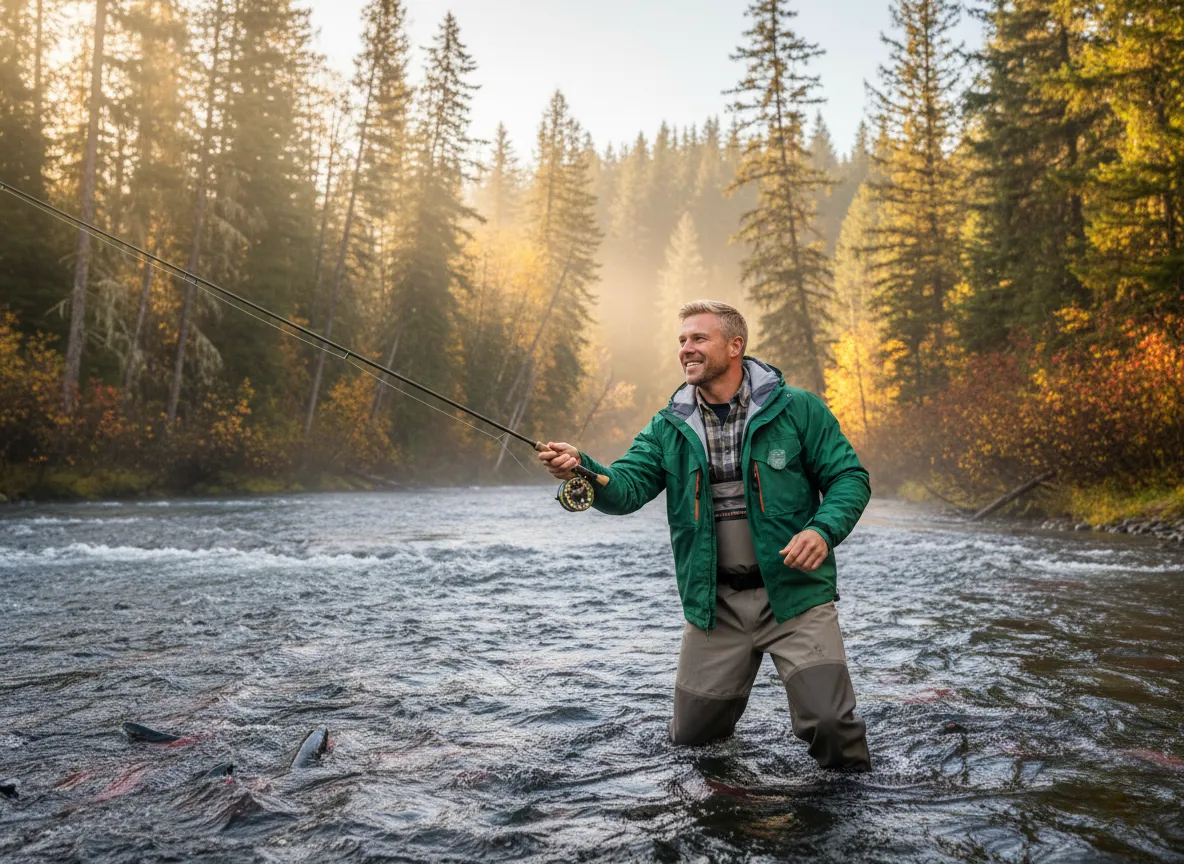
Standing on a riverbank in the crisp autumn air, the water boils with flashes of crimson and olive as thousands of powerful fish fight their way home. This isn’t just a spectacle; it’s the final, heroic act of the Pacific Northwest salmon run, an annual fish migration event central to both the ecology and cultural heritage of the region. For millennia, Native American cultures have celebrated salmon returning home with first fish ceremonies, recognizing them as a sacred gift. This guide is your blueprint to move beyond just watching the spectacle and truly understand the life, the science, and the spirit behind this iconic journey, empowering you to find your own place along the river with knowledge and respect.
This journey is about turning what you read here into confident action. We’ll start by learning to distinguish the six key Oncorhynchus species in both their brilliant ocean forms and their rugged spawning colors. Then, we will uncover their epic anadromous life cycle and understand why a salmon’s death is the very foundation of the entire coastal ecosystem. From there, we’ll give you a field guide to the best times and locations in Washington State and Oregon to witness the run yourself. Finally, we’ll equip you with the essential knowledge for ethical angling and conservation, helping you understand both how to sustainably fish for these icons and the critical threats they face. True competence isn’t just knowing; it’s doing. Let’s get started.
The Anadromous Icons: What Species Define the Run?

The salmon run is a drama with a cast of incredible actors. Understanding who they are is the first step to appreciating the story unfolding in the river. This is the foundational knowledge you need to identify each of the Pacific salmon species and understand the unique biological strategy that drives it home to its natal spawning ground.
How Do You Identify the Six Key Pacific Salmonids?
Identifying salmon can feel daunting, but it’s a skill built on observing a few key features. The first thing to understand is that you will encounter these anadromous fish in two primary phases: the sleek, silvery “ocean-bright” phase when they first enter fresh water, and the dramatically transformed “spawning” phase, when their bodies have morphed for the final act of reproduction at the end of their 2-to-5-year life span.
For anglers and keen observers, the most reliable features for identifying ocean-bright fish are found in two places: the tail and the mouth. The pattern of spots on the tail (or lack thereof) and the color of the mouth and gum line are your most trusted clues.
Pacific Salmon Species Identification Guide
Compare key features: mouth/gum color and tail spotting patterns
Scientific Name
Oncorhynchus tshawytscha
Tail Spotting Pattern
Spots on both upper & lower lobes
Scientific Name
Oncorhynchus kisutch
Tail Spotting Pattern
Spots on upper lobe only
Scientific Name
Oncorhynchus nerka
Tail Spotting Pattern
No spots on tailmarks
Scientific Name
Oncorhynchus keta
Tail Spotting Pattern
Faint vertical “watermarks”, No spots
Scientific Name
Oncorhynchus gorbuscha
Tail Spotting Pattern
Large, oval spots on both lobes
Scientific Name
Oncorhynchus mykiss
Tail Spotting Pattern
Small, even spots across entire tail
Once these fish species begin preparing to spawn, they undergo a stunning transformation fueled entirely by stored energy, as they stop feeding upon entering freshwater. This is a one-way trip, as all species of Pacific salmon die after spawning. Males develop a hooked jaw, called a kype, and their bodies change into a vibrant, rugged display. Sockeye turn a brilliant, impossible red with a green head. Chum develop bold, vertical “tiger stripes” of purple and green. Pinks grow a comically large hump on their back, earning them the name “humpies.” In contrast to the five species of Pacific salmon, the anadromous form of rainbow trout, the Steelhead, undergoes a more subtle color change and retains the ability to survive spawning and return to the Pacific Ocean, a trait shared by some Atlantic salmon. For an authoritative visual reference, consult the U.S. Fish and Wildlife Service identification guide. This dramatic physical change from ocean predators to freshwater spawners is driven by a profound biological difference in their life’s purpose.
The Epic Journey: How Does a Salmon’s Life Unfold?
To truly grasp the significance of the salmon run, you have to understand the journey. It’s a multi-stage salmon life cycle of migration and transformation, a biological marvel that has been perfected over millennia in the western rivers of the Pacific Northwest.
What Are the Six Stages of a Salmon’s Life?
The life of a Pacific salmon is a circle, beginning and ending in the cold, clean water and gravel beds of its natal streams. It’s a story told in six distinct chapters.
It begins as an Egg (Stage 1). The female salmon deposits between 1,000 and 7,000 eggs into a gravel nest called a “redd,” which she digs with powerful sweeps of her tail in a carefully selected riffle. Once the eggs are laid, the male fertilizes them, and the female gently covers them for protection. After hatching, the tiny fish enters the Alevin phase, also known as a sac fry (Stage 2). Still hidden in the gravel, this tiny creature draws all its nutrition from the large yolk sac attached to its belly. Once the yolk sac is fully absorbed, the juvenile fish must emerge as a parr (Stage 3), which develops vertical camouflage markings and begins feeding on its own.
As the young salmon grows, it prepares for the most critical transformation: “smoltification.” As a smolt (Stage 4), its entire physiology changes through a process called osmoregulation, adapting its body to survive in saltwater. It loses its parr marks, turns silvery, and begins its downstream fish migration to the estuary. After a period of acclimatization, the post-smolt enters the Ocean Adult (Stage 5) phase, a period of rapid growth where the fish will spend one to five years feeding and reaching sexual maturity. Finally, cued by an ancient instinct, the Spawner (Stage 6) begins its return migration. It ceases feeding, transforms physically, and uses all its remaining energy to fight its way back to that exact natal spawning ground to reproduce. For a definitive government overview of this process, NOAA Fisheries explains the salmon life cycle. This incredible return isn’t luck; it’s the result of a sophisticated, two-phase natural homing mechanism.
How Do Salmon Navigate Thousands of Miles Home?
For centuries, the salmon’s ability to navigate thousands of miles of open ocean and return to its home river was a profound mystery. We now know they rely on a brilliant two-phase system that combines a global sense of direction with a hyper-specific sense of smell.
The first phase is magnetoreception. Scientists believe that salmon use the Earth’s magnetic field as a massive, invisible “map” to navigate the open ocean. The theory of “geomagnetic imprinting” suggests that as a smolt leaves its natal river, it “memorizes” the unique magnetic signature of that specific location on the globe. This incredible ability doesn’t point them to the exact riffle they were born in, but it gets them back to the general coastal area of their home river—a macro-navigation tool for crossing a vast, featureless ocean. For an overview of the data behind this, you can review the scientific consensus on salmon homing mechanisms.
Once they reach the coast, the second phase kicks in: olfactory imprinting. As a smolt, the salmon also memorized the unique chemical cocktail of its natal stream—a precise recipe of minerals, soil, and decaying vegetation. As the adult returns, its highly sensitive nose detects this trail in the main-stem river. It follows this scent, making correct ‘turns’ at tributaries by choosing the path that smells most like home. Magnetoreception provides the map, but olfaction provides the final, precise address. This biologically expensive and dangerous journey culminates in a final, transformative act that defines the entire coastal ecosystem.
The Ecological Powerhouse: Why is the Salmon Run So Important?
When a salmon returns to the river, it does more than just reproduce. It becomes the lifeblood of the entire ecosystem. Pacific salmon are a classic “keystone species,” a term for an organism that has a disproportionately large ecological impact; in this case, they support over 130 other species, from insects to Grizzly bears. Their role is so critical that without them, the entire forest would suffer.
How Do Dying Salmon Fertilize an Entire Forest?
The secret lies in an amazing process of nutrient transfer called the Marine-Derived Nutrient (MDN) Cycle. It’s a simple, powerful, three-step system for moving the wealth of the ocean deep into the forest.
The process begins with Transport. A salmon feeds in the Pacific Ocean, accumulating ocean nutrients like nitrogen, phosphorus, and sulfur. The second step is Delivery. The salmon carries these nutrients hundreds of miles inland on its spawning migration. The final step is Deposit. After spawning, the salmon die, and their nutrient-rich salmon carcasses are released into the ecosystem.
This nutrient pulse has profound dual benefits. The Aquatic Benefit is immediate: decomposing carcasses fertilize the stream, fueling blooms of algae and insects that become food for the next generation of juvenile salmon. The Terrestrial Benefit is just as vital. Predators like Grizzly bears, Black bears, and Bald eagles drag salmon carcasses out of the river and into the riparian zones. Here, this riparian nutrient cycling acts as a direct fertilizer. The impact is staggering. Isotopic analysis shows that trees like Sitka spruce can derive over 20% of their nitrogen directly from salmon. For a deeper scientific look, you can read the research on salmon-derived nitrogen in riparian forests.
Pro-Tip: When you’re walking along a salmon river in the fall, look for more than just fish. Look for the signs of the nutrient cycle: eagle feathers on the ground, claw marks on trees, and the rich, earthy smell of decay. These are clues that the ecosystem is healthy and functioning as it should.
This natural fertilization process creates a powerful positive feedback loop, where the salmon populations literally build their own ideal habitat for their offspring, ensuring the strength of the next generation.
A Field Guide to Witnessing the Run: Where and When Can You Go?
Observing the spawning salmon is an unforgettable experience. This section provides the practical, actionable information you need for salmon viewing, from prime viewing locations in Washington and Oregon to essential viewing tips.
What Are the Prime Viewing Locations in Washington and Oregon?
The peak viewing months generally run from late August through November, with the spawning season for many species occurring from September to November amidst stunning fall colors.
In Washington State, the Issaquah Salmon Hatchery offers an incredibly accessible view. For a more natural setting, the Kennedy Creek Salmon Trail near Hoodsport provides a wonderful walk where you can observe Chum salmon. A unique urban location is the Ballard Locks in Seattle, where you can watch Sockeye, Chinook, and Coho navigate the fish ladder. Many reliable spots are man-made structures, a reminder of the conservation challenges. For a comprehensive list, check out the Washington Department of Fish & Wildlife’s salmon viewing map.
In Oregon, the Columbia River Basin is the epicenter. The Bonneville Fish Hatchery in the Columbia River Gorge is world-famous, with a fish viewing window. For more natural settings, Oxbow Regional Park on the Sandy River and the Wildwood Recreation Area on the Salmon River Trail both offer excellent opportunities, including easy hike and ADA-accessible trails through beautiful old-growth forest.
No matter where you go, the single most important tip is to get real-time information. Always check with local agencies like WDFW or ODFW. When you arrive, approach a stream slowly and stand quietly at the edge; do not enter the water. Once you’ve chosen your destination, a few simple rules of etiquette will ensure both your safety and the well-being of the fish.
The Ethical Angler’s Dossier: How Can You Fish the Run Sustainably?
Participating in the salmon run as one of many sport anglers is a privilege that comes with great responsibility. It demands knowledge, respect, and an ethical approach to sport fishing, including using sustainable fishing techniques.
What is the Most Important Rule for Modern Salmon Angling?
In the complex world of modern fisheries management, one concept stands above all others: the Wild vs. Hatchery distinction. This is the lynchpin of “Mark-Selective Fisheries,” a strategy designed to protect threatened native populations while allowing anglers to harvest surplus fish from hatchery production.
Your primary duty as an angler is to know the difference. You can identify a hatchery fish by its missing adipose fin—a small, fleshy fin located on the fish’s back between the large dorsal fin and the tail. This fin is clipped at the hatchery, and a healed, smooth scar will be present. A wild fish, by contrast, will have its adipose fin fully intact. In most mark-selective fisheries, it is illegal to retain a wild (un-clipped) fish.
This knowledge is not optional; it is the fundamental entry point for ethical participation. Furthermore, regulations can change rapidly. It is imperative that you check the official regulation links before every single trip. You can find these on sites like Washington’s eRegulations on mark-selective fisheries. With this core principle understood, mastering catch-and-release methods becomes the most vital physical skill in your arsenal.
Pro-Tip: When releasing a wild salmon, always handle the fish with wet hands to protect its sensitive slime coat. Keep the fish in the water as much as possible and support its weight horizontally. To revive it, gently hold it facing into the current until it is strong enough to swim away on its own power. A healthy release is your contribution to the future of the run.
A System in Peril: What Threats Do Salmon Face?
To be a true steward of this resource, you must also understand the profound threats Pacific salmon face. Their story is one of resilience, but they are swimming against a powerful current of cumulative threats that have pushed many salmon populations to the brink of decline.
What Are the “Four Hs” Threatening Salmon Survival?
The major threats facing salmon are often summarized as the “4 Hs.”
- Habitat: The single biggest contributor to salmon decline is habitat loss and degradation. The loss of access to cold, clean water and pristine gravel beds for redds has had a devastating impact.
- Hydropower: Dams on major rivers like the Columbia and Snake create massive problems. They form impassable barriers to migration—drowning out historically vital fishing sites like Celilo Falls—kill juvenile fish in turbines, and create warm, slack-water reservoirs.
- Harvest: While modern regulations are much stricter, historical overfishing by commercial fishermen decimated many runs before the true scale of the problem was understood. Sustainable harvest management remains a constant challenge.
- Hatcheries: Though intended as a solution, programs at facilities like the Little White Salmon National Fish Hatchery can have complex, unintended consequences. They can lead to genetic dilution and intense competition for resources for struggling wild populations.
Compounding all of these is Climate Change, which acts as a “threat multiplier,” exacerbating all four “H” factors by warming rivers and disrupting the marine food web. You can see NOAA’s overview of threats to Pacific salmon for a comprehensive summary. As a result, 28 distinct populations of salmon and steelhead are listed as threatened or endangered under the Endangered Species Act (ESA). But this story of decline is not an ending; it is a call to action, and a new paradigm of restoration is taking hold across the Northwest.
Conclusion
The Pacific Northwest salmon run is far more than a spectacle of nature; it is the resilient heartbeat of an entire region. We’ve seen that it’s a complex fish migration of six distinct species, each driven by a life strategy honed over millennia. Their six-stage journey from egg to ocean predator and back is guided by an astonishing internal map and an imprinted sense of smell. Upon their return, these keystone species fuel the entire coastal ecosystem through riparian nutrient cycling. As humans, our engagement—whether viewing from the bank or fishing from the water—demands a deep ethical commitment, grounded in understanding regulations and mastering skills like wild vs. hatchery identification and proper catch-and-release.
The river is telling a story of resilience and struggle. Now that you have the blueprint, go listen. Explore our full library of species guides and conservation articles to continue your journey from angler to steward.
Frequently Asked Questions about the Pacific Northwest Salmon Run
When is the best time to see the salmon run?
The best time to see the annual salmon run is generally during the autumn, from September through November. However, peak viewing times vary significantly by location and species, with some runs starting as early as late August, so always check local conditions.
Why do salmon die after they spawn?
Most Pacific salmon die after they spawn because they are semelparous, an evolutionary strategy of putting all available energy into a single, massive reproductive event. They stop eating when they enter freshwater, and their bodies break down to create their salmon eggs and sperm, leaving no reserves to return to the ocean.
How far do salmon swim to spawn?
Salmon can swim incredible distances. The migration distance can range from a few hundred to several thousand miles to return to their home river. For example, some Chinook salmon from the Yukon River travel over 2,000 miles inland to reach their spawning grounds.
Can you eat a salmon after it has started to spawn?
While technically edible, the quality of a salmon’s meat deteriorates rapidly once it enters freshwater and begins its spawning transformation. Its body is consuming its own muscle and fat reserves, making the flesh pale, soft, and unappetizing compared to an ocean-bright fish.
Risk Disclaimer: Fishing, boating, and all related outdoor activities involve inherent risks that can lead to injury. The information provided on Master Fishing Mag is for educational and informational purposes only. While we strive for accuracy, the information, techniques, and advice on gear and safety are not a substitute for your own best judgment, local knowledge, and adherence to official regulations. Fishing regulations, including seasons, size limits, and species restrictions, change frequently and vary by location. Always consult the latest official regulations from your local fish and wildlife agency before heading out. Proper handling of hooks, knives, and other sharp equipment is essential for safety. Furthermore, be aware of local fish consumption advisories. By using this website, you agree that you are solely responsible for your own safety and for complying with all applicable laws. Any reliance you place on our content is strictly at your own risk. Master Fishing Mag and its authors will not be held liable for any injury, damage, or loss sustained in connection with the use of the information herein.
Affiliate Disclosure: We are a participant in the Amazon Services LLC Associates Program, an affiliate advertising program designed to provide a means for us to earn advertising fees by advertising and linking to Amazon.com. As an Amazon Associate, we earn from qualifying purchases. We also participate in other affiliate programs and may receive a commission on products purchased through our links, at no extra cost to you. Additional terms are found in the terms of service.