In this article
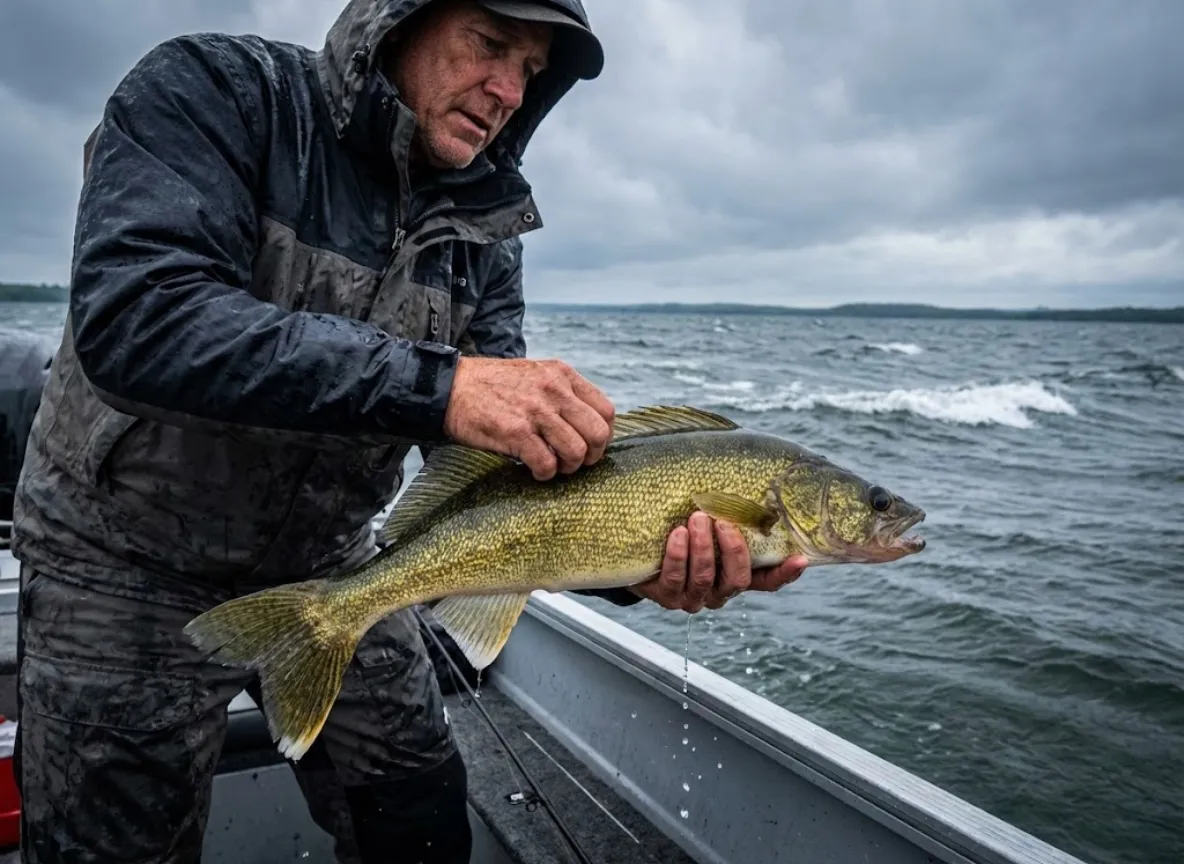
The surface of the lake is broken by a distinct, rhythmic chop, and the sun is barely cutting through the slate-grey overcast. Most recreational boaters are heading for the ramp to escape the weather, but you are just untying the dock lines. This is not a sport of luck or lazy afternoons; targeting Sander vitreus—the most popular cool-water game fish—is a pursuit of precision, driven by a biological understanding of light, vibration, and depth.
To catch Walleye consistently, you must stop fishing for them like Bass or Panfish. You need to start exploiting the specific physiological traits that make them the ghost of the deep water and a prize in freshwater sport fishing. This guide moves past the basics to provide a tactical understanding of the “marble eye,” helping you select the right fishing gear, master the “Big Three” presentation systems, and understand the ethical limits of deep-water angling.
The Biology of the Bite: Why Walleye Behave That Way?

This section deconstructs the physiological makeup of the Walleye. By understanding the biology, you can understand why specific tactics work, moving you from guessing to strategic planning.
How does the Walleye’s unique vision dictate its feeding windows?
The Walleye possesses a specialized layer of tissue behind the retina called the tapetum lucidum, which reflects light back through the photoreceptors a second time. This structure acts like biological night-vision goggles. It gives low-light feeders like the Walleye a massive predatory advantage over Perch and Bluegill in dim conditions. Because of this, the most productive fishing times are invariably crepuscular periods—dawn, dusk, heavy overcast periods, or night fishing.
Conversely, this light amplification causes “photophobia” (light sensitivity) during high-sun days. This forces the fish to retreat to deep basins or bury in thick weed lines. Successful walleye anglers use this knowledge to target structure during “prime time” and switch to reaction baits in the weeds during midday.
The “opaque” look of their eyes is the physical manifestation of this unique ocular adaptation found in nocturnal predators. It serves as a constant reminder of their environmental preference. Understanding this links directly to the broader science of fish vision, which dictates lure color selection and depth control.
Why is the “Walleye Chop” essential for shallow water success?
The “Walleye Chop” refers to surface turbulence caused by wind (typically 10-15 mph) that breaks up sunlight penetration. This optical scattering reduces the underwater light intensity. It allows light-sensitive Walleye to move into shallow water (4-8 feet) to feed without ocular discomfort.
Anglers should always prioritize the wind-blown side of the lake or structure. Do not seek the comfort of the calm, leeward side. Beyond the optical advantage, wind activation creates wave action that physically dislodges crayfish and disorients baitfish from rocks, creating a “mudline” or turbidity plume.
Walleye use this turbid water as a tactical cloak to ambush prey, making the “mudline” a high-percentage target zone for active fish. In these conditions, aggressive presentations like crankbaits or snap jigging become far more effective than subtle finesse tactics. This behavior aligns with their biological preferences for low-light and turbid water. When planning your trip, consider how fishing barometric pressure and wind speed interact to create these ideal feeding windows.
The Gear Matrix: What Tools Do I Actually Need?
This section moves beyond generic gear setup advice to explain the specific physics required to detect the notorious “suction bite” of the Walleye.
Why is rod sensitivity the most critical factor?
Unlike Pike that slash, Walleye often feed by “glomming”—inhaling water to create a vacuum that pulls the baitfish in. This bite often registers not as a “thump,” but simply as a loss of weight, a “tick bite,” or a “mushy” feeling on the line.
Detecting this requires a Fast or Extra Fast action spinning rod made of high-modulus graphite. These materials transmit subtle vibrations better than fiberglass or composite blends. For general applications, a 6’6″ to 7’0″ Medium-Light power rod strikes the perfect balance between rod sensitivity and hook-setting power.
The “Fast” tip allows for visual bite detection (watching the tip straighten) before the fish feels the resistance of the rod backbone. Using a heavy, insensitive fiberglass rod will result in the fish spitting the bait before you ever realize you had a strike. Their distinctive large canine teeth and suction feeding mechanism require this specific toolset. Pair this with a spinning reel size 2000-3000 for balance. If you are unsure about the difference between the bend of the rod and its lifting strength, review the mechanics of rod power vs action.
Pro-Tip: Watch your line where it enters the water, not just your rod tip. Often, the line will “jump” or slacken slightly before the rod tip ever moves. If the line does something different than the waves, set the hook.
How should I rig my line for maximum stealth and strength?
The modern standard for walleye fishing is a braided line main line (8-10 lb test) tied to a fluorocarbon leader. Braid has zero stretch, meaning every pebble, weed strand, or fish “tick” is transmitted instantly to the rod grip. The High-Vis braid (Neon/Yellow) allows you to visually detect “jump bites” where the line moves but the rod doesn’t load.
A 6-8 lb Fluorocarbon leader is mandatory because it is nearly invisible underwater. It also sinks, helping light jigs reach the bottom. The leader should be connected via a Double Uni or FG knot (a solid braid-to-fluoro connection) to pass smoothly through the rod guides.
This system eliminates the “coil memory” of monofilament and provides the abrasion resistance needed when fishing near zebra mussels or jagged rocks. Always check your local walleye fishing regulations and fishing gear restrictions regarding the number of lines or hooks allowed per rod. For a detailed comparison of why we mix line types, look at the data on braid vs fluorocarbon vs monofilament.
The Seasonal Roadmap: Where Are the Fish Right Now?
You must interpret the calendar and water temperature to predict fish location, utilizing the concept of Thermal-Optical Habitat Area (TOHA).
How do Walleye migrate throughout the open water season?
Walleye follow a predictable pattern of seasonal migrations driven by spawning urges and temperature.
- Spring (Pre/Post Spawn): Fish concentrate in rivers, below dams, or on shallow gravel reefs (4-10ft) to spawn when water hits 42-50°F (spawn temperature).
- Summer Peak: As water warms, fish migrate to deep water structures like humps, saddles, and deep weed edges to find cooler water and dissolved oxygen (optimal temperature zones).
- Fall Transition: Cooling water triggers a return to shallow structures and steep breaks to feed heavily before winter.
This migration is driven by the search for the “Thermal-Optical Habitat Area” (TOHA). This is the intersection of preferred light levels and metabolic temperature. In clear water lakes, this pushes fish much deeper (25ft+) than in stained, dark water lakes where they may remain shallow (10ft) all summer.
Anglers must consult bathymetric maps to identify the “highways” (drop-offs and channels) fish use to travel between these seasonal homes.
Scientific studies on evaluating thermal and optical habitat occupancy confirm that Walleye will sacrifice temperature comfort to stay in low-light environments. This behavior is one of the definitive walleye facts that separates expert anglers from novices.
The “Big Three” Tactical Systems: How Do I Catch Them?
Three foundational techniques—Jigging, Rigging, and Trolling—form the core of the angler’s playbook, covering 90% of walleye fishing scenarios.
When and how should I deploy the vertical jig?
Jigging is the most versatile technique, effective from ice-out to freeze-up. It is primarily used to target specific fish marked on sonar or your fish finder. The basic presentation involves dropping the jig to the bottom, lifting it 6-12 inches, and following it back down on a semi-slack line. Most strikes occur on the drop; if you have too much slack, you will miss the bite entirely.
In cold water (<50°F), tip the jig (often a Fire-Ball jig or Whistler jig) with a live minnow (Fatheads or Shiners) and keep movements subtle. In warm water (>60°F), “Snap Jigging” with plastics (curly tail grub, power grubs, or paddletails) or “Jigging Raps” triggers a reaction strike through speed and aggression.
Boat control is critical; the line must remain vertical to detect bottom contact and depth changes instantly. Reviewing effective jigging techniques for seasonal walleye can help refine your cadence. For those new to the motion, our guide on jigging for beginners breaks down the mechanics step-by-step.
Why is the Lindy Rig the ultimate solution for neutral fish?
The Lindy Rig (or slip-sinker rig) creates a separation between the sinker and the bait. This allows the minnow, leeches, or nightcrawlers to swim naturally near the bottom. It utilizes a “Walking Sinker” that slides on the main line to a barrel swivel, ensuring that when a Walleye inhales the bait, it feels zero resistance. The presentation is a slow drag (0.5 – 0.8 mph), keeping the sinker occasionally ticking the bottom structure.
Upon feeling the “tap-tap” of a bite, the angler must immediately drop the rod tip and open the bail to feed line. This “feed phase” (5-10 seconds) gives the fish time to swallow the bait before the hookset. Leader length is the variable. Use short leaders (2-3ft) in snags/turbid water, and long leaders (6-10ft) in clear water to distance the bait from the hardware.
State agencies recommend these live bait rigging strategies for finicky fish when the bite gets tough. Understanding the specific components, like those found in a fishing weights guide, is essential for assembling this rig correctly.
Pro-Tip: When using a Lindy Rig, never set the hook with a sharp “snap.” Instead, reel up the slack until you feel the weight of the fish, and then perform a long, sweeping pull to drive the hook home.
How do I cover water effectively using bottom bouncers?
Bottom Bouncers are L-shaped wire weights designed to drag along the bottom without snagging. They deliver a spinner rig (Crawler Harness) into the strike zone. The standard rule for depth control is “1 ounce of weight for every 10 feet of depth” to maintain a 45-degree line angle at trolling speed (1.0 – 1.5 mph). This method allows anglers to quickly search large basins or flats to locate suspended fish or active walleye.
Blade selection is critical: Use broad Colorado blades for slow speeds and “thump” in murky water. Use narrow Willow Leaf blades for higher speeds and “flash” in clear water. Crankbaits like Rapala Shad Raps, Husky Jerks, or Flicker Shads can also be effective behind planer boards to cover the water column.
Because the fish hooks itself against the forward motion of the boat, rod holders are often more effective than holding the rod by hand. These trolling techniques using spinner rigs are standard practice on large bodies of water like Lake Erie. This is a specialized form of trolling for freshwater fish, adapted specifically for bottom-hugging predators.
Conservation and Ethics: How Do I Protect the Fishery?
Catching fish is the goal, but ensuring they survive release is the responsibility. We must address the specific dangers of deep-water catch and release.
What is barotrauma and how do I prevent it?
Walleye are physoclistous fish. This means their swim bladder is not connected to their gut, preventing them from burping gas to equalize pressure. When pulled rapidly from depths greater than 30 feet, the swim bladder expands. This causes “barotrauma” (often visible as the stomach protruding from the mouth).
The mortality rate for released fish caught deeper than 30 feet is extremely high. Therefore, ethical anglers avoid catch-and-release in deep water. If you are fishing deep water, catch your limit and stop; do not “cull” or upgrade.
If a fish must be released, do not puncture the stomach (“fizzing”) unless trained. Instead, use a descending device to lower the fish back to depth immediately. Protecting the large breeders (large females) and practicing selective harvest on smaller “eater” males (15-19 inches) is the best practice. It is vital to stay updated on understanding barotrauma and descending devices to ensure compliance and sustainable fishing. For a step-by-step tutorial on handling these situations, read our guide on fixing barotrauma in fish.
Final Strategy
Mastering walleye fishing is not about luck; it is about applying biological knowledge to on-the-water variables.
- Fish the Conditions: Success is dictated by light levels (Tapetum Lucidum) and wind (Walleye Chop).
- Gear Up: Use sensitive graphite rods and non-stretch braid to detect the subtle suction bite.
- Adapt Tactics: Shift from Jigging (Precision) to Rigging (Finesse) to Trolling (Coverage) based on fish mood and location.
- Respect Depth: Avoid releasing fish from below 30 feet to prevent fatal barotrauma.
Next time the wind kicks up and the sky turns grey, don’t head for the dock. Head for the wind-blown point and put these tactics to the test. Share your first freshwater sport fishing success story in the comments below.
FAQ – Frequently Asked Questions
What is the best time of day to catch Walleye?
The Golden Hours of dawn and dusk are historically the most productive due to the Walleye’s low-light vision advantage. However, during Walleye Chop (windy, overcast days), feeding can occur aggressively in shallow water throughout the middle of the day.
What is the best lure color for Walleye?
In stained or turbid water, Chartreuse, Firetiger, Orange, and Glow (Phosphorescent) are most visible. In clear water, natural metallic finishes like Gold, Silver, and Blue that mimic baitfish flash are superior.
How deep should I fish for Walleye?
There is no single depth; it depends on the season and water clarity. Spring fish may be in 4-8 feet, while Summer fish in clear lakes often drop to 25-35 feet or suspend over deep basins.
Is live bait better than artificial lures?
Live bait (Minnows, Leeches, Crawlers) is generally better for cold water (<50°F) or neutral, passive fish. Artificials (Plastics, Crankbaits) trigger reaction strikes and are often better in warm water or when covering water quickly to find active schools.
Risk Disclaimer: Fishing, boating, and all related outdoor activities involve inherent risks that can lead to injury. The information provided on Master Fishing Mag is for educational and informational purposes only. While we strive for accuracy, the information, techniques, and advice on gear and safety are not a substitute for your own best judgment, local knowledge, and adherence to official regulations. Fishing regulations, including seasons, size limits, and species restrictions, change frequently and vary by location. Always consult the latest official regulations from your local fish and wildlife agency before heading out. Proper handling of hooks, knives, and other sharp equipment is essential for safety. Furthermore, be aware of local fish consumption advisories. By using this website, you agree that you are solely responsible for your own safety and for complying with all applicable laws. Any reliance you place on our content is strictly at your own risk. Master Fishing Mag and its authors will not be held liable for any injury, damage, or loss sustained in connection with the use of the information herein.
Affiliate Disclosure: We are a participant in the Amazon Services LLC Associates Program, an affiliate advertising program designed to provide a means for us to earn advertising fees by advertising and linking to Amazon.com. As an Amazon Associate, we earn from qualifying purchases. We also participate in other affiliate programs and may receive a commission on products purchased through our links, at no extra cost to you. Additional terms are found in the terms of service.