
In this article
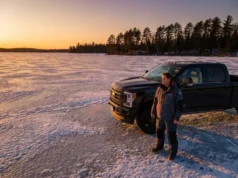
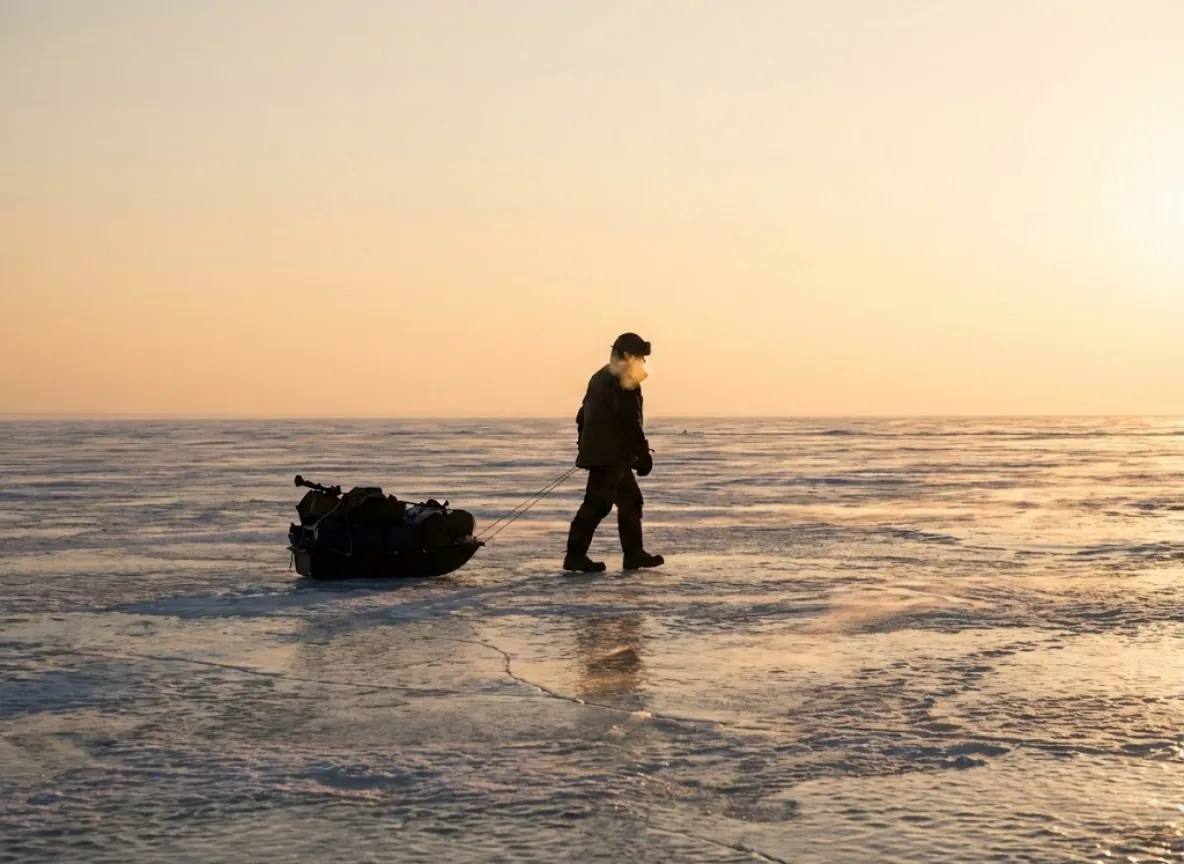
The wind on the open ice doesn’t just blow; it scours. Beneath your boots, a sheet of frozen water expands and contracts, booming like distant artillery. This is the “hardwater” frontier, a distinct branch of outdoor recreation that transforms the lake from a fluid, accessible medium into a fortress that must be breached.
To succeed here requires more than just luck; it demands a shift from casual winter sports to calculated survival skills and logistical precision. For decades, I have walked these frozen expanses—from early ice to the late-season thaw—and I have learned that the ice demands respect before it yields a harvest. This guide covers the ice fishing basics, moving you past the guesswork to focus on reading the ice, assembling a modern gear system, and executing the tactical ice workflow used by professional ice anglers.
How do we ensure survival on the hardwater environment?
Survival on the ice begins with the realization that the surface is a dynamic, shifting membrane, not a concrete floor. Before you ever drill holes, you must learn to interpret the language of the freeze.
How does ice formation physics affect load-bearing strength?
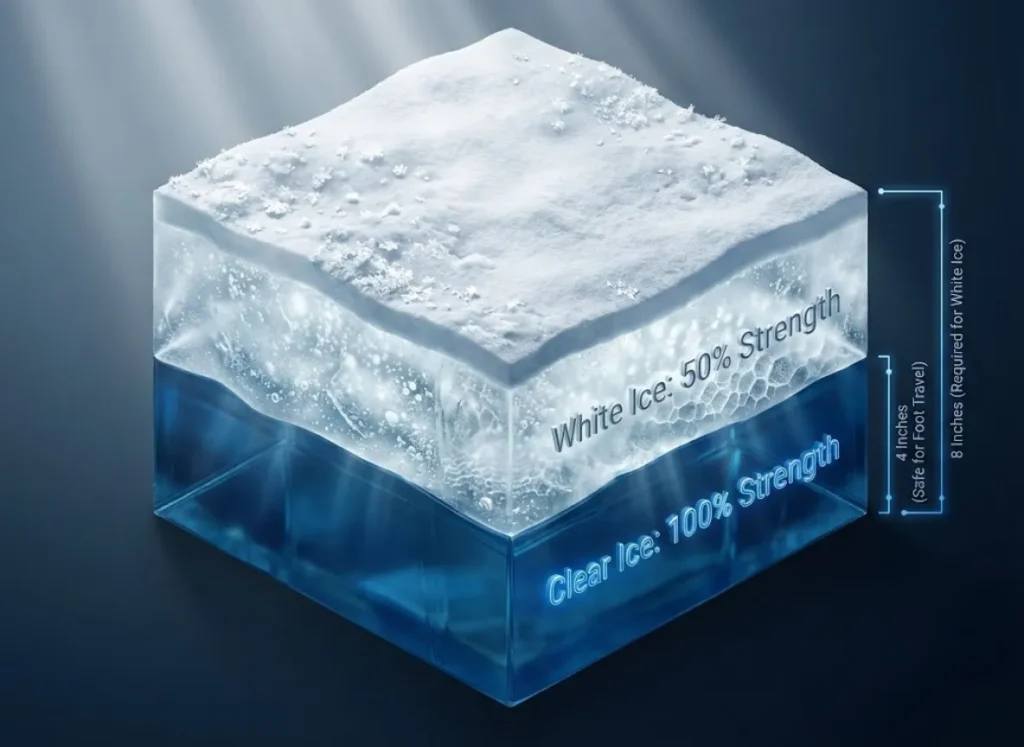
The structural integrity of ice depends entirely on how the water froze. Clear Ice (often called black ice or blue ice) forms on calm, cold nights and acts as a cohesive solid. The definitive standard for foot travel is a minimum of 4 inches of clear ice, which can support approximately 200 to 300 pounds.
However, you will often encounter “White Ice” or snow ice, formed by slush refreezing on top of the sheet. White ice contains air bubbles, resulting in honeycomb ice that possesses only about half the tensile strength of clear ice. If you are walking on white ice, that 4-inch minimum effectively doubles to 8 inches for the same safety margin.
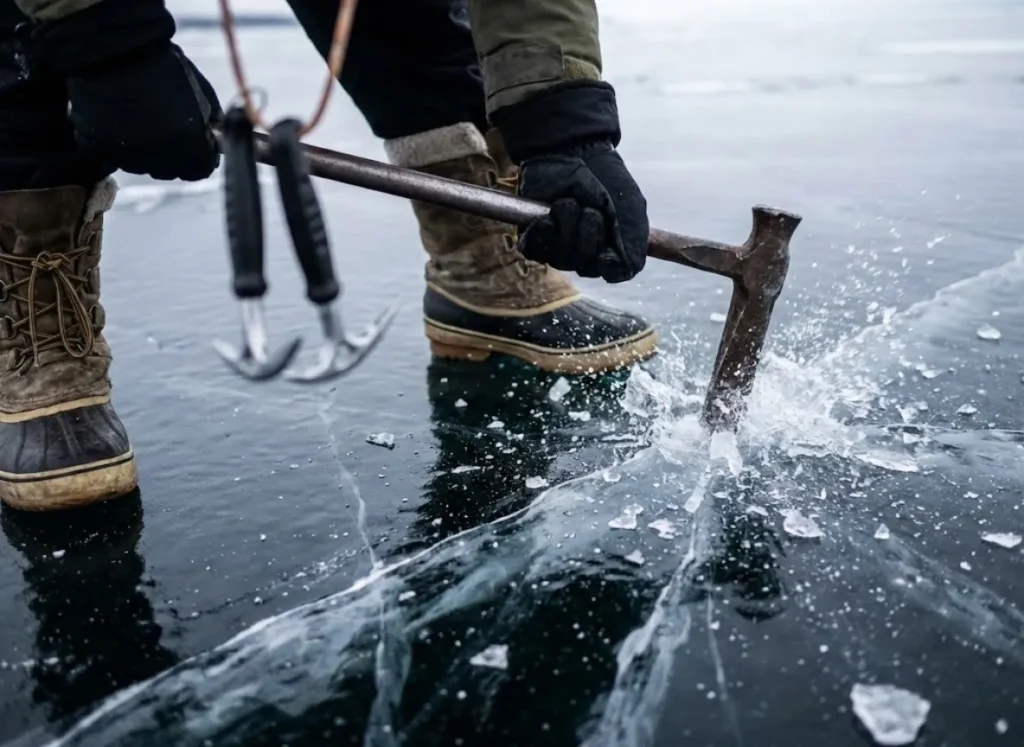
In the early season, or when exploring unknown waters, you must utilize the “Spud Bar Protocol.” Strike the ice hard with a heavy metal ice chisel (or spud bar) ahead of every step. If water seeps through or the bar punches through in one hit—signaling rotten ice—turn back immediately.
Pro-Tip: Listen to the spud bar. A solid, safe strike rings with a sharp “thud.” A hollow, lower-pitched “thump” often indicates rotting ice or honeycombed layers that are deteriorating from below.
Always verify your local conditions against authoritative sources, such as an official ice thickness chart, before heading out. Beyond basic thickness, understanding the nuances of how moving water, pressure ridges, and vegetation weaken the sheet is covered in our definitive guide to safety & tactics for early season anglers.
What is the 1-10-1 rule for cold water immersion?
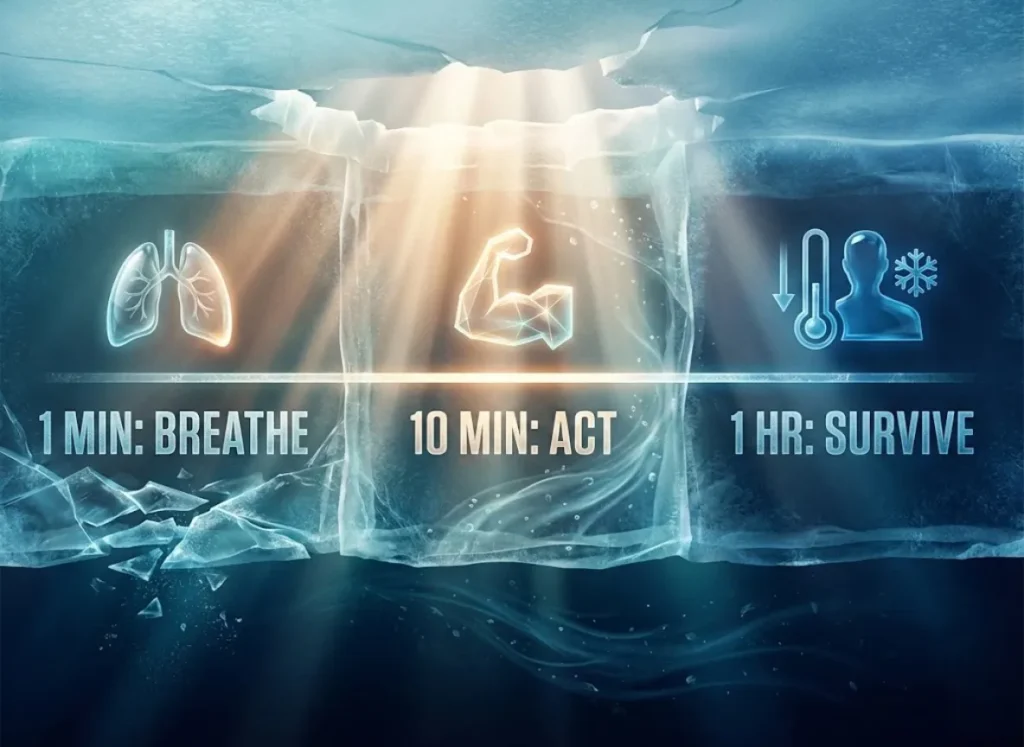
If the ice fails, your survival depends on suppressing panic and adhering to the 1-10-1 Rule.
- 1 Minute (Cold Shock): When you plunge in, your body will trigger an involuntary gasp reflex. You have one minute to get your breathing under control. Do not try to swim; focus entirely on keeping your head above water and calming your breath.
- 10 Minutes (Incapacitation): You have roughly ten minutes of meaningful movement before the cold numbs your nerves and muscles. This is your window for self-rescue.
- 1 Hour (Hypothermia): After ten minutes, you will likely lose the ability to move your limbs effectively. Unconsciousness sets in around the one-hour mark.
To escape, do not swim vertically like you are in a pool. Kick your legs up behind you to get your body horizontal, then use ice picks or safety spikes to pull your torso onto the shelf you fell from. Once out, roll away from the hole rather than standing up, distributing your weight until you reach thicker ice.
Prevention is as vital as rescue. Always dress in layers, starting with a moisture-wicking base layer and ending with a waterproof shell. Wear insulated boots or specific snowmobile-type boots to protect your feet, and carry a safety rope and whistle.
For a deeper understanding of the physiological timeline, review the phases of cold water immersion response. This knowledge, paired with the right gear like a life vest (PFD) detailed in our definitive guide to fishing safety, effectively eliminates the margin for fatal error.
What equipment constitutes the modern ice fishing system?
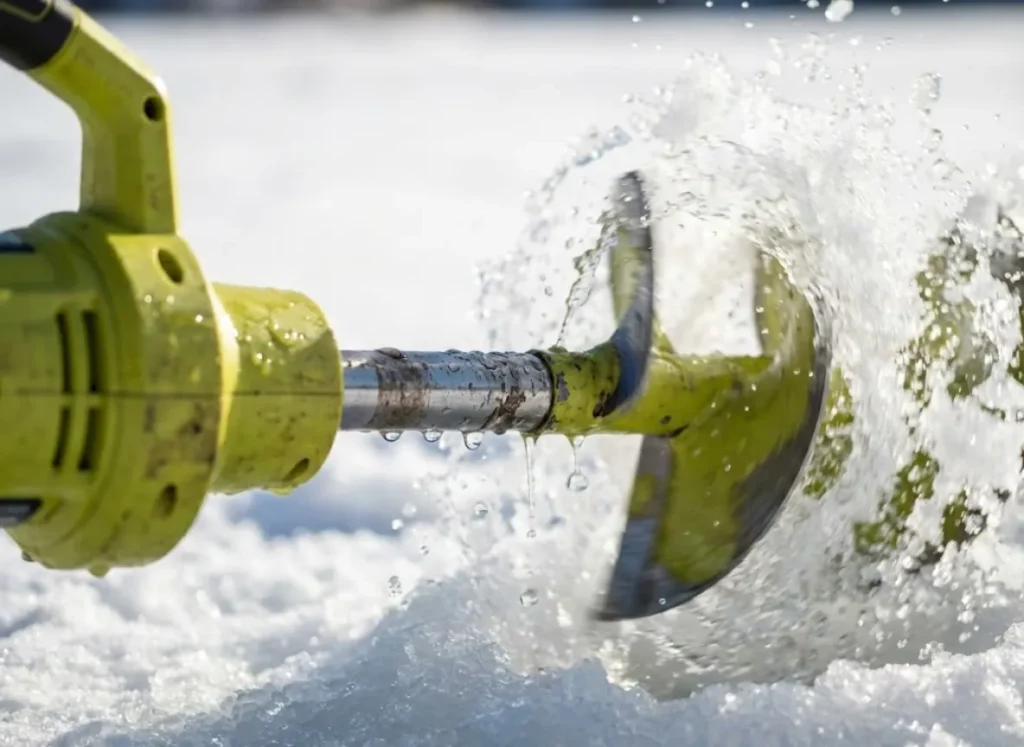
The days of dragging heavy, fuming equipment are over. The modern ice fishing expert views fishing gear as a cohesive system of power, shelter, and detection designed to maximize time with a lure in the water.
Why has the industry shifted to lithium-ion auger systems?
The “Lithium Standard” has replaced the traditional gas auger and heavy hand auger for one primary reason: efficiency. A modern electric auger, specifically the lithium auger, offers push-button starting, zero exhaust fumes inside a shelter, and a massive reduction in weight. While gas units weigh upwards of 30 pounds, dedicated lithium units or drill-plate assemblies (using a brushless drill) often weigh less than 15 pounds.
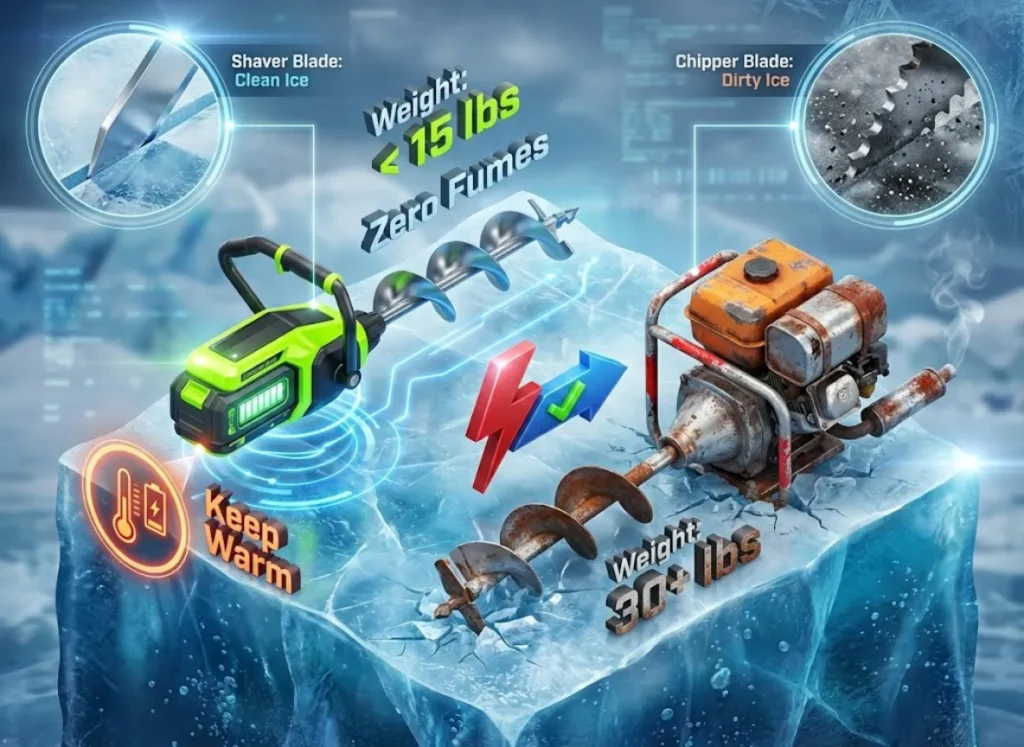
Blade geometry is equally critical. “Chipper” blades are serrated and durable, designed for re-frozen or dirty ice. “Shaver” blades act like razors, cutting incredibly fast on clean ice but dulling quickly if they hit debris. When operating electric units, battery management is vital.
Pro-Tip: Lithium batteries lose voltage potential in extreme cold. Keep your spare batteries inside your jacket pocket, close to your body heat, until you are ready to use them.
State agencies provide extensive ice strength and safety tool guidelines that confirm the efficacy of these modern tools for checking ice thickness without the fatigue of manual drilling. Don’t forget a durable ice scoop or ice skimmer to clear slush from the hole—a vital step often overlooked by novices.
How do electronics and shelters function as the angler’s infrastructure?
Your sonar and shelter are your eyes and your armor. Modern sonar units, whether mechanical flashers (like a Vexilar or Marcum) or digital fish finders, rely on “Target Separation.” This is the unit’s ability to distinguish your tiny tungsten jig from a fish hovering just one inch away. Without crisp separation, a fish hugging the bottom becomes invisible. An underwater camera can also be a valuable tool for identifying species in clear water.
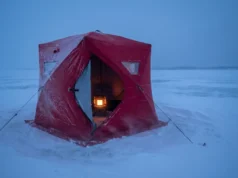
Shelters generally fall into three camps: the ice shanty (permanent shack), hub shelters (or pop-up shelter), and flip-over shelters. Hub shelters offer massive floor space and are lightweight but require setup time. Flip-over sleds offer instant mobility but are heavy and best towed by machines. Regardless of style, choose insulated fabric. The quilting prevents condensation—”indoor rain”—and retains the heat generated by your portable heater (such as a Mr. Heater).
Learning the difference between a hard bottom return and a soft mud bottom is a skill in itself. We cover this extensively in our guide on mastering your fish finder, which is essential for interpreting the data your unit provides.
How do you organize for efficiency and mobility?
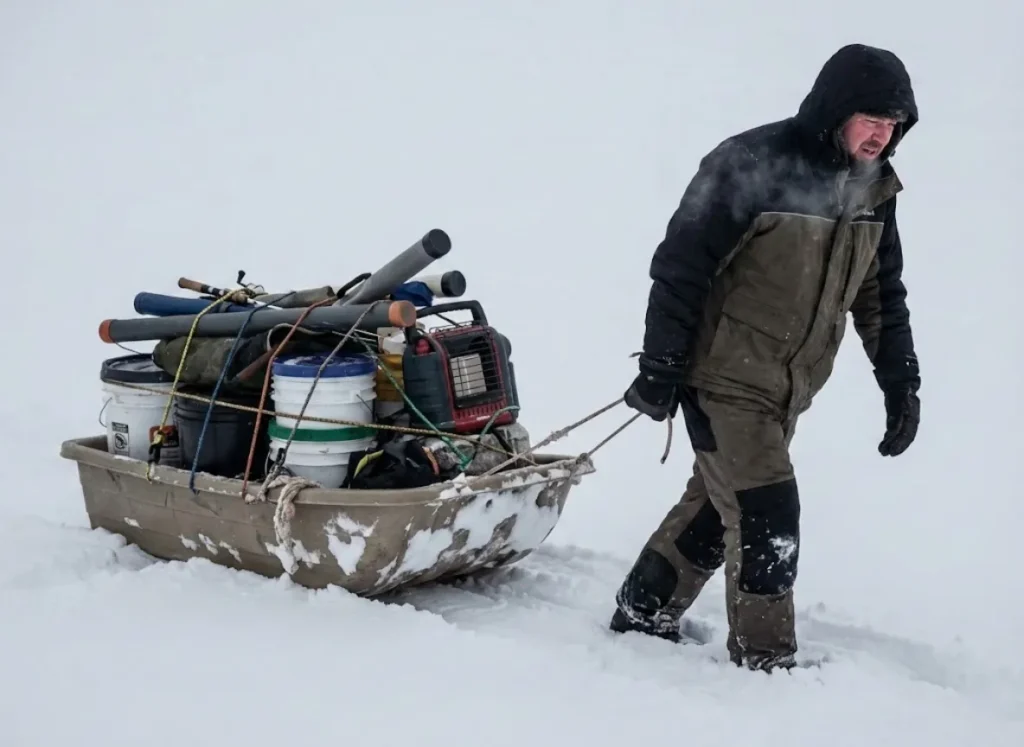
Gear is potential; logistics is kinetic. The way you pack the sled and the routine you execute upon arrival determines whether you spend the day finding fish or camping over empty water.
How should a sled be packed to maximize fishing time?
Packing a fishing sled (often a Jet Sled) is an exercise in “Sled Tetris” and center-of-gravity management. Heavy items—your ice auger head, batteries, and propane tank—must be placed at the rear of the sled (the hitch side). This prevents the sled from fishtailing during transport.
Delicate items, specifically fishing rods and electronics, require protection. Never lay rods loose in the tub where shifting gear can crush the tips. Use a hard case or vertical PVC tubes mounted to the sled walls.
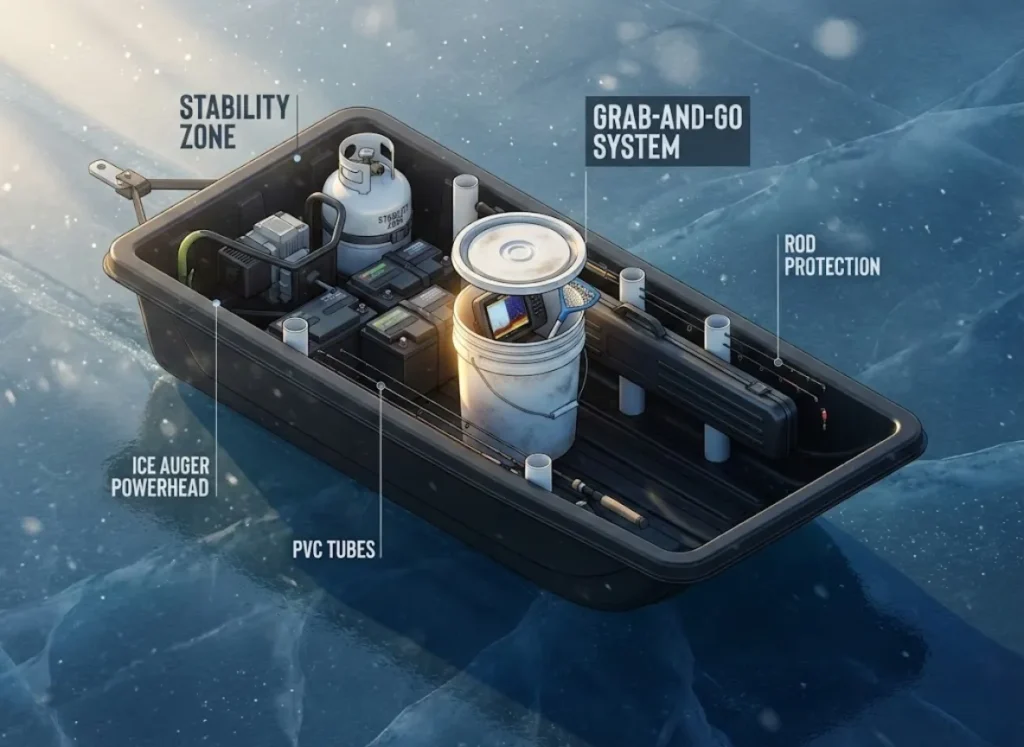
The most critical element of packing is the “5-gallon bucket” system. This bucket, often fitted with a bucket seat, is placed in the center of the sled containing your ice skimmer, sonar, and bait puck. When you stop to check a spot, you grab this single bucket and your auger, allowing you to check depth and presence of fish without unpacking the entire sled. You can find recommendations for the specific pliers and cutters to keep in your bucket in our list of essential fishing tools.
What is the optimal arrival routine for locating fish?
Do not set up your tent immediately. Silence the noise of arrival and execute the Drill-Scoop-Scan workflow. Start with the “Triangle Drill” method: bore three holes in a triangle formation, spaced 15 to 20 feet apart. This allows you to triangulate structure, such as a drop-off, humps, or a weed edge.
Scoop the slush immediately to prevent it from freezing into your fishing line, then drop your transducer. Scan every hole. If you do not mark fish or see the structural element you expected, employ mobile hole hopping and move on.
Once you find active schooling fish, employ the “One-Two Punch.” Actively jig one rod—perhaps an ultralight rod for panfish like bluegill and crappie, or a medium action rod for walleye—to call fish in. Meanwhile, a second “Deadstick” (a live minnow under a spring bobber or slip bobber) sits nearby to tempt wary biters.
Common baits include waxworms, maggots, spikes, or shiners for larger predators like northern pike or lake trout. For pike, many anglers deploy a tip-up with a fluorocarbon leader and wait for the tip-up flag to fly. For the specific rod length and actions required to run this dual-threat strategy, refer to our breakdown of the best ice fishing combo.
For species-specific tactics, such as locating walleye fishing spots on structure, professional resources like those found here on ice fishing for walleye strategies are invaluable for refining your search.
How does ethical angling change in sub-zero temperatures?
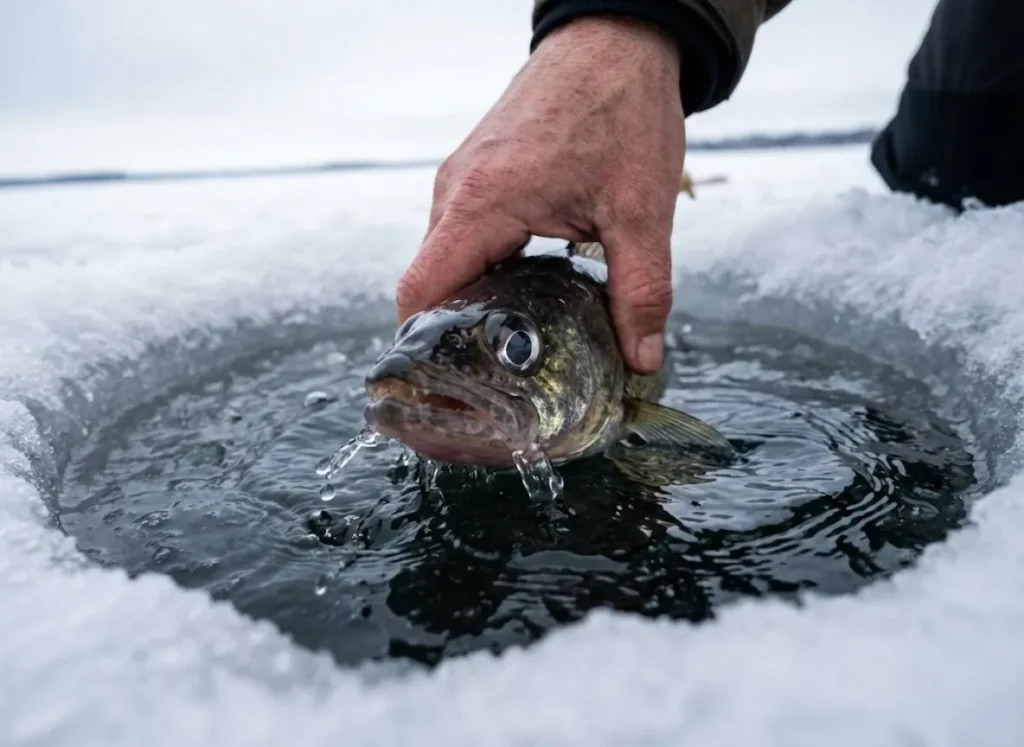
The cold that preserves your catch also poses a severe threat to the fish you intend to release. Sustainable fishing practices and cold-water care are mandatory on the hardwater.
What physiological risks do fish face in freezing air?
Fish are aquatic creatures adapted to liquid environments, not sub-zero temperatures. The most immediate danger is corneal freezing. The liquid layer on a fish’s eyes can freeze in seconds when exposed to temperatures below freezing, causing permanent blindness. Similarly, the delicate filaments of the gills can suffer necrosis (tissue death) almost instantly in the bitter cold.
To mitigate this, practice the “Dip Protocol.” When removing a hook—whether it’s a small micro jig or a treble hook from a flutter spoon—re-submerge the fish in the hole every 10 to 15 seconds. This maintains a liquid barrier over the eyes and gills. Additionally, never lay a fish on the snow or ice carpet. This strips their protective slime coat, inviting fungal infections once they return to the freshwater.
Deep water presents another challenge: barotrauma. Pulling fish from a deep basin (depths greater than 30 feet) can cause their swim bladders to expand, often fatally. Understanding the science of catch and release helps you identify when to stop fishing deep basins to protect the population.
For further reading on minimizing impact, including specific handling techniques, consult these tips to decrease impacts when catch-and-release ice fishing.
Conclusion
Ice fishing is a paradox: it is a pursuit of patience that requires urgent attention to detail. Ice safety is not a checklist, but a continuous assessment of the ice beneath your feet using visual cues and auditory feedback. Survival relies on memorizing the 1-10-1 rule before the ice ever breaks. Success comes from the efficiency of the “Drill-Scoop-Scan” workflow, and the future of our sport depends on the ethical catch and release of fish in freezing conditions.
The hardwater is a fortress, but with the right system, it is one you can breach time and time again.
FAQ – Frequently Asked Questions about Ice Fishing Basics
How thick does ice need to be to walk on safely?
For new, clear ice, the standard minimum is 4 inches for foot travel. If the ice is white or snow ice, you should double this requirement to at least 8 inches, as it has only half the strength of clear ice.
What do I do if I fall through the ice?
Do not try to swim immediately; focus on controlling your breathing (1 minute) to overcome the cold shock response. Once breathing is controlled, kick your feet to a horizontal position, use ice picks to pull yourself back onto the shelf you came from, and roll away.
Do I need a shelter to start ice fishing?
No, a shelter is not mandatory for beginners, especially on mild days. However, an insulated ice shelter becomes critical for longer outings, fishing in wind, or using electronics that require warmth to function properly.
How do I find fish under the ice without electronics?
Focus on finding depth changes by looking at the shoreline; steep banks usually mean steep drop-offs underwater. Drill multiple holes starting shallow and moving deep (a transect) to locate the breaks where fish patrol.
Risk Disclaimer: Fishing, boating, and all related outdoor activities involve inherent risks that
can lead to injury. The information provided on Master Fishing Mag is for educational and informational purposes
only. While we strive for accuracy, the information, techniques, and advice on gear and safety are not a substitute
for your own best judgment, local knowledge, and adherence to official regulations. Fishing regulations, including
seasons, size limits, and species restrictions, change frequently and vary by location. Always consult the latest
official regulations from your local fish and wildlife agency before heading out. Proper handling of hooks, knives,
and other sharp equipment is essential for safety. Furthermore, be aware of local fish consumption advisories. By
using this website, you agree that you are solely responsible for your own safety and for complying with all
applicable laws. Any reliance you place on our content is strictly at your own risk. Master Fishing Mag and its
authors will not be held liable for any injury, damage, or loss sustained in connection with the use of the
information herein.
Affiliate Disclosure: We are a participant in the Amazon Services LLC Associates Program, an
affiliate advertising program designed to provide a means for us to earn advertising fees by advertising and linking
to Amazon.com. As an Amazon Associate, we earn from qualifying purchases. We also participate in other affiliate
programs and may receive a commission on products purchased through our links, at no extra cost to you. Additional
terms are found in the terms of service.