
In this article
The river is a wall of white noise. To the untrained eye, it is just a chaotic body of water moving downstream, hiding its secrets under a surface of opaque turbulence. But for the technical angler and serious fly fisherman, this chaos resolves into a predictable grid of energy and biology.
I have spent decades standing in currents from the Rockies to the Appalachians, and I have learned that fishing success is rarely a matter of luck; it is a matter of translation. You must learn to decode the hydraulic language of the current—river hydrology—to predict where a fish is mathematically required to be.
This guide will move you from simply looking at the water to truly seeing it. We will break down the geology that forms the river, the biology that drives fish behavior, and the visual indicators that reveal where the next strike will come from.
What Are the Fundamental Units of River Anatomy?

Rivers do not flow randomly. They seek a constant equilibrium between the sediment they transport and the water they discharge. This struggle results in a repeating “wave” pattern known as the Pool-Riffle sequence.
How does the Riffle-Run-Pool sequence create predictable habitat?
Geomorphologists have noted that this sequence typically repeats at intervals of 5 to 7 times the channel width. This offers a predictive metric for anglers exploring new water. If you are standing in a productive run, you can visually estimate the channel width and look downstream to gauge where the next likely holding water begins.
The sequence starts with the Riffle. This acts as the river’s hydraulic jump. It is characterized by shallow, fast-moving water flowing over coarse gravel. This is supercritical flow, and it serves as the primary driver of oxygenation levels for the system. While the flowing shallows are often too fast for holding large fish, the sorting of stream substrate within riffle-pool sequences creates the perfect incubator for aquatic insects.
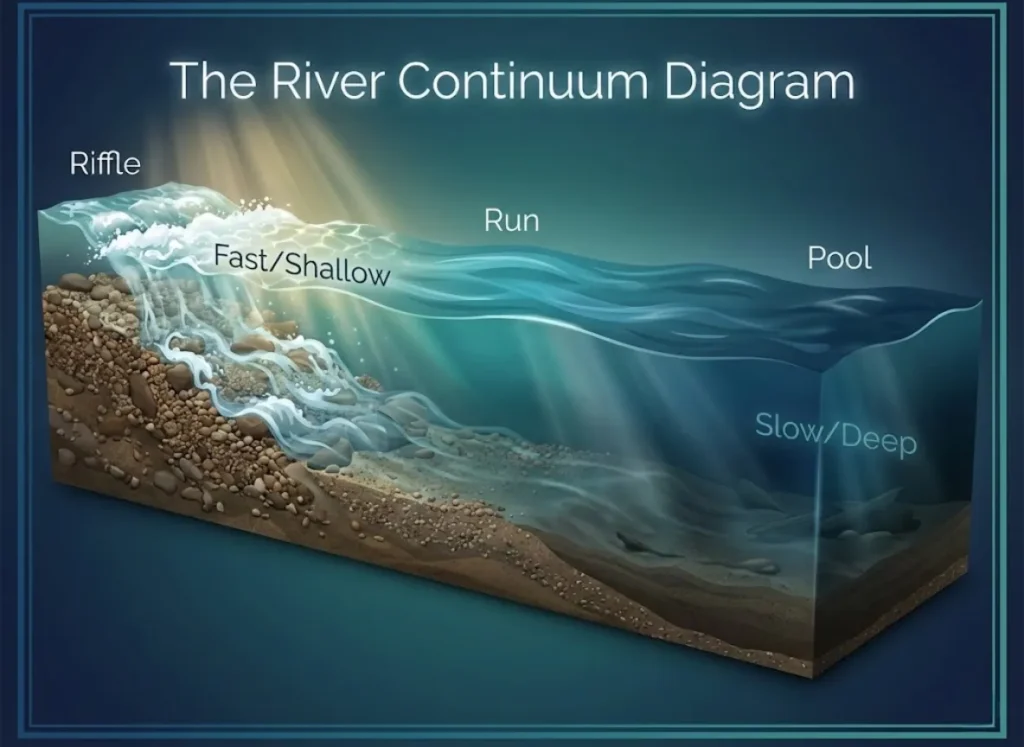
Below the riffle lies the Run. This functions as the transition zone or “conveyor belt.” Here, the depth increases and the flow becomes laminar. It is the ideal delivery system for drifting invertebrates and a prime location for anglers mastering the dynamics of fishing in current. This is often where you find well-oxygenated runs capable of supporting active feeding.
Finally, the water enters the Pool. This serves as the energy dissipation zone. The river widens and deepens, slowing to subcritical flow. This allows fine sediment to settle and provides thermal refuge during temperature extremes. Within these deep holding zones and slack water areas, you may also find tailouts where the current picks up speed again. Understanding this sequence allows you to look at a singular riffle and mentally map the likely location of the next productive intended fishing spot downstream.
Why is the Thalweg the “artery” of the river?
Once you understand the linear rhythm of the river, you must identify the specific artery of current that connects these features. This is the Thalweg.
The thalweg is the invisible line connecting the deepest and fastest points along the riverbed. It represents the core momentum of the flow. In straight channels, the thalweg remains central. However, as the river meanders, centrifugal force pushes this high-velocity core toward the outside banks.
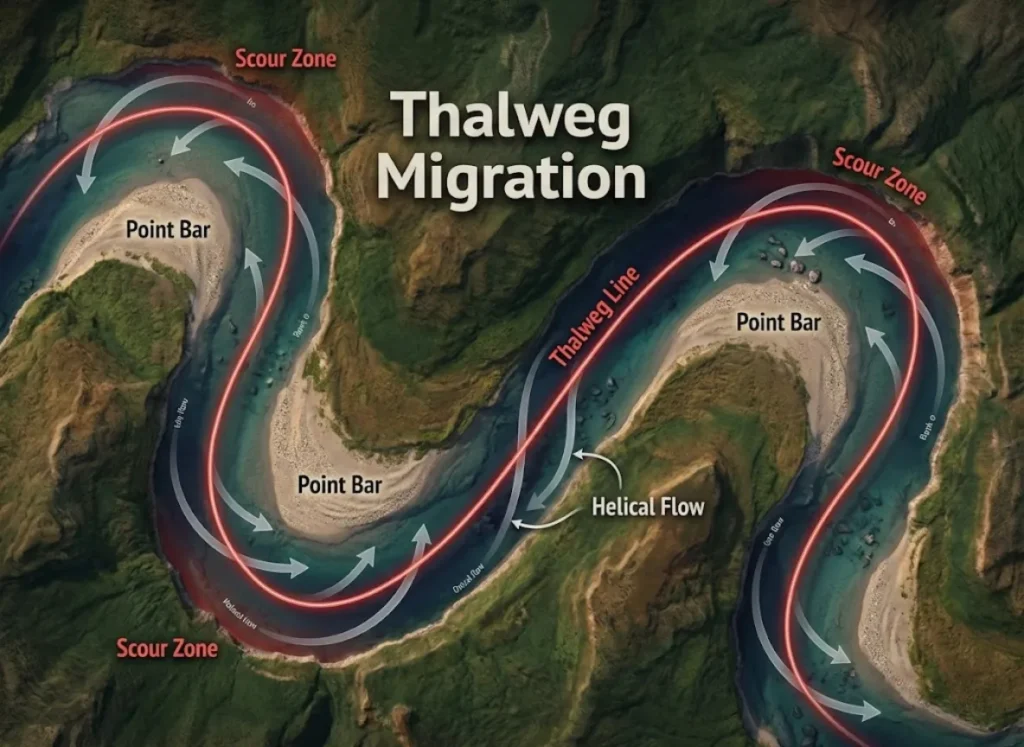
Tracing this line is critical because it dictates the “primary feeding lane,” transporting the highest density of food to waiting predators. It defines the current seams where fast water meets slow.
Pro-Tip: Don’t just cast to the middle. Look for the “bubble line” on the surface. Foam and bubbles accumulate in the thalweg, giving you a visual marker of where the main food conveyor belt is moving.
The thalweg is dynamic. During high-water events—where flow rates and cfs (cubic feet per second) spike—it straightens out to cut across point bars. This creates immense shear stress that pushes fish to the banks, a common scenario when river fishing after rain.
Conversely, during low-water summer conditions, the thalweg meanders excessively. This forces fish into the deepest “guts” of outside bends to find security. Recognizing the helical (spiral) flow generated by the thalweg on bends explains why food is often deposited on the inside “point bar” while the deep holding water is scoured on the outside. Recent studies suggest that migrating fish utilize river thalwegs for efficient passage, using the hydrodynamics to minimize energy use.
How Do Fish Decide Where to Hold? (Bioenergetics)
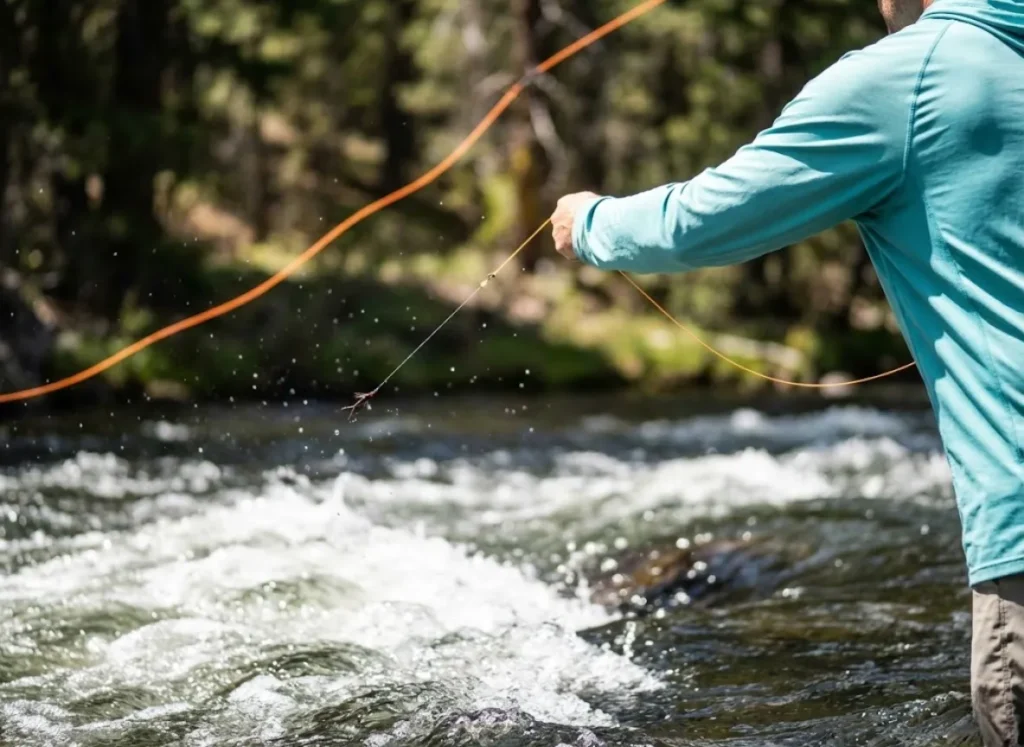
We have mapped the physical structure of the water. Now we must overlay the biological imperatives that force fish to occupy specific coordinates within it. Fish location is not a preference; it is a mathematical optimization of energy conservation.
What is the “Net Energy Intake” equation?
Fish behavior is governed by a simple bioenergetics equation: Growth = Consumption – (Respiration + Waste).
To survive, a fish must maximize “Consumption” (food intake) while minimizing “Respiration” (the metabolic cost of swimming against the current). This forces fish to seek Flow Refugia. These are areas of low velocity—behind boulders, rocks, submerged logs, or in boundary layers along the bottom—immediately adjacent to high-velocity currents carrying food.

This creates the “Drift-Feeding Paradox.” More current means more food, but also higher energy costs. This requires precise positioning. A mere 10% increase in drift density can alter the Net Energy Intake calculation enough to cause a fish to move from a safe pool to a risky run.
Anglers who grasp these fundamental concepts of trout fishing for beginners quickly learn to target the “shear zones.” These are the seams where slow water meets fast water, rather than casting blindly into the center of the current. Bioenergetics modeling of stream trout growth confirms that fish will tolerate higher currents only if the caloric payoff justifies the exertion.
How does water temperature dictate location?
While energy defines the ideal location, stream temperature acts as the master switch that determines if that location is physically sustainable.
Fish are poikilotherms. Their internal body temperature and metabolic rate are directly controlled by the surrounding water temperature. In high temperatures (typically above 65°F for trout), metabolic rates soar. This demands high oxygen and massive caloric intake, pushing fish into aerated Riffles and the heads of Runs.
In low temperatures (below 45°F), metabolism plummets. The energy cost of fighting current becomes unsustainable. During these cold periods, fish migrate to the deepest, slowest Pools and “dead” eddies to conserve limited reserves. Understanding these thermal constraints on fish habitat selection prevents wasted time.
Fishing a fast riffle in winter is biologically futile. Dredging a stagnant pool in the heat of summer is equally unproductive. The savvy angler carries a stream thermometer to instantly diagnose the river’s “metabolic state” before making a single cast. This is one of the core tactics required for winter trout fishing effectively.
How Do You Translate Surface Disturbance into Subsurface Structure?
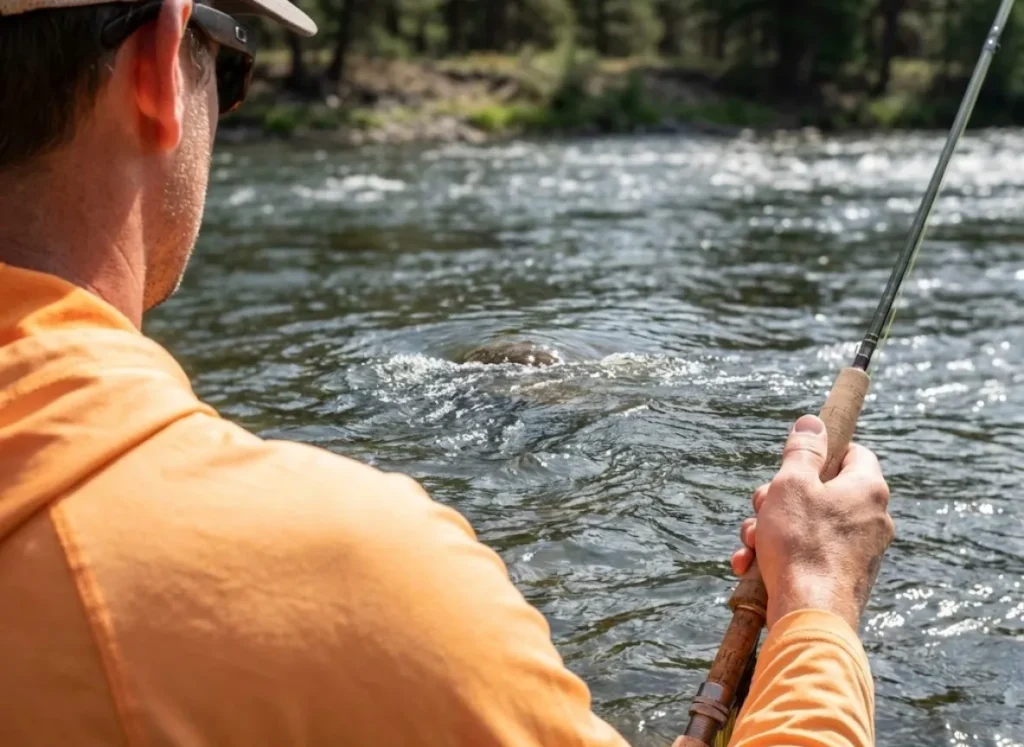
With the biological constraints understood, the final step is learning to see these invisible subsurface highways by reading the surface. This is the core of the angler’s vision framework.
What distinguishes Laminar Flow from Turbulent Flow?
Laminar Flow appears as “glassy” or smooth water. Here, fluid layers slide parallel to one another. This generally indicates a smooth, uniform bottom composition like sand or gravel.
Turbulent Flow manifests as boils, chop, or standing waves. This indicates hydraulic friction caused by rough substrates like boulders, rubble, or cobble. Educational resources on distinguishing between laminar and turbulent flow lines emphasize that surface chaos is a direct reflection of bottom obstruction.
Anglers should look for “Nervous Water.” These are subtle surface corrugations in an otherwise smooth run. They betray the presence of a submerged boulder or ledge disrupting the flow. Turbulence provides “overhead cover” through light refraction, allowing fish to hold in shallower water without feeling exposed to avian predators like ospreys or herons.
The transition point where Laminar flow crashes into Turbulent flow often marks a drop-off or “bucket.” This is a prime holding spot for predators, fitting the classic ambush behavior of smallmouth bass and large trout alike. By reading the “texture” of the water, you create a mental topographic map of the bottom without ever seeing it, noting the snag potential before you cast.
What gear enhances your ability to “read” the water?
Visual interpretation is powerful, but specialized gear allows us to verify these deductions with precision, regardless of water clarity or turbidity.
Polarized Optics are non-negotiable. However, not all lenses are equal. Lenses specifically in Copper or Bronze tints filter high-energy blue light (HEV) to maximize contrast against brown river bottoms.
Unlike gray lenses which simply darken the view, copper lenses enhance the separation between fish, rock, and vegetation. This is crucial when selecting the best polarized sunglasses for fishing.
Rod Sensitivity (Modulus) acts as a tactile sensor. High-modulus graphite transmits vibrations that allow you to distinguish between a “mushy” mud bottom and the “ticking” of productive gravel.
Polarized Lenses for Rivers
Guide to selecting the optimal lens tint for specific water and light conditions.
Base Tint
Brown
Best River Condition
Gold Standard. Versatile for sun/clouds. High contrast for spotting fish against gravel.
Base Tint
Yellow
Best River Condition
Low Light Specialist. Essential for dawn/dusk or heavy canopy shade.
Base Tint
Copper / Amber
Best River Condition
Flats/Shallow. Excellent for high-sun shallow riffles.
Base Tint
Neutral
Best River Condition
Open Water. Reduces brightness but flattens contrast. Poor for sight fishing rivers.
Base Tint
Gray
Best River Condition
Deep Ocean. Too dark for river environments.
Wading Traction is also a sensing tool. Studded rubber soles provide the feedback needed to navigate slippery rocks. More importantly, they help in preventing the spread of aquatic invasive species often associated with porous felt soles.
Pro-Tip: Carry a microfiber cloth in a rapidly accessible pocket. Water spots and fog on your sunglasses can reduce your ability to read subsurface structure by up to 50%. Clean lenses are as important as sharp hooks.
Final Thoughts
The river is no longer noise; it is a map waiting to be read. By understanding the Pool-Riffle sequence, you can predict where habitat will form. By applying the bioenergetic equation, you know why fish choose specific lies, from undercut banks to mid-stream boulders. And by utilizing the Thalweg and proper optics, you can pinpoint the exact drift required for fishing success.
Next time you step into the current, pause before you cast. Read the water, calculate the energy, and visualize the structure. Share your experience reading your local river in the comments below.
FAQ – Frequently Asked Questions about Reading Rivers
How can you tell how deep a river is just by looking at the surface?
Darker water generally indicates greater depth, while lighter water suggests shallows (depending on clarity). Slow-moving, smooth surface water often indicates a deep pool, whereas fast, choppy water typically signifies a shallow riffle or run.
Where do the biggest fish typically hide in a river?
Large, dominant fish claim the prime lies that offer the best protection and food access. Look for them deep in the belly of a pool, behind substantial structure like boulders, or under undercut banks where they are hidden from overhead predators.
What is the difference between fishing a Riffle and a Run?
Riffles are shallow and turbulent, requiring active techniques like high-stick nymphing. Runs are deeper with smoother flow, allowing for longer, more controlled drifts with dry flies or suspension rigs.
Do different species read the water differently?
Yes. Trout are drift feeders that hold in seams to intercept food moving downstream. Bass and Pike are often ambush predators that prefer slack water in eddies or deep structure to attack passing prey from the side.
Risk Disclaimer: Fishing, boating, and all related outdoor activities involve inherent risks that
can lead to injury. The information provided on Master Fishing Mag is for educational and informational purposes
only. While we strive for accuracy, the information, techniques, and advice on gear and safety are not a substitute
for your own best judgment, local knowledge, and adherence to official regulations. Fishing regulations, including
seasons, size limits, and species restrictions, change frequently and vary by location. Always consult the latest
official regulations from your local fish and wildlife agency before heading out. Proper handling of hooks, knives,
and other sharp equipment is essential for safety. Furthermore, be aware of local fish consumption advisories. By
using this website, you agree that you are solely responsible for your own safety and for complying with all
applicable laws. Any reliance you place on our content is strictly at your own risk. Master Fishing Mag and its
authors will not be held liable for any injury, damage, or loss sustained in connection with the use of the
information herein.
Affiliate Disclosure: We are a participant in the Amazon Services LLC Associates Program, an
affiliate advertising program designed to provide a means for us to earn advertising fees by advertising and linking
to Amazon.com. As an Amazon Associate, we earn from qualifying purchases. We also participate in other affiliate
programs and may receive a commission on products purchased through our links, at no extra cost to you. Additional
terms are found in the terms of service.