
In this article
A bright red snapper floats helplessly on the surface, its eyes bulging and stomach protruding from its mouth like a pink balloon. It is not dead, but without immediate intervention, it is doomed to drift until it succumbs to thermal shock or a passing shark. This phenomenon is barotrauma, a physical consequence of physics that turns a trophy game fish into a casualty.
I have seen this scene play out too many times on the water—a prized sport fish released with good intentions, only to bob away like a cork. This discard mortality is a critical issue in marine conservation and modern ichthyology. Fortunately, this condition is entirely reversible with the right tools and a commitment to responsible angling.
In this guide, effectively serving as your angler’s field medic guide, we will break down the pressure physics behind the injury, how to distinguish critical pressure injuries from simple fatigue, and why physically returning fish to depth via recompression is scientifically superior to “venting.” We will also navigate the DESCEND Act to ensure your vessel is compliant with federal mandates and stewardship principles.
What Actually Happens to a Fish During Rapid Ascent?
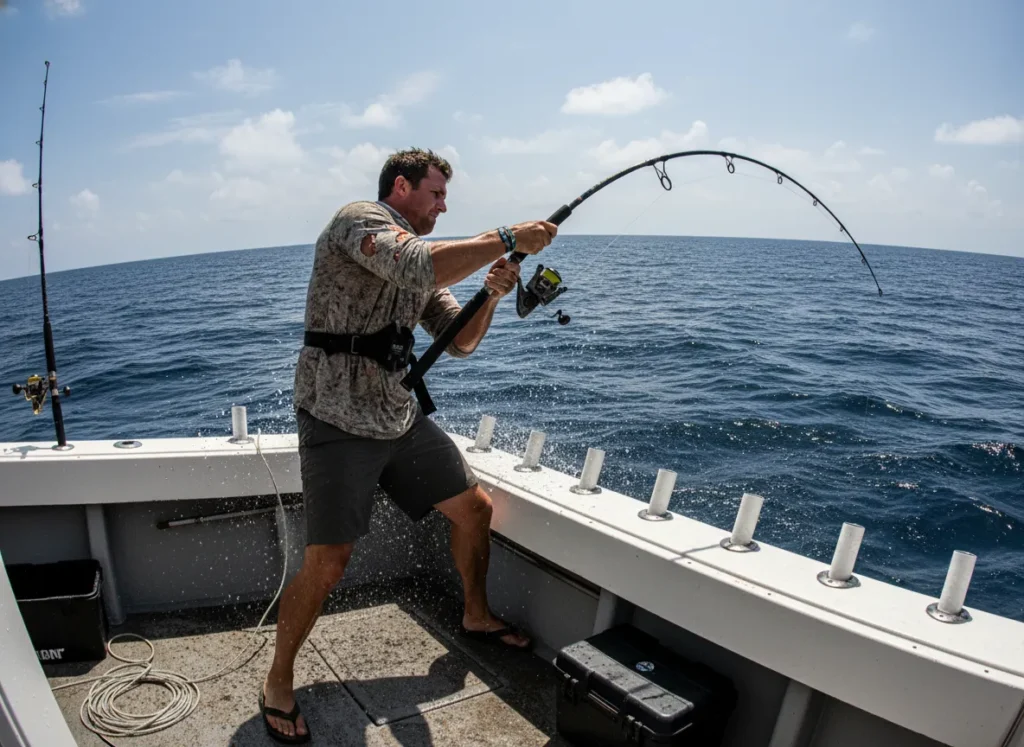
Barotrauma is a pressure-related injury caused by the rapid pressure change and expansion of gases inside a fish’s body as it is pulled from deep water to the surface.
Why does depth cause internal swelling?
Water is far denser than air, creating a rapid pressure gradient where pressure increases by 1 atmosphere (atm) for every 10 meters (33 feet) of depth. According to Boyle’s Law, the volume of a gas is inversely proportional to the pressure surrounding it. As pressure decreases during ascent, gas volume increases.
A fish hooked at 33 feet (2 atm) and brought to the surface (1 atm) experiences a doubling of gas volume within its swim bladder (often called the gas bladder). At 100 feet (4 atm), the gas volume expands to four times its original size, exerting massive internal force against the organs. The University of Florida analysis of pressure volume breaks down this mathematical reality, showing just how violent this gas expansion is on a cellular level.
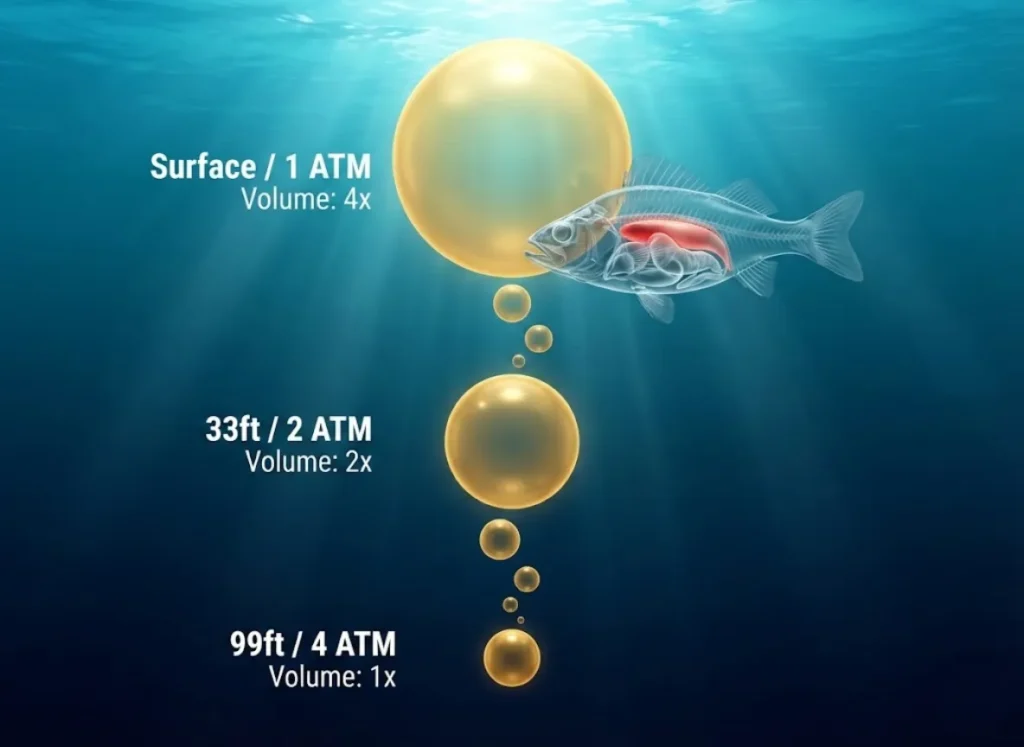
This expansion is not just inflation; it physically crushes the liver and heart. It displaces the stomach, forcing it into the esophagus (eversion). Beyond the mechanical damage, Henry’s Law dictates that gases dissolved in the blood come out of solution during rapid decompression.
This results in gas embolisms (bubbles) forming in the eyes, heart, and skin, identical to “the bends” in human divers. Thermal shock acts as a compound stressor, as deep-water fish are dragged from cold, pressurized water into warm, low-pressure surface layers.
Understanding the physics reveals the severity of the trauma, but preventing it starts with using modern fish-finding technology and interpreting traditional 2D sonar to monitor depth so you know exactly when you are dropping into the depth danger zone.
Which fish species are most vulnerable to barotrauma?
The primary biological factor determining vulnerability is the presence or absence of a pneumatic duct connecting the swim bladder to the gut. This determines the species susceptibility matrix.
Physostomous fish (open bladder species like Trout, Salmon, Catfish, Lake Trout, and Sturgeon) have an open duct, allowing them to “burp” or expel expanding gas naturally during the fight.
Physoclistous fish (closed bladder species like Red Snapper, Grouper, Walleye, Smallmouth Bass, Yellow Perch, Black Crappie, Pearl Perch, and Bull Red Drum) have a closed system where gas exchange occurs slowly through the blood. When a physoclistous fish is pulled up quickly, the gas expands faster than the blood can reabsorb it, leading to inevitable barotrauma.
This distinction creates a “Freshwater Blind Spot,” where anglers assume barotrauma is only a saltwater issue. Walleye and Yellow Perch caught from critical depths greater than 25 feet suffer severe, often fatal, barotrauma. This is particularly common when targeting late summer walleye in deep basins or during ice fishing scenarios.
Rockfish (Sebastes) are critically vulnerable due to their deep habitats; unassisted release often results in 100% mortality. Recent NOAA telemetry studies on Red Snapper validate that recognizing the species type is the first step in determining whether you need to have a release device ready before your line hits the water.
Fish Barotrauma & Recompression Guide
Physiology, Vulnerability, and Regulatory Context by Species
Vulnerability: Critical
Risk starts > 30-50 ft. Surface release causes near 100% mortality due to thermal shock and predation.
Regulatory Status
Mandatory descending devices in CA, OR, WA. CA specifically requires descent for Quillback incidental catch.
Mortality & Survival
Recompression is highly effective if performed fast.
Vulnerability: High
High immediate survival (~85%) after descent, but delayed mortality (13-15%) occurs due to organ damage or venting infection.
Regulations
DESCEND Act mandates venting tool or descending device on Gulf of Mexico vessels.
Physiology Notes
Thick body walls make venting risky; descending strongly preferred. Robust but exposed to extreme pressure changes.
Regulations
Covered under reef fish requirements in Gulf and South Atlantic.
Vulnerability: Critical
Severe barotrauma. Low survival even with recompression due to catastrophic physiological trauma of 30+ atm pressure change.
Habitat
Deep-drop species (300-800 ft).
Vulnerability: Low
Do not suffer swim bladder expansion (they sink). Risks limited to Henry’s Law (dissolved gas), suffocation, and thermal stress.
Regulations
Regulations often require descending devices on vessel due to co-occurring groundfish/rockfish.
Handling Notes
“Fizzing” (venting) is a common, controversial tournament practice. Vented/descended fish have better orientation.
Vulnerability
High. Anglers often encounter “floaters” in late summer/winter.
Symptoms
Severe exophthalmia (“bug eyes”) and bloating. Common issue in ice fishing.
Vulnerability
High. Physical trauma is lethal quickly due to small body size.
Tournament Risk
Floating fish in livewells die from stress and lack of oxygen exchange. Needle venting (“fizzing”) is common for livewell survival.
Winter Vulnerability
Catch-and-release mortality can be very high in winter due to the combination of depth and cold water handling.
How Do I Diagnose Barotrauma on the Water?
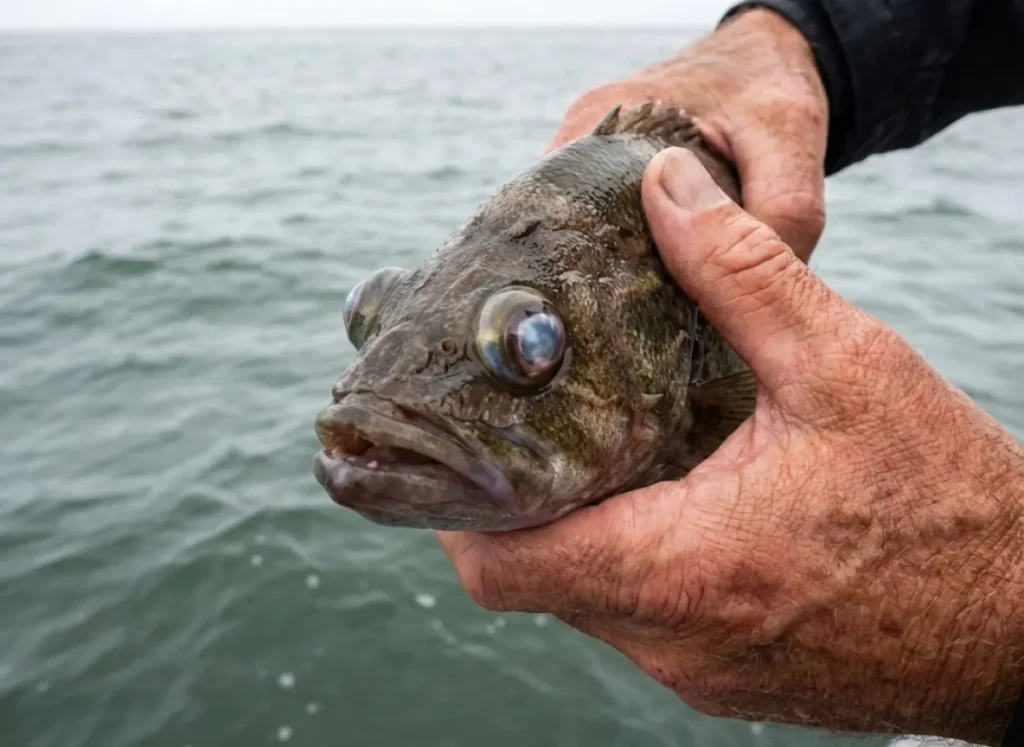
Effective treatment actions require immediate recognition of the visual symptoms so you can treat the condition rather than mistaking it for simple exhaustion.
Is the protruding organ the stomach or the swim bladder?
The most alarming and common symptom is stomach eversion, where a pink or red bulbous mass protrudes from the fish’s mouth.
A widespread myth is that this organ is the swim bladder itself. In reality, the expanding bladder behind the stomach pushes the stomach out. Exophthalmia, or “pop-eye,” occurs when gas pressure behind the eye sockets forces the eyes outward, often accompanied by gas bubbles in the corneal tissue. Distended intestines or intestinal prolapse may also occur, where the intestines are forced out through the anal vent.
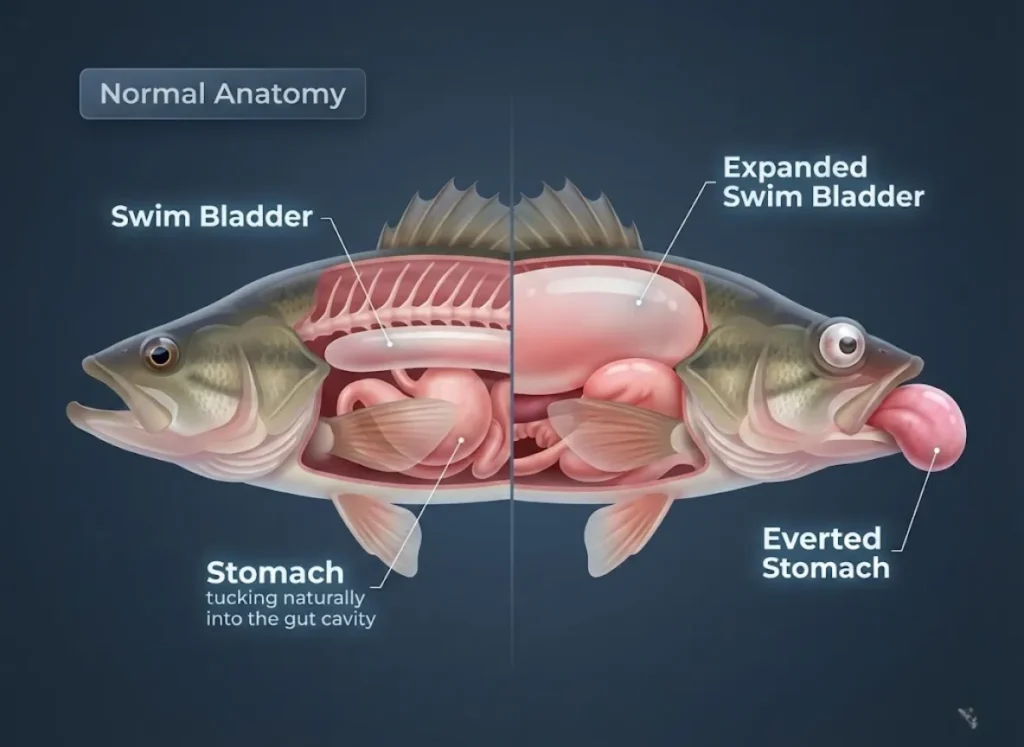
“Cryptic” barotrauma is a silent killer; a fish may have no external protrusion but a tight bloated midsection (or bloated belly) and an inability to submerge. Observing the fish’s behavior is as critical as checking for physical deformities. A fish floating upside down or sideways has lost equilibrium. Subcutaneous emphysema manifests as small, crackling bubbling scales or skin, and you may occasionally see bleeding gills due to pressure rupture.
Pro-Tip: Never attempt to push the stomach back in manually or puncture it. This introduces bacteria and stomach acid to sensitive tissues, often causing fatal infection. Treat the gas pressure, and the stomach will retract on its own.
You can reference the Minnesota DNR diagnostic criteria for a clear visual checklist of these symptoms, specifically for freshwater species. Once identified, this connects directly to mastering the science of catch & release to ensure the fish survives the encounter.
Venting vs. Descending: Which Method Saves More Fish?
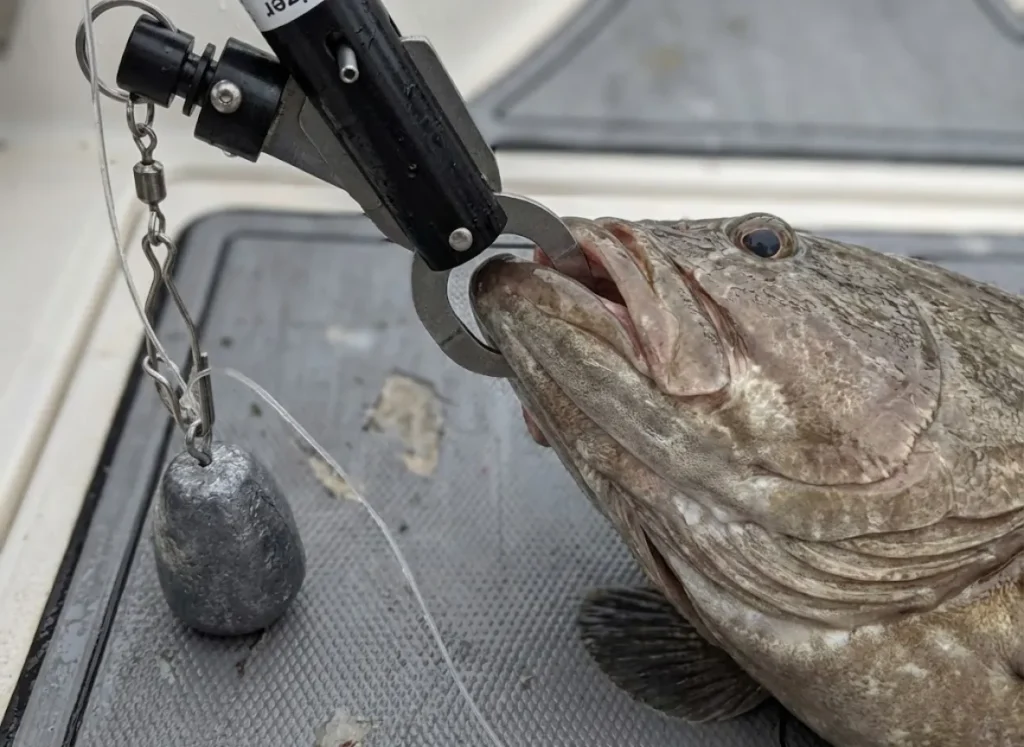
Diagnosis is useless without intervention. This leads to the critical tactical decision in barotrauma mitigation: do you let the air out via venting, or do you take the fish down via descending?
Why are descending devices considered the gold standard?
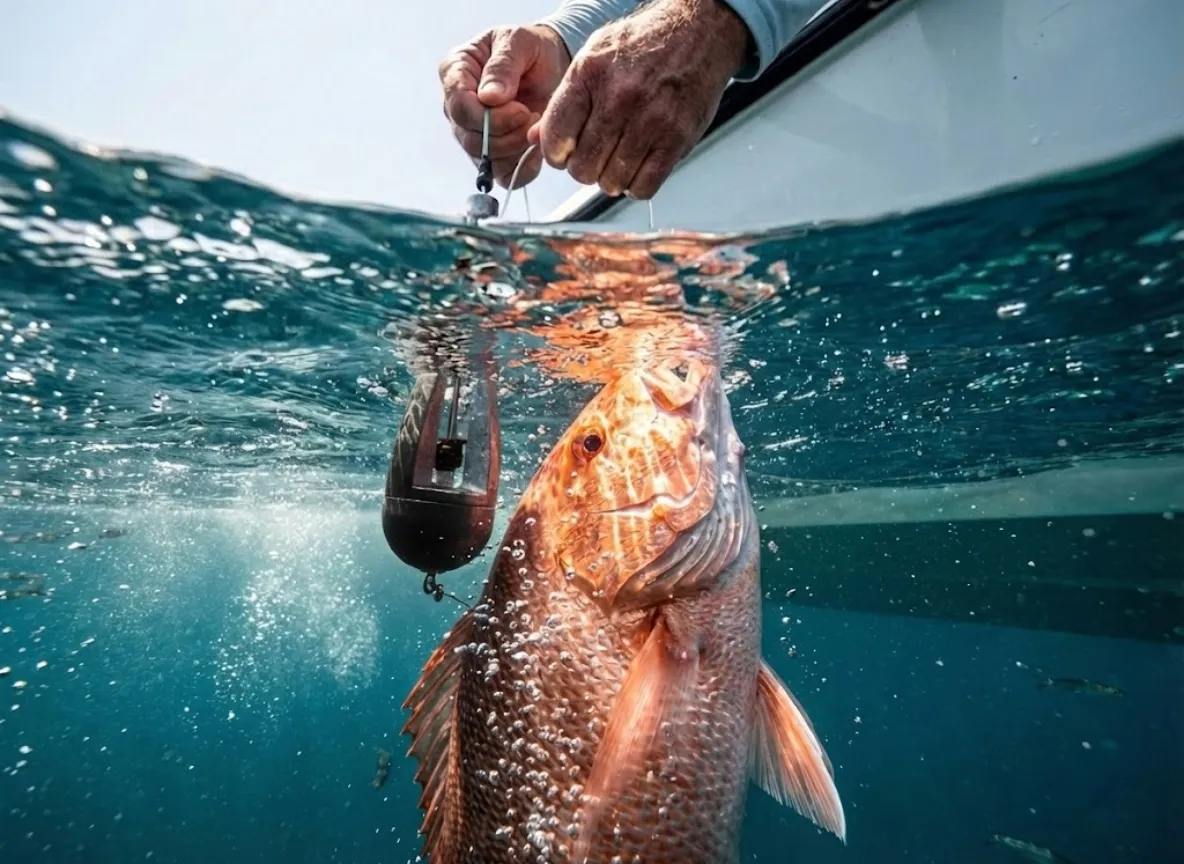
Descending devices work by mechanically returning the fish to a specific depth where hydrostatic pressure naturally recompresses the gas. This process is known as recompression.
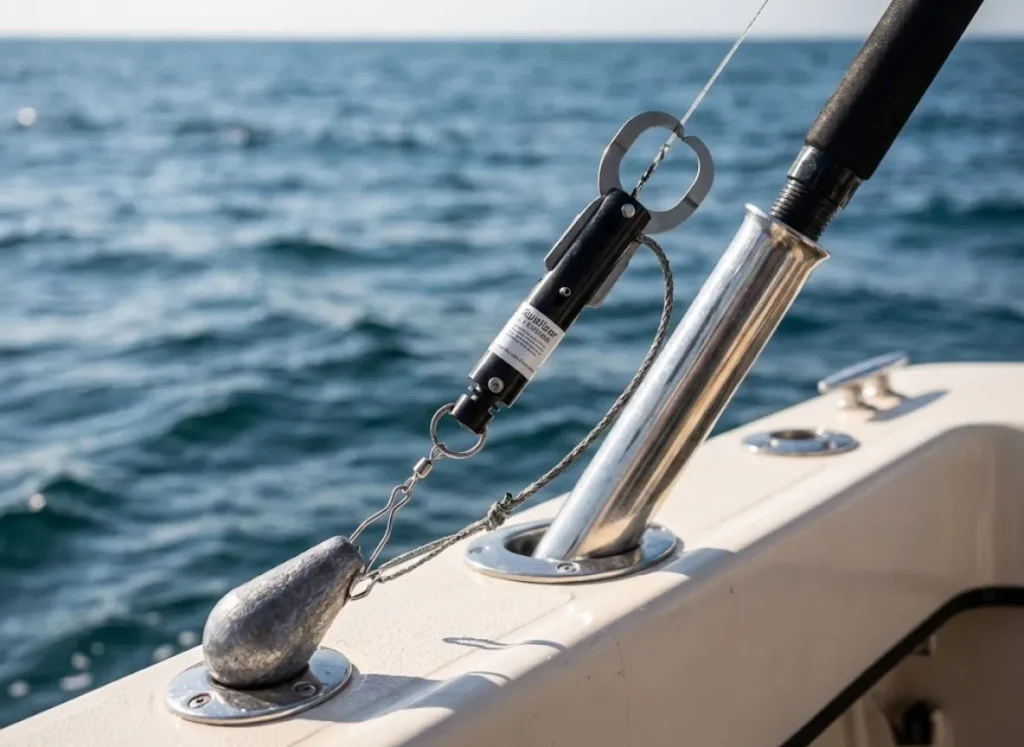
This method is non-invasive, requiring no puncture wounds, which significantly lowers the risk of infection and organ damage. Devices range from simple inverted hooks and weighted lip clamps (like the RokLees) to pressure-activated releases (like the SeaQualizer) and release cages (sometimes called a fish elevator). Research indicates fish survival rates for descended fish are significantly higher (often >85%) compared to vented or untreated fish.
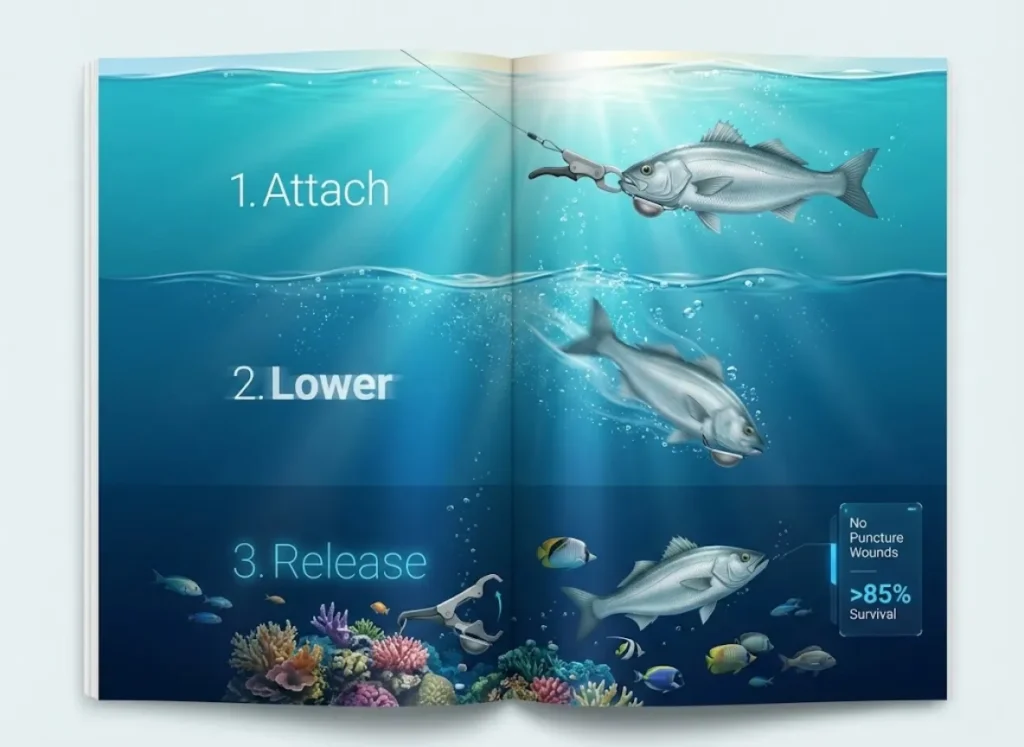
Descending addresses the “vending machine” fear. Detailed Return ‘Em Right predation studies show that returning fish rapidly to the bottom actually reduces predation by getting them out of the danger zone quickly. It immediately places the fish back into its optimal thermal range, reversing the effects of thermal shock experienced at the surface.
Acoustic telemetry proves that fish released at depth resume normal schooling behavior much faster than those left to recover at the surface. The “Rigged and Ready” concept means having a dedicated heavy rod or handline set up before the first cast. This is a core part of committing to fish conservation, ensuring zero delay in release.
When is venting (fizzing) actually necessary?
Venting, or “fizzing,” involves using a hollow needle to manually release excess gas from the swim bladder.
This technique is considered a triage measure or “Plan B” when descending is not feasible due to extreme currents, lack of release weights, or device failure. It is also commonly used in competitive bass and walleye tournaments to managing fish health in the livewell, where descending is not an option until weigh-in.
The tool must be a hollow needle (like a hypodermic needle); knives and ice picks are strictly prohibited as they cause trauma without allowing gas to escape. Proper execution requires precise anatomical knowledge; the puncture must be made at a 45-degree angle under a scale, typically behind the pectoral fin.
Gulf of Mexico regulations specifically mandate a minimum 16-gauge needle to ensure the hole is large enough for effective gas exchange but small enough to heal. The risk of piercing the heart, liver, or stomach is high for inexperienced anglers. For anglers on the West Coast, strict California Department of Fish and Wildlife protocols limit when and how this can be done, favoring descending devices almost exclusively.
Pro-Tip: If you must vent a fish, listen for the hiss of escaping air. Once the hissing stops and the fish loses its buoyancy, remove the needle immediately. Do not squeeze the fish to force air out.
What Are the Legal Requirements for Ethical Anglers?
Mastering these on-deck actions is no longer just a matter of personal ethics; in many waters, it is now a matter of federal law.
What does the DESCEND Act require in the Gulf of Mexico?
The DESCEND Act (Direct Enhancement of Snapper Conservation and the Economy through Novel Devices) is a federal law aimed at reducing reef fish mortality.
It requires all commercial, charter, and private recreational vessels fishing for reef fish in Gulf federal waters to possess a venting tool or descending device. The critical legal definition is “Rigged and Ready,” meaning the device must be available for immediate use, not still in its packaging or buried in a tackle box. This applies when fishing for any reef species, including Snappers, Groupers, Amberjacks, and Triggerfish.
Pacific Coast regulations (CA, OR, WA) have similar mandates for groundfish and rockfish, specifically requiring descending devices for incidental catches. In the south, the FWC (Florida Fish and Wildlife Conservation Commission) and Louisiana Wildlife & Fisheries have harmonized with federal rules, requiring possession of mitigation gear and mandating its use if a fish shows signs of barotrauma. Even inland agencies like the Arkansas Game & Fish are increasing education on barotrauma mitigation for deep reservoir stripers.
Compliance officers check for these devices during routine stops; failure to produce a rigged device can result in citations. These laws represent a shift in management philosophy from “catch limits” to “survival maximization.” You can review the Official DESCEND Act requirements to ensure you are compliant. Always double-check regarding navigating complex state fishing regulations, as local laws can be even stricter than federal ones.
Conclusion
Physics is unavoidable; any physoclistous fish pulled from depths greater than 30 feet is at risk of barotrauma. However, we now know that descending is the scientifically superior method for mitigation, offering higher fish survival rates and protection from predators.
With the DESCEND Act and various state laws, compliance is now mandatory. “Rigged and Ready” gear is a legal requirement, not just a suggestion. But beyond the law, stewardship is survival. The future of our fishery depends on anglers transitioning from simple catch-and-release to active catch-and-sustain practices.
Before your next trip, audit your boat. Ensure you have a descending device rigged on a dedicated rod, ready to save the gamefish that will build the stock for tomorrow.
FAQ – Frequently Asked Questions
Is poking the stomach back in the mouth a good way to treat barotrauma?
No, absolutely not. Pushing the stomach back in does not relieve the internal pressure and often causes lethal damage to the organ or introduces infection. The stomach is protruding because the swim bladder behind it is expanded; you must treat the gas (via descending), not the symptom.
Do freshwater fish like Walleye and Perch get the bends?
Yes, Walleye and Perch are physoclistous fish and suffer severe barotrauma when pulled from depths greater than 25 feet. Anglers targeting these species in deep basins during late summer or winter should carry a descending device or release weights.
What is the specific depth where barotrauma becomes a danger?
The depth danger zone generally begins at 30 feet (approx. 20 meters is deep, but 10 meters is the start) for sensitive species, where pressure is nearly double that of the surface. While some fish can recover from 30-50 feet, mortality rates skyrocket for fish caught deeper than 90 feet without intervention.
Don’t descending devices just feed the fish to sharks?
Research indicates the opposite; descending devices reduce predation risk by greater than 99% compared to floating a fish on the surface. The device transports the fish rapidly through the danger zone where visual predators hunt and releases it near the safety of the bottom structure.
Risk Disclaimer: Fishing, boating, and all related outdoor activities involve inherent risks that
can lead to injury. The information provided on Master Fishing Mag is for educational and informational purposes
only. While we strive for accuracy, the information, techniques, and advice on gear and safety are not a substitute
for your own best judgment, local knowledge, and adherence to official regulations. Fishing regulations, including
seasons, size limits, and species restrictions, change frequently and vary by location. Always consult the latest
official regulations from your local fish and wildlife agency before heading out. Proper handling of hooks, knives,
and other sharp equipment is essential for safety. Furthermore, be aware of local fish consumption advisories. By
using this website, you agree that you are solely responsible for your own safety and for complying with all
applicable laws. Any reliance you place on our content is strictly at your own risk. Master Fishing Mag and its
authors will not be held liable for any injury, damage, or loss sustained in connection with the use of the
information herein.
Affiliate Disclosure: We are a participant in the Amazon Services LLC Associates Program, an
affiliate advertising program designed to provide a means for us to earn advertising fees by advertising and linking
to Amazon.com. As an Amazon Associate, we earn from qualifying purchases. We also participate in other affiliate
programs and may receive a commission on products purchased through our links, at no extra cost to you. Additional
terms are found in the terms of service.