
In this article
The “thump” of a crappie strike is unmistakable—a distinct, vacuum-sealed pressure that vanishes as quickly as it arrives. It isn’t a random quirk of nature; it is the physical result of a highly specialized evolutionary engineering project designed for low-light predation.
For years, I treated that thump as a lucky break. I would cast into the abyss, hope for a school, and attribute my success to the color of my jig. It wasn’t until I stopped looking at the tackle box and started studying the ichthyology of the fish that my catch rate stabilized.
This article isn’t just about trivia. It is about understanding the North American panfish species profile of the Pomoxis genus—a key member of the Centrarchidae (sunfish family) within the order Perciformes. From retinal structure to suction mechanics, we will explore how to transform from a lucky guesser into a strategic predator. We will move beyond knowing what a crappie is, and master why specific techniques work, backed by hard telemetry data that debunks the most common myths on the water.
What Distinct Biological Traits Define the Pomoxis Genus?
Before you can catch them, you have to know exactly what you are targeting. While many anglers lump them together under umbrella terms like specks, calico bass, strawberry bass, or Oswego bass, the two primary species behave differently, inhabit different cover, and require different approaches.
How do you scientifically distinguish Black Crappie from White Crappie?
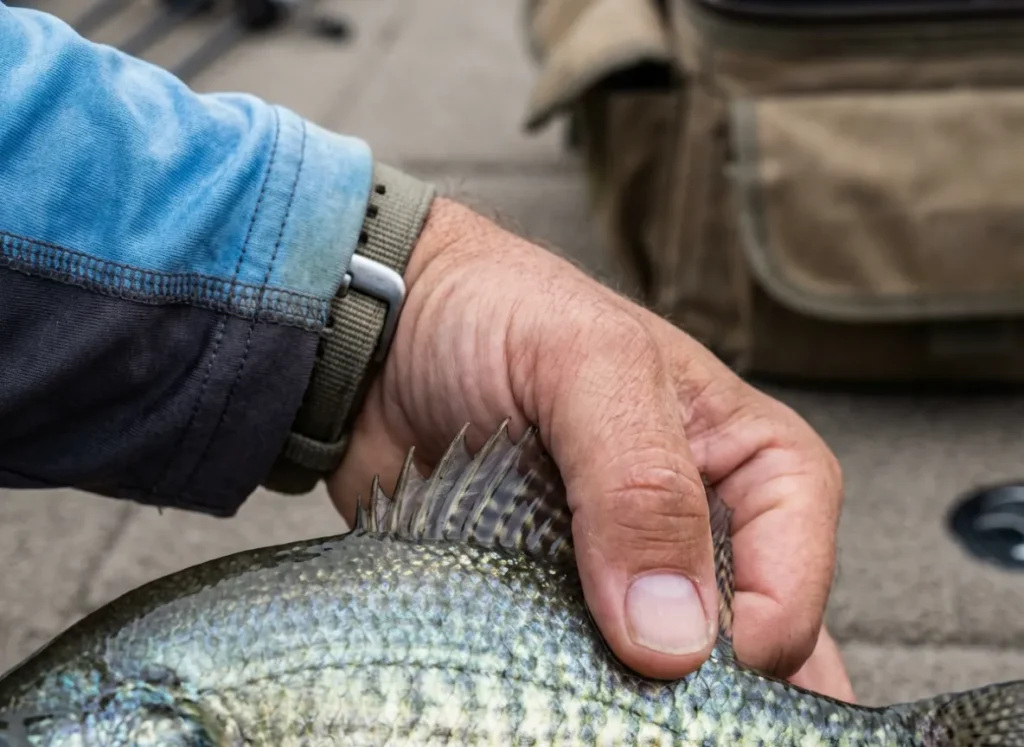
The only definitive field identification metric is the dorsal spine count, rather than color, which can vary wildly depending on water clarity and stain.
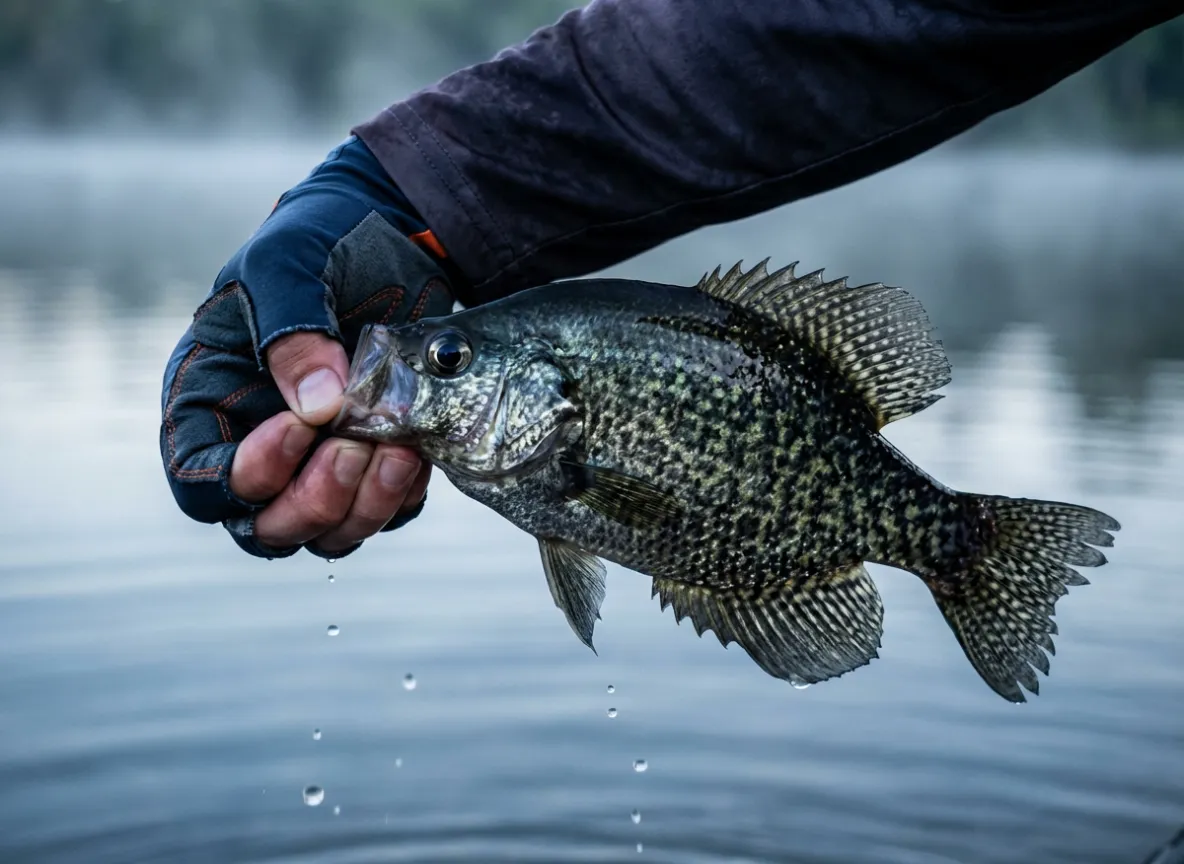
Black Crappie (Pomoxis nigromaculatus) possess 7 to 8 dorsal spines, providing significant structural rigidity to the fin. In contrast, White Crappie (Pomoxis annularis) consistently possess 5 to 6 dorsal spines. Note that both species generally have six anal spines, so focus your attention on the top of the fish. If you are arguing over a fish in the livewell, stop looking at the spots and start counting the spines.
Pro-Tip: If you can’t get a clear count, pull the dorsal fin forward. On a Black Crappie, the length of the fin base is equal to the distance from the front of the fin to the eye. On a White Crappie, the distance to the eye is much longer.
Secondary visual indicators can help, but they are less reliable. Black Crappie generally feature random, irregular mottling. White Crappie display vertical barring or “tiger stripes.” This identification matters because it dictates your location strategy.
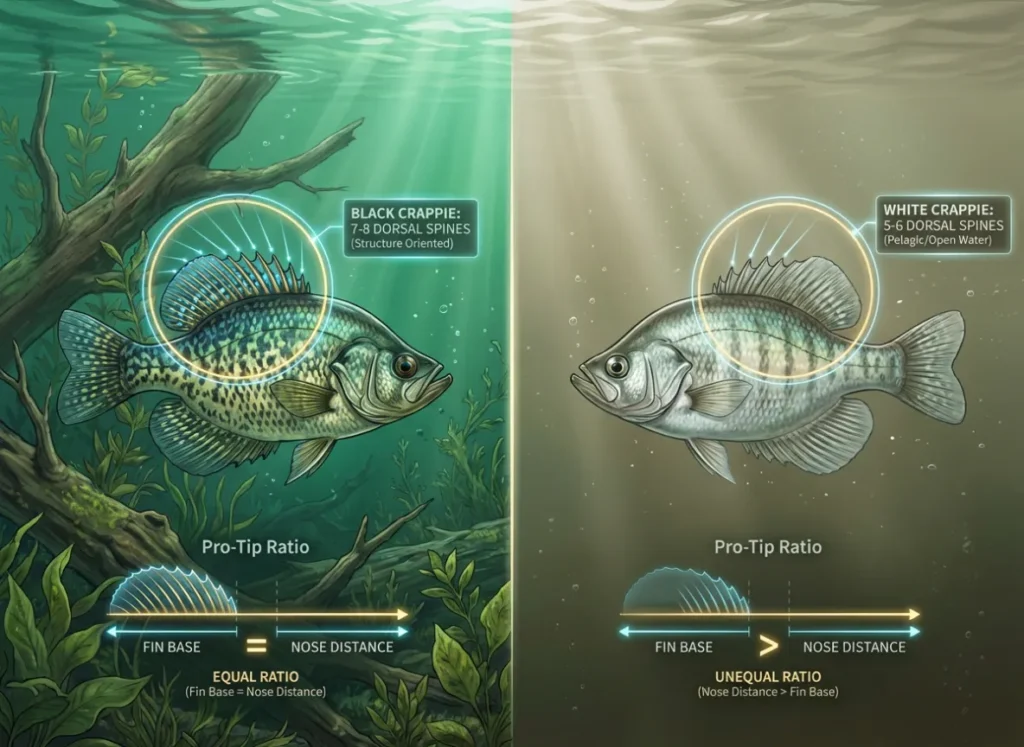
You should consult the distinctive identification keys provided by state wildlife agencies to ensure you are legally compliant with length limits, but biologically, this ID tells you where to fish: Black Crappie are structure oriented, gravitating toward vegetation and hard bottoms, while White Crappie prefer a pelagic habitat in turbid, open water. Mastering this identification is the first step in building a complete crappie angler system, ensuring you aren’t fishing for weed-oriented fish in open water channels.
What are the “Magnolia” and “Black Nose” crappie variants?
Once you can identify the standard species, you must learn to recognize the genetic anomalies and color mutations that confuse even seasoned anglers.
The “Black Nose” (or Black Stripe) crappie is often mistaken for a separate species. In reality, this is a dominant genetic marker—a black stripe running from the dorsal fin down the nose to the lip—that occurs naturally in Black Crappie populations. It is simply a pigment trait, similar to eye color in humans. Hatcheries often use this trait to mark stocked fish, but it appears in the wild as well.
The Magnolia Crappie, however, is a matter of science, not chance. This is a specific, Mississippi hybrid resulting from sterile hybrid development by Mississippi biologists.
The Magnolia is the offspring of a male Black Stripe Black Crappie and a female White Crappie. The eggs are pressure-treated to induce triploidy (three sets of chromosomes). This process renders the fish sterile. The biological purpose is specific: it allows fishery managers to stock small impoundments without the risk of the fish overpopulating and stunting, a common issue with prolific crappie. Understanding these variants connects directly to fish conservation for anglers, helping you distinguish between a natural mutation and a managed population.
How Does Crappie Physiology Dictate Their Feeding Behavior?
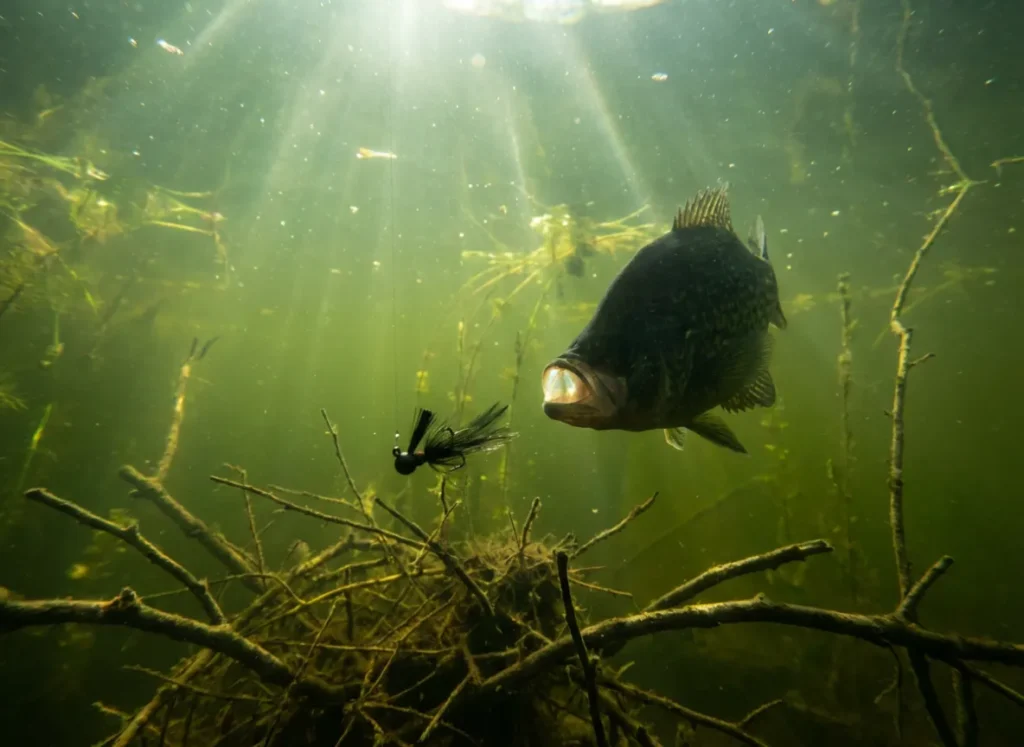
With the target species identified, we must shift focus to the sensory hardware they use to hunt you—or rather, your bait. Biology dictates the gear you use. The structure of the crappie’s eye and the mechanics of its mouth are the two most important factors in lure selection.
Why does the Tapetum Lucidum make crappie dominant in low light?
The crappie’s dominance in dark water is due to the Tapetum Lucidum, a biological retro-reflector layer of guanine crystals located behind the retina.
This layer mirrors light back through the photoreceptors, effectively doubling the capture of available photons. This mechanism increases visual sensitivity in scotopic (low-light) conditions by roughly 44%. This classifies the crappie as a “crepuscular” predator, biologically engineered to hunt most effectively during dawn, dusk, and night. They utilize rods and cones differently than bass, prioritizing contrast over color detail in deep water.
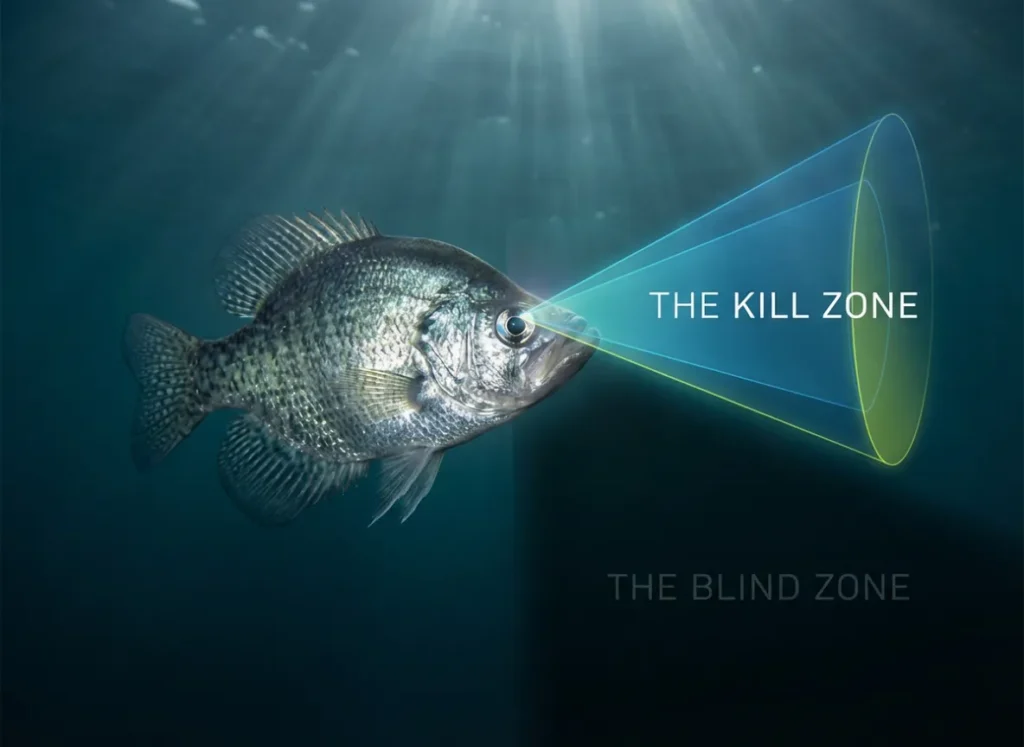
This adaptation has a downside. In clear water, high solar penetration can overwhelm their sensitive vision—a condition known as photophobia—forcing them into deep shade or suspension during midday. Their upward-facing eyes are positioned to silhouette prey against the surface light, creating a specific anatomy of the strike where they attack from below.
When selecting lures based on visual adaptations in freshwater fishes, remember that their retina is rod-dominated. They see contrast better than they see color. This is why high-contrast profiles, like Black/Chartreuse, are superior in low light. If you want to understand the full spectrum of their vision, you need to study how do fish see underwater, but for practical purposes, know that darkness is their ally, not their enemy.
How Does the “Suction Feeding” Mechanism Impact Hook Selection?
Superior night vision locates the prey, but the angle of approach determines whether the strike ever happens. Crappie do not bite; they inhale. They use buccal expansion to create a negative pressure vacuum.
To feed, the fish must inhale a sphere of water to capture the prey suspended within it. This is the “Ingested Volume of Water” (IVW). Once inside, the prey is gripped by Cardiform Teeth—pads of fine, Velcro-like bristles that resemble a wool carding tool—rather than the shearing canines you might find on a Walleye. Gill rakers assist in straining smaller organisms like zooplankton and insect larvae when the fish are young, before they switch to a primary diet of shad, minnows, and grass shrimp.
This anatomy explains the “Papermouth” nickname (or Sac-a-lait, Cajun for “bag of milk,” the Louisiana state fish). The maxillary membrane is structurally thin and fragile. This brings us to the Wire Gauge Theorem. Heavy wire hooks are detrimental because they require significant force to penetrate, which often tears the delicate membrane.
Pro-Tip: Switch to Light Wire Aberdeen hooks. The thin diameter penetrates with minimal force, perfectly complementing the low-resistance suction feed. Plus, if you snag brush, the hook bends before your line breaks.
Additionally, your jig weight matters. A heavy jig resists the suction vacuum. A lighter, balanced jig (1/16 – 1/32 oz) “floats” easily into the mouth when the fish inhales. This aligns with academic studies on suction feeding performance in Centrarchid fishes, which confirm that drag impacts feeding efficiency. For a detailed breakdown on matching your gear to this biology, review fishing hook sizes explained.
What Do Telemetry Studies Reveal About Seasonal Migration?
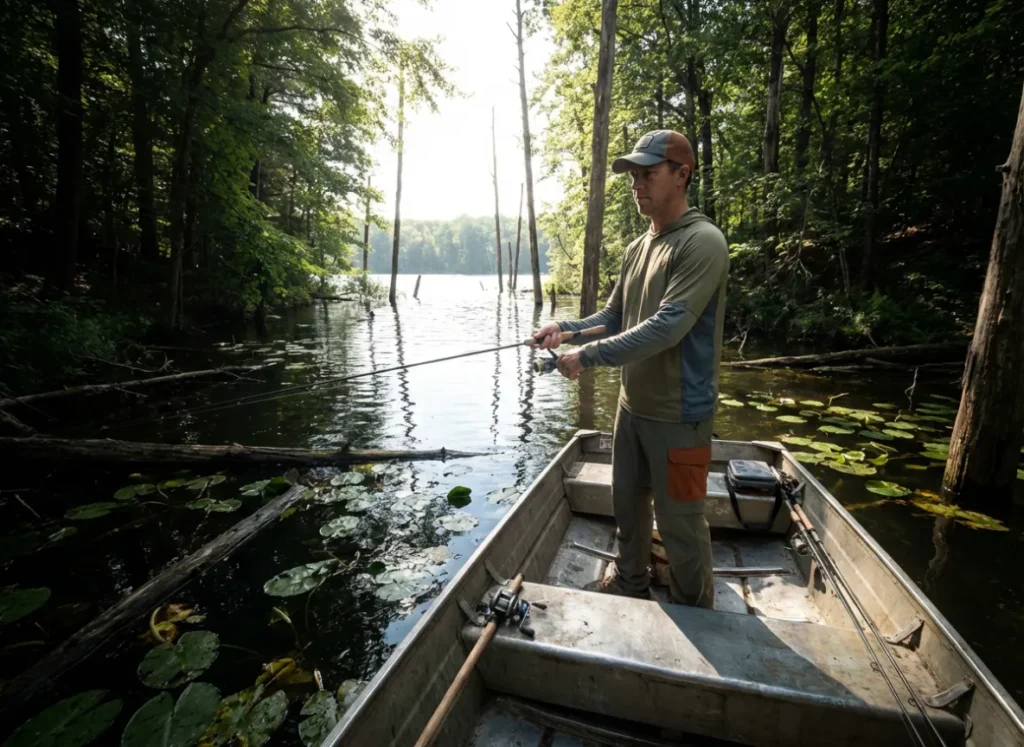
Biology dictates the gear, but telemetry data dictates where you drop that gear in the first place. Conventional wisdom says crappie move deep in the summer. Data from famous fisheries like Grenada Lake, Reelfoot Lake, Wilson Lake, and Lake Istokpoga proves that “conventional wisdom” is often wrong.
How does water temperature trigger the spawning cycle?
Water temperature is the primary “gating mechanism” for reproduction, superseding moon phase or calendar dates.
Black Crappie generally stage at 50°F, with active nesting occurring between 60°F and 64°F. White Crappie prefer slightly warmer water, peaking between 65°F and 72°F.
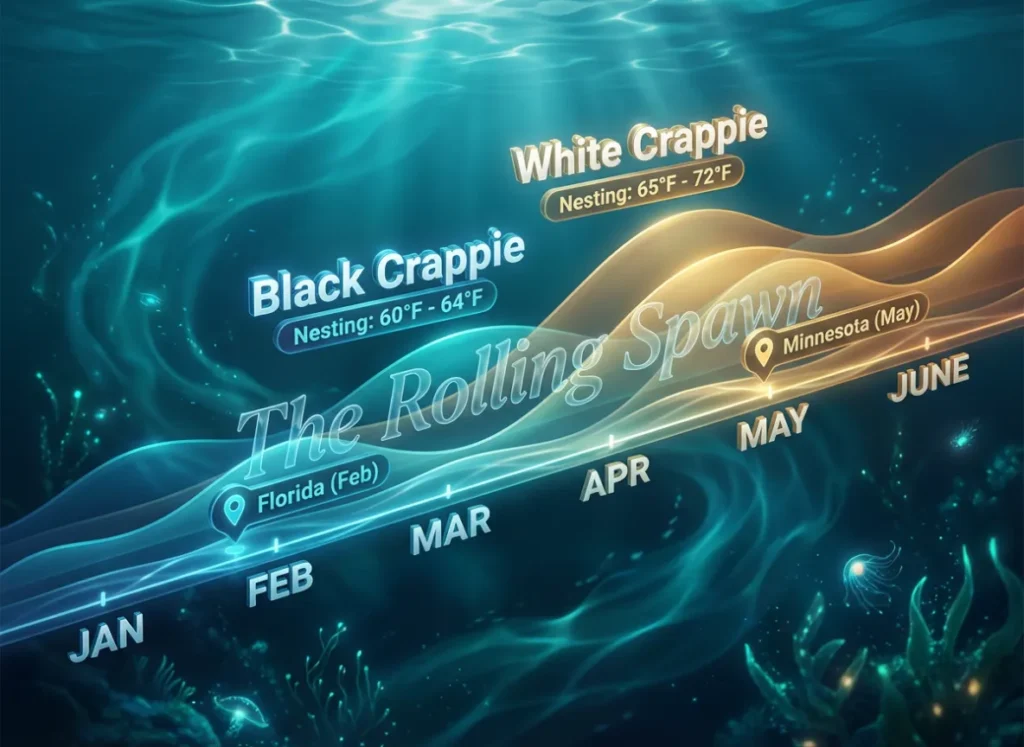
This temperature offset creates the “Rolling Spawn” phenomenon. In lakes with mixed populations, the spawn can last 6-8 weeks because the species activate at different times. This also explains latitudinal shifts; Florida crappie may spawn in February when water hits 60°F, while Minnesota fish wait until May.
You can track these windows by monitoring freshwater fish preferred temperature ranges. While temperature is the hard trigger, many anglers successfully combine this data with fishing by the moon to pinpoint the exact days of the biggest waves of fish moving shallow.
Why is the “Deep Water Migration” often a myth for Black Crappie?
Once the spawn concludes, conventional wisdom says to move deep. For decades, anglers believed all crappie migrated to deep river channels (20ft+) to escape summer heat. A pivotal telemetry research by Kentucky Fish and Wildlife study shattered this myth.
Researchers tracked ultrasonic-tagged fish over a full year. The White Crappie behaved as predicted, suspending over deep ledges and channel swings post-spawn. However, the Black Crappie exhibited “resident behavior.”
Instead of migrating to deep water, Black Crappie remained in shallow bays (4-8ft) throughout the heat of summer. They didn’t seek depth for cool water; they utilized dense shade—stake beds, heavy brush, and docks—to create micro-climates. If you abandon the banks in July, you are leaving behind the entire Black Crappie population. This data validates the importance of fishing heavy cover year-round, specifically for the Black species.
Conclusion
Catching piscivorous panfish consistently isn’t about luck; it’s about applying biological facts to your decision-making process.
- Identification is Strategy: Knowing if you are chasing Black (7-8 spines) or White (5-6 spines) determines if you fish the weeds or the ledges.
- Respect the Vacuum: Heavy tackle defeats the suction feeding mechanism; light wire hooks and balanced jigs are physics-compliant tools.
- Trust the Thermometer: Spawning happens at 60-68°F regardless of the calendar month.
- Don’t Abandon the Shallows: Summer heat drives White Crappie deep, but Black Crappie stay shallow and shady.
Next time you feel that subtle “thump,” visualize the mechanics behind it. Share your own experiences with shallow summer crappie in the comments below—did you find them where the science said they’d be?
FAQ – Frequently Asked Questions about Crappie Biology & Behavior
How do you tell the difference between a black and white crappie?
Count the dorsal spines. Black Crappie have 7-8 spines, while White Crappie have 5-6. While markings can be deceptive in stained water, the spine count is the definitive method.
Do crappie bite at night?
Yes, they are highly effective nocturnal hunters due to the tapetum lucidum in their eyes. This reflective layer enhances their vision in low light, often making night fishing more productive than midday fishing in clear water.
What is the life expectancy of a crappie?
Crappies have an average maximum life span of 7 years in the wild, though some exceptional specimens may reach 15 years. Their growth rate depends heavily on food availability and competition.
How is the culinary quality of crappie?
Crappie are widely regarded as one of the best-tasting freshwater fish. Their white, flaky flesh is mild and sweet, making them a favorite for fish fries across North America.
What is a Magnolia Crappie?
It is a sterile, triploid hybrid created by crossing a male Black Stripe Black Crappie with a female White Crappie. It is stocked in specific lakes (primarily in Mississippi) to provide high-quality fishing without the risk of overpopulation.
What water temperature do crappie spawn at?
Black Crappie spawn between 60°F and 64°F, while White Crappie spawn slightly warmer, between 65°F and 72°F. This usually occurs from February in Florida to May or June in the northern states.
Risk Disclaimer: Fishing, boating, and all related outdoor activities involve inherent risks that
can lead to injury. The information provided on Master Fishing Mag is for educational and informational purposes
only. While we strive for accuracy, the information, techniques, and advice on gear and safety are not a substitute
for your own best judgment, local knowledge, and adherence to official regulations. Fishing regulations, including
seasons, size limits, and species restrictions, change frequently and vary by location. Always consult the latest
official regulations from your local fish and wildlife agency before heading out. Proper handling of hooks, knives,
and other sharp equipment is essential for safety. Furthermore, be aware of local fish consumption advisories. By
using this website, you agree that you are solely responsible for your own safety and for complying with all
applicable laws. Any reliance you place on our content is strictly at your own risk. Master Fishing Mag and its
authors will not be held liable for any injury, damage, or loss sustained in connection with the use of the
information herein.
Affiliate Disclosure: We are a participant in the Amazon Services LLC Associates Program, an
affiliate advertising program designed to provide a means for us to earn advertising fees by advertising and linking
to Amazon.com. As an Amazon Associate, we earn from qualifying purchases. We also participate in other affiliate
programs and may receive a commission on products purchased through our links, at no extra cost to you. Additional
terms are found in the terms of service.