In this article
The distinct scent of failure on a sportfishing boat isn’t rotting bait or diesel fumes; it is the acrid, metallic smell of a burning drag washer.
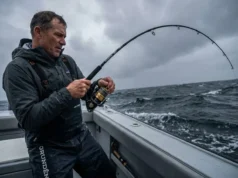
When a Yellowfin Tuna initiates a 400-yard run, or a Wahoo strikes your lure at 60mph, your reel ceases to be a simple line storage device. In that fraction of a second, it transforms into a high-stress heat engine.
In these critical moments of big game fishing, the difference between a landed trophy and a seized mechanism is rarely luck. It is a predictable calculation of Joules, Watts, and thermal expansion.
Most anglers view their drag system as a simple brake. However, to consistently land high-energy species, we must view the reel as a Tribological Energy Conversion System (TECS). We need to understand how kinetic energy from the fish converts into massive heat loads, why specific drag materials like carbon fiber save gears while oiled felt fails, and how the architectural differences between lever drag and star drag reels dictate their thermal limits.
What is the Fundamental Physics Behind a Fishing Reel Drag?
At its core, a drag system does not stop a fish; it converts the fish’s energy into a different form to tire it out. This process generates immense physical stress that we can quantify to understand why angling equipment mechanics fail.
How Does Kinetic Energy Convert to Thermal Energy?
A fishing reel’s drag doesn’t just magically slow a fish down; it works by turning the fish’s pulling power into heat. Every foot of line a fish rips off the spool creates friction. Since that energy has to go somewhere, it turns into heat inside your reel’s washers. This is why your reel can get hot to the touch during a long fight with a big fish—you are literally burning off the fish’s energy to stop it.
Nearly 100% of the mechanical work done by the fish pulling line against resistance is converted immediately into Thermal Energy. This creates a linear, unforgiving relationship: if you double the drag pressure or the fish runs twice as far, you generate double the heat buildup within the friction interface.
To visualize the magnitude of this drag force, consider the “Tuna Benchmark.” A 400-yard run at 30lbs of drag generates approximately 48,000 Joules of energy.
Without dissipation, this energy load is sufficient to raise a 50g stainless steel plate to nearly 2,000°C, theoretically exceeding its melting point. This calculation proves that heat dissipation is not a luxury feature; it is a structural necessity to prevent instantaneous adiabatic melting of the reel’s core components.

Biologists have long studied the swimming speeds and depth of blue marlin, providing the velocity data needed to calculate the power output (Watts) a reel must handle. If the reel cannot shed this heat via thermal conductivity, it conducts directly into the line.
This thermal stress is often the deciding factor when choosing between braided vs fluorocarbon vs monofilament, as different materials have vastly different melting points and heat resistance.
Why Do Start-up Inertia and Static Friction Cause Line Breakage?
Friction basically comes down to two stages: the force needed to get something moving and the friction felt while it’s already sliding. It always takes a lot more effort to break a heavy load or a stuck line loose from a standstill than it does to keep it moving once it’s already in motion.
“Start-up Inertia” occurs when the static friction is significantly higher than the dynamic friction. This creates a dangerous force spike required to get the spool moving.
If this inertia spike exceeds your line’s breaking strength—for example, a 20lb spike on an 18lb test line—the connection fails instantly before the drag stack even engages. High-quality lubrication helps mitigate this by introducing hydrodynamic lift and a “meniscus effect” to smooth the transition from still to moving.
Pro-Tip: If you are fighting a fish with an oscillating swimming pattern (stop-and-go), back your drag off by 10% once the fish settles deep. The repeated start-up inertia of a deep-dogging fish puts more stress on your knots than a steady, high-speed run.
When lubrication fails or materials degrade, we experience the “Stick-Slip” phenomenon. This is the “chattering” feel in dry or glazed drags, caused by rapid oscillation between static grip and dynamic slip.
Managing this delta is critical for species like Tarpon or Bonefish, as validated by NASA research on friction and lubrication regimes which outlines the necessity of stable coefficients of friction in composite materials. This physics concept is the foundation of our species-specific guide to setting your fishing drag, ensuring the initial surge doesn’t result in a snap-off.
How Do Material Choices Impact Heat Management?
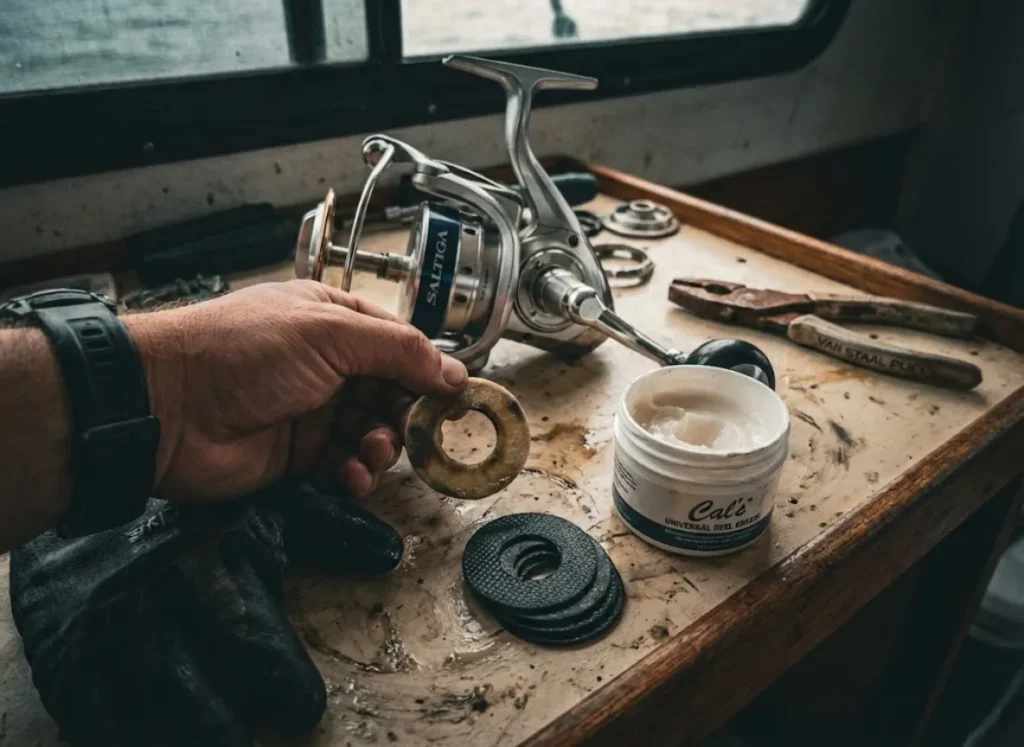
Once the forces are defined, the survival of the system depends entirely on the mechanical engineering and materials chosen to endure them. The “service ceiling” of a reel is dictated by material science.
Why Is Carbon Fiber Superior to Oiled Felt for High-Stress Applications?
For heavy-duty fishing, carbon fiber drag washers (like Carbontex) work by pulling heat away from the parts of the reel that rub together. Instead of letting that heat build up and ruin your gear, the carbon fibers act like a cooling system, moving the heat out and spreading it along the material. This keeps your drag running smooth and prevents it from locking up or getting jerky during a long fight with a big fish.
Older materials like oiled felt or cork act like a heavy blanket—they trap heat instead of letting it escape. During a long run with a big fish, this trapped heat can actually boil the grease and melt the fibers into a hard, slick plastic. While carbon fiber stays smooth and consistent even when it’s burning hot, felt starts to break down and get ‘jerky’ as soon as it heats up.
Woven carbon fiber’s porosity also allows for grease impregnation, creating a self-replenishing boundary layer during high-heat events. This prevents “Flash Glazing,” where intense heat flux polishes the washer surface to a glass-smooth finish, destroying stopping power.
Material Thermal Properties
Comparison of conductivity, specific heat, and expansion for common engineering materials.
Specific Heat & CTE
Cp: 0.896 J/g·K | CTE: 23.6 μm/m·°C
Engineering Notes
Excellent Heat Sink material, though it features High Thermal Expansion.
Specific Heat & CTE
Cp: 0.50 J/g·K | CTE: 17.3 μm/m·°C
Engineering Notes
Relatively poor thermal conductor with lower expansion compared to Aluminum.
Specific Heat & CTE
Cp: ~0.8-1.2 J/g·K | CTE: ~0-2 μm/m·°C
Engineering Notes
High dimensional stability; thermal conductivity is highly directional along fibers.
Specific Heat & CTE
Cp: ~1.5 J/g·K | CTE: N/A
Engineering Notes
Excellent thermal insulator, but flammable at relatively low temperatures.
Specific Heat & CTE
Cp: 1.5 J/g·K | CTE: 110-130 μm/m·°C
Engineering Notes
Structural polymer that melts at approximately 175°C.
Data regarding the thermal conductivity of carbon fiber confirms why it is the standard for offshore gears. This is a primary consideration when selecting durable saltwater spinning reels, where prolonged fights generate heat loads that would destroy felt systems instantly.
How Does Thermal Expansion Lead to Mechanical Seizure?
Even with the right washers, mechanical seizure can occur due to the Coefficient of Thermal Expansion (CTE) mismatch between dissimilar metals.
The aluminum used in most reel frames grows much faster when it gets hot than the stainless steel used for the gears and shafts inside. As your reel heats up during a long fight, these parts expand at different rates, causing the tiny gaps between them to disappear. This can make the reel feel stiff or even cause it to jam up just when you need it most.
This creates an interference fit that locks the mechanism. This is the “Seize Horizon”—the specific temperature delta required to close the tolerance gap. Once this threshold is crossed, the drag cannot be backed off because the metal parts have physically expanded into one another, often compressing the Belleville washers or wavy washers beyond their yield point.
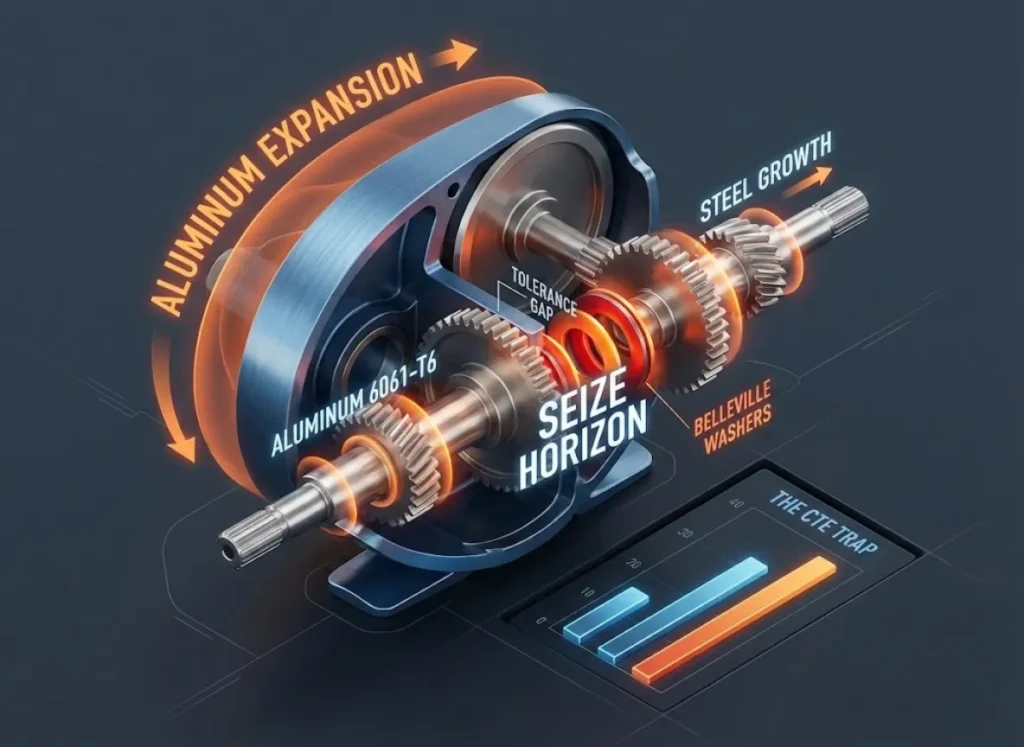
Engineers reference the Aluminum 6061-T6 thermal properties to predict these material failure points. High-end manufacturers mitigate this with “floating” drag plates, but frame distortion remains a risk. This relates directly to frame rigidity; a rigid frame resists twisting, but it must also manage thermal growth without binding the spool.
Which Mechanical Architecture Handles Heat Better: Star or Lever Drag?
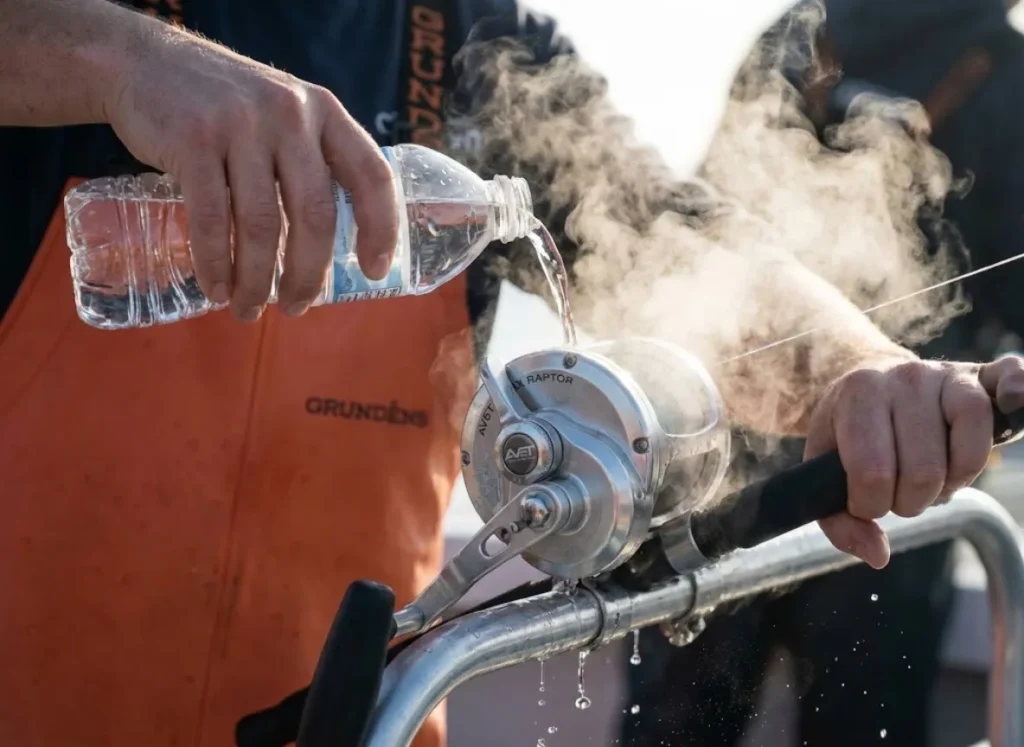
The path heat takes to exit the reel is determined by its mechanical architecture. We must contrast the “Heat Sink” of the lever drag with the “Heat Trap” of the star drag.
How Does Lever Drag Architecture Utilize the Spool as a Heat Sink?
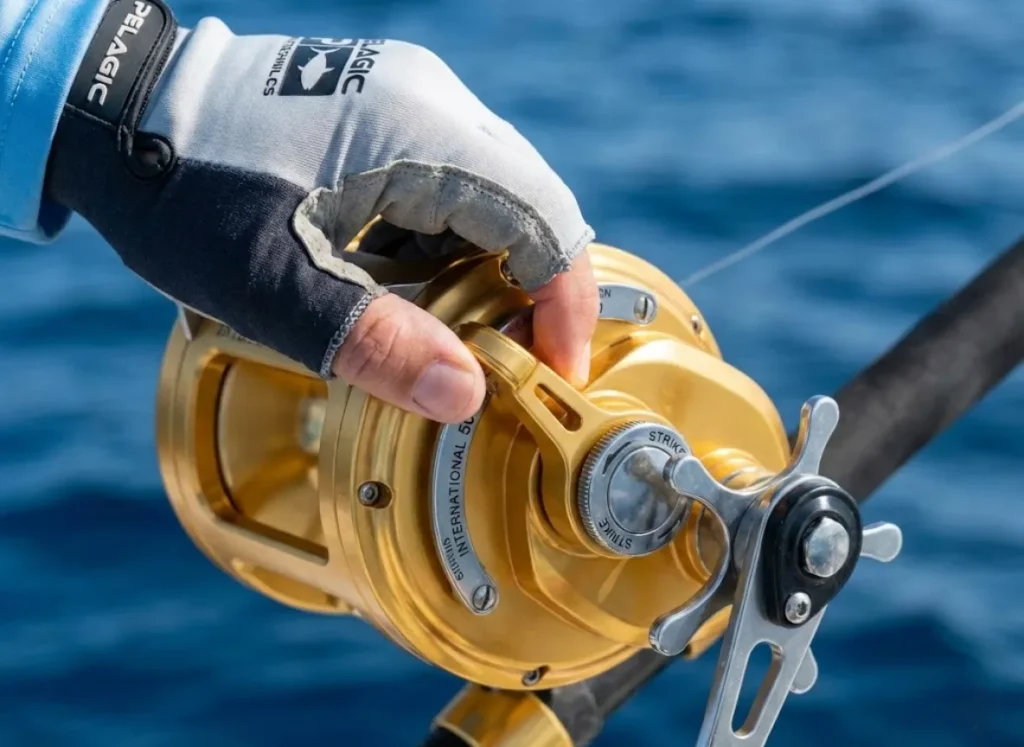
Lever drag reels attach the friction washer directly to the spool. This design utilizes the spool’s massive surface area and mass as a heat sink.
Aluminum spools possess high thermal conductivity, allowing the unit to rapidly absorb the 48,000 Joules of a Tuna run, “diluting” the heat into a large aluminum mass. This prevents critical glazing temperatures at the washer interface. Industry experts like John Bretza at Okuma have analyzed these drag forces extensively in the design of the Makaira series, emphasizing heat dissipation.
There’s a catch: ‘Line Cook-off.’ When your reel gets hot, the metal spool acts like a frying pan, cooking the fishing line wrapped around it. This heat weakens the line, often damaging the layers buried deep on the spool. This is why you might suffer a ‘mystery snap’ on your next trip—the line was ruined by the heat of the previous fight, even if it looks perfectly fine on the outside.
Pro-Tip: After a long fight on a lever drag reel, strip the top 50 yards of line and discard it. The heat transfer from the spool core has likely compromised the molecular structure of the line closest to the metal.
The specific heat capacity of stainless steel versus aluminum highlights why utilizing the aluminum spool as a sink is thermodynamically superior to isolating heat in steel gears. This design is non-negotiable when facing bluefin tuna’s legendary power, where total energy absorption is the priority over line longevity.
Why Are Star Drag Systems Prone to “Heat Trap” Failure?
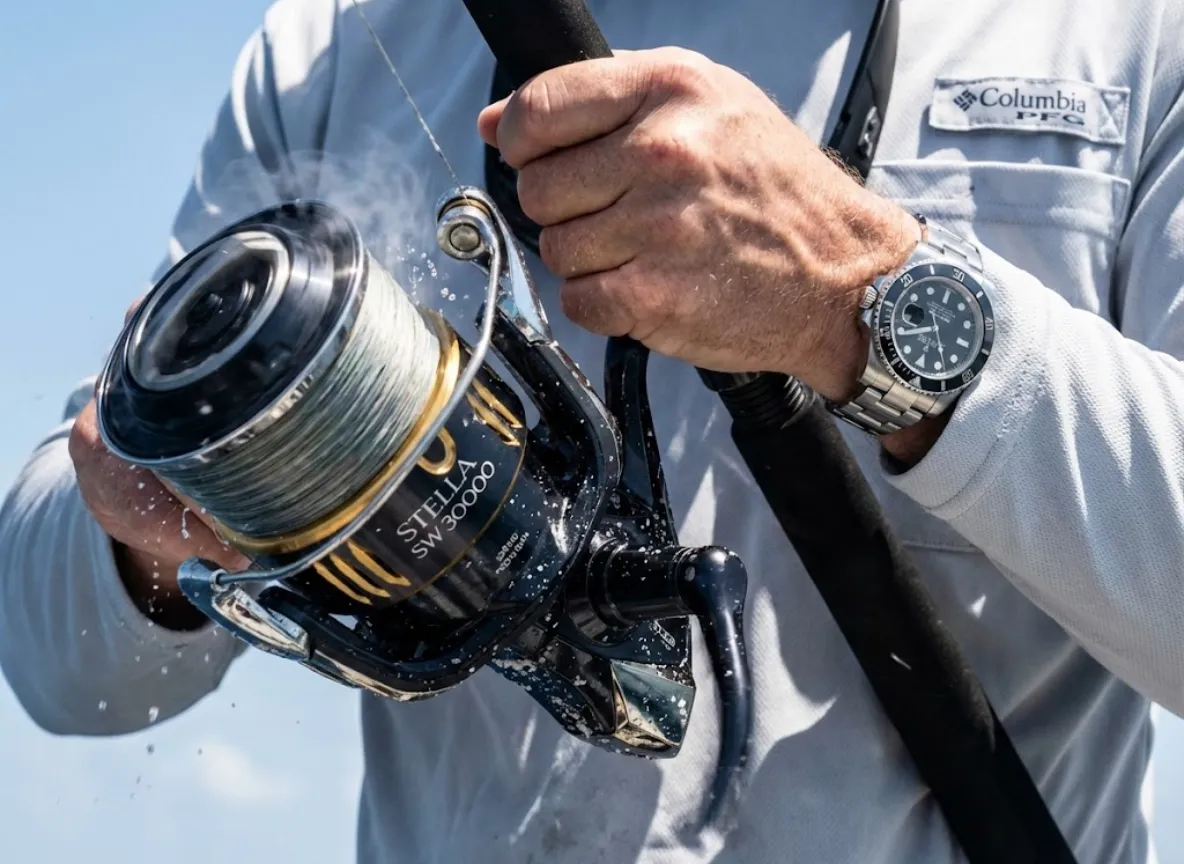
Star drag systems isolate the drag stack inside the main gear, often riding on a gear sleeve separate from the spool hub. This creates an “Insulated Chamber.”
While this protects the line from heat, it traps energy within the gearbox components. The Gear Sleeve acts as a “thermal bottle” with low mass. During sustained runs, this causes rapid temperature spikes.
Because the heat cannot radiate outwards effectively, the internal components are highly susceptible to Thermal Expansion Seizure. While excellent for casting due to low spool weight, standard star drags lack the thermal mass for the “Tuna Benchmark,” a fact demonstrated in independent heat tests like the “Dragenstein” project.
Comparing thermal expansion coefficients for engineered materials allows us to see why the tight tolerances of a star drag gearbox are a liability under heavy load. This limitation is a key differentiator in saltwater vs freshwater durability, where the sustained runs of saltwater pelagics expose the thermal weaknesses of the star drag design.
Conclusion
A fishing reel is not a static winch; it is a dynamic heat engine. A single Tuna run generates enough joules of energy to melt steel if that energy is not properly managed.
For the serious angler, the takeaways are clear. Carbon fiber washers are essential for high-stress fishing due to their conductivity, while felt is an insulator best left for low-energy trout streams. Lever drag reels use the spool as a heat sink to survive long fights, while star drags protect the line but risk internal seizure during marathons.
True competence comes from matching your gear selection to the “Thermodynamic Profile” of the fish—Velocity multiplied by Duration—rather than just the weight of the catch.
FAQ – Frequently Asked Questions
Why does my drag get sticky when it gets hot?
Stickiness is often caused by glazing of the washer surface or the breakdown of grease viscosity under heat. This leads to the stick-slip phenomenon, where friction oscillates rapidly between holding (static) and sliding (dynamic), creating a jerking sensation.
Is it better to grease carbon fiber drag washers or run them dry?
Greasing carbon fiber with a dedicated PTFE grease (like Cal’s Universal Drag Grease, a standard recommended by reel experts like Alan Tani) is physically superior for reliability and heat transfer. While dry drags offer slightly higher maximum stopping power, grease eliminates chatter, waterproofs the system, and creates a boundary layer that prevents the washers from grinding themselves into dust.
What causes a star drag reel to lock up during a fight?
This is typically a Thermal Expansion Seizure. The aluminum star or frame expands at a different rate than the steel gear sleeve. The heat generated by the drag eliminates the mechanical tolerances, essentially shrink-fitting the components together until they cool down.
How much drag pressure do I actually need for big game?
Drag pressure should be set based on the heat generation potential, not just line strength. Setting drag too high on a long-running fish increases heat linearly, risking total system failure. A safe thermodynamic limit for sustained runs is generally 25% to 30% of the line’s breaking strength.
Risk Disclaimer: Fishing, boating, and all related outdoor activities involve inherent risks that
can lead to injury. The information provided on Master Fishing Mag is for educational and informational purposes
only. While we strive for accuracy, the information, techniques, and advice on gear and safety are not a substitute
for your own best judgment, local knowledge, and adherence to official regulations. Fishing regulations, including
seasons, size limits, and species restrictions, change frequently and vary by location. Always consult the latest
official regulations from your local fish and wildlife agency before heading out. Proper handling of hooks, knives,
and other sharp equipment is essential for safety. Furthermore, be aware of local fish consumption advisories. By
using this website, you agree that you are solely responsible for your own safety and for complying with all
applicable laws. Any reliance you place on our content is strictly at your own risk. Master Fishing Mag and its
authors will not be held liable for any injury, damage, or loss sustained in connection with the use of the
information herein.
Affiliate Disclosure: We are a participant in the Amazon Services LLC Associates Program, an
affiliate advertising program designed to provide a means for us to earn advertising fees by advertising and linking
to Amazon.com. As an Amazon Associate, we earn from qualifying purchases. We also participate in other affiliate
programs and may receive a commission on products purchased through our links, at no extra cost to you. Additional
terms are found in the terms of service.