In this article
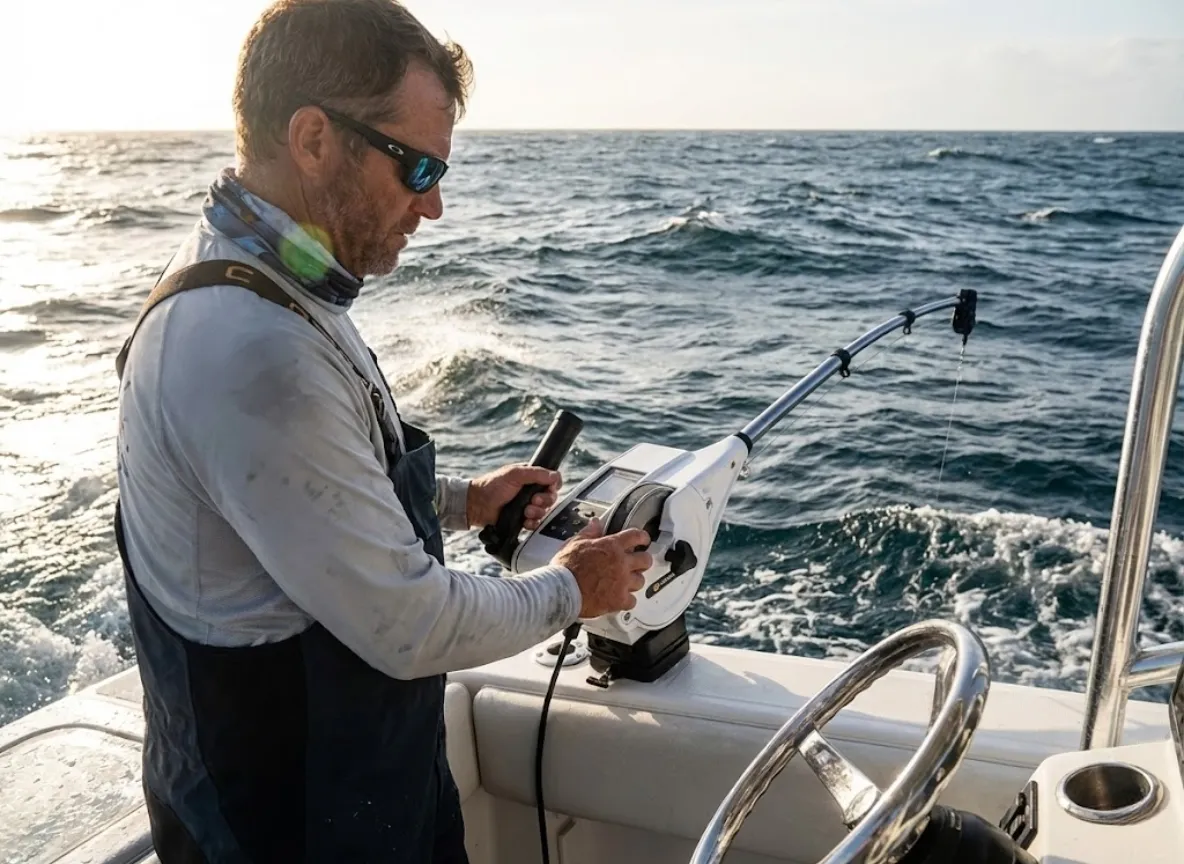
The analog depth readouts on your downrigger are often lying to you. At a standard salmon trolling speed of 3.5 mph, 100 feet of deployed cable places your lure at a true depth of only 76 feet. This silent discrepancy, governed by hydrodynamic cable drag and known as “blowback,” is the primary reason anglers miss fish suspended in narrow thermoclines.
In 2026, solving this isn’t just about hanging a heavier lead ball. It is about choosing a technological doctrine for Precision Controlled-Depth Trolling (CDT). You are either building a “smart” vessel where your downrigger communicates wirelessly with your sonar via a One-Boat Network, or you are investing in industrial-grade torque to brute-force your way through deep waters.
Having run gear over hundreds of miles of offshore terrain—from the caustic salt spray of the Pacific Northwest to the deep, cold trenches of the Great Lakes—I know that equipment failure usually happens when the bite is hottest. This guide moves past the marketing brochures to dissect the physics of blowback calculation, helping you execute the correct downrigger setup that matches your vessel’s electrical infrastructure and your philosophy on technology versus durability.
How to Choose the Right Downrigger System

Why Does “Blowback” Dictate Your Purchase?
If you don’t respect the physics of water density, you are fishing blind. The core adversary here is cable drag, which increases with the square of your velocity. According to the drag equation principles outlined by NASA, a move from 1.5 mph to 3.5 mph doesn’t just double the resistance—it creates a massive, non-linear increase in the cable angle.
Treating the cable as a hypotenuse, a 50-degree angle results in a staggering 36% loss of true depth. This is why the market has shifted toward heavier 12lb to 20lb weights. The downrigger ball shape matters too; a slim torpedo weight cuts water better than a standard round ball or pancake weight. To manage that kind of ballast without bending your boom like a recurve bow, you need rigid, stainless steel arms and a robust swivel base.
Once you master the physics of lure depth vs counter depth, you can start executing the precision system of speed and depth control necessary to target specific thermal layers that deep-diving crankbaits simply cannot reach.
Pro-Tip: If you are running lighter weights (8-10lbs) and seeing significant blowback, stop trusting the counter. Watch your sonar. If you can’t see your cannonball on the screen, you are likely shallower than you think.
Positive Ion Control: Real Science or Marketing Hype?
Your boat is essentially a floating battery. The interaction between your aluminum hull, zinc anodes, and electrolyte water creates a galvanic cell that emits a negative electrical field through electrolysis. Predatory fish possess electroreceptors called the Ampullae of Lorenzini. As detailed in studies on electroreception in fish, negative fields act as repellents, while a regulated positive voltage (+0.6V)—known as Positive Ion Control (PIC)—can actually pique curiosity and reduce avoidance.
This creates the “Ion Dilemma.” PIC requires a conductive path to the water. Stainless steel cable works perfectly for this voltage adjustability. However, many anglers prefer braided line (Spectra/Dyneema) because it is thinner and quieter, reducing the notorious cable hum.
The catch? Braid is an insulator. Using it effectively disables your ion control unless you rig complex copper grounding wires. This is a critical trade-off when fighting galvanic corrosion from salty electrolytes and trying to maintain a stealthy presentation. This is the braid paradox: you gain stealth from silence but lose the electrochemical advantage.
Our Selection Process: How We Built This Guide
We do not accept manufacturer samples in exchange for positive reviews. The salt doesn’t care about marketing budgets, and neither do we. Our analysis is derived from technical specs and verified user field reports, focusing heavily on “anti-sell” data—common failure modes like screen freezes, acoustic signatures of motors, or brake slippage.
Every unit below was scored on Retrieval Speed (fpm), Amp Draw (electrical load), and Mechanical failure points. We also looked hard at the 2026 lineups from Cannon, Scotty, Big Jon, and Brocraft, while noting that legacy brands like Walker, Penn, and Seahorse have largely faded from the modern downrigger selection sportfishing conversation.
A crucial note on infrastructure: If you buy a high-performance electric downrigger, be prepared to upgrade your boat’s wiring. Standard 14-gauge wire is a fire hazard with these new high-torque motors; 10-gauge with 30-amp fusing is the new standard for safety.
The Best Downriggers of 2026: Our Top Recommendations for Every Need
Our Top Picks for The “Connected Ecosystem” Angler

Our Top Picks for The “Heavy-Duty” & Charter Angler
Our Top Picks for The Manual & Kayak Angler
Conclusion
The choice between Cannon and Scotty in 2026 isn’t just about brand loyalty; it’s about whether you value Speed or Intelligence. If you want automated bottom tracking to hug the reef while you steer, the Cannon Optimum is your co-pilot. If you want raw, industrial speed to cycle lines quickly in deep water, the Scotty 2106 High Performance is your workhorse.
But remember the wiring mandate: heavy-duty electric units require heavy-duty power. If you aren’t ready to upgrade your fusing to 30 Amps and your wiring to 10 AWG, stick to the lower-draw Big Jon or a reliable manual downrigger.
Finally, respect the physics of drag. Use stainless steel cable if you need Positive Ion Control to mask your boat’s voltage, or switch to braid if you want to slice through the water and reduce blowback. Assess your boat’s electrical infrastructure before you buy, and you’ll spend more time fishing and less time troubleshooting your riggers.
FAQ – Frequently Asked Questions
Can I use braided line on my downrigger instead of steel cable?
Yes, braided line drastically reduces blowback and eliminates the hum caused by cable vibration. However, because braid is an electrical insulator, using it disables Positive Ion Control features. You will also need to add a specialized shock absorber snubber to the terminal end to prevent gear loss, as Spectra line has zero stretch.
Why does my electric downrigger screen keep freezing?
This is a known issue with smart downriggers like the Cannon Optimum TS, often caused by software glitches or temporary voltage drops from the boat power supply. Fixing it usually requires a hard power cycle (unplugging the unit). Keeping firmware updated via the mobile app is critical to stability.
How heavy of a downrigger weight do I really need?
For inland lakes targeting Walleye or Trout, 8-10 lbs is standard. However, for Great Lakes or Ocean trolling at speeds over 2.5 mph, you should upgrade to 12-15 lbs. This added mass is necessary to keep your downrigger cable vertical and minimize the depth loss caused by blowback.
Will a high-speed downrigger drain my boat battery?
Yes, high-torque models like the Scotty 2106HP can draw up to 19 amps under peak load. They require a robust deep-cycle battery and, critically, heavy-gauge wiring (10 AWG) to prevent voltage drop and breaker trips during retrieval.
Risk Disclaimer: Fishing, boating, and all related outdoor activities involve inherent risks that can lead to injury. The information provided on Master Fishing Mag is for educational and informational purposes only. While we strive for accuracy, the information, techniques, and advice on gear and safety are not a substitute for your own best judgment, local knowledge, and adherence to official regulations. Fishing regulations, including seasons, size limits, and species restrictions, change frequently and vary by location. Always consult the latest official regulations from your local fish and wildlife agency before heading out. Proper handling of hooks, knives, and other sharp equipment is essential for safety. Furthermore, be aware of local fish consumption advisories. By using this website, you agree that you are solely responsible for your own safety and for complying with all applicable laws. Any reliance you place on our content is strictly at your own risk. Master Fishing Mag and its authors will not be held liable for any injury, damage, or loss sustained in connection with the use of the information herein.
Affiliate Disclosure: We are a participant in the Amazon Services LLC Associates Program, an affiliate advertising program designed to provide a means for us to earn advertising fees by advertising and linking to Amazon.com. As an Amazon Associate, we earn from qualifying purchases. We also participate in other affiliate programs and may receive a commission on products purchased through our links, at no extra cost to you. Additional terms are found in the terms of service.