In this article
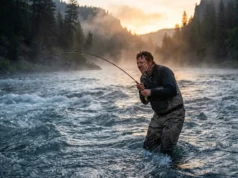
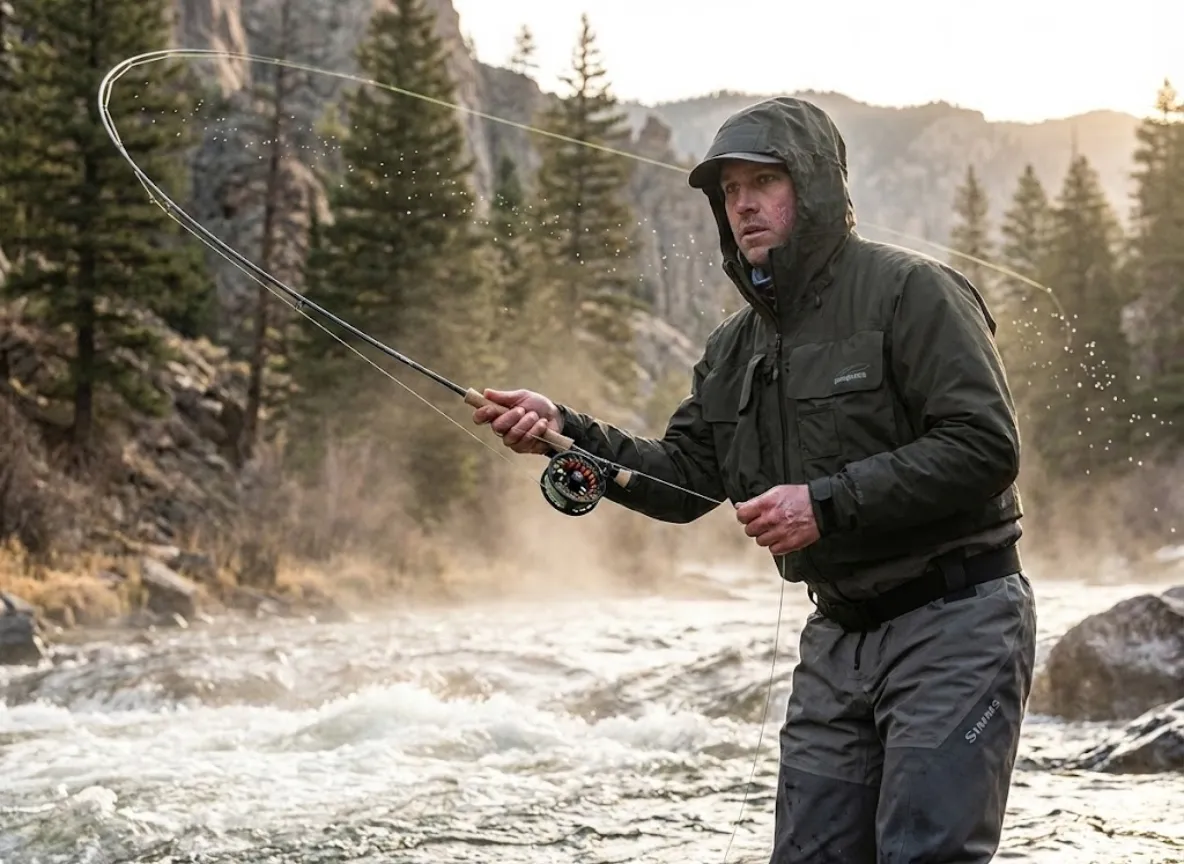
The main current pushed against my thighs, a constant, heavy weight trying to knock me off balance. To the uninitiated, the water looked like a chaotic, tumbling mess of whitewater and dark slicks. But as I stood there, scanning the riffle and run, I wasn’t looking for “luck.” I was looking for the equation.
Competence in angling is not about gambling on a cast; it is the deliberate application of physics. By understanding the invisible energy equations of the river—the friction of water against stone, the velocity gradients, and the drag coefficients—you transform from a hopeful participant into a predator. This applies whether you are drifting flies for trout, working crankbaits for smallmouth, or soaking bait for catfish behind a wing dike.
The river does not move at random. Every swirl, eddy, and slick is the rigid output of gravitational potential energy colliding with bottom substrate. For the angler standing waist-deep in the flow, the water is not simply a habitat; it is a field of energy gradients that dictates biological survival and metabolic cost. To catch the fish, you must first solve the fluid dynamics equation that governs its position.
What Defines the Physics of Open Channel Flow?

To understand where fish live, we must deconstruct the movement of water. We have to move beyond surface appearances to explain the vertical and horizontal velocity profiles that create the actual habitat.
How does the “Law of the Wall” create the Boundary Layer?
At a microscopic level, water molecules in contact with the riverbed obey the “No-Slip Condition.” This means their speed is effectively zero due to friction against the gravel or cobble. As you move up from the bottom, the current speed increases, but not linearly. It follows a logarithmic profile, creating a tiered “layer cake” of speeds.
The bottom tier is known as the Boundary Layer. This is a critical buffer zone near the substrate where the flow is significantly slower than the roaring main flow seen by the angler. According to a geomorphological analysis of open-channel flow profiles, this logarithmic distribution creates a refuge where water velocity drops dramatically inches from the bed.
For a fish, this is a metabolic miracle. It allows a trout or bass to hold inches from the bottom with near-zero energy expenditure while a raging current passes just overhead. This is the same zone where insect concentration of species like Mayflies and Stoneflies thrive, protected from the shearing force of the water column.
Pro-Tip: When nymphing, if you aren’t occasionally snagging the bottom, your flies are likely drifting in the fast current above the boundary layer, passing harmlessly over the fish’s head.
What defines a “Seam” in terms of Shear Stress and Velocity?
If the boundary layer is the vertical refuge, the “seam” is the horizontal one. The core of maximum velocity in a river is called the Thalweg, typically found just below the surface in the center or outer third of the channel. Hydrodynamics experts visualize this using isovels—contour lines of equal velocity—that show the river as a 3D tube of varying speeds, as detailed in a foundational USGS Report on Velocity-Head Coefficients in Open Channels.
The seam is the specific shear zone or transition zone where fast water meets slow water. This friction creates a sharp gradient known as Kelvin-Helmholtz instability. To the angler, this appears as “nervous water”—writhing vortices and boils. These gradients mechanically trap and concentrate drifting invertebrates, creating a natural conveyor belt of food often visible as a bubble line or foam line.
This zone offers the predator a “Two-World” advantage. By applying these principles of fishing in current, you realize the fish holds in the slower-moving water (The Slow) while monitoring the high-energy food delivery (The Fast).
Why Do Fish Choose Specific Seams?
However, finding the spot is only step one. Biology dictates if they can afford to stay there. Biology is expensive, and fish are biological machines strictly governed by the need to optimize energy inputs against outputs.
What is the Net Energy Intake strategy?
Every fish is basically an accountant trying to save energy. For a fish to grow and stay healthy, the energy it gets from eating has to be more than the energy it spends swimming and staying alive. Because of this, fish are experts at finding ‘sweet spots’ in the water.
This is known as the ‘Focal Point’: a specific place where a fish can sit comfortably without fighting the current, while still having a front-row seat to watch for food drifting by. They aren’t just swimming randomly; they are looking for the most calories for the least amount of work.
The cost of swimming increases exponentially with current speed. Adding to this burden is the energy cost of digestion—known as Specific Dynamic Action—which forces fish to seek even slower water or deeper boundary layers after a heavy meal. This explains why the largest fish often occupy the “prime lies” where the gradient between fast food delivery and energy shelter is sharpest.
A Royal Society study on fish responses to flow velocity quantifies this relationship. It shows how fish constantly adjust position to balance turbulence against caloric intake, even as shifting fishing barometric pressure alters their feeding windows.
How does Critical Swimming Speed limit habitat selection?
Every fish has a ‘cruising speed’—the fastest it can swim for a long time without wearing out. Think of it like a marathon pace. If a fish has to go faster than that, it kicks into a ‘sprint mode.’ While this gives them a massive burst of speed to chase a lure or escape a predator, it burns through their fuel almost instantly. Once they hit that sprint, they are running on borrowed time and will ‘hit the wall’ quickly, needing a long time to recover their strength.
Not all fish are built the same when it comes to handling the current. Trout and salmon are like marathon runners designed for fast, rushing water; they can stay in the heavy flow for a long time without getting tired. On the other hand, fish like bass and catfish don’t have that same stamina. They get worn out much faster in a strong current and will almost always look for slower, calmer water where they don’t have to work so hard just to stay in one place. A USDA Forest Service evaluation of Critical Swimming Speeds provides the data on these velocity criteria.
This is why finding a ‘break’ in the current is vital for survival. For fish that aren’t built for fast water, like bass or catfish, finding a spot behind a rock, a fallen log, or in a calm pocket is a must. These ‘current breaks’ act like rest stops, allowing them to hang out and wait for food without having to fight the full force of the river., specifically when applying this to a how to catch smallmouth bass blueprint, must hug the submerged boulders more tightly than trout. In summer, warmer water increases a fish’s metabolic scope, allowing them to hold in faster water they would avoid in winter.
How do fish exploit turbulence via “Kármán Gaiting”?
Fish do not just endure turbulence; they harness it. When water flows past a cylinder (like a submerged boulder), it creates a repeating pattern of swirling vortices known as a Kármán vortex street.
Fish engage in a behavior called “gaiting.” They synchronize their body undulations with these vortices to capture energy rather than fight it. It is essentially slalom skiing through the wake. An NIH/PMC article on Rainbow trout swimming energetics in turbulence provides physiological evidence that fish holding in these turbulent wakes show significantly reduced muscle activity compared to smooth laminar flow.
This creates a paradox for the angler: “pocket water” that looks chaotic and exhausting is actually energetically efficient. This is especially true during a high water event or river fishing after rain, where fish move into the turbulent boils behind rocks to rest.
How Can Anglers Visually Identify Productive Seams?
We must translate abstract hydrology into concrete visual cues on the stream bank. This is the art of “reading water.”
What are the “Five Seams” created by midstream obstructions?
When a main current hits a boulder, it creates a predictable hydraulic signature consisting of five distinct zones.
- The Stagnation Point (Pillow): This is the high-pressure “cushion” of slack water immediately upstream of the boulder.
- Fast Left: The accelerated flow diverting around the left side (Venturi effect).
- Fast Right: The accelerated flow diverting around the right side.
- The Eddy (Slow Center): The recirculating water zone directly behind the rock.
- The Merger Seams: The V-shaped convergence downstream where the Fast Left/Right meets the Slow Center.
While the Eddy offers an easy hold, it often lacks food delivery. The Merger Seams are the prime lies. A PMC study on Fish Habitat Selection and Hydrodynamic Indicators correlates these specific structures with high fish preference. Identifying these mergers is a critical step in the step-by-step system for how to read a river for fishing.
How does Substrate Roughness (Manning’s n) affect holding potential?
The bottom of a river does more than just hold water; it acts like a giant brake that creates friction against the current. A smooth, sandy bottom offers very little resistance, which allows the water to glide past quickly and smoothly. In contrast, a riverbed filled with cobbles and large boulders is much “rougher,” causing it to grab the passing water and force it to slow down. For an angler, these rocky areas are much better spots to find fish because that extra friction creates the calm pockets and slower water that fish need to rest.
Think of the riverbed as a carpet. Sand is a hardwood floor; boulders are a thick shag carpet. Fish live in the shag. The gaps between rocks—interstitial spaces—provide shelter from the current and habitat for food.
A USDA Forest Service paper on hydraulic roughness details how larger roughness elements increase the height of the velocity shelter. This is why a riffle with basketball-sized rocks holds more fish than a deep, smooth glide. Recognizing this texture allows you to score the perfect fishing spot based on bottom composition alone.
How Do Physics Principles Optimize Tackle Selection?
Physics doesn’t stop at the water’s edge; it extends to your gear. Success depends on managing drag vectors and sink rates, whether using soft plastics, plugs, or flies.
How does Line Diameter and Density influence Drag Vectors?
The amount of resistance or “drag” your line feels from the current depends mostly on how much surface area the water is hitting. When you use a thinner line, you are giving the current a much smaller target to push against. By dropping down to a thinner diameter, whether you are using monofilament for deep-diving lures or a fine tippet for fly fishing, you allow your gear to cut through the water more easily. This allows your lures to sink deeper and stay in the strike zone without being constantly dragged out of position by the force of the flow.
The conflict arises when your line belly is in fast water while your lure is in slow water. This creates an unnatural drag vector that pulls the lure out of the strike zone. Beyond diameter, line density determines success. According to eLife article on in-line swimming dynamics and fluid interaction, fluid interaction is key.
Fluorocarbon (Specific Gravity ~1.78) is denser than Nylon (SG ~1.15). It breaks surface tension and cuts through the boundary layer more efficiently, which is why choosing the right braided vs fluorocarbon vs monofilament is a physics decision, not just a brand preference. Euro nymphing works so well because it keeps almost all of your line out of the water. By holding a thin, tight line directly to your flies instead of letting a thick floating line or a bobber sit on the surface, you take away the current’s ability to grab and pull your gear. This allows your fly to drift naturally at the same speed as the bottom current, which looks much more convincing to a hungry fish.
What is the Tactical Algorithm for Fishing Seams?
The final step is execution. We must apply a strategic algorithm to these environments, monitoring the flow arrows and surface cues.
How should anglers adjust for Drag Conflict in complex currents?
The goal is Vector Management. You must position yourself to minimize the number of different current speeds your line crosses. Often, this means wading closer or casting upstream.
Mechanically, you use the “Reach Cast” to align the line angle before it hits the water. Once the drift begins, you employ mending techniques like the “Vertical Mend.” This uses the rod’s length to lift the line belly off the fast currents (creating a Lift Vector) rather than flipping it sideways.
This requires understanding how rod action vs power dictates lifting capability. A longer rod (10-11ft) increases the height of the lift vector, reducing the wetted line surface. A Texas DOT Manual on Open Channel Flow properties outlines the flow properties we are actively fighting against. You must learn to distinguish the tactile “tick” of the boundary layer from a strike.
Pro-Tip: Focus on “Micro-Mending.” Instead of one giant rip of the line, make small, constant rod tip adjustments to keep the line moving at the speed of the bottom current, not the surface.
How does “Pocket Water” hydrodynamics differ from “Tailout” flow?
Pocket water is characterized by High Reynolds numbers (Re)—chaotic, turbulent flow with short drift windows. Fish here rely on reaction strikes due to limited visibility. The strategy is “High Sticking”—using short-line tactics to puncture distinct pillows and mergers.
Tailouts are Low Re environments with laminar-like flow. Visibility is high, and fish are easily spooked. As noted in Canadian Science Publishing on trout sprinting performance, the burst capabilities needed here differ. You must use stealth, long leaders, and fine tippets.
In tailouts, the boundary layer is thinner. Your fly or lightweight rig must be precisely weighted. This is essentially utilizing the deep pools critical for winter trout fishing, where fish value scrutiny over shelter. In pockets, fish prioritize shelter; in tailouts, they prioritize observation.
Conclusion
The river is a math problem waiting to be solved, defined by cubic feet per second (CFS) and friction.
- The Boundary Layer is the fundamental bio-physical refuge that allows fish to exist in high-velocity rivers.
- Net Energy Intake is the biological imperative that forces fish into Merger Seams, where fast food meets slow water.
- Drag is a solvable physics equation managed through line diameter reduction and vertical rod leverage (Vectors).
Next time you approach the water, pause. Do not cast. Look for the invisible grid of energy—the pillows, the shears, the foam, and the slicks. When you see the physics, the fish will appear. Share your experience reading the bubbles and seams in the comments below.
FAQ – Frequently Asked Questions
What is a current seam in fishing terms?
A current seam is the distinct interface where two bodies of water moving at different speeds or directions meet, creating a visible line of shear. These zones concentrate drifting food while providing a low-energy holding area for predatory fish nearby.
Why do fish hold behind rocks in fast water?
Fish hold behind rocks to exploit the pressure cushion or eddy where velocity is low, allowing them to conserve energy. Advanced physics reveals they also use Kármán gaiting to surf the rhythmic vortices shed by the rock, further reducing swimming costs.
How does river bottom substrate affect fishing?
Rough bottom substrate like cobble and boulders create a thicker boundary layer (a zone of slow water near the bottom) than smooth sand or gravel. This thicker layer provides better shelter for fish and habitat for aquatic insects, making rough bottoms generally more productive.
What is the bubble line and why is it important?
The bubble line is a surface accumulation of foam and debris that indicates the primary current seam or conveyor belt of the river. Because the current convergence that traps bubbles also traps insects, feeding fish are often positioned directly beneath or adjacent to this line.
Risk Disclaimer: Fishing, boating, and all related outdoor activities involve inherent risks that can lead to injury. The information provided on Master Fishing Mag is for educational and informational purposes only. While we strive for accuracy, the information, techniques, and advice on gear and safety are not a substitute for your own best judgment, local knowledge, and adherence to official regulations. Fishing regulations, including seasons, size limits, and species restrictions, change frequently and vary by location. Always consult the latest official regulations from your local fish and wildlife agency before heading out. Proper handling of hooks, knives, and other sharp equipment is essential for safety. Furthermore, be aware of local fish consumption advisories. By using this website, you agree that you are solely responsible for your own safety and for complying with all applicable laws. Any reliance you place on our content is strictly at your own risk. Master Fishing Mag and its authors will not be held liable for any injury, damage, or loss sustained in connection with the use of the information herein.
Affiliate Disclosure: We are a participant in the Amazon Services LLC Associates Program, an affiliate advertising program designed to provide a means for us to earn advertising fees by advertising and linking to Amazon.com. As an Amazon Associate, we earn from qualifying purchases. We also participate in other affiliate programs and may receive a commission on products purchased through our links, at no extra cost to you. Additional terms are found in the terms of service.