In this article
You feel the “thump”—a tactile disruption in the line that travels from the depths to your nervous system in milliseconds. In that singular moment, the difference between a story about “the one that got away” and a secured catch isn’t luck; it is a rapid calculation of physics.
The hook set is the transfer of kinetic energy from your muscles, through a lever (the rod) and a dampening medium (the line), to drive a wedge (the hook) into a biological target. It is the most critical mechanical event in angling, defining the pivotal moment between a miss and a solid hook-up. Yet, most anglers rely on a panic response rather than proper hook-setting form built on muscle memory.
This guide deconstructs that split-second event for serious skill acquisition. We will analyze how line stretch acts as an energy thief, why the bony mouth of a bass demands a different kinetic response than the papery mouth of a trout, and how to master the three core movements: the Snap, the Sweep, and the Reel set.
What Actually Happens When You Set the Hook? (The Physics)

Before we talk about muscle movement, we have to talk about the terminal tackle mechanics that prevent your force from reaching the fish. The hook set is effectively a physics of force transfer equation, and your gear often works against you.
Why does line stretch matter for hook setting?
Monofilament line acts as a capacitor that absorbs kinetic energy through elongation. Under a heavy load, monofilament can stretch 20% to 30%. This creates a massive problem known as the quantitative stretch factor, or “Lost Sweep Distance.”
Imagine you make a long cast of 100 feet. If your line stretches just 25%, you theoretically need to move the rod tip 25 feet just to achieve a tight line. That is a physical impossibility with a single stroke. This is why anglers often encounter missed bites on long casts—they are fighting the material, not the fish.
Pro-Tip: If you are fishing deep water or making long casts with monofilament, use the “Reel-Down” technique. You must crank the handle rapidly to remove effective slack before you ever raise the rod.
To bypass this dampening effect, many anglers switch to braided line (Gel-Spun Polyethylene). Braid has <4% stretch, creating a “hard link” that transmits impulse almost instantaneously. However, this braid directness means there is no shock absorption, which changes how you must fight the fish.
Nylon monofilament is also hygroscopic, meaning it absorbs water. This increases stretch and lowers breaking strength by 8-12% after soaking. Understanding the tensile properties of fishing gear under load explains why your hook set might feel “mushy” late in the day.
At long distances with mono, you may generate less than one-third of the potential force available at the reel. You must distinguish between visible slack (line bowing in the wind) and “effective slack” (the stretch potential hidden in the molecular structure). This physics problem is often the deciding factor in the braid vs fluorocarbon vs monofilament line showdown.
How does rod action influence the impulse?
Your fishing rod setup acts as a Class 3 lever. It multiplies speed and distance but requires significant input force to move the load. The “Action” of the rod—where it bends—determines the speed of that energy transfer, known as Impulse.
A fast action rod bends in the top 20-30%. When you snap the rod, it creates a high-impulse “shockwave.” This is ideal for driving single-point hooks through tough tissue because the rod “locks up” quickly. It stops flexing and begins transmitting raw force almost immediately.
Conversely, a medium action rod (or moderate action) features a parabolic bend. It acts as a shock absorber. This is critical when using treble hooks, as it maintains momentum without generating a spike of force that could rip the hooks free.
Pro-Tip: Match your rod to the hook, not just the fish. Use Fast action for single hooks (Jigs, Worms) to drive the point home. Use Moderate action for treble hooks (Crankbaits) to prevent tearing the mouth.
If you use a slow rod with a Texas Rig, the rod absorbs the strike energy, resulting in a missed fish. If you use a fast rod with crankbaits, you risk tearing the lips. The impulse and momentum connection dictates that force must be applied over time correctly to be effective.
Additionally, rod length changes your vector and rod sweep distance. A 7’6″ rod moves significantly more line than a 6’6″ rod, which aids in deep-water sets. This synergy is key to decoding rod power and rod action for your specific setup.
Does the Species Dictate the Hook Set Technique? (The Biology)
The rod and line deliver the message, but the clarity of that message depends entirely on who is on the receiving end. A “one-size-fits-all” hook set is a recipe for failure because fish mouth anatomy varies wildly.
How do you set the hook on suction feeders like Bass?
Largemouth Bass feed by expanding their buccal cavity to create a negative pressure vacuum. They inhale prey, taste it, and decide whether to swallow or reject it.
Research on the kinematics of suction feeding in largemouth bass reveals that this entire sequence—inhalation and potential rejection—can occur in approximately 50 milliseconds. That is 1/20th of a second.
Bass also possess a “hard mouth.” Their jaw structure consists of bony plates and tough, sandpaper-like pads. To penetrate this armor, you need a high-velocity, high-force impact—think of the speed of a pro like Kevin VanDam. You are not just setting the hook; you are counteracting the hydrodynamic force of the fish trying to spit the lure out.
This is why the largemouth bass fishing blueprint emphasizes heavy gear. Flipping hooks use heavy gauge wire. Doubling the wire diameter requires roughly 4x the force to penetrate. You must watch for visual cues, like the line “jumping” sideways, and react with controlled violence.
Why is the hook set different for Trout and soft-mouthed fish?
Trout and other Salmonids are the biological opposite of bass. They possess a delicate Maxillary Process—a membrane and cartilaginous connection in the upper fish lip that is prone to tearing.
If you use a violent bass set on a trout, you will likely rip the hook straight through this delicate tissue, leaving a hook-hole tear. The correct technique is the “Trout Set,” which is a firm lift rather than a snap. The goal is to slide the fine-wire hook into place using wedge mechanics, not to drive it through bone.
Trout often exhibit nibbling or sipping behavior rather than a violent vacuum intake. The priority here is constant tension. You want to maintain a bend in the rod to prevent the fish from shaking the hook loose.
Understanding the internal anatomy of trout helps you visualize why direction matters. Setting “upstream” pulls the hook into the corner of the mouth, while a downstream hookset pulls it out.
This finesse approach is a cornerstone of trout fishing for beginners. It ensures you hook the fish securely without causing the damage that leads to mortality.
Which Technique Should You Use? (The Mechanics)
We have covered the physics and the biology. Now, let’s translate that into physical technique. There are three distinct hook-setting motions, and you must know when to deploy each one to avoid troubleshooting lost fish.
When should you use the Snap Set?
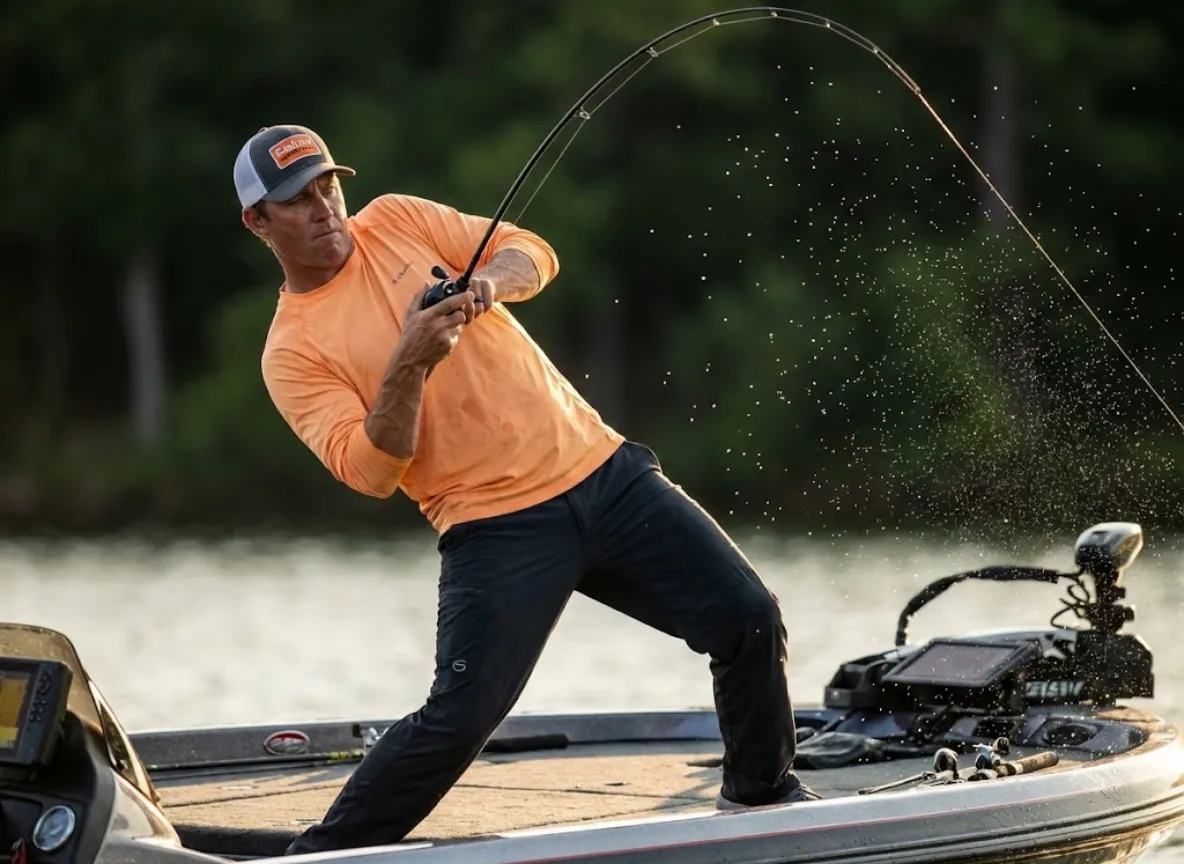
The Snap Set (or straight-up hookset) is the vertical power move. It is designed for single-point hooks like Jigs, Texas Rigs, and Spinnerbaits, specifically when targeting hard-mouthed fish like bass, pike, or walleye.
Step 1: Slack Removal. This is the most common failure point. You must reel down to take out any slack in the line until the rod tip is near the water and the line is semi-taut. If you snap with slack line, the rod movement simply straightens the bow in the line without moving the hook.
Step 2: The Vertical Vector. Snap the rod upward to the 12 o’clock position or sharply backward. This generates the linear force needed to drive the hook point upward into the roof of the mouth.
Step 3: High Hands. Finish the motion with the rod high. This keeps the fish’s head coming toward the surface and away from cover.
Because you are overcoming the forces exerted on prey by aquatic suction feeders, you need to engage your core, shoulders, and keep your elbows tight to the body, not just rely on a wrist flick. This technique is essential for weedless soft plastics where the hook point must penetrate the plastic body before entering the fish, a concept detailed in the science behind fishing hook sizes.
How do you execute the Sweep Set properly?
The Sweep Set is a long sweeping motion used for treble-hook lures like Crankbaits, Jerkbaits, and stick baits. The goal here is not to drive the hook, but to load the rod.
Step 1: Feel the Weight. When you feel the strike, do not react instantly. Wait until the tactile vibration of the lure stops and is replaced by a heavy, “mushy” feeling.
Step 2: Horizontal Sweep. Pull the rod to the side, parallel to the water, while continuing to reel. Do not stop reeling.
Treble hooks have small gap widths and fine points. A violent snap will often straighten them out or rip them free. By using a sweep (or side set), you utilize the movement of the fish. A horizontal pull drags the lure across the mouth, increasing the odds of snagging the corner of the jaw.
This is why how to fish deep diving crankbaits requires a specific mindset. You are relying on active angling hook penetration mechanics that prioritize sustained momentum over sudden impulse.
Why is the “Reel Set” mandatory for Circle Hooks?
The “Reel Set” is the most counter-intuitive technique for experienced anglers. It is mandatory when using Circle Hooks, which are designed with an inward-facing point for live bait scenarios.
Step 1: Dead Stick. When you feel the bite, do absolutely nothing. Do not lift the rod (the “no-strike rule”).
Step 2: Reel Fast. Simply begin reeling rapidly. As the fish swims away with the bait, the tension pulls the hook to the corner of the mouth, where it rotates and locks into the jaw hinge.
If you jerk the rod, you will pull the circle hook straight out of the fish’s throat without it ever catching tissue. This design is a conservation miracle, avoiding gut-hooked fish 85% of the time and drastically needing efforts to reduce catch-and-release mortality.
This technique is often legally required for species like Striped Bass or Reef Fish. It is a vital component of the science of catch & release, ensuring the fish swims away healthy.
Conclusion
The perfect hook set is not a random reaction; it is the product of an equation. You must balance Impulse (Rod Action) and Transmission (Line Stretch) against Resistance (Hook Wire & Jaw Density).
Adapt your physical motion to the scenario: use a vertical Snap for J-hooks and Bass, a horizontal Sweep for Trebles, and a steady Reel for Circle hooks. Respect the biology of the fish you pursue. A 50ms reaction time wins against a Bass, while patience and finesse win against a Trout.
Next time you are rigging up, perform the “wrap around pinky test” on your drag—pull the line against your finger. If it cuts off circulation before the drag slips, it’s too tight. Visualize the stretch in your line, and make the adjustment.
FAQ – Frequently Asked Questions
Do you set the hook immediately when you feel a bite?
It depends on the lure. For single-point hooks (jigs, worms), set immediately to prevent the fish from spitting it. For moving baits (crankbaits) or topwater frogs, wait 1-2 seconds until you feel the full weight of the fish to ensure they have inhaled the lure.
Why do I keep losing fish right after setting the hook?
This is often caused by effective slack due to line stretch (using mono at distance) or a drag set too loose. Ensure you reel down to remove slack before striking, or switch to braided line for better energy transmission.
How hard should you set the hook?
Force should be proportional to hook wire gauge and distance. Heavy wire hooks and long casts require maximum force. Fine wire hooks and close-range fights require a gentle lift to avoid tearing the hook out of the fish’s mouth.
How do you set the hook with a circle hook?
Do not jerk the rod. The correct technique is to simply reel rapidly until the line creates tension and the rod loads up. Jerking a circle hook will pull the hook straight out of the fish’s mouth without engaging the jaw corner.
Risk Disclaimer: Fishing, boating, and all related outdoor activities involve inherent risks that can lead to injury. The information provided on Master Fishing Mag is for educational and informational purposes only. While we strive for accuracy, the information, techniques, and advice on gear and safety are not a substitute for your own best judgment, local knowledge, and adherence to official regulations. Fishing regulations, including seasons, size limits, and species restrictions, change frequently and vary by location. Always consult the latest official regulations from your local fish and wildlife agency before heading out. Proper handling of hooks, knives, and other sharp equipment is essential for safety. Furthermore, be aware of local fish consumption advisories. By using this website, you agree that you are solely responsible for your own safety and for complying with all applicable laws. Any reliance you place on our content is strictly at your own risk. Master Fishing Mag and its authors will not be held liable for any injury, damage, or loss sustained in connection with the use of the information herein.
Affiliate Disclosure: We are a participant in the Amazon Services LLC Associates Program, an affiliate advertising program designed to provide a means for us to earn advertising fees by advertising and linking to Amazon.com. As an Amazon Associate, we earn from qualifying purchases. We also participate in other affiliate programs and may receive a commission on products purchased through our links, at no extra cost to you. Additional terms are found in the terms of service.