In this article
The drag screams, the rod loads into a deep parabola, and then—abrupt weightlessness. That sickening slack in the line isn’t just a lost fish; it is a failure of physics and preparation. I have seen this happen to novices and seasoned captains alike during decades of recreational fishing. The connection between your main line and your leader line is the single most critical structural point in your entire setup, yet it is often the most overlooked until the moment it snaps.
You do not need a library of twenty knots. You don’t need to memorize the Blood Knot, Triple Surgeon’s Knot, Bristol Knot, or the Perfection Loop for every trip. In my experience, from alpine streams to blue water, I have found that you need a tactical quiver of three specific connections. These are the best knots for tying braid to a leader that adapt to freezing hands, micro-guides, and heavy drag settings.
Why Do Leader Connections Fail Under Stress?

To stop breaking off fish, we have to shift our mindset regarding angling skills. We aren’t just tying loops; we are engineering a line connection between two disparate materials.
What is the “100% Knot” Myth?
“Linear Breaking Strength” is the force required to break a straight line, but “Knot Strength” is almost always lower. This is due to the mechanics of shear force. At the entry point of most knots, the line cuts into itself under tension, compromising knot integrity.
There is a distinct difference between Friction Knots and Compression Knots. Friction knots, like the Clinch, Double Surgeon’s Knot, or Uni, rely on the lines strangling each other to hold. Compression knots, like the FG or a Bimini Twist rig, rely on surface area grip—similar to a Chinese finger trap.
Laboratory tests that show static pull strength rarely match real-world failure, which often involves shock impact. A 90% strength knot tied perfectly is superior to a 100% strength retention knot tied poorly. Material hardness also plays a massive role. The Recreational Boating & Fishing Foundation explains the fundamental mechanics of knot integrity, highlighting that braided line acts like a saw against softer monofilament or fluorocarbon.
Once you accept that no braid-to-leader connection is invincible, the priority shifts to preventing the mechanical failures caused by improper drag calibration. This means calibrating your drag system becomes just as important as the knot itself.
How Do You Select the Right Knot for the Conditions?
Choosing a knot isn’t just about strength; it’s about the environment. I use a “Scenario Matrix” to decide what to tie based on weather, light, and gear. This is the mark of an adaptive angler.
When Should You Prioritize Reliability Over Raw Strength?
When you are dealing with an “Adverse Condition” protocol—low light conditions, freezing temperatures, or unstable footing on a rocking boat—fine motor skills disappear. In these moments, complex weaves like the FG or the Orbit Knot are dangerous choices. You need ease of tying.
You must also identify your gear constraints. If you are fishing a rod with standard eyelets, you have room for a bulkier, easier-to-tie knot. If you are using micro-guides, you are forced into slim profiles.
| Recommended Fishing Knots by Scenario | ||
|---|---|---|
| Scenario / Condition | Recommended Knot | Rationale |
| Cold Hands / Low Light | Double Uni | Requires minimal dexterity; tactile feedback. |
| Rocking Boat / Kayak | Double Uni / Alberto | Quick to tie; does not require “teeth tension.” |
| Trophy Fishing (Heavy Drag) | FG Knot | Maximizes system strength; prevents breakage. |
| Micro-Guides / Long Casts | FG Knot | Slimmest profile; prevents guide damage. |
| Wire Leader (Toothy Fish) | Albright Special | Capable of gripping wire loops securely. |
| Weedy Water (Vegetation) | FG Knot | Rear-facing tag sheds weeds. |
Consider the “Time-to-Tie” metric. In a blitz, speed to tie is more valuable than a 5% strength increase. Hydrodynamics also matter. If the water is full of grass or slime, you need a knot that sheds debris. The NOAA Marine Debris Program highlights how lost gear, often due to line breakage, impacts marine environments. A reliable knot that doesn’t break prevents us from leaving ghost gear behind.
Finally, visualize the “Tag End.” A forward-facing tag collects grass, while a rear-facing tag sheds it. This profile is dictated by understanding rod guide sizing and selecting the knot that passes through cleanly.
How Do You Tie the Essential Connections?
Once you know which profile fits your rod, you need to execute the tie perfectly. This is your technical core for terminal tackle rigging. Master these three, and you can handle 99% of fishing scenarios.
How to Tie the Double Uni Knot (The Utility Backup)?
The Double Uni Knot utilizes an “Opposing Barrels” mechanism. Essentially, you are tying two independent knots that slide together and jam against one another. It is vastly superior to the Nail Knot or No-Name Knot for general purpose joining.
To tie it, overlap your lines. Make 5-7 wraps for the monofilament leader side. For the slick braid side, you must increase this to 10-12 wraps. The most crucial step is wetting the line with saliva or lubricant before the final cinch to prevent friction burn, which weakens the line instantly. This works for braid to fluoro, mono to mono, and braid to leader setups.
Pro-Tip: If using very thin braid, use the “Double-Double” variation. Fold the braid over to double its thickness before tying your wraps. This increases surface area and prevents the braid from slicing through the mono leader.
The primary drawback is the “Football” profile, which can clunk through guides. However, for field repairs, night fishing, and novice anglers (beginner skill level), it is the most reliable workhorse. State agencies like the Florida Fish and Wildlife Conservation Commission provide resources on proper tackle rigging, and the Uni knot is a staple of responsible angling education. Executing it cleanly often requires pliers or line cutters (clippers), so ensure you are stocking essential tools in your kit.
How to Tie the FG Knot (The High-Performance Pro)?
The FG Knot uses the “Chinese Finger Trap” mechanism. It uses compression rather than friction, meaning the harder you pull, the tighter it grips. It is essentially a streamlined alternative to wind-on leaders or the Quintet Knot.
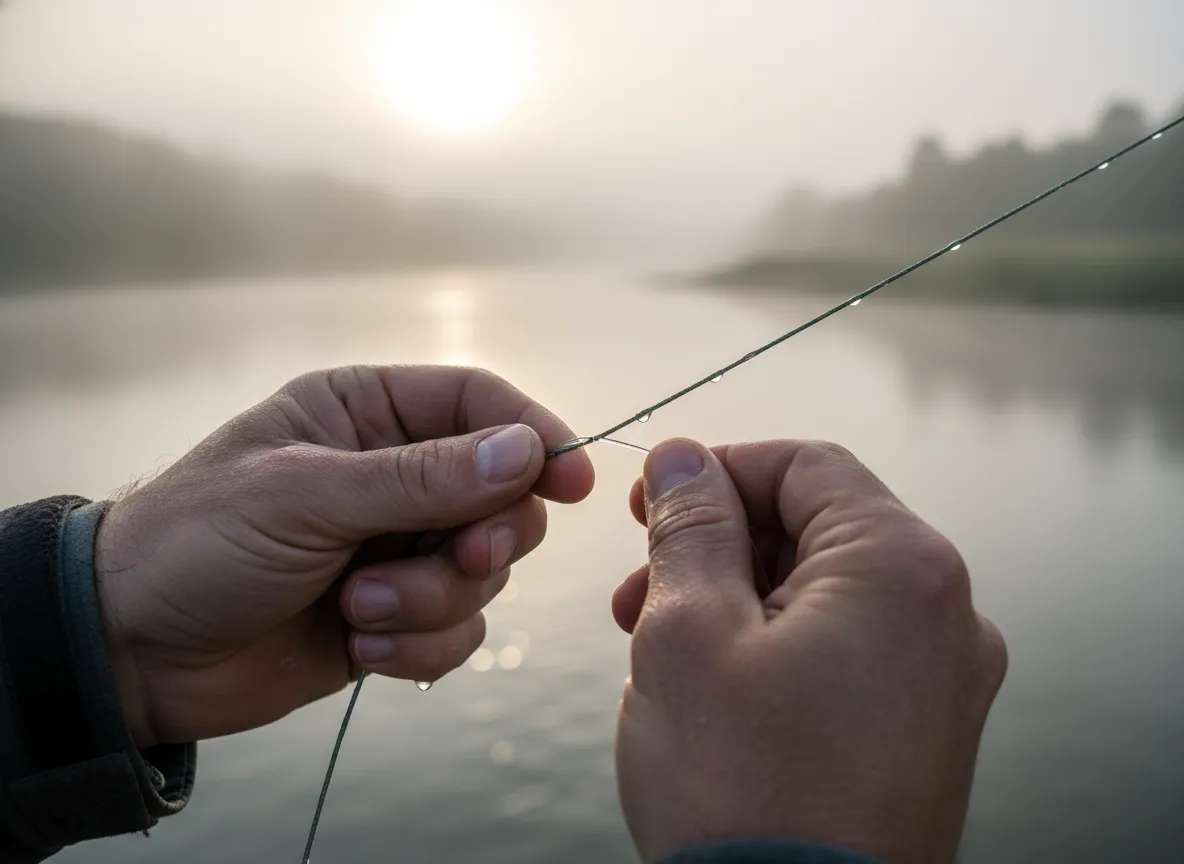
Tension is the requirement here. You must use a rod holder, a knob, or your teeth to keep the main line taut during the weave. As you weave the leader through the braid, watch for the visual cue: the braid should change color and become translucent as it “bites” into the mono leader. This is an at-home rigging job until you reach a pro skill level.
The advantage is the slim profile (slimness). It is the thinnest possible connection, essential for micro-guides and casting distance. It also features a weedless architecture where the tag end direction points backward, creating a smooth ramp for vegetation.
Research by the IGFA establishes strict regulations on leader lengths and double lines. Because the FG creates a long connection, it distributes stress incredibly well. However, this knot is only as good as the line gripping it, so choosing high-performance braid with a tight weave is critical to stop braid slipping.
How to Tie the Albright and Alberto Knot (The Specialist)?
The Albright Knot and its improved cousin, the Alberto Knot (often called the Improved Albright Knot), utilize “Loop Wrap” mechanics. These are ideal for joining lines of vastly different diameters, such as connecting braid to a thick leader, lead core, or wire leader.
The distinction is in the wrapping line. The standard Albright uses wraps in one direction. The Alberto adds security by wrapping 7 times down the loop, and then 7 times back up over the previous wraps. Unlike the Seaguar Knot, this can handle metal materials.
The Critical Error is the exit path. You must ensure the tag end exits the loop in the same direction it entered. If the lines exit opposite ways, the loop acts as a guillotine under tension and will shear the leader material.
This is the best use case for attaching wire bite-leaders for pike, wahoo, or sharks in saltwater fishing. The New York DEC outlines regulations for using wire leaders when targeting species like Muskellunge to prevent bite-offs. Once your wire is secure, you can focus on selecting terminal hardware like snaps and swivels to finish the rig.
Conclusion
We do not tie knots to pass a test; we tie them to bring fish to hand and protect the resource. Whether you are trolling or bait fishing, these connections matter.
- The Double Uni Knot is your fallback for adverse conditions and cold hands, prioritizing reliability over profile.
- The FG Knot offers the highest strength-to-diameter ratio, using compression to solve the “slippery braid” problem.
- The Alberto/Albright bridges the gap between extreme line diameter differences and materials like wire.
The Golden Rule: A lubricated, well-seated knot at 80% strength is better than a dry, complex knot that slips.
Next time you are rigging up, try tying the FG knot at home until you can do it blindfolded—then take that confidence to the water. Share your “knot failure” stories or successes in the comments below to help others learn what works.
FAQ – Frequently Asked Questions
What is the strongest knot for braid to fluorocarbon leader?
The FG Knot is consistently tested as the strongest connection because it relies on compression (gripping the line) rather than friction knots that create shear points. When tied correctly, it often retains nearly 100% of the main line’s linear strength.
Why does my leader knot keep breaking when I cast?
This is usually caused by the knot hitting the rod guides (micro-guides). Switch to a slimmer knot like the FG, or shorten your leader (e.g., a shorter 3-6ft leader) so the knot stays outside the tip guide during the cast.
Do I really need to use saliva or water when tying a knot?
Yes, lubrication is non-negotiable. Tightening a dry knot creates friction heat that can damage the molecular structure of monofilament and fluorocarbon, instantly reducing its strength by up to 50%.
Is the Double Uni knot good for braided line?
Yes, but it requires modification. Because braid is slippery and thin, you must use twice as many wraps (10-12) on the braid side compared to the mono side, or double the braid over to increase its volume before tying.
Risk Disclaimer: Fishing, boating, and all related outdoor activities involve inherent risks that can lead to injury. The information provided on Master Fishing Mag is for educational and informational purposes only. While we strive for accuracy, the information, techniques, and advice on gear and safety are not a substitute for your own best judgment, local knowledge, and adherence to official regulations. Fishing regulations, including seasons, size limits, and species restrictions, change frequently and vary by location. Always consult the latest official regulations from your local fish and wildlife agency before heading out. Proper handling of hooks, knives, and other sharp equipment is essential for safety. Furthermore, be aware of local fish consumption advisories. By using this website, you agree that you are solely responsible for your own safety and for complying with all applicable laws. Any reliance you place on our content is strictly at your own risk. Master Fishing Mag and its authors will not be held liable for any injury, damage, or loss sustained in connection with the use of the information herein.
Affiliate Disclosure: We are a participant in the Amazon Services LLC Associates Program, an affiliate advertising program designed to provide a means for us to earn advertising fees by advertising and linking to Amazon.com. As an Amazon Associate, we earn from qualifying purchases. We also participate in other affiliate programs and may receive a commission on products purchased through our links, at no extra cost to you. Additional terms are found in the terms of service.