In this article
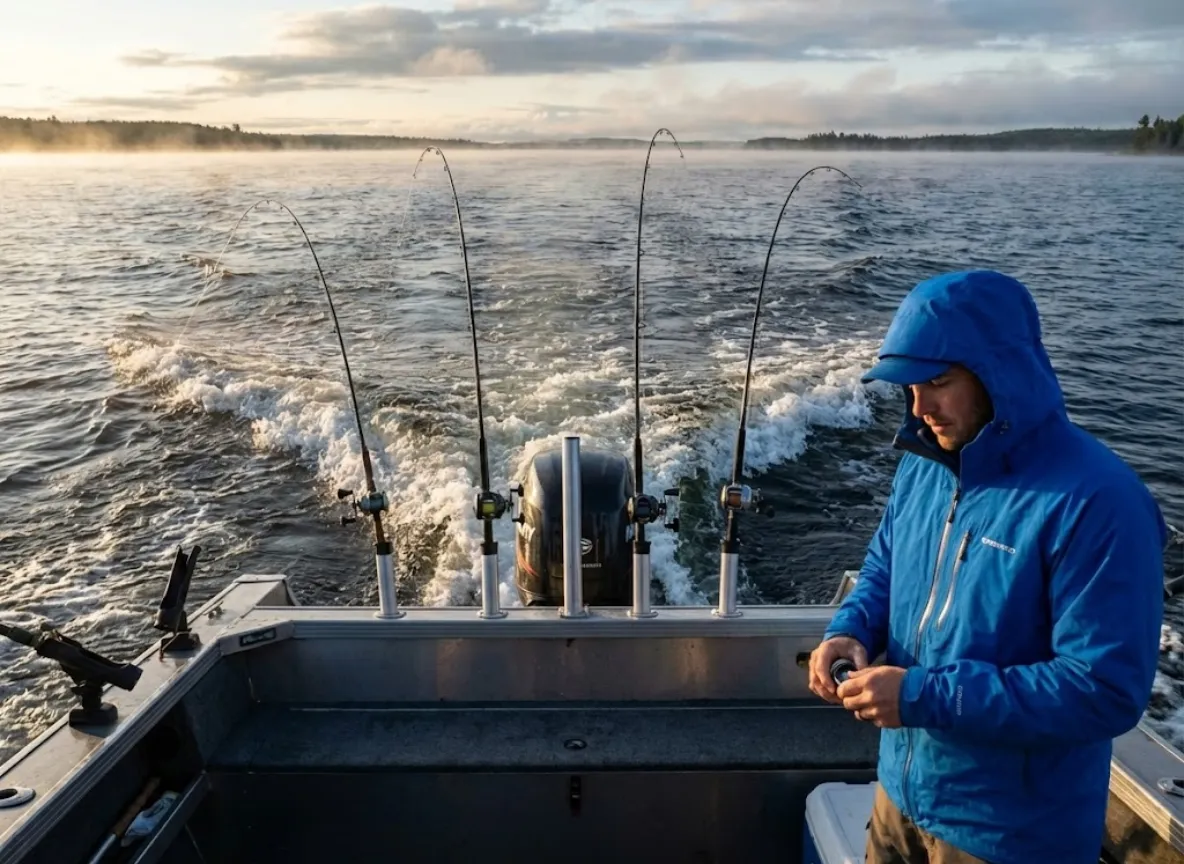
The rod tip loads under the pressure of the drag, bending into a steady, rhythmic arch. It’s not a fish—not yet. That bend is the result of an invisible wall of water resistance. At 20 feet down, your lure is fighting physics, not just searching for a predator.
Too many anglers treat trolling for freshwater fish as little more than dragging bait behind a moving fishing boat, hoping a hungry predator fish intersects with their line. But out here on the open water, hope is not a strategy. Precision trolling is a complex equation of fluid dynamics, vector analysis, and biological modeling. To catch fish consistently in the vast, featureless expanse of a freshwater lake, you must trade hope for calculation. You have to stop fishing and start engineering.
Here is how you turn theoretical knowledge into a precise tactical plan that covers the water column to target freshwater species ranging from walleye and lake trout to muskellunge.
What Are the Fundamental Physics of Precision Trolling?

Before we talk about lures, we have to talk about the invisible forces acting on them. Understanding why a trolled bait behaves the way it does is the only way to troubleshoot when the bite goes cold.
Why Does Line Diameter Matter More Than Lure Selection?
If you want to reach the depths, you might assume you need a lure with a bigger plastic lip. In reality, the diameter of your fishing line is the single most significant variable in depth attainment. It often overshadows the design of the lure itself.
Thicker lines present greater surface area to the water. This generates increased friction and hydrodynamic lift that forces lures upward, away from your target. To achieve maximum depth efficiency, you must prioritize line profile over raw breaking strength. This is why seasoned captains often use digital calipers to measure their line; the box rating is marketing, but the micrometer doesn’t lie.
Modern superlines (braid) offer diameters equivalent to monofilament one-third their strength. For example, 30lb braid often has the diameter of 8lb mono. This allows crankbaits and spoons to dive 20-30% deeper due to reduced drag. However, switching lines isn’t a simple swap. It requires comparing the diameter physics of braid vs fluorocarbon vs monofilament to understand how each material impacts the dive curve.
This principle is well documented in commercial applications as well. The NOAA Fisheries Trawl Scope Ratio Analysis creates the foundational physics understanding of how drag and line length (scope) interact to determine depth. Whether you are pulling a massive trawl net or a single Shad Rap, the physics of drag remain the same.
Pro-Tip: If you switch from 10lb mono to 10lb braid, your lure will run significantly deeper with the same amount of line out. You must recalibrate your depth charts, or you will spend your day dragging bottom.
How Do Drag and Velocity Create the Depth Paradox?
There is a common misconception that increasing trolling speed always forces a deep diving crankbait deeper because the water pressure on the lip increases. This is false.
As velocity increases, the drag on the fishing line increases proportionally to the square of that velocity. This creates a massive upward lift vector. For most diving lures, the downward force of the lip and the upward lift of the line cancel each other out. This results in a “terminal depth” that remains relatively constant across a wide speed range.
In weighted presentations using trolling sinkers or cannonballs, speed is the enemy of depth. At zero velocity, a weight sinks to the bottom. As you apply throttle, lift increases radically.
Navigational adjustments must account for current. Trolling against a current increases water pressure on the lure, while trolling with the current reduces it. Mastering this equilibrium allows you to manipulate the lure depth by adjusting the thrust on your electric trolling motor or kicker motor to maintain speed over water, rather than just speed over ground.
Understanding these stress factors is crucial not just for catching fish, but for releasing them. The NOAA Fisheries Catch and Release Best Practices discuss the physical forces exerted during retrieval, which directly correlates to the drag physics we manage during the troll.
How Do You Engineer Exact Depth Control?
Once you understand the resistance, you need mechanical solutions to overcome it. We don’t guess at depth; we construct it using specific trolling rigs.
How Does the ’50 Plus 2′ Method Standardize Snap Weights?
The “50 Plus 2” method brings mathematical rigor to the use of snap weights. It removes the guesswork by fixing the leader length variable at exactly 50 feet.
Here is the process: You let out your lure and 50 feet of line. You then attach a 2-ounce snap weight to the line. This creates a predictable depression point in the trolling setup. From there, you deploy the “dropper” line behind the weight to achieve the final target depth. By standardizing the weight (2oz) and the leader (50ft), you can rely on data tables rather than intuition.
This method allows standard deep diving crankbaits to reach depths exceeding 40 feet, eliminating the need for downriggers in many scenarios.
However, be aware that this system is highly speed-sensitive. A variation of just 0.2 mph can alter the depth by several feet. Throttle control is critical. The mathematical validity of analyzing line angles to determine depth is a concept reinforced by this Trea.com Patent – Method to achieve a trolling depth, which highlights the engineering approach to fishing.
What Is the Hydrodynamic Advantage of Lead Core Line?
Sometimes you need a presentation that snakes and contours along the bottom rather than dropping to a specific point. This is where lead core line excels.
Lead core functions as a “distributed weight” system. It creates a gentle catenary curve that allows the line to follow bottom contours naturally, perfect for bottom-bouncing. The line is metered with color changes every 10 yards (30 feet). This allows anglers to communicate depth settings in “colors” (e.g., “5 colors out”) rather than feet.
The standard sink rate for traditional nylon-sheathed lead core is approximately 5 feet of depth per color at 2.0 mph. Unlike a sinker, which creates a sharp “V” angle, the snaking action of lead core adds a lifelike, undulating movement to the lure, whether you are running flutter spoons, plugs, or stickbaits.
Connecting this bulky line to a leader requires specific skills. You must learn how to tie fishing knots specifically for lead core, such as the Willis Knot or the Albright Special, to ensure the connection passes through your trolling rods guides smoothly.
How Do You Architect an Effective Trolling Spread?
Depth is only one dimension. To truly maximize efficiency, you must also conquer the horizontal plane using “Spread Management Engineering” to cover more water.
How Do Planer Boards Expand the Strike Zone?
Planer boards divert the fishing line laterally away from the boat. They carry lures 50 to 150 feet to the side, covering unpressured water that has not been disturbed by your hull or outboard motor.
This lateral spread moves the presentation out of the boat’s “cone of disturbance,” which is essential for targeting spooky fish in clear water or shallow flats. Inline planer boards attach directly to the line and include ballast systems to maintain stability.
Effective use of boards requires strict organization using robust rod holders. You must run your shortest lines on the inside and longest lines on the outside to prevent tangles. Precise navigation is also required. You should be using your fish finder to read structure and steer the boards so they skim the edges of drop-offs, ledges, and humps without snagging.
Why Does the Geometry of a Turn Trigger Strikes?
Trolling in a straight line is rarely the most effective strategy. The geometry of a turn creates speed differentials that trigger predatory instincts.
During a turn, the outside boards travel a longer distance in the same amount of time. This causes the lure action to accelerate and rise in the water column—the “Whip Effect.” Predators following a lure will often strike during this acceleration, interpreting it as baitfish attempting to flee.
Simultaneously, the inside boards travel a shorter distance. Those lures slow down, sink, and often flutter or stall. This mimics a dying minnow, offering an easy meal. Experienced trollers constantly execute “S” turns to ensure the lures are never moving at a static speed, utilizing speed manipulation to induce bites.
What Are the Specific Trolling Algorithms for Key Species?
We have the physics and the delivery system. Now we must tune the presentation to the biological algorithms of the target freshwater species.
How Do Speed and Temperature Dictate Walleye Presentations?
Walleye are notoriously speed-sensitive. In cold water (below 50°F), slow trolling at 0.8–1.5 mph is mandatory to match their suppressed metabolic rate. This is the domain of worm harnesses tipped with nightcrawlers or leeches. As water warms above 65°F, speeds should increase to 1.8–2.5 mph to trigger reaction strikes using aggressive crankbaits or spinner rigs.
Walleye eyes are adapted for low light, leading them to suspend over deep basins. Lures must be placed precise distances above marked fish, as they feed upward. Mastering these walleye fishing 101 speed controls is often the difference between a loaded livewell and an empty one.
Precision depth control using snap weights is essential here. Missing the depth by just two feet below the fish often results in zero catch.
What Tactics Are Required for High-Speed Musky Trolling?
While Walleye demand finesse, summer Musky (and large Northern Pike) trolling is a study in violence. It often utilizes speeds of 4.0 to 6.0 mph (and up to 10 mph) to trigger pure reaction strikes.
At these speeds, the fish does not have time to examine the lure. The biological imperative is to attack the fleeing object or lose the energy opportunity. “Short line” trolling is a dominant tactic here. This involves placing soft plastic swimbaits or large plugs just 10 to 20 feet behind the boat, directly in the chaotic turbulence of the prop wash.
Contrary to wary species, Muskellunge are often attracted to the prop wash, viewing the disturbance as a baitfish school. You must adapt your how to catch musky strategies to include heavy gear. Stiff action rods must handle the immense drag, and leaders must be wire or heavy fluorocarbon.
How Does Ethical Stewardship Intersect with Advanced Technology?
The ability to reach fish at various depths brings with it a responsibility to ensure their survival upon release, a core tenet of conservation.
How Can Anglers Mitigate Barotrauma in Deep Water?
As trolling technology allows access to deeper fish (30ft+), the risk of barotrauma in fish increases significantly. This is rapid gas expansion in the swim bladder caused by the pressure change.
Physoclistous fish (like Walleye, Smallmouth Bass, Striped Bass, and Perch) cannot burp gas. Symptoms of trauma include bulging eyes, stomach eversion, and an inability to submerge. The modern angler knows that if you have the technology to catch them deep, you must have the technology to release them safely.
Venting (puncturing the bladder with a needle) is outdated and risky. The gold standard is now the use of descending devices, such as weighted clips, to return fish to depth for recompression. According to NOAA Fisheries Rockfish Barotrauma and Recompression, descending devices are scientifically proven to increase survival rates.
Pro-Tip: If you are marking fish deeper than 30 feet and intend to release them, catch one or two for the table and then move shallower. Constant catch-and-release in deep water often results in delayed mortality, regardless of your release method.
Final Calculations
Precision trolling is a physics problem: Diameter drives depth, and drag dictates the curve. Systematic depth control, whether via the 50+2 method or lead core line, replaces guessing with repeatability. Spread geometry utilizes the “Cone of Silence” and turn dynamics to trigger strikes from wary fish.
But remember, advanced capability demands advanced ethics. Utilizing descending devices is non-negotiable for deep-water conservation.
Master the variables, document your data, and turn every trip into a calculated operation. Share your most successful trolling speed and depth combinations in the comments to help build our community database.
FAQ – Frequently Asked Questions
What is the best speed for trolling freshwater?
There is no single best speed; it depends entirely on the freshwater species and water temperature. For example, 1.0 mph is common for cold-water Walleye, while 3.0 mph or higher is standard for Salmon and Lake Trout. Always measure speed over water (SOW) rather than speed over ground (SOG) to account for current.
Do I really need a line counter reel for trolling?
Yes. For precision trolling, line-counter reels are essential to replicate the exact amount of fishing line out that produced a bite. Without them, you are guessing at depth, making it impossible to establish a repeatable pattern.
How deep does lead core line dive?
Standard lead core line sinks approximately 5 feet for every color (30 feet) of line deployed at 2.0 mph. This rate varies with speed; slower speeds allow it to sink deeper, while faster speeds lift it due to drag.
Can I troll with regular spinning gear?
Yes, for light applications like flat-lining shallow floating crankbaits for Crappie or shallow Walleye. However, spinning rods generally lack the line capacity and drag systems necessary for heavy lead core or planer boards. For serious trolling, baitcasting reels on dedicated rods are superior.
Risk Disclaimer: Fishing, boating, and all related outdoor activities involve inherent risks that can lead to injury. The information provided on Master Fishing Mag is for educational and informational purposes only. While we strive for accuracy, the information, techniques, and advice on gear and safety are not a substitute for your own best judgment, local knowledge, and adherence to official regulations. Fishing regulations, including seasons, size limits, and species restrictions, change frequently and vary by location. Always consult the latest official regulations from your local fish and wildlife agency before heading out. Proper handling of hooks, knives, and other sharp equipment is essential for safety. Furthermore, be aware of local fish consumption advisories. By using this website, you agree that you are solely responsible for your own safety and for complying with all applicable laws. Any reliance you place on our content is strictly at your own risk. Master Fishing Mag and its authors will not be held liable for any injury, damage, or loss sustained in connection with the use of the information herein.
Affiliate Disclosure: We are a participant in the Amazon Services LLC Associates Program, an affiliate advertising program designed to provide a means for us to earn advertising fees by advertising and linking to Amazon.com. As an Amazon Associate, we earn from qualifying purchases. We also participate in other affiliate programs and may receive a commission on products purchased through our links, at no extra cost to you. Additional terms are found in the terms of service.