In this article
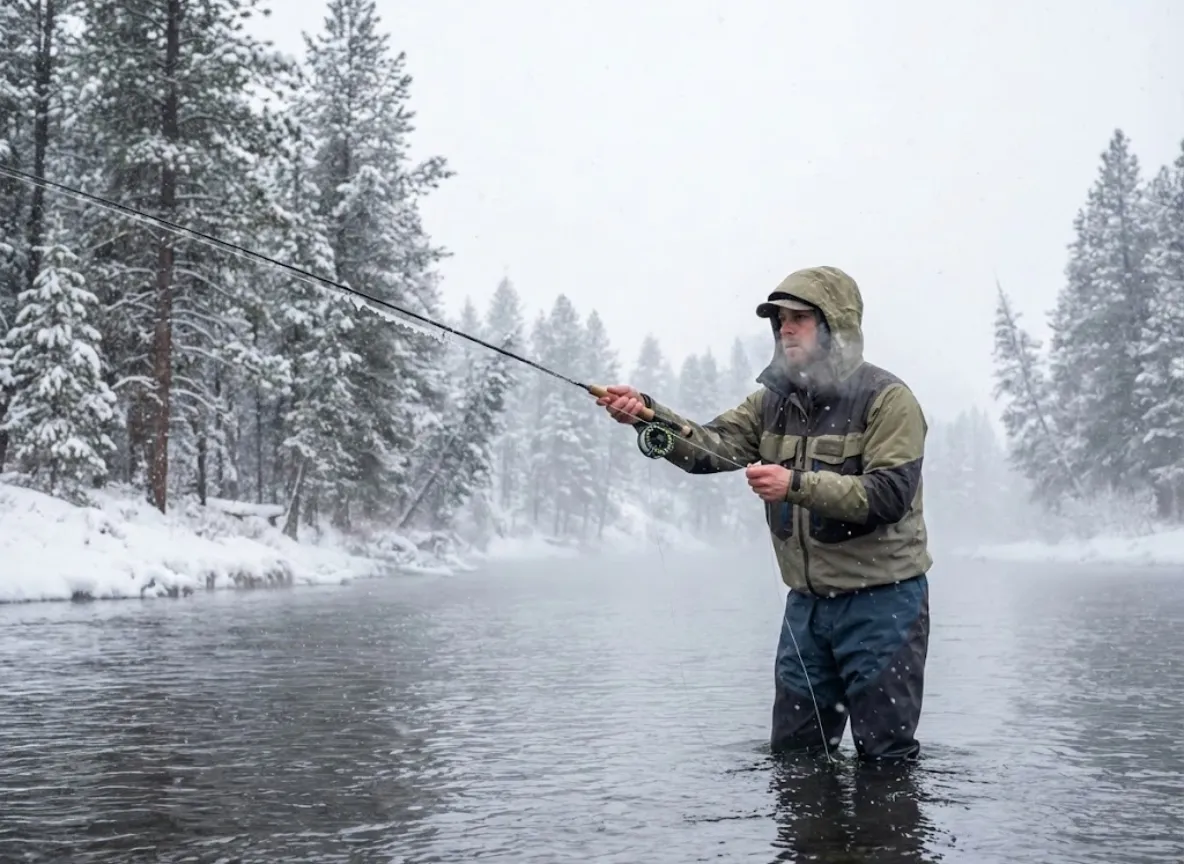
The wind on the river cuts through standard fleece like a razor, and the water temperature hovers at a paralyzing 38°F. Your rod guides are choked with ice, your fingers are stiffening, and the river looks lifeless. This is not the romanticized dry fly fishing of summer evenings; this is winter trout fishing—a discipline governed by the ruthless laws of thermodynamics.
As someone who has spent decades standing in freezing tailwaters and icy freestones like the Big Thompson River or the Bitterroot, I can tell you that winter offers the year’s most technical fishing and profound solitude. Whether you are cold weather fly fishing for river trout or refining your spin fishing techniques on a local pond, success doesn’t require luck. It requires a fundamental shift from aggressive summer tactics to a system of biological empathy and thermal preservation. We are going to break down exactly how to stay warm, where the winter trout hide, and the specific presentations required to trigger a strike when the water is near freezing.
Why do trout behave differently in cold water?

How does the Q10 coefficient dictate feeding behavior?
The Q10 temperature coefficient dictates that metabolic rates decrease 2- to 3-fold for every 10°C (18°F) drop in temperature, forcing trout to maximize caloric intake while expending near-zero energy.
Trout are obligate poikilotherms, meaning their internal body temperature mirrors the surrounding water temperature with zero lag time. When the water drops, trout metabolism hits the brakes. Digestion slows dramatically; a meal that takes 4 hours to process in summer may take 12 to 24 hours in winter conditions. Because of this lethargy, the frequency of winter feeding windows reduces significantly, often condensing activity to the warmest part of the day, typically the 10 am – 3 pm window.
This biological reality means the “Caloric ROI” (Return on Investment) becomes the primary decision driver for the fish. They will not chase prey that costs more energy to capture than it provides in sustenance. Consequently, the “Chase Radius” shrinks to inches. A fly drifting a foot away from a trout’s nose might be ignored simply because the energy conservation cost is too high. You can read more about metabolic rates and digestive processes in fish to understand the science behind this behavior.
To catch these lethargic fish, you must understand their specific constraints. Review these strategic rainbow trout facts to see how different species handle the cold. Understanding this is critical for drift calibration; “covering water” quickly is a failed strategy, while thoroughly dissecting small grids is effective.
Why is the 45-degree water temperature threshold critical?
Anglers and biologists observe a distinct behavioral “soft threshold” at approximately 45°F (7°C), below which trout enter a state of metabolic depression.
Below this 45°F mark, fish hug the bottom and require extremely precise, slow presentations. However, once the temperature ticks above this number, enzymatic activity increases enough to allow fish to move into slightly faster currents and expand their feeding radius. This is why tailwaters—rivers fed by dam releases like the White River, South Holston River, Green River, Missouri River, or the legendary San Juan River—are critical; they often maintain artificial temperatures above this threshold year-round due to reservoir insulation.
Temperature trends are often more important than absolute values. A warming trend of just 2-3 degrees can trigger aggressive feeding even if the water is still cold. Conversely, a dropping temperature, often associated with cold fronts and shifting barometric pressure, will shut down feeding almost instantly. Checking the fishing barometric pressure can help you predict these shut-down phases. For a technical analysis of species limits, you can review the data on thermal tolerance among redband trout populations.
How can anglers stay warm and functional in freezing conditions?
What is the most effective layering system for active fishing?
The most effective system relies on a strict “No Cotton” rule, utilizing hydrophobic synthetics or wool to move moisture away from the skin while trapping dead air for insulation.
You must adhere strictly to the “No Cotton” rule; cellulose fibers absorb moisture and hold it against the skin, accelerating heat loss. Start with a hydrophobic base layer (Merino wool or Capilene) to wick sweat away from the body during the hike in. Utilize a high-loft mid-layer, such as fleece or down, to trap “dead air,” which acts as your primary thermal insulator. Finish with a windproof and waterproof shell to prevent convective cooling from winter winds.
When selecting gear, consider that best fly fishing waders for winter pose a choice between modern breathable waders with heavy layering or classic neoprene waders. While neoprene offers inherent insulation, breathable options allow for better moisture management. Regardless of choice, the “One Sock Rule” is essential. It feels counter-intuitive, but wearing multiple socks compresses the foot inside the boot, cutting off blood flow and causing freezing toes.
Always manage sweat aggressively. If you overheat while walking to fishing spots on the Musconetcong or Big Flat Brook, vent your layers immediately. Review these guidelines on preventing hypothermia and cold water immersion before heading out.
How do you maintain manual dexterity for knot tying?
The “Three-Tier Hand System” balances warmth with the fine motor skills needed for #18-24 flies by utilizing nitrile liners, wool fingerless gloves, and radial heating.
Tier 1: Wear thin 9-mil Nitrile exam gloves against the skin. This creates a total vapor barrier, keeping hands dry during fish release.
Tier 2: Layer wool fingerless gloves over the nitrile. This provides insulation while leaving fingertips free for line management.
Tier 3: Utilize “Radial Artery Heating” by placing chemical hand warmers on the inner wrist, secured by the glove cuff, rather than the palm. This warms the blood before it reaches the fingers.
Pro-Tip: Keep a dedicated microfiber towel tucked inside the top of your waders. After releasing a fish or handling wet line, dry your hands instantly. Wet skin loses heat 25 times faster than dry skin.
Maintaining dexterity is not just about comfort; it is necessary for tying complex connections with lightening tippet. If your hands are frozen, navigating the angler’s knot matrix becomes impossible. Always prioritize wading safety; read the Iowa DNR’s advice on how to stay safe on the water.
Where do trout hold when the water drops below 40 degrees?
How do you identify productive “frog water” and soft seams?
Winter trout migrate to deep, slow runs and pools known as “frog water” where current velocity is minimal, allowing them to hold position without expending energy.
Apply the “Walking Speed Rule” when reading winter water. Look for surface bubbles or foam moving at a slow, leisurely strolling pace (roughly walking speed current). Focus on the “Belly” of the pool—the deepest center section, often 3-5 ft depth—and the “winter seam” where fast current shears against dead water. In winter, oxygen saturation is naturally high due to cold water, so trout do not need turbulent water to breathe; they prioritize energy conservation found in Laminar Flow.
Watch the “tailouts” of the pool during midday warming trends on rivers like the Lower Sacramento or Blackfoot River. Active fish will often slide back into shallower water here to intercept drifting midges, chironomids, or Blue Winged Olives (BWOs). However, avoid water that is completely stagnant. There must be enough conveyance to bring food to the fish. To improve your ability to spot these hydraulic features, consult the field guide to reading a river. For a technical understanding of flow, you can review the fundamental hydraulics of cross sections.
What tactical adjustments are required to catch lethargic trout?
How does the “Low and Slow” nymphing approach work?
This approach focuses on the “Strike Zone,” a narrow band of water 6 to 12 inches off the bottom, where flies must drift naturally to tempt stationary fish.
The “Strike Zone” is unforgiving in winter; flies drifting above this narrow channel are usually ignored. Use a “tandem-nymph rig” (or double-nymph rig) with a heavy anchor fly—such as a Pat’s Rubber Legs, Copper John, Girdlebugs, or a San Juan Worm—to achieve depth. Follow this with a small trailer fly like a Zebra Midge, Pheasant Tail, Hare’s Ear, Griffith’s Gnat, or egg patterns to match the available food.
You must embrace downsizing flies and lightening tippet. Switch to fluorocarbon tippet in 5x tippet, 6x tippet, or even 7x tippet. Its density helps sink flies, and its invisibility is crucial in clear, low winter water.
Pro-Tip: If you aren’t snagging the bottom occasionally, you aren’t fishing deep enough. Add split shot or tungsten putty until you feel the tick of the riverbed, then adjust slightly upward.
Mastering tightline techniques or using strike indicators (like an Air-Lock or yarn indicators) is essential to detect “hesitation strikes.” Execute a pure dead drift or suspended drift; any unnatural drag signals “fake” to a fish that has all day to inspect its food. If you are new to these mechanics, review the beginner’s guide to fly fishing to ensure your rod setup is correct.
Can spin anglers effectively target winter trout?
Yes, by abandoning fast-moving spinners in favor of the “Float-n-Fly” technique or “Deadsticking” soft plastics to mimic the suspension of natural prey.
Fast-moving lures like standard spinners often move too quickly for winter trout to chase. Instead, adopt the “Float-n-Fly” technique. Suspend a tiny 1/16 oz hair jig or Trout Magnet under a sensitive bobber. Cast into deep pools and allow the wave action to impart a subtle “shiver” to the jig without reeling it in.
Alternatively, utilize “Deadsticking” with soft plastics or Power Bait (where legal). Cast upstream and let the lure drift near the bottom like a nymph. For predatory Brown Trout on the Taylor River or Oak Creek, use suspending jerkbaits (Rapala Countdown) or Kastmaster spoons with extreme pauses (5-10 seconds) between twitches. Use light line, typically 4lb test. The key is suspension; holding a bait motionless triggers an opportunistic response. For more lure options, check the trout lure matrix.
Conclusion
Winter fishing is a game of precision and patience. The Q10 coefficient dictates the biological rules: metabolism slows, the chase radius shrinks, and the feed window condenses. Your success depends on respecting the 45°F threshold and seeking out the stable temperatures of tailwaters or deep “frog water” pools.
Equally important is your system protocol for comfort. You cannot focus on a microscopic strike if you are shivering. Adhere to the “No Cotton” rule, use the three-tier hand system, and prioritize the bottom six inches of the water column. Next time the temperature drops, don’t stow your fishing rod—layer up, grab your wading staff, and head to the river. Whether chasing winter stoneflies or midges, the river belongs to the all-season angler. Share your favorite winter fly pattern or success story in the comments below.
FAQ – Frequently Asked Questions
What is the best time of day to fish for trout in winter?
The prime window is typically between 11:00 AM and 3:00 PM when the sun is highest. This slight warming trend often triggers midge hatches and activates lethargic fish. You can sleep in and still catch the best action.
How do I stop my rod guides from freezing?
Icing guides is a common struggle. Apply a de-icing paste like Stanley’s Ice-Off or simple Chapstick to the guides before fishing. If ice forms, dip the rod tip into the river water to melt it safely; do not pick it off with fingers, as this can damage the ceramic inserts.
What size tippet should I use for winter trout?
Downsize to 5x, 6x, or even 7x Fluorocarbon. Winter waters are often low and clear, making standard line visible, and thinner diameter helps small flies sink faster.
Is it safe to handle fish in freezing air temperatures?
No, lifting a fish out of water when air temps are below 20°F can instantly freeze their gill filaments, causing necrosis. Keep the fish submerged in the net at all times during catch-and-release.
Risk Disclaimer: Fishing, boating, and all related outdoor activities involve inherent risks that can lead to injury. The information provided on Master Fishing Mag is for educational and informational purposes only. While we strive for accuracy, the information, techniques, and advice on gear and safety are not a substitute for your own best judgment, local knowledge, and adherence to official regulations. Fishing regulations, including seasons, size limits, and species restrictions, change frequently and vary by location. Always consult the latest official regulations from your local fish and wildlife agency before heading out. Proper handling of hooks, knives, and other sharp equipment is essential for safety. Furthermore, be aware of local fish consumption advisories. By using this website, you agree that you are solely responsible for your own safety and for complying with all applicable laws. Any reliance you place on our content is strictly at your own risk. Master Fishing Mag and its authors will not be held liable for any injury, damage, or loss sustained in connection with the use of the information herein.
Affiliate Disclosure: We are a participant in the Amazon Services LLC Associates Program, an affiliate advertising program designed to provide a means for us to earn advertising fees by advertising and linking to Amazon.com. As an Amazon Associate, we earn from qualifying purchases. We also participate in other affiliate programs and may receive a commission on products purchased through our links, at no extra cost to you. Additional terms are found in the terms of service.