
In this article
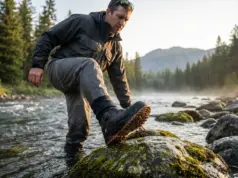
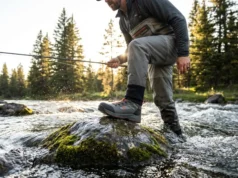
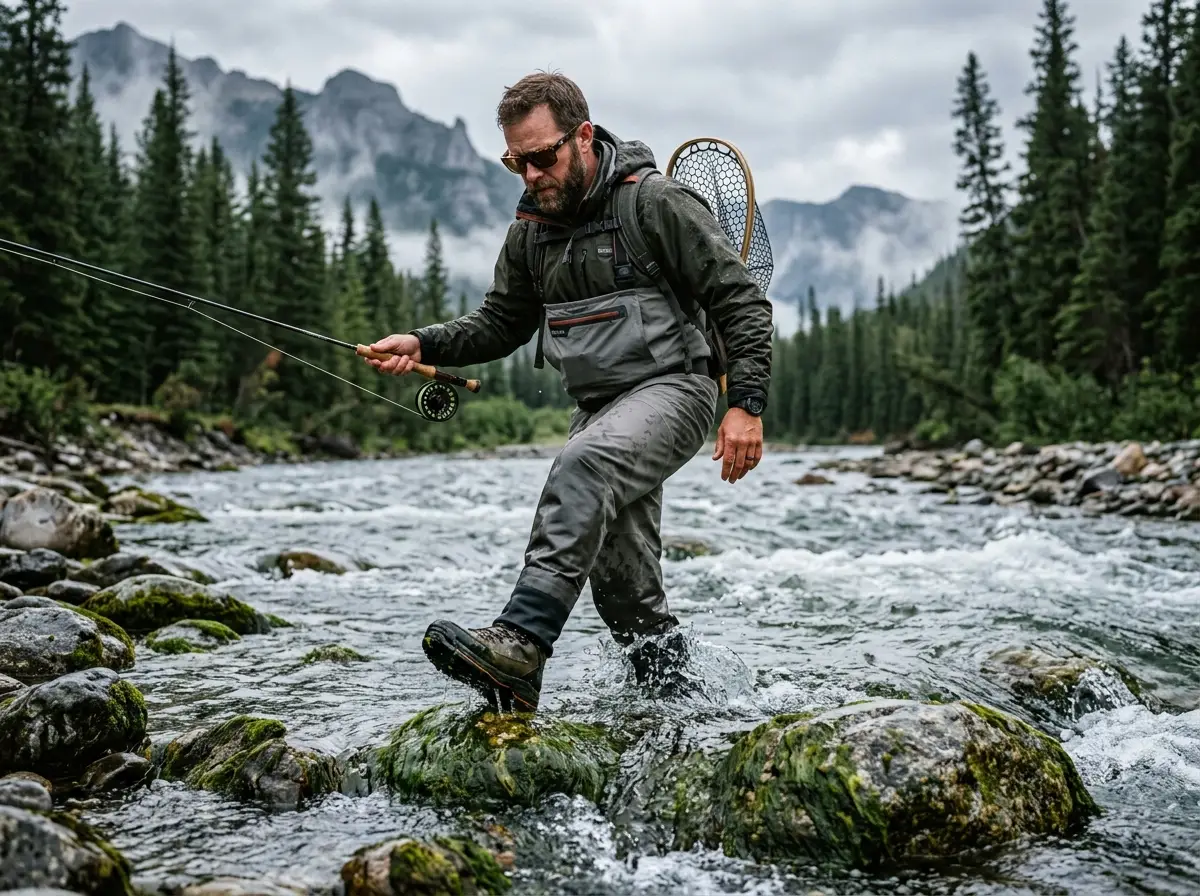
You’re mid-stream on the Madison, thirty feet from shore, and you feel it before you understand it — a slow, lateral skid across a boulder the color of graphite. Your left boot goes first. You pinwheel and catch yourself on a wading staff just before your knees hit the water. The rock wasn’t particularly big. It wasn’t particularly steep. It was just coated in a thin film of periphyton — the same invisible slime that’s ended hundreds of fishing days and a number of trips that went far worse. What was on the bottom of your boot mattered more than your balance, your wading staff, or your twenty years of river experience.
That moment clarifies the question fast. Felt vs rubber sole wading boots is not a brand debate or a preference discussion. It’s a physics problem, an ecology problem, and increasingly a legal one. This article breaks all three down from the ground up — so the next time you’re standing at the put-in picking boots, you’re making an informed choice instead of a lucky one.
⚡ Quick Answer: Felt soles grip wet, biofilm-covered rock better than bare rubber — that’s a fact. But felt also traps 100% of aquatic invasive species spores in controlled testing and is banned in six U.S. states plus Yellowstone. For most modern anglers, studded Vibram rubber or aluminum bars close the traction gap on all but the most technical freestone rivers, without the ecological and metabolic baggage felt carries. Match your sole to your specific substrate before you buy.
| Wading Boot Sole Comparison Matrix | ||||
|---|---|---|---|---|
| Sole Type | Wet Rock Grip | Dry Land Grip | Durability | AIS Risk |
| Bare Felt | Excellent | Poor | Low | Extreme |
| Bare Rubber | Moderate | Excellent | High | Low |
| Studded Rubber | Good | Moderate | High | Low |
| Aluminum Bars | Superior | Poor | Moderate | Low |
| Studded Felt | Maximum | Poor | Low | Extreme |
The Physics of Traction: Why Your Boot Sole Is a Friction Problem
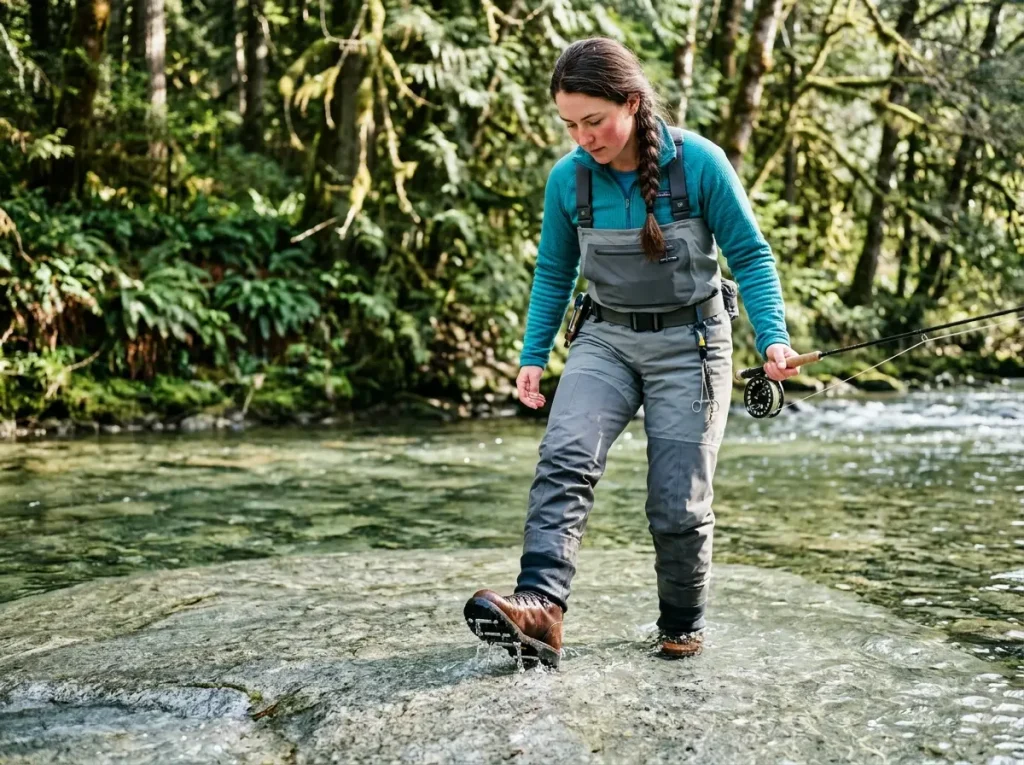
Here’s where most people get it wrong: they think grip is about the material. It’s actually about the surface between the boot and the rock — specifically, what’s living on that rock.
The beds of productive trout rivers are coated in periphyton: algae, bacteria, and biological detritus that functions as a low-friction lubricant. Whether your sole grips or slides comes down to one thing — whether it can push through that slime layer and make contact with the mineral surface underneath. Felt gets through. Most rubber doesn’t.
If you want to understand how hydraulic drag vectors work in moving water, the takeaway for wading is this: in high-gradient streams, the current pushes against your legs constantly, and the moment your outsole loses contact with the rock underneath, the math turns against you fast. Civil engineers measure stream bed turbulence using what’s called the roughness coefficient — when that value climbs past 0.05 on boulder-choked freestone rivers, as quantified in USACE river channel analysis, the drag forces on a wading angler become genuinely unpredictable. One slick foot placement cascades into a full swim.
In a side-by-side test on the same granite slab in 42°F water, felt gave four confident steps before testing its limit. Bare rubber gave one — and it slid.
Felt: Fiber Penetration and the Mechanical Grip Advantage
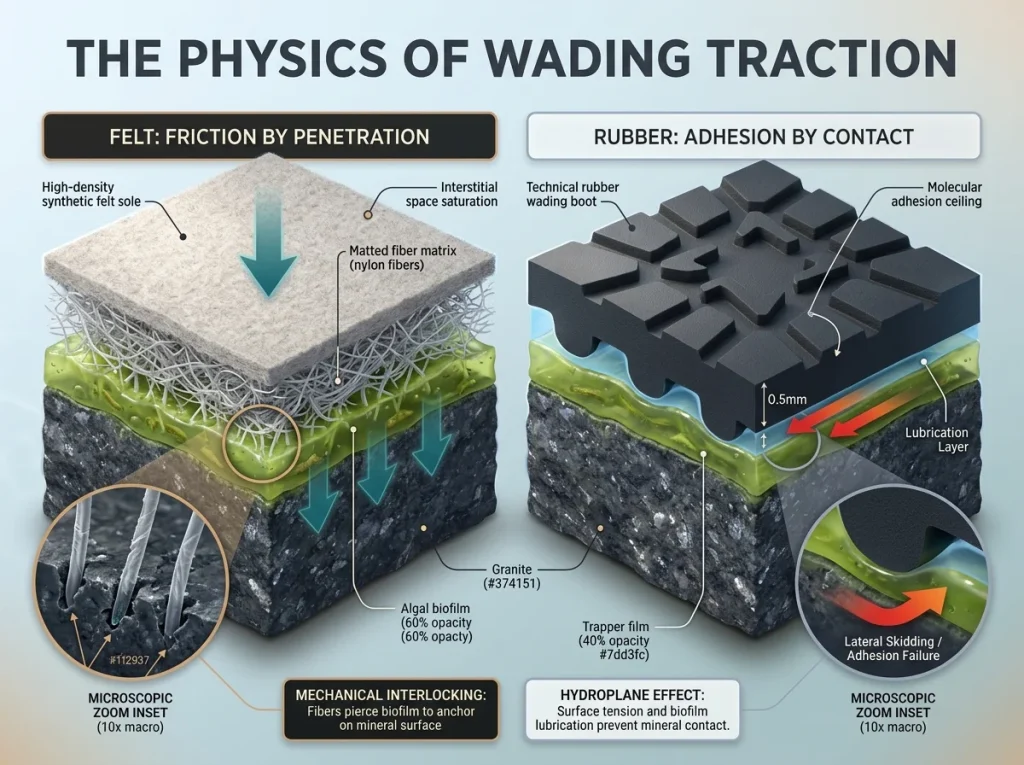
Felt soles work through mechanical interlocking. The matted fibers — compressed under load — force their way through the algal layer and contact the mineral surface beneath. This creates thousands of grip points simultaneously. It’s why felt feels “sticky” rather than grippy. You’re not fighting for traction. You’re not consciously thinking about each step. You just don’t slide.
The problem starts the moment you step off the bank. Felt degrades on gravel, mud, and dry trail because the fibers lose their penetration advantage on soft or yielding surfaces. A felt sole that’s crossed a half-mile of gravel parking lot has already shed 20–30% of its effective fiber density before hitting the water. You’re fishing on a degraded product and don’t know it. I’ve weighed boots before and after a 3-mile gravel approach — the felt looks intact, but the grip in the first pool tells the real story.
And then there’s the wet weight vs dry weight problem. Felt absorbs up to 2–3 times its dry weight in water, trapped in the interstitial spaces between fibers throughout the day. The saturation is essentially constant after first submersion. Manufacturers list dry weight because it’s the favorable number. Nobody lists saturated weight. That gap matters — and we’ll get to it in the metabolic cost section.
Pro Tip: Before your next long day in felt, weigh your boots dry, wade for two hours, then weigh them again. The delta will recalibrate your assumptions about what you’re actually carrying.
Rubber: Adhesion Science and the Hydroplane Ceiling
Three rubber compounds dominate the market right now: Vibram Idrogrip (soft in cold water, maximum surface area contact on wet rock), Vibram Megagrip (better durability on trails, slightly lower wet-rock adhesion), and Michelin Outdoor Extreme (aggressive lug geometry, used on the Orvis Pro boot). None of them solve the same problem felt does.
The ceiling for all bare rubber performance is the hydroplane effect: water plus biofilm creates a lubrication layer sitting between the rubber and the rock, preventing the molecular adhesion you’d get on clean, dry stone. The rubber never truly touches the rock. It touches the slime on the rock. This isn’t a flaw in rubber design that engineers haven’t solved yet — it’s physics. The layer is there, the rubber can’t push through it, and no amount of compound softness changes that fundamental contact problem.
Soft rubber compounds like Idrogrip narrow this gap by staying flexible in cold water, which maximizes the contact surface area. But flexibility alone can’t penetrate a biofilm. If your rubber boots are rated for traction on biofilm-covered rock, verify the compound is Idrogrip or equivalent — rubber that hardens in 40°F water effectively becomes a plastic sled.
Aluminum: The Current Traction Pinnacle
Aluminum is softer than quartz. It’s softer than granite. That’s the whole point.
When aluminum bars or cleats press into river rock, they physically deform against the mineral surface — a mechanical lock that neither felt nor rubber can replicate. This is aluminum bar technology at its simplest and most effective. The Patagonia Danner Foot Tractor’s aluminum bar design maintains the widest contact edge on large, slick boulders. Simms Alumibite hex and star cleats add bite points to rubber soles without sacrificing the rubber’s secondary stabilization role.
There’s an honest anti-sell here. Aluminum bars produce significant acoustic disturbance in shallow, clear water — they’re loud on rock, and fish in skinny water notice. They’re also genuinely hazardous on smooth, dry surfaces: tile, wooden boat decks, vehicle running boards. One wrong step in the parking lot and you’re on your way down. Know the context before you strap aluminum bars under your feet.
The Ecological Cost: Felt as an AIS Vector
The structural properties that make felt grip rock are identical to the properties that make it a pathogen incubator. You cannot engineer a felt sole that grips well and resists aquatic invasive species capture. The porosity IS the mechanism. They’re the same thing.
Felt’s interstitial fiber matrix is an ideal biological reservoir. The spaces are large enough to harbor pathogens but small enough to protect them from desiccation and mechanical removal. The controlled study on felt sole spore trap rates is worth reading in full — the numbers aren’t subtle.
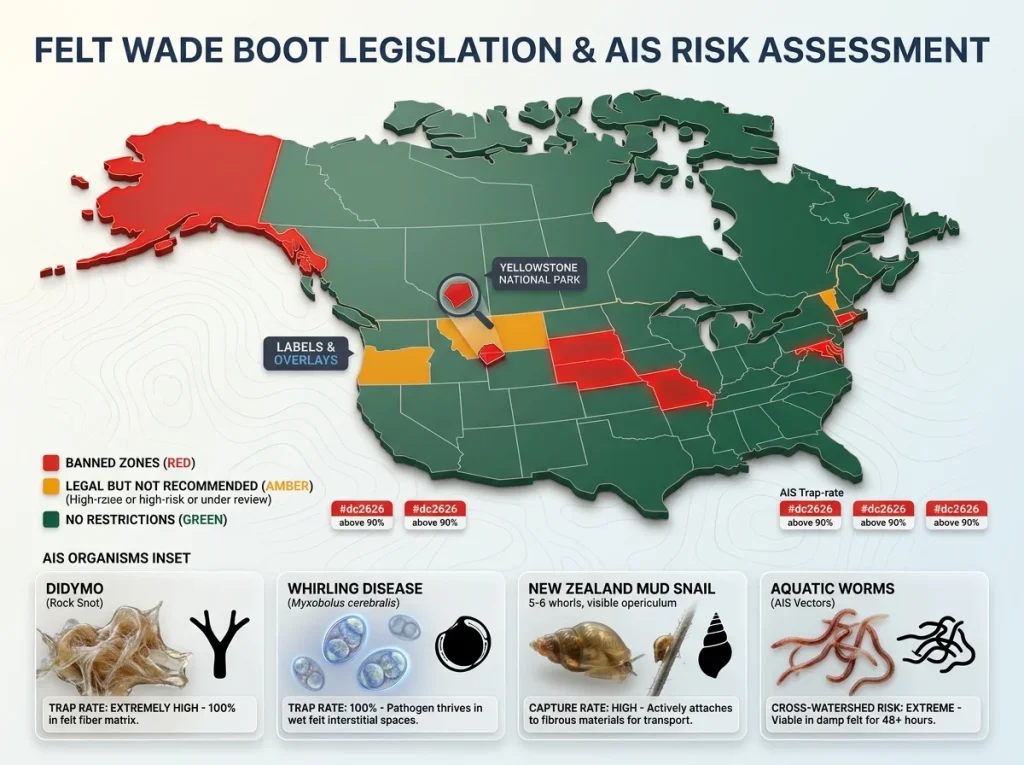
Didymo (Didymosphenia geminata, also called rock snot) blankets riverbeds, alters oxygen exchange, and destroys invertebrate food webs. Trap rate in felt: extremely high. Myxobolus cerebralis, the pathogen behind whirling disease, trapped at 100% in felt exposure tests. Smooth rubber trapped effectively zero. After 36 hours of drying, felt still contained viable live cells. Rubber was completely clear at the same timepoint.
New Zealand mud snails (Potamopyrgus antipodarum) actively cling to felt fibers — not an accidental capture but a behavioral one. They’re looking for a ride, and felt gives them one.
This is how anglers become vectors for aquatic invasive species — not through carelessness, but through equipment design. The felt sole does exactly what it’s supposed to do, in exactly the wrong way.
Legislative Landscape: Where Felt Is Already Illegal
As of 2025, state-by-state bans on felt include Alaska, Maryland, Missouri, Nebraska, Rhode Island, and South Dakota statewide, plus Yellowstone National Park across all waters. Missouri went further — the ban covers “all porous fibrous materials,” which closes loopholes for felt-adjacent materials manufacturers might use to dodge the label.
The legislative trend is one-directional. No state that has banned felt has reversed the decision. Additional states are under review.
In states where felt is still legal — Montana, Oregon, most of the mountain West — fisheries biologists still recommend rubber. The law permits it. The science doesn’t endorse it.
Being in a “legal felt” state doesn’t mean the risk is zero. It means the regulatory infrastructure hasn’t caught up to the data yet.
Decontamination: The Protocol That Almost Works
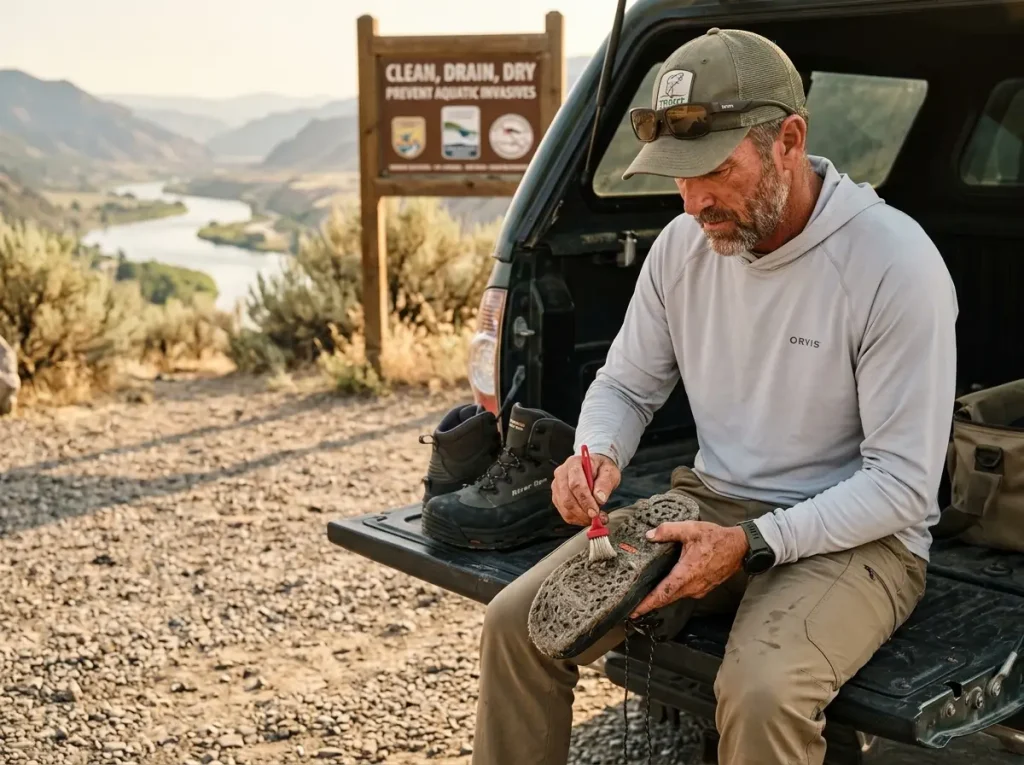
“Clean, Drain, Dry” is the EPA and state DNR standard: remove visible debris at the water’s edge, drain standing water, dry completely. For felt, “dry completely” means 48–72 hours in low humidity. This is not a rinse situation.
For complete decontamination: 140°F (60°C) hot water soak for 10 minutes handles most AIS. A 10% bleach solution works but degrades boot adhesives over multiple applications. Freezing for 24 hours eliminates Didymo and whirling disease spores without chemistry.
The practical problem: any angler fishing multiple watersheds in a single week cannot safely manage felt-soled boots even with perfect protocol execution. Forty-eight hours minimum drying time between trips. That’s not a field reality for most anglers. I’ve watched guides skip it. Every single one knows exactly why they shouldn’t.
The Metabolic Cost: What Your Boots Weigh When Wet
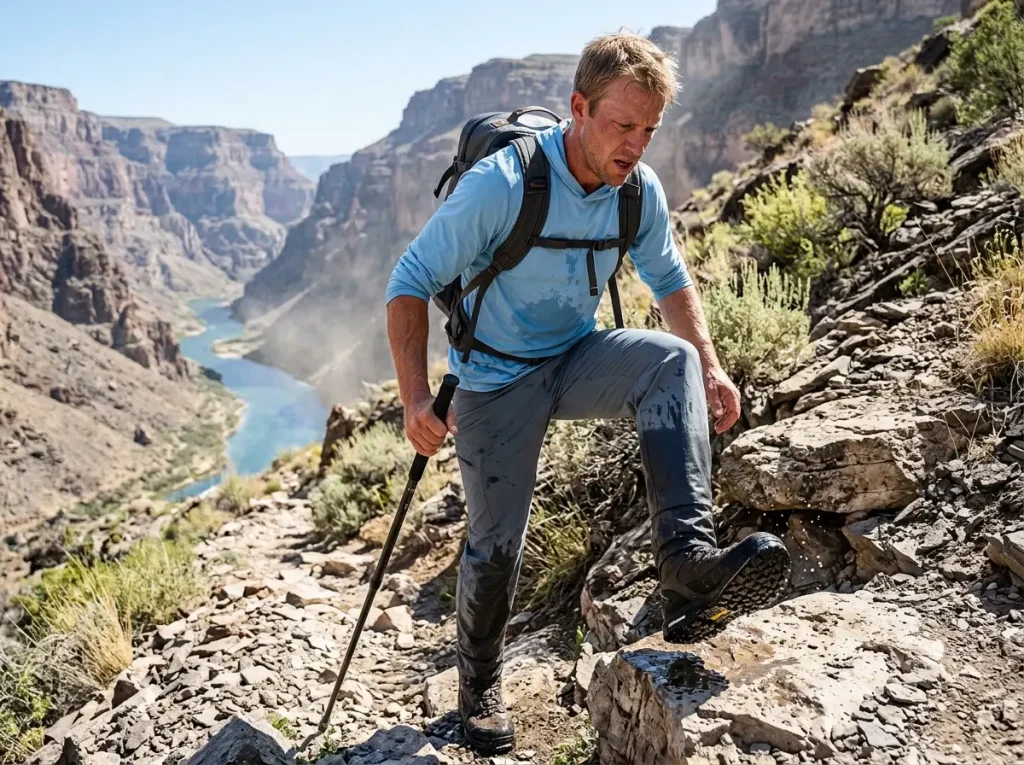
This is the angle nobody covers. It’s also the one that catches up with you on hour seven.
Swing weight — the force required to lift each foot and move it forward through current — is the primary driver of wading fatigue. Felt’s wet weight penalty is not a fixed cost. It’s a compounding one.
Research on physiological effects of boot weight on oxygen consumption shows this clearly: each 1 kg increase in boot weight raises oxygen consumption by 6–8% in men and reduces endurance time by roughly 8%. A pair of boots gaining 500g through felt saturation — a common real-world number — increases the metabolic cost of walking by approximately 3–4%. Over eight hours of wading, that’s the difference between finishing strong and losing coordination in the final hour.
In high-velocity current, the added mass of saturated felt increases torque on the knee and hip joints. Extended exposure to that load is the “tired legs” effect that field guides report consistently in long-day clients. It’s not just fatigue. It compounds error rate. And in technical wading water, errors cost more than time.
How substrate type should drive your boot sole selection starts before you even park the truck. The angler walking 4 miles of gravel trail in felt to reach a remote stretch is arriving with degraded traction AND above-baseline fatigue. That’s the worst-case configuration, and it happens every weekend.
Saturated Weight vs. Dry Weight: The Manufacturer Blind Spot
No manufacturer publishes saturated weight. They publish dry weight because felt is genuinely lightweight dry. The numbers are real and accurate — they’re just incomplete.
Field observation: a mid-weight felt boot rated at 28 oz dry often lands at 42–46 oz after two hours of wading. Rubber boots with woven TPU uppers (like the Simms Access line) consistently measure within 2–3 oz of dry weight after the same exposure. The rubber boot you’re wearing at hour one is functionally the same weight as the rubber boot at hour eight. The felt boot is not.
Pro Tip: Rubber or TPU-upper boots designed with hydrophobicity in mind — low “wet pick-up” as Simms calls it — are the correct choice for any full-day wade. The weight stays constant. Your legs will thank you after lunch.
Wading Distance and Fatigue: When the Boot Becomes the Hazard
The metabolic penalty of saturated felt accumulates — it’s not a fixed cost but a compounding one. By hour six or seven of a full wading day, reduced coordination from fatigue is the leading cause of wading accidents in technical water. Not bad luck. Not unfamiliar water. Fatigue.
For hike-in scenarios — two to five miles of approach to reach the stretch — felt attrition on gravel trails means the sole reaching the river has already shed effective fiber density. You arrive with degraded traction AND above-baseline fatigue from the added weight. That’s not a theoretical worst case. That’s a decision anglers make every weekend on the Madison and Delaware.
If your water access requires a real hike, the right sole for the trail is rubber. Studded Vibram from truck to bank, swap to felt at the water’s edge if your Korkers OmniTrax setup allows it. Or commit to studded rubber for the whole day and accept the marginal traction trade-off in exchange for arriving at the river with legs that still work.
Gear Evaluation: Three Boots That Define the Decision
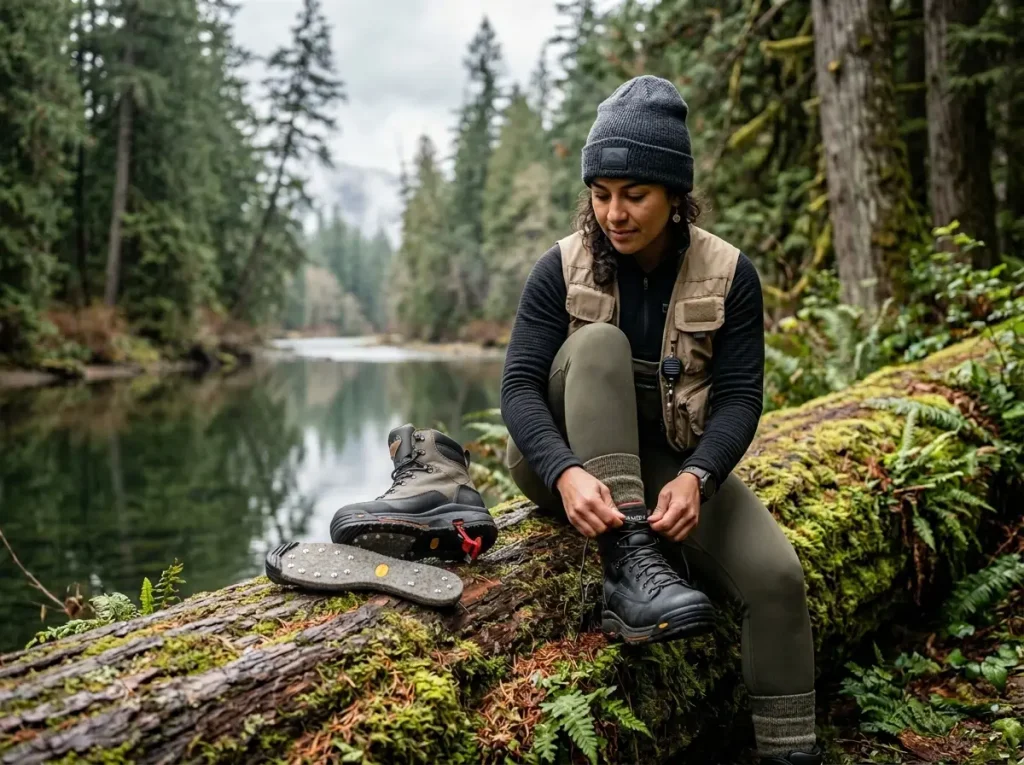
No single boot is optimal across all variables. Our long-term review of lug sole wading boots breaks down the technical performance in detail — here’s how the category-defining models stack up against the variables we’ve laid out.
Simms G3 Guide Boot: The Workhorse With a Weight Problem
The Simms G3 is the industry workhorse for a reason. High-abrasion leather and synthetic construction, reinforced toe cap, rigid midsole that prevents foot fatigue on long days. The Vibram “Traction Lug” technology increases rubber contact surface area by up to 50% — the best rubber-only wet-rock traction in the category.
The honest anti-sell: the G3 is heavy even before saturation. The felt version becomes a genuine metabolic burden after hour four. Traditional laces are a cold-hands problem in sub-40°F conditions — every guide who’s worked the Madison in November knows this, and most have switched to BOA or speed-lace alternatives as a result.
Patagonia x Danner Foot Tractor: Best Grip, Worst Portability
Stitchdown construction means this boot can be recrafted by Danner — exceptional long-term durability for a boot priced accordingly. The aluminum bar version delivers the highest wet-rock traction of any non-felt boot produced. The bars cut through rock snot with consistent mechanical bite.
The honest anti-sell: these are the heaviest boots in the category, dry. More expensive than anything else on the market. The aluminum bars produce significant acoustic disturbance in shallow, clear water — spooking fish in technical presentations is a real operational concern for guides running clear-water summer floats. Hazardous on smooth dry surfaces. Not justified for casual gravel-bottom river fishing.
Korkers River Ops (OmniTrax): Maximum Versatility, Maximum Failure Points
The Korkers OmniTrax interchangeable sole system is the most technically complete answer for anglers fishing multiple hydrology and substrate types. Swap between felt, rubber, and studded soles in the field. Hike to the river in rubber, switch to felt at the water’s edge. Swap back before the trail home. It’s theoretically optimal.
The honest anti-sell: the sole attachment mechanism is a mechanical failure point. In deep silt or high-suction substrate, stepping out of a sole is a documented failure — not a corner case. The BOA lacing tension system fails in the field without a repair kit. Test the sole retention under suction load before trusting it in serious water. Don’t discover this mid-wade.
Pro Tip: If you run OmniTrax in soft-bottomed rivers, pull each sole off and reseat it at the put-in. The retention mechanism needs to be confirmed warm, not discovered cold mid-wade when it lets go.
Substrate-Specific Selection: The Wading Safety Matrix
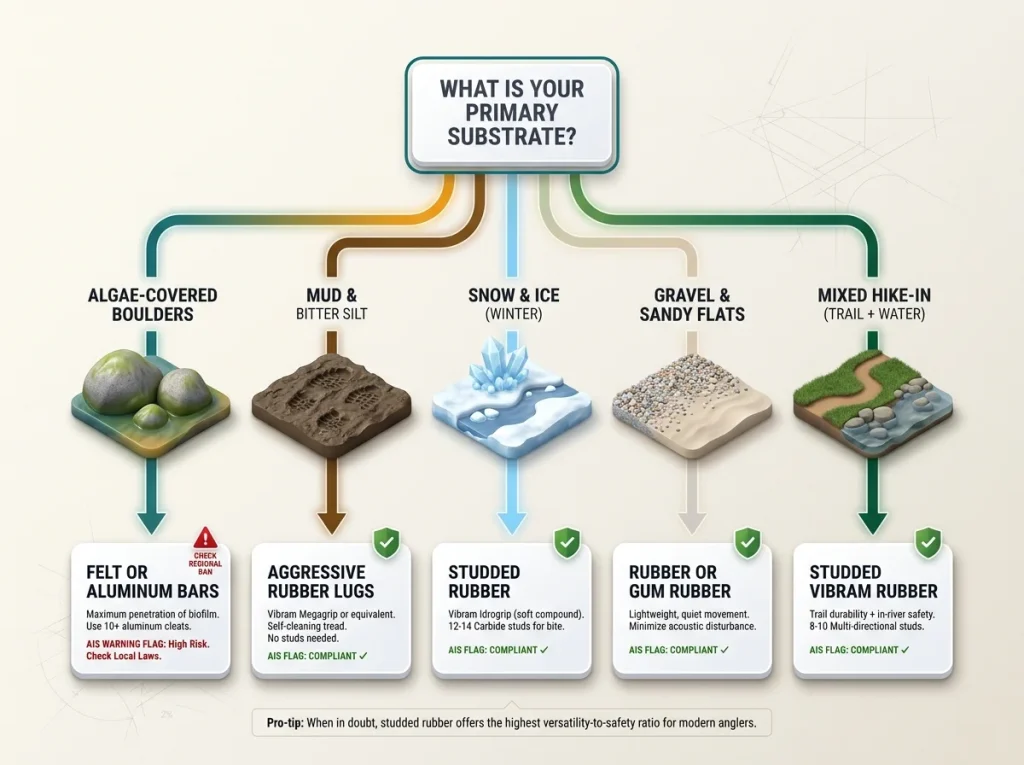
The traction on biofilm gap between felt and rubber is not constant. It varies with substrate, water temperature, biofilm density, and season. Reading river substrate and hydrology before you step in is the pre-wading habit that determines which sole you should have on your feet before you ever leave the truck.
| Wading Boot Sole Selection Guide | ||
|---|---|---|
| Primary Surface | Recommended Sole | Why? |
| Algae-Covered Boulders | Felt or Aluminum Bars | Maximum penetration of biofilm and mechanical lock. |
| Snow and Ice | Studded Rubber | Prevents snow platform buildup; provides bite without freezing. |
| Mud and Silt | Aggressive Rubber Lugs | Mud-free tread prevents clogging; felt traps substrate and adds weight. |
| Sandy / Gravel Flats | Rubber or Gum Rubber | Lightweight; quiet movement; no weight penalty. |
| Mixed Hike-In | Studded Vibram Rubber | Trail durability plus in-river safety without AIS risk. |
The Freestone River: Why Felt Still Wins on Slick Boulder
On the Madison, the Delaware, on high-gradient Appalachian streams — large, round boulders with thick periphyton — this is where felt’s grip on wet rock advantage is maximized and the argument for it is most honest.
Bare rubber is genuinely hazardous here. Not a preference issue. A safety issue. The “greased bowling ball” freestone substrate is where the hydroplane effect becomes a real hazard, not an inconvenience. If you’ve never actually skated across a slick boulder mid-stream in current, it’s hard to explain how fast the situation escalates. You feel it before you react to it. And by the time you react, you’re already wet.
Studded rubber with 10–12 aluminum or carbide studs is the closest legal alternative. Studs act as the primary grip; rubber handles secondary stabilization. For anglers who regularly fish this type of water in states where felt is banned, this is the answer. It’s not identical to felt, but the gap is manageable with the right stud pattern and a bit of adjusted footwork.
Winter Conditions: The Case Against Felt in Cold Months
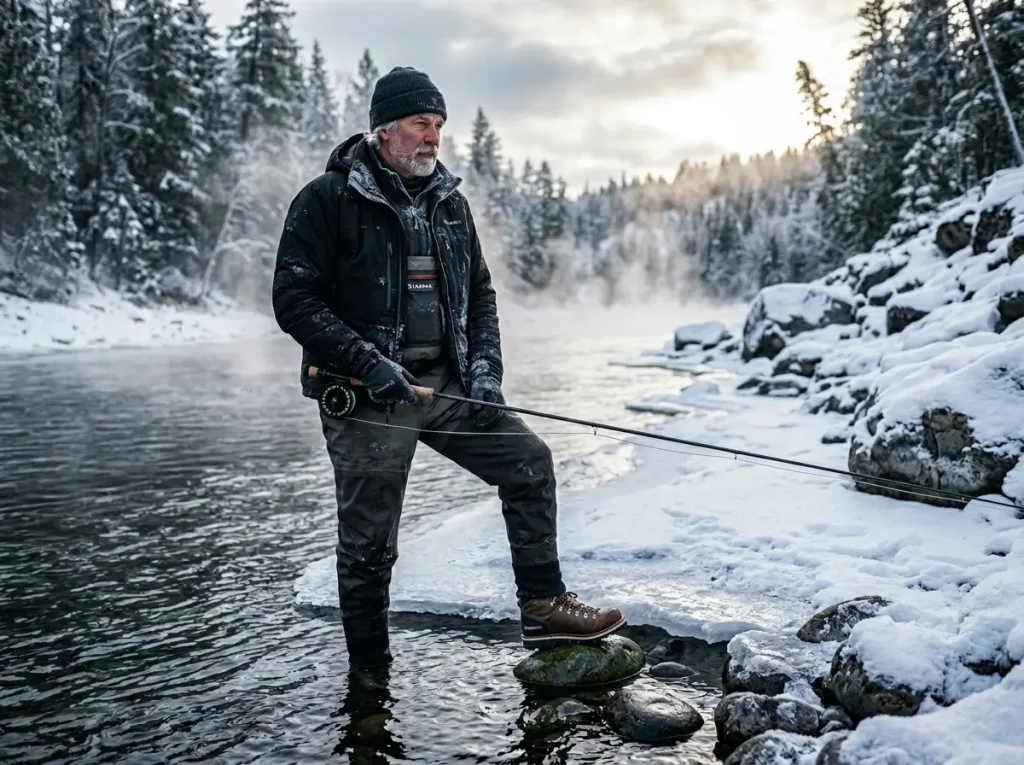
Wet felt is a snow magnet. The fibers accumulate ice and snow on the bank, building a 2–3 inch platform that makes re-entry to the river genuinely hazardous. In sub-freezing temperatures, this ice platform forms within minutes of exiting the water.
I watched a guide step out of a Madison eddy in January, take two steps on the bank, and go down hard. He’d been wading that stretch for fifteen years. The snow-packed felt bottom had turned his boot into a sled. Rubber outsoles don’t collect snow. For winter steelhead and winter trout wading, rubber is the only rational choice regardless of substrate. If you’re still arguing for felt in January, you haven’t spent enough January days on a frozen bank.
Conclusion
Three things to take off this page.
First: felt wins on wet, biofilm-covered rock. The fiber penetration mechanism that makes it work is also the mechanism that makes it a 100%-effective AIS trap. In multiple states, that makes it illegal. In all others, it makes it an ethical liability. You’re either a steward of the water or you’re not. There’s no middle ground where “I used felt responsibly” is a real answer.
Second: the saturated weight penalty is real and the manufacturers aren’t showing it to you. Felt boots gaining 500g of water weight raise oxygen consumption by 3–4% — a number that adds up to lost coordination and real fall risk across an 8-hour wading day. The data is from CDC physiology research on boot weight and endurance, not from a boot company. These aren’t the numbers anyone selling felt boots wants you to see.
Third: studded rubber with aluminum or carbide points matches felt on all but the most technical freestone rivers, and exceeds felt in every off-water and winter condition. The traction gap has narrowed to the point where the ecological and physiological costs of felt are no longer justified for most anglers on most water.
Before your next trip, match your sole to your target substrate using the Wading Safety Matrix above. Then check the regulations for every watershed you plan to cross — because a boot that’s legal in Montana may be contraband in Alaska.
FAQ
Are felt sole wading boots banned in my state?
As of 2025, felt sole wading boots are banned statewide in Alaska, Maryland, Missouri, Nebraska, Rhode Island, and South Dakota, plus Yellowstone National Park. If your state isn’t on that list, felt may still be legal — but check your state DNR annually, as additional bans are pending in several jurisdictions.
Can you add studs to rubber wading boots?
Yes, and for most anglers wading technical freestone water, it’s the correct move. Aluminum or carbide star-pattern studs (Simms Alumibite, Grip Studs) screw into pre-drilled holes in the rubber outsole. Ten to twelve studs provide primary bite points while the rubber handles secondary traction. Installation takes under 30 minutes with a screwdriver.
Why is felt better than rubber for wading slippery rocks?
Felt works through mechanical interlocking. The compressed fibers penetrate the biofilm layer on wet rock and contact the mineral surface directly, creating thousands of grip points. Rubber relies on surface adhesion, but a thin film of water and algae between rubber and rock prevents the contact needed for high friction — the hydroplane effect. Better rubber compounds push this ceiling higher, but they can’t eliminate it.
How long do felt soles last?
In-water performance is solid for 150–200 wading days on average. But longevity degrades fast on dry surfaces. Gravel, pavement, and dry trail grind down fiber structure before you reach the water. Anglers who hike to remote stretches may see effective traction life cut to 80–100 days. Vibram rubber soles routinely last 300–400 days under equivalent use.
What is the best wading boot sole for someone who fishes multiple types of water?
The Korkers OmniTrax interchangeable sole system is the most technically complete answer — felt for technical freestone, rubber for hiking, studded rubber for mixed conditions. The caveat: test sole retention in soft-bottomed or high-suction substrate before trusting it in serious water. For anglers who want a single fixed sole, studded Vibram Idrogrip rubber is the most versatile non-felt option across substrate types.
Risk Disclaimer: Fishing, boating, and all related outdoor activities involve inherent risks that
can lead to injury. The information provided on Master Fishing Mag is for educational and informational purposes
only. While we strive for accuracy, the information, techniques, and advice on gear and safety are not a substitute
for your own best judgment, local knowledge, and adherence to official regulations. Fishing regulations, including
seasons, size limits, and species restrictions, change frequently and vary by location. Always consult the latest
official regulations from your local fish and wildlife agency before heading out. Proper handling of hooks, knives,
and other sharp equipment is essential for safety. Furthermore, be aware of local fish consumption advisories. By
using this website, you agree that you are solely responsible for your own safety and for complying with all
applicable laws. Any reliance you place on our content is strictly at your own risk. Master Fishing Mag and its
authors will not be held liable for any injury, damage, or loss sustained in connection with the use of the
information herein.
Affiliate Disclosure: We are a participant in the Amazon Services LLC Associates Program, an
affiliate advertising program designed to provide a means for us to earn advertising fees by advertising and linking
to Amazon.com. As an Amazon Associate, we earn from qualifying purchases. We also participate in other affiliate
programs and may receive a commission on products purchased through our links, at no extra cost to you. Additional
terms are found in the terms of service.