
In this article
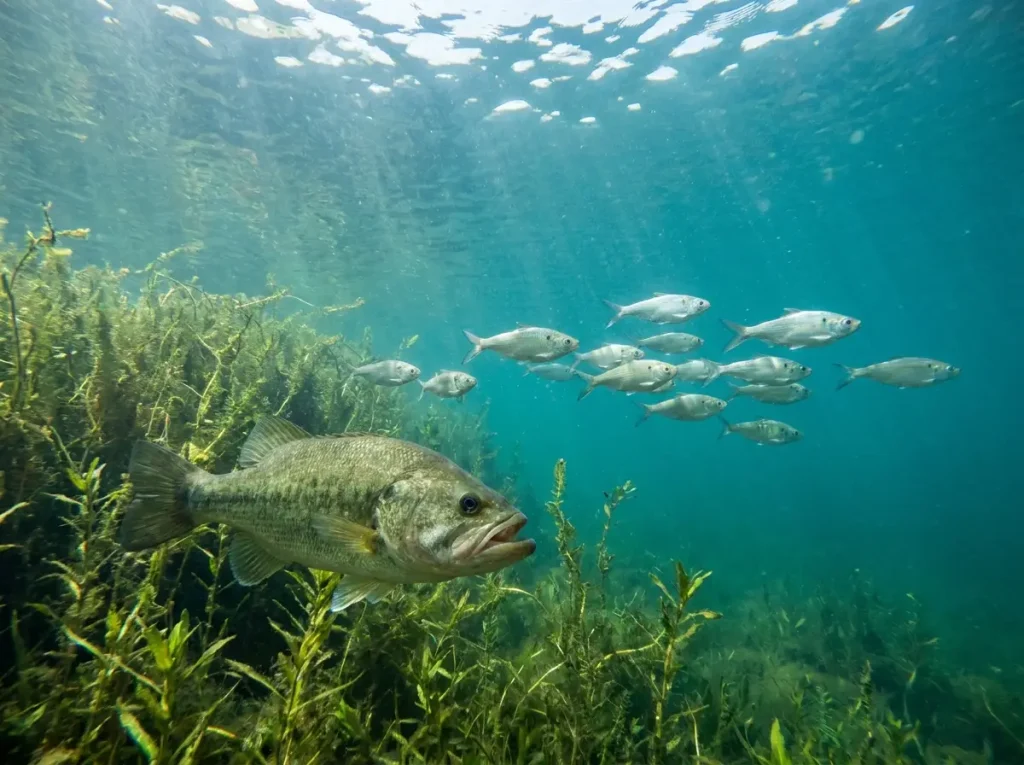
The bass kept following the white swimbait and turning away. Same lake, same depth, same water temperature I’d caught fish in the week before. Fifteen minutes of watching follows and flares, no commits. I switched to an orange-brown crawfish plastic on a football jig, dropped it to the same bottom, and a 4-pound largemouth ate it on the first drag. Nothing changed except the profile. The bass weren’t eating shad anymore — they’d shifted to crawfish on the rocky bottom as September pushed into October.
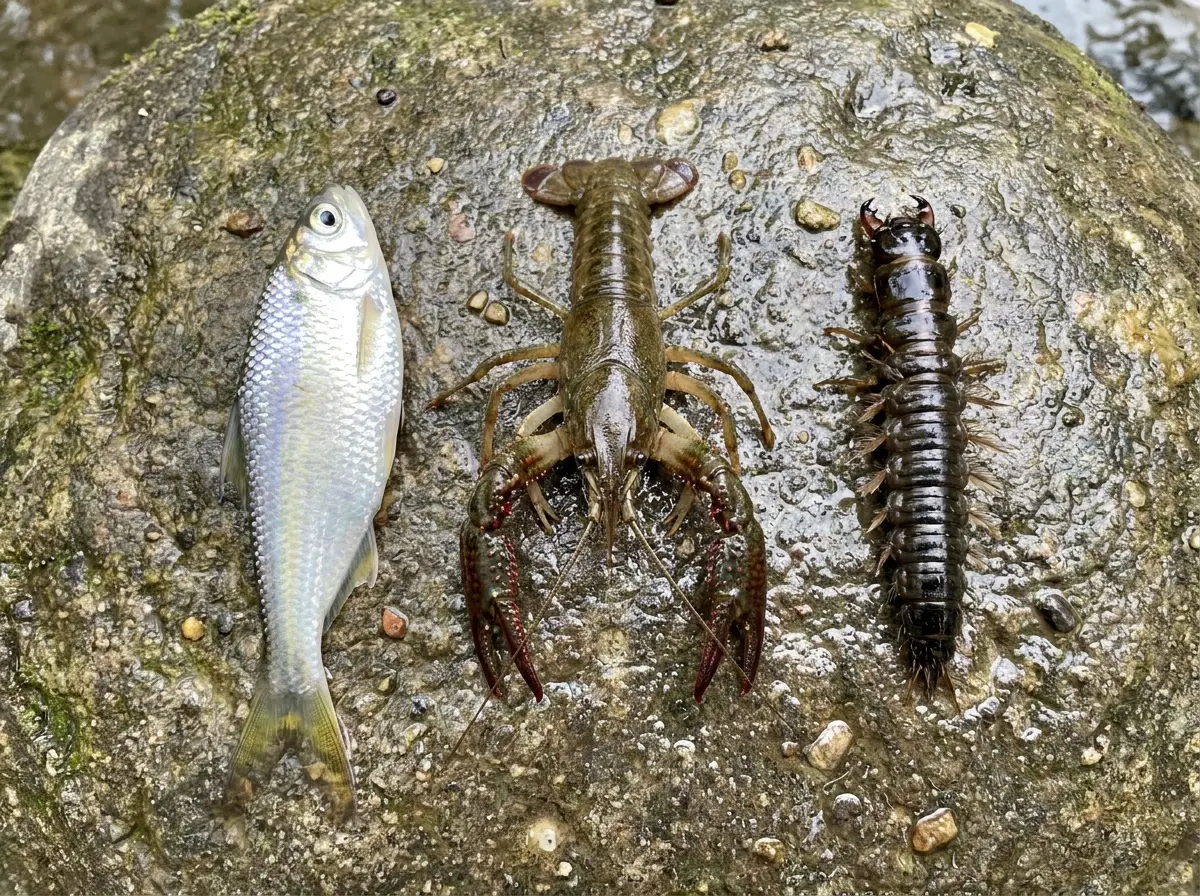
The lure that looks “most like a fish” is not always the right choice. The lure that matches what the fish are actively hunting in that water, at that depth, in that season, is what produces. Understanding the three dominant freshwater forages — shad, crawfish, and hellgrammites — means understanding the feeding biology that determines which profile to throw and when.
⚡ Quick Answer: Shad dominate open-water and mid-column feeding from spring through fall — match threadfin shad in clear water, gizzard shad in stained. Crawfish become the primary forage on rocky bottoms from late summer through fall, when bass move shallow to feed before winter. Hellgrammites are the premier trout and smallmouth forage in clean, fast-flowing rivers and streams year-round, but peak in importance through spring and fall. Each forage has a specific presentation that triggers the take — here’s what the biology tells you.
Why Forage Biology Matters More Than Lure Color
The forage matching framework
“Match the hatch” is a phrase borrowed from fly fishing, where it means imitating the specific insect the fish are currently feeding on. The concept applies equally to spin and bait fishing, but the matching required is broader: not just appearance but size, depth zone, movement pattern, and the time of year when each forage is available or vulnerable.
A bass cruising a rocky shoreline in October is not executing the same feeding program as a bass chasing threadfin shad over a mid-lake flat in June. The first fish is running a bottom-oriented, ambush-and-crush strategy on crayfish that are active in the rocks. The second is running a mid-column interception strategy on a schooling baitfish. Showing the October bass a swimbait pulled through open water may produce a reaction bite occasionally, but showing the June bass a crawfish plastic sinking through 22 feet of water to reach bottom is going to produce almost nothing.
The three core freshwater profiles
Most freshwater gamefish — largemouth and smallmouth bass, walleye, trout, catfish, pike, crappie — reduce their diet to three categories by biomass: pelagic baitfish (primarily shad), benthic crustaceans (primarily crawfish), and aquatic invertebrates (primarily hellgrammites and related larvae in stream fisheries). Each forage occupies a different physical space in the water column and is active in different conditions. Learning to identify which forage is locally dominant in any season is the framework that makes lure selection logical rather than guesswork.
Shad — Threadfin vs Gizzard and What Each Tells Predators
Two species with different biology and different implications
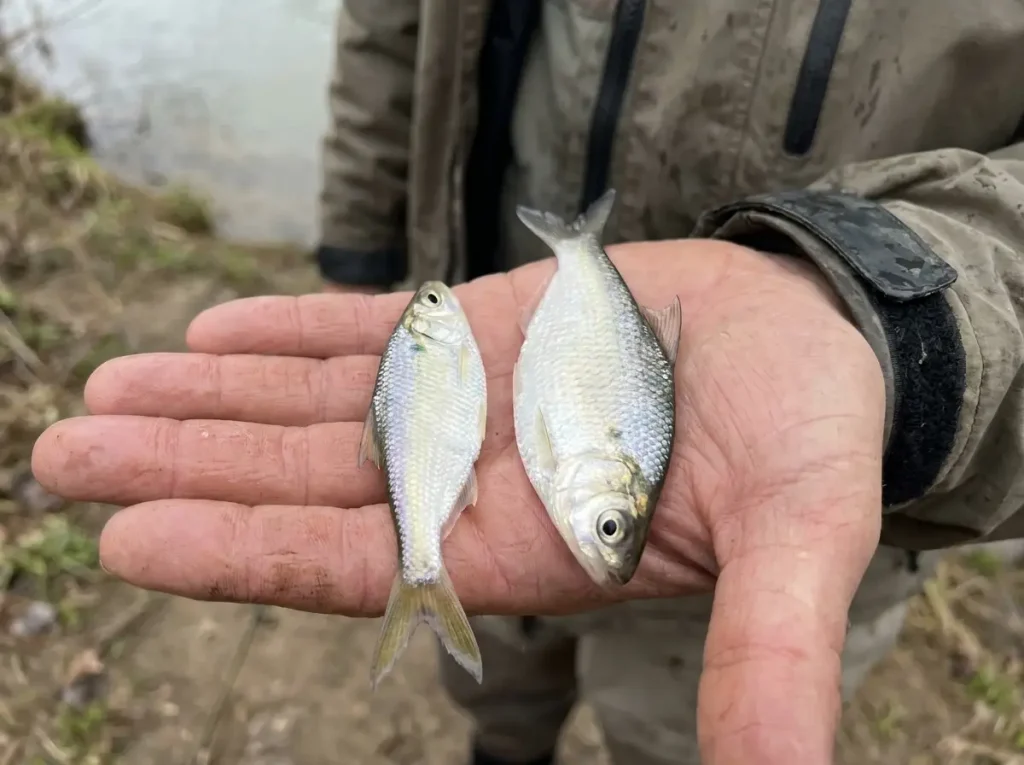
The shad family includes two dominant freshwater species: threadfin shad (Dorosoma petenense) and gizzard shad (Dorosoma cepedianum). They often coexist in the same lakes and reservoirs, but they differ in size, behavior, and what their presence tells you about feeding depth and season.
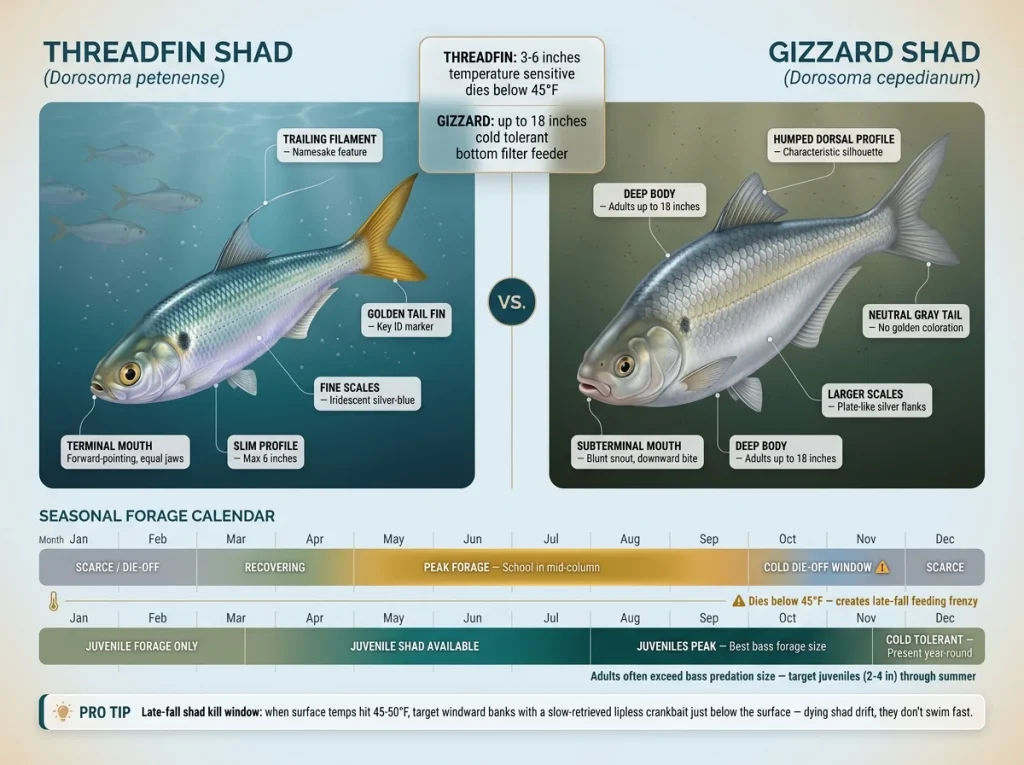
Threadfin shad are the smaller species — rarely exceeding 6 inches and typically running 3-4 inches when juveniles are most available as forage. They’re identified by a more laterally compressed body and a yellow or golden hue to the tail fin. They feed by targeting individual zooplankton, schooling in mid-water and surface zones in warm months. Most importantly, threadfin shad are temperature sensitive: die-offs occur at water temperatures below 45°F, producing natural shad kills in late fall and early winter that concentrate predators in a feeding frenzy near the surface and in shallows.
Gizzard shad grow significantly larger — up to 18 inches — and have a blunt snout with a subterritorial mouth adapted for bottom feeding on sediment detritus. They filter feed through gill rakers rather than targeting individual food items. Because they grow larger than most bass can efficiently eat, adult gizzard shad are less vulnerable to largemouth bass than threadfin shad. Juvenile gizzard shad — in the 2-4 inch range through their first summer — are among the most important forage items in bass production.
Reading shad schools to find predators
In lakes where shad make up more than 50% of the total fish biomass, finding shad schools means finding the predator fish that follow them. On a fish finder, look for dense bait clouds in the mid-column or near the surface during warm months — predators appear as individual arches below, behind, or adjacent to the bait cloud. The predators rarely school inside the bait; they position at the edges, cutting off escape routes.
The threadfin shad die-off in late fall is one of the most reliable feeding windows of the year. When water temperatures drop below 48°F on a reservoir with a dense threadfin population, shad begin dying and drifting to the surface. Bass, stripers, crappie, and catfish all surface-feed on dead and dying shad in water that’s often 2-5 feet deep or less. This is the window when flat-sided lipless crankbaits retrieved slowly just below the surface — mimicking a dying, horizontal shad — produce dramatically.
Pro tip: When you see dead shad washing against a bank or dam face in late fall, check your water temperature. If it’s 45-50°F, you’re in the die-off window. Work the windward bank where dead shad are concentrating and use a very slow retrieve — dying shad don’t move fast.
Crawfish — Seasonal Color, Soft Shell, and the Tailflip Escape
The universal freshwater predator forage
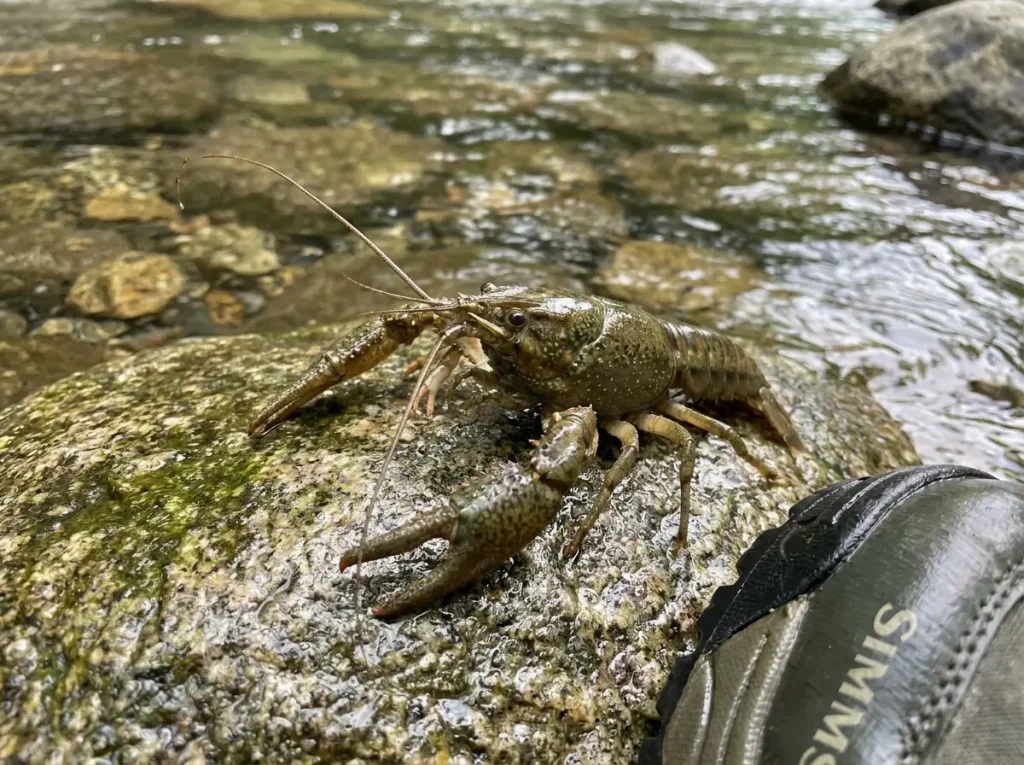
Crawfish (also called crayfish, depending on your region) are consumed by virtually every freshwater predator that can fit one in its mouth. Largemouth bass, smallmouth bass, walleye, catfish, perch, trout, and pike all eat crawfish with consistent enthusiasm. In rocky-bottom lake systems, crawfish can be the primary caloric source for largemouth bass from late summer through winter.
Understanding why crawfish produce requires understanding how they behave. Crawfish are clumsy swimmers — they walk across the bottom and, when threatened, fire a tailflip escape in a backward burst of speed. That escape is tail-first, and gamefish have learned this. Most strikes on crawfish occur from behind, targeting the tail, because the tail is the direction the prey is moving when it’s trying to escape. This is why crawfish plastics fished on the bottom work best when retrieved in short backward hops — the hop-and-pause mimics the escape-and-settle pattern of the natural.
Soft-shell season and color matching
Crawfish molt — shed their exoskeleton — multiple times per year as they grow. In the brief period immediately after molting, the “soft-shell” or “peeler” stage, crawfish are vulnerable: their shells are soft and they can’t move quickly. This is when bass target them most aggressively, because the resistance of hard-shell crawfish (they can pinch) is absent.
Soft-shell crawfish display muted, light coloration — pale yellow-green, tan, or light orange, often with translucent claws. This color phase drives peak crawfish feeding by bass. On late-summer rocky bottoms, matching a soft-shell color profile — particularly orange, rust, or peach crawfish plastics — outperforms hard-shell imitation colors significantly.
Hard-shell season (late summer through fall) calls for darker, mottled patterns — olive-brown with dark spots, burnt orange, or black with blue claws (for pressured bluegill-body-of-water bass that have become selective). The color transition between soft and hard shell follows water temperature: crawfish molt most frequently in warm water, slowing through the fall cooling period.
Hooking live crawfish for bait: run the hook point upward through the soft underside of the tail. Crawfish are eaten tail-first, so a tail-hooked craw presents the hook in the first position a predator encounters. Use a #2 or 1/0 hook for crawfish in the 2-3 inch range — the hook needs to set through the tough tail material on a firm strike.
Pro tip: If you’re collecting live crawfish, keep them in a bucket of cold, well-aerated stream water. They’re hardier in cold water and will stay active much longer than crawfish in warm water. A lively crawfish walking along a rocky bottom produces significantly more strikes than a dead or sluggish one — the movement is the trigger.
Hellgrammites — Clean Water Indicator and the Trout Bait Most Anglers Never Try
The biology of the dobsonfly larva
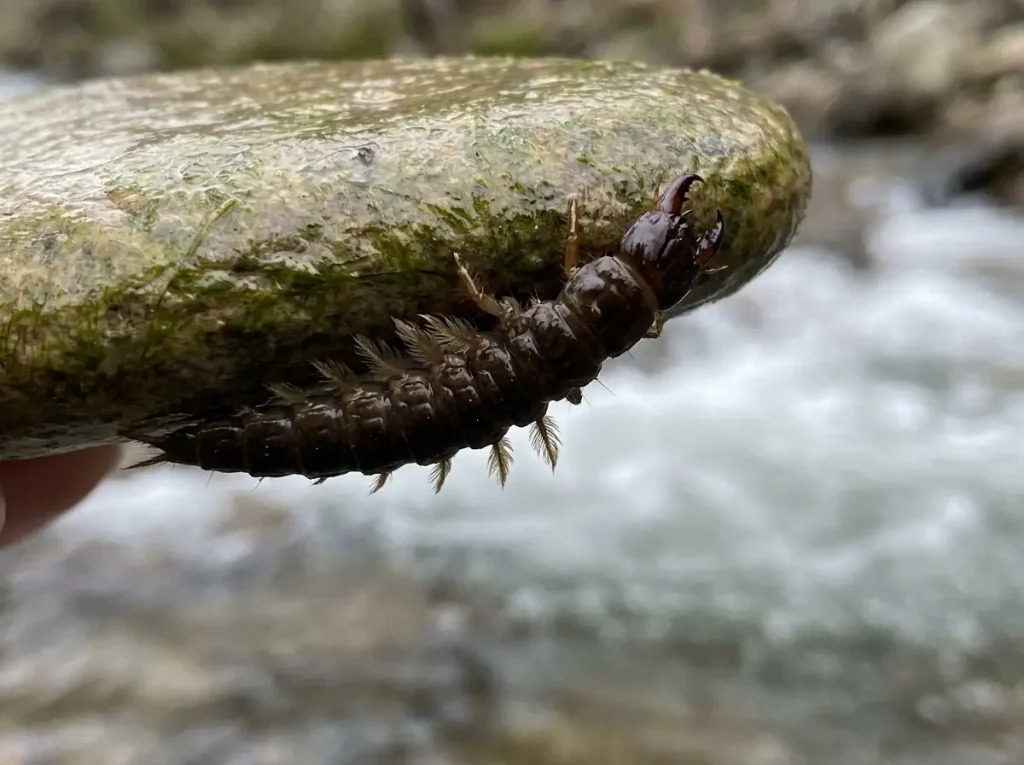
The hellgrammite is the aquatic larval stage of the dobsonfly (Corydalus cornutus), one of the largest insects in North America. The larva reaches up to 4 inches long with a dark brown to black segmented body, eight pairs of gill filaments along the abdomen, and a formidable pair of mandibles at the head that will draw blood if you handle one carelessly. Hold them from behind the head, or use forceps.
Hellgrammites are found only in clean, cold, fast-flowing streams and rivers with rocky or gravelly substrates. They cling to the undersides of stones in riffles and runs, where they spend two to three years developing before crawling ashore, pupating in moist soil, and emerging as dobsonflies. Finding hellgrammites in a stream is an accurate indicator of healthy dissolved oxygen levels and low pollution — they’re bioindicators used by stream ecologists to assess water quality. If hellgrammites are present, the water quality is good, and trout and smallmouth bass almost certainly are too.
Why trout and smallmouth eat them preferentially
Stream-dwelling trout and smallmouth bass in rocky rivers eat hellgrammites as a significant component of their diet throughout the year, but particularly in spring and fall when hellgrammites are largest before emerging. Brown trout in eastern freestone streams know exactly what a hellgrammite looks like and respond to the profile, size, and movement pattern with a selectivity similar to their dry fly selectivity during a hatch.
The practical fishing application is straightforward: insert a size 6 wire hook under the collar just behind the hellgrammite’s head — not through the body — so the larva remains alive and active. Add a small split shot about 10 inches up the line. Drift the hellgrammite through riffles and the runs directly below them, maintaining contact with the bottom without anchoring. The natural presentation drifting through fast, oxygenated water over cobble is exactly where trout and smallmouth hold.
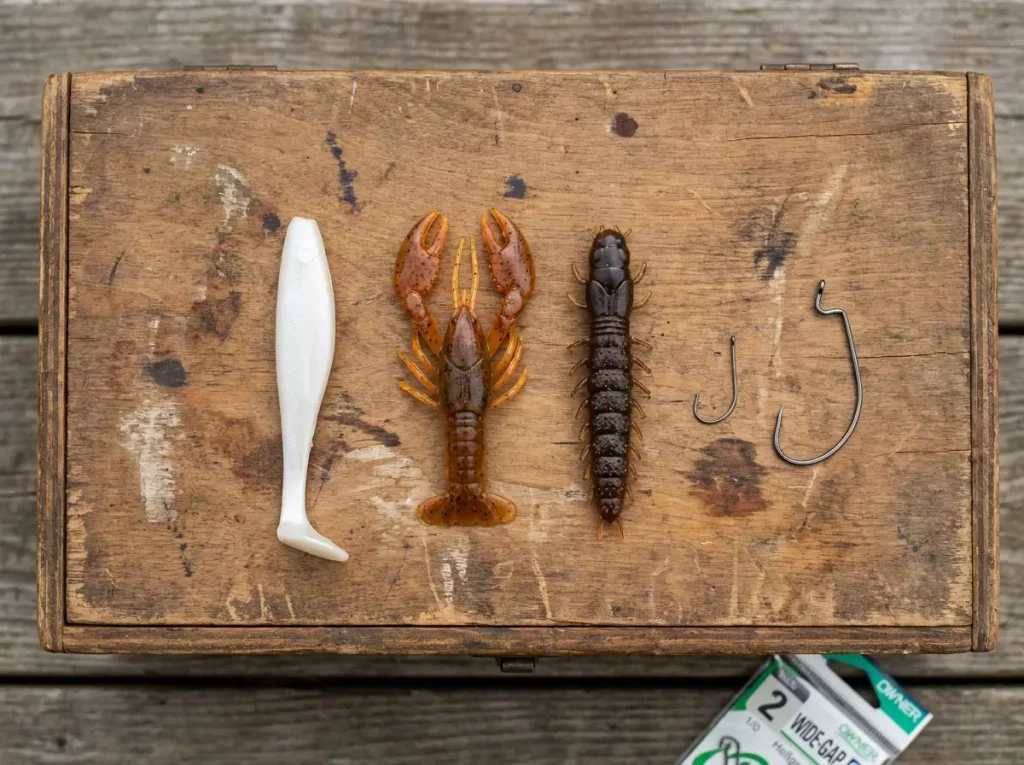
For artificial imitation, soft-plastic hellgrammites rigged Texas-style on a 1/0 worm hook are effective in streams where live hellgrammites aren’t available. The profile — segmented dark body, tapered at both ends, lateral gill filaments — produces when dead-drifted or slow-rolled near the bottom.
Pro tip: To collect hellgrammites, position a fine-mesh dip net immediately downstream of a riffle, then turn over the rocks in the riffle and let the current carry the dislodged hellgrammites into the net. They’re fast enough to escape toward the rocks if you just lift rocks without the net intercepting them downstream. Collect in the morning when fishing that afternoon — hellgrammites stay alive in a cool, aerated container for hours.
Live, Cut, and Artificial — How to Present Each Forage
Live bait presentation priorities
Live forage should be presented in the manner that most closely mimics its natural behavior when it’s vulnerable. Vulnerable threadfin shad are horizontal, nearly motionless, and drifting just below the surface — not swimming aggressively. A live shad suspended under a bobber at the right depth, drifting in current toward a feeding striper or walleye, outperforms a cast-and-retrieve presentation in most situations.
Live crawfish should never be allowed to burrow — they’ll immediately find cover under the nearest rock and become unfishable. Light tension on the line or a small float keeps a live crawfish in the productive zone without anchoring it to the bottom. A live hellgrammite should drift naturally with the current — no heavy sinker that pins it to the substrate; a small split shot that allows movement is the correct setup.
Cut bait and scent profiles
Fresh-cut shad is among the most effective catfish and large bass baits available on shad-heavy reservoirs. The oils and scent that shad release when cut are irresistible to catfish, which can detect chemical signals at extremely low concentrations. Cut a fresh shad just behind the head — the head piece with exposed visceral tissue produces the most scent — and fish it on the bottom on a Carolina rig or a slip-sinker rig.
Cut crawfish tail is effective for catfish and large bass on rocky bottoms when live crawfish aren’t available. The meat from the peeled tail is soft, scent-active, and stays on the hook well. Use the whole tail section with the shell on for larger hooks; peel the shell for a softer presentation on small hooks.
Matching artificial to forage behavior
Artificial shad imitations should swim and pulse at the depth where real shad are holding. A swimbait retrieved through the mid-column in summer, where the actual shad are schooling, produces because bass are already targeting that depth. A swimbait falling to 20 feet through empty water to the bottom is not a shad imitation — shad don’t go to the bottom.
Crawfish plastics produce on the bottom with a hop-and-pause retrieve that mimics the tailflip escape. The pause is as important as the hop — a crawfish that escapes lands and holds still for a moment before moving again. The pause is when the bass commits.
Hellgrammite artificials work best dead-drifted or slow-rolled near the bottom with minimal action — hellgrammites don’t swim or vibrate like a lure. The presentation should feel like a waterlogged log going downstream.
Reading the Season to Know Which Forage Is Active
The seasonal forage calendar
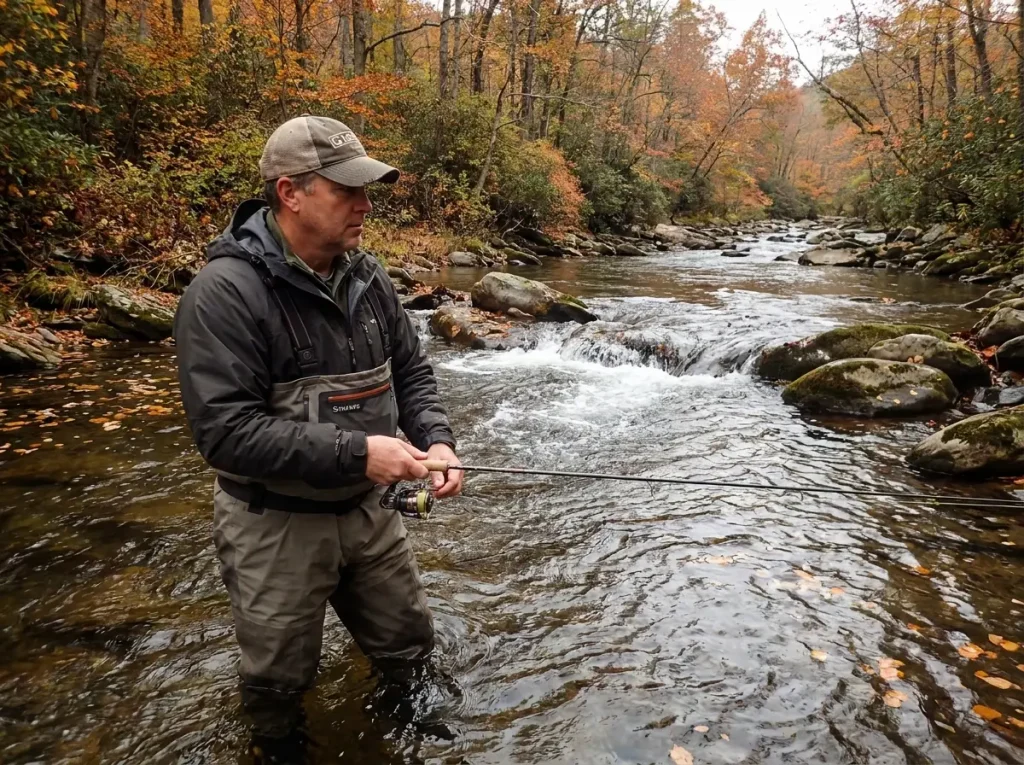
Spring (water warming through 60°F): Crawfish are molting frequently in warming water — peak soft-shell season. Bass and smallmouth on rocky bottoms are crawfish-focused. Shad are beginning to school as temperatures rise. Hellgrammites are approaching peak size ahead of late spring emergence.
Early summer (60-75°F): Shad spawn and juvenile shad become widely available. Predators begin transitioning from crawfish bottom patterns to mid-column shad-school patterns. Hellgrammite fishing in streams is excellent through the first month of summer before water warms.
Late summer (75°F+): Threadfin shad are abundant in mid-column and surface positions. Deeper shad schools concentrate on fish finders. Crawfish are hard-shell and less vulnerable, though still present. Stream hellgrammite fishing slows as water warms.
Fall (cooling back through 60°F): The most important forage transition of the year. Shad begin dying in cold snaps — surface feeding windows on dying shad. Bass return to rocky bottoms and re-focus on crawfish as temperatures drop. On rivers and streams, hellgrammite fishing picks back up with fall cooling.
Winter: Shad die-offs create opportunistic surface and shallow feeding windows when temperatures crash. Crawfish are the primary cold-water bottom forage for bass. In cold rivers, hellgrammites remain available and trout eat them through winter.
The practical rule: the forage most recently stressed or made vulnerable is what predators are hunting. A crawfish that just molted, a shad that’s dying from cold water, a hellgrammite dislodged by rising spring flows — vulnerability creates opportunity. Understanding what makes each forage vulnerable in each season is what translates biology into fish in the boat.
Conclusion
Three forages, three seasons, three physical zones in the water. Shad in the mid-column and surface from spring through fall die-off. Crawfish on the rocky bottom from late summer through early winter, particularly during soft-shell windows. Hellgrammites in the bottom substrate of clean, cold rivers year-round with peak activity in spring and fall.
Match the forage to the season and the structure, present it at the right depth in the right manner, and lure selection stops being a question of confidence and starts being a question of biology. The next time a retrieve produces follows but no commits, ask which forage is currently vulnerable in that water. The answer usually changes the lure.
FAQ
What is the best freshwater fishing bait — shad, crawfish, or hellgrammite?
It depends on the season and species. Shad imitations and live shad are most productive for mid-column and surface feeding in warm months. Crawfish produce best on rocky bottoms from late summer through fall. Hellgrammites are the premier stream bait for trout and smallmouth bass in clean rivers year-round. Each forage dominates in a specific context.
What is the difference between threadfin and gizzard shad?
Threadfin shad are smaller (max 6 inches), with a terminal mouth, more compressed body, and yellow-tinged tail fin. They’re cold-sensitive and die below 45°F, creating late-fall feeding frenzies. Gizzard shad grow much larger (up to 18 inches), have a blunt subterritorial mouth, and are cold-tolerant. Juvenile gizzard shad are important bass forage; adults are often too large to swallow.
How do you hook live crawfish for fishing?
Run the hook point upward through the soft underside of the tail. Crawfish are eaten tail-first by predators, so tail-hooking positions the hook in the first contact zone. Use a #2 or 1 or 0 hook for 2-3 inch crawfish. Keep them alive in cold, well-aerated water and fish with light line tension to prevent burrowing.
What is a hellgrammite and why is it good bait?
A hellgrammite is the aquatic larval stage of the dobsonfly, found under rocks in clean, fast-flowing streams. Up to 4 inches long with a dark segmented body and large mandibles, it’s the primary natural forage for stream trout and smallmouth bass in rocky river systems. Hook through the collar behind the head with a size 6 wire hook and drift near the bottom in riffles.
When do bass feed on crawfish vs. shad?
Bass feed on shad primarily in open water from spring through fall, following shad schools in the mid-column. They transition to crawfish-dominated feeding on rocky bottoms in late summer and fall, particularly when crawfish are in the soft-shell phase after molting. Understanding this seasonal forage shift — and matching lure profile to the current forage — is what separates consistent anglers from lucky ones.
Risk Disclaimer: Fishing, boating, and all related outdoor activities involve inherent risks that
can lead to injury. The information provided on Master Fishing Mag is for educational and informational purposes
only. While we strive for accuracy, the information, techniques, and advice on gear and safety are not a substitute
for your own best judgment, local knowledge, and adherence to official regulations. Fishing regulations, including
seasons, size limits, and species restrictions, change frequently and vary by location. Always consult the latest
official regulations from your local fish and wildlife agency before heading out. Proper handling of hooks, knives,
and other sharp equipment is essential for safety. Furthermore, be aware of local fish consumption advisories. By
using this website, you agree that you are solely responsible for your own safety and for complying with all
applicable laws. Any reliance you place on our content is strictly at your own risk. Master Fishing Mag and its
authors will not be held liable for any injury, damage, or loss sustained in connection with the use of the
information herein.
Affiliate Disclosure: We are a participant in the Amazon Services LLC Associates Program, an
affiliate advertising program designed to provide a means for us to earn advertising fees by advertising and linking
to Amazon.com. As an Amazon Associate, we earn from qualifying purchases. We also participate in other affiliate
programs and may receive a commission on products purchased through our links, at no extra cost to you. Additional
terms are found in the terms of service.