In this article
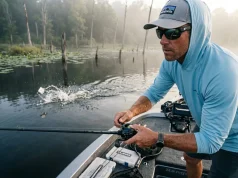
The surface of the water shatters. A gallon of water displaces in a white-water explosion, and your rod loads instantly. This moment—the visceral collision between angler and predator at the interface of air and water—is the pinnacle of sport fishing.
Yet, this explosion strike is not a random act of luck. It is the predictable result of a physics equation involving surface tension, buoyancy, and biological impulse.
I have spent years running guided fishing service trips for clients who believe topwater fishing is simply about throwing a lure and hoping for the best. The reality is quite different. True competency building requires looking past the brand names on the box. We must understand the hydrodynamic laws that govern the strike.
By understanding the universal topwater physics of what happens above and below the surface, we move from being passive participants to confident predators.
The Science of the Strike: Physics & Sensory Biology
Before we discuss gear setup, we must accept a universal truth. Predators are biologically engineered to dominate the surface. They view their prey through specific laws of optics and acoustics that we must understand to be effective.
How do fish visually locate surface prey? (Snell’s Window)
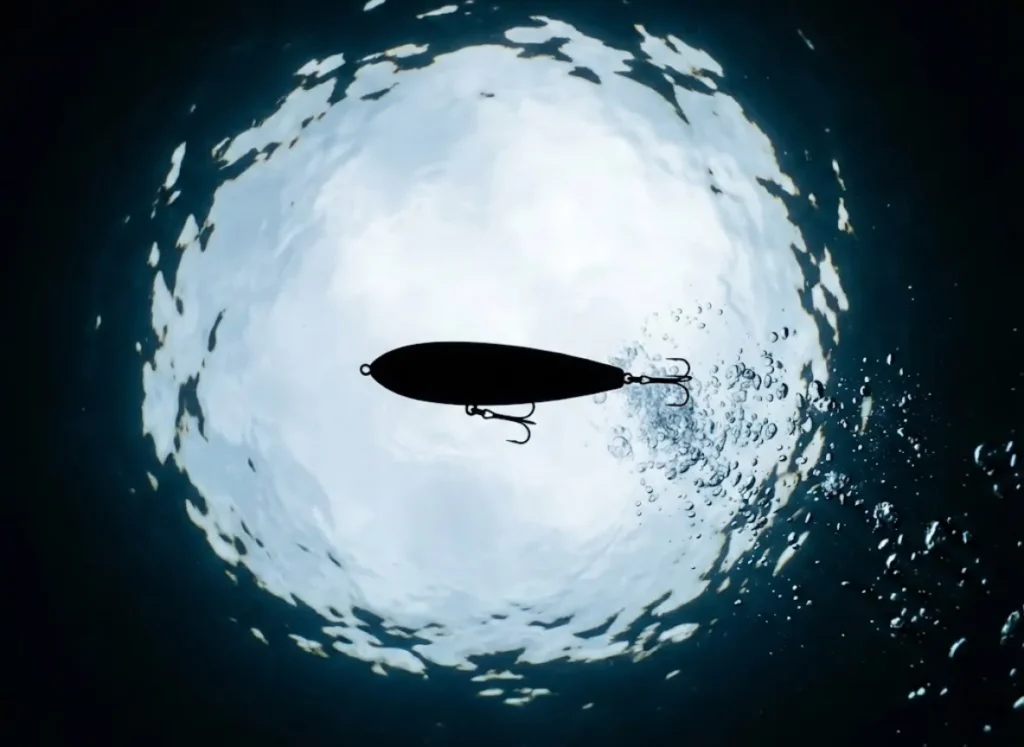
A fish does not see the surface the way we do. Due to the optical geometry of Snell’s Window, a fish looking upward sees the entire 180-degree hemisphere of the sky compressed into a tight 97.2-degree cone of vision.
Within this cone, your surface lure is viewed almost exclusively as a silhouette against the bright background of the sky or clouds. This is why color detail often matters less than profile.
Outside of this 97-degree cone, the surface acts as a mirror due to Total Internal Reflection. This “mirror zone” hides the lure from view until it enters the window.
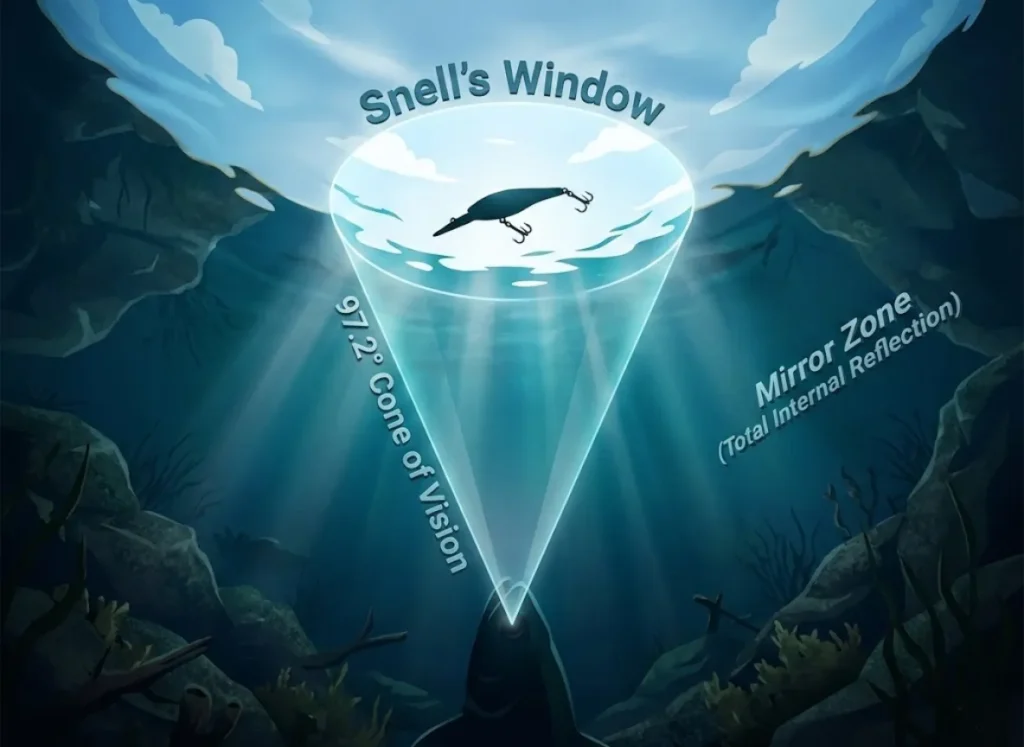
This optical phenomenon dictates our strategy. “Contrast over Color” is the rule. A black or dark purple lure often outperforms natural patterns in low light because it creates a harder, more distinct silhouette against the light of the night sky or dawn.
This geometry also explains why stealth is critical. Making long casts ensures the boat and angler remain in the “mirror zone,” rendering you optically invisible to the fish.
By the time the lure enters the fish’s window, the predator should already be tracking it. To understand how they do this, we have to look at the broader science of fish vision and how they process light.
How do predators detect lures without seeing them? (Lateral Line)
While vision confirms the target in the final milliseconds, the predator begins tracking the lure long before seeing it. They utilize the Lateral Line System, a series of mechanoreceptors running along the fish’s flank that detects hydrodynamic pressure gradients.
This system is highly sensitive to low-frequency vibrations, typically tuned to a range between 1 Hz and 200 Hz. When a topwater lure pushes water, it creates a “V-Wake” generating gravity waves. Largemouth bass, snook, and pike can track these waves in total darkness to determine the speed and trajectory of their next meal.
Pro-Tip: In choppy water, switch from glass rattles (high pitch) to tungsten or brass (low pitch). The lower frequency travels further through the turbulent water, helping fish hone in on the target.
We categorize lures by these acoustic signatures. Displacement refers to the low-frequency thumps generated by Poppers or Ploppers. Rattle refers to the higher-frequency clicks from internal beads.
Studies on the frequency response properties of the lateral line confirm that these specific vibration ranges trigger an attack response. When we select a lure, we are essentially selecting a frequency to broadcast. This connects directly to the biological blueprint of largemouth bass, which rely heavily on prey mimicry—targeting the frequencies of injured baitfish, fleeing prawns, frogs, or struggling insects.
The Gear Ecosystem: Buoyancy & Mechanics
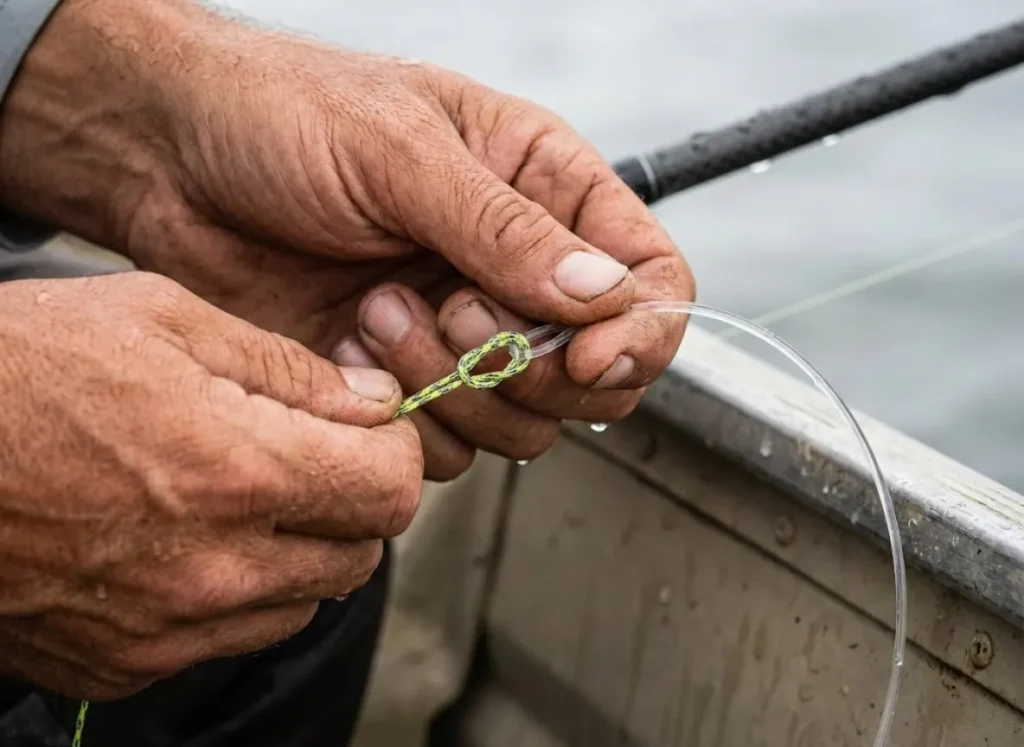
Understanding sensory biology provides the theory. Converting that into a physical presentation requires a gear setup engineered for specific buoyancy management.
Why does line choice determine topwater success? (Specific Gravity)
Water has a Specific Gravity (SG) of 1.0. For topwater success, your control line must not exert a downward vector on the lure. This is where most anglers fail before they make a single cast.
Polyethylene Braid (SG ~0.97) is the “Floating Engine” of topwater fishing. Because it is lighter than water, it stays on the surface. This keeps the lure’s nose elevated for crisp, responsive action. Heavy braid (40-60lb) is standard for driving hooks home in grass cover.
Conversely, Fluorocarbon (SG ~1.78) is the “Topwater Killer.” Its high density drags the line—and subsequently the lure—downward. This dampens the action of walking baits and causes the cups of poppers to sink, ruining the presentation. To understand the physics layer of density further, you can review Snell’s Law of Refraction and how different materials interact with the water column.
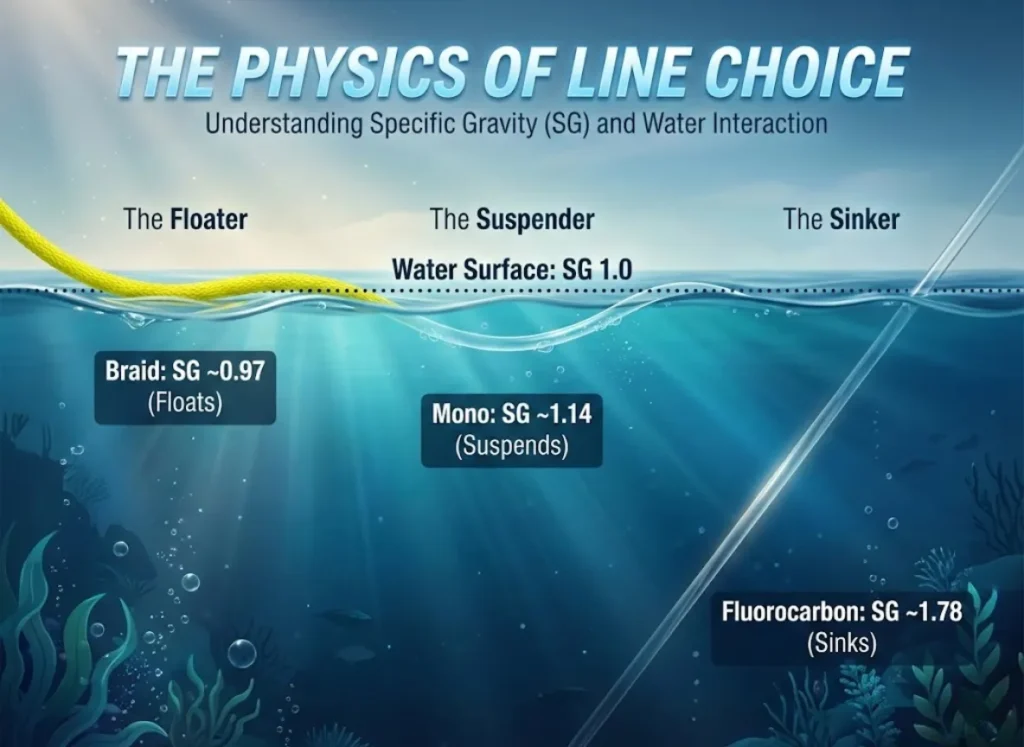
Nylon Monofilament (SG ~1.14) occupies the middle ground. While technically denser than water, its surface tension properties allow it to suspend in the meniscus. More importantly, its elasticity acts as a shock absorber.
The “Gold Standard” rig is simple: Braided line for action control, paired with a short Monofilament leader for shock absorption and stealth. For a detailed breakdown of these materials, consult our guide on braid vs fluorocarbon vs monofilament.
How do you optimize the lure connection? (The Pro-Mod Matrix)
Once the line choice is sorted, the connection point becomes the final variable. I never fish a topwater lure directly out of the box.
The Non-Slip Loop Knot is mandatory. Unlike a clinch knot that locks the lure in place, a loop knot creates a “free hinge.” This allows walkers to pivot nearly 180 degrees with minimal effort.
I also recommend removing the Split Ring from the nose of the lure. This reduces weight, improving buoyancy, and eliminates a common snag point for the line.

If you are using braid, implement the “Bobber Stop Mod.” Place a rubber bobber stop 1/4 inch above the eye of the lure. This prevents the limp braid from tangling in the front treble hooks during aggressive casting.
Finally, consider the hooks. Swapping rear trebles for feathered hooks adds fluid drag to the tail. Research into hydrodynamic imaging with artificial lateral lines suggests that drag stabilization acts like a rudder, keeping the lure tracking true. For heavy mats or lily pads, consider swapping to single inline hooks for better grass safety. To learn the correct way to tie these connections, refer to the Angler’s Knot Matrix.
The Lure Taxonomy: Functional Classes
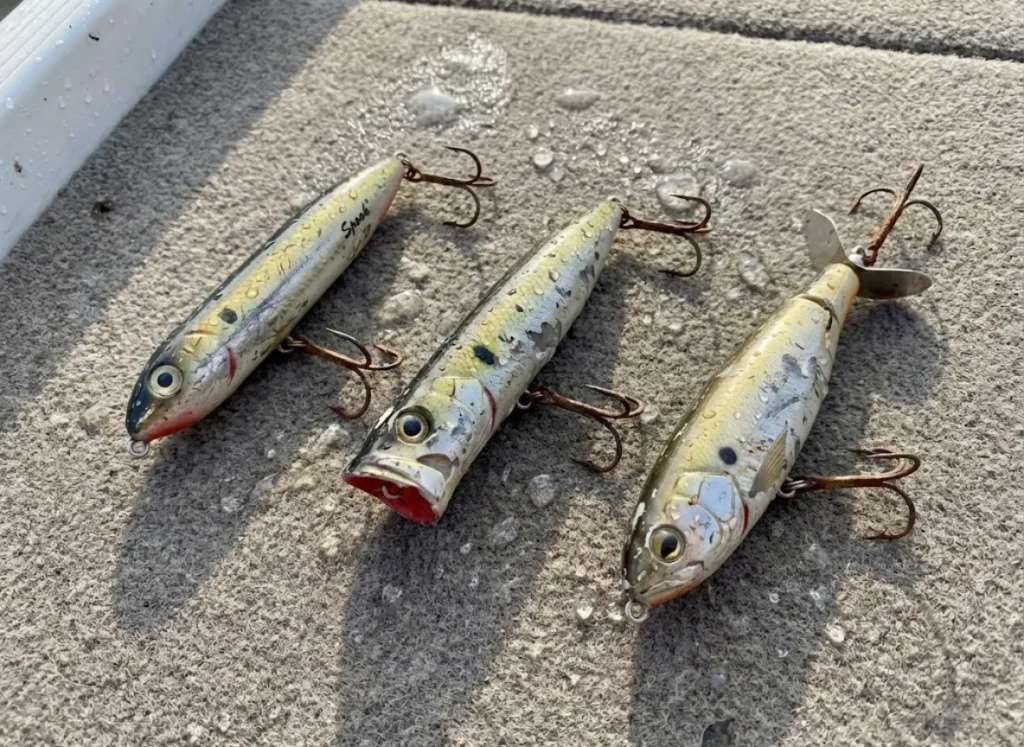
We should stop categorizing lures by brand and start categorizing them by hydrodynamic function. There are three core lure categories: Gliders, Displacers, and Turbulators.
How do you master ‘The Gliders’? (Walking Baits)
Walking Baits (like the Heddon Zara Spook, Megabass Dog-X, or Moonwalker) are rear-weighted gliders designed to pivot around their center of mass. They are “Search Baits,” utilized to cover vast amounts of open water to locate active schooling bass.
The action is known as “Walk the Dog”—a zig-zag action generated by rhythmic slack-line twitches. Because of their aerodynamic torpedo shape, they offer a significant casting advantage, allowing you to stay far away from the target.
When choosing a glider, sound matters. Use a “One-Knocker” (low frequency thud) for wind or choppy water, and silent baits for slick, calm water where fish are skittish. Size selection is about matching the hatch—3-inch profiles for shad, up to 5-inch profiles for trophy targets. For specific recommendations, see our list of the best lures for largemouth bass.
When should you use ‘The Displacers’ and ‘Turbulators’? (Poppers & Ploppers)
Poppers (like the Rebel Pop-R) are “Displacers.” Their concave face traps water to create a cavitation bubble and a distinct acoustic “bloop.” They are precision tools, best used for target-oriented chugging next to stumps, docks, or laydowns using a pop n’ pause cadence.
The magic of the popper is in the pause. The ripples spreading after the “pop” mimic a dying insect or fish, often triggering the strike when the lure is stationary.
Prop Baits (like Turbulators or the River2Sea Whopper Plopper) and Buzzbaits utilize a rotating tail or blade. This creates a continuous, churning wake. Unlike the popper, these are kept in motion.
The constant vibration creates a feedback loop, helping fish track the lure in stained water. These high-energy lures are particularly effective during the peak of summer; check our summer fishing tips for more on warm-water strategies. For heavy vegetation, hollow body frogs (like the Jackall Gavacho Frog) are essential for frogging over thick slop.
Mechanics of Execution: Technique & Strategy
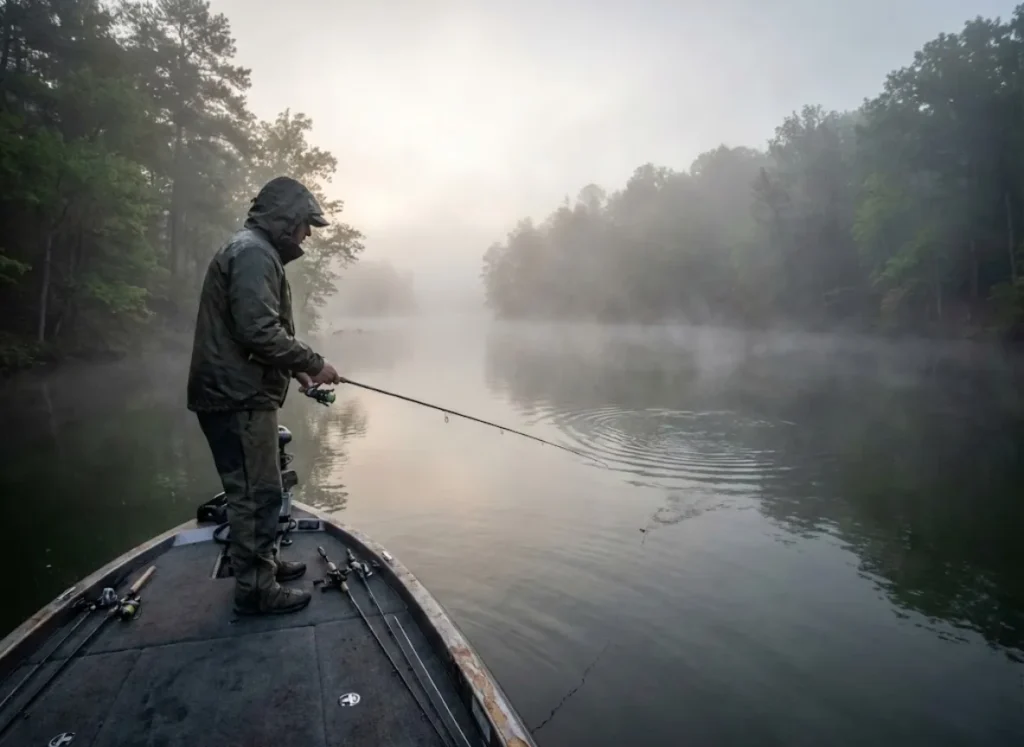
Possessing the right gear is only potential energy. Converting it into kinetic success requires mastering the mechanical manipulation of the rod and reel.
What is the ‘Cadence Drill’ for walking the dog?
The number one error anglers make is reeling while twitching. This creates a “Tight Line,” which drags the lure forward rather than letting it glide sideways.
The mantra you must learn is: “Twitch, Slack, Reel.”
The lure walks during the slack phase, not the pull. Start with your rod tip position low, pointed at the water. This keeps the wind from grabbing your line.
- Twitch the rod tip 6-12 inches.
- Immediately return the tip to the start position to create a loop of Slack.
- Reel only enough to pick up that slack, not to move the lure.
Vary this cadence. A “Twitch-Twitch-Pause” mimics a fleeing baitfish stopping to check for safety. You need a rod with a fast tip to execute this correctly. High-speed reels with a gear ratio 8.0:1 help manage slack line efficiently. Understanding rod power vs action is vital for selecting the right walking stick rod.
Why must you delay the hook set? (The Weight Check)
The explosion is exciting, but it is also the most dangerous moment for your hook-up ratio.
Bass and snook are Suction Feeders. They create a vacuum to inhale prey. If you strike at the visual sign of the splash, you will often pull the lure out of the vacuum vortex before the mouth has closed.
You must implement the “Weight Check” Protocol. When the explosion happens, do nothing. Wait until the rod tip loads with the heavy, physical weight of the fish.
Pro-Tip: Train your internal monologue. When you see the splash, say “God save the Queen” or “One-Mississippi” before you react. That one-second delay is the difference between a hooked fish and a flying lure.
Use a “Sweep Set” (pulling sideways) rather than a “Snap Set” (jerking up). This drives the hooks into the corner of the jaw and is safer for both the angler and the fish. For a detailed analysis of securing the catch and reducing missed strikes, read how to set the hook.
Summary of Tactics
Topwater fishing is not a gamble; it is a discipline.
- Specific Gravity Rules: Braid floats the lure; Mono cushions the strike; Fluoro sinks the success.
- The Cone of Vision: Fish see silhouettes against the sky, making contrast more critical than detail.
- The Slack Line Paradox: Topwater action is created by the slack between twitches, not the tension.
- The Discipline of Delay: Success is defined by the two-second pause between the visual explosion and the physical hook set.
Refine your tackle box with our recommended gear list or share your “one that got away” story in the comments below.
FAQ – Frequently Asked Questions
Why do I keep missing fish on topwater lures?
You are likely setting the hook too early; waiting for the visual splash rather than the physical weight of the fish. Implement the weight-check drill: wait 1-2 seconds until the rod loads up before sweeping the rod to the side.
Can I use fluorocarbon line for topwater fishing?
No, fluorocarbon is significantly denser than water (SG 1.78) and sinks rapidly. This drags the nose of the lure down and ruins the action. Use braided line for the main line and a short monofilament leader for the best results.
What is the best color for topwater lures?
In low light or muddy water, Black or dark colors are best because they create the strongest silhouette against the sky. In bright sun or clear water, Bone or White or translucent patterns are effective as they reflect light and mimic baitfish bellies.
When is the best time to throw topwater lures?
Low-light periods like dawn and dusk are prime times as predatory fish move shallow to ambush points. However, topwater can work all day during post-spawn periods, fall topwater fishing during baitfish migration, or when cloud cover breaks up surface visibility. Ideally, look for water temperature above 55 degrees.
Risk Disclaimer: Fishing, boating, and all related outdoor activities involve inherent risks that
can lead to injury. The information provided on Master Fishing Mag is for educational and informational purposes
only. While we strive for accuracy, the information, techniques, and advice on gear and safety are not a substitute
for your own best judgment, local knowledge, and adherence to official regulations. Fishing regulations, including
seasons, size limits, and species restrictions, change frequently and vary by location. Always consult the latest
official regulations from your local fish and wildlife agency before heading out. Proper handling of hooks, knives,
and other sharp equipment is essential for safety. Furthermore, be aware of local fish consumption advisories. By
using this website, you agree that you are solely responsible for your own safety and for complying with all
applicable laws. Any reliance you place on our content is strictly at your own risk. Master Fishing Mag and its
authors will not be held liable for any injury, damage, or loss sustained in connection with the use of the
information herein.
Affiliate Disclosure: We are a participant in the Amazon Services LLC Associates Program, an
affiliate advertising program designed to provide a means for us to earn advertising fees by advertising and linking
to Amazon.com. As an Amazon Associate, we earn from qualifying purchases. We also participate in other affiliate
programs and may receive a commission on products purchased through our links, at no extra cost to you. Additional
terms are found in the terms of service.