
In this article
The tournament clock shows T-minus 30 minutes. You fire up your twin Garmin units—console and bow both flicker to life. Then the heading icon starts spinning. Your Point-1 GPS antenna drops offline. Your Lowrance Ghost trolling motor loses its anchor lock, drifting you off the brush pile you just marked. Three hours of pre-fishing waypoints are now unreachable.
What went wrong? Somewhere between the transom and the bow, 78 meters of cable, 14 T-connectors, and a single missing 120-ohm terminator just cost you the first cast of the day.
After two decades of rigging bass boats and center consoles, I’ve traced more “ghost in the machine” problems than I can count. The fix is almost never a bad sonar unit or a faulty GPS. It’s the network—the invisible data highway connecting everything from your CHIRP sonar frequencies to your engine gauges.
Here’s exactly how to design, install, and troubleshoot a rock-solid NMEA 2000 network for your fishing boat—no electrical engineering degree required.
⚡ Quick Answer: NMEA 2000 is a high-speed data network connecting your fishfinders, GPS, trolling motor, and engine. It requires a linear backbone with exactly two 120-ohm terminators, careful voltage drop planning for long cable runs, and proper power insertion. Master these three elements and your electronics will work as a seamless system instead of isolated islands.
The CAN Bus Foundation: Why NMEA 2000 Works (And Fails)
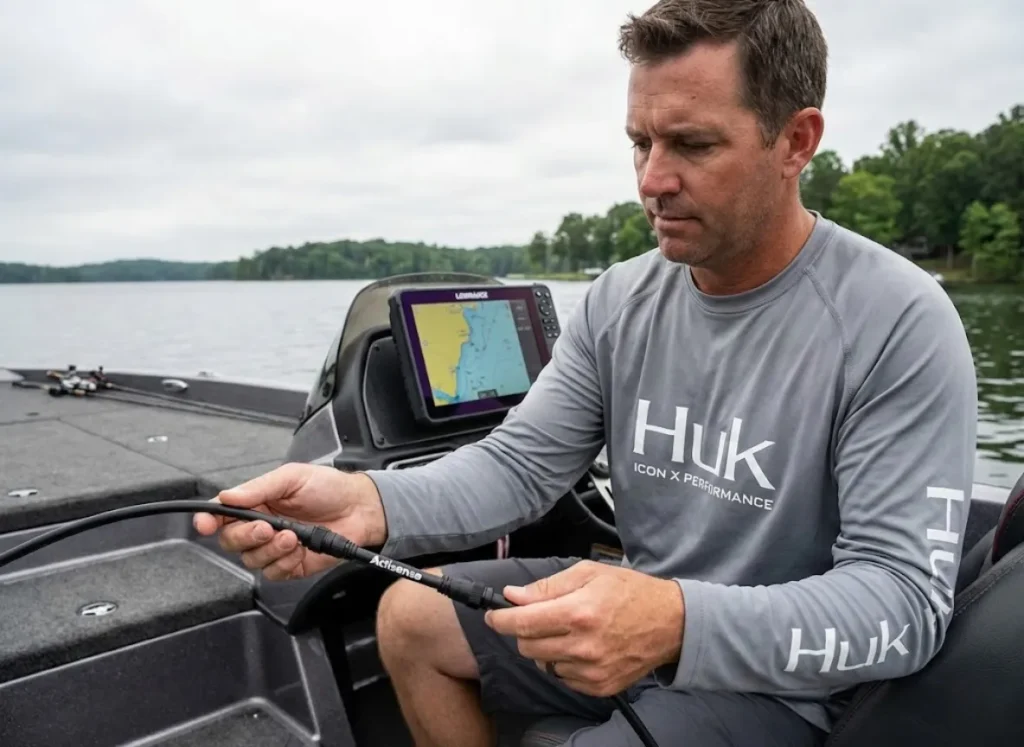
Understanding why certain rules exist sepearates a reliable install from a frustrating pile of intermittent gremlins.
Differential Signaling and Noise Immunity
NMEA 2000 is built on CAN bus technology—the same robust network protocol that runs automotive systems. It transmits data across two wires: CAN High (white) and CAN Low (blue), using differential signaling where voltages move in opposite directions. When interference hits both wires equally, the receiver ignores it because only the difference matters.
This architecture delivers exceptional noise immunity. Your trolling motor draws massive current and generates electromagnetic interference. Your livewell pump creates electrical noise. Your outboard’s ignition system sprays RF garbage across the boat. The CAN bus shrugs it off.
Compare this to the old NMEA 0183 standard—a slow, single-talker serial connection running at 4,800 baud. If you ever had depth readings flicker when your trolling motor ramped up, that was 0183 struggling with interference. NMEA 2000 runs at 250 kbits/second with multi-master capability. Every device talks and listens simultaneously.
Linear Topology—The Highway, Not a Spider Web
Here’s where most DIY installs go wrong. NMEA 2000 network topology demands a strict linear backbone with short drop cables—think highway with driveways, not an Ethernet star.
Signals travel down this backbone cable at high speed. If they reach an unterminated end, they reflect back like an echo, causing data collisions and packet corruption. This is the physics behind the “spinning map” symptom that plagues poorly installed networks.
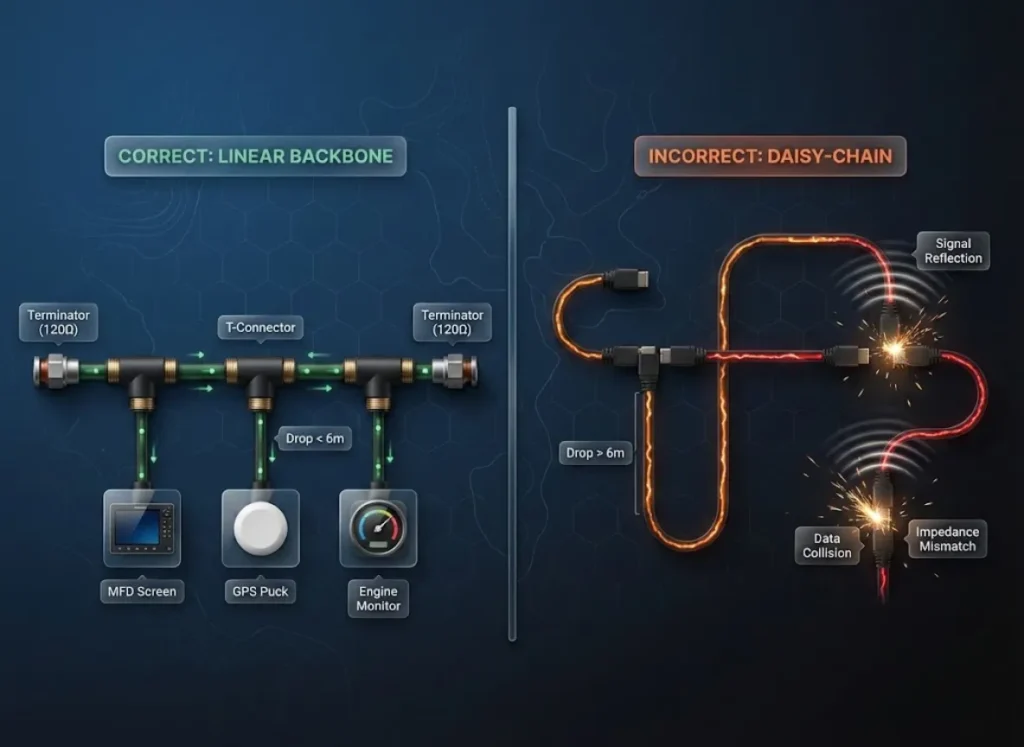
The 6-meter maximum drop cable rule exists because longer stubs act like antennas, receiving reflected signals and amplifying corruption. The cumulative drop length cannot exceed 78 meters across your entire network. Daisy-chaining devices—plugging one device directly into another—is strictly prohibited because it disrupts the line’s impedance.
Pro tip: If your MFD’s device list shows devices appearing and disappearing randomly, your first check should be backbone topology. Someone probably extended a drop cable beyond 6 meters.
The 120-Ohm Termination Rule
Every NMEA 2000 backbone requires exactly two 120-ohm termination resistors—one at each physical end. These create a total parallel resistance of 60 ohms across the data pair, absorbing signal energy so it doesn’t reflect back.
Zero terminators means total network failure. One terminator causes intermittent dropouts. Three terminators—often a hidden factory-installed one in an engine gateway—creates a 40-ohm reading and corrupts data.
Here’s the diagnostic test I run on every new install: measure resistance between the white (NET-H) and blue (NET-L) pins at any T-connector. 60 ohms is correct. 120 ohms means you’re missing one terminator. 40 ohms means you’ve got one too many. This 30-second test with a cheap multimeter prevents hours of troubleshooting later.
For devices at the extreme ends of your boat—a GPS puck at the stern or a wind sensor on a mast—use an inline terminator. It connects between the last device and the backbone, terminating the line while allowing the device to connect.
According to NMEA 2000 official standard specifications, proper termination is mandatory for reliable network operation.
Power Physics—Why Your Network Dies at the Bow
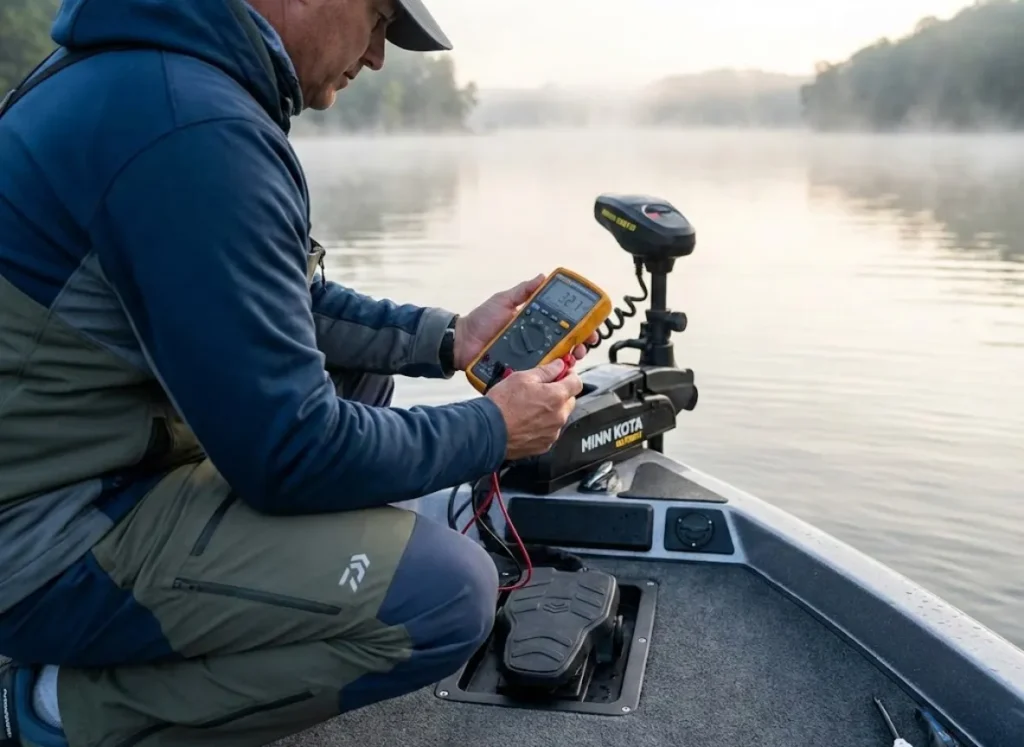
Power problems kill more fishing boat networks than any other issue. Master these concepts and you’ll avoid the frustrating “disappearing sensor” syndrome.
Load Equivalency Number (LEN) Demystified
The NMEA 2000 standard uses Load Equivalency Number to simplify power calculations. One LEN equals 50mA at 12V DC. Instead of wrestling with decimal amperage, you just add integers.
Micro cable backbone handles a maximum of 60 LEN—that’s 3 amps total. Here’s what common fishing boat electronics draw:
Your Point-1 GPS antenna runs 1-2 LEN. A Garmin GPSMAP internal transceiver draws 2 LEN. An engine gateway takes 1 LEN. A heading sensor like the SteadyCast needs 1-2 LEN. Digital gauges like the GMI 20 pull 3-4 LEN because they’re powered entirely by the bus.
A tournament bass boat with three MFDs, Point-1, engine gateway, and heading sensor runs about 10-12 LEN—well under the limit. The constraint isn’t usually total power draw. It’s voltage drop.
Voltage Drop Calculation—Your New Best Friend
NMEA 2000 requires 9-16V DC at every device. Below 9V, sensors go offline or transmit corrupted data. The problem: as current flows through the backbone cable, resistance causes voltage to drop over distance.
On a 22-foot bass boat with 10 LEN total, a 15-meter backbone using Micro cable drops about 0.86V. If your battery sits at 12.6V, the bow devices see 11.74V—perfectly safe.
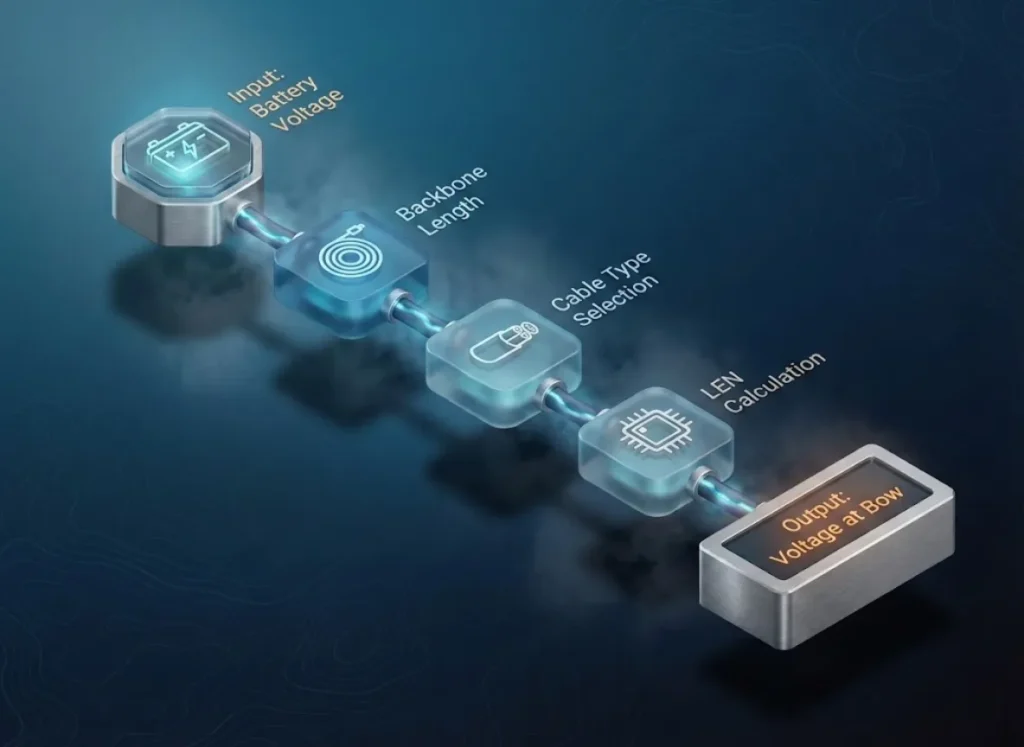
Now here’s where tournament anglers run into trouble. During engine cranking, battery voltage sags to 10.5V. If you’ve already got a 1.5V drop to the bow from a less-than-ideal layout, your Point-1 sees 9.0V—right at the cutoff. That “disappearing heading” during engine start isn’t a bad sensor. It’s voltage sag.
If you’re running three graphs at the bow on a 24-foot Triton, consider upgrading to a marine LiFePO4 battery for your house bank. Lithium batteries hold voltage under load far better than lead-acid.
Power Insertion Strategies—End vs. Middle
An end-powered backbone places the Power T at one end—typically the stern near the battery. It’s simple but creates maximum voltage drop at the far end.
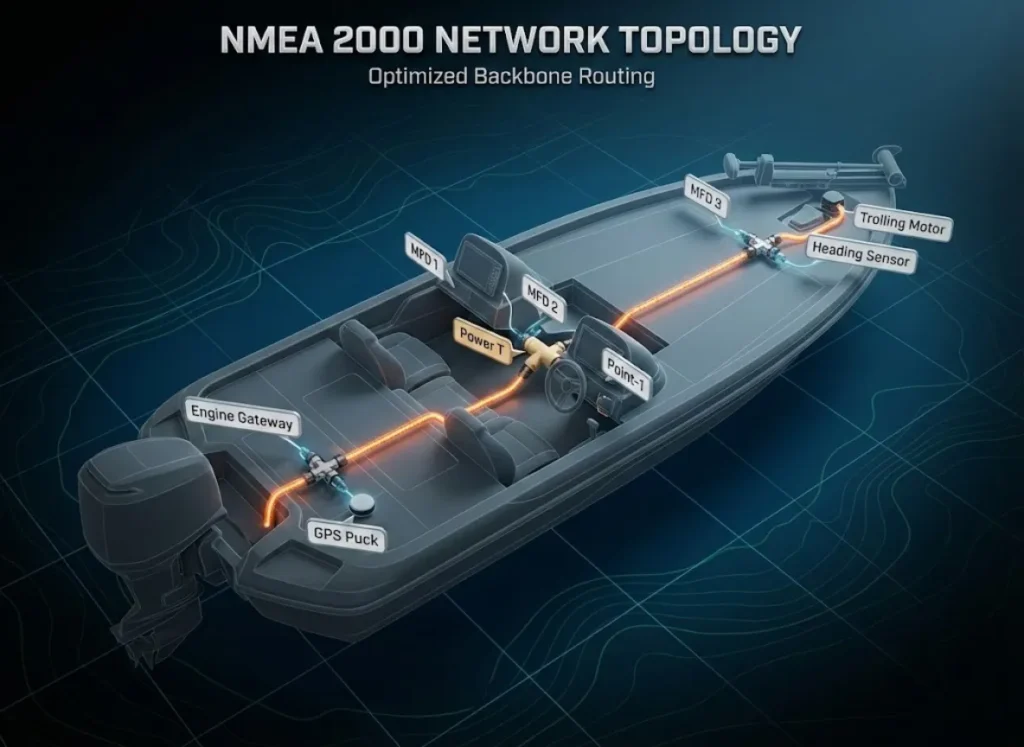
A middle-powered backbone places the Power T at the console, splitting current flow in both directions. This effectively doubles your voltage drop capacity because current travels half the distance each way.
For tournament rigs with bow-mounted MFDs, always use middle-powered topology. The few extra minutes of installation prevent season-long headaches.
One safety note that isn’t optional: your network power MUST be fused. A 3A or 5A fuse depending on cable capacity. And connect to your house battery circuit, not the starting battery—this prevents cranking sag from rebooting your entire network mid-tournament.
Network Topology for Fishing Boats—The Right Layout for Your Hull
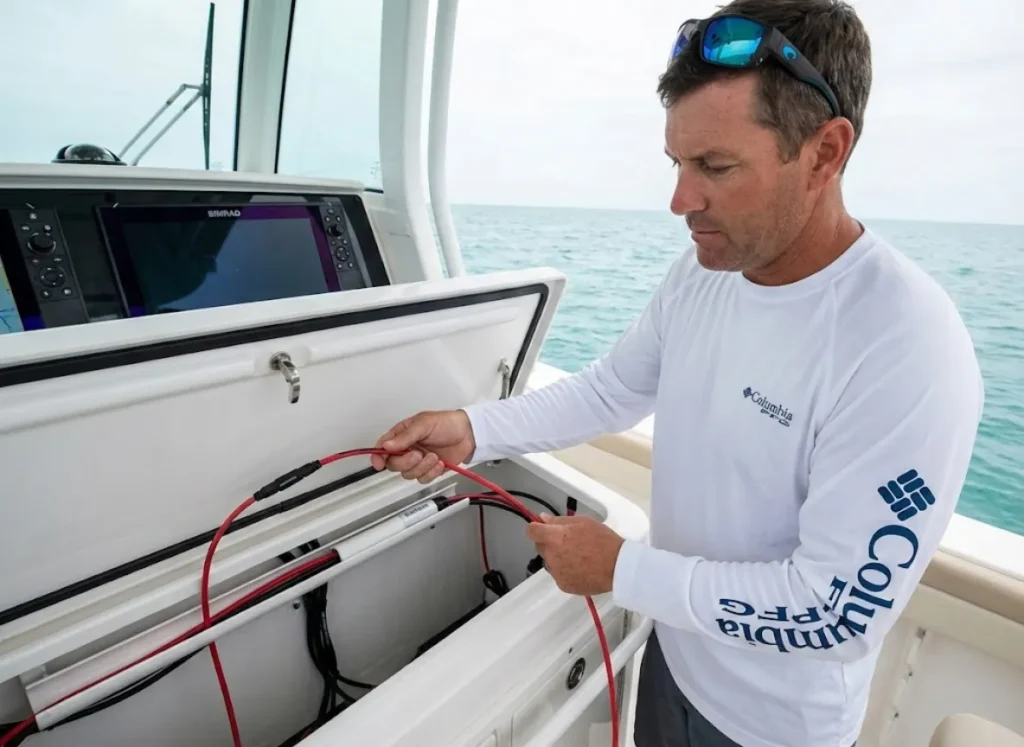
Theory only matters if you can apply it to your specific boat. Here’s what proper layouts look like for common fishing platforms.
Bass Boat Layout (18-22ft)
The backbone runs from the battery compartment at the stern, under the gunwale, through the console, and terminates at the bow panel. Place your Power T at the console where it connects to a switched house circuit.
At the stern, you’ll typically have the engine gateway and a transom-mounted GPS puck. The console cluster handles MFD 1, MFD 2, and the Point-1 if you mount it there. The bow gets MFD 3, the Ghost or Ultrex trolling motor, and often a secondary heading sensor.
Pro tip: Cluster your T-connectors at device locations rather than running long drop cables. Three T-connectors behind the console with 2-foot drops beats three 15-foot drops from a single stern connection.
Leave 6-inch service loops at every connector. When something fails—and something always fails eventually—you’ll thank yourself for the access.
Center Console Layout (20-35ft)
Center consoles run the backbone from the bilge or transom area, up through the console, and forward to the bow. If you’ve got a GPS antenna or weather station on the T-top, the backbone extends up the tower leg—just remember that vertical run counts toward your 100-meter backbone length limit.
Place the Power T inside the console at the main fuse block. This centralizes distribution and makes troubleshooting accessible. Route backbone through conduit on saltwater boats to protect from spray and UV.
For kayak fishfinder rigging, these same principles scale down—just with shorter cable runs.
The Backbone vs. Drop Confusion (The #1 DIY Mistake)
The backbone is the highway. Drop cables are driveways. You cannot daisy-chain driveways to extend your highway.
If you need to reach a device that’s farther away, extend the backbone—not the drop. Maximum single drop: 6 meters. Maximum cumulative drops across the entire network: 78 meters.
Here’s the mistake I see constantly: an angler buys 25-foot “extension cables” thinking they’re backbone sections. Often, they’re drop cables without proper shielding. The fix creates more problems than the original layout.
Component Selection—Starter Kits, Cables, and Connectors
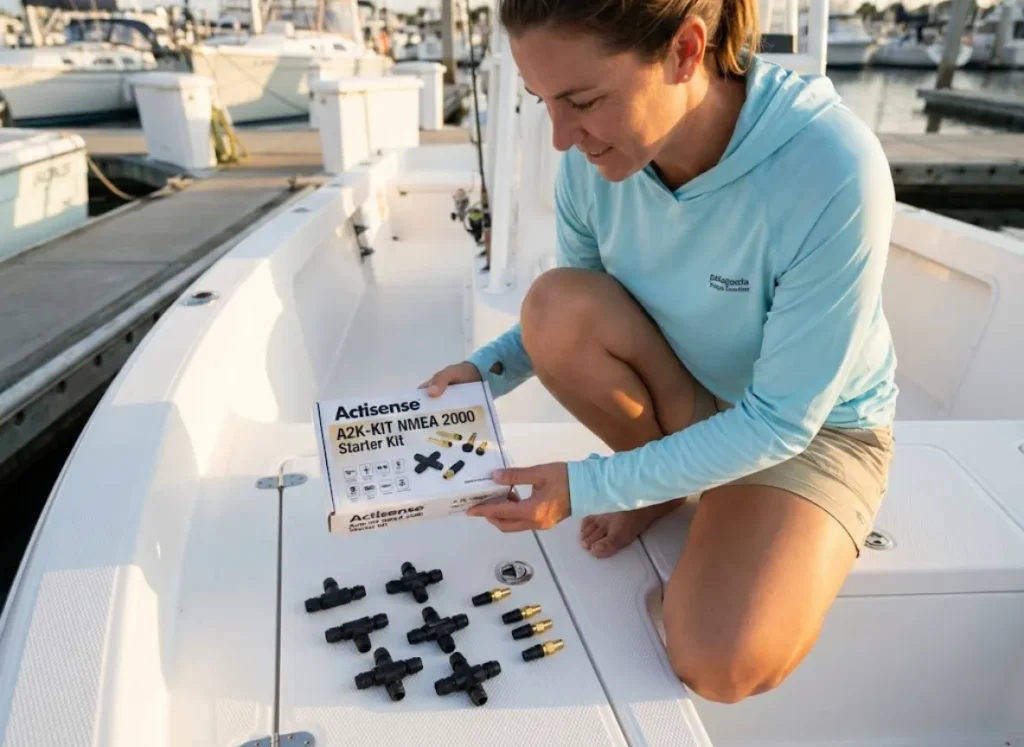
The right components ensure compatibility and longevity. The wrong ones create corrosion and frustration.
Starter Kits Worth Buying
A quality NMEA 2000 starter kit includes a fused Power T, male and female terminators, two T-connectors, and short and long backbone cables.
Garmin NMEA 2000 Starter Kit (010-11442-00) is the industry standard with excellent connector quality. Lowrance/Simrad Kit (000-0124-69) offers identical functionality and full compatibility. Actisense A2K-KIT uses premium metal connectors for high-corrosion saltwater environments. Digital Yacht ZDIGN2KIT includes a helpful DIY guide and targets refits.
All use the standard Micro-C connector (DeviceNet M12 thread), so cross-brand compatibility is guaranteed. Avoid no-name Amazon kits with non-tinned copper—they corrode within months in marine environments.
Proprietary Connector Hell: SeaTalkNG, SimNet, and Adapters
Standard NMEA 2000 Micro-C connectors work with Garmin, Lowrance (red/black connectors), newer Simrad, and Humminbird (via adapter).
SeaTalkNG from Raymarine uses proprietary connectors that carry NMEA 2000 data. You need the A06045 adapter to connect to a standard backbone. SimNet from legacy Simrad equipment requires SimNet-to-Micro-C adapters.
Humminbird Helix units need the AS ETH NMEA2K gateway module. Newer G4N units have a direct N2K dongle. When selecting a marine GPS unit, check connector type before buying.
Pro tip: If you inherit a boat with Raymarine equipment, budget $50-100 for adapter cables before assuming anything works together.
Cable Quality—Tinned Copper or Nothing
Micro cable handles most fishing boats—100-meter max backbone, 3A capacity. Mid cable offers heavier gauge for longer runs up to 250 meters.
Every cable MUST use tinned copper conductors. Non-tinned copper oxidizes—turns black—and increases resistance within a single season. Check the spec sheet for Garmin, Lowrance, Ancor, or Maretron. These brands use tinned copper. Generic cables often don’t.
Fishing-Specific Integrations—Trolling Motors, Engines, and Anchors
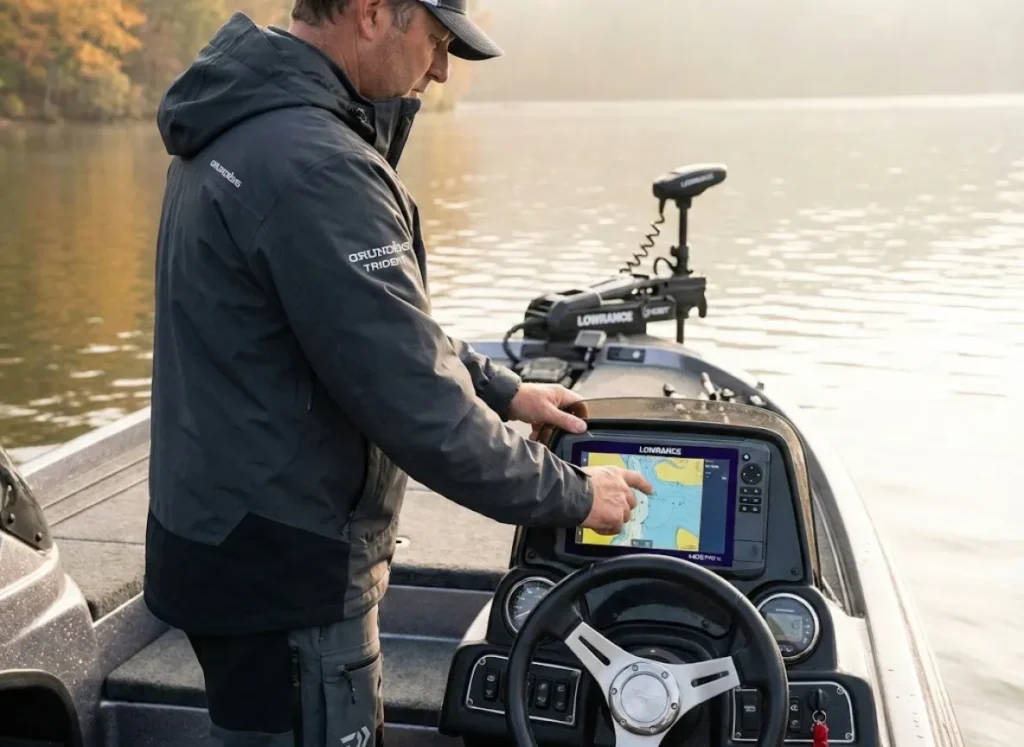
Beyond basic networking, NMEA 2000 transforms how you fish when you integrate tactical equipment.
Trolling Motor Integration (Ghost, Ultrex, Force)
Modern trolling motors act as autonomous navigation systems when properly networked.
The Lowrance Ghost connects via NMEA 2000 to HDS Live, HDS Pro, and Elite FS units for full touchscreen control—steer, anchor, jog. The “One Boat Network” uses Ethernet for sonar sharing but N2K for control commands.
Minn Kota Ultrex and Quest primarily use Ethernet through i-Pilot Link for advanced features like “Follow the Contour.” NMEA 2000 provides heading and GPS data redundancy.
Garmin Force connects wirelessly to newer chartplotters but requires N2K for hardwired reliability on older units.
Trolling motors with built-in compasses broadcast heading data to the network, solving the infamous “spinning map” issue when you’re sitting stationary over a brush pile.
If your map spins at anchor, the trolling motor isn’t sending heading data. Check the N2K connection or enable “Heading Source” in your chartplotter settings.
Engine Gateway Bridging (Yamaha, Mercury, Suzuki)
Connecting your outboard to NMEA 2000 displays RPM, engine temp, oil pressure, and fuel rate on your MFD.
The real value? Fuel management. ECU fuel rate data calculates “Fuel Remaining” with far better accuracy than a mechanical tank float. On offshore runs, this matters.
Yamaha requires the Command Link to NMEA 2000 Gateway cable. Mercury needs a VesselView Link or gateway stick. Suzuki often requires an interface cable to the SDS port.
Shallow Water Anchor Control (Power-Pole)
The C-Monster Gateway (CM2-GTW-N2K) allows MFD touchscreen control of Power-Pole deployment and retraction. LEN is just 1—negligible power draw.
Beyond convenience, it lets you verify anchors are fully retracted before takeoff. A shallow water anchor vs. Spot-Lock comparison covers when each system makes sense.
Installation and Troubleshooting Masterclass
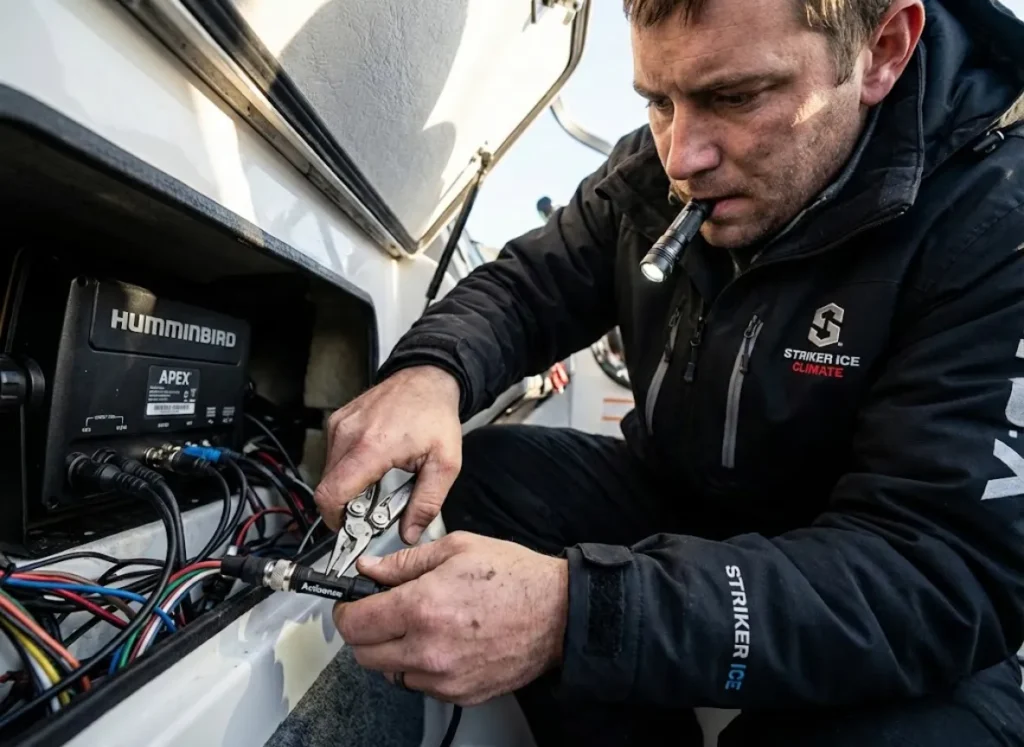
The difference between a factory install and a tournament-grade install lies in the details.
Cable Routing and Physical Protection
Route backbone cables at least 12 inches from VHF antenna cables and high-power transducer cables to prevent crosstalk. Leave 6-inch service loops at every T-connector.
Minimum bend radius is 10 times the cable diameter. Sharp kinks fracture internal twisted pairs. Secure backbone every 18 inches using cushioned P-clamps or UV-resistant zip ties. Loose cables vibrating against fiberglass will chafe through insulation—a fire hazard waiting to happen.
Waterproofing and Corrosion Defense
Apply a light coating of silicone dielectric grease to connector threads. Do NOT pack grease into pin sockets—it prevents proper seating or insulates the data pins.
Hand-tighten locking collars only. Pliers crack plastic coupling nuts. Orient exposed connectors pins-down to prevent water pooling.
Every open port on a T-connector MUST be capped with a waterproof blanking plug or terminator. An open port is a direct path for water intrusion. For more on protecting marine electronics, see saltwater corrosion prevention for reels and electronics.
In saltwater, inspect connectors seasonally for “green death”—copper oxide buildup that increases resistance.
The Half-Split Troubleshooting Method
When devices randomly appear and disappear, use the half-split method advocated in the Actisense NMEA 2000 testing guide:
- Power off the system
- Disconnect the backbone at the midpoint
- Move one terminator to the end of the first half
- Test—if the problem persists, the fault is in this half
- Repeat until you isolate the faulty cable, T-connector, or device
Common symptoms and their causes: “Bus Off” error means the device disconnected to protect the bus—check termination and cable limits. Spinning map means magnetic interference near the heading sensor—relocate away from the trolling motor. Missing depth at engine start means voltage sag—move N2K power to the house battery.
Pro tip: Carry a spare T-connector, 6-foot drop cable, and a multimeter on the boat. 90% of on-water failures trace to loose connectors you can swap in five minutes.
Conclusion
NMEA 2000 network design comes down to three fundamentals: linear topology with exactly two 120-ohm terminators, power insertion that prevents voltage drop at distant devices, and quality components with tinned copper and proper shielding.
The fishing-specific integrations—trolling motor control, engine monitoring, Power-Pole automation—transform a basic network into a tactical advantage.
Before your next tournament, pull out a multimeter, measure your backbone termination (should read 60 ohms), and check voltage at your furthest device with the engine off and during cranking. Those two tests take 10 minutes and will reveal 90% of potential failures before they cost you a fish.
FAQ
What’s the difference between NMEA 0183 and NMEA 2000?
NMEA 0183 is a slow, single-talker serial protocol running at 4,800 baud. NMEA 2000 is a high-speed CAN bus operating at 250 kbits/second where all devices communicate simultaneously. Modern fishfinders, GPS units, and trolling motors require NMEA 2000 for full integration.
How many devices can I put on an NMEA 2000 network?
The standard allows 50 nodes maximum. Most fishing boats run 8-15 devices. The practical limit is usually power draw (60 LEN maximum) and voltage drop over distance, not raw device count.
Do I need a terminator on NMEA 2000?
Yes—exactly two, placed at the physical ends of the backbone. They must create 60 ohms total resistance. Missing or extra terminators cause data corruption and intermittent device dropouts.
Can I run my fishfinder and trolling motor on the same NMEA 2000 network?
Yes. Lowrance Ghost, Minn Kota, and Garmin Force support NMEA 2000. The sonar video from LiveScope or ActiveTarget uses Ethernet—NMEA 2000 handles control data, heading, and GPS coordinates.
Why does my heading sensor spin when the boat is sitting still?
Magnetic interference from the trolling motor or high-current cables. Relocate the sensor at least 24 inches from motors and batteries. If it still spins, check that the sensor is set as the primary heading source in chartplotter settings.
Risk Disclaimer: Fishing, boating, and all related outdoor activities involve inherent risks that
can lead to injury. The information provided on Master Fishing Mag is for educational and informational purposes
only. While we strive for accuracy, the information, techniques, and advice on gear and safety are not a substitute
for your own best judgment, local knowledge, and adherence to official regulations. Fishing regulations, including
seasons, size limits, and species restrictions, change frequently and vary by location. Always consult the latest
official regulations from your local fish and wildlife agency before heading out. Proper handling of hooks, knives,
and other sharp equipment is essential for safety. Furthermore, be aware of local fish consumption advisories. By
using this website, you agree that you are solely responsible for your own safety and for complying with all
applicable laws. Any reliance you place on our content is strictly at your own risk. Master Fishing Mag and its
authors will not be held liable for any injury, damage, or loss sustained in connection with the use of the
information herein.
Affiliate Disclosure: We are a participant in the Amazon Services LLC Associates Program, an
affiliate advertising program designed to provide a means for us to earn advertising fees by advertising and linking
to Amazon.com. As an Amazon Associate, we earn from qualifying purchases. We also participate in other affiliate
programs and may receive a commission on products purchased through our links, at no extra cost to you. Additional
terms are found in the terms of service.