In this article
Every angler knows the feeling. You return to a once-thriving spot—a place etched in your memory with the flash of a turning flank and the pull of a heavy fish—only to find it quiet and barren. That quiet is more than just an absence of bites; it’s often the sound of a habitat in decline. It’s the sound of a fishery losing its foundation, stone by stone. But what if you could do more than just change spots? What if you could become the reason that spot comes back to life? This guide is your blueprint for transforming that deep-seated passion into meaningful action. It provides the knowledge and tools to move from a recreational angler to a grassroots restorationist, ensuring the health of the fisheries you love and the future of sustainable fishing for generations to come.
Together, we’ll explore why top federal agencies like NOAA Fisheries agree that habitat is the key to unlocking our fisheries’ potential and understand the different mindsets that drive our fellow anglers, learning how to speak a language of conservation that everyone can understand. We will look at the proven models for action created by powerful organizations like Trout Unlimited and B.A.S.S., which provide clear pathways for angler engagement. And finally, we’ll roll up our sleeves with a hands-on toolkit for impactful, accessible habitat projects you can undertake yourself. This is your journey from participant to steward, and it starts now.
Why Is Habitat the Foundation of a Healthy Fishery?

To truly grasp our role, we first need to understand the scale of the challenge and the incredible opportunity it presents. This isn’t just about making our favorite fishing hole a little better; it’s about rebuilding the engine of our entire aquatic ecosystem. This section establishes the ecological and economic imperative for fish habitat restoration, grounding our passion as anglers in authoritative, science-based data.
What is the federal consensus on the state of aquatic habitat?
For decades, fisheries management conversations often revolved around stocking numbers and harvest limits. While those are important tools, the nation’s leading scientific bodies, from the National Oceanic and Atmospheric Administration (NOAA) to the U.S. Fish & Wildlife Service (FWS), have reached an undeniable consensus: habitat degradation is the single greatest limiting factor for our fisheries. You can’t have healthy, self-sustaining fish populations without healthy, functioning places for them to live. This understanding has led to a powerful, dual-pronged strategy of “protection and restoration.” Protection focuses on safeguarding the high-quality, intact habitats we still have, while restoration aims to repair the damage done to those that have been degraded. This work is built on three main pillars of action: to Rebuild critical structures like oyster reefs, to Reconnect fragmented waterways through methods like dam removal, and to Restore the function of vital areas like wetlands and in-stream habitats. The scale of this effort is immense; since 1996, NOAA’s Community-based Restoration Program alone has invested over $600 million in thousands of grassroots habitat restoration projects, all powered by local partners.
The results of this focus on fish and wildlife habitats are tangible and profound. These investments have led to the restoration of over 130,000 acres of habitat and, crucially, the reopening of over 6,100 stream miles for fish migration, giving species like wild steelhead and salmon access to spawning grounds they haven’t seen in a century. This represents a critical economic paradigm shift, moving away from a 20th-century reliance on stocking as a long-term fix and toward habitat as the fundamental solution. It’s an investment, not a cost. The nearly $200 billion U.S. fishing industry is directly supported by what is known as “Essential Fish Habitat” (EFH), and restoring it has a powerful economic impact that directly benefits fishing communities. On average, every $1 million invested in restoration creates 15 jobs and boosts community resilience by reducing flood risk and improving water quality. With the problem and its economic stakes clearly defined, the central challenge becomes mobilizing the primary stakeholders—the anglers themselves. We are the eyes and ears on the water, and our voice is the most important one in this fight. For more detail, you can explore NOAA’s framework for habitat conservation to see how this high-level strategy connects to the fundamental principles of fish conservation that every angler should understand.
What is Your Psychological Role as an Angler-Conservationist?
To effectively rally our community, we need to do more than just present the facts; we need to understand what truly motivates us. The angling community isn’t a monolith. We come to the water for different reasons, and what inspires one person to act might not resonate with another. This section dissects the unique psychological motivations within our ranks, providing a framework for more effective communication and mobilization.
What is the “Observable Benefits” gap and why is it a challenge?
Have you ever wondered why it seems easier to get a group together to plant a food plot for deer than it is to restore a section of a stream bank? The answer lies in what researchers call the “observable benefits” gap, which is the primary hurdle in mobilizing anglers for fisheries restoration. When we manage habitat for terrestrial wildlife, the results are often direct and immediately visible. We share that habitat. We can walk through the food plot we planted and see the deer using it. The positive feedback is immediate. Fisheries habitat restoration, however, is a different beast. The work is often slow, complex, and happens underwater, making its benefits invisible to the naked eye. The key strategic takeaway is this: successful angler engagement hinges on making the invisible benefits of habitat restoration work visible.
This psychological gap explains the historical preference some anglers have for fish stocking over habitat work. Stocking is the ultimate “directly observable” benefit. A truck arrives, fish are put in the water, and in that moment, the perceived problem is “solved.” We can see the fish. We can catch the fish. The connection between action and result is instantaneous. Habitat work, while providing the long-term sustainability and resilience that makes a fishery truly thrive, offers a delayed and less apparent reward. This creates a significant engagement challenge. Therefore, any successful grassroots effort must be engineered to bridge this gap. We must learn to prioritize and communicate our projects in a way that highlights direct, observable impacts on fishing success. This core challenge is the key to moving beyond a one-size-fits-all message and speaking directly to the different values within our community, a concept supported by a 2017 study comparing inland fish and wildlife habitat management.
How do you tailor conservation messages for different types of anglers?
A groundbreaking research analyzing angler support for stocking versus habitat identified two distinct angler personas that help us understand this challenge: the “Utilitarian” Angler and the “Protectionist” Angler. The “Utilitarian” Angler is motivated by what the study calls “angling centrality”—fishing is a core part of their identity, and their primary desire is to “catch many fish.” This angler, logically, tends to favor stocking because it provides the most direct path to their goal. To engage the Utilitarian, we need to speak their language. Frame habitat projects as “fish factories” or “fish aggregators.” Use action-oriented phrasing like “this structure will draw in fish” and “this will create a new hotspot.” It’s critical to prioritize projects that have a direct, observable impact on fishing success, like building and placing brush piles or artificial reefs that immediately concentrate fish and provide a tangible target.
On the other side is the “Protectionist” Angler. This group leans toward habitat work naturally. They are motivated by “protection values” and cherish the holistic experience of being outdoors, independent of their catch success. To engage the Protectionist, we need to focus on the long-term, holistic vision. Use language that speaks to their values, like “caring for and recovering our rivers,” “promoting long-term sustainability,” and “restoring ecological integrity.” This angler will be motivated by process-based projects like planting a riparian buffer or advocating for dam removal, even if the fishing benefits aren’t immediate. The most effective communication strategy, however, blends the two messages. We bridge the gap when we connect a “Protectionist” action (planting a streamside buffer) to a “Utilitarian” reward (healthier water and more insect life creates bigger, healthier fish).
Pro-Tip: When you’re talking with a fellow angler who seems skeptical about habitat work, don’t lead with abstract concepts like “biodiversity.” Start by asking them about their favorite lure or technique for that specific spot. Then, you can bridge the conversation by saying something like, “Imagine how many more fish would be here to hit that lure if we gave them a perfect place to spawn just upstream.” This connects the conservation goal directly to their fishing success.
With a clear understanding of how to motivate fellow anglers, the next step is to find the right organizational vehicle to channel that energy effectively.
How Can You Join Existing “Ecosystem Engineer” Networks?
You don’t have to reinvent the wheel. Some of the most effective, angler-centric conservation organizations have been working for decades to build powerful, efficient networks. This section provides a survey of these groups, offering clear, actionable pathways for any angler to get involved and make a real difference.
What is the “grassroots-to-national” model for coldwater restoration?
The premier example of a “grassroots-to-national” conservation model is Trout Unlimited (TU). Founded by anglers on the banks of the Au Sable River in Michigan in 1959, TU was built on the idea that if we take care of the fish, the fishing will take care of itself. What makes TU so effective is its “Volunteer Pipeline,” a structured process that allows any angler to get involved. It’s as simple as: 1) Find your local chapter, 2) Access fantastic resources like their “Volunteer Tacklebox,” 3) Get trained via webinars and events, and 4) Participate in a wide spectrum of activities. With hundreds of chapters nationwide, TU’s structure empowers anglers to work directly on the streams in “their neck of the woods,” protecting and restoring habitat for sensitive species like wild steelhead and salmon. The work ranges from hands-on stream improvements and cleanups to critical data collection and grassroots policy advocacy to confront challenges like overharvest and the impacts of hatcheries.
This hyper-local, science-based work is what gives the organization its national power. For example, Michigan’s “River Stewards Program” trains volunteers to collect data on temperature, flow, and macroinvertebrates. That data—amounting to over 700,000 volunteer hours annually across the country—isn’t just a feel-good exercise. It’s hard science that informs state and federal agencies and gives TU’s national staff the credibility and political capital to tackle massive, complex projects. This model is how local concern scales up to national impact, evidenced by TU’s instrumental role in the historic dam removals on the Klamath and Penobscot rivers. The TU model is a “turn-key” solution that provides a clear pathway from a local concern (“my stream is in trouble”) to national-level infrastructure change. You can learn more about About Trout Unlimited’s mission and structure on their official site.
How do tournament circuits like B.A.S.S. and MLF drive conservation?
This integrated model has a powerful parallel in the bass fishing world, where tournament circuits have become pioneers of a “Pro-Am” (Professional-Amateur) conservation model that promotes angler stewardship. The B.A.S.S. Nation Grant-Based Model empowers local clubs by providing funds for projects they design and execute. Taking a slightly different approach is the Major League Fishing (MLF) “Event-Based” Model, institutionalized through its Fisheries Management Division (FMD). The process is brilliantly simple: 1) A major tournament is scheduled for a specific lake, and 2) The FMD, with support from partners like Mercury Marine, organizes a significant habitat project on that same lake just before the event.
A fantastic example is the project at the Duck River Reservoir in Cullman, Alabama. MLF’s FMD partnered with the Alabama Department of Conservation & Natural Resources (ADCNR) to deploy dozens of artificial structures. This method of artificial structure deployment, using durable materials from companies like MossBack Fish Habitat, is designed to improve the survival of juvenile fish and create underwater edge habitat to improve ambush success for predators like largemouth bass, immediately improving angler catch rates. The “Pro-Am” team approach brings together professional anglers, local volunteers from groups like the Union Sportsmen’s Alliance, and high school fishing teams to execute the project. It’s a multi-level strategy that provides priceless mentorship, generates positive media, and directly improves the fishery. This deep partnership has created a new, technologically advanced model for grassroots restoration. To learn more, you can visit MLF’s Fisheries Management Division page. This work directly supports the foundational knowledge every bass angler needs, like the proven strategies for largemouth bass we cover in our other guides.
Angler Conservation Group Models
Comparison of Different Angler Conservation Models
Primary Focus
Coldwater
Common Project Types
Stream work
Primary Focus
Coastal
Common Project Types
Oyster reefs
Primary Focus
Freshwater Tournament
Common Project Types
Reservoir structures
These powerful grassroots networks are amplified exponentially when they plug into the funding and technical expertise of the federal government.
What Are the Key Federal Programs That Empower Local Action?
Getting involved can feel intimidating, especially when you hear terms like “federal funding” and “regulatory support.” But the system is designed to empower local groups, not hinder them. This section will demystify the federal framework that provides the large-scale resources necessary to scale local projects to a watershed level.
How does the National Fish Habitat Partnership (NFHP) act as a bridge for funding?
Think of the National Fish Habitat Partnership (NFHP) as the primary “bridge” connecting local, grassroots priorities to federal funding sources and technical power. It’s crucial to understand that the NFHP is not a single agency you call in Washington, D.C. It’s a national board that coordinates 20 regional Fish Habitat Partnerships (FHPs). These regional FHPs are the action-oriented bodies on the ground. They are powerful coalitions that bring together federal and state agencies, nonprofit organizations (like Trout Unlimited and the North Carolina Coastal Federation), and private-sector interests to get work done. The engagement model is simple and effective: a local angler club with a great idea doesn’t apply to a faceless federal bureaucracy, but rather engages directly with the experts in their specific regional FHP.
This structure creates the ideal partnership for coastal restoration projects like oyster reef restoration and salt marsh planting. The local club provides the invaluable local ecological knowledge and volunteer engagement, while the regional FHP provides the structure, funding, and technical expertise. The NFHP’s comprehensive conservation goals aim to protect healthy waters, restore hydrology, and improve water quality, which benefits targeted species like red drum, sheepshead, spotted seatrout, Atlantic croaker, and shrimp. The partnership’s impact is staggering: since 2006, the FWS and its partners have leveraged this model to provide over $320 million for conservation projects. For any angler-conservationist, the call to action is clear: your first step is to identify and connect with your regional Fish Habitat Partnership. You can get started by exploring The National Fish Habitat Partnership framework, a system that is ultimately supported by the foundational way all anglers contribute through how your fishing license funds conservation.
How can anglers advocate for large-scale projects like dam removal?
While the NFHP provides a powerful partnership model, a different federal tool is specifically designed for one of the most impactful restoration actions: removing barriers. The National Fish Passage Program (NFPP), administered by the FWS, is one of the most effective conservation tools available for improving habitat connectivity. Its ecological impact is staggering; in 2023 alone, the program’s projects reopened 2,200 miles of stream habitat. It’s critical to position the angler’s role here clearly: this is not a “DIY” play. An individual cannot remove a dam. The angler’s role is to bring a voice and become a tireless advocate for barrier removal to ensure improved fish passage. In practice, advocacy means showing up to town council meetings, supporting the NGOs like Trout Unlimited that lead these complex efforts, and lobbying for the federal funding that makes them possible.
To be an effective advocate, you must learn to speak a language that resonates with everyone, not just anglers. The most effective strategy is the “Human-First” sales pitch. When advocating to a non-angling public or a town council, the “fish” are a happy co-benefit, not the primary selling point. The NFPP’s own data provides the two most powerful human-first arguments: 1) Public Safety & Infrastructure (removing aging, obsolete dams reduces community flood risk) and 2) Economic Return (these restoration projects create jobs and add significant economic value to the community). The successful angler-advocate is someone who can re-frame a culvert replacement not just as a fish passage project, but as a public safety project that stops a vital road from washing out in the next big storm. Learning this “human-first” language is the key to becoming a highly effective agent for large-scale change. You can see this framing in action on the official page for The National Fish Passage Program. This type of public engagement goes hand-in-hand with understanding state fishing regulations and the public processes that create them.
Shifting from large-scale advocacy to direct action, the final step is to master the hands-on projects that form the backbone of grassroots restoration.
What Are the Most Impactful “Hands-On” Restoration Projects?
This is where the rubber meets the road—or in our case, where the waders meet the water. This section is a practical, operational manual for specific, small-scale restoration projects, starting with the most critical legal and safety prerequisites that every single person must follow.
What is the non-negotiable first step before starting any project?
Let’s be crystal clear about the single most important message for any aspiring angler-conservationist: “DIY” (Do-It-Yourself) does not mean “Do-It-Without-Permission.” Before you even think about buying supplies or gathering volunteers, your first step is always a phone call to regulatory agencies, not a trip to the hardware store. This isn’t about bureaucratic red tape; it’s about avoiding unintentional ecological harm from pollutants like DDTs and PCBs, preventing public safety hazards, and protecting yourself from significant legal liability. Almost any project that takes place in or near water requires permits, as these areas fall under the jurisdiction of multiple state and federal statutes. The “burden of proof” is on you to prove a project is exempt; you cannot simply assume it is. A single project may require permits from federal (U.S. Army Corps of Engineers – USACE), state (Department of Natural Resources – DNR), and local (your county or city floodplain administrator) agencies.
Beyond the legalities, we must address the critical physical and engineering risks, especially when planning to install in-stream structures like Large Woody Debris (LWD). There are two major risks to consider: Flood Risk, as poorly designed or placed structures can increase flow resistance and exacerbate downstream flooding, and Public Safety, as structures must not create a hazard for boaters or other recreational users. The need for professional design rigor cannot be overstated. As The National Large Wood Manual states, the analysis for these projects should be conducted with the same rigor as any other river engineering project. This all boils down to a clear, four-step “Step Zero” for every single project: 1) Call your state DNR biologist, 2) Call your local USACE office, 3) Call your local floodplain administrator, and 4) Better yet, partner with an established organization (TU, CCA, FWS) that already has the expertise and relationships to navigate this process.
How do you restore a stream by planting a riparian buffer?
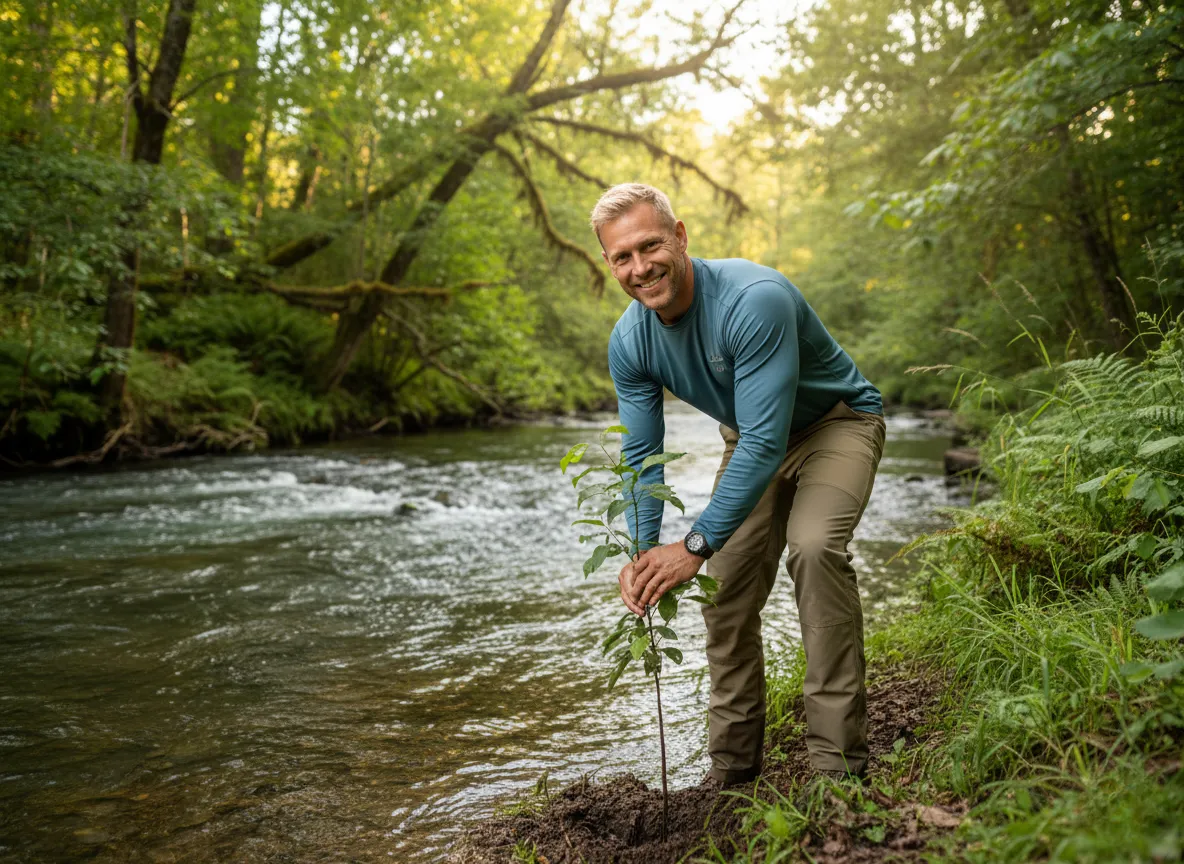
With that critical safety and legal framework in place, we can explore one of the most popular and effective projects for freshwater anglers. For an angler who is also a landowner, planting a riparian buffer is the undisputed “DIY Super-Project.” It’s a foundational part of any Backyard Angler Restoration effort. A “riparian forest buffer” is simply an area of land adjacent to a stream that contains a combination of native trees, shrubs, and perennial plants. Its power lies in its multi-tool ecological function. It dramatically improves Water Quality by filtering sediment and pollutants from runoff. It enhances Bank Stability as complex root structures bind the soil and prevent erosion. And it provides critical Fish Habitat and improves habitat connectivity by offering shade that lowers water temperatures and by becoming a source of terrestrial insects—a key food source for many fish species. The most effective approach is the “3-Zone Model”: Zone 1 (Bankside) uses trees and shrubs for stability and shade, Zone 2 (Middle) uses more trees and shrubs for filtering, and Zone 3 (Upland) uses native grasses to trap sediment before it ever reaches the stream.
A simplified how-to guide starts with mapping your site to plan the distribution of plants across the three zones. The next, and most important, step is to select a variety of native plants that are appropriate for your site’s specific moisture levels (Wet, Medium, Dry). A high-value, illustrative plant list for a temperate climate might include species like Oregon Ash for wet areas, Red Oak for medium-to-dry soils, and Roughleaf Dogwood for areas that are wet to dry. Once planted, maintenance, including invasive species control, is key. This includes controlling noxious weeds that will compete with your new plants and checking on tree shelters used to protect young saplings from deer and rodents. This project reinforces a powerful long-term vision: the trees you plant today become the “large woody debris” of the future, completing the riparian habitat restoration cycle. The principles of shoreline restoration, as detailed in guides like the USDA’s on Riparian Forest Buffers, connect directly to the foundational angling skill of learning how to read a river for fishing.
Pro-Tip: When sourcing plants, contact your local Natural Resources Conservation Service office or county extension. They can provide technical assistance and often have annual native tree sales offering inexpensive, locally-adapted saplings perfect for restoration projects. This is far more effective and affordable than buying from a commercial nursery.
The principles of shoreline restoration translate directly from freshwater streams to coastal habitats, where landowners can build living defenses against erosion.
Conclusion
Our journey from the quiet, barren bank of a struggling fishery to the heart of the restoration movement reveals a series of powerful truths. We know now that Habitat is the Limiting Factor; a clear consensus among federal agencies and fisheries managers identifies its degradation as the primary bottleneck, making its restoration our most critical long-term strategy. We’ve learned that Motivation is Key, requiring a nuanced, “dual-channel” approach that speaks to both the Utilitarian’s desire for better fishing and the Protectionist’s drive for ecological integrity. We’ve seen that Pathways Exist, with highly effective, angler-centric organizations like TU, CCA, and B.A.S.S. providing proven, “turn-key” models for any of us to get involved in meaningful, science-based community-driven projects. And most importantly, we understand that You Are the Agent of Change. From advocating for a federal project to planting a single native tree on a stream bank, every angler has the power to become a direct and indispensable force for the restoration of their home waters through dedicated volunteer engagement.
Your journey from angler to steward starts with a single step. Use the resources in this guide to find your local conservation chapter or contact your regional Fish Habitat Partnership this week. Make the call. Send the email. Show up for a meeting. The future of your fishery is in your hands.
Frequently Asked Questions about Angler Habitat Restoration
What’s the difference between habitat restoration and simply stocking fish?
Stocking is a short-term solution that adds fish to a system, while fish habitat restoration is a long-term solution that fixes the underlying problems, allowing fish populations to become self-sustaining. Restoration creates the conditions for fish to successfully spawn, feed, and shelter, addressing the root cause of decline rather than just treating the symptom.
Can a small project by one person really make a difference?
Absolutely. Yes, small-scale projects, when multiplied across a watershed by many individuals, create significant cumulative benefits for water quality and habitat. A project like planting a riparian buffer on your property directly reduces erosion and filters pollutants, contributing to the overall health of the entire downstream ecosystem.
Do I need a permit for a small habitat project on my own property?
Most likely, yes. Any work done in or near a waterway, even on private land, typically requires consultation with and/or permits from local, state, and federal agencies. Always follow the Step Zero rule: Stop, and Call First. Contact your state’s DNR, the local Army Corps of Engineers office, and your local floodplain administrator before beginning any work.
What’s the best way to get started if I have no experience?
The most effective way to start is by joining the local chapter of an established conservation organization like Trout Unlimited (TU) or the Coastal Conservation Association (CCA). These groups provide the training, expert guidance, and organized volunteer events that allow you to plug in to existing projects and learn the ropes in a supportive environment.
Risk Disclaimer: Fishing, boating, and all related outdoor activities involve inherent risks that can lead to injury. The information provided on Master Fishing Mag is for educational and informational purposes only. While we strive for accuracy, the information, techniques, and advice on gear and safety are not a substitute for your own best judgment, local knowledge, and adherence to official regulations. Fishing regulations, including seasons, size limits, and species restrictions, change frequently and vary by location. Always consult the latest official regulations from your local fish and wildlife agency before heading out. Proper handling of hooks, knives, and other sharp equipment is essential for safety. Furthermore, be aware of local fish consumption advisories. By using this website, you agree that you are solely responsible for your own safety and for complying with all applicable laws. Any reliance you place on our content is strictly at your own risk. Master Fishing Mag and its authors will not be held liable for any injury, damage, or loss sustained in connection with the use of the information herein.
Affiliate Disclosure: We are a participant in the Amazon Services LLC Associates Program, an affiliate advertising program designed to provide a means for us to earn advertising fees by advertising and linking to Amazon.com. As an Amazon Associate, we earn from qualifying purchases. We also participate in other affiliate programs and may receive a commission on products purchased through our links, at no extra cost to you. Additional terms are found in the terms of service.