In this article
The wind on the flats does not care about your effort; it only respects your efficiency. I recall standing on the bow of a skiff in the Keys, muscles burning as I tried to punch a heavy crab fly into a twenty-knot headwind. My guide, a man of few words, finally spoke up: “Stop fighting it. You can’t out-muscle the air.”
He was right. A fly cast that collapses halfway to the target is rarely a failure of strength. It is a failure of classical mechanics.
The unrolling loop is a dynamic equation involving energy conservation, fluid dynamics, and momentum moving through a resistant medium. As anglers, we often romanticize the art, but mastering the physics of fly casting is what actually puts the fly in front of the fish. By understanding the equations of motion behind this phenomenon, we transform the rod from a simple stick into a precision instrument. This allows us to punch through resistance not by casting harder, but by casting smarter.
This discussion breaks down the fly fishing mechanics: the rod as a flexible lever, the propagating loop as a nonlinear wave, the air drag that kills distance, and how specific line taper geometry manages energy release.
What Actually Powers the Fly Cast?

To maximize efficiency, we must first dispel the “loaded spring” myth and clarify the mechanical advantage that actually generates line velocity.
Is the Fly Rod a Spring or a Lever?
Contrary to popular belief, the fly rod does not function primarily like a bow shooting an arrow. It operates as a Class 3 Lever. Approximately 80% of the energy imparted to the line is derived from this leverage, which amplifies the rotation speed of the human arm into high tip velocity. The rod’s flexibility serves a secondary role—roughly 20%—acting as a spring to smooth the application of force and allow the tip to track in a straight line path.
Treating the rod purely as a spring leads to a common error known as “Creep.” This occurs when the caster unconsciously moves the rod forward without loading it, reducing the effective casting arc. This forces a sudden, inefficient spike in force to load the rod at the last second, treating it like a static energy tank rather than a dynamic lever.
Proper mechanics rely on Drift, which extends the arc. Since the work-energy theorem dictates that $Work = Force \times Distance$, a longer arc allows the lever to accelerate the line over a greater distance. This generates more speed with less perceived effort. Quantitative understanding of fly casting via robotic measurement validates this kinematic relationship, showing that tip velocity is primarily a product of rod rotation, minimizing the “spring” hypothesis.
This mechanical advantage relies heavily on understanding the anatomy of a fishing rod. The specific components, from the blank’s modulus to the handle’s position relative to the fulcrum, are what make this leverage possible.
Pro-Tip: To fix “Creep,” watch your rod tip during the backcast. Don’t let your hand move forward until the line has fully straightened behind you. Think “drift back, then accelerate forward.”
How Does the Double Haul Increase Kinetic Energy?
Once the rod is already in motion, you can add a massive amount of extra power to your cast without having to swing your arm any faster. This is why the double haul is so vital. By pulling the line with your non-casting hand, you are boosting the speed of the line itself. Because of the way energy works, even a small increase in line speed results in a huge jump in total power. This extra boost is what allows you to punch through the wind and reach those distant spots that a normal cast simply cannot reach.
The double haul manually pulls the line through the guides, adding the speed of the haul directly to the speed of the rod tip. Because of that squared relationship, a modest 30% increase in line speed results in a nearly 70% increase in loop energy. NASA’s definition of Kinetic Energy and Mass relationships provides the foundational physics formula confirming why velocity has such an exponential impact on the total energy delivered to the fly.
For this to work, hauling must occur during the acceleration phase—before the rod stops. Hauls which end before loop formation add velocity and energy efficiently; hauling too late only pulls the loop tight without adding launch energy. It is the most efficient method to maintain tension in a variable mass system. This is why selecting a beginner fly rod and reel with smooth guides is crucial for learning this technique.
How Does a Fly Line Defy Gravity?
With maximum energy generated by the lever and the haul, the line is launched. However, it must now survive the hostile environment of the air.
What is the Physics of the Propagating Loop?
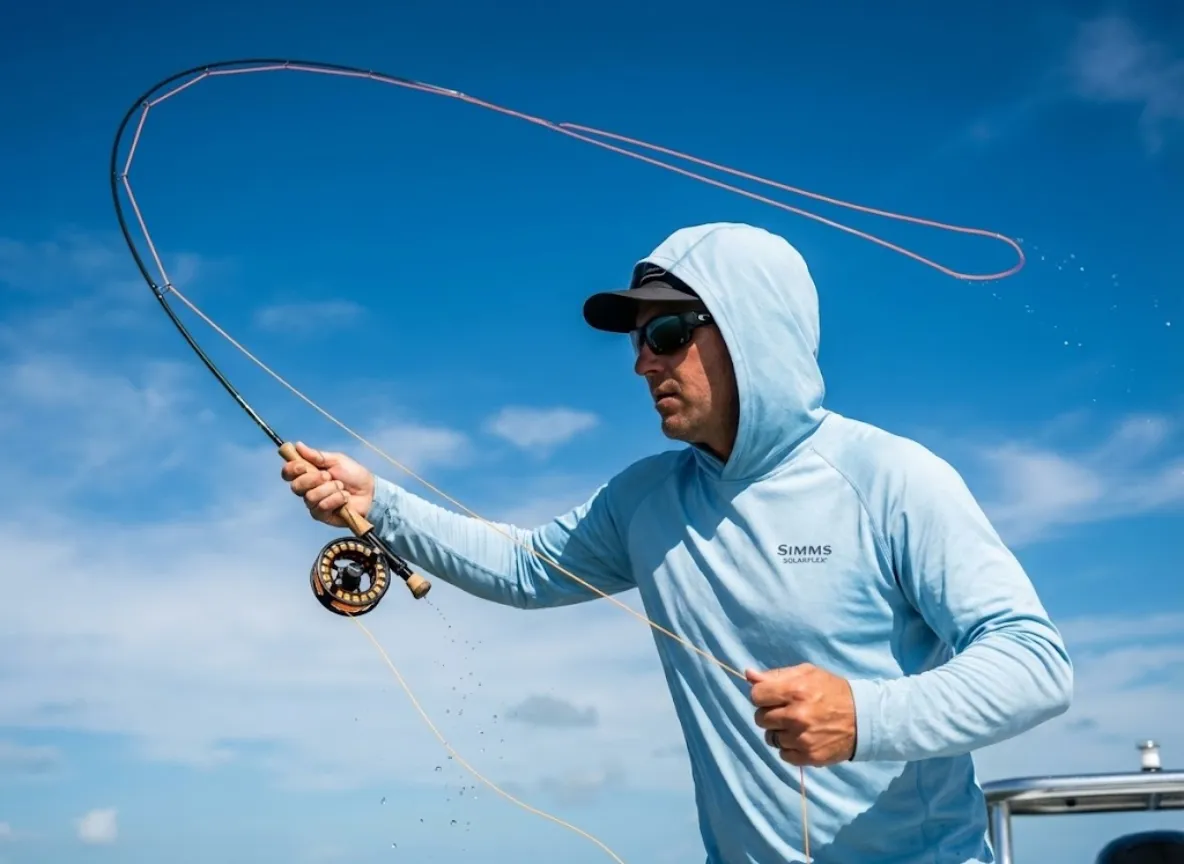
The fly loop is a nonlinear transverse wave that propagates along a flexible tether. It operates as a variable mass system: as the propagating loop unrolls, the mass of the traveling loop (the “fly leg”) decreases while the stationary “rod leg” gains length. According to the Conservation of Momentum, as the moving mass decreases, the velocity must increase to maintain momentum. This is what causes the fly to accelerate at the end of the cast, often resulting in the audible “whip crack” or bullwhip effect.
This acceleration is only possible if the energy inputs outweigh the energy dissipation from air drag. Tension is the structural glue of the cast. Without the resistance of the rod leg (the “Check”), the wave propagation cannot occur, and the loop collapses.
The loop effectively “consumes” the fly leg, transferring energy from the heavy line to the light leader. Physics Stack Exchange on Variable Mass Systems explains the complex momentum conservation principles that apply to systems losing mass, similar to how a rocket operates.
These principles become even more critical when discussing high altitude fishing physics. In these environments, low air density alters how gravity and drag forces interact with the loop, making loop stability harder to maintain.
Why Does Loop Shape Determine Casting Distance?
Momentum wants to push the fly forward, but the air acts as a brake. The winner of this contest is determined by the loop shape. Aerodynamics dictate that drag is composed of Form Drag (pressure on the loop face) and Skin Drag (air dragging along the line’s length).
Form drag creates a pressure wake behind the loop and creates resistance proportional to the frontal area. A wide loop presents a large surface area to the air, acting like a parachute that rapidly bleeds kinetic energy. The “Perfect Cast” utilizes a narrow, wedge-shaped loop to minimize this frontal area, slicing through the air with minimal viscous loss.
However, extremely narrow loops increase the risk of collision (wind knots) if the rod tip path is not perfectly straight. Climbing Loops (positive angle of attack) are superior because they generate aerodynamic lift, extending flight time by up to 4x compared to symmetrical loops. Research on the Effect of Loop Shape on the Drag-Induced Lift of Fly Line establishes the aerodynamic lift coefficients that prove why casting slightly upward yields better distance.
Generating these tight loops is often easier when understanding rod action. Fast-action rods recover quickly and facilitate the narrow tip path required to reduce form drag.
How Do Different Line Tapers Manage Energy?
While the caster controls the loop shape, the manufacturer controls the mass distribution and line density, which dictate how that energy is released.
Why Do Shooting Heads Outperform Double Tapers for Distance?
Shooting heads concentrate mass in the first 30-40 feet, creating a high-energy projectile. Once the head is aerialized, it pulls a thin, low-mass running line. This design significantly reduces Skin Drag on the rod leg. The reduction in friction means less energy is wasted “towing” the line, leaving more kinetic energy transfers for the turnover.
The trade-off is stability. The low-mass running line provides less tension (resistance) for the loop to push against, leading to potential hinging. Physics dictates that Weight Forward heads maintain higher terminal velocity, making them ideal for distance but poor for delicate arrivals. They rely on raw momentum transfer rather than the controlled deceleration of a double taper. The Mechanics of Flycasting: The Flyline provides velocity history data comparing these taper types, confirming why shooting heads are the superior tool for distance.
What Causes the Tailing Loop Phenomenon?
Understanding energy management also helps us diagnose errors. A tailing loop is a physical manifestation of a transverse shock wave introduced into the rod leg. It typically results from a “Concave Tip Path,” where the rod tip dips during the casting stroke due to uneven power application.
This dip sends a ripple down the line that intersects with the traveling loop, displacing the fly leg below the rod leg. Common causes include Creep (starting too early/shortening the arc) or “punching” the forward cast too abruptly. The physics solution is Constant Acceleration: applying force smoothly to maintain a Straight Line Path (SLP). Eliminating these shock waves preserves the integrity of the wave propagation.
Materials play a role in how these errors are transmitted. In the debate of graphite vs glass rods science, we see that while graphite offers power, fiberglass can sometimes dampen these shock waves more effectively due to its flexibility.
Pro-Tip: To prevent tailing loops, visualize painting a ceiling with a roller. You must apply pressure evenly from start to finish. If you flick your wrist (shock) at the end, paint flies everywhere. Smooth, constant acceleration keeps the paint—and your fly line—controlled.
Conclusion
Maximizing loop energy isn’t about gym time; it’s about actual physics. The rod is a flexible lever, not a bow; utilize Drift to maximize your arc. Remember that Drag forces scale with velocity squared; you cannot fight the air, you must slice through it with narrow loops. Lift is real, and a climbing loop acts like a wing, carrying your fly further. Finally, match your line taper to the job—Shooting Heads for raw distance, Double Tapers for control.
Next time you are on the water, stop fighting the air. Visualize the wave you are creating, smooth your acceleration, and let the physics do the heavy lifting.
FAQ – Frequently Asked Questions about Fly Line Physics
Why does my fly line crack like a whip?
This is the Conservation of Momentum in action. As the heavy loop unrolls, the mass of the moving line decreases rapidly. To conserve momentum ($p=mv$), the velocity ($v$) of the remaining lightweight tip must spike. This causes the tip to break the sound barrier if not dampened by a properly tapered leader.
Does a tighter loop always cast further?
Generally, yes, because a tight loop reduces the frontal area, which linearly reduces Form Drag. However, the loop must be stable. If it is too tight, the rod leg and fly leg may collide, dissipating energy into friction or causing tangles.
How does wind affect the energy of the loop?
Headwinds effectively increase the airspeed in the drag equation ($D \propto v^2$), exponentially increasing resistance. To counter this, anglers must increase line speed (via hauling) and tighten the loop to minimize the surface area the air molecules can act upon.
Is the rod tip path really a straight line?
Ideally, yes. The Straight Line Path (SLP) ensures all energy vectors are directed toward the target. The rod bends (spring effect) to compensate for the rotational movement of the arm, flattening what would otherwise be a convex arc into a straight path.
Risk Disclaimer: Fishing, boating, and all related outdoor activities involve inherent risks that can lead to injury. The information provided on Master Fishing Mag is for educational and informational purposes only. While we strive for accuracy, the information, techniques, and advice on gear and safety are not a substitute for your own best judgment, local knowledge, and adherence to official regulations. Fishing regulations, including seasons, size limits, and species restrictions, change frequently and vary by location. Always consult the latest official regulations from your local fish and wildlife agency before heading out. Proper handling of hooks, knives, and other sharp equipment is essential for safety. Furthermore, be aware of local fish consumption advisories. By using this website, you agree that you are solely responsible for your own safety and for complying with all applicable laws. Any reliance you place on our content is strictly at your own risk. Master Fishing Mag and its authors will not be held liable for any injury, damage, or loss sustained in connection with the use of the information herein.
Affiliate Disclosure: We are a participant in the Amazon Services LLC Associates Program, an affiliate advertising program designed to provide a means for us to earn advertising fees by advertising and linking to Amazon.com. As an Amazon Associate, we earn from qualifying purchases. We also participate in other affiliate programs and may receive a commission on products purchased through our links, at no extra cost to you. Additional terms are found in the terms of service.