In this article
The vibration of a strike traveling up a graphite rod is a sensation that predates recorded history. It is a direct current connecting the modern angler to the first hominid who realized the water held life.
I have spent forty years on the water, from high mountain streams to the deep salt, yet every time I hold a rod, I feel I am shaking hands with my ancestors. This is not just a chronicle of tools; it is the timeline of the evolution of the angler. It charts our journey from a hunter-gatherer lifestyle using bone gorges to conservationists wielding aerospace composites.
Here is the chronological narrative of how we evolved from the organic to the synthetic, and why the history of fishing is the history of us.
Epoch I: The Organic Era – Survival and Instinct

What evidence exists that early humans were skilled anglers?
Anthropology confirms that humans mastered fishing techniques over 40,000 years ago. This isn’t speculation based on found tools; it is a fact written in the chemical signature of ancient bones from the Upper Paleolithic era.
The most compelling proof comes from the Tianyuan Cave near Beijing. Researchers performed stable isotope dietary analysis of the Tianyuan 1, a human skeleton dating back 40,000 years. By measuring the Sulfur-34 isotopes in the bone collagen, they discovered a distinct chemical signature that separates freshwater protein from terrestrial meat. This isotopic analysis confirmed that freshwater fish, likely carp, were a dietary staple for the Tianyuan man long before sophisticated fishing tackle appeared in the archaeological record.
While some humans mastered the rivers, others conquered the ocean. Excavations at the Jerimalai shelter in East Timor revealed tuna bones dating back 42,000 years. Catching pelagic species like tuna implies the existence of the first maritime industry. These early fishing communities possessed seaworthy craft and the cognitive ability to plan for seasonal migrations. These ancient mariners were already capable of selecting essential fishing tools from shell and bone that mirrored the specific prey they targeted.
How did the prehistoric gorge hook function compared to modern tackle?
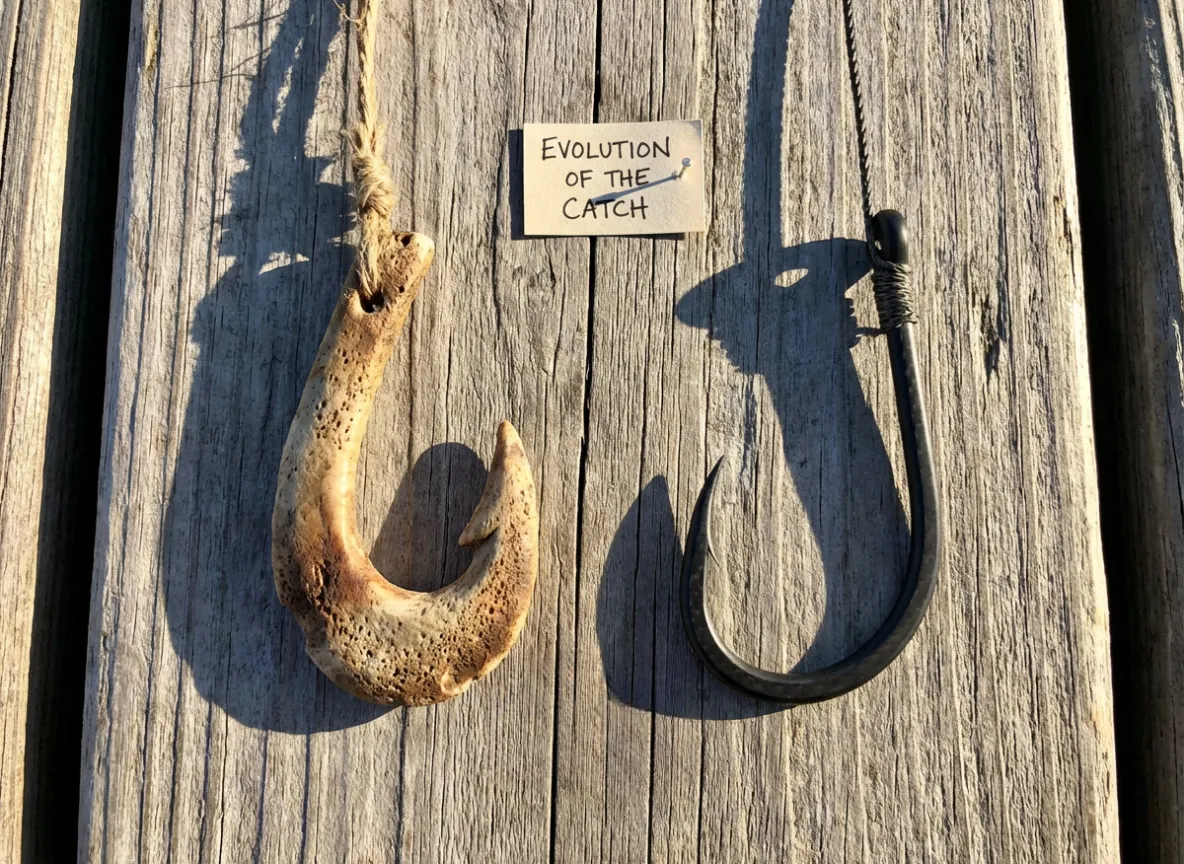
Before the invention of the fishing net or weir basket, the gorge hook reigned supreme. It functioned on a mechanical principle called a “toggle,” distinct from the curved penetration of modern fishing hooks.
A gorge is a straight sliver of bone, wood, or stone sharpened at both ends. It was buried parallel inside a piece of bait. When a fish swallowed the bait and tension was applied to the line (often made of flax or animal sinew), the gorge would rotate 90 degrees, lodging crosswise in the fish’s gullet. This method relied entirely on the fish swallowing the bait deep, resulting in high mortality. It was a tool of subsistence fishing, where the only goal was securing calories.
Today, we see the mechanical descendant of the gorge in the modern circle hook. However, the intent has reversed. While the gorge was designed to kill, the circle hook is designed to save. By curving the point back toward the shank, the hook slides out of the gullet and rotates into the corner of the jaw, facilitating catch and release.
Pro-Tip: When using circle hooks, never strike to set the hook. Simply reel down until the line is tight. Striking pulls the hook out of the fish’s mouth, whereas reeling allows the mechanical “toggle” design to catch the jaw hinge.
This evolution highlights our shift in responsibility. We now use ancient physics to reduce gut-hooking mortality using circle hooks, ensuring the resource survives. The transition from the primitive gorge to the science behind fishing hook sizes demonstrates how we have refined our fishing gear to prioritize precision over brute force.
Epoch II: The Metal & Manuscript Era – The Birth of Sport
When did fishing transition from labor to leisure?
The shift from subsistence fishing to recreational angling began when ancient civilizations produced enough surplus food to allow for leisure. In Ancient Egypt, fishing took on a philosophical dimension. Tomb paintings and tomb reliefs, such as those in the Tomb of Menna, depict noblemen fishing in the marshes of the Nile River. This was not just for food, but a ritual of restoring Maat (order) over the chaos of the wild.
This philosophical divide grew in the Mediterranean Basin. Oppian of Corycus described fishing as a form of war and deceit in his work Halieutika. Conversely, Claudius Aelianus recorded the first instance of artificial fly fishing. He observed Macedonians on the Astraeus River wrapping hooks in red wool and feathers to mimic local insects—the ancestors of the modern beginner fly fishing guide.
By the Middle Ages, the ethics of the sport began to crystallize in England. In 1496, Dame Juliana Berners (credited in the Boke of Saint Albans) published the Treatyse of Fysshynge wyth an Angle. This text established the concept of a bag limit based on conscience rather than law, urging the fisherman not to take more than needed.
You can read the original text of the Treatyse of Fysshynge wyth an Angle to see how early these ideals formed. This lineage of thought culminated in Izaak Walton’s The Compleat Angler (1653), which solidified the “Brotherhood of the Angle” and framed fishing as a meditative act.
How did the “Kentucky Reel” revolutionize casting?
For centuries, the fishing reel was little more than a storage winch with a 1:1 gear ratio. It held the line, but it did not help fight the fish or cast the lure. That changed in the early 19th century in Kentucky.
George Snyder, a watchmaker and angler, applied the mechanics of clock gears to the fishing reel around 1810. He invented the “multiplying reel,” commonly known as the Kentucky reel. A single turn of the handle rotated the spool three or four times. This increase in speed allowed for rapid line retrieval, transforming fishing from a passive wait into an active pursuit using artificial lures.
Later, Kentucky artisans like Meek and Milam introduced jeweled bearings—using sapphires and rubies to reduce friction. This precision engineering gave birth to the bait-casting reel, capable of casting a lure directly from the spool rather than stripping line by hand.
While Oppian’s Halieutica on fishing techniques described fishing as a battle of wits, the Kentucky reel turned it into a battle of mechanics and skill. This invention laid the groundwork for The Baitcaster Casting Blueprint, requiring anglers to master thumb control and spool tension.
Epoch III & IV: The Industrial to Digital – Material Science
Why was split cane bamboo an engineering marvel?
With reels now capable of speed, the fishing-rod needed to catch up. Before the 1800s, rods were made of solid woods like ash wood, hickory, or Lancewood. These were heavy, slow to recover from a bend, and prone to warping. The solution was found in the anatomy of bamboo.
Rod builders realized that the strongest fibers of bamboo are located in the enamel, the outermost layer. By splitting the cane into triangular strips and gluing six of them together, they created a hexagonal rod. This construction placed the dense power fibers on the perimeter, maximizing the “Second Moment of Area,” a physics principle that creates immense stiffness with minimal weight.
Bamboo functions as a natural composite material. It possesses a unique damping quality that absorbs shock, making it the perfect tool for delicate fly-fishing techniques. This technological leap mirrored the broader academic review of fishing and societal development, where industrial revolution techniques were applied to leisure. Today, when identifying the parts of a fishing rod, the terms “taper” and “action” are direct legacies of the split cane era.
How did the chemistry of Nylon and Carbon Fiber redefine performance?
The final leap in the history of fishing occurred in a laboratory. In 1935, Wallace Carothers at DuPont synthesized Nylon 6,6. When Stren launched its monofilament line in 1958, it democratized sport fishing. Nylon was strong, translucent, and, crucially, it did not rot like the horsehair line or silk line of the past.
Following nylon, the introduction of aerospace carbon fiber (graphite) in the 1970s changed rod building forever. Graphite fibers have a high “Young’s Modulus,” meaning they are incredibly stiff for their weight. This stiffness transmits vibration efficiently, allowing an angler to feel a fish breathe on the bait in deep water.
However, efficiency came at a price. The ability to extract fish with industrial precision led to ecological disasters, such as the collapse of the Atlantic Cod fishery on the Grand Banks. Looking at five centuries of cod catch data reveals the danger of technology without restraint. The deployment of the steam trawler and massive fishing fleets turned overfished waters into barren deserts.
Pro-Tip: Modern graphite is sensitive but brittle. Never “high-stick” your rod (lifting it past 90 degrees vertical) when landing a fish, as this point-loads the tip and will cause it to snap.
Today, the choice when comparing braid vs fluorocarbon vs monofilament is a luxury of chemistry that our ancestors could never have imagined.
Conclusion
Fishing is not a recent hobby; it is a 40,000-year-old survival strategy that we have refined into an art form. The gear evolution timeline—from the gorge hook to the Kentucky reel—has always been driven by the desire to solve the mechanical problems of reach, depth, and speed.
True angling mastery involves understanding that your high-modulus carbon rod is simply a modern refinement of the first stick picked up by a human hand. But with this advanced technology comes a responsibility that the Tianyuan man never faced. We have the power to empty the oceans, and therefore we must have the discipline to protect them.
Next time you tie a knot or cast a line, remember the legacy in your tackle box. Explore the principles of fish conservation for anglers to ensure this fishing tradition continues for the next generation.
FAQ – Frequently Asked Questions
When did humans first start fishing?
Evidence suggests fishing began at least 40,000 years ago during the Upper Paleolithic era. Isotopic analysis of the Tianyuan Man remains proves that freshwater fish were a significant part of the human diet by this time.
What was the first fishing tool invented?
The gorge hook, a straight piece of bone or wood sharpened at both ends, is considered one of the earliest specialized tools. It functioned by toggling sideways in a fish’s throat, differing from the curved fishing hooks we use today.
Who invented the fishing reel?
While simple winders existed earlier, the modern multiplying reel was invented by George Snyder in Kentucky around 1810. His geared design allowed the spool to spin faster than the handle, enabling rapid retrieval and eventually casting.
How did the invention of nylon change fishing?
DuPont’s invention of nylon in the 1930s replaced rotting organic lines like horsehair line and silk line with a durable, translucent, and elastic material. This made high-performance fishing affordable and accessible to the average fisherman for the first time.
Risk Disclaimer: Fishing, boating, and all related outdoor activities involve inherent risks that can lead to injury. The information provided on Master Fishing Mag is for educational and informational purposes only. While we strive for accuracy, the information, techniques, and advice on gear and safety are not a substitute for your own best judgment, local knowledge, and adherence to official regulations. Fishing regulations, including seasons, size limits, and species restrictions, change frequently and vary by location. Always consult the latest official regulations from your local fish and wildlife agency before heading out. Proper handling of hooks, knives, and other sharp equipment is essential for safety. Furthermore, be aware of local fish consumption advisories. By using this website, you agree that you are solely responsible for your own safety and for complying with all applicable laws. Any reliance you place on our content is strictly at your own risk. Master Fishing Mag and its authors will not be held liable for any injury, damage, or loss sustained in connection with the use of the information herein.
Affiliate Disclosure: We are a participant in the Amazon Services LLC Associates Program, an affiliate advertising program designed to provide a means for us to earn advertising fees by advertising and linking to Amazon.com. As an Amazon Associate, we earn from qualifying purchases. We also participate in other affiliate programs and may receive a commission on products purchased through our links, at no extra cost to you. Additional terms are found in the terms of service.