In this article
The monofilament snaps with the sound of a pistol crack, sending your expensive lure sailing into the horizon—completely unattached. Or worse, the line leaves the spool in a snarled, helical mess that chokes the first guide and halts your cast instantly. These failures are not bad luck; they are the result of ignoring rotational dynamics during your DIY fishing tackle preparation.
As a guide who has spent countless hours on the water, I can tell you that fishing line is the single point of failure between you and the fish. Yet, its installation is often the most misunderstood discipline in angling. If you treat spooling line as a chore rather than a critical aspect of fishing gear maintenance, you are setting yourself up for frustration.
This guide transforms that process. We will move beyond the anecdotal “label side up” guessing games and apply a specific protocol based on the physics of line twist. By mastering the “Zero-Twist” method, you ensure your reels operate silently and effectively. This lets you focus on the ecosystem around you rather than the tangle in your hands, whether you are using a rugged Ugly Stik or a refined Pflueger President.
Why Does Fishing Line Twist and How Do We Stop It?

To fix line twist, we must first accept a hard truth about spinning reels: their design inherently creates torsion. Unlike a baitcasting reel or even a closed-face reel (spincast), a spinning reel operates on a 90-degree redirection principle. The reel spool remains stationary while the rotor wraps the line around it.
For every single revolution of the rotor, one full twist is geometrically introduced into the line. If you pull line off the end of a supply spool (uncoiled) rather than unrolling it, you also introduce one twist per loop. This creates a compounding problem for new anglers and veterans alike.
The “Zero-Twist” state is achieved through Rotational Matching. The twist created by the line leaving the supply spool must cancel out the twist created by the reel’s rotor. This is based on the principles of rotational dynamics and helix geometry. Since most spinning reels rely on clockwise rotation, the line must usually spiral off the supply spool in a counter-clockwise direction to achieve neutrality.
Many rely on the old “label side up” or “label side down” rule, but this is unreliable. Manufacturers do not consistently wind supply spools in the same direction. The only way to guarantee performance is to understand these essential fishing terms and visually verify the directionality yourself.
How Should You Prepare Your Equipment Before Spooling?
Before we touch the reel handle, we must address the material properties of the fishing lines. Different polymers—like monofilament (mono) and braided line (braid)—require different handling to ensure they sit correctly on the arbor.
Does monofilament line really need to be soaked?
Yes, if you want manageable line. Nylon monofilament is hydroscopic, meaning it readily absorbs water molecules into its polymer matrix. Soaking your supply spool in a bucket of water (warm, approx. 40°C) for 15-60 minutes acts as a plasticizer.
This process lowers the Glass Transition Temperature (Tg), relaxing the line memory of the supply spool shape. According to research on the absorption of water by polyamide (nylon) structures, this moisture uptake alters the mechanical properties of the material.
The result is a line that is far more pliable. This allows the nylon to conform to the smaller arbor of your fishing reel without springing off in coils. You can also use a commercial line conditioner like Real Magic to further soften the line.
Pro-Tip: Never use boiling water. Excessive heat degrades UV stabilizers and tensile strength. Warm tap water is the thermal limit for safe relaxation.
It is worth noting that while nylon loves a bath, Fluorocarbon is hydrophobic. It benefits less from soaking line and requires strictly thermal management. Understanding the differences between braid, fluorocarbon, and monofilament is critical for choosing the right prep method.
Why does braided line require backing or tape?
Braided line (PE) has a chemically inert surface with a near-zero coefficient of friction. If you tie it directly to a smooth metal or graphite spool arbor, the entire mass of line will rotate under pressure. This failure is known as “Ghost Drag.”
To prevent this, you must apply an “anchor” of high-friction material to the arbor first. The preferred method is Mono Backing. You wind several layers of cheap monofilament first, which grips the spool, and then connect it to the braid. Avoid a simple slip knot or overhand knot here; they will slip.
The connection is made using a Double Uni Knot (or a clean Blood Knot), which is slim enough to be buried by the line lay without creating a bump. While mastering the Angler’s Knot Matrix, ensure you are comfortable with the Arbor Knot for the initial connection. Electrical tape or masking tape is a secondary option to grip the arbor, but mono backing provides a superior, level bedding for the braid to pack against.
How to Spool a Spinning Reel Correctly?
With the line prepped and the arbor secured, we move to the physical execution. This is where we integrate the “Counter-Clockwise Rule” and strict tension control. Grab your scissors or nippers to trim tags close.
How do you perform the “20-Crank Verification” test?
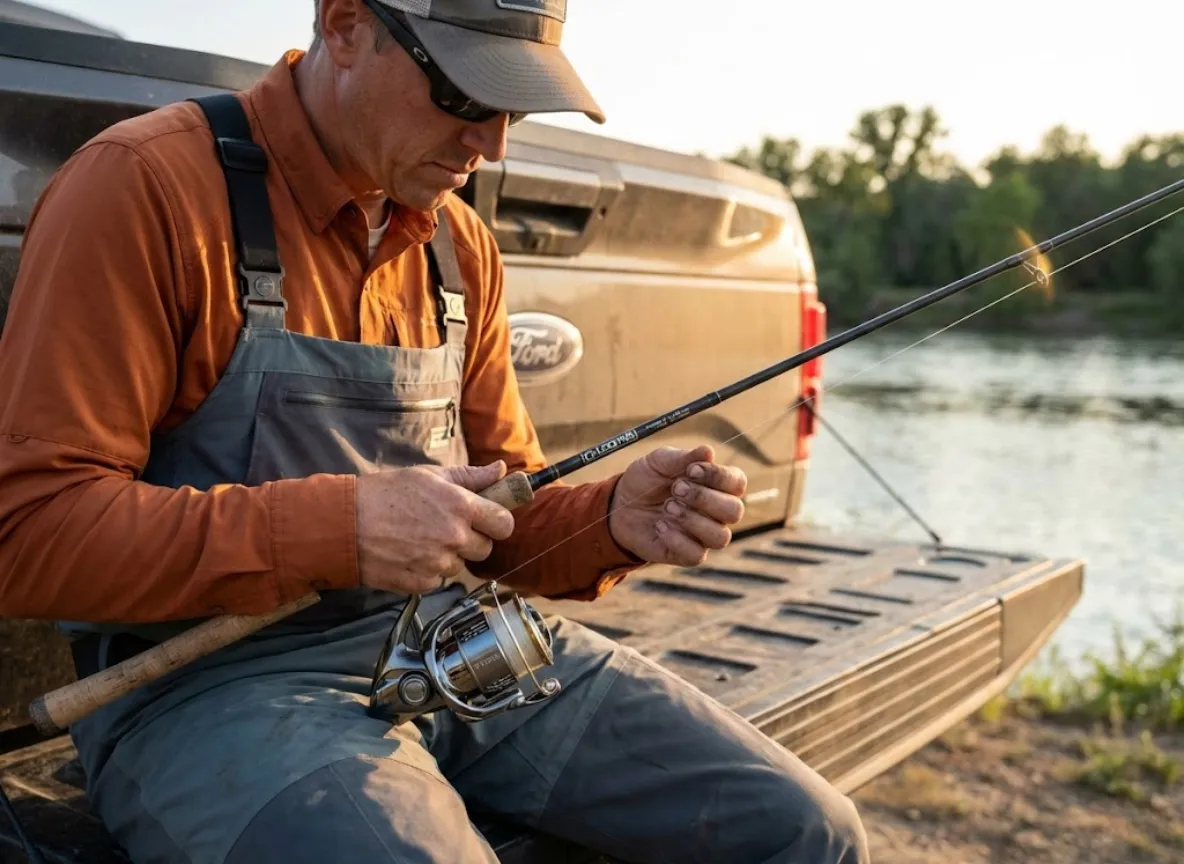
Place the supply spool flat on the floor. Verify the line exits in a Counter-Clockwise spiral, matching the standard clockwise rotor of your reel. Open the bail arm (or open bail), run through rod guide (specifically the first butt guide or rod eyes), and attach it to the spool.
Wind the reel handle approximately 20 times to lay a foundation of line. The line should pass over the line roller smoothly. Now, stop. Stop winding and drop the rod tip toward the spool to create slack line.
If the line hangs in a relaxed curve, your orientation is correct; continue filling. If the line instantly twists into kinks or snarls, the orientation is wrong. Flip spool if tangling occurs immediately to reverse the input geometry. This simple check saves hours of headache on the water.
How much tension should be applied during winding?
Never wind line onto a reel without resistance. Loose coils lead to casting loops and wind knots. Use the wet towel pinch: hold the line with a damp towel between your thumb and forefinger just above the reel. Apply moderate tension—enough to put a slight bend in the rod tip.
Some anglers suggest running the line through a phone book or having a partner holding spool, but the wet cloth method gives you the most direct control. Material variance plays a huge role here. Mono requires moderate pressure to prevent stretching, while Braid requires heavy tension (3-5 lbs).
Because of the mechanical properties of high-modulus polyethylene fibers, braid has very low friction. If not packed densely, the thin line will slice through loose underlying layers under drag pressure, a disaster called “digging in.”
Stop filling when the line creates a gap of exactly 1/8th inch (3mm) (or 3mm gap) from the spool lip or spool rim. Do not overfill. Overfilling is the primary cause of wind knots and reduced casting distance. This precise fill level ensures the line flows freely, which is essential when setting your fishing drag for a fight.
How to Spool a Baitcasting Reel?
While spinning reels require complex geometric line management, baitcasting reels operate on a simpler principle. They function as winches, meaning the spool rotates to accept line directly without a 90-degree twist.
How does the “Pencil Method” differ for baitcasters?
Because a baitcaster does not twist the line, the line must come off the supply spool straight, not in spirals. If you lay the supply spool flat as you would for a spinning reel, you will introduce massive twist into the system, leading to a nasty backlash or bird’s nest.
Insert a pencil or pen through the center of the supply spool. Have a helper hold it, or use a tensioned line spooling station. The supply spool must rotate on its axis (line coming off top), unrolling like toilet paper, as the line feeds into the reel.
Apply tension directly to the supply spool by squeezing the sides rather than pinching the line itself. This saves your fingers from braid burns and ensures an even lay. Once spooled, you are ready to explore The Baitcaster Casting Blueprint and get on the water.
Conclusion
Spooling your reel is not just maintenance; it is the baseline requirement for success. Remember the core principles of loading correctly:
- Geometry is Destiny: For spinning reels, match the rotor’s wrap with a counter-clockwise supply feed.
- Material Awareness: Soak nylon to relax its memory; back braid with mono to anchor it.
- The 20-Crank Rule: Never guess. Verify the line lay visually after 20 turns.
- Tension is Critical: Pack braid tight to prevent digging and leave a 1/8 inch gap at the lip.
Finally, always close the bail by hand (manual bail closing) after a cast rather than cranking the handle to snap it shut. This reduces twist significantly. Now that your reel is tuned for performance with tour grade line, the next step is connecting to the fish. Explore our full library of gear guides to ensure your terminal connections are as secure as your spool.
FAQ – Frequently Asked Questions
Which way should the label face when spooling a spinning reel?
The label side up rule is unreliable. Instead, place the spool flat and ensure the line uncoils in a counter-clockwise rotation. Always perform the 20-Crank Test to visually verify that no twist is being introduced.
Do I really need to put backing on braided line?
Yes. Braided line is too slippery to grip the spool arbor on its own and will slip under pressure (Ghost Drag). Use a few layers of monofilament backing or a strip of electrical tape to create a non-slip anchor.
How full should I fill my fishing reel spool?
Fill the reel spool until the line is approximately 1/8th of an inch (3mm) from the outer rim of the spool. Overfilling causes the line to jump off in clumps (wind knots), while underfilling creates friction against the spool lip that reduces casting distance.
How can I remove line twist without cutting the line?
Remove all terminal tackle (hooks, lures, ball bearing swivels) and let the empty line drift behind a moving boat. Alternatively, walk the line off through short grass. The friction of the water or grass will naturally pull the twists out of the line as you reel it back in under tension.
Risk Disclaimer: Fishing, boating, and all related outdoor activities involve inherent risks that can lead to injury. The information provided on Master Fishing Mag is for educational and informational purposes only. While we strive for accuracy, the information, techniques, and advice on gear and safety are not a substitute for your own best judgment, local knowledge, and adherence to official regulations. Fishing regulations, including seasons, size limits, and species restrictions, change frequently and vary by location. Always consult the latest official regulations from your local fish and wildlife agency before heading out. Proper handling of hooks, knives, and other sharp equipment is essential for safety. Furthermore, be aware of local fish consumption advisories. By using this website, you agree that you are solely responsible for your own safety and for complying with all applicable laws. Any reliance you place on our content is strictly at your own risk. Master Fishing Mag and its authors will not be held liable for any injury, damage, or loss sustained in connection with the use of the information herein.
Affiliate Disclosure: We are a participant in the Amazon Services LLC Associates Program, an affiliate advertising program designed to provide a means for us to earn advertising fees by advertising and linking to Amazon.com. As an Amazon Associate, we earn from qualifying purchases. We also participate in other affiliate programs and may receive a commission on products purchased through our links, at no extra cost to you. Additional terms are found in the terms of service.