In this article
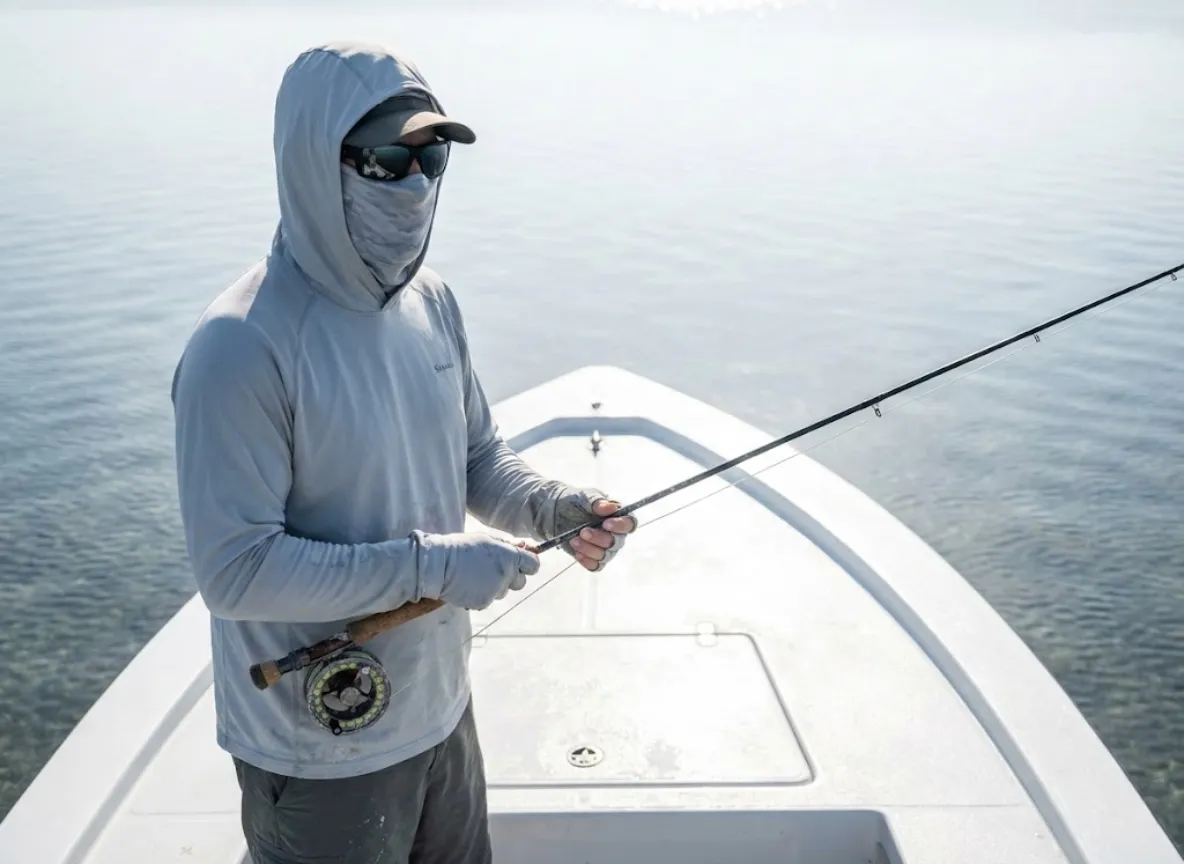
The sun on a shallow flat or open ocean doesn’t just shine; it assaults. If you have spent any significant time on the bow of a skiff at noon, you know the feeling. It is not warmth. It is pressure. Photons bombard you from the solar disk above, the mirror-like surface below, and the white fiberglass deck underfoot.
You are standing in a solar reactor.
After decades on the water, both guiding and fishing, I’ve learned that standard cotton t-shirts fail before the first cast is made. This is not a recreational environment; it is a radiative trap. To survive this exposure without cumulative cellular damage, we must stop viewing our clothing as fashion and start viewing it as engineered outdoor performance apparel—specifically, Personal Protective Equipment (PPE).
True protection requires understanding the strict laws of applied physics—specifically optics and thermodynamics. This guide will take you from the marketing labels of “bamboo” and “breathability” to the hard science of refractive indices and molecular shielding. You will understand exactly why your gear works, or why it fails.
The Solar Reactor – Defining the Hazard Profile

Most anglers underestimate the sun because they only look up. However, on the water, the danger is multi-directional. To protect yourself, you must understand the specific physics of water reflection in the aquatic environment.
What is the “Angler’s Albedo” and why does it matter?
Albedo is the measure of diffuse reflection of solar radiation out of the total solar radiation received by a surface. In an angling context, the albedo effect explains why you burn twice as fast on a boat as you do on a golf course. Anglers are suspended between two radiation sources: the direct sun and the water surface.
This is the “Solar Reactor” effect. While grass absorbs most UV radiation (low albedo), water reflects it. This effect is amplified by Fresnel Reflection. When the sun is at a low angle, such as early morning or late evening, the reflectivity of the water increases dramatically. This bounces nearly 100% of UVA rays and UVB rays directly under the brim of your hat and into your nose and neck area.
A rough sea state with whitecaps (diffuse scatterers) increases the UV load differently than flat water (specular reflection). It scatters light into areas you thought were shaded.
The threat doesn’t stop at the water line. The Boat Deck Effect turns your vessel into a third reflector. White gel coats are pigmented with Titanium Dioxide—the most reflective white pigment known to man. This irradiates the angler from below. When you combine Direct + Sky Scatter + Water Reflection + Deck Reflection, the total UV load is catastrophic.
This physics explains the medical reality that occupational exposure to ultraviolet reflection causes anglers to disproportionately suffer skin cancer on the ear helix and underside of the chin. A hat is never enough. You need 360-degree protection, pairing your sun-protective clothing with the best polarized sunglasses for fishing to manage ocular albedo and prevent cataracts alongside skin DNA damage.
How do “Cover Factor” and porosity determine protection?
Cover Factor (CF) is the ratio of the fabric surface covered by yarns versus the open space, or pores. It is the first mechanical layer of defense.
UV radiation travels in straight lines. This creates the “Pinhole Effect”: any gap between fibers (inter-fiber pores) or yarns (inter-yarn pores) allows direct transmission of radiation to the skin. The mathematical limit of protection is strict: the maximum UPF rating is inversely proportional to optical porosity.
This creates a physics paradox between thermal comfort and “Protection.” To make a shirt flow more air, you must make it more porous. To block light, you must close the pores with tightly woven fabric.
Pro-Tip: Perform the “Hold it to the Light” test. Take your fishing shirt and hold it up against a bright light source or the sun. If you can see distinct points of light coming through the weave, UV rays are hitting your skin. A true UPF 50+ shirt should block almost all visible light in this test.
Manufacturers solve this through Cross-Sectional Engineering. Instead of round fibers, they use multi-lobed shapes (like stars or clovers). These shapes fit together like puzzle pieces to block direct lines of sight while maintaining some airflow. They also utilize Micro-denier yarns, packing thousands of smaller fibers into the space of a few large ones.
Heavier fabrics generally have higher cover factors, but wearing heavy gear in the tropics is dangerous for other reasons. Understanding the extended cover factor theory in UV protection helps us select gear that balances weave density with tolerable fabric weight (GSM). This is especially vital when dealing with high altitude fishing physics where the atmosphere provides less natural filtration.
Material Science – The Chemistry of the Shield
Weave density is mechanical protection. But what is the fiber actually made of? This is where the difference between a \$20 shirt and a \$100 shirt usually lies.
What is the difference between “Doping” and “Coating”?
Extrinsic Protection (Coating) is the application of UV-inhibiting additives (like benzotriazoles) as a finish on the fabric surface. It is cheap and effective—at first.
The problem is the Durability Failure. Laundry detergents and simple abrasion strip these chemical finishes rapidly. Data suggests that coated UPF 50+ garments can drop to UPF <20 after roughly 30-40 washes. You are left wearing a shirt that you think protects you, but functionally does not.
Intrinsic Protection (Doping) is superior. This involves “Melt Spinning,” where ceramic particles (usually Titanium Dioxide or Zinc Oxide) are mixed into the liquid polymer before it is extruded into fiber. The UV protection is locked inside the fiber’s DNA through molecular absorption. It cannot wash out.
These embedded ceramic TiO2 particles (approx. 200nm size) utilize Mie Scattering. They deflect UV photons, bouncing them around inside the fiber until the energy dissipates. This is why you should look for “solution-dyed” or “doped” gear. It costs more, but it maintains its safety margin for the life of the garment.
Research into sustainable UV shielding materials and mechanisms confirms that doped fibers offer consistent performance. To protect this investment, you should follow protocols for sustainable fishing gear maintenance to avoid damaging the fiber structure itself, even if the chemicals are internal. Look for labels citing ASTM D6544 or AATCC 183, which verify the fabric has been tested for durability.
Why does a wet shirt lose its protective power?
Water is the enemy of optics. A dry shirt protects you because of the Refractive Index (n) mismatch.
When your shirt is dry, the air and the fabric are very different, which causes light to bounce off the surface and make the material look solid. However, water is much more similar to the fabric than air is. When the shirt gets wet, that similarity allows light to pass through the fibers instead of bouncing away, which is why wet clothes become see-through or change color.
When your shirt gets wet, water fills the tiny air gaps between the fibers. This creates a sort of ‘bridge’ that lets light pass right through the fabric instead of bouncing off it, making the material see-through. This ‘wet T-shirt’ effect is a big problem for fishermen because it means the shirt loses a lot of its sun protection the moment it gets soaked.
UPF Fabric Performance Guide
A technical comparison of failure modes between Cotton and Specialized Polyester under real-world angling conditions.
Mechanism
Refractive Index Matching: Water (n=1.33) fills pores, matching fiber (n=1.54). Scattering drops significantly.
Polyester Performance
Negligible: Hydrophobic fibers shed water. Interface maintained. UPF remains stable.
Impact on Angler
Wet cotton offers virtually no protection. Translucency allows UV to penetrate directly to the skin.
Cotton Risk
High Risk: Natural fibers lack elastic recovery, staying “bagged out” and keeping pores permanently open.
Polyester Recovery
Elastane blends allow recovery, though protection still drops slightly at the apex of a stretch.
Angler Tip
A tight shirt is a porous shirt. Size up to ensure the fabric remains unstretched for maximum safety.
Mechanism
Micro-Abrasion: Salt crystals act as sandpaper, grinding fibers during physical movement.
Resistance
Cotton (High Vulnerability): Soft fibers fibrillate quickly. Polyester (Moderate): High tenacity fibers resist abrasion better.
Care Requirement
Always rinse gear with fresh water after saltwater exposure to prevent long-term mechanical breakdown.
Mechanism
Photo-oxidation: UV energy breaks polymer bonds, leading to yellowing and weakening of the material backbone.
Durability
Polyester: PET rings absorb UV without breaking the backbone. Cotton: Cellulose yellows and loses tensile strength over time.
Lifecycle
Synthetic technical gear lasts significantly longer under the constant high UV load of offshore environments.
Cotton vs. Polyester: Cotton is hydrophilic (water-loving). It swells, absorbing water into the fiber itself, replacing all air voids. This leads to a catastrophic drop in protection, often falling below UPF 5.
Hydrophobic Synthetics: Nylon and polyester resist water absorption. They maintain the fiber-air interface better and shed water quickly to restore opacity. This is known as Hydrochromism—the darkening of wet fabric is actually a visual signal of increased UV transmission.
Do not rely on wet cotton for cooling. Wetting a shirt for evaporation inherently increases UV transmission via the hydration effect. This is why ceramic doping is critical—it works wet or dry. The physics here is similar to how the best rain gear for fishing relies on hydrophobic membranes to manage moisture; your sun gear must rely on hydrophobicity to manage light.
Pro-Tip: If you use a “cooling towel” or wet your buff to stay cool, ensure it is made of dark, ceramic-doped synthetic material. A wet, light-colored gaiter offers dangerously low protection.
The effect of stretching on ultraviolet protection in a wet state further compounds the issue. Wet fabric sticks to skin, causing mechanical distortion that stretches the weave and opens the pores (Pinhole Effect) at the same time optical bridging is occurring.
The Verdict – Forensic Gear Analysis
Marketing often clouds the science. Let’s look at the materials through a forensic lens to separate myth from utility.
Is “Bamboo” fishing apparel a marketing myth?
Bamboo fishing shirts are incredibly popular due to their soft hand-feel, but from a material science standpoint, the marketing is misleading.
The “Bamboo” Label almost always refers to Viscose or Rayon. This is chemically regenerated cellulose. The plant structure is dissolved in strong solvents and extruded. The resulting fiber is chemically identical to rayon, lacking the natural lignins that might offer some protection.
The Chemical Structure of cellulose is transparent to UV light. Unlike polyester, which contains aromatic benzene rings that naturally absorb UVB radiation, cellulose lets it pass right through. To achieve a high UPF rating, bamboo textiles must be knitted very thick and heavy.
Rayon is also extremely hydrophilic. It absorbs moisture aggressively. As we learned in the previous section, this leads to Refractive Index Failure. A sweaty bamboo shirt offers significantly less protection than a dry one.
Polyester (PET) remains the superior choice for aquatic environments. It is naturally hydrophobic and possesses intrinsic UV absorption. While “bamboo” is marketed as eco-friendly, the chemical processing of rayon is harsh. Textile research on UV protection factors confirms the inherent transparency of cellulose structures compared to synthetics.
Bamboo is excellent for lounging in the AC after the trip. But on the skiff, stick to Doped Polyester. This fabric longevity is a critical factor when evaluating the textiles designed for a best fishing vest or technical shirt.
Conclusion
Protection is not about fashion; it is about optical engineering. The sun doesn’t care about your brand loyalty. It obeys the laws of physics.
To survive the solar reactor, remember these four pillars:
- Physics over Fashion: Protection is a result of scattering and absorption, verified by a spectrophotometer.
- The Polyester Imperative: Polyester is the scientifically sound base material for aquatic exposure due to its hydrophobicity and benzene rings.
- The Ceramic Standard: Look for “doped” or “solution-dyed” fabrics. If the protection is painted on, it will wash off.
- Wet = Vulnerable: Assume any wet fabric has lost significant protective capacity due to fabric wetness.
Don’t just buy a shirt. Buy the physics. Inspect your gear for ASTM D6544 compliance (which tests durability) and invest in ceramic-doped synthesis. Your skin is the only gear you can’t replace.
FAQ – Frequently Asked Questions
Does washing my fishing shirt reduce its sun protection?
Yes, if the shirt relies on a chemical coating (common in cheaper gear), the UPF will degrade after ~30 washes. High-end shirts with doped ceramic fibers (solution-dyed) retain their UPF indefinitely because the protection is inside the fiber.
Why did I get sunburned through my white fishing shirt?
White cotton or untreated nylon has a low Cover Factor and high UV transmission. This is worse when wet due to Refractive Index Failure, where water makes the fabric translucent. A white shirt must be heavily doped with titanium dioxide to scatter UV rays effectively.
Is SPF the same as UPF?
No. SPF (Sun Protection Factor) measures how long sunscreen protects skin from redness (the erythemal action spectrum). UPF (Ultraviolet Protection Factor) measures how much UVA and UVB radiation a fabric blocks from passing through to the skin.
Does a tighter fit mean better sun protection?
No, actually the opposite. Fabric stretch (like across the shoulders during a cast) opens the pores between yarns, significantly reducing the UPF (the Pinhole Effect). A loose fit provides better coverage and allows for cooling airflow.
Risk Disclaimer: Fishing, boating, and all related outdoor activities involve inherent risks that can lead to injury. The information provided on Master Fishing Mag is for educational and informational purposes only. While we strive for accuracy, the information, techniques, and advice on gear and safety are not a substitute for your own best judgment, local knowledge, and adherence to official regulations. Fishing regulations, including seasons, size limits, and species restrictions, change frequently and vary by location. Always consult the latest official regulations from your local fish and wildlife agency before heading out. Proper handling of hooks, knives, and other sharp equipment is essential for safety. Furthermore, be aware of local fish consumption advisories. By using this website, you agree that you are solely responsible for your own safety and for complying with all applicable laws. Any reliance you place on our content is strictly at your own risk. Master Fishing Mag and its authors will not be held liable for any injury, damage, or loss sustained in connection with the use of the information herein.
Affiliate Disclosure: We are a participant in the Amazon Services LLC Associates Program, an affiliate advertising program designed to provide a means for us to earn advertising fees by advertising and linking to Amazon.com. As an Amazon Associate, we earn from qualifying purchases. We also participate in other affiliate programs and may receive a commission on products purchased through our links, at no extra cost to you. Additional terms are found in the terms of service.