Home Beginner's Corner What Gear To Start Fishing: The Essential Beginner Checklist

What Gear To Start Fishing: The Essential Beginner Checklist

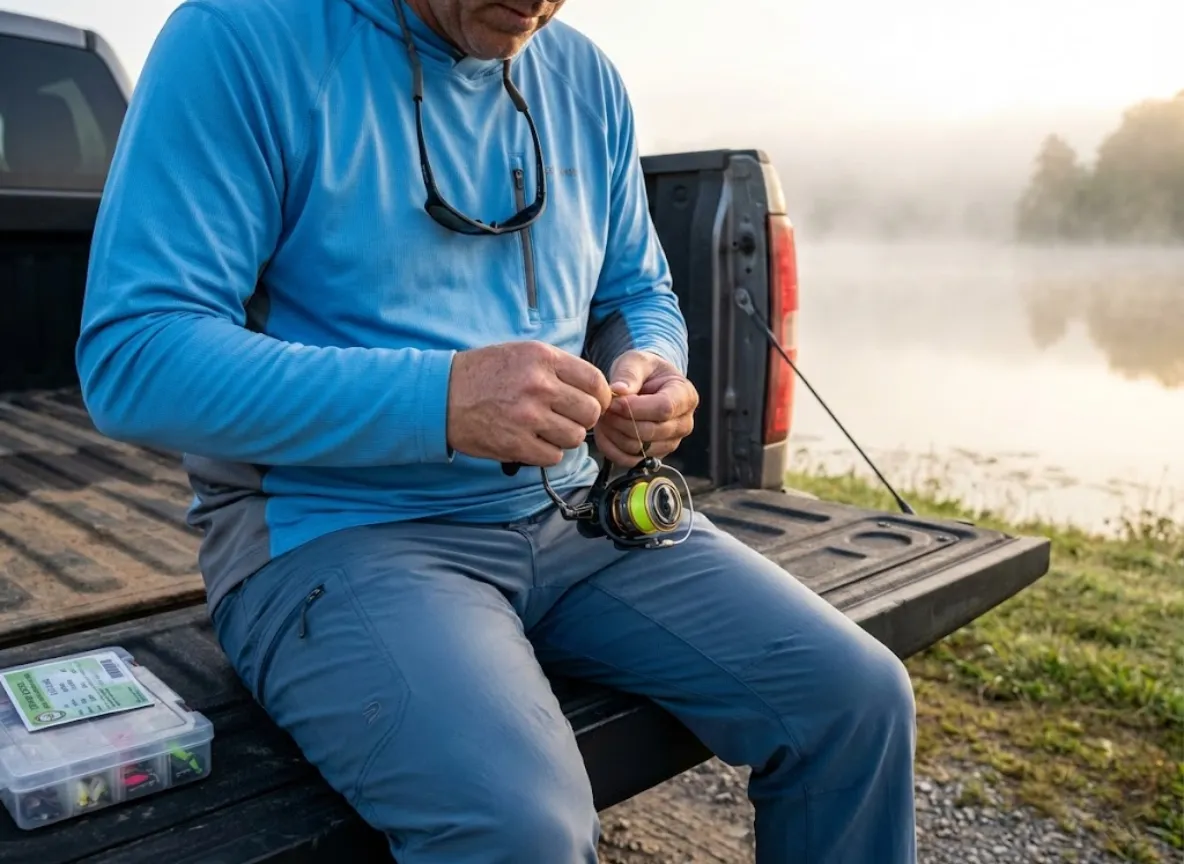
Angler sitting on a truck tailgate at sunrise preparing a spinning rod and reel for a fishing trip.

You stand in the aisle of the sporting goods store, staring at a wall of rods that stretches for forty feet. The marketing tags scream “High Modulus,” “IM7,” and “Zero-Reverse,” but none of them tell you if the rod will snap the first time you hook a tree branch.

For the beginner, the barrier to entry isn’t the cost; it is the “Analysis Paralysis” induced by infinite choice and opaque engineering. You don’t need a tournament-grade arsenal. You need a tool that balances the physics of forgiveness with the mechanics of success.

In this guide, we walk through the physics of failure—why graphite is sensitive but brittle—and why fiberglass is the beginner’s safety net. We will decode the Action/Power Matrix, distinguishing “Backbone” from “Flex,” and provide persona-based loadouts for everyone from the Nervous Novice to the Little Angler. Finally, we cover the biological ethics essential for catch-and-release success.

How to Choose the Right Fishing Gear Setup

Angler wading in a river testing the flexibility and action of a spinning rod against the water current.

Why Does Rod Material (Graphite vs. Fiberglass) Matter?

Rod material dictates the critical trade-off between durability and sensitivity. Fiberglass is heavy and “parabolic,” meaning it bends deeply into the handle. This makes it nearly indestructible and incredibly forgiving of mistakes, acting as a shock absorber for clumsy hooksets.

Graphite, or carbon fiber, sits on the opposite end. High modulus graphite offers incredible weight reduction and vibration transmission, allowing you to feel a fish breathe on your bait. However, it is brittle and tolerates zero impact abuse.

A split-screen 3D infographic comparing the flex patterns of fishing rods: a fiberglass rod showing a deep parabolic bend labeled Durability, and a graphite rod showing a sharp tip flex labeled Sensitivity.

For most beginners, the smart money is on a composite solution. This is the “Goldilocks” zone that fuses a graphite core with a fiberglass tip to prevent the most common beginner failure: tip breakage. While the U.S. Fish & Wildlife Service guide to fishing offers a broad overview of getting started, the nuance lies in selecting spinning rods as skill-building tools that prioritize survival over sensitivity.

Why Are “Power” and “Action” Often Confused?

Power is the resistance required to bend the rod, while Action defines exactly where that bend occurs along the blank. To pick the right engine for your fishing, you must distinguish between these two critical mechanics.

For general purposes like Bass or Walleye, “Medium” is the universal standard for Power. Action, conversely, is about flex. “Fast” action bends strictly at the tip for precision, while “Moderate” action bends in the middle for shock absorption.

A split-screen 3D editorial diagram comparing fishing rod mechanics. The left side illustrates "Power" showing the rod's backbone resistance, while the right side illustrates "Action" showing the specific flex point at the tip.

For a beginner, the sweet spot is a Medium Power rod with Moderate-Fast Action. This provides enough backbone to drive a hook home but enough flex to keep a fish pinned during a chaotic fight. The Kentucky Department of Fish & Wildlife breaks down the physics of Power vs Action well. However, for a deep dive into matching these specs to specific lures, our guide on decoding rod power and rod action is essential reading.

Why Line Choice is the “Shock Absorber” of the System?

Line choice acts as the shock absorber of the entire system because Monofilament (nylon) stretches up to 25% under load. This elasticity is vital for beginners, buffering the shock if you set the hook too hard or fight a fish with the drag locked down.

A split-screen macro illustration comparing fishing lines under tension. The left side shows translucent monofilament stretching elastically with the label "Forgiveness Factor," while the right side shows rigid braided line.

Beyond stretch, monofilament bites into itself, offering superior knot security compared to slippery braided lines. While veteran anglers love braid for its sensitivity, it is a “Phase 2” upgrade. Braid is prone to “wind knots” and offers zero shock absorption, which often leads to pulled hooks for novices. You can see the knot strength physics detailed by Salt Strong, or review our data-driven showdown of braid vs fluorocarbon vs monofilament to see exactly why mono remains the king of the learning curve.

Pro-Tip: When spooling monofilament, soak the spool in warm water for 10 minutes before winding it onto your reel. This relaxes the nylon memory and drastically reduces tangles on your first trip.

Our Selection Process: How We Built This Guide

Close-up of an angler's hand inspecting the durability and mechanics of a spinning fishing reel.

We commit to absolute objectivity, ignoring “box store” marketing claims to focus on the engineering specs that determine longevity. Every rod and reel in this guide was scored on a weighted matrix of Durability (resistance to impact/abuse), Sensitivity (vibration transmission), and Ease of Use (forgiveness of error).

We analyzed distinct personas—from the “Greenhorn” who fears breaking gear to the “Aspiring Pro” seeking finesse—and matched them with the specific engineering solution that solves their primary pain point. While we may earn a commission through affiliate links, our recommendations are driven by the graduation path from novice to expert. We ensure you buy the right tool for your current skill level.

The Best Fishing Gear of 2026: Our Top Recommendations for Every Need

A spinning rod bent under the weight of a fish, showcasing the gear's performance during a catch.

Our Top Picks for The “Greenhorn” & “Value Hunter” (General Beginner)

Ugly Stik GX2 Spinning Combo

$ $ $ $
Ugly Stik GX2 Spinning Combo

The Ugly Stik GX2 is the undisputed champion of entry-level durability, utilizing a graphite and fiberglass composite construction to create a nearly unbreakable blank. Its signature Clear Tip® delivers added strength right where beginners need it most—the top six inches—making it the ultimate “fail-safe” option for general freshwater fishing. It is essentially a tank; you can drop it on the dock or slam it in a car door, and it will likely survive. However, that durability comes with a cost: weight. It is heavier than modern graphite rods, and the sensitivity is dampened, meaning you might miss subtle bites that don’t aggressively pull the tip down.

Overall
Durability (Tank Factor)
Sensitivity
Value
Forgiveness
Ease of Use
Rod Material

Composite (Graphite & Fiberglass)

Reel Bearings

3 or 4 Ball Bearings

Rod Action

Moderate-Fast

Best For

Bass, Walleye, General Freshwater

You Should Buy This If…

  • You are terrified of breaking your fishing rod (High durability needs).
  • You want a single “workhorse” rod that can do everything decently.
  • You are shopping on a strict budget under $60.

You Should Reconsider If…

  • You need high sensitivity to feel subtle bites (bottom contact).
  • You want a lightweight, balanced setup for all-day casting.

Shimano Sienna Spinning Combo

$ $ $ $
Shimano Sienna Spinning Combo

Bringing high-end Japanese engineering to the entry-level market, the Shimano Sienna focuses on line management and smoothness. Featuring the Propulsion Line Management System to reduce casting tangles and a balanced “G-Free Body,” this is the smart choice for the “Value Hunter” who prioritizes operational precision over brute strength. The retrieve is buttery smooth compared to the grinding feel of cheaper reels, and the instant anti-reverse hooksets are solid. The downside is the construction material; the graphite composite body has more flex than metal, and it lacks the sheer abuse tolerance of the Ugly Stik. If you treat it rough, it will eventually feel “loose.”

Overall
Durability
Sensitivity
Value
Smoothness
Casting Efficiency
Reel Technology

Propulsion Line Management System

Anti-Reverse

Super Stopper II (Instant)

Balance

G-Free Body Center of Gravity

Best For

Finesse fishing, Trout, Light Bass

You Should Buy This If…

  • You struggle with “wind knots” or casting tangles (Propulsion spool helps).
  • You want a reel that feels smooth and has zero handle “slop” (Anti-reverse).
  • You plan to fish with lighter lures for Trout or Panfish.

You Should Reconsider If…

  • You are extremely rough on gear (Composite body has flex).
  • You need a heavy backbone for pulling fish out of thick weeds.

Our Top Picks for The “Aspiring Pro” & Saltwater Angler

Pflueger President Spinning Combo

$ $ $ $
Pflueger President Spinning Combo

Widely regarded as the best-in-class reel under $100, the President features a 10-bearing system and slow oscillation gearing for flawless line lay. When paired with a Fenwick or high-modulus graphite rod, it offers the “Fast Action” and sensitivity required to detect the subtle “tick” of a bite that cheaper fiberglass rods absorb. It is a true finesse tool, perfect for learning techniques like drop-shotting or Texas rigging where “feel” is everything. The trade-off is fragility. High-modulus graphite is brittle; if you high-stick this rod (lift it straight up past 90 degrees) or step on it, it will snap instantly. It demands respect.

Overall
Durability
Sensitivity
Value
Reel Smoothness
Line Management
Bearing System

10-Bearing System

Rod Material

IM8 or High-Modulus Graphite

Drag Material

Sealed Oiled Felt

Best For

Finesse Bass, Walleye, Learning “Feel”

You Should Buy This If…

  • You want to learn “finesse” techniques like jigging or Texas Rigs.
  • You are careful with your gear and don’t need “tank-like” durability.
  • You want gear you won’t need to upgrade for several years.

You Should Reconsider If…

  • You are prone to high-sticking or stepping on rods (Graphite is brittle).
  • You are fishing in saltwater (Magnesium/Aluminum components may corrode).

Penn Battle III Spinning Combo

$ $ $ $
Penn Battle III Spinning Combo

Saltwater environments destroy freshwater gear in weeks. The Penn Battle III counters this with a Full Metal Body that maintains gear alignment under heavy load and HT-100 Carbon Fiber drag washers that won’t seize up during the scorching runs of ocean fish. It is the essential investment for any coastal beginner, capable of handling Redfish, Snook, or even small Sharks. The reel feels substantial and solid in hand, giving you confidence against hard-fighting fish. The negative is the weight; the full metal body is significantly heavier than graphite reels, which can be fatiguing if you are casting lures continuously for hours.

Overall
Durability (Corrosion)
Sensitivity
Value
Drag Performance
Power
Body Material

Full Metal Body

Drag System

HT-100 Carbon Fiber

Bearings

5+1 Stainless Steel Sealed

Best For

Inshore Saltwater, Redfish, Striper, Catfish

You Should Buy This If…

  • You plan to fish in brackish water, surf, or saltwater piers.
  • You target large, hard-pulling species (Stripers, Big Catfish).
  • You need a drag system that can handle heat friction.

You Should Reconsider If…

  • You are strictly fishing small creeks or ponds (Too heavy).
  • You need high sensitivity for light bites (Heavy build dampens feel).

Our Top Picks for The “Little Angler” (Youth/Kids)

Kid Casters Tangle-Free Combo

$ $ $ $
Kid Casters Tangle-Free Combo

Designed to save parents from endless detangling duty, this rod features a patented inline feed system where the line runs inside the shaft rather than through external eyelets. This physically eliminates the possibility of the line wrapping around the rod tip, keeping the “Little Angler” fishing rather than waiting. It is purely an engagement tool, designed to keep a child happy and interested for the first hour of a trip. However, if the line snaps inside the rod blank, re-threading it requires a special tool and patience, which can effectively end the fishing trip right there if you aren’t prepared.

Overall
Durability
Sensitivity
Frustration-Free
Kid Appeal
Casting Distance
Tech

Inline Feed System (Internal Line)

Reel Type

Spincast (Button)

Length

~34 Inches

Best For

Children under 6, Panfish

You Should Buy This If…

  • Your primary goal is to prevent line tangles and eyelet wraps.
  • You are buying for a very young child (3-6 years old).
  • You want a “toy-like” appearance that excites the child.

You Should Reconsider If…

  • The child is older (8+) and wants to learn “real” casting.
  • You expect to catch fish larger than a Bluegill.

Zebco Dock Demon

$ $ $ $
Zebco Dock Demon

Do not let the size fool you—the Dock Demon is a legitimate tool in a miniature package. Featuring a 30-inch solid fiberglass blank, it is virtually indestructible and possesses enough backbone to land large Bass or Catfish. It is the perfect “trunk rod” or transition step for a child who has outgrown plastic toys but isn’t ready for a 6-foot rod. The solid glass is incredibly tough. The downside is the reel quality; the included spincast reel is basic plastic and can feel “gritty” after heavy use, often requiring a replacement sooner than the rod itself.

Overall
Durability
Sensitivity
Value
Portability
Power
Rod Material

Solid Fiberglass

Length

30 Inches

Reel

Basic Spincast

Best For

Kids, Dock Fishing, Car Trunks

You Should Buy This If…

  • You need a rod that is virtually impossible for a child to break.
  • You want a compact “backup” rod to keep in your vehicle.
  • The child is ready to fight larger fish (Bass/Catfish).

You Should Reconsider If…

  • You need casting distance (Short rod limits range).
  • You want high-speed lure retrieval.

The Final Cast

We’ve stripped away the marketing jargon to focus on what keeps you fishing: durability and forgiveness. Start with Monofilament line; its stretch is your safety net against mistakes. Prioritize Durability (Fiberglass/Composite) over Sensitivity (Graphite) for your first rod.

Remember that Licensing is conservation: 100% of your fee funds the stocking and protection of the fish you catch. Finally, always wet your hands before handling a fish to protect its slime coat and ensure survival.

Don’t overthink the purchase. Grab the Ugly Stik or the Sienna, buy a license, and get your line in the water—because the only gear that catches zero fish is the gear that stays in the shopping cart.

FAQ – Frequently Asked Questions

Do I really need a fishing license if I’m just catching and releasing?

Yes, a license is legally required for the act of fishing, regardless of whether you keep the fish. Fees directly support conservation. See our guide to understanding fishing licenses and conservation for more details on fees and rules.

What is the strongest knot for a beginner to learn first?

The Uni Knot is the most versatile option, capable of tying line to the spool, hooks, and joining two lines together. For connecting hooks to Monofilament, the Improved Clinch Knot is a reliable standard.

Why do my fish die even when I let them go?

You may be removing their protective slime coat with dry hands or towels, leading to fatal infections. Always wet your hands and review mastering science-backed catch and release techniques to improve survival rates.

Can I use a freshwater reel in the ocean?

Technically yes, but the salt will corrode the internal magnesium and aluminum components within weeks. We recommend understanding the critical differences between saltwater and freshwater gear durability before making a crossover mistake.

Risk Disclaimer: Fishing, boating, and all related outdoor activities involve inherent risks that can lead to injury. The information provided on Master Fishing Mag is for educational and informational purposes only. While we strive for accuracy, the information, techniques, and advice on gear and safety are not a substitute for your own best judgment, local knowledge, and adherence to official regulations. Fishing regulations, including seasons, size limits, and species restrictions, change frequently and vary by location. Always consult the latest official regulations from your local fish and wildlife agency before heading out. Proper handling of hooks, knives, and other sharp equipment is essential for safety. Furthermore, be aware of local fish consumption advisories. By using this website, you agree that you are solely responsible for your own safety and for complying with all applicable laws. Any reliance you place on our content is strictly at your own risk. Master Fishing Mag and its authors will not be held liable for any injury, damage, or loss sustained in connection with the use of the information herein.

Affiliate Disclosure: We are a participant in the Amazon Services LLC Associates Program, an affiliate advertising program designed to provide a means for us to earn advertising fees by advertising and linking to Amazon.com. As an Amazon Associate, we earn from qualifying purchases. We also participate in other affiliate programs and may receive a commission on products purchased through our links, at no extra cost to you. Additional terms are found in the terms of service.