In this article
The first time a 4-foot longnose gar exploded on my topwater plug — twice — and walked off with my lure both times, I was hooked. Not them. After thirty years chasing fish across half a dozen states, I’d never seen anything attack a bait with that kind of prehistoric violence and then spit the hook like a watermelon seed. This guide covers what longnose gar actually are, where they live, when they spawn, and the hookless rope technique that finally lets you land them.
Quick Answer: Longnose gar (Lepisosteus osseus) are slender, prehistoric predators with a beak-like snout, ganoid armor scales, and the ability to gulp atmospheric air through a swim bladder that doubles as a primitive lung. They live in slow rivers, backwaters, and brackish estuaries from Quebec to Texas, and the most reliable way to catch them is with a frayed nylon rope lure that tangles in their hundreds of teeth. The trick most anglers get wrong? They set the hook.
How to Identify a Longnose Gar (vs Other Gars)
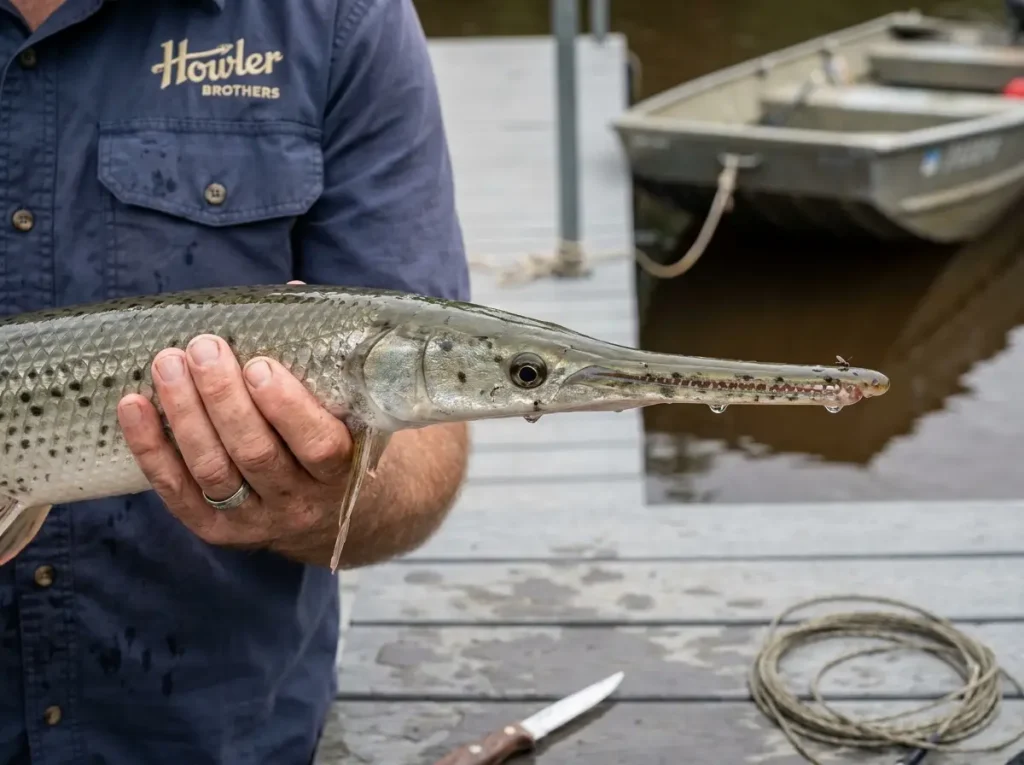
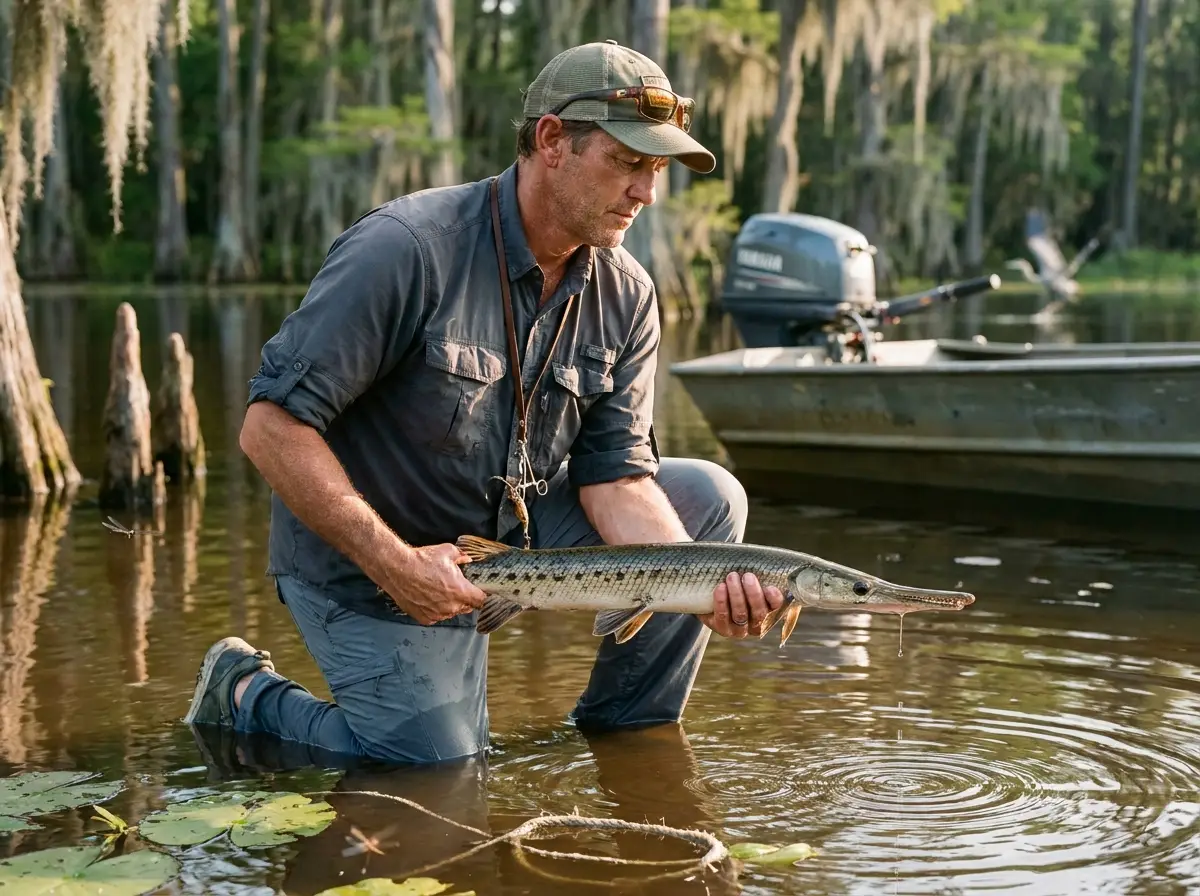
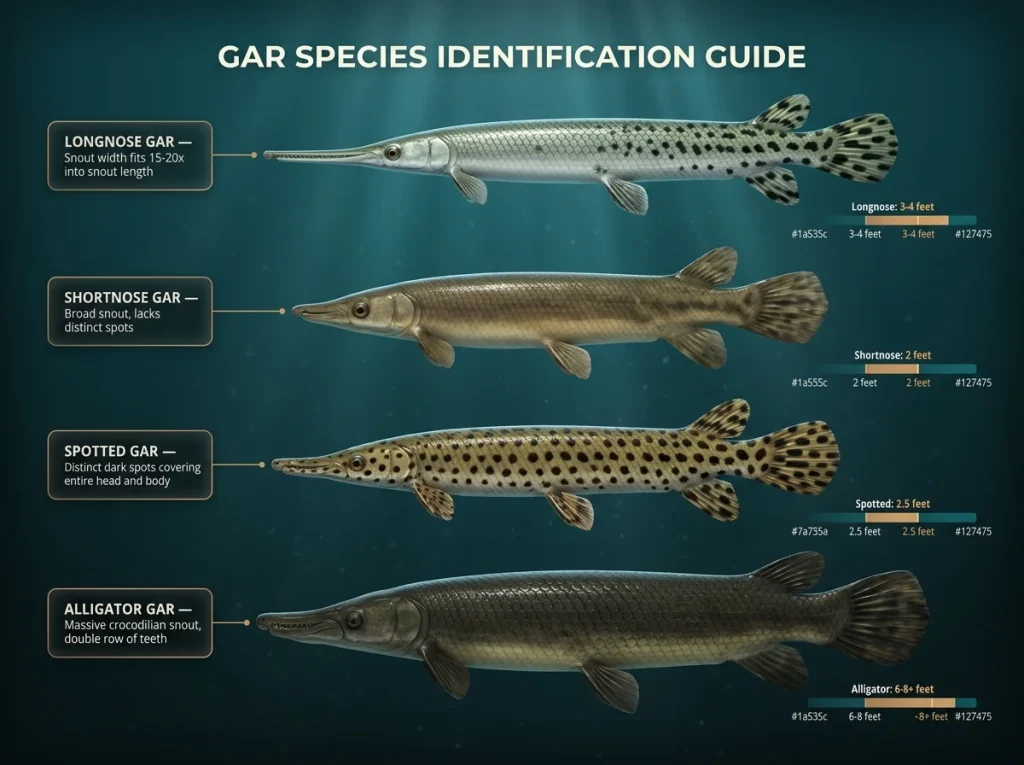
The longnose gar is one of the easiest fish in North America to identify, but only if you know what to look for. The dead giveaway is the snout: long, narrow, and almost comically out of proportion with the rest of the head. Measure the snout’s least width and divide it into the snout’s length — on a true longnose, that ratio comes in around 15 to 20. On any other gar species, that number is closer to 5 to 10. If the beak looks like a pencil glued onto a fish, you’re holding a longnose.
Snout-to-Head Ratio Rules
The slender genus Lepisosteus — longnose, shortnose gar, and spotted gar — all have proportionally narrower beaks than their broad-headed cousin Atractosteus, which includes the alligator gar. Alligator gars look like crocodiles with fins; longnose look like a needle attached to a torpedo.
Coloration and Spotting Pattern
Longnose are silver-green along the flank with dark spots scattered onto the dorsal, anal, and caudal fins. They are NOT spotted across every fin — that’s the spotted gar’s trademark. In tannic backwater they look almost olive; in clear riverine flats they shine like aluminum.
Size You’re Likely to Encounter
Most longnose you catch will run 24 to 36 inches and 5 to 6 pounds. That’s the everyday fish. Trophy specimens push past 4 feet, and the all-tackle world record sits around 6 feet and roughly 50 pounds — but a true 50-incher is a fish of a lifetime. In northern waters they tend to run smaller; in Texas oxbows they get heavy.
The Ganoid Scale Armor
Run your hand from tail to head and you’ll feel something almost no other freshwater fish has: interlocking ganoid scales coated in ganoine, a material that’s a precursor to tooth enamel. That’s why a knife slides across a gar’s flank like it’s hitting plastic. They look prehistoric because they basically are — gar fossils go back to the late Jurassic.
Where Longnose Gar Live — Habitat, Range, and Reading Water
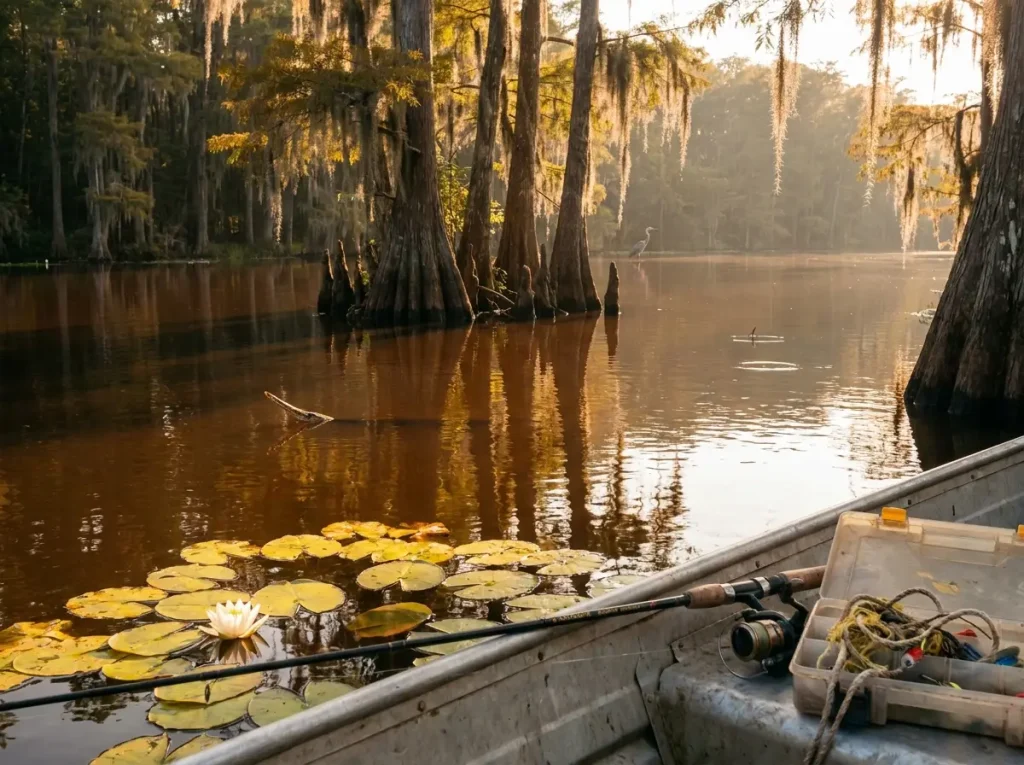
If you want to find longnose gar, stop looking where you’d find bass. They want the opposite of what bass want most days: warm, slow, weedy, and often poorly oxygenated. The fact that gar can breathe atmospheric air at the surface means they thrive in stagnant backwaters where most game fish suffocate. According to the U.S. Fish and Wildlife Service, they’re the most widely distributed gar species in North America, ranging from southern Quebec all the way to northern Mexico.
Slow Rivers, Oxbows, and Backwaters
The textbook longnose spot looks like this: a slow tannic-stained pool off the main river channel, lily pads or flooded timber along one edge, soft mud or sand bottom, water temperature above 65°F. They cruise the upper third of the water column, often finning openly when the sun is up. If you see a long thin shadow that doesn’t move for a full minute and then drifts six inches and stops again — that’s a gar.
Brackish Estuaries (The Underrated Range)
Most articles skip this entirely, but longnose gar are surprisingly salt-tolerant and routinely push into brackish water estuaries to chase menhaden along the Gulf and Atlantic coasts. If you’re already a coastal angler, you have gar within reach during the warm months without driving inland — useful information that bass-focused content never covers. For more on how salinity changes fish behavior, see our breakdown of brackish water fishing tactics.
Seasonal Movement
In spring, gar move out of deep wintering holes and stage in the upper sections of backwaters that warm first. By summer they’re scattered across the system, shallow at dawn and dusk and pushed deeper by midday heat. In fall they retreat to the deepest river holes, sometimes stacking in 20-plus feet of water — a pattern almost no recreational angler exploits.
What Longnose Gar Eat and How They Hunt
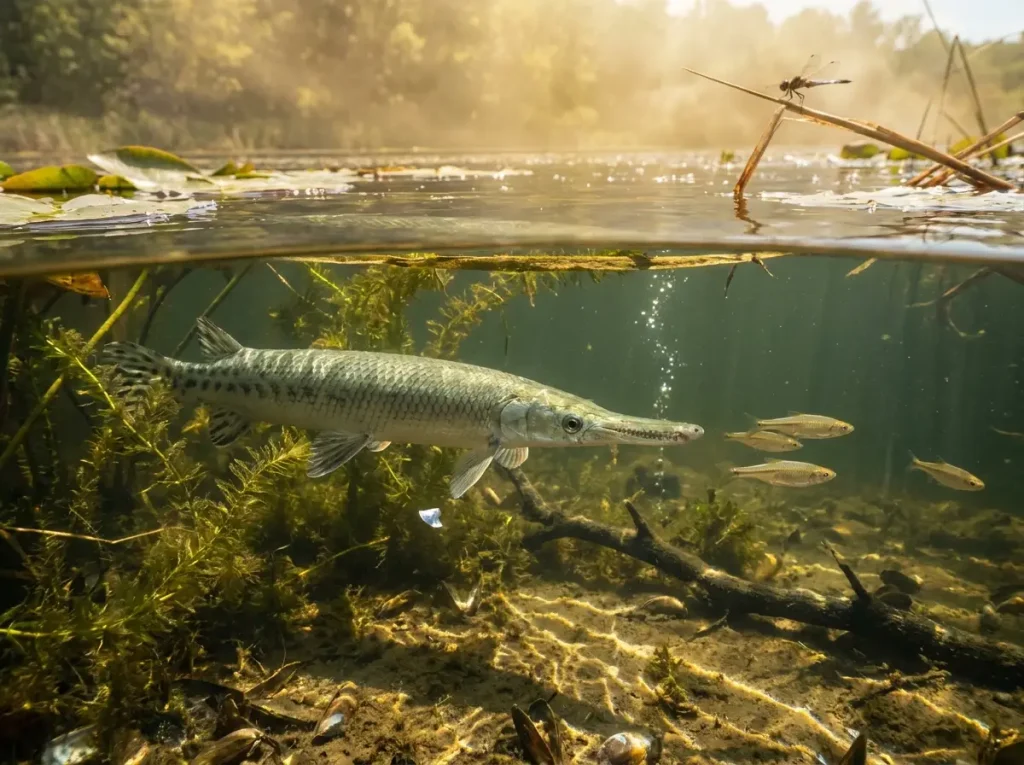
Longnose are obligate piscivores — fish eaters, almost exclusively. They eat sunfish, shad, shiners, young bass, and along the coast, menhaden. Studies referenced by state fisheries agencies show they rarely make a dent in sport fish populations because they prefer the most abundant smaller forage species available. The “they’ll eat all my bass” myth is just that — a myth.
The Sit-and-Wait Predator
A gar hunts by hovering parallel to the surface, sometimes for ten minutes at a stretch. They look dead. They aren’t. When a baitfish wanders close, the gar sideswipes with that beak and impales the fish on its side teeth in a single sweep, then turns it headfirst and swallows. This is why a topwater retrieve straight at a gar usually fails — they need the prey to cross perpendicular to that beak.
The Air-Gulp Tell
Here’s a Level 3 detail you won’t read on most sites: gar will rise to the surface to gulp air every 5 to 30 minutes depending on water temperature and dissolved oxygen. That brief surface roll — beak up, head tilt, slow descent — is one of the most reliable ways to locate them in a backwater. If you see one roll, plant yourself there. Another fish almost always rolls within 50 yards in the next 20 minutes.
Pro tip: When the bite is dead in summer, idle into the most dead-looking, sun-baked, weed-choked backwater you can find. The fish that rolls every ten minutes is a gar, and a gar in stagnant water is a fish that hasn’t seen a lure in years.
Spawning Season — When and Where Gar Get Easy to Find
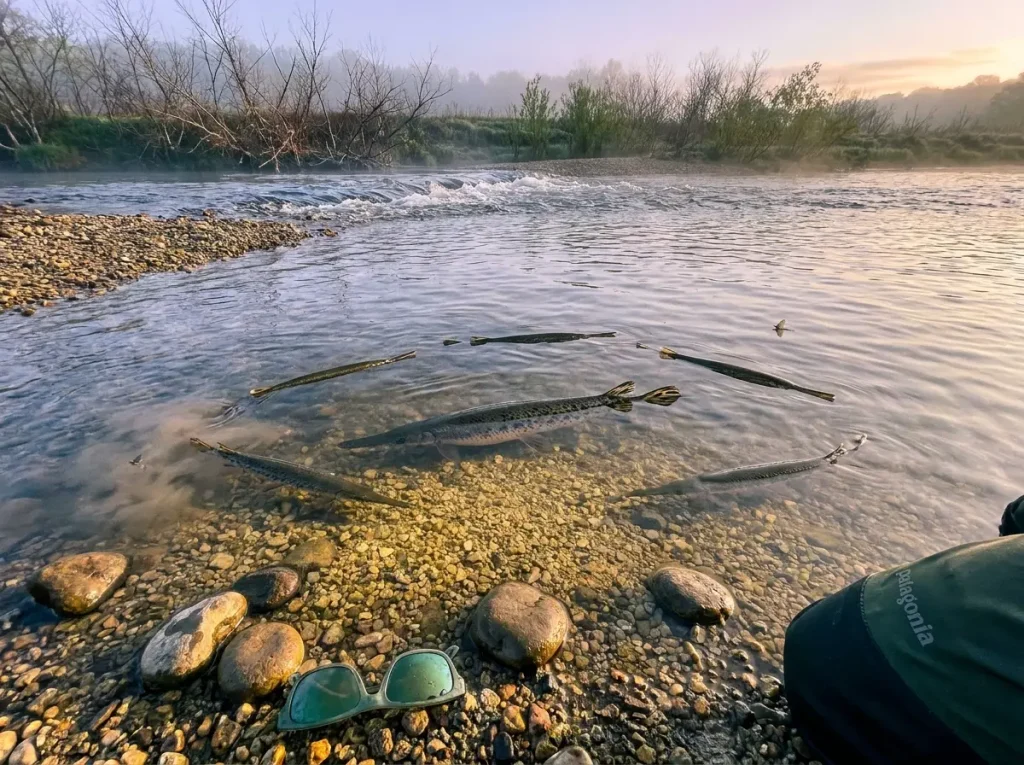
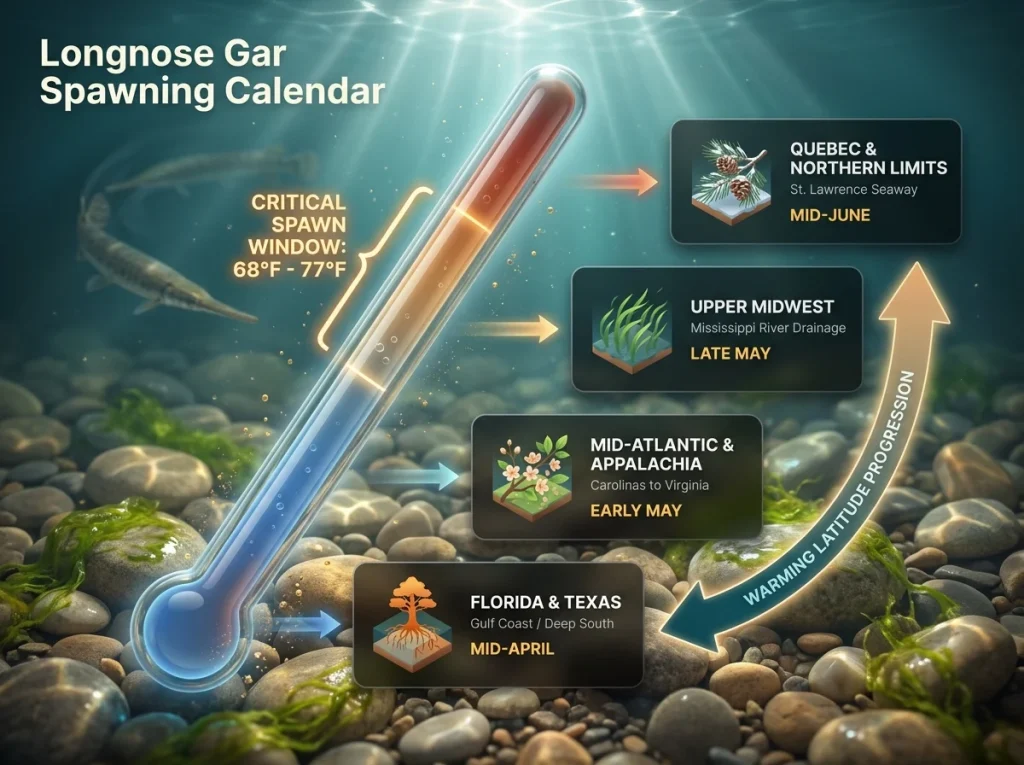
Longnose gar spawn from late April through mid-June across most of their range, triggered when water temperature climbs into the 68°F to 77°F window. This is the easiest time to find them because they aggregate in shockingly shallow gravel and sand-bottom riffles, often in groups of one female being trailed by a dozen or more males.
Water Temp Triggers
The bite — and the visible aggregation — kicks off right around 68°F surface temp. In the lower Mississippi drainage that’s mid-April; in Iowa it’s late May; in southern Quebec it can be mid-June. A reliable thermometer on the boat is worth more than another rod during this window.
Spawning Aggregations
The female releases adhesive eggs onto submerged vegetation, woody debris, or gravel substrate, where they hatch in 3 to 9 days. According to a study published in the Transactions of the American Fisheries Society, spawning aggregations can include 15 or more males per female, swimming in elliptical patterns for up to 15 minutes before egg release. Walk a gravel riffle in late spring and you can see the show.
Why You Should Release Spawners
A 36-inch female longnose is somewhere between 10 and 18 years old and carries thousands of eggs. Removing her from the system during the spawn — even just one — knocks out an entire year-class of future fish. If you want to harvest a gar for the table, do it outside the spawning window. The fish are still abundant the rest of the year.
How to Catch Longnose Gar — Tackle, Rope Lures, and Hookless Technique
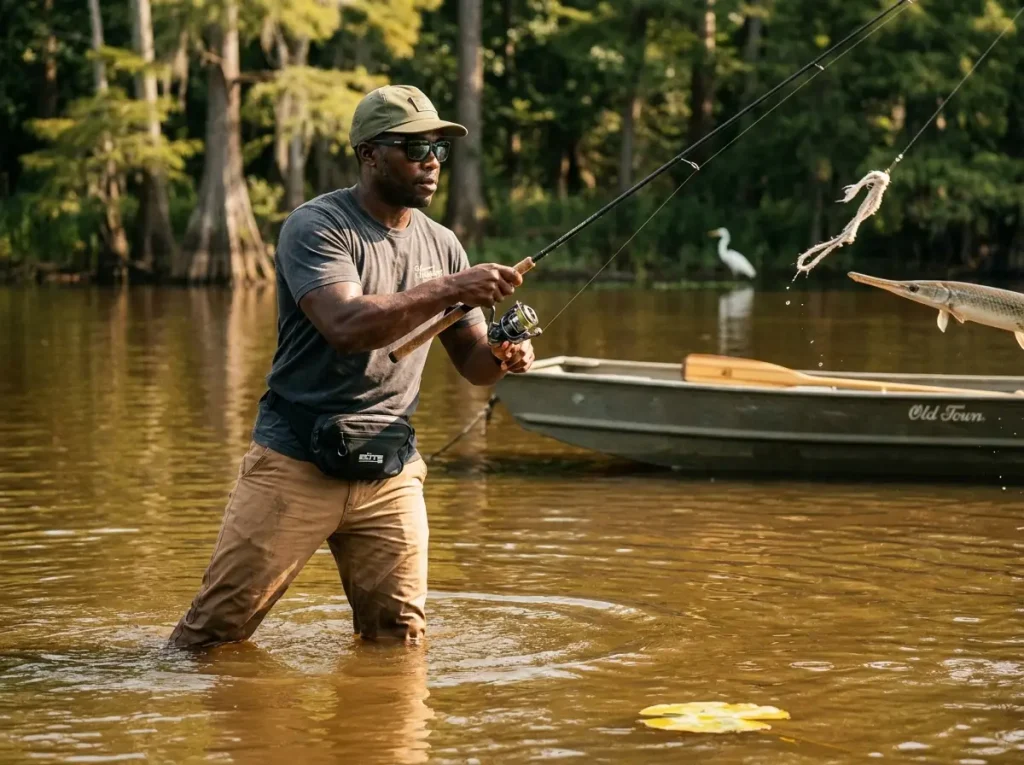
This is where almost every fisherman gets gar wrong, and where the rest of this article matters most. A longnose gar’s beak is solid bone covered in fine hair-thin teeth. A standard hook simply will not penetrate. You can hammer a treble into the side of its head with a Powerball-sized hookset and it will still throw the lure. The fix is simple, weird, and devastatingly effective: use a frayed rope lure with no hook at all.
Building the Rope Lure
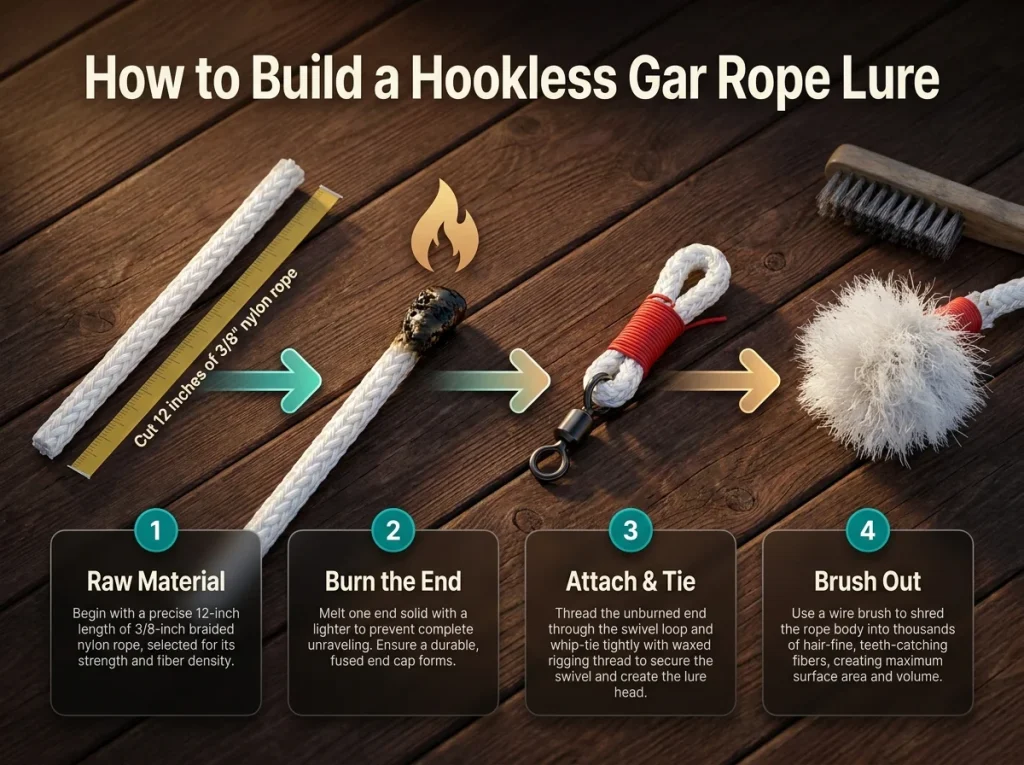
Take a 12-inch piece of 3/8-inch white nylon rope. Burn one end with a lighter so it doesn’t unravel. Pass the unburned end through the loop of a #2 barrel swivel, fold it back on itself, and whip-tie it tight with waxed thread or a strong zip-tie. Then take a stiff-bristle wire brush and shred the entire rope until it’s a pom-pom of hair-fine fibers. The shaggier, the better — those fibers are what tangle in the gar’s teeth on the take.
Tackle Setup
A 7-foot medium-heavy spinning rod handles this perfectly. Spool 50-pound braid straight to a small barrel swivel, then a 12-inch leader of 40 to 50-pound monofilament to the rope lure. Some anglers add a short steel or titanium leader where alligator gar mix in. Baitcasters work, but spinning gear is faster to fire at sighted fish.
The Hookless Hookset (or Not-Set)
Cast across or just past a sighted gar, then twitch the lure perpendicular to the fish’s snout. When the gar attacks — and it will hammer it — resist every instinct you have to set the hook. There is no hook to set. Instead, hold the rod at 45 degrees, apply steady pressure with your finger on the spool, and wait. The gar will shake its head violently to dislodge the rope, and that head shaking is what twists hundreds of nylon fibers around its teeth like fishhooks. After 10 to 20 seconds of head shaking, the fish is locked on. Now you can lift the rod and start working it toward you.
Pro tip: Dip your rope lure in the water for two seconds before each cast. The added weight gives you 25 percent more casting distance with no change in retrieve action — the difference between reaching a fish at 35 feet and watching one slide off at 40.
Other Lures That Work
Topwater walking baits, large inline spinners, and 5-inch white swimbaits all draw strikes, but hook-up ratios sit around 1 in 10. Stick to rope unless you fly fish — a frayed-yarn streamer on a 9-weight is the gold standard. Our guide to sight fishing tactics translates directly to gar work.
Landing, Handling, and Releasing a Gar (Without Drama)
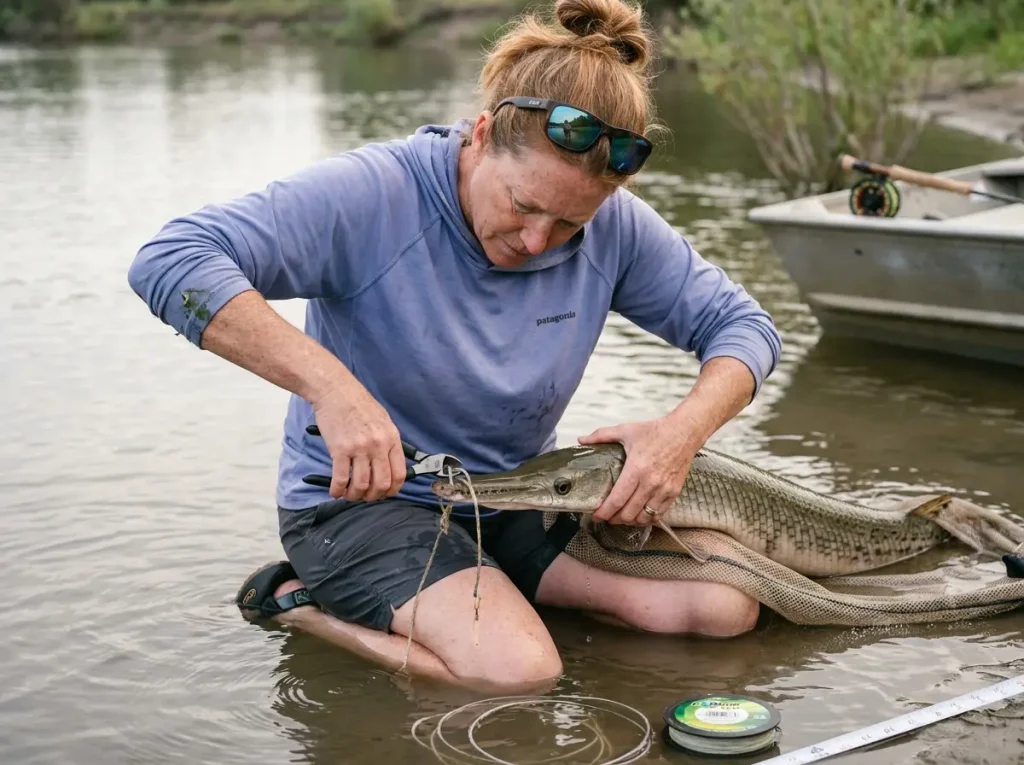
This is the section other guides skip, and skipping it is how anglers end up with a rope-bound gar drifting off to starve. A 40-inch longnose has hundreds of needle teeth, and that beak swings like a bat when the fish flexes.
Subdue the Fish in the Water
Don’t lift a gar by the gill plate or rope it up by the tail mid-air. Slide your hand under its belly while it’s still in the water, support it with both hands, and lift only when the fish is calm. Most gar relax once they’re horizontal and supported.
Cut the Rope, Don’t Try to Untangle It
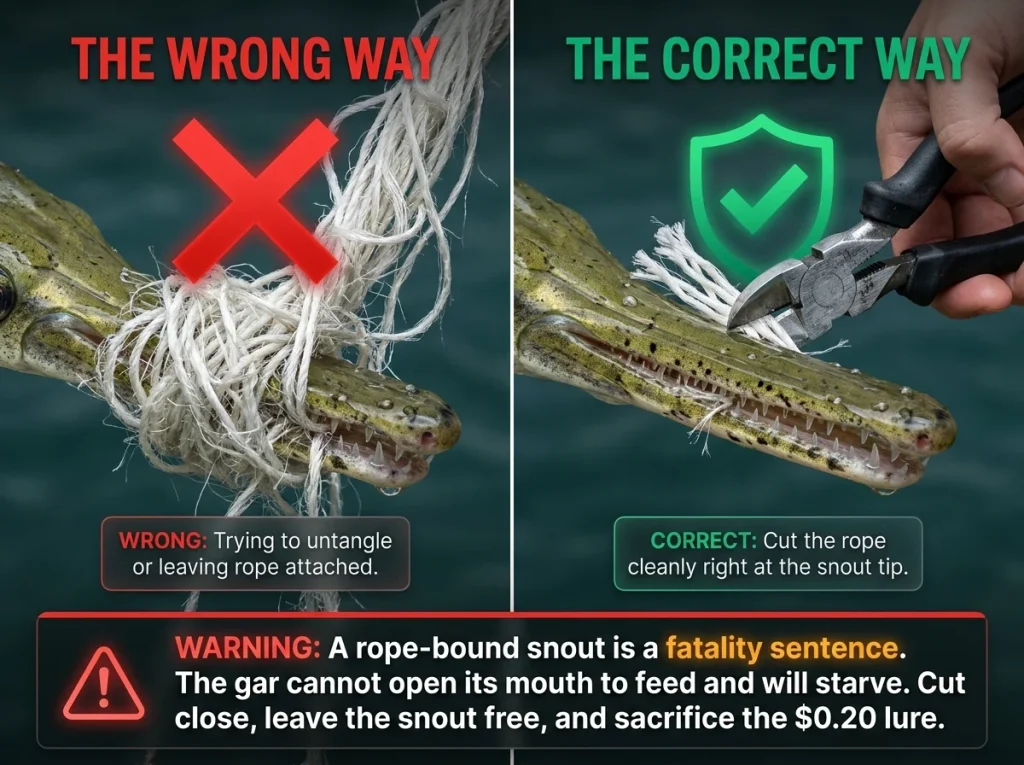
Once you have the fish stable, take a pair of heavy needle-nose pliers or angled wire cutters and cut the rope at the snout. Do not — under any circumstance — try to peel the tangled rope off the teeth and release the fish with the rope still wrapped. A rope-bound snout is a fatality sentence: the gar can’t open its mouth to feed and starves out within a few weeks. Cut close, leave the snout free, accept that you’ve spent a $0.20 lure, and move on.
Wire Leader vs Heavy Mono
Plenty of anglers swear by a 6-inch wire leader between the swivel and rope. It prevents bite-offs when a gar’s teeth contact the leader directly, and it’s worth the rigging time on big-fish water. On smaller fish, 50-pound mono is plenty. For broader handling principles across gar species, see how to handle gar safely after the catch.
Eating Gar Legally and Cleanly
If you harvest a gar, check your state regulations first — many states now require tagging or have season closures around the spawn. To clean one, use heavy tin snips to cut along the lateral line on each side, then peel the armor plate back like opening a sardine can. The meat is white, mildly sweet, and nothing like the muddy reputation suggests — but watch the row of Y-bones in the fillet. Never eat the eggs — gar roe is toxic to humans and most mammals.
Pro tip: Keep a dedicated pair of $15 wire-cutting pliers clipped to the boat just for gar. The gar-rope cycle dulls cheap pliers fast, and you don’t want to be searching the tackle box one-handed with a thrashing fish across your lap.
Conclusion
Longnose gar are one of the most underused, misunderstood, and downright fun species swimming in North America. Three things matter most: find them by reading slow weedy water and watching for the air-gulp roll, catch them with a hookless frayed rope lure and the patience to skip the hookset, and release them clean by cutting the rope at the snout instead of trying to untangle it. Tie up a few rope lures this week, find the slowest backwater within an hour of your house, and go meet the dinosaur living in it.
Q1 Are longnose gar hazardous to humans?
Longnose gar are not aggressive toward humans and there are no recorded unprovoked attacks. The hazard is the teeth — a thrashing fish at boatside can cut a hand badly. Handle them belly-supported with the snout pointed away and you’re fine.
Q2 Can you eat longnose gar?
Yes, longnose gar meat is white, firm, and mildly sweet — closer to grouper than catfish in flavor. Use heavy tin snips to peel back the ganoid scale armor, then fillet around the row of Y-bones. Never eat gar eggs, which are toxic to mammals.
Q3 What is the best bait for longnose gar?
The best bait for longnose gar is a frayed nylon rope lure fished hookless on the surface or just below it. The fine fibers tangle in the gar’s hundreds of teeth on contact. Topwater plugs and large inline spinners draw strikes too, but landing ratios are far lower.
Q4 Where can you find longnose gar in the US?
Longnose gar live in slow rivers, oxbows, backwaters, lakes, and brackish estuaries from southern Quebec south through the Mississippi drainage and across the Gulf Coast into Texas and northern Mexico. They prefer warm, weedy, slow-current water above 65°F.
Q5 Why do longnose gar gulp air?
Longnose gar gulp atmospheric air because their swim bladder doubles as a primitive lung connected to the esophagus. This adaptation lets them survive in stagnant low-oxygen backwaters where most game fish suffocate, and it’s why you’ll see them roll the surface every 5 to 30 minutes.
Risk Disclaimer: Fishing, boating, and all related outdoor activities involve inherent risks that
can lead to injury. The information provided on Master Fishing Mag is for educational and informational purposes
only. While we strive for accuracy, the information, techniques, and advice on gear and safety are not a substitute
for your own best judgment, local knowledge, and adherence to official regulations. Fishing regulations, including
seasons, size limits, and species restrictions, change frequently and vary by location. Always consult the latest
official regulations from your local fish and wildlife agency before heading out. Proper handling of hooks, knives,
and other sharp equipment is essential for safety. Furthermore, be aware of local fish consumption advisories. By
using this website, you agree that you are solely responsible for your own safety and for complying with all
applicable laws. Any reliance you place on our content is strictly at your own risk. Master Fishing Mag and its
authors will not be held liable for any injury, damage, or loss sustained in connection with the use of the
information herein.
Affiliate Disclosure: We are a participant in the Amazon Services LLC Associates Program, an
affiliate advertising program designed to provide a means for us to earn advertising fees by advertising and linking
to Amazon.com. As an Amazon Associate, we earn from qualifying purchases. We also participate in other affiliate
programs and may receive a commission on products purchased through our links, at no extra cost to you. Additional
terms are found in the terms of service.