
In this article
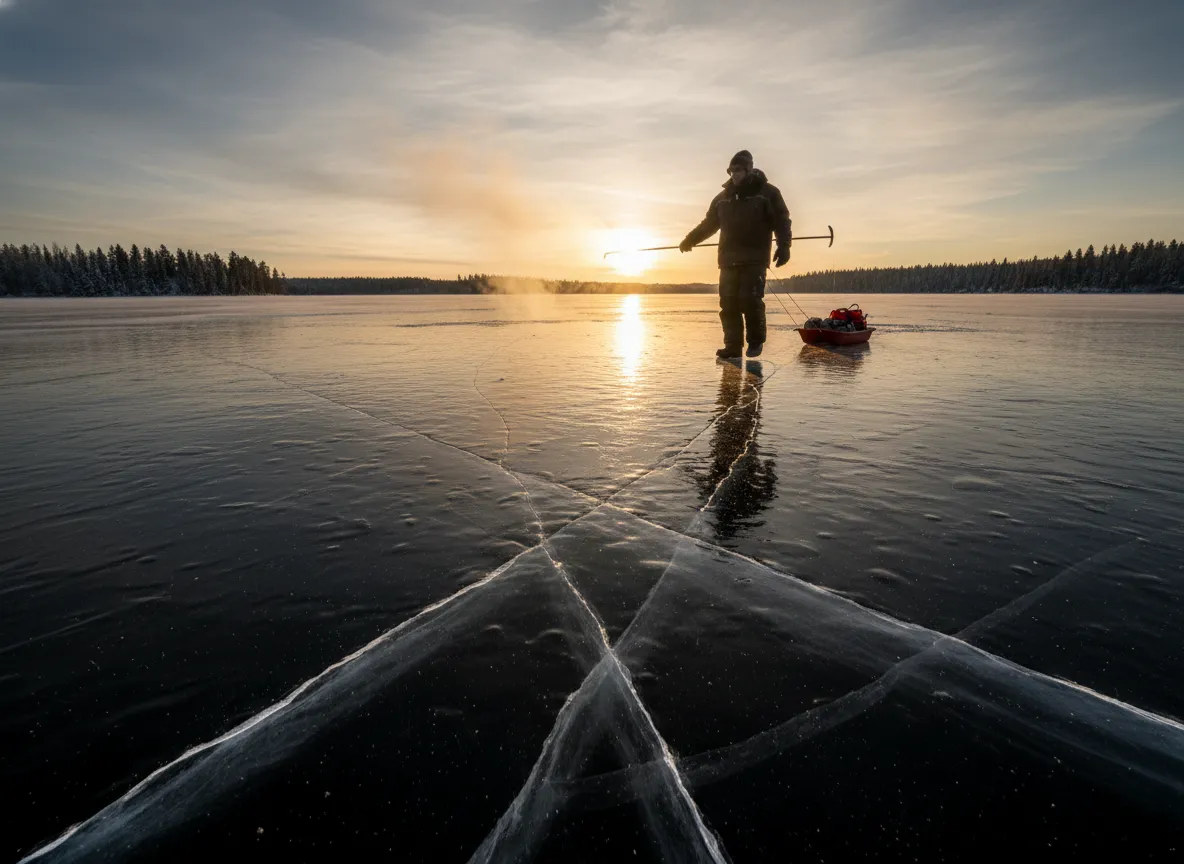
The lake does not care about your enthusiasm. Standing on three inches of frozen water, separated from the black depths by nothing but a crystalline lattice and your own judgment, is a binary existence: you are either perfectly safe, or you are in immediate peril.
This is the reality of the first ice period. It is a fleeting, high-stakes window where the biological reward of aggressive fish collides with the physical risk of a dynamic environment. I have spent two decades devoted to hardwater fishing, and I have learned that the ice commands respect.
To succeed here requires strict discipline. It demands a rigid operational protocol that transforms fear into calculated precision.
In this guide, we will move beyond basic advice. We will cover the Safety Triad (spud bar, picks, float suit) and the Green Weed Imperative for locating oxygen-rich zones. We will also master the Stealth Approach to stalk spooky fish without triggering their startle response, and define the Mobility Standard to optimize your fishing gear for safety and speed.
Phase I: Pre-Deployment – What is the “First Ice” Survival Standard?
This section establishes the material baseline for the operation. We must distinguish the specialized “First Ice Kit” from standard mid-winter gear based on two non-negotiable criteria: survivability and mobility.
How does modern flotation technology redefine survival?
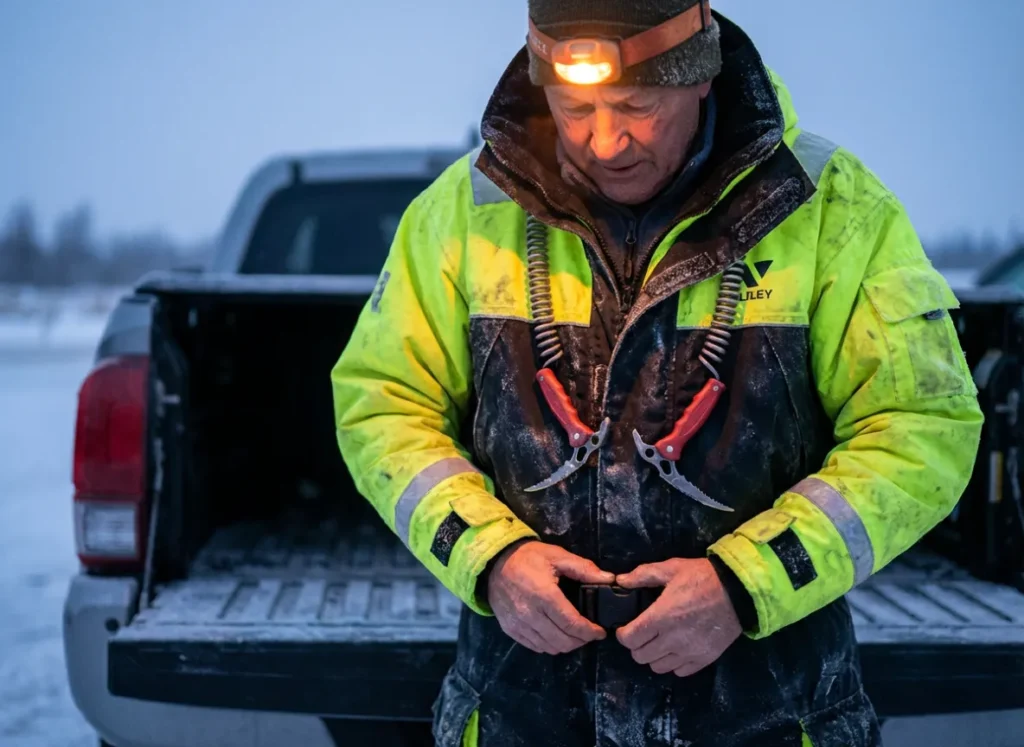
Modern ice fishing suits have moved far beyond simple insulation; they now function as “wearable lifeboats.” Floatation bibs and jackets featuring technologies like Sureflote and Motion Float utilize segmented baffles to provide buoyancy assistance.
The “First Ice” protocol demands a float suit that balances warmth with active mobility. Unlike the stationary mid-winter angler, the early season angler is a hiker. The suit must vent perspiration via cross-flow venting to prevent the dangerous “sweat-then-freeze” cycle.
Functionality extends to “self-rescue” capability. If a breakthrough occurs, the suit acts as a PFD (Personal Flotation Device), keeping the head above water. This is vital for mitigating the “gasp reflex” detailed in the National Weather Service’s Cold Water Survival Guidelines, allowing the angler to focus on self-extraction rather than staying afloat.
A critical metric for early ice is the “warmth-to-weight” ratio. Lighter insulation in the sleeves (e.g., 60g vs. 100g body) facilitates the constant motion of drilling and jigging without the fatigue caused by heavy bulk. For a deeper look at how life jacket ratings factor into your definitive guide to fishing safety gear, consider how these suits integrate into your wider safety system.
What is the “Safety Triad” required for every angler?
The “Safety Triad” consists of three mandatory items: a Spud Bar (or ice chisel), Retractable Ice Picks (handheld safety spikes), and a Throw Rope for assisting others.
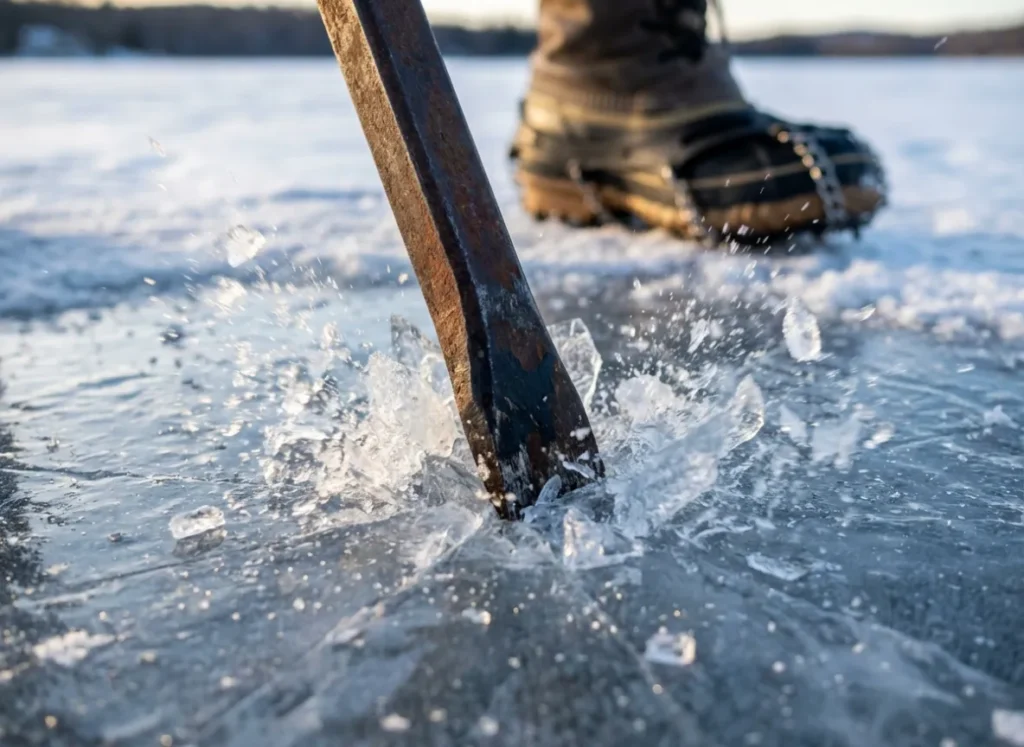
The Spud Bar is the primary sensory tool. It is a 5-10lb steel chisel used to strike the ice ahead of every step. It acts as a tactile radar, revealing changes in ice density before your weight commits to the step. This is far more reliable than a visual check alone.
Pro-Tip: Always attach the safety strap of your spud bar to your wrist. If you strike through a weak spot, the bar will slide through the hole and be lost to the lake bottom without the strap—leaving you stranded without your primary testing tool.
Ice picks must be worn around the neck, never buried in a pocket. In the event of a fall, wet gloves on smooth clear ice offer zero traction. Picks allow you to “walk” your upper body onto solid ice using a seal-like motion.
The psychological discipline of the “Three-Hit Rule” (striking the same spot three times) provides a consistent safety margin. Before heading out, review your first-trip gear checklist to ensure these items are present.
If water seeps through or the bar penetrates during your check, the protocol dictates an immediate retreat along the known safe path. Refer to the Minnesota DNR’s Ice Safety and Thickness Guidelines for specific load-bearing standards.
Why is the lightweight auger critical for early season mobility?
On thin ice (4-6 inches), every pound of gear contributes to the localized Pressure Per Square Inch (PSI) exerted on the sheet. Heavy power auger units are obsolete in this phase; the standard is now the cordless drill-plate system or a dedicated lithium auger.
Systems pairing a brushless hammer drill with a lightweight composite or synthetic bit (e.g., Eskimo Pistol Bit or K-Drill) can weigh under 10 lbs total. This is a massive improvement over the 30+ lbs required for traditional gas units or an exhausting manual hand auger.
This weight reduction serves a dual purpose: safety (less load on the ice) and tactical efficiency (less fatigue for the angler). The “Run and Gun” tactic requires drilling dozens of holes to locate active fish.
A lightweight setup encourages this necessary exploration, whereas a heavy unit encourages a sedentary approach common with tip-ups or ice traps. Understanding the Physics of Ice Bearing Capacity helps you appreciate why reducing localized weight is a critical safety factor.
Phase II: Infiltration – How do you safely access the hardwater frontier?
With the proper tools secured, we move to the operational phase: the physical act of stepping onto the frozen surface. This bridges the gap between safety theory and the on-ice reality of reading a dynamic surface.
How do you interpret ice thickness and quality?
Ice is not a uniform material; its strength is determined by its crystalline structure. Clear ice (often called black ice) is the strongest, formed directly from water freezing. White ice (or snow ice) is frozen slush and has significantly lower tensile strength.
Not all ice is created equal. White or cloudy ice is only half as strong as clear, solid ice. This means that if you measure 4 inches of white ice, it effectively only gives you the safety protection of 2 inches. This distinction is vital to understand before you step out onto the ice.

The structural differences are validated by studies such as the Laboratory Study on Ice Flexural Strength. Visual inspection provides the first clue. Clear ice acts as a window to the dark water below, while white ice scatters light.
Anglers must apply a continuous verification loop: checking ice thickness every 150 feet or whenever the surface appearance changes. Watch for snow drifts, cracks, pressure ridges, or dangerous springs near inlets. These are the safety protocols used on Minnesota’s best ice fishing lakes to ensure access to prime structures.
Why is acoustic discipline essential on thin ice?
Sound travels approximately 4.5 times faster in water than in air. On thin ice, the sheet acts as a giant diaphragm, transmitting vibrations directly into the water column.
Freshwater fish possess a “startle response” triggered by transient, low-frequency sounds. Specifically, the rhythmic thump-thump-thump of heavy footsteps mimics the approach of a large predator.
The “Stealth Protocol” involves drilling holes in a batch (the “Swiss Cheese” method) and then allowing the area to settle for 15 minutes before fishing. Movement should be a “shuffle” rather than a march.
Wearing ice cleats (often called creepers) allows for a smooth gait that minimizes impact transients, preventing the spooking of fish in skinny water (3-8 foot zones). This sensitivity is detailed in research on the Impacts of Anthropogenic Sounds on Fishes. For a better grasp of how fish perceive their environment, reviewing understanding how fish see underwater will complement your knowledge of their acoustic limitations.
Phase III: Target Acquisition – Where do fish congregate during the “Gold Rush”?
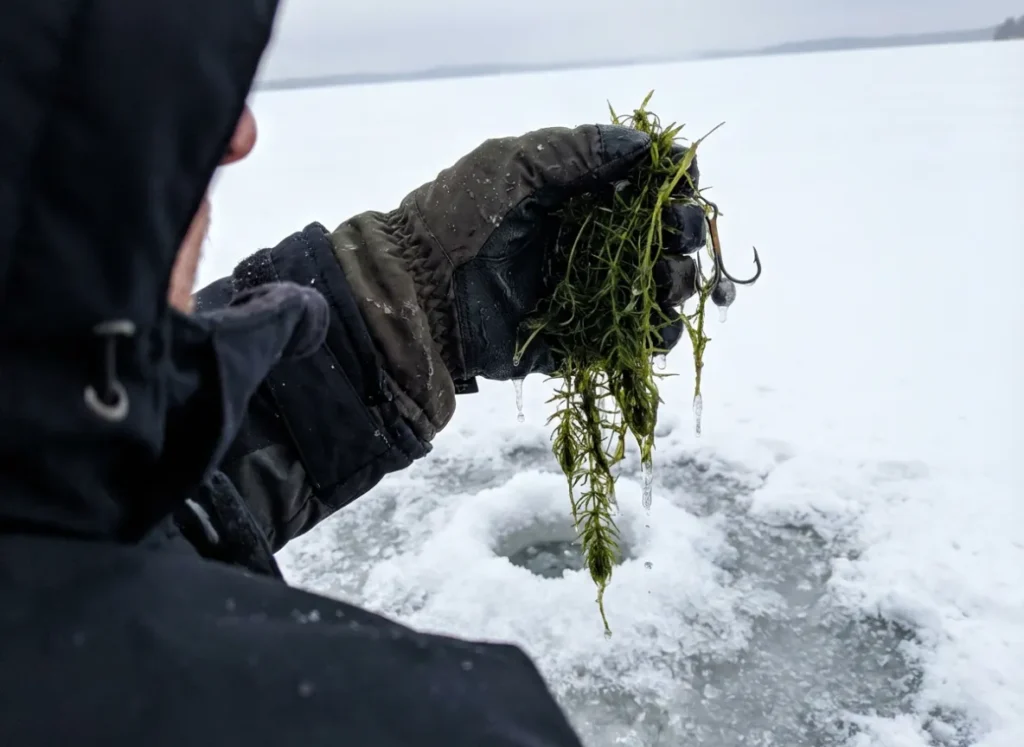
With our presence masked and our safety assured, we turn our attention to the biological imperative: finding the quarry. We must look at the interaction between oxygen, vegetation, and water temperature.
How does the “Green Weed” mechanism drive fish location?
In early winter, the primary limiting factor for fish is Dissolved Oxygen (DO). As long as the clear ice is free of heavy snow, sunlight penetrates to the bottom. This allows aquatic plants to photosynthesize and produce high oxygen levels.
Key vegetation like cabbage, coontail, and milfoil create “Oxygen Islands” that attract baitfish and predators. These shallow weed beds in bays and shoreline breaks are the epicenter of life during First Ice.

Conversely, dead or decaying weeds (brown/slimy) consume oxygen through bacterial decomposition. These areas become hypoxic “dead zones” that repel walleye, northern pike, and panfish.
Identifying the transition line between living green weeds and decaying brown weeds is often the key to finding the “spot on the spot.” This phenomenon relates to Divergent oxygen trends in ice-covered lakes and is a core component of a data-backed method for choosing a fishing spot.
What is the “Weighted Treble” protocol for verification?
While underwater cameras are useful, they are slow to deploy. The “Weighted Treble” method (or green weed test) is a rapid, low-tech intelligence gathering tactic.
The rig consists of a large treble hook (size 2/0 or larger) with a heavy bell sinker or molded lead on the shank. It is dropped to the bottom and ripped upward to snag vegetation samples. The sample provides immediate data.
Bright green and crisp indicates a high-oxygen zone (Fish Here). Olive or dull indicates marginal habitat. Brown, slimy, or foul-smelling indicates decomposition (Move Immediately).
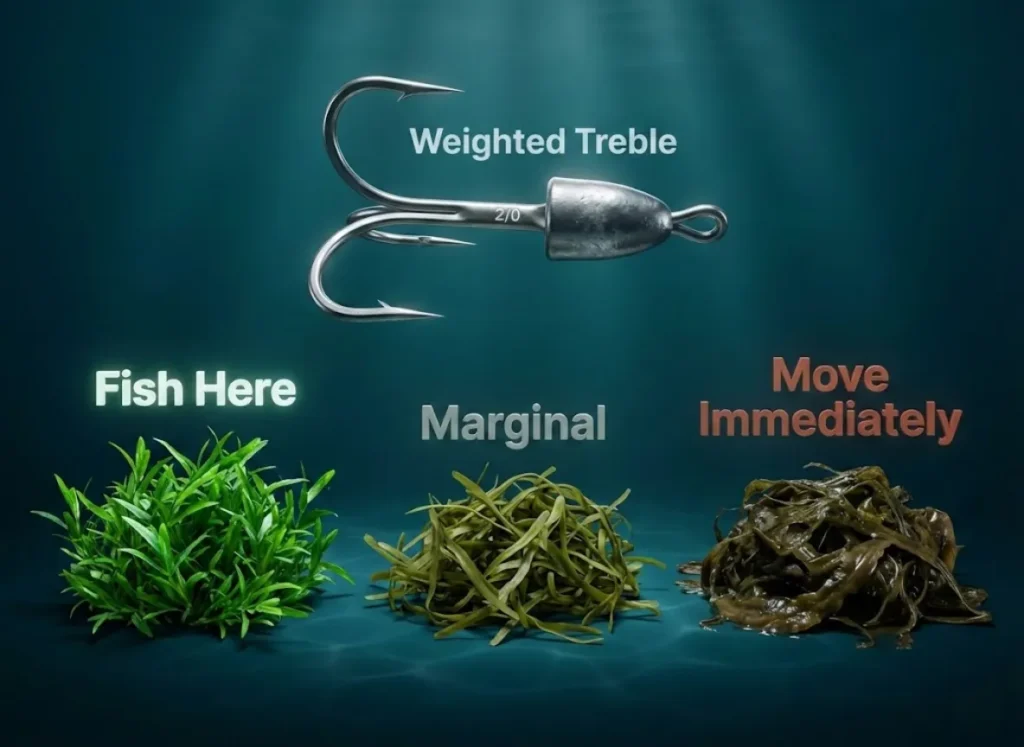
This method allows an angler to survey a massive weed flat in minutes, mapping the “life line” of the ecosystem before wetting a line.
Pro-Tip: Keep a dedicated heavy-action rod rigged with a weighted treble in your sled. This saves you from having to retie your primary jigging rod every time you need to check weed quality.
For formal methodology, refer to the Macrophyte Sampling Techniques manual. This approach is a specific application of strategies for fishing heavy cover.
Phase IV: Tactical Engagement – How do you trigger strikes in shallow water?
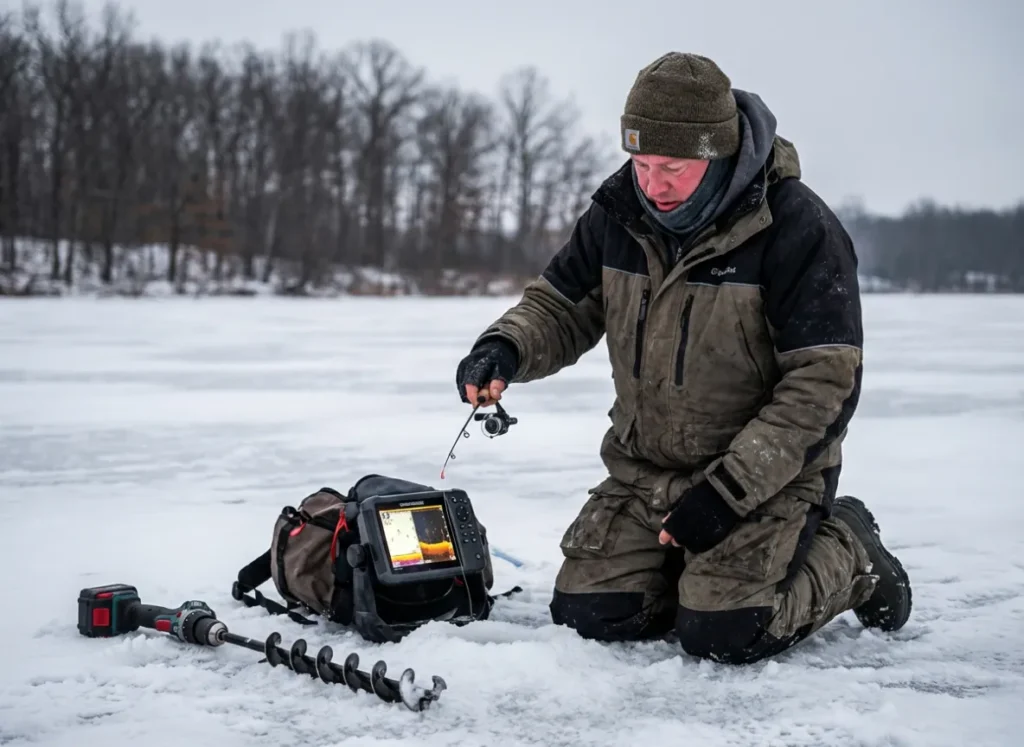
Having located the prime habitat, the final phase is the engagement—convincing the predator to strike using specific presentations and gear adjustments.
Why does aggression trump finesse during first ice?
First ice is prime time for hitting untouched packs of jumbo perch in shallow water. These fish are metabolically active, having just transitioned from the late-fall feed. They are often concentrated in schools, creating a competitive feeding environment.
Reaction baits—such as flutter spoons, Jigging Raps, and tungsten jigs tipped with soft plastics—trigger instinctive strikes even from neutral fish. The goal is to call fish in from a distance using vibration and flash.
Unlike mid-winter where “dead-sticking” (stationary bait) is dominant, First Ice favors a “Rip-Pause” cadence. The aggressive upward rip draws attention, while the pause allows the fish to strike.
Upsizing lures effectively targets big fish; a larger profile mimics the substantial forage (bluegill, perch, shiners) that predators are hunting in the weeds. To maximize this, you must be matching your ice fishing rod and reel combo to the weight of the lure—pairing short rods with inline reels or spinning reels for optimal control.
Understanding Fish Visual Physiology and Behavior helps explain why these high-visibility, high-vibration tactics work so well in the filtered light of early winter. Modern fish finders, particularly flashers like a Vexilar or 2D sonar, are essential for timing this cadence to the fish’s reaction.
Operational Debrief
Early season success is not about luck; it is about the disciplined application of science.
- Safety is Physics: Trust the Spud Bar and Gold’s Formula. Minimum 4 inches of clear ice is the baseline for foot travel, and white ice requires double that thickness.
- Biology Dictates Location: Green weeds produce oxygen, which anchors the food chain. If the weeds are brown, the fish are gone.
- Mobility Wins: The “First Ice” bite is a hunt. Lightweight gear and aggressive tactics allow you to cover water and find the active fish before they are pressured.
Before you head out to the hardwater, double-check your gear checklist and review the local ice reports. Share your ‘First Ice’ success stories or questions in the comments below.
FAQ – Frequently Asked Questions about First Ice Fishing
How thick does ice need to be for safe walking?
The Minnesota DNR recommends a 4-inch ice rule for new, clear ice for foot travel. If the ice is white or snow-covered, this minimum should be doubled to at least 8 inches due to its reduced structural integrity. 2 inches unsafe is the universal standard for keeping off the ice.
What is the most important safety tool for early ice?
The Spud Bar (Ice Chisel) is the most critical tool because it prevents you from stepping on unsafe ice in the first place. It should be used to strike the ice ahead of every step; if water seeps through or the bar penetrates, you must turn back immediately.
Why can’t I find fish in the shallow weeds during early winter?
If shallow weeds are present but hold no fish, they are likely decaying (brown) and depleting oxygen rather than producing it. Use a weighted treble hook to snag a weed sample; if it is brown or slimy, move to a different area or slightly deeper water where oxygen levels may be more stable.
Is it safe to drive an ATV on first ice?
Generally, no. Most safety guidelines recommend waiting for at least 5 to 7 inches of clear ice before using snowmobiles or small ATVs. First Ice is notoriously variable in thickness; a machine adds significant weight and speed, making it difficult to detect weak spots in time to stop.
Risk Disclaimer: Fishing, boating, and all related outdoor activities involve inherent risks that
can lead to injury. The information provided on Master Fishing Mag is for educational and informational purposes
only. While we strive for accuracy, the information, techniques, and advice on gear and safety are not a substitute
for your own best judgment, local knowledge, and adherence to official regulations. Fishing regulations, including
seasons, size limits, and species restrictions, change frequently and vary by location. Always consult the latest
official regulations from your local fish and wildlife agency before heading out. Proper handling of hooks, knives,
and other sharp equipment is essential for safety. Furthermore, be aware of local fish consumption advisories. By
using this website, you agree that you are solely responsible for your own safety and for complying with all
applicable laws. Any reliance you place on our content is strictly at your own risk. Master Fishing Mag and its
authors will not be held liable for any injury, damage, or loss sustained in connection with the use of the
information herein.
Affiliate Disclosure: We are a participant in the Amazon Services LLC Associates Program, an
affiliate advertising program designed to provide a means for us to earn advertising fees by advertising and linking
to Amazon.com. As an Amazon Associate, we earn from qualifying purchases. We also participate in other affiliate
programs and may receive a commission on products purchased through our links, at no extra cost to you. Additional
terms are found in the terms of service.