In this article
Saltwater does not wait for permission to destroy your equipment. The moment your reel leaves the factory, it enters a losing battle against galvanic corrosion and entropy, where aluminum frames turn to white powder and stainless bearings seize into solid blocks.
I have seen high-end equipment reduced to scrap metal not by abuse on the boat, but by neglect in the garage. Preventative maintenance is not about keeping your fishing gear looking new; it is a mandatory engineering protocol to disrupt the electrochemical circuit that turns a $500 investment into a paperweight.
This guide moves beyond bare minimum maintenance. We will examine the physics of failure—understanding how salt crystallization mechanically destroys internal components—and implement a tiered maintenance protocol. From the immediate post-trip ritual to chemical intelligence regarding lubricant viscosity, this is how you keep your asset protection strategy robust and your gear fighting fit.
The Physics of Degradation: Why Do Fishing Reels Fail?

To protect your gear, you must first understand the enemy. It isn’t just water; it is a complex interaction of chemistry and physics that attacks your fishing tools on two fronts: electrochemical reaction and physical abrasion.
What is the “Galvanic Battery” Effect in Saltwater Gear?
Fishing reels are intricate assemblies of dissimilar metals. You have aluminum frames, brass gears, and stainless steel bearings, all possessing different electrical potentials. When saltwater acts as an electrolyte connecting these metals, it creates a galvanic cell, effectively turning the reel into a battery.
In this scenario, the aluminum usually acts as the anode. It surrenders electrons to the noble steel cathode, resulting in rapid pitting and the formation of aluminum oxide—that dreaded white powder we find inside neglected reels. Corrosion prevention is fundamentally about electrical isolation: removing the electrolyte (rinsing) or maintaining a dielectric barrier (grease) between metals.
Anodization provides a protective coating, but this layer is microscopic. A single scratch from sand or a hook point exposes the reactive substrate to immediate attack. This is an electrochemical process where one metal corrodes preferentially, consuming the gear from the inside out.
The speed of this reaction increases with temperature and salinity. This explains why specific saltwater vs freshwater gear materials are chosen by manufacturers; however, even the best materials cannot withstand a permanent electrolyte bath. Once a seal is breached, the internal galvanic reaction is contained and accelerated, overwhelming your saltwater defense.
How Does Salt Crystallization Destroy Rod Guides and Drag Systems?
While chemistry occurs silently, the physical threat is often audible. Seawater contains approximately 3.5% dissolved salts. When the water evaporates, the salt remains and undergoes a phase change into jagged, crystalline solids.
These crystals are hygroscopic, meaning they continue to absorb moisture from the air and grow. This exerts hydraulic-like expansion pressure. In rod guides, this expansion occurs between the metal frame and the ceramic inserts, often cracking the brittle ring or popping it out entirely.
Inside a reel, salt crystals function as a grinding agent. They are harder than many soft alloys, leading to abrasive wear on gear teeth and the gritty “coffee grinder” sensation. The properties of sodium chloride crystallization allow these shards to act like sandpaper inside your precise machinery, destroying mechanical performance.
This crystallization force is strong enough to delaminate rod coatings and seize the hood locking nut on reel seats. Unlike organic grime, salt cannot simply be wiped off; it must be dissolved back into solution using fresh water. This geologic mechanism underscores the urgency of Tier 1 care; you must remove the saltwater before evaporation completes the crystallization cycle.
Pro-Tip: Check your reel seat locking nuts after every saltwater trip. Salt crystals often form in the threads, seizing the reel to the rod permanently. A soft toothbrush and warm water prevent this expensive lock-up.
Understanding the fragile anatomy of rod guides is critical to preventing line failure. We will cover how to inspect for this damage in Tier 2.
Tier 1: The Post-Trip Neutralization Protocol (Every Trip)
The most critical maintenance happens five minutes after you step off the boat or leave the surf. This is the “Do No Harm” phase, designed to neutralize the electrolyte without forcing it deeper into the mechanism.
How Should You Rinse Gear Without Forcing Salt Inside?
The “Do No Harm” principle dictates avoiding high-pressure water. A jet spray might knock off sand, but it forces salt and particulate matter past the reel’s rubber seals and directly into the gearbox.
Use a low pressure rinse from a garden sprayer or a gentle shower setting. Utilize gravity to let water cascade down the equipment rather than blasting it laterally. Rinse the reel in a vertical orientation, exactly as it sits on the rod, or with the spool facing down. This ensures water flows away from drain ports, not into them.
Before the water touches the reel, tighten the drag knobs completely. This compresses the seals, preventing water intrusion into the drag washers and drag systems.
Once rinsed, employ the “Spin Dry” technique. Shake the reel vigorously and spin the handle rapidly to utilize centrifugal force to expel water from the rotor. Then, blot dry with a clean microfiber cloth. Warm water is chemically superior to cold water for dissolving salt deposits, making a warm shower rinse more effective than a cold hose down.
Rod guides require specific attention. Use a soft toothbrush on the guide feet where salt tends to accumulate and corrode the frame welds. Never soak a reel in a bucket of water unless it is fully sealed, as this submerges non-sealed components in a diluted salt solution. This adheres to standards for the maintenance of historic mechanical systems, where gentle preservation is preferred over aggressive cleaning.
Even when comparing modern reels with IPX8 sealing, the risk of pressure washing remains. Seals are designed to stop splashes and dunks, not high-velocity jets.
Why Must the Drag Be Tightened During Washing but Loosened for Storage?
During the rinse, the drag must be locked down to create a watertight seal. This protects the felt or carbon fiber washers from water saturation. However, storing a reel in this state is a critical error.
Storing a reel with a tightened drag leads to “compression set.” The washers lose their elasticity and ability to expand. This results in a jerky, “all-or-nothing” drag performance that lacks fine adjustability.
The protocol is simple: Tighten to wash, then immediately loosen completely to dry and store. This allows the washers to relax and retain their spring properties, ensuring storage longevity.
This practice extends to spincast reels, baitcasters, and spinning reels alike. If a drag has been left tight for an extended period, the washers may need to be removed and massaged (if felt) or re-greased (if carbon) to restore function. The mechanical behavior of compressed elastomers dictates that once a material takes a “set,” its performance is permanently compromised.
For lever drag reels, ensure the lever is in the “Free Spool” position during storage to disengage the pressure plate from the spool. Proper drag management is the precision required when you set fishing drag, ensuring that when a trophy fish runs, the line peels smoothly rather than snapping.
For long-term storage, consider placing reels in zip-lock bags with silica gel packs to control humidity. Rods should be stored in vertical rod racks or horizontal rod racks to prevent warping and set bends in the rod blank. Using mesh rod covers or rod socks protects the eyelets and prevents tangles during transportation safety checks.
Tier 2: The Chemical Refresh (Monthly Maintenance)
While rinsing removes the bulk electrolyte, the internal mechanics require periodic attention to keep moving parts fluid. This intermediate care step bridges the gap between rinsing and full disassembly.
Which External Parts Require Lubrication Between Deep Cleans?
The “Tier 2” refresh focuses on external moving parts that are most exposed to spray and washout. Specifically, we target the line rollers, handle shaft, and bail arm.
The line roller is the hardest-working bearing in a spinning reel. A single drop of oil here prevents the “screeching” sound that indicates a dry bearing or seizure. Apply a drop of corrosion-inhibiting oil (like Lucas Oil or Ardent Reel Butter) to the handle knob shafts and work it in by spinning the knob.
Lubricate the bail arm pivot points to ensure the bail snaps shut decisively. A sluggish bail can result in loose line loops and wind knots. This maintenance contributes directly to the rotational refinement found in the best spinning reels.
On baitcasting reels, apply a minimal amount of light grease (not oil) to the worm gear of the level wind. Excess grease here traps sand and creates an abrasive paste. Remove the spool on spinning reels to wipe down the main shaft and apply a fresh film of light oil. Cycle the handle to distribute it down into the pinion gear.
Avoid over-lubrication. Excess oil attracts dust and can migrate into the drag washers, causing them to slip unpredictably. Understanding the tribology and lubrication regimes for rolling bearings highlights why running these high-speed parts dry is a recipe for failure.
How Can You Detect Micro-Fractures in Ceramic Guides?
Modern rod guides use ceramic inserts (Silicon Carbide, Alconite) that are harder than steel but brittle. They can develop hairline cracks from impacts that are invisible to the naked eye. These micro-fractures act like razor blades, slicing through braided line under tension.
The diagnostic tool of choice is a simple Q-Tip (cotton swab) or a piece of fine pantyhose. Pass the cotton through each guide ring. If the fibers snag, pull, or fray, it confirms the presence of a crack. The guide must be replaced immediately.
Pay special attention to the “tip-top” guide, as it is the most prone to damage from reeling swivels or lures all the way to the rod tip. Also, inspect the guide frames for green corrosion (verdigris) at the foot where the epoxy wrap meets the blank. This indicates saltwater intrusion under the wrap.
Inspect the cork handle and butt section for grime; clean them with mild soap or a Magic Eraser to maintain grip. Check the hook keeper for rust that could stain the blank. Detecting these issues prevents the heartbreak of losing a fish due to preventable equipment failure. The fracture mechanics of ceramic materials means these cracks will not heal; they will only grow. This damage is particularly dangerous when compromising the abrasion resistance of braided vs fluorocarbon line, as braid snaps instantly upon contacting a sharp ceramic edge.
Tier 3: The Mechanical Overhaul (Annual Deep Clean)
When external care is no longer enough, or when the seasons change, we must go deeper. The annual “reset”—or off-season deep clean—focuses on deep cleaning and diagnosing internal fluid failure using visual diagnostics.
What Are the Signs of Internal Lubricant Emulsification?
When opening a reel for Tier 3 maintenance, the condition of the old grease serves as a forensic clue to the reel’s health. “Milky,” “frothy,” or mayonnaise-colored grease is the definitive sign of emulsification.
This means water has breached the gearbox and mixed with the lubricant under high shear. The effects of water contamination on lubricating grease include a loss of film strength and load-carrying capacity. This allows metal-on-metal contact, leading to rapid gear wear.
Black or grey paste indicates heavy metal wear (aluminum or brass particles), suggesting gear misalignment or a long period of “dry” running. If emulsification is found, the reel requires a full solvent flush using Acetone or Naphtha for metal parts to remove all contaminated grease before repacking.
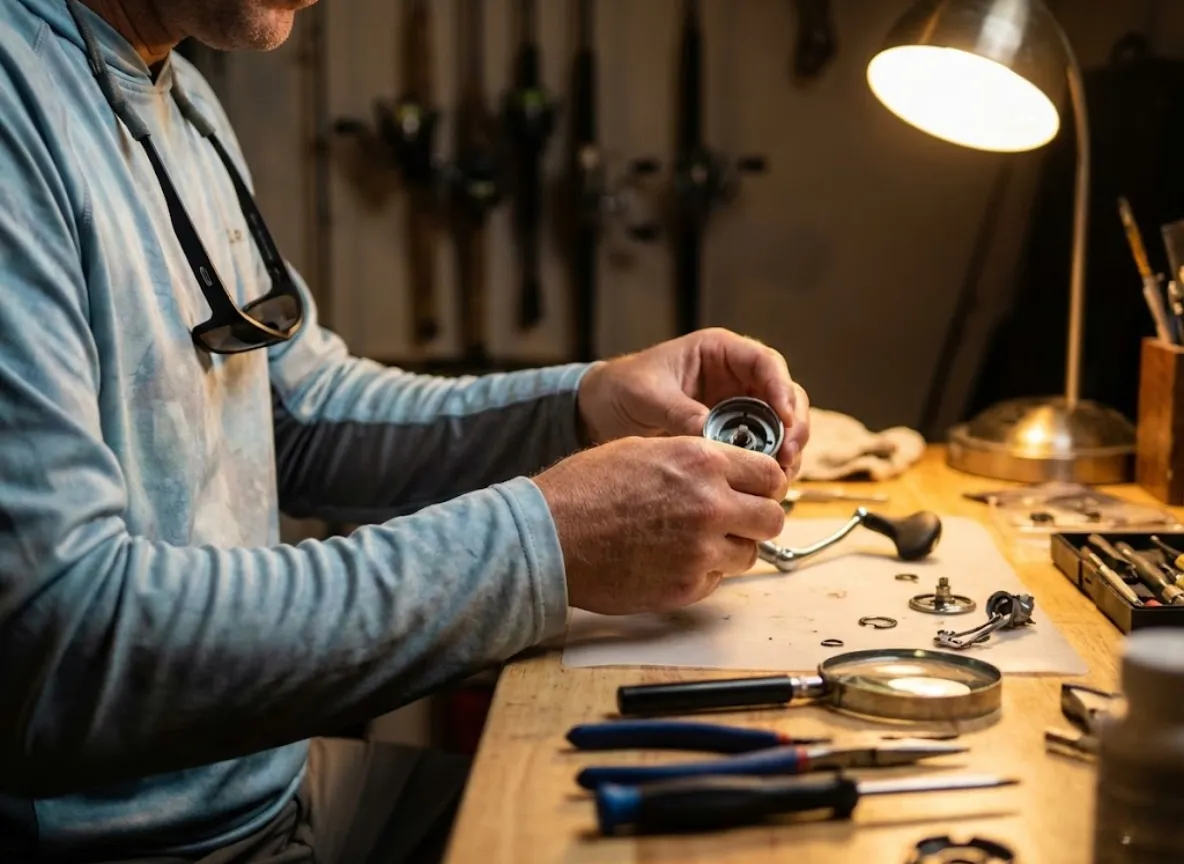
Healthy grease should retain its original color (usually blue, clear, or amber). Use a “White Buffing Towel” on your workbench. This high-contrast background makes it easier to spot small washers, clips, and the color of grease contaminants. This deep clean helps in adopting sustainable fishing gear maintenance practices, keeping gear out of landfills.
When Should You Attempt DIY Disassembly vs. Professional Service?
Modern high-end reels often feature advanced sealing technologies like “Magsealed” (ferrofluid) or “X-Protect.” These create contactless barriers against water. Disassembling these specific components—usually the rotor and anti-reverse switch assembly—breaks the magnetic seal. The fluid leaks out and cannot be refilled by the user.
Check the schematic and warranty policy. Usually, opening the main gearbox of these reels voids the warranty. The DIY boundary is generally defined as: Spool, Handle, Drag Washers, and Line Roller (Safe) vs. Pinion Assembly, Magseal Rotor, and Main Gearbox (Pro Service for sealed reels).
For standard mechanical reels, full disassembly is encouraged. Always use a schematic diagram and a numbered parts tray to organize components in the exact order of removal. If you encounter a screw with red Loctite or a part that requires force, stop immediately.
Professional service centers have ultrasonic cleaners that can remove oxidation from crevices a toothbrush cannot reach. The importance of specialized tools for complex mechanical assemblies mirrors the complex braking systems in the best baitcasting reels, which often require factory calibration.
The Chemistry of Care: Selecting the Right Solvents and Lubricants
The chemistry you apply to the reel matters as much as the mechanical work. Using the wrong product can do more harm than salt itself.
Why Is WD-40 Dangerous for Modern Fishing Reels?
WD-40 stands for “Water Displacement, 40th formula.” It is primarily a solvent and penetrating fluid, not a long-term lubricant. When sprayed into a reel, WD-40 dissolves the factory grease and oil, stripping away the protective film. Once the volatile carrier evaporates, your gears are left exposed to friction.
More critically, standard WD-40 can chemically degrade certain rubber compounds (O-rings) and polycarbonate plastics used in modern reel bodies. This leads to structural cracking. It should be used only as a cleaner/degreaser on disassembled metal parts, rusty hooks, or swivels, and must always be followed by proper lubrication.
For general lubrication, use specialized reel oils like TSI 321 or CorrosionX, which have high dielectric strength to prevent galvanic corrosion. Avoid “3-in-One” oil or vegetable-based oils that gum up over time. Understanding the chemical compatibility of elastomers with solvents is the “Software” that protects the “Hardware” of your reel. Proper chemical selection is vital when complementing your kit of essential fishing tools.
How Do You Choose Between Grease and Oil for Different Components?
The rule of tribology in reels is simple: Grease is for Load, Oil is for Speed.
- Grease: Apply to main gears, pinion gears, and drag washers (if carbon fiber). It stays in place under pressure and creates a thick water-resistant barrier. High-quality options include Penn Grease or Abu Garcia Grease.
- Oil: Apply to ball bearings (spool, handle, line roller). Low viscosity reduces startup inertia, allowing for longer casts and smoother rotation.
Mixing them indiscriminately causes performance issues. Grease in a spool bearing will kill casting distance, while oil on main gears will wash out and lead to grinding.
For drag systems, use specialized PTFE-based grease like Cal’s Universal Drag Grease. This manages heat and prevents “stick-slip.” Viscosity matters; use ultra-low viscosity oil for freshwater fishing casting reels to maximize distance, and heavier oil for saltwater equipment to maximize protection.
Apply grease with a precision brush. You want a “painting” of grease on the teeth, not a “glob.” Excess grease coats the inside of the frame, trapping dirt. This targeted application ensures you are fine-tuning the performance of your rod and reel combo, making the reel feel free where it needs speed, and solid where it needs strength. The principles of elastohydrodynamic lubrication confirm that a thin, unbroken film is all that is required to separate metal parts.
Final Thoughts
Proper maintenance separates the angler who lands the fish of a lifetime from the one who tells a story about “the one that got away” due to a seized drag.
Remember the core tenets:
- Store Drag Loose: Prevent compression set in your washers and maintain drag systems.
- Mist, Don’t Blast: High-pressure water forces salt past seals; use a fresh water mist.
- Dielectric Defense: Grease is your primary shield against galvanic corrosion.
- WD-40 is a Solvent: Keep it away from your assembled reel.
Before your next trip, perform the “Q-Tip Test” on your rod guides and check your line inspection routine for backing line integrity. It takes thirty seconds and could save your next trophy catch. Explore our full library of Gear Selection guides to ensure you’re starting with the best equipment possible.
FAQ – Frequently Asked Questions
Is it safe to use WD-40 to lubricate my fishing reel?
No, standard WD-40 is a solvent that strips away existing lubricants and can damage rubber seals and plastic components. Use it only for cleaning disassembled metal parts, and always follow up with proper reel oil and grease.
How often should I grease my fishing reel?
Perform a deep clean and re-greasing once a year for typical use, or immediately if the reel has been submerged in saltwater. For heavy usage (weekly trips), a mid-season check of the main gear grease is recommended.
Do I really need to rinse my gear after freshwater fishing?
Yes, although less urgent than saltwater, freshwater contains algae, minerals, and suspended grit that can accumulate in crevices. A gentle rinse prevents biological buildup and keeps the level wind and line roller operating smoothly.
How do I remove green corrosion from my rod guides?
Scrub the area with a soft toothbrush dipped in a mixture of vinegar and water to dissolve the oxidation, then rinse thoroughly. If the corrosion has penetrated under the epoxy wrap or the frame is pitted, the guide may need professional replacement.
Risk Disclaimer: Fishing, boating, and all related outdoor activities involve inherent risks that can lead to injury. The information provided on Master Fishing Mag is for educational and informational purposes only. While we strive for accuracy, the information, techniques, and advice on gear and safety are not a substitute for your own best judgment, local knowledge, and adherence to official regulations. Fishing regulations, including seasons, size limits, and species restrictions, change frequently and vary by location. Always consult the latest official regulations from your local fish and wildlife agency before heading out. Proper handling of hooks, knives, and other sharp equipment is essential for safety. Furthermore, be aware of local fish consumption advisories. By using this website, you agree that you are solely responsible for your own safety and for complying with all applicable laws. Any reliance you place on our content is strictly at your own risk. Master Fishing Mag and its authors will not be held liable for any injury, damage, or loss sustained in connection with the use of the information herein.
Affiliate Disclosure: We are a participant in the Amazon Services LLC Associates Program, an affiliate advertising program designed to provide a means for us to earn advertising fees by advertising and linking to Amazon.com. As an Amazon Associate, we earn from qualifying purchases. We also participate in other affiliate programs and may receive a commission on products purchased through our links, at no extra cost to you. Additional terms are found in the terms of service.