

In this article
The 6XD was running three feet shallower than it should have been. I could feel it — planing off the tops of the brush piles instead of grinding the bottom where the post-spawn bass were stacked. I’d been cranking for forty minutes with a 7.1:1 gear ratio reel, and every cast produced the same frustrating result: too fast, too shallow, zero bites.
I swapped to the 5.4:1 rig sitting untouched in the rod locker. Third cast, the crankbait slammed into a stump at fifteen feet and a four-pounder nearly ripped the rod out of my hand.
After twenty-plus years of bass fishing and more reel swaps than I care to count, I’ve watched the same mistake play out hundreds of times on my own boat and on every dock I’ve ever guided from. Most anglers grab one “do-everything” baitcasting reel, spool it up, and crank every lure at the same speed. Then they wonder why their deep-diving crankbaits run shallow, their jigs miss hooksets, and their forearm is wrecked by noon.
Here’s the truth: your gear ratio controls your lure presentation speed, and matching the right ratio to the right technique is the single fastest way to put more fish in the boat without buying a single new lure.
⚡ Quick Answer: A baitcaster’s gear ratio determines how fast the spool turns per handle crank, which directly controls your lure speed. Low ratios (5.1–5.8:1) provide torque for deep cranks and big swimbaits. Medium ratios (6.2–6.8:1) balance speed and power for spinnerbaits and chatterbaits. High ratios (7.1–8.5:1) recover line fast for jigs, topwater, and flipping. Most anglers fail by using one ratio for everything. Build a three-reel arsenal to match the mechanical demands of each technique.
The Mechanical Physics of Gear Ratio and IPT
What the Numbers on Your Reel Actually Mean
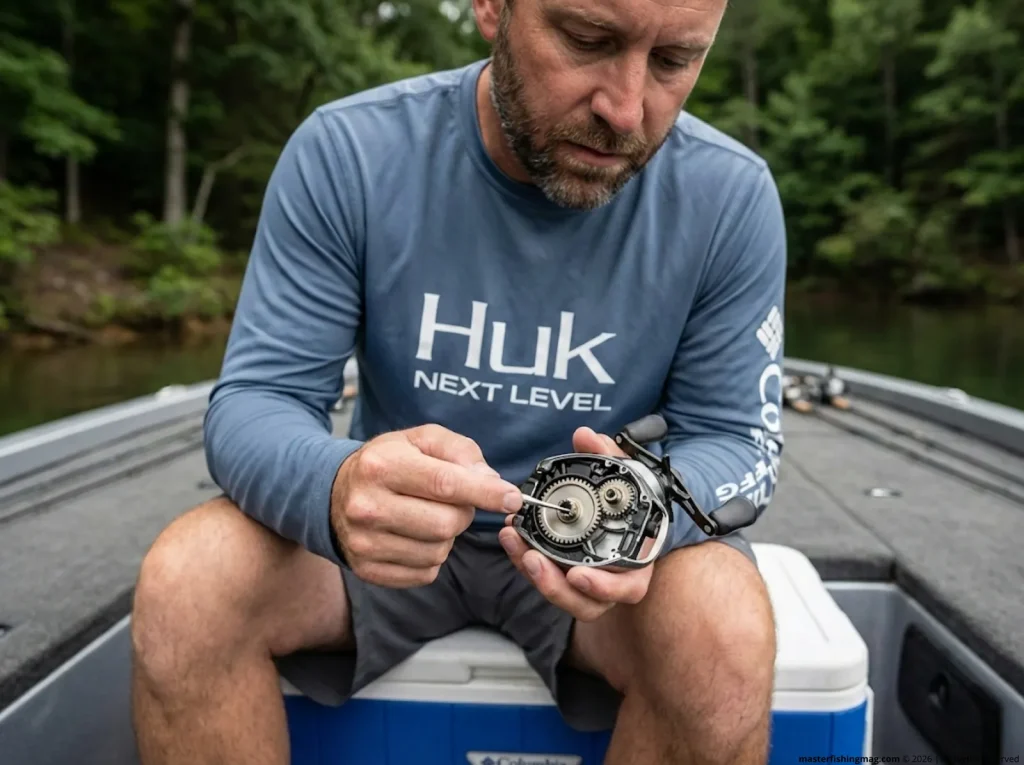
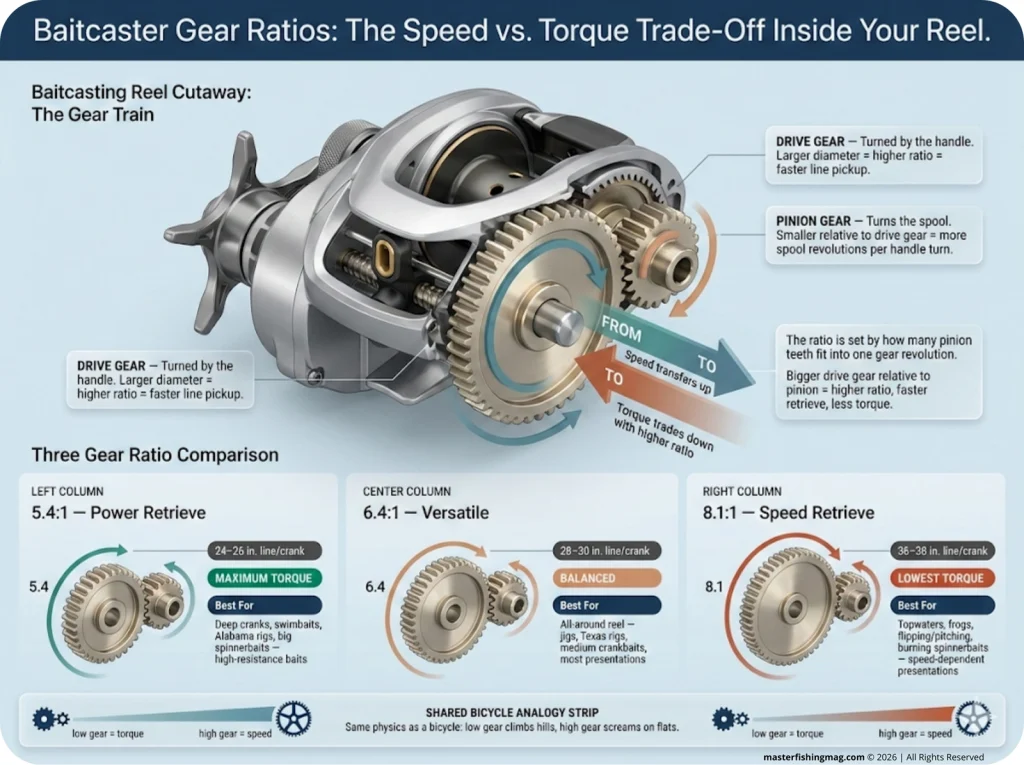
The number stamped on your baitcasting reel tells you how many times the spool spins for every full turn of the reel handle. A 6.3:1 gear ratio means 6.3 spool revolutions per crank. Simple enough.
What that number hides is the trade-off happening inside the gear train. The ratio is set by two gears: a large drive gear and a smaller pinion gear. A higher ratio needs a bigger drive gear relative to the pinion. That gives you faster line pickup, but it costs you torque — the raw grinding power you need to pull high-resistance baits through the water without your arm falling off.
Think of it like a bicycle. Low gear pedals slow but climbs hills with ease. High gear screams on flat ground but burns your legs on any incline. Same physics, different application.
Why IPT Matters More Than Gear Ratio
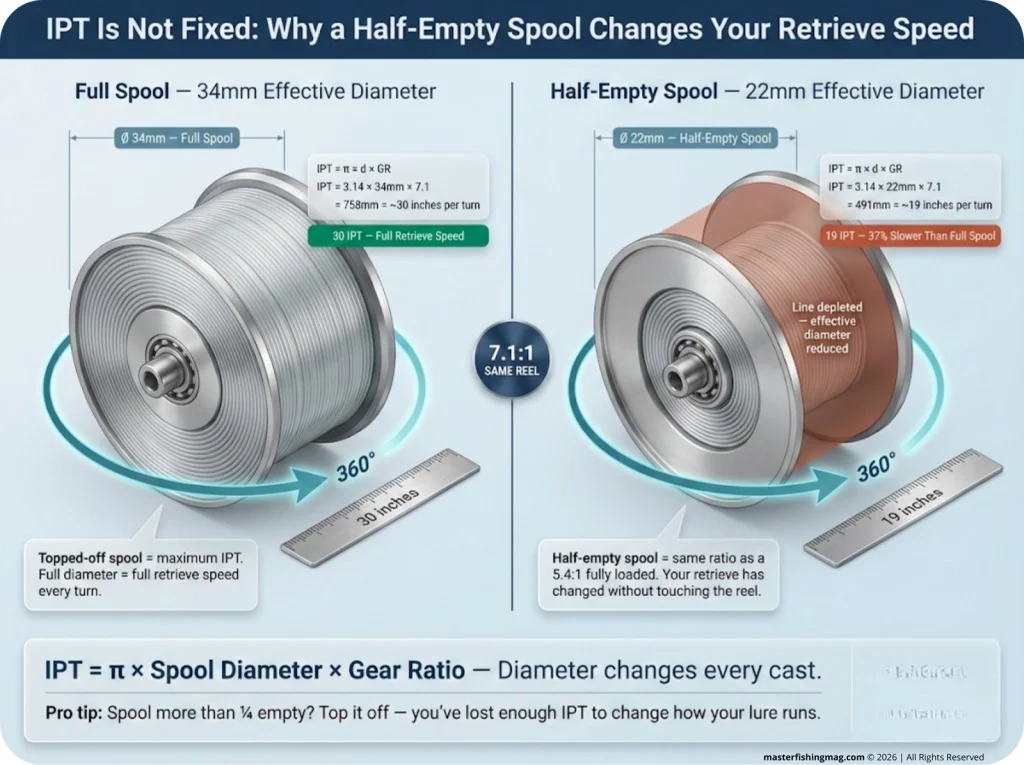
Here’s where most anglers get tricked. The gear ratio alone doesn’t tell you how fast your lure actually moves. What matters is inches per turn — the actual length of fishing line your reel collects per handle turn.
IPT depends on the spool diameter, not just the ratio. A big spool (34–36mm) picks up more line per revolution than a small one, even at the same gear ratio. Kevin VanDam has pointed out that wider spools keep your IPT more consistent throughout a long cast because the line level drops slower as line depletes.
And here’s the part nobody talks about: IPT is not a fixed number. When you chuck a long cast and half your line is off the spool, the effective diameter shrinks. A half-spooled 7.1:1 reel can actually retrieve at the same rate as a fully loaded 5.4:1. That’s why topped-off spools matter. The spool-fill effect changes your real-world retrieve dynamics more than most anglers realize.
Pro tip: Before you blame the reel for a slow retrieve, check your spool. If it’s more than a quarter empty, you’ve lost enough IPT to change how your lure runs. Top it off with backing or fresh line and you’ll feel the difference immediately.
Understanding the relationship between internal bearing friction that compounds under high-speed retrieves and your gear ratio helps explain why some reels feel buttery at low speed but grind under heavy loads.
How Gear Ratio Controls Lure Depth and Action
The “Dig vs. Plane” Phenomenon
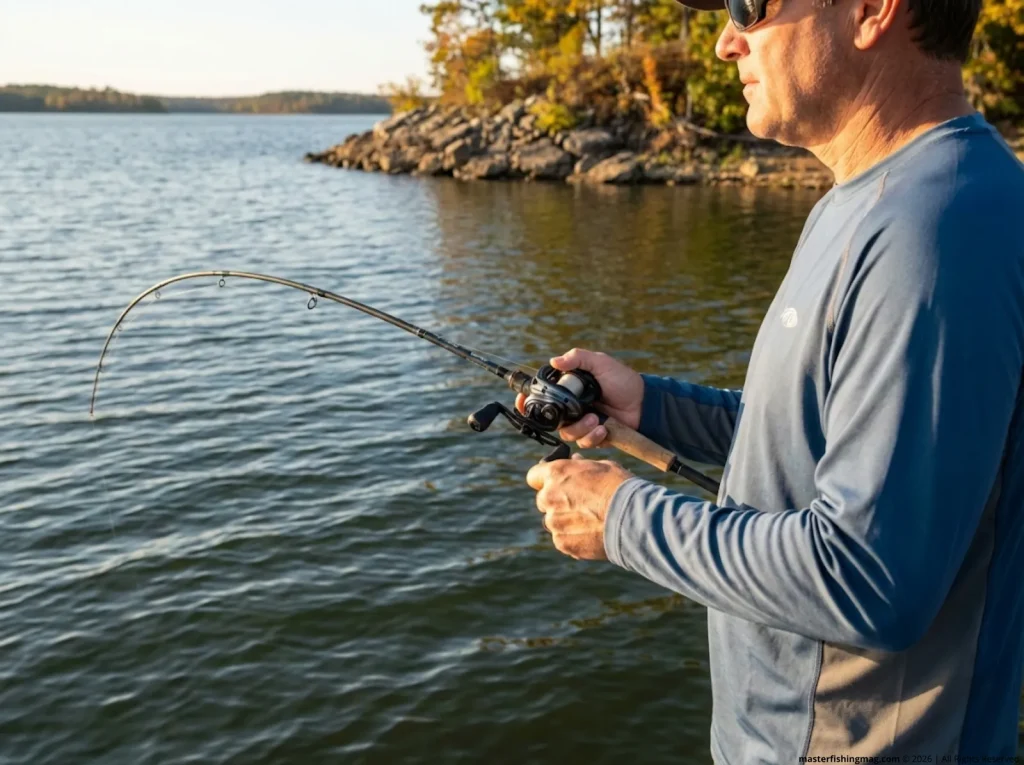
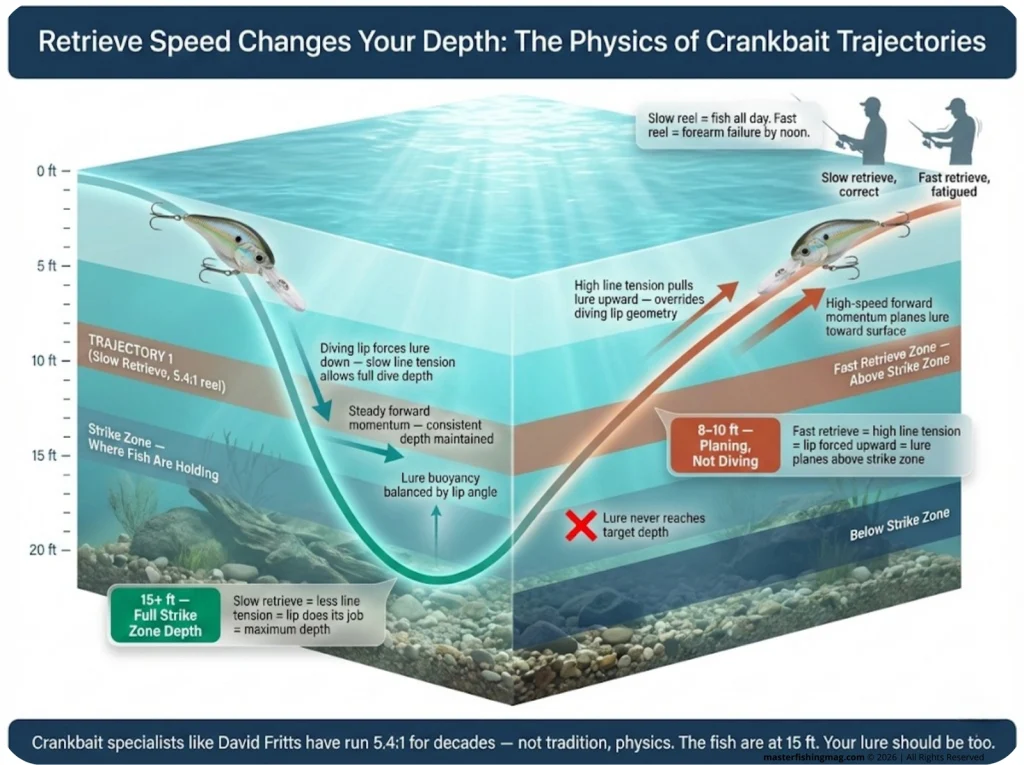
This is where the wrong gear ratio actively costs you fish, not just comfort. Most bass anglers assume a faster reel gets a crankbait deeper, faster. The physics say the opposite.
When you retrieve a deep-diving crankbait too quickly, the increased line tension creates an upward pull that causes the lure to “plane,” running shallower than its rated depth. Baits like the Strike King 6XD or 10XD reach their maximum depth through a steady, moderate retrieve that lets the bill dig into the water column without fighting the drag of the line itself.
A 5.1:1 gear ratio gives you the control to maintain that sweet spot. And because the gears aren’t strained, you feel every vibration — every tick against wood, every change in the rhythmic thump that signals a bite or contact with structure. Understanding the bill angle and aspect ratio that determine a crankbait’s dive curve completes the picture of what makes a crankbait reach its rated depth.
The Fatigue Equation
Retrieving high-resistance baits on a high-speed reel is a recipe for a destroyed forearm. The gear train multiplies speed but divides power, which means your muscles pick up the slack. After an hour of crankbaiting with the wrong ratio, most anglers start slowing down without realizing it, and that inconsistent speed means inconsistent depth.
Crankbait specialists like David Fritts have advocated for low-speed reels for decades. Not because they’re old-fashioned, but because a slow reel lets you grind all day without the fatigue that kills your presentation by afternoon. The fish don’t care if your arm is tired. They care if the lure is in the strike zone.
Pro tip: If your forearm burns after 30 minutes of cranking, the reel is wrong, not your conditioning. Switch to a 5.4:1 and you’ll fish the same crankbait all day without thinking about it.
Matching Gear Ratio to Your Technique
Bottom-Contact Baits: Jigs and Soft Plastics
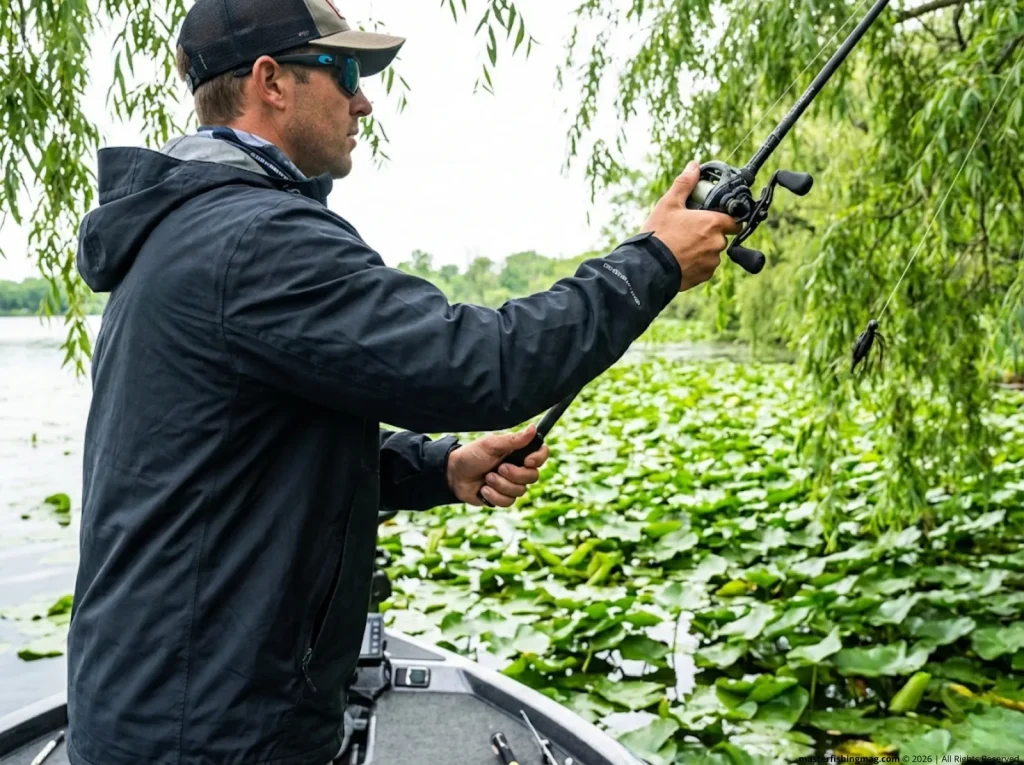
For jigs, Texas rigs, Carolina rigs, and drop shot rigs, the rod does the work. You hop, drag, and shake with your wrist. The reel is there for one job: pick up slack and hustle the bait back for another pitch.
That’s why a high-speed reel between 7.1:1 and 8.5:1 is non-negotiable for jig fishing. When a bass inhales a jig and swims toward the boat, which happens more often than you’d think, you need quick slack take-up or you’ll never get a solid hookset. Fast reels also let you pull hooked fish away from cover before they wrap you in submerged timber or thick vegetation.
The efficiency angle is real too. A 30+ IPT reel saves seconds on every cast cycle. Over six hours of flipping heavy cover, that adds up to dozens of extra presentations. In tournament bass fishing, extra pitches directly translate to more opportunities. According to the Recreational Boating & Fishing Foundation, choosing technique-specific reels is one of the biggest equipment decisions an angler can make.
Reaction Baits: Spinnerbaits and Chatterbaits
The medium gear ratio range, 6.1:1 to 6.8:1, is where reaction strikes happen. Spinnerbaits need enough speed to spin the blades and create that distinctive thump, but an overly fast retrieve kills the action. A 6.3:1 gear ratio provides a comfortable cadence where the blades turn properly at a natural cranking pace.
Where this matters most is the pre-spawn. Fish holding in shallow cover want a slow-rolling presentation, the spinnerbait crawling over logs and through grass at a pace that cold, sluggish bass will track and commit to. A medium-speed reel lets you do this without constantly fighting your natural cranking rhythm. Dialing in how water clarity determines which blade style produces the right vibration completes your spinnerbait setup beyond just the reel.
Topwater, Buzzbaits, and Jerkbaits
Walking baits and jerkbaits run on a slack-line cadence: you twitch the rod tip, then reel up the slack. A high gear ratio reel (7.5:1 or faster) picks up that slack before the next twitch so you’re never reeling dead air when a fish blows up on the bait.
Buzzbaits and lipless crankbaits are often “burned” at high speeds to trigger aggressive reaction strikes. The Abu Garcia Revo Rocket (10.1:1, 41 IPT) handles this without burning out your wrist. But reels above 9.0:1 are specialized tools built for high-speed techniques and maximizing casts per hour, not for everyday use.
The Human Factor: Why Your Default Cadence Betrays You
Comfortable Revolutions Per Minute (CRPM)
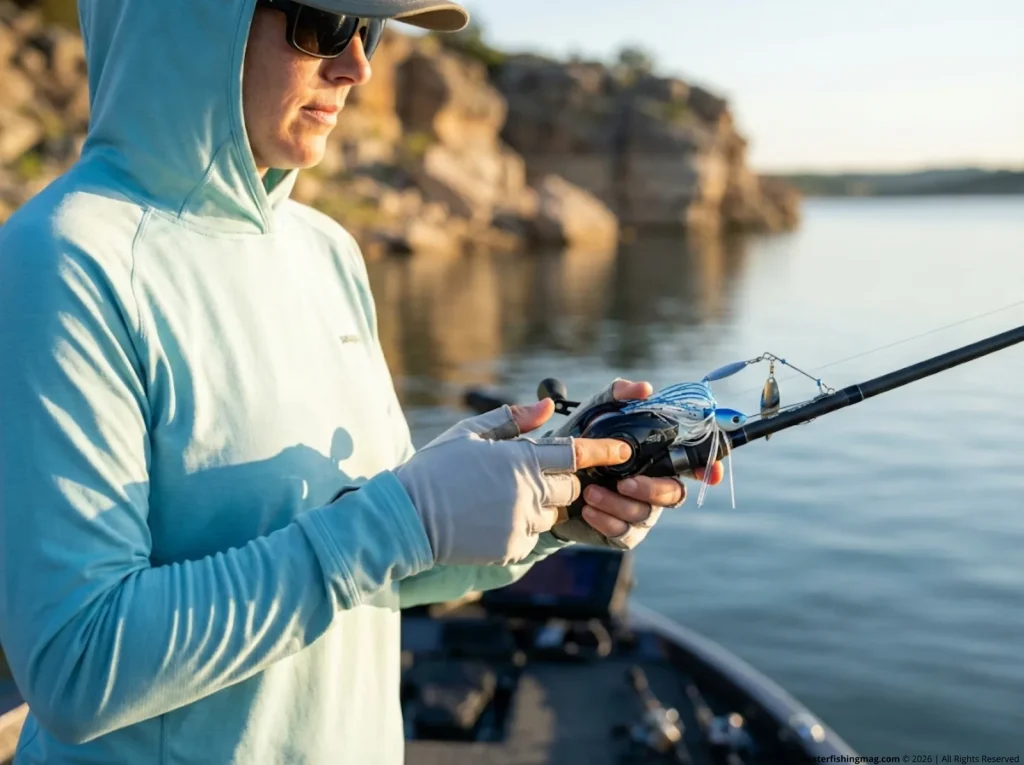
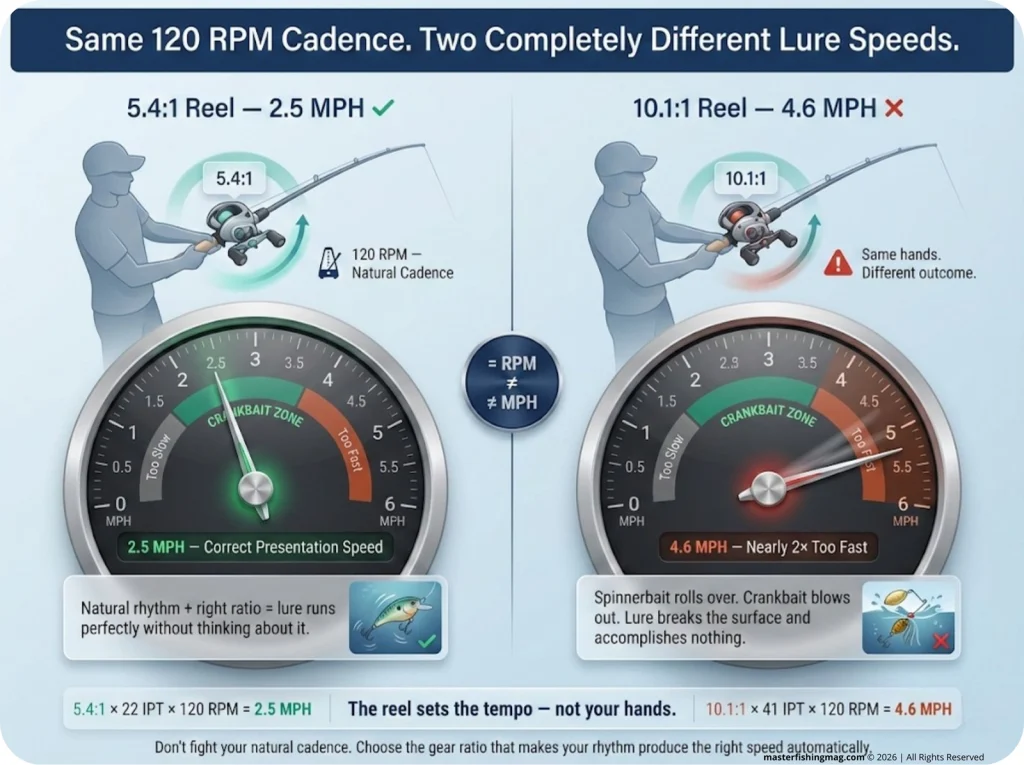
Here’s the part that makes most anglers pick the wrong gear ratio without ever knowing it. You have a default cranking rhythm, a natural, subconscious cadence you fall into every time you pick up a rod. For most people, that’s roughly 120 handle turns per minute.
The problem: that same rhythm produces wildly different lure speeds depending on the reel. At 120 RPM, a 5.4:1 reel with 22 IPT moves your bait at around 2.5 MPH, about right for a crankbait. But a 10.1:1 gear ratio reel with 41 IPT at that same cadence sends your lure screaming at 4.6 MPH, nearly twice the intended speed. Try slow rolling a spinnerbait at 4.6 MPH and watch it roll over, break the surface, and accomplish nothing.
The smarter approach isn’t trying to consciously slow your hands. It’s letting the reel’s mechanical limit set the tempo. Use the right gear ratio and your natural rhythm produces the correct lure presentation speed without you thinking about it.
Kayak Anglers and Platform Drift
Gear ratio becomes even more critical when you fish from a kayak. Wind and current push the hull toward your lure, creating slack faster than a slow reel can recover. A bass angler in a kayak running a 5.4:1 reel is fighting two battles: the fish and the drift.
Kayak anglers typically favor 7.5:1 or higher for all techniques, treating the fast ratio as compensation for the lack of boat positioning control. If you fish from a kayak, understanding how pedal drives change boat positioning and presentation angles gives you one more variable to manage.
Water Temperature and Clarity: The Environmental Override

Cold Water, Slow Metabolism, Slow Reel
Bass are cold-blooded. When water temperature drops below about 55°F, their metabolism tanks and the strike zone shrinks to inches. A fast-moving lure passes right through that window before a sluggish fish can commit. The same crankbait that catches fish at 6.4:1 in July might need a 5.1:1 gear ratio in February to produce.
Understanding how water temperature drives everything from digestion speed to strike aggression makes it clear why the cold-water rule is straightforward: slow down everything. Slower reel speed. Slower cadence. Longer pauses.
Pro tip: A good rule from the dock: once you need a jacket on the water, drop one gear ratio category. If you’re fishing a 6.4:1 in summer, switch to a 5.4:1 when the water dips below 55°F.
Clear Water Burns, Muddy Water Crawls
Water clarity changes the game. In ultra-clear water, bass inspect a slow-moving lure long enough to spot the hooks and turn away. Burning a bait with a high-speed reel gives them a split second to react instead of a full examination. Clear water plus pressured fish calls for high-speed techniques.
Flip the conditions. In stained or muddy water, fish rely on their lateral line to locate the vibration. A medium gear ratio or slow gear ratio gives them time to track the sound and home in on the bait in low-visibility conditions.
The Three Mistakes That Cost You Fish
The “One-Reel” Trap
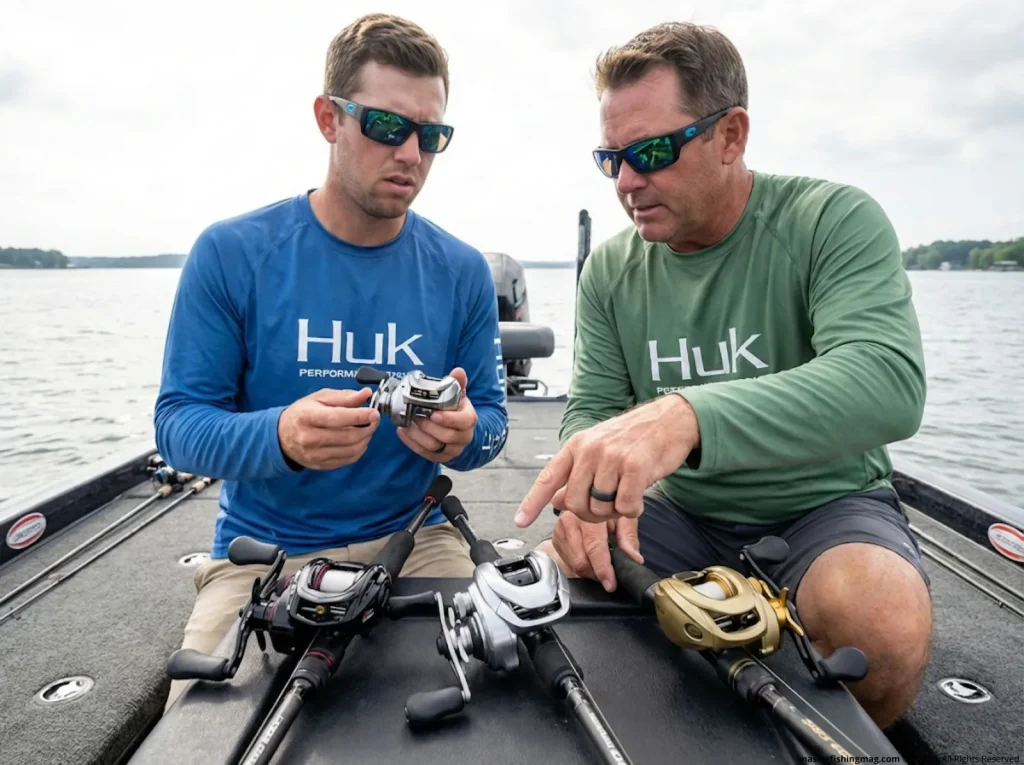
The most common mistake is trying to force a single 6.3:1 reel to handle everything. It’s too slow for efficient flipping and pitching (you lose cast count) and too fast for effortless deep crankbaiting (you fight the handle). For serious bass fishing, a minimum three-reel arsenal covers the full range:
- High-Torque (5.1–5.8:1): Deep-diving crankbaits, big swimbaits, heavy slow-rolling spinnerbaits, pair with 10-14 lb fluorocarbon
- Versatile (6.2–6.8:1): Squarebills, chatterbaits, medium-depth spinnerbaits, pair with 12-15 lb fluorocarbon or monofilament
- High-Speed (7.1–8.5:1): Jigs, Texas rigs, topwater, flipping, pair with 30-50 lb braid or heavy fluorocarbon
For specialized scenarios or tournament efficiency, an ultra-speed tier (10.1:1) handles lipless crankbaits, buzzbaits, and maximum cast-count days.
The Depth-Perception Error
Plenty of anglers think reeling faster with a high gear ratio reel will get a crankbait to maximum depth faster. As covered above, the physics say the opposite. Increased line tension and drag fight the dive curve. To hit 20+ feet with a deep diver, you need a low-speed reel and a patient, steady cadence. Let the lure do the work.
The Recovery Oversight
When a hooked bass runs toward the boat, the line goes slack and the hook starts to pull free. On a 5.4:1 reel, you physically cannot reel fast enough to maintain the “pin,” that critical tension keeping the hook seated. This is why many pros run 7.1:1 gear ratio or higher for anything with a single hook: jigs, worms, soft plastic stickbaits. Constant tension is the only thing between you and a lost fish.
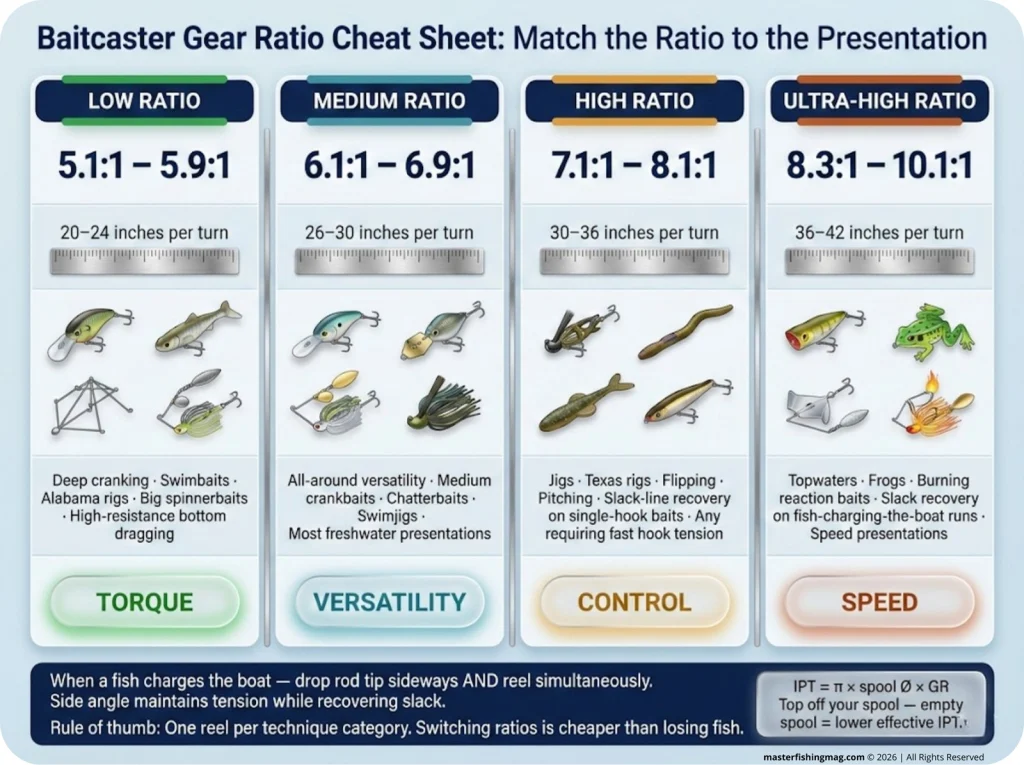
Pro tip: When a fish charges the boat, don’t just reel — drop the rod tip to the side and reel at the same time. The side angle helps you recover slack while keeping the line tight against the fish’s jaw.
Conclusion
Three things will change how you fish if you take them seriously.
Your IPT, not your gear ratio, tells you how fast your lure actually moves, and it changes with spool fill. Keep your spools topped off or you’re fishing a different reel than you think.
Match the reel to the technique, not the other way around. Low ratios grind deep cranks. Medium ratios control reaction baits. High ratios manage slack for jigs and topwater.
Build a three-reel arsenal instead of forcing one reel to do everything poorly. High-Torque, Versatile, and High-Speed covers 95% of bass fishing situations. Add an ultra-speed for specialized burning and you’re set for anything the water throws at you.
Next time you spool up, grab your phone and figure out your IPT at full spool versus half spool. The difference will change how you think about every cast you make.
FAQ
What gear ratio is best for crankbaits?
Low gear ratios between 5.1:1 and 5.8:1 are best for crankbaits, especially deep divers. The slower retrieve lets the bill dig to maximum depth and provides enough torque to grind through cover without fatiguing your forearm over a full day of casting.
Does a higher gear ratio mean more power or faster retrieve?
Higher gear ratio means faster retrieve, not more power. Power (torque) and speed are inversely related. A 7.1:1 reel spins the spool fast but provides less mechanical advantage to overcome resistance from heavy-pulling lures.
What is IPT on a fishing reel and why does it matter?
IPT stands for inches per turn, the actual length of line retrieved per handle turn. It matters more than gear ratio because it accounts for spool diameter, giving you the true lure speed. Two reels with the same ratio but different spool sizes will move your lure at different speeds.
Should I buy multiple gear ratios or one versatile reel?
Multiple reels is the better investment. A single versatile reel around 6.3:1 handles many tasks adequately but excels at none. A three-reel arsenal covering low (5.1–5.8:1), medium (6.2–6.8:1), and high (7.1–8.5:1) gear ratios gives you the right tool for every technique.
What gear ratio do kayak anglers need?
Kayak anglers generally benefit from 7.5:1 or higher across all techniques. Wind and current push the kayak toward the lure, creating slack that a slow reel cannot overcome. The high-speed reel compensates for the lack of boat positioning control.
Risk Disclaimer: Fishing, boating, and all related outdoor activities involve inherent risks that
can lead to injury. The information provided on Master Fishing Mag is for educational and informational purposes
only. While we strive for accuracy, the information, techniques, and advice on gear and safety are not a substitute
for your own best judgment, local knowledge, and adherence to official regulations. Fishing regulations, including
seasons, size limits, and species restrictions, change frequently and vary by location. Always consult the latest
official regulations from your local fish and wildlife agency before heading out. Proper handling of hooks, knives,
and other sharp equipment is essential for safety. Furthermore, be aware of local fish consumption advisories. By
using this website, you agree that you are solely responsible for your own safety and for complying with all
applicable laws. Any reliance you place on our content is strictly at your own risk. Master Fishing Mag and its
authors will not be held liable for any injury, damage, or loss sustained in connection with the use of the
information herein.
Affiliate Disclosure: We are a participant in the Amazon Services LLC Associates Program, an
affiliate advertising program designed to provide a means for us to earn advertising fees by advertising and linking
to Amazon.com. As an Amazon Associate, we earn from qualifying purchases. We also participate in other affiliate
programs and may receive a commission on products purchased through our links, at no extra cost to you. Additional
terms are found in the terms of service.