In this article
I was three hours into a steelhead float and the rod loaded perfectly on the swing — until the tip top launched off the blank and landed in the river like a tiny chrome missile. No backup rod. No tackle shop for forty miles. Just me, a broken rod, and a river full of fish.
That’s the moment you learn whether you carry a repair kit or you carry regret. Fixing a broken rod tip is one of the easiest repairs in fishing, but most anglers either don’t know how or they do it wrong and the fix fails after one trip.
Here’s how to repair a rod tip both on the water in under two minutes and at home as a permanent fix — plus how to size the replacement, pick the right adhesive, and know when the rod isn’t worth saving.
Quick Answer: To fix a broken fishing rod tip:
- Remove the old tip top by heating the base with a lighter for 3–5 seconds
- Clean and lightly sand the exposed graphite blank
- Measure the blank diameter to select the right replacement size
- Apply amber hot melt glue to the blank and inside the new tip top
- Slide the new tip top on and align it with the other guides before the glue sets
Why Rod Tips Break (And When It’s Your Fault)
The Physics of the Weakest Point
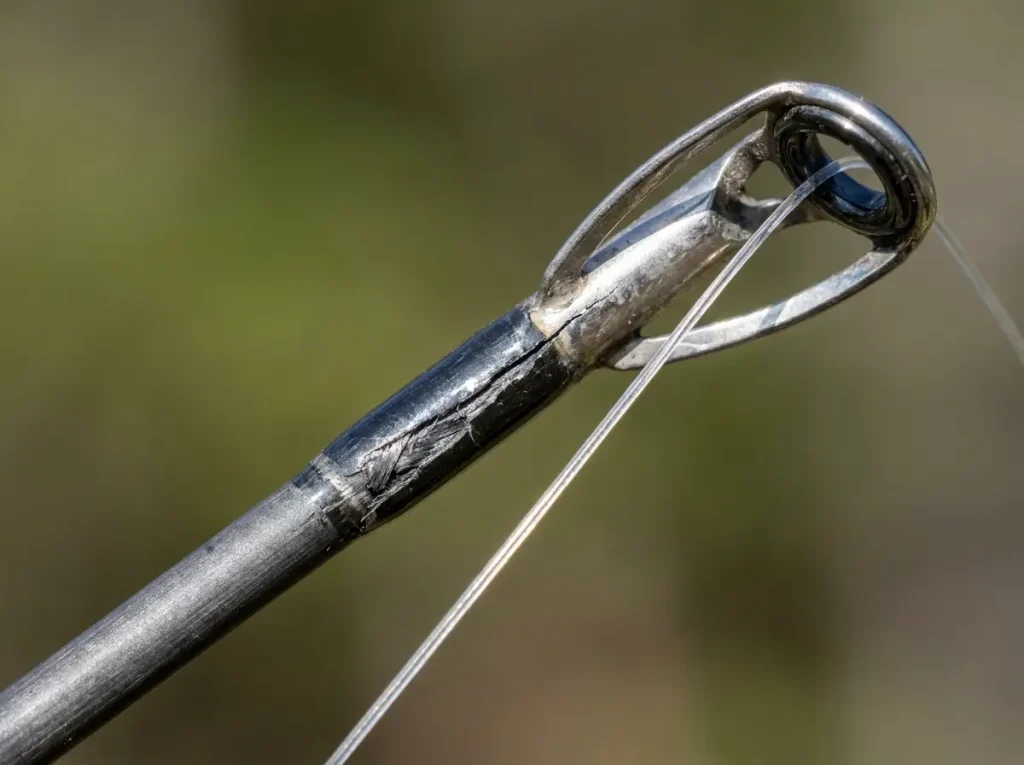
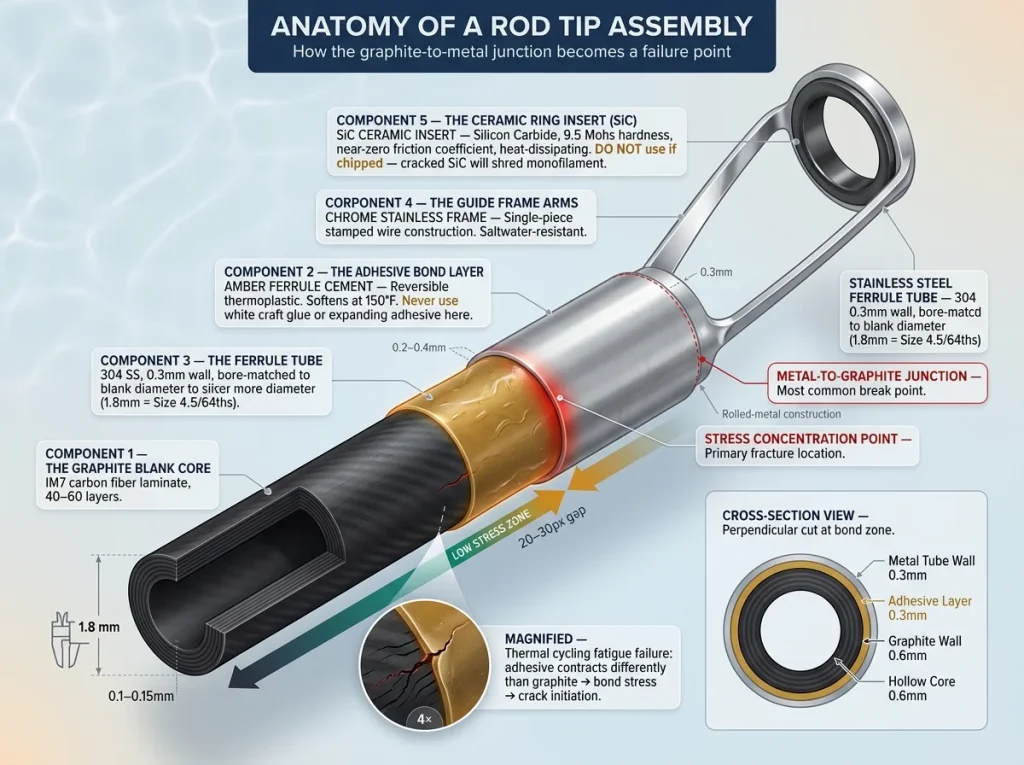
The tip section of a fishing rod is the thinnest, most flexible, and most vulnerable part of the blank. A standard graphite casting rod tapers from roughly 12mm at the butt to under 2mm at the tip. That 2mm tube of carbon fiber carries every load the rod absorbs — hook sets, fish fights, casting energy — and it concentrates stress right where the tip top guide attaches.
The tip top guide adds a metal tube bonded to the graphite with adhesive. That junction point — metal meeting carbon — is where most breaks occur. Thermal cycling (hot car trunks, freezing truck beds), impact, and adhesive fatigue all weaken this bond over time.
Breaks You Caused vs. Breaks That Just Happen
Some rod tip breaks are user error. Closing a car door on the rod, high-sticking during a fight (pulling the rod past 90 degrees), stepping on the tip section, or storing the rod horizontally with weight on the tip — these are all avoidable. Manufacturers know the difference, and most warranty claims get denied for high-stick damage because the fracture pattern is distinctive.
Other breaks just happen. Adhesive dries out after years of thermal cycling. A micro-crack from a previous bump propagates during a cast. The graphite delaminates at the tip top junction because the rod was stored in a hot garage for three summers.
These failures aren’t your fault, but they’re still your problem.
The $5 Insurance Policy
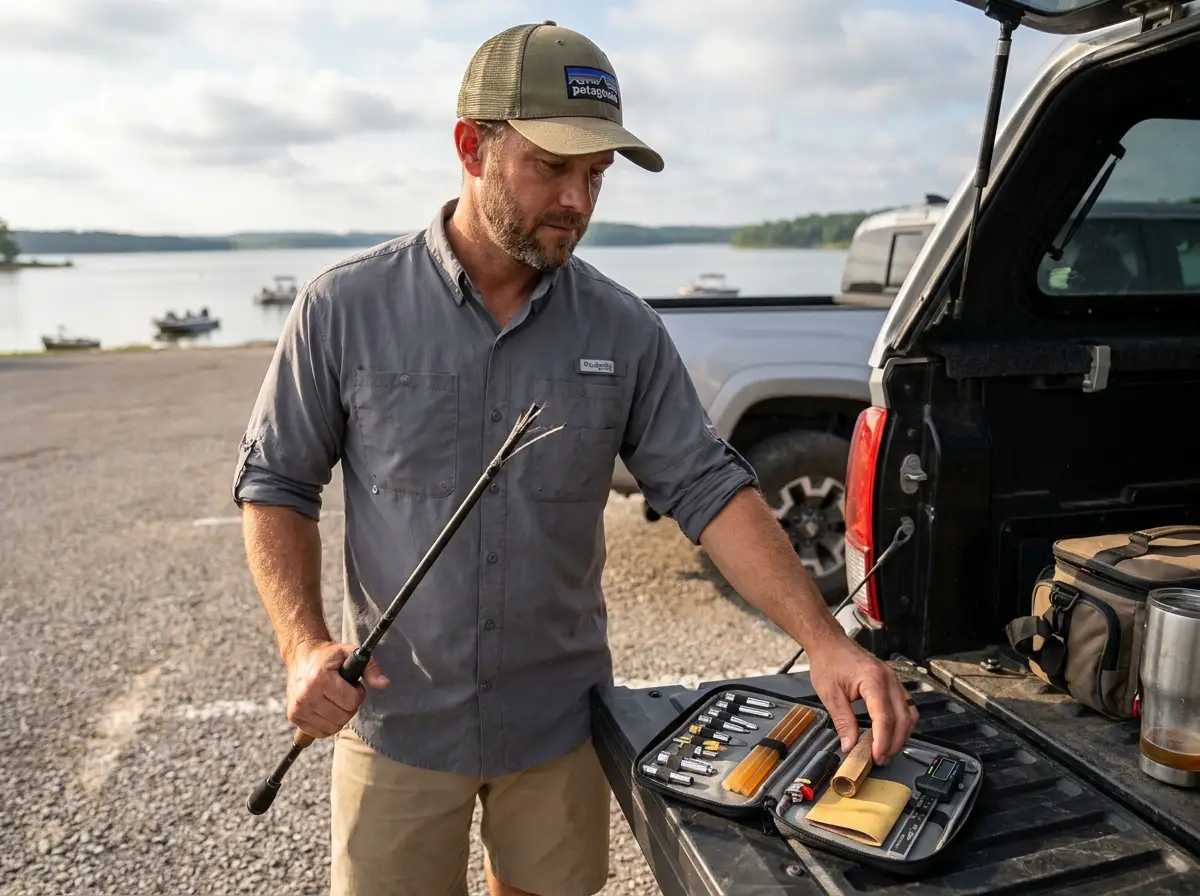
A rod tip repair kit costs between $5 and $15 and fits in a shirt pocket. Carry one in your tackle bag, your vest, and your truck. The kit should include 6–8 replacement tip tops in graduated sizes, a stick of amber hot melt glue (not white craft glue — more on this later), a lighter, and a small piece of sandpaper.
That’s it. You can fix a rod streamside in under two minutes and keep fishing.
Pro tip: Buy a kit with stainless steel tip tops if you fish saltwater even occasionally. Chrome-plated tips corrode at the insert junction in salt air, and a corroded guide ring will shred your line. Stainless costs about $2 more and lasts twice as long.
The Emergency Field Repair (Under 2 Minutes, No Kit Required)
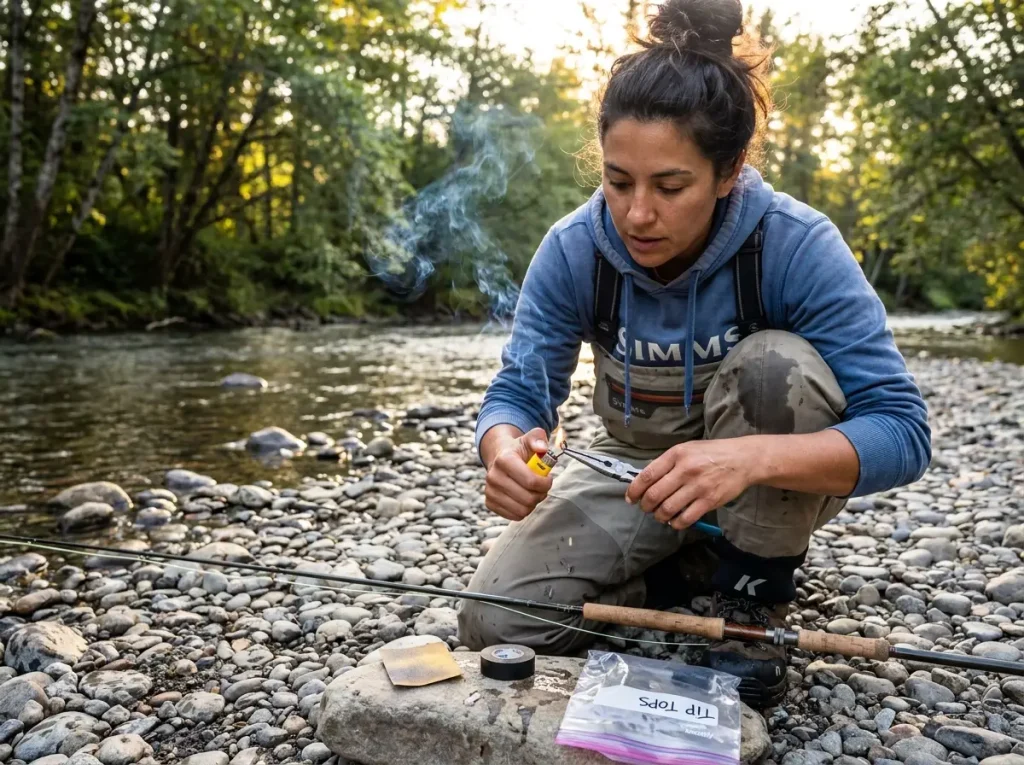
What You Actually Need Streamside
The minimum for a field fix: a replacement tip top that fits (or is close), a lighter, and something to apply adhesive. If you carry a proper kit, you have all of this. If you don’t, you can improvise.
No replacement tip? The old tip top might still be usable if the graphite broke behind it rather than at the guide tube. Heat the old tip top off the broken piece, sand the new break point on the blank with a rock or your knife, and re-attach the original tip top to the shorter blank. You lose an inch or two of rod length and slightly change the action, but the rod fishes.
The 2-Minute Field Fix Step by Step
Step 1 — Remove the old tip top. Hold the lighter flame to the metal tube of the old tip top for 3–5 seconds. Heat the metal, not the graphite. The adhesive softens quickly. Grip the guide with pliers or a cloth and twist it off. If the graphite broke and the tip top is gone — skip this step.
Step 2 — Clean the end. If the blank snapped, it left jagged carbon fibers. Sand them flush with fine sandpaper or carefully scrape with a knife blade. You need a clean, smooth surface for the new tip top to bond properly. Blow off the dust.
Step 3 — Dry-fit the replacement. Try the tip top on the blank without adhesive. It should slide on snugly — tight enough to hold with slight friction, loose enough that you don’t have to force it. If it’s too tight, sand the blank gently. If it’s too loose, go up one size or wrap a single layer of thread around the blank to build diameter.
Step 4 — Apply adhesive and seat. Heat the end of the amber hot melt glue stick with the lighter until it’s soft and glossy. Dab a thin coat onto the blank and roll a small amount inside the tip top tube. While the glue is still soft, slide the tip top onto the blank, push it down firmly, and immediately align the guide ring with the rest of the rod’s guides. You have about 10 seconds before the glue sets.
Step 5 — Check alignment and go fish. Sight down the rod from the butt end. Every guide ring should line up. If the tip top is crooked, reheat it with the lighter for 2 seconds, twist it straight, and hold until it sets. Done.
Pro tip: If you don’t have hot melt glue, a tiny drop of super glue (cyanoacrylate) works as a temporary field fix. It’s not ideal — it’s brittle and doesn’t tolerate thermal cycling — but it’ll hold long enough to finish your trip. Redo the repair properly with hot melt when you get home.
The Permanent Home Repair (Done Right the First Time)
Tools and Materials
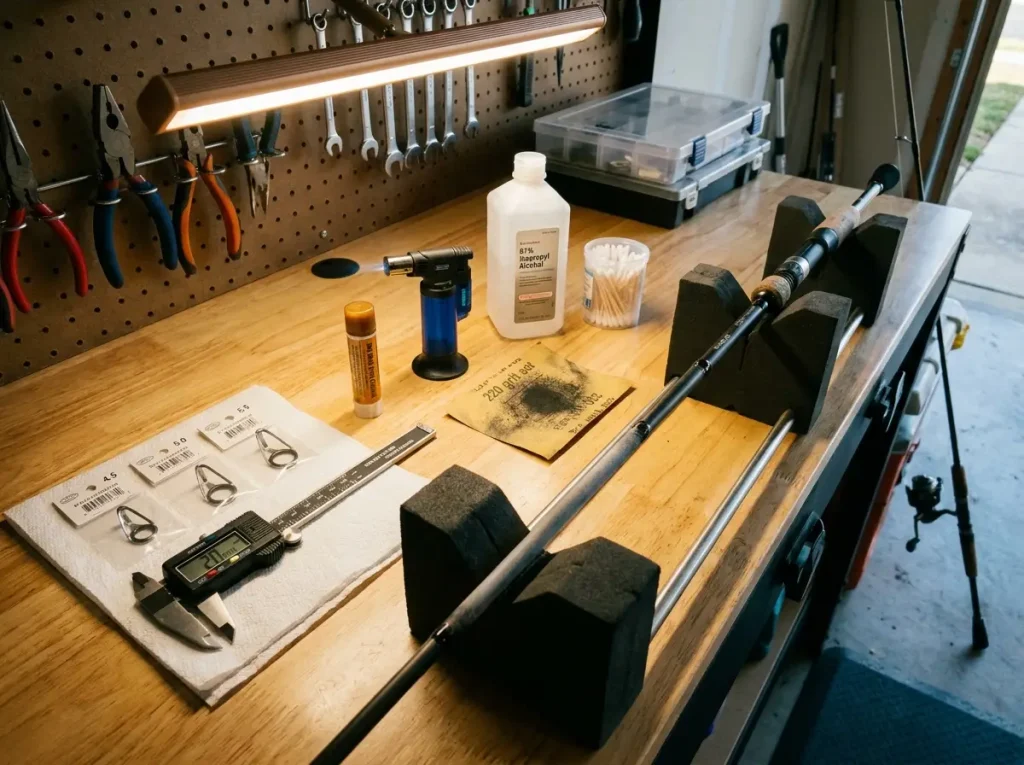
For a repair that lasts years, you need slightly more precision than the field fix. Gather these before you start:
A small butane torch or heat tool (more control than a lighter), replacement tip tops in 2–3 sizes bracketing your rod’s diameter, a digital caliper for measuring the blank, amber ferrule cement (the rod-building standard) or quality 5-minute rod epoxy, 220-grit sandpaper, isopropyl alcohol and cotton swabs, and a permanent marker for alignment.
The Home Repair Process
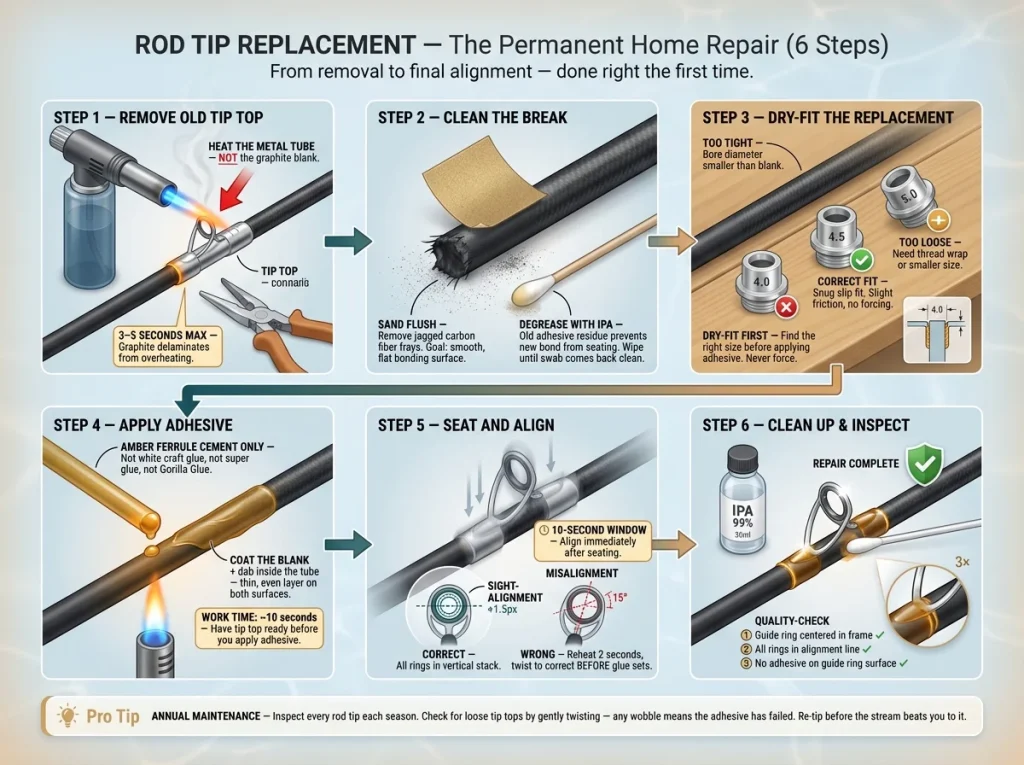
Remove the old tip top using gentle heat from the butane torch. Keep the flame moving — never hold it in one spot for more than 2 seconds. Graphite can overheat and delaminate if the blank gets too hot. Once the adhesive softens, twist and pull the old tip top off.
Clean and prep the blank. Lightly sand the last half-inch of the blank with 220-grit to remove old adhesive residue. Wipe with alcohol to degrease. This step matters more than most anglers think — old adhesive under new adhesive creates a weak bond that fails under load.
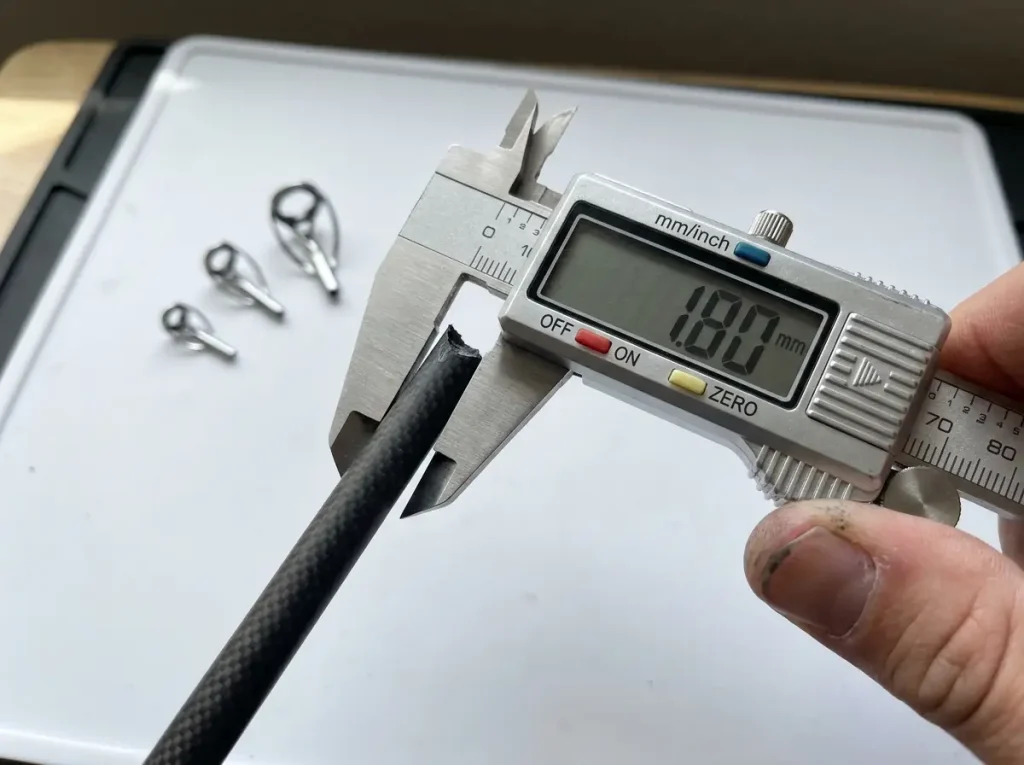
Measure the blank. Use the digital caliper to measure the outside diameter of the blank about a half inch below the tip. This measurement in millimeters tells you the exact tube size you need. Tip tops are sold by tube size — a reading of 1.8mm means you need a size 4.5 tip top (tip tops are sized in 64ths of an inch: 4.5/64 = 1.79mm).
Apply adhesive. Heat the amber hot melt stick with the torch until it’s glossy and pliable. Roll a thin, even coat onto the blank’s last half inch and dab a small amount inside the tip top tube. Work quickly.
Seat and align. Push the tip top onto the blank with firm, steady pressure. Align it with the rod’s guide train before the adhesive sets. Sight down the rod from the butt end to confirm alignment. Hold for 15 seconds.
Clean up excess. While the adhesive is still slightly warm, wipe any squeeze-out with an alcohol-dampened swab. A clean repair looks professional and prevents adhesive from interfering with line flow.
How to Size a Replacement Tip Top (Without Guessing)
The Caliper Method (Most Accurate)
A digital caliper is the gold standard. Measure the outside diameter of the blank about a half inch below the tip. The readout gives you the tube size directly.
Standard freshwater rods typically measure between 1.4mm and 2.2mm at the tip. Standard saltwater rods run 2.0mm to 3.5mm. Fly rods are often the thinnest — some 2-weight rods measure under 1.2mm.
The Try-and-Fit Method (Field Conditions)
If you don’t have a caliper — and you won’t on the riverbank — use trial and error. A good tip repair kit includes 6–8 sizes. Start with the size that looks closest and try sliding it onto the blank dry. You want a snug slip fit: tight enough that friction holds it in place, loose enough that you can push it on without forcing.
Too tight: the tip top won’t slide past the first millimeter. Sand the blank lightly or try one size up.
Too loose: the tip top wobbles and spins freely. Try one size down, or wrap a single layer of nylon rod-wrapping thread around the blank to build diameter.
The Break-Point Problem
Here’s what makes sizing tricky: if the rod broke behind the original tip top, the new break point has a larger diameter than the original tip. That means the original-size tip top won’t fit — you need to go up one or two sizes. This is why a kit with multiple sizes matters. A single replacement tip top in “one universal size” is a marketing lie.
Pro tip: Mark the size of each rod’s tip top on a piece of tape and stick it inside your tackle bag. When a tip breaks streamside, you already know the size you need instead of guessing. Takes two minutes at home with a caliper and saves you five minutes of fumbling on the water.
Hot Melt vs Epoxy: The Adhesive Decision That Matters
Why Amber Hot Melt Is the Standard
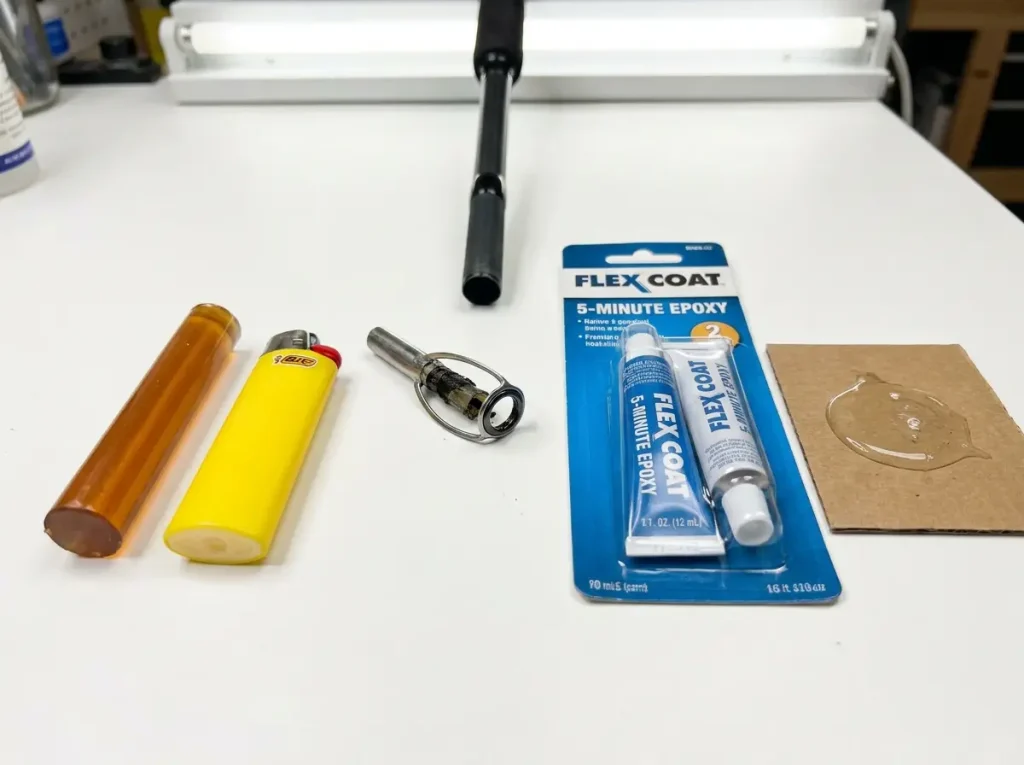
Professional rod builders overwhelmingly use amber ferrule cement — a specific type of hot melt adhesive designed for rod work. It melts at a lower temperature than epoxy cures at, which means less heat exposure to the graphite blank. It’s reversible — reheat and the tip comes right off for future adjustments. And it creates a bond that’s flexible enough to absorb vibration without cracking.
The amber color matters. Generic white hot glue sticks from the craft store have a different formulation — softer, lower melt point, weaker bond. Amber ferrule cement is harder, grips better, and doesn’t soften in a hot car. If you buy one thing for rod repair, make it a stick of amber ferrule cement from a rod-building supplier like Mud Hole or CRB.
When to Use Epoxy
Two-part epoxy (5-minute cure) creates a stronger permanent bond than hot melt. Rod builders use it for guide wraps and structural repairs on blanks. But for tip tops, epoxy has a significant downside: it’s permanent. If you need to remove the tip top later — to resize, realign, or replace a damaged guide ring — you have to heat the epoxy past its curing temperature, which is dangerously close to the temperature that damages graphite.
Use epoxy only if you’re confident the tip top size and alignment are perfect and you never plan to remove it. For most anglers, hot melt is the better choice because it’s forgiving. Get it wrong? Reheat, pull, and try again.
What to Never Use
Super glue (cyanoacrylate) is a temporary fix only. It’s brittle, doesn’t absorb vibration, and fails with thermal cycling. Gorilla Glue expands as it cures and will push the tip top off-center.
UV-cure adhesives sound high-tech but don’t penetrate the bond surface the way hot melt does. Stick with amber ferrule cement for 95% of rod tip repairs.
Pro tip: Store your amber hot melt glue stick in a small ziplock bag inside your repair kit. It keeps moisture and debris off the glue surface, and the bag doubles as a clean work surface for field repairs.
When Repair Isn’t Worth It (The Replacement Decision)
The Cost Comparison
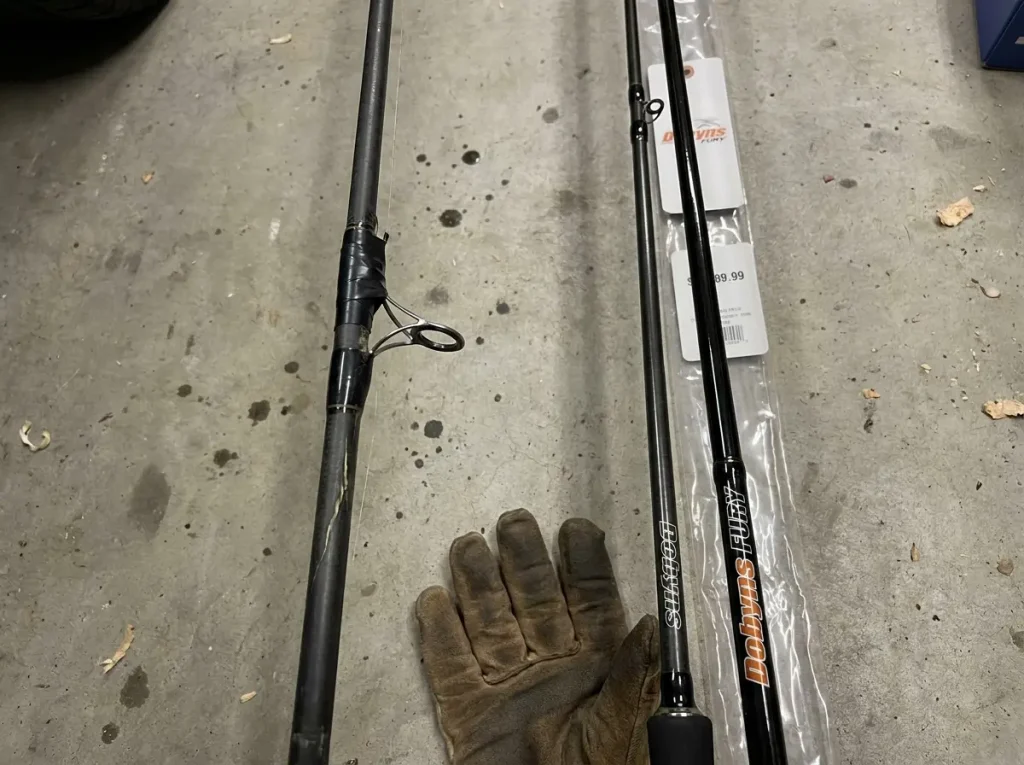
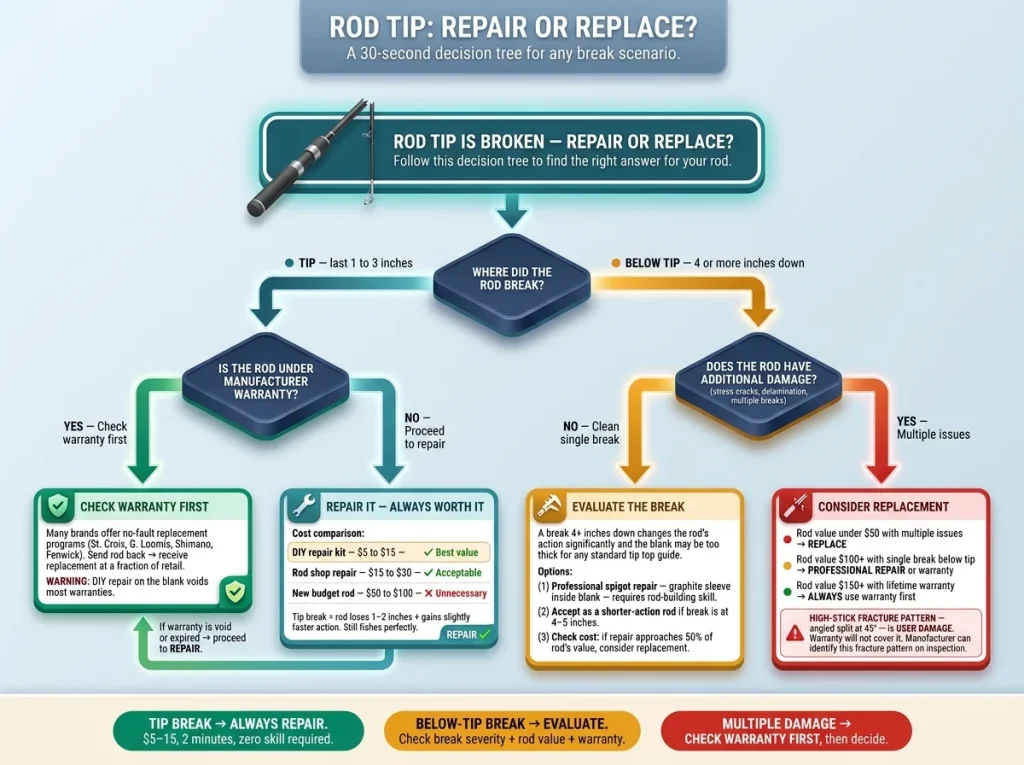
A tip repair costs $5–$15 in materials and 10 minutes of time. A professional rod shop charges $15–$30. A new budget rod costs $50–$100. A new mid-range rod costs $100–$250.
If the rod cost under $50 new and the blank has additional damage — stress cracks, delamination, a bent guide frame — the repair cost approaches replacement cost and the rod will never perform the same. Replace it.
Damage Beyond the Tip
A clean tip break — the last 1–3 inches snapping off — is always repairable. The rod loses a small amount of length and gains a slightly faster action (because you removed the most flexible section), but it fishes fine.
A break further down the blank — 5 inches or more from the tip — is a different problem. You lose significant length, the action changes noticeably, and the remaining tip section may be too thick for any standard tip top guide. Internal spigot repairs (gluing a graphite splint inside the blank) are possible but require rod-building skills most anglers don’t have.
The Warranty Check
Before you repair anything, check the manufacturer’s warranty. Many rod companies — St. Croix, G. Loomis, Shimano, Fenwick — offer replacement programs where you send the broken rod back and receive a new one for a fraction of retail price. Some warranties are lifetime. Some require the original receipt.
All of them become void the moment you attempt a DIY repair on the blank itself, so check the warranty BEFORE you heat up the glue.
The Gear Setup That Saves Future Trips
Building the Perfect Rod Repair Kit
Every angler should carry a rod repair kit. Here’s what goes in it:
6–8 replacement tip tops in graduated sizes (stainless steel for saltwater, chrome for freshwater), one stick of amber ferrule cement hot melt glue, a butane lighter (Bic is fine), a 2-inch square of 220-grit sandpaper, a small pair of needle-nose pliers, and a ziplock bag to hold everything. Total weight: about 2 ounces. Total cost: under $15.
Store the kit in your tackle bag, not in a drawer at home. The whole point is having it when the tip breaks — which is never at home.
The Home Workshop Addition
If you fish regularly and own more than three rods, add these to your home setup: a digital caliper ($10–$20 for a decent one), a small butane torch with a flame guard, isopropyl alcohol and cotton swabs, 220-grit sandpaper in sheets (not the tiny square from the kit), and a foam V-block cradle to hold the rod steady during repair.
The caliper alone pays for itself the first time you need to size a replacement. Guessing costs time and sometimes costs the rod.
Pro tip: Once a year, inspect every rod tip in your rack. Look for adhesive cracking around the tip top base, guide ring inserts that have cracked or chipped, and any wobble when you twist the tip top gently. Catching a loose tip before it launches off the rod mid-cast is easier than fishing without one.
Conclusion
A broken rod tip ends your day only if you let it. Carry a $10 repair kit, learn the 2-minute field fix, and you’ll never lose another fishing session to a snapped tip.
The repair itself is straightforward — clean break, right size, amber hot melt, align and go. The part most anglers skip is the preparation: knowing their tip sizes, carrying the kit, and checking their rod tips before they hit the water instead of after they hear the snap.
Q1 How do you fix a broken rod tip?
Heat the old tip top with a lighter for 3–5 seconds to soften the adhesive, twist it off, sand the blank smooth, apply amber hot melt glue, and press the new tip top on while aligning it with the other guides. The entire repair takes under two minutes.
Q2 What glue is best for rod tip repair?
Amber ferrule cement hot melt glue is the rod-building standard. It bonds strongly, tolerates vibration, melts at safe temperatures for graphite, and is fully reversible with heat. Avoid generic white hot glue, super glue, and expanding adhesives like Gorilla Glue.
Q3 Can you replace a rod tip yourself?
Yes. Rod tip replacement is one of the simplest fishing gear repairs. A basic kit with replacement tips and adhesive costs under $15, and the process requires no special skills — just a lighter, steady hands, and the right size tip top.
Q4 How do you measure for a replacement rod tip?
Use a digital caliper to measure the outside diameter of the blank about half an inch below the tip. The reading in millimeters corresponds directly to the tip top tube size. Without a caliper, trial-fit tips from a graduated kit until you find a snug slip fit.
Q5 Is it worth repairing a broken fishing rod?
If the break is in the last 1–3 inches of the tip, always repair it — the fix costs under $15 and takes minutes. If the break is further down the blank or the rod has additional damage like stress cracks, check the manufacturer’s warranty first. Replace rods under $50 that have multiple issues.
Risk Disclaimer: Fishing, boating, and all related outdoor activities involve inherent risks that
can lead to injury. The information provided on Master Fishing Mag is for educational and informational purposes
only. While we strive for accuracy, the information, techniques, and advice on gear and safety are not a substitute
for your own best judgment, local knowledge, and adherence to official regulations. Fishing regulations, including
seasons, size limits, and species restrictions, change frequently and vary by location. Always consult the latest
official regulations from your local fish and wildlife agency before heading out. Proper handling of hooks, knives,
and other sharp equipment is essential for safety. Furthermore, be aware of local fish consumption advisories. By
using this website, you agree that you are solely responsible for your own safety and for complying with all
applicable laws. Any reliance you place on our content is strictly at your own risk. Master Fishing Mag and its
authors will not be held liable for any injury, damage, or loss sustained in connection with the use of the
information herein.
Affiliate Disclosure: We are a participant in the Amazon Services LLC Associates Program, an
affiliate advertising program designed to provide a means for us to earn advertising fees by advertising and linking
to Amazon.com. As an Amazon Associate, we earn from qualifying purchases. We also participate in other affiliate
programs and may receive a commission on products purchased through our links, at no extra cost to you. Additional
terms are found in the terms of service.